Yoga Mat Rack: Top Types, Setup, and Storage Guide 2026
A yoga mat rack is a dedicated storage solution that holds one or more rolled yoga mats in an accessible, organized position, either mounted to a wall, hanging from a ceiling or door, or standing freely on the floor. The right yoga mat rack does more than tidy your space: it keeps your mat at the ready, removes the friction of unrolling and re-rolling from a pile on the floor, and signals to your brain that this is a space where practice happens.
Home yoga practice is the fastest-growing segment of the yoga market. According to the National Center for Complementary and Integrative Health, more than 21 million Americans practiced yoga regularly by 2023, with home practice cited as the preferred format for a growing percentage of those students. The physical setup of your home practice space directly affects how consistently you practice.
This guide covers every type of yoga mat rack from wall-mounted holders to freestanding towers to DIY solutions, with specific guidance for small apartments, hot yoga students, seniors, multi-mat households, and anyone building a dedicated home yoga studio in 2026.
What Is a Yoga Mat Rack and Why Does It Matter?
A yoga mat rack is a storage fixture specifically designed to hold one or more rolled yoga mats in a stable, ventilated, and accessible position. It replaces the common alternatives of leaning a mat against a wall (unstable, slides and falls), storing it under a bed (inaccessible), or leaving it rolled on the floor (trips, pets, clutter).
The functional difference between a dedicated mat rack and no storage solution is primarily behavioral. A mat stored visibly and within arm’s reach takes fewer physical and mental steps to use. Behavioral science research, including work published by BJ Fogg at Stanford University on tiny habit formation, consistently shows that reducing the number of steps required to begin a behavior increases the frequency with which people actually perform it. A mat that requires no effort to access is a mat that gets used more often.
Beyond habit support, the right mat rack addresses genuine material care requirements. Natural rubber yoga mats should not be stored tightly rolled for extended periods. Cork mats need adequate airflow. Wet mats from hot yoga or outdoor practice need ventilated storage before rolling. A rack that holds the mat in an open, partially unrolled, or vertical position supports the mat’s material longevity and reduces bacterial growth from moisture trapped inside a tightly stored roll.
- Reduces the mental friction that prevents regular practice
- Protects mat material from damage caused by tight, prolonged storage
- Keeps practice space visually organized and intentional
- Allows wet mats to air-dry before being rolled for storage
- Accommodates multiple mats, props, and accessories in one dedicated area
Types of Yoga Mat Rack: Wall Mount, Freestanding, and Hanging
The three primary types of yoga mat rack serve different spaces, mat quantities, and storage preferences. Choosing the right type starts with understanding what each format does and does not do well.
Wall-mounted yoga mat racks attach directly to a wall using screws and anchors. They hold mats horizontally in pegs or hooks, keeping the mats off the floor and clearly visible. Wall mounts are the most space-efficient option for small rooms because they use vertical wall space rather than floor area. They require installation and permanent wall attachment, which makes them less suitable for renters or frequently-moving households.
Freestanding yoga mat racks stand independently on the floor, typically using a base and vertical post or tower structure with horizontal arms or pegs for mat storage. They require no installation. They can be moved to different rooms or repositioned as needed. The trade-off is floor footprint: a freestanding rack occupies floor space even when not in a designated yoga room.
Hanging yoga mat racks use ceiling hooks, door-mounted hooks, or over-door hangers to suspend mats vertically. They are the most space-efficient of all three formats in terms of floor and wall impact. Ceiling mounting requires secure attachment to a joist. Door-mounted options require no permanent installation but limit the number of mats that can be stored.
| Type | Installation | Space Used | Mats Capacity | Best For |
|---|---|---|---|---|
| Wall-mounted | Required (screws, anchors) | Wall surface only | 2 to 8 mats | Dedicated home studio |
| Freestanding | None | Floor footprint | 3 to 10 mats | Renters, movable setups |
| Hanging (ceiling) | Required (joist anchor) | Ceiling point | 1 to 4 mats | Small rooms, high ceilings |
| Door-mounted | None (over-door) | Door back | 1 to 3 mats | Apartments, minimal commitment |
Yoga Mat Holder Wall: Wall-Mounted Options Explained
A yoga mat holder wall mount is the most popular format for dedicated home studios because it keeps mats visually organized, easily accessible, and off the floor without consuming any usable room space. The wall mount category includes several distinct designs.
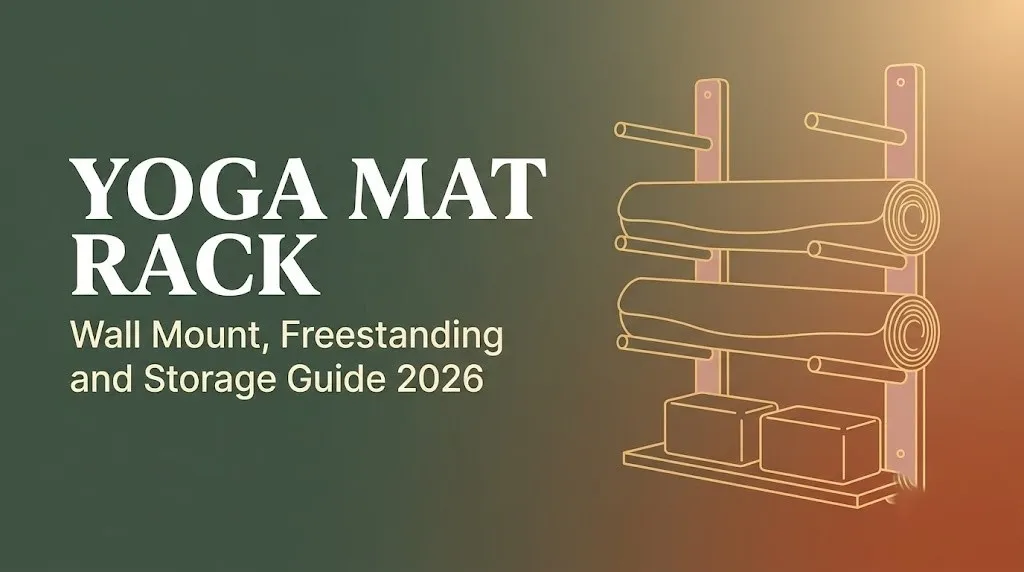
Horizontal peg-style wall mounts use two or more horizontal pegs or dowels that extend from a wall plate. The yoga mat rests across the pegs, supported along its length. This style works well for standard-width mats and allows the mat to partially hang, improving airflow. The peg spacing matters: pegs set too close together let the mat sag in the center; pegs too far apart may not support wider or heavier mats at the ends.
Bracket-style wall mounts use a pair of L-shaped or U-shaped brackets that cradle the rolled mat from beneath. The mat rests in the bracket without being threaded through anything, making it quick to retrieve and replace. This style is particularly good for heavier natural rubber mats because the bracket supports the full weight evenly rather than suspending it by the center.
Hook-and-loop wall mounts use individual hooks that the mat hangs from, either by a loop of strap threaded through the mat roll or by the mat’s carrying strap if it has one. This is the most minimal and lowest-cost wall mount option.
Pose Tip:
- When choosing a wall mount height, position it so the top of the hung mat is at approximately shoulder height. This allows you to lift the mat off without bending down, which is especially relevant for seniors or anyone with lower back sensitivity.
- Space multiple wall pegs or brackets at least 6 inches apart horizontally to allow each mat enough room to hang without touching adjacent mats, which restricts airflow.
- If your wall surface is drywall without a stud directly in the desired position, use toggle bolt anchors rated for at least 25 pounds per anchor point for safe installation.
Key Takeaway: A yoga mat rack is not just a storage product. It is a behavioral tool that removes friction from your practice routine, and the right placement at shoulder height makes daily access effortless regardless of your mobility level.
Wall Mounted Yoga Mat Rack: Installation Guide
Installing a wall-mounted yoga mat rack correctly requires three things: locating a secure attachment point, using the right hardware for your wall type, and confirming the load rating before mounting.
The safest installation attaches the rack directly into a wall stud, the vertical wooden framing member inside most residential walls, typically spaced 16 inches apart from center to center. A stud finder (a simple handheld device available at any hardware store) locates studs accurately. Screwing directly into a stud provides the most secure anchor point for any wall-mounted rack.
When a stud is not available at the desired position, use wall anchors rated for the combined weight of the rack and the mats it will hold. A single standard yoga mat weighs approximately 2 to 6 pounds depending on material and size. A rack holding six mats plus props may carry 30 to 50 pounds of total load. Toggle bolt anchors rated for 50 pounds or more provide adequate safety margin for most multi-mat wall installations.
To install a standard wall-mounted yoga mat rack:
- Use a stud finder to locate studs in your chosen wall area. Mark the stud centers with a pencil.
- Hold the rack mounting plate against the wall at your desired height. Use a level to confirm the plate is horizontal.
- Mark the screw hole positions through the mounting plate onto the wall.
- Drill pilot holes at the marked positions. If drilling into a stud, use a bit slightly smaller than your screw diameter. If drilling into drywall without a stud, drill to the correct size for your chosen anchor type.
- Insert anchors if required, then drive screws through the mounting plate into the anchors or studs.
- Test the installation by applying firm downward pressure to the mounted rack before loading it with mats.
Safety note: never mount a multi-mat rack using only adhesive strips or command hooks, regardless of their stated weight rating. The dynamic load of pulling a heavy rolled mat off a hook creates forces greater than static adhesive ratings account for.
Yoga Mat Hanging Rack: Ceiling and Door-Mounted Options
A yoga mat hanging rack suspends mats from a ceiling hook or over-door hanger rather than attaching to a wall, making it suitable for spaces where wall mounting is impossible or undesirable.
Ceiling-mounted hooks for yoga mat storage work best in rooms with high ceilings (above 8 feet) where a hanging mat will not obstruct movement through the space. The hook must be anchored into a ceiling joist, not just into drywall. A joist finder (similar to a stud finder) locates ceiling joists. A single hook rated for 25 to 50 pounds is sufficient for two to three standard yoga mats on a hanging strap. The mats hang vertically, which is ideal for airflow and particularly good for wet mats that need to dry before being stored rolled.
Over-door hanging racks require no installation at all. They hook over the top edge of a door and typically hold one to three mats on individual hooks or loops. The door must be able to close with the rack in place for daily use. These racks work in apartments, dorm rooms, or any space where permanent installation is not possible.
The limitation of hanging systems is capacity. A ceiling hook or over-door rack rarely accommodates more than three to four mats before the hanging weight becomes unwieldy and the mats obstruct each other during retrieval.
- Ceiling hook: best for ventilating wet mats and for rooms with limited wall space
- Over-door hanger: best for renters, temporary setups, or single-mat households
- Hanging strap loop: threads through a rolled mat for vertical suspension on any hook
- Load limit: never exceed the rated weight capacity of the hook or its mounting hardware
Freestanding Yoga Mat Rack: Floor-Standing Options
A freestanding yoga mat rack holds mats in individual slots, pegs, or horizontal arms without requiring any wall or ceiling attachment. It can be moved, repositioned, and relocated without tools, making it the most flexible storage format for renters, frequently-moving practitioners, or anyone who has not yet committed to a permanent practice space.
Freestanding racks range from minimal single-mat stands (a simple A-frame or tripod base that cradles one mat) to large multi-mat towers with five to ten individual peg slots arranged vertically or horizontally. The structural stability of a freestanding rack depends on its base design and material. A narrow-base tower with ten heavy mats loaded near the top can tip if bumped. Look for designs where the base is wider than the rack’s height for the most stable configuration.
Think of a freestanding yoga mat rack like a coat stand for your practice gear. A narrow, top-heavy coat stand tips when you pull a coat off it. A wide-base, low-center-of-gravity design stays stable. The same physics apply to mat racks.
For studio use or multi-practitioner households, large freestanding racks that hold six to ten mats are the most practical choice. Students retrieve their own mat and return it after practice without touching anyone else’s mat or disrupting the storage arrangement. Commercial yoga studios use exactly this format in their reception areas.
| Freestanding Style | Mat Capacity | Base Stability | Best For |
|---|---|---|---|
| Single mat stand (A-frame) | 1 to 2 mats | Good | Solo practitioner, small space |
| Vertical tower (pegs) | 4 to 8 mats | Moderate (check base width) | Multi-mat household |
| Horizontal shelf tower | 3 to 6 mats | Good (wide base) | Home studio, studio reception |
| Rolling cart with mat hooks | 4 to 8 mats | Good (lockable wheels) | Studio, garage, movable setup |
Yoga Mat Rack Materials: Wood, Metal, Bamboo, and More
The material of a yoga mat rack affects its load capacity, durability, aesthetic integration with your practice space, ease of installation, and how it interacts with mat materials over time. The four most common materials each have specific trade-offs.
Bamboo is the most popular material for yoga-specific mat racks because it is sustainably harvested, lightweight, visually warm, and strong enough to support the weight of multiple mats. Bamboo racks typically support 20 to 40 pounds of combined mat weight. The natural texture of bamboo also provides gentle grip friction that helps prevent mats from sliding off horizontal pegs.
Solid wood (pine, oak, walnut) is the most aesthetically premium option and integrates well into home studio designs where the rack is a visible design element rather than a hidden utility item. Wood racks are heavy, require more precise installation for wall mounts, and are the most expensive option. They support the highest loads of any material, typically 40 to 80 pounds, making them suitable for commercial studio environments.
Steel is the most durable and highest-capacity material at the lowest cost point relative to strength. Steel racks are typically powder-coated to prevent rust and are common in gym environments. They are less visually warm than wood or bamboo but are the best choice for high-use environments, garages, or any location where moisture is a concern.
Powder-coated aluminum is lighter than steel with comparable rust resistance. It is the most common material for freestanding tower racks. Lower weight makes installation and repositioning easier but also means lighter base weight, which can reduce stability in tall configurations.
Key Takeaway: For a home yoga studio where the rack is visible and aesthetically integrated, bamboo or solid wood are the best choices. For a garage, utility room, or high-use family setup, powder-coated steel is the most durable and practical material.
Yoga Mat Rack with Prop Storage: Blocks, Straps, and Beyond
A yoga mat rack with prop storage integrates space for yoga blocks, straps, bolsters, and blankets alongside the mat holders, creating a single organized storage station for all practice equipment. This is the format most experienced home practitioners eventually choose because it eliminates the scattered-equipment problem that makes home practice feel chaotic.
The most useful prop storage additions to a mat rack are:
- Shelf or basket for yoga blocks: yoga blocks weigh 1 to 3 pounds each and stack readily. A single shelf wide enough to hold two blocks side by side is sufficient for most solo practitioners. Families or studios need wider shelving for four to six blocks.
- Hooks or pegs for yoga straps: yoga straps hang naturally from a single hook. Dedicated strap hooks on the side of a mat rack frame keep straps from tangling and are retrievable in one motion.
- Lower shelf or bin for yoga blankets: blankets are bulky and do not roll compactly. A lower open shelf or fabric bin holds folded blankets more effectively than hooks.
- Deep shelf or vertical slot for yoga bolsters: bolsters are large and cylindrical. A wide deep shelf or a dedicated vertical slot (similar to a wine rack slot) holds a bolster securely without it rolling away.
When choosing a combined mat and prop rack, confirm the total weight rating covers all stored items simultaneously. A rack rated for 50 pounds that holds four mats at 4 pounds each (16 pounds total) plus two blocks at 2 pounds each, three straps at 0.5 pounds each, two blankets at 2 pounds each, and one bolster at 3 pounds carries approximately 28 pounds total. That load is within most wall-mounted or freestanding rack ratings, but verifying it prevents overloading a rack at its anchor points.
Yoga Mat Rack for Multiple Mats: Capacity and Household Use
A yoga mat rack for multiple mats serves families where several household members practice, home studios that host small group classes, and avid practitioners who own multiple mats for different styles or surfaces.
The minimum rack capacity for specific household compositions:
- Solo practitioner with one mat: any single-mat holder or standard peg
- Solo practitioner with two to three mats (travel mat, thick mat, daily mat): three-peg or three-slot rack
- Couple or two-practitioner household: four-slot minimum, six-slot preferred
- Family of four with mixed adult and child mats: six to eight slots, with at least one smaller peg for a child-sized mat
- Small group class host (four to eight students): eight to twelve slot commercial freestanding rack
Child-sized yoga mats are shorter and lighter than adult mats (typically 56 inches long versus the standard 68-inch adult mat). Standard adult peg spacing works for child mats, but the child mat will overhang less on the peg. A lower peg position (at child-accessible height) is worth considering for households where children retrieve their own mat independently.
According to research published in the International Journal of Yoga, family-based yoga practice, where multiple household members practice together or in the same dedicated space, shows higher long-term adherence rates than solo practice in isolation. A mat rack that accommodates the whole household’s equipment makes shared practice easier to sustain practically.
- Confirm peg or slot spacing: standard yoga mats roll to approximately 3 to 4 inches in diameter. Slots narrower than 4 inches will not accommodate a fully rolled mat.
- Extra-large or thick mats (6mm or above) roll to a larger diameter: approximately 4 to 5 inches. Verify slot or peg spacing accommodates thicker rolls before purchasing.
- Natural rubber mats are heavier than TPE or PVC: a six-mat rubber mat rack carries significantly more weight than the same rack loaded with foam mats.
Yoga Mat Rack for Home Studio and Small Space Setup
A yoga mat rack for a home studio or small space setup functions as both a storage solution and a space-defining element that signals to your brain: this is where practice happens. That psychological boundary matters as much as the physical organization.
In a dedicated yoga room, wall-mounted racks are the preferred format because they use vertical wall space without consuming floor area. Position the rack on the wall closest to the entrance of the room so the mat is the first thing you see and reach when entering. This positioning reduces the number of steps between deciding to practice and actually stepping onto the mat.
In a small apartment or multipurpose room, the challenge is storing yoga equipment without the practice space feeling cluttered when not in use. A freestanding rack in a corner, or a wall mount on a narrow wall adjacent to a sliding door or closet, can create a defined practice corner without permanent room division. A yoga mat rolled and displayed on a rack in a corner is far less visually intrusive than a mat leaning against a wall or stored on the floor.
For genuinely minimal spaces, an over-door hanging system for the mat combined with a small basket or drawer unit for props creates a complete storage system using only a door back and one square foot of floor space.
Pose Tip:
- Measure your available wall or floor space before purchasing any rack. Minimum wall space for a standard wall mount is approximately 18 inches wide by 12 inches tall for a single-mat holder.
- Leave at least 24 inches of clearance between the bottom of the hung mat and the floor to prevent the mat from dragging or touching the floor surface.
- In a multipurpose room, a freestanding rack with a visual anchor element (a small plant, a candle, or a meaningful object on a shelf above) helps delineate the practice zone without permanent construction.
Yoga Mat Rack for Hot Yoga and Wet Mat Storage
A yoga mat rack for hot yoga practice needs to handle wet, heavy mats without trapping moisture, promoting bacterial growth, or causing material damage from being stored damp.
Hot yoga classes (including Bikram yoga, also called 26 and 2 yoga, and other heated formats) produce significant sweat. A mat, a microfiber towel, and sometimes a second smaller towel all come home damp or soaked. The worst storage choice for a wet mat is rolling it tightly and placing it inside a bag or against a wall. Moisture trapped inside a rolled mat creates the ideal environment for mold, bacteria, and material degradation.
The best yoga mat rack for hot yoga use holds the mat in an open or partially unrolled position to allow complete air-drying before the mat is rolled and stored. A horizontal peg-style wall mount or a ceiling hook with a hanging strap serves this function best. The mat drapes across two wide pegs or hangs vertically from a ceiling hook, exposing maximum surface area to airflow.
A rack positioned near a window, a fan, or an air vent accelerates drying time. Most yoga mat manufacturers recommend that natural rubber and cork mats dry completely before being rolled for storage. TPE and PVC mats are more moisture-tolerant but also benefit from drying before rolling.
- Never store a hot yoga mat in a sealed bag while still damp. The trapped moisture damages all mat materials.
- Hang the mat and the microfiber towel separately on adjacent hooks or pegs, not draped over each other.
- Wipe both surfaces before hanging: a damp cloth removes sweat and reduces bacterial load before the mat air-dries.
- Natural rubber mats are the most sensitive to moisture damage when stored wet. They should air-dry for a minimum of 2 to 4 hours before being rolled for storage.
Key Takeaway: For hot yoga practitioners, the yoga mat rack is a drying station as much as a storage solution. An open-peg wall mount or ceiling hook that displays the mat in an unrolled position is the correct format, not a tight slot or enclosed holder.
Yoga Mat Storage for Seniors: Accessibility and Safety
Yoga mat storage for seniors requires specific attention to retrieval height, grip requirements, and the physical effort involved in accessing and replacing a mat before and after practice.
According to the National Center for Complementary and Integrative Health, yoga practice in adults over 65 produces measurable improvements in balance and fall risk reduction when practiced consistently. Setting up a storage system that makes accessing the mat physically easy reduces a barrier to consistent practice in exactly the population where consistent practice has the strongest documented benefit.
The most important accessibility consideration for senior practitioners is mounting height. A wall-mounted mat rack positioned so that the stored mat is at waist to hip height (approximately 30 to 40 inches from the floor) is the easiest to access without bending or reaching. Higher mounting positions require overhead reach, which can challenge shoulder mobility. Lower positions require bending, which creates lower back strain risk.
Freestanding racks with a low center of gravity and a wide base are safer for senior practitioners than tall, narrow tower designs that can tip when a heavy mat is removed from a high peg. A weighted base or a rack designed to be anchored to the wall at a single low point provides additional tip-resistance.
For seniors managing arthritis, grip strength limitations make loop-style retrieval systems difficult. A mat that simply rests in an open shelf or cradled bracket, requiring only a lifting motion rather than a threading or looping motion to retrieve, is the most accessible format.
- Optimal rack height for seniors: 30 to 40 inches from floor to mat storage point
- Avoid: tall single-post tower racks without wide bases (tip risk when retrieving heavy mats)
- Best format: open bracket or cradle style on a low wall mount, or a wide-base freestanding shelf unit
- Additional tip: place a non-slip mat beneath any freestanding rack to prevent it from sliding on hardwood or tile floors
How to Organize a Home Yoga Room Around Your Mat Rack
Organizing a home yoga room around your mat rack starts with positioning the rack as the anchor point of the space and building the rest of the organization outward from it.
The rack placement determines the practice direction. Most home yoga practitioners face the longest wall of their available space when practicing. Position the mat rack on the wall perpendicular to the practice direction so the mat storage is accessible from the side of the practice area rather than directly in front of or behind where you stand. This keeps the storage visible and accessible without creating an obstacle in the practice path.
Props stored on or near the mat rack should be arranged by frequency of use. Items used in every practice session (blocks for Adho Mukha Svanasana (Downward-Facing Dog) modifications, a strap for seated poses) belong at arm’s reach at the front of the storage area. Items used occasionally (bolster for Restorative yoga sessions, extra blanket for Savasana (Corpse Pose)) can be stored at lower or higher positions that require slightly more effort to reach.
A fully organized home yoga practice space reduces the pre-practice setup time to under thirty seconds. Mat off the rack. Blocks from the shelf. Strap from the hook. Practice starts. That frictionless access is the physical infrastructure that makes daily practice sustainable.
- Position the mat rack on the side wall, perpendicular to your practice direction
- Place frequently used props at waist-to-chest height for effortless retrieval
- Store infrequently used props (bolster, extra blankets) at lower shelf or high shelf positions
- Keep a small basket near the rack for items that do not have a dedicated slot (hair tie, timer, notebook)
- Ensure at least 6 feet of clear floor space in the direction you practice before mounting or positioning any rack
Yoga Mat Rack DIY: Building Your Own Storage Solution
A DIY yoga mat rack is a practical option for practitioners who have basic woodworking skills, want a custom size or style, or want to avoid spending $50 to $150 on a commercial product. The most common DIY formats use standard lumber, dowel rods, or bamboo poles combined with standard wall mounting hardware.
The simplest DIY wall-mounted yoga mat rack uses two wooden dowel rods (1 to 1.5 inches in diameter) mounted horizontally on a wall with simple L-bracket supports at each end. The dowels are spaced approximately 18 to 24 inches apart vertically and spaced far enough from the wall (3 to 5 inches) to allow a rolled mat to rest across them without touching the wall surface.
To build a basic two-peg wall mount yoga mat rack:
- Purchase two wooden dowel rods cut to 12 to 16 inches in length. Sand smooth. Optionally paint or seal the wood.
- Purchase four L-brackets rated for at least 10 pounds each (two per dowel).
- Use a stud finder to locate wall studs at your desired mounting height.
- Mark and drill pilot holes for the L-bracket screws at each stud location.
- Attach L-brackets to the wall using 2-inch wood screws into the studs.
- Insert the dowel rod into the L-bracket openings. Optionally secure with a small screw through the bracket into the dowel end.
- Test by hanging a weighted item before loading with mats.
Total material cost for this design: approximately $15 to $30 depending on wood type and hardware. Commercial equivalent racks typically cost $40 to $80.
How to Choose the Best Yoga Mat Rack for Your Practice
Choosing the best yoga mat rack for your practice means answering five questions in order before looking at any specific product.
The five selection questions are:
- How many mats do I need to store? Solo practitioners need one to three slots. Families or shared spaces need four to ten.
- Can I make permanent wall or ceiling installations? Renters or temporary setups should choose freestanding or over-door options. Owners can choose wall or ceiling mounts.
- What mat materials do I practice with? Natural rubber mats need open-air storage (no tight slots). Hot yoga mats need ventilated positions. Heavy mats require higher weight-rated hardware.
- Do I need prop storage alongside the mat? If yes, look for integrated prop storage or plan a secondary storage unit positioned alongside the mat rack.
- What is my budget? Entry-level options start at approximately $20 to $40. Mid-range with prop storage runs $60 to $120. Premium wood or commercial-grade racks reach $150 to $300.
The table below matches practice profile to rack type:
| Practice Profile | Recommended Rack Type | Key Feature to Prioritize |
|---|---|---|
| Solo apartment renter | Over-door or freestanding single | No-installation required |
| Family of four | Freestanding 6 to 8 slot tower | Wide base for stability |
| Home studio owner | Wall-mounted with prop storage | Prop integration, aesthetic finish |
| Hot yoga practitioner | Open peg wall mount or ceiling hook | Ventilation for wet mats |
| Senior practitioner | Low wall mount or wide-base freestanding | Waist-height retrieval |
| Small group class host | Commercial freestanding 10-slot | Capacity and durability |
Yoga Mat Rack and Practice Consistency: The Habit Connection
A yoga mat rack improves practice consistency not through discipline or motivation but through the reduction of what behavioral scientists call friction: the small physical and mental steps that stand between the intention to practice and actually stepping onto the mat.
Research on habit formation, including work from BJ Fogg’s Behavior Design Lab at Stanford University and James Clear’s analysis of behavioral cue systems, consistently demonstrates that making a desired behavior easier to initiate increases its frequency. The physical environment is one of the most reliable levers for this. A mat stored in a dedicated, visible, accessible position on a wall rack takes one motion to retrieve. A mat stored in a closet, under a bed, or behind a door takes multiple steps: opening the closet, moving other items, unrolling, carrying to the practice space.
According to the National Center for Complementary and Integrative Health, the yoga practitioners who report the most consistent long-term practice are those who have a designated practice space at home with their equipment immediately accessible. This is not coincidental. It is behavioral infrastructure.
The implication for home practitioners is direct. Investing in a yoga mat rack and positioning it correctly in your home is an investment in your practice frequency, not just your storage organization. A mat you can see and reach in five seconds is a mat you will step on more often than a mat that requires two minutes and three decisions to access.
Pose Tip:
- Place your mat rack in the room where you spend the most time, not necessarily in a dedicated yoga room. Proximity to your daily movement patterns increases the likelihood of a spontaneous short practice.
- After every practice, return the mat to the rack immediately rather than leaving it unrolled on the floor. This single habit reinforces the practice space identity of the area.
- A mat on display is an invitation. A mat in a bag is an obligation.
Frequently Asked Questions About Yoga Mat Racks
What is the best type of yoga mat rack for a small apartment?
An over-door hanging rack or a compact freestanding single-mat stand is the best option for small apartments with no permanent wall mounting available.
Over-door racks require no installation and use the back of a closet or bedroom door without taking any floor or wall space.
For apartments where one wall hook is acceptable, a single wall-mounted bracket at waist height holds one mat with minimal wall impact.
How much weight can a wall-mounted yoga mat rack hold?
Most standard wall-mounted yoga mat racks rated for residential use hold between 20 and 50 pounds, depending on the mounting hardware and wall attachment method.
A single yoga mat weighs 2 to 6 pounds, so a rack holding six mats carries 12 to 36 pounds of mat weight plus any additional props.
Always use anchors or screws rated for at least double the expected load, and anchor into wall studs whenever possible for the most secure installation.
Can I store a wet yoga mat on a rack right after hot yoga?
Yes, but store it in an open, partially unrolled position rather than tightly rolled on a closed peg or in a slot.
An open-peg wall mount or a ceiling hook where the mat hangs vertically provides the airflow needed to dry the mat before it is rolled for storage.
Natural rubber mats should air-dry for 2 to 4 hours before being rolled; storing them wet and tightly rolled accelerates material breakdown and promotes bacterial growth.
How do I install a wall-mounted yoga mat holder without damaging the wall?
Use a stud finder to locate wall studs and attach directly to studs with wood screws, which leaves only small screw holes that are easily filled and repainted when removed.
If studs are not available at your desired location, use toggle bolt anchors rated for at least twice the expected load; these leave a larger hole when removed but cause no structural damage.
For renters who want zero wall damage, over-door systems and freestanding racks are the best alternatives to permanent wall installation.
What is the best yoga mat rack for storing blocks and straps too?
A wall-mounted rack with an integrated shelf for blocks and side hooks for straps provides the most organized all-in-one storage for yoga mats and props.
Look for racks that include a shelf rated for at least 10 pounds (sufficient for two to four yoga blocks) and two or more side hooks or pegs for hanging straps and resistance bands.
Freestanding tower racks with add-on shelving modules offer similar integrated storage with the advantage of no wall installation required.
Set It Up and Show Up
The right yoga mat rack removes the last excuse between you and your practice. Mount it at waist height where you can see it from your daily path through your home. Return your mat to it immediately after every session.
Start this week: choose one spot in your home, hang or position your rack, and place your mat on it. Notice how much easier it is to step onto that mat tomorrow when it is waiting for you rather than rolled up somewhere out of sight.