Warrior 1 Yoga Pose: Full Guide, Benefits & Tips 2026
The warrior 1 yoga pose, known in Sanskrit as Virabhadrasana I, is one of the most practiced standing poses in yoga. It builds lower body strength, stretches the hip flexors, and trains balance in a single, integrated movement.
Yoga remains one of the most studied movement practices of the last two decades. The National Center for Complementary and Integrative Health (NCCIH) reports that approximately 21 million American adults practiced yoga in recent years, with musculoskeletal strength and flexibility as the top cited reasons. Warrior 1 sits at the center of that conversation.
This guide covers exactly what Warrior 1 is, how to do it correctly, which muscles it targets, who it benefits, and who should modify or avoid it. You’ll also find a clear comparison between all three warrior poses, a chair version for seated practice, and a research-backed look at what this pose actually does for your body.
Warrior 1 Yoga Pose: What You Need to Know
Warrior 1 is a standing yoga pose that combines a deep lunge, hip rotation, and overhead arm reach into one compound shape. It appears in nearly every style of yoga taught in studios today.
The pose simultaneously works the front leg’s strength and the back leg’s flexibility. That dual demand makes it uniquely useful for people who sit for long periods. Think of the hip flexors on your back leg like a rubber band that has been left compressed in a shortened position for eight hours. Warrior 1 is one of the most direct ways to begin reversing that.
Because it challenges balance, coordination, and multiple muscle groups at once, it is considered a foundational pose in both beginner and intermediate practice. Most yoga teachers introduce it in the first or second class of a beginner series.
Pose Tip:
- You do not need to go deep into the lunge to get benefits. A shallower stance with good alignment outperforms a deep stance with collapsed form.
- Start with your feet about hip-width apart, not on a tightrope line. That narrow base destabilizes the pose unnecessarily for new students.
- Use a wall or the back of a chair nearby if balance is a concern. This is always a valid choice.
What Is Warrior 1 Pose in Yoga?
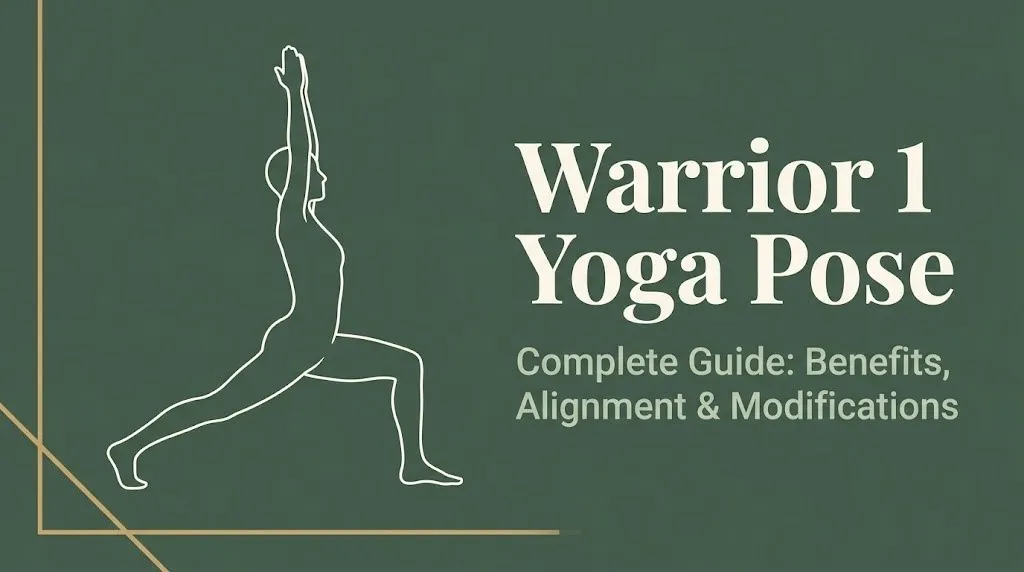
Warrior 1 pose in yoga is a standing lunge position with the arms raised overhead, the front knee bent to approximately 90 degrees, and the back leg extended with the foot angled outward. The torso faces forward over the front leg.
It is a posture that asks the body to do several things at once. The front leg generates strength. The back leg generates a stretch across the hip flexors and groin. The spine extends upward. The arms reach overhead or alongside the ears.
The pose appears in Hatha yoga, Vinyasa flow, Ashtanga yoga, and Iyengar yoga, though how it is set up varies slightly by tradition. In Iyengar yoga, precision of hip position and prop use are prioritized. In Ashtanga yoga, it is part of a fixed sequence practiced in a specific order every class. In Vinyasa, it often flows between other poses without a long hold.
Understanding this matters. If you take both a Hatha class and a Vinyasa class, you may get slightly different instructions for the same pose. Both are valid. They reflect different teaching priorities, not one teacher being wrong.
Virabhadrasana I: The Sanskrit Name and Its Meaning
Virabhadrasana I (pronounced veer-ah-bah-DRAHS-anna) is the Sanskrit name for Warrior 1, and it honors Virabhadra, a fierce mythological warrior figure from Hindu tradition. The name connects the physical posture to a story of strength and intention.
“Vira” means hero or brave. “Bhadra” means friend or auspicious. “Asana” means pose or seat. Together, the name describes a pose of courageous, grounded action.
This etymology is not just historical background. Understanding that the pose embodies intentional strength changes how practitioners approach it. You are not just stretching. You are physically rehearsing what it feels like to stand with purpose.
The pose was first systematized in the modern era through the work of teachers like B.K.S. Iyengar, whose 1966 text “Light on Yoga” described the full warrior series with detailed alignment guidance. That influence shapes how virtually every studio teacher worldwide learns and cues this pose today.
Key Takeaway: Warrior 1 is a compound standing pose that simultaneously builds lower body strength, stretches hip flexors, and trains balance. Its benefits apply to beginners and experienced practitioners alike, and it appears in nearly every major yoga style.
Warrior 1 Pose Muscles Worked
Warrior 1 targets the quadriceps, hip flexors, gluteus maximus, hamstrings, erector spinae, and shoulder girdle muscles simultaneously. Few single poses activate this range in one shape.
Here is a breakdown of the primary and secondary muscles involved:
| Muscle Group | Location | Role in Warrior 1 |
|---|---|---|
| Quadriceps femoris | Front of front thigh | Holds the bent knee position |
| Psoas major and iliacus | Hip flexors, back leg | Stretched and lengthened |
| Gluteus maximus | Back of back hip | Stabilizes the extended back leg |
| Hamstrings | Back of front thigh | Isometric stabilization |
| Erector spinae | Along the spine | Supports spinal extension and uprightness |
| Trapezius and deltoids | Upper back and shoulders | Supports arms raised overhead |
| Gastrocnemius and soleus | Back leg calf | Anchors the back heel to the mat |
The front knee’s position determines quadriceps demand. Deeper knee bend equals more quad engagement. The back foot’s angle affects how much the psoas and iliacus are challenged.
The erector spinae play an underappreciated role. They work against gravity to keep the torso upright as the arms rise overhead. This is part of why Warrior 1 is an effective posture-training exercise, not just a strength or flexibility drill.
Warrior 1 Pose Benefits
Warrior 1 builds lower body strength, stretches the hip flexors and groin, improves postural alignment, and trains single-plane balance. These are not just gym metrics. Each has real daily life carry-over.
A study published in the International Journal of Yoga found that regular yoga practice incorporating standing poses improved lower limb strength and balance scores in adults over 12 weeks. Standing poses like Warrior 1 were among the most frequently used in the intervention sequences.
Hip flexor tightness is documented as a contributor to lower back pain in sedentary populations. The American College of Sports Medicine notes that stretching the hip flexors regularly may reduce compressive forces on the lumbar spine. Warrior 1 directly addresses this through the back leg’s extended position.
Key benefits include:
- Quadriceps and gluteal strengthening from the front leg’s loaded position
- Hip flexor and groin lengthening from the back leg’s extended stance
- Thoracic spine extension from the upward arm reach
- Ankle and calf stability from maintaining the back heel on the mat
- Shoulder girdle endurance from the overhead arm position
- Improved proprioception and balance from the split-stance demand
The Harvard T.H. Chan School of Public Health has noted in its yoga research summaries that yoga practices combining strength and flexibility training produce broader health outcomes than flexibility-only or strength-only routines. Warrior 1 is a textbook example of that combination.
How to Do Warrior 1 Step by Step
To practice Warrior 1 correctly, begin from a standing position and move deliberately through each body zone: feet, legs, hips, spine, and arms, in that order.
Never rush the setup. Placement of the feet determines everything that follows. Most alignment errors in this pose originate in the lower body, not the arms or spine.
To practice Virabhadrasana I (Warrior 1):
- Begin standing in Tadasana (Mountain Pose) at the top of your mat.
- Step your left foot back approximately 3.5 to 4 feet. Your right foot stays forward, toes pointing straight ahead.
- Angle your left (back) foot outward to approximately 45 degrees. The back heel should stay flat on the mat.
- Bend your right knee until it tracks directly over the second toe. Aim for a 90-degree angle, but only go as deep as your body allows with control.
- Square your hips toward the front of the mat as much as your body allows. Draw the left hip gently forward. Do not force this.
- Inhale and raise both arms overhead, palms facing each other or touching at the top.
- Draw your shoulders down away from your ears. Soften any gripping in the neck and jaw.
- Keep your gaze forward or slightly upward. Hold for 3 to 5 breath cycles.
- To release: exhale, lower your arms, straighten your front knee, and step your back foot forward to return to Tadasana.
- Repeat on the opposite side. Always practice both sides.
Modification for beginners: Reduce the stance length. A shorter step back means less hip flexor demand and a smaller balance challenge. This is the most effective beginner adjustment for this pose.
Warrior 1 Yoga Alignment Cues That Actually Help
The most effective alignment cues for Warrior 1 address the front knee, the back heel, and the spinal position, because these three points cause the most common errors.
Front knee: The knee must track over the second toe. When the knee collapses inward, it creates lateral stress on the knee joint. Your yoga teacher may say “knee over pinky toe” or “press the knee outward.” Both cues are pointing at the same correction.
Back heel: It must stay grounded. Many practitioners lift the back heel as they deepen the lunge. This shortcuts the hip flexor stretch and destabilizes the pose. Think of pressing the outer edge of your back foot actively downward.
Spine: The most overlooked area. Many students lean the torso forward as they raise their arms. The spine should stay vertical or even slightly extended backward. Imagine a string lifting the crown of your head straight up while your tailbone drops toward the floor.
Pose Tip:
- If your front knee is tracking inward, widen your stance laterally (move feet slightly apart, like you are on two parallel train tracks, not one rail).
- If your lower back is compressing, micro-bend the back knee slightly and engage the core.
- If the shoulders are riding up near the ears, consciously slide the shoulder blades down the back before raising the arms.
According to yoga anatomy research reviewed in the Journal of Alternative and Complementary Medicine, alignment precision in standing poses is associated with reduced joint stress and improved muscle activation patterns compared to generically cued practice.
Key Takeaway: Correct alignment in Warrior 1 depends on three points working together: the front knee tracking outward over the second toe, the back heel pressing flat into the mat, and the spine lifting vertically rather than leaning forward.
Warrior 1: Open Hips or Square Hips?
The “square your hips” cue in Warrior 1 is one of the most debated alignment instructions in yoga, and the honest answer is that perfect squaring is anatomically impossible for most bodies. The goal is intentional rotation toward the front, not identical hip position.
Here is why: The back leg is externally rotated (foot turned out) while the front leg points forward. These two positions create opposing rotational forces at the hip joints. Asking both hip points to face perfectly forward simultaneously requires a degree of internal rotation at the back hip that many people cannot achieve without strain.
A useful target: draw the left hip crease (if your right foot is forward) forward and down. Aim for 70 to 80 percent of “square.” That is enough to feel the hip engagement and gain the postural benefit without forcing the sacroiliac joint into a strained position.
| Hip Approach | Effect on Body | Best For |
|---|---|---|
| Full square hips (ideal) | Maximum hip opener stretch, higher SI joint demand | Hypermobile or highly flexible practitioners |
| 70-80% square (practical) | Hip opener benefits with less SI joint stress | Most beginner to intermediate students |
| Hips open at 45 degrees | Reduced hip flexor stretch, lower SI demand | People with SI joint dysfunction or hip pathology |
Iyengar yoga typically uses the block under the front foot heel to assist in achieving a more squared position safely. Vinyasa yoga often cues “square your hips” as an aspirational direction rather than an absolute requirement.
Your teacher’s cue is a direction, not a destination you must force.
Warrior 1 Breathing Technique
The recommended breath pattern for Warrior 1 is steady, diaphragmatic breathing, inhaling as you enter the pose and exhaling to settle deeper into the shape. Do not hold your breath. That is the single most common breathing error in this pose.
Many students unconsciously restrict their breath when they concentrate on balance and alignment. A tensed jaw, gripped chest, or locked belly all signal that breathing has stalled. The pose becomes harder, not easier, when this happens.
Ujjayi pranayama, the soft, ocean-breath technique used in Vinyasa and Ashtanga, pairs especially well with Warrior 1. To practice Ujjayi: breathe in and out through the nose, gently constricting the back of the throat. This creates a soft hissing sound and slows the breath naturally.
Breath pattern for a standard hold:
- Inhale to enter the pose or to lift taller through the spine
- Exhale to settle the hips lower or to ground the back heel
- Maintain 3 to 5 slow, full breath cycles before releasing
- On the final exhale, begin to release by straightening the front leg
Research published in Complementary Therapies in Medicine found that breath-synchronized movement in yoga practice reduced cortisol markers and improved participants’ subjective experience of effort. Connecting your breath to Warrior 1 is not a stylistic preference. It changes how hard the pose feels physiologically.
Warrior 1 Pose Modifications for Beginners
Beginners should modify Warrior 1 by shortening the stance length, reducing knee bend depth, and using props to support balance and hip positioning. These adjustments preserve the pose’s benefits while removing the barriers that cause most early injuries.
The most common beginner mistake is going too deep too soon. A partial lunge with excellent alignment builds more strength and body awareness than a deep lunge with collapsing form. Start shallow. Progress over weeks, not days.
| Modification | How to Do It | Who It Helps |
|---|---|---|
| Shortened stance | Step back only 2 to 3 feet instead of 3.5 to 4 | New students, those with tight hip flexors |
| Yoga block under front heel | Place block under the heel for stability | People with tight calves or balance challenges |
| Hands on hips instead of overhead | Keep hands at the hips or on a chair | Shoulder issues, balance concerns, beginners |
| Back knee lowered to a half-lunge | Drop the back knee to the mat | Anyone with hip flexor or back pain |
| Wall for balance | Place one hand on a wall at shoulder height | Balance difficulties, first-time students |
| Wider lateral stance | Move feet slightly wider than hip-width | Improved base of support for beginners |
For people new to yoga, yoga teachers and physical therapists generally recommend holding Warrior 1 for 3 to 5 breath cycles initially, roughly 15 to 30 seconds, before extending the hold as strength and flexibility develop.
Key Takeaway: Breathing is not optional decoration in Warrior 1. Steady breath through the nose reduces muscular tension, improves endurance in the pose, and directly affects how much benefit you receive from each hold.
Warrior 1 for Seniors and Limited Mobility
Warrior 1 is appropriate for most seniors when modified to reduce stance depth, use props, and avoid positions that stress arthritic joints or compromised balance systems. The benefits, including hip strength, spinal extension, and balance training, are especially relevant for older adults.
The NCCIH has noted that yoga practice is associated with improved balance and reduced fall risk in older adults, which is one of the most impactful health outcomes for this demographic. Standing poses like Warrior 1 are a primary vehicle for that benefit.
Joint considerations for seniors:
- Knees with osteoarthritis: Reduce the knee bend angle. A 30 to 45 degree bend rather than 90 degrees dramatically reduces compressive load on the joint.
- Hips with replacement surgery: Check with a physical therapist before practicing. Deep external rotation at the back hip may conflict with prosthesis positioning guidelines depending on the approach used in surgery.
- Ankles with reduced dorsiflexion: A slightly elevated back heel (using a folded blanket under the heel) allows the pose without forcing the ankle into an unavailable range.
- Balance difficulties: Use a wall or sturdy chair back. This keeps the pose safe without removing its functional value.
For seniors practicing at home, a sturdy dining chair placed nearby serves as a reliable safety support. The pose can be entered, held, and exited with one hand on the chair back throughout.
Warrior 1 Chair Yoga Modification
The chair yoga version of Warrior 1 allows seated or standing practitioners with significant mobility limitations to experience the hip flexor stretch, spinal extension, and arm strengthening of the pose without a full standing lunge. This is a legitimate, effective adaptation.
Chair yoga adaptations of Warrior 1 are used in rehabilitation settings, senior living centers, and gentle yoga programs. A 2022 analysis published in the Journal of Alternative and Complementary Medicine found that chair-based yoga programs improved lower body function and reduced self-reported pain in older adults over 8 weeks.
To practice Warrior 1 seated on a chair:
- Sit on the front edge of a sturdy, non-rolling chair. Feet flat on the floor.
- Turn your body to the right so your right hip faces the chair’s front edge.
- Extend the left leg back, placing the left foot flat on the floor behind you. This creates the lunge shape in a seated position.
- Keep the right knee at approximately 90 degrees over the right ankle.
- Inhale and raise both arms overhead, palms facing each other.
- Sit tall. Breathe for 3 to 5 cycles.
- Lower the arms on an exhale. Return to center. Repeat on the other side.
This version delivers a meaningful hip flexor stretch, trains overhead shoulder mobility, and engages the erector spinae without the balance demands of the standing pose. It is a full modification, not a consolation prize.
Warrior 1 Yoga Contraindications and Who Should Skip It
Warrior 1 should be avoided or significantly modified by anyone with a current knee injury, active sacroiliac joint dysfunction, recent hip surgery, shoulder impingement, or acute lower back pain. These are not rare edge cases.
Many popular yoga content sources treat contraindications as a brief footnote. They are not. They deserve direct, specific attention.
Conditions that require modification or avoidance:
- Sacroiliac (SI) joint dysfunction: The hip-squaring demand places rotational stress on the SI joint. Reduce hip rotation significantly. Turn the back foot out further (60 to 70 degrees) and do not try to square the hips. If this still produces pain in the low back or buttock, skip the pose and discuss options with a physical therapist who has yoga knowledge.
- Meniscus tears or knee ligament injuries: The front knee in a loaded bent position challenges compromised knee structures. Reduce bend depth or switch to the chair version.
- Shoulder impingement or rotator cuff issues: Overhead arm raises can aggravate impingement patterns. Keep arms at shoulder height or hands on the hips instead.
- High blood pressure (uncontrolled): Arms overhead increase cardiac demand. Practice with hands on hips and clear the full pose with a physician who knows your cardiovascular status.
- Second or third trimester pregnancy: The deep lunge compresses the lower abdomen. Widen the stance significantly, reduce depth, and keep one hand on a chair. A certified prenatal yoga teacher should guide this modification in person.
- Recent hip replacement: Clearance from the operating surgeon and a physical therapist is necessary before attempting any deep hip position.
Key Takeaway: Warrior 1 is accessible to most people, but contraindications are real and specific. Sacroiliac joint pain, knee injuries, and shoulder impingement each require targeted modifications, not a generic “listen to your body” reminder.
Warrior 1 vs Warrior 2 vs Warrior 3
Warrior 1, Warrior 2, and Warrior 3 are three distinct poses that share a name and a standing lunge foundation but differ in hip orientation, arm position, gaze direction, and the physical demands they place on the body. They are not progressions of one another. They are separate shapes.
| Feature | Warrior 1 | Warrior 2 | Warrior 3 |
|---|---|---|---|
| Sanskrit Name | Virabhadrasana I | Virabhadrasana II | Virabhadrasana III |
| Hip Orientation | Squared toward front | Open to the side | Square, one-legged |
| Arm Position | Both arms overhead | Arms extended to sides | Arms forward or alongside body |
| Gaze Direction | Forward or up | Over front fingertips | Forward or downward |
| Primary Demand | Hip flexor stretch, quad strength, balance | Hip opener, inner thigh, lateral shoulder | Single-leg balance, glute strength, core |
| Difficulty Level | Beginner to intermediate | Beginner to intermediate | Intermediate to advanced |
| Back Foot Angle | 45 degrees | 90 degrees (parallel to back of mat) | Lifted off mat entirely |
| Best For | Hip flexor tightness, posture improvement | Hip opening, shoulder strengthening | Balance training, posterior chain strength |
The most common confusion is between Warrior 1 and Warrior 2. In Warrior 1, the hips face the front. In Warrior 2, the hips open wide to the side. These are opposite orientations. Getting them mixed up changes which muscles are primarily engaged.
Warrior 3 is in a different category entirely. It is a single-leg balancing pose that removes one foot from the ground. Balance and core demand increase substantially.
Warrior Pose Flow Sequence and Related Poses
Warrior 1 flows naturally into and out of several poses that share similar footwork, hip positions, or spinal demands, making it an anchor pose in standing sequences. These connections are how yoga sequences are built logically.
Common preparatory poses before Warrior 1:
- Tadasana (Mountain Pose): Establishes grounding and postural baseline
- Anjaneyasana (Low Lunge): Opens hip flexors with less balance demand
- Adho Mukha Svanasana (Downward-Facing Dog): Lengthens hamstrings and calves before the lunge
Common follow-up poses after Warrior 1:
- Virabhadrasana II (Warrior 2): Natural transition by opening the hips to the side
- Trikonasana (Triangle Pose): Extends the hamstring of the front leg after the quad-dominant Warrior 1 hold
- Parsvakonasana (Extended Side Angle): Builds on the lunge position with a lateral body stretch
- Balasana (Child’s Pose): A restorative counter-pose to release the lower back and hips
A simple beginner-friendly Warrior 1 sequence:
- Tadasana, 5 breaths
- Low Lunge right side, 3 breaths
- Warrior 1 right side, 5 breaths
- Warrior 2 right side, 5 breaths
- Tadasana, 3 breaths
- Repeat left side
- Child’s Pose, 10 breaths
This sequence takes approximately 8 to 10 minutes and covers the hips, quads, hip flexors, and upper back in a logical, safe order. According to yoga teachers and physical therapists, practicing standing poses in a connected sequence rather than in isolation improves both muscle activation patterns and the carry-over effect of each pose.
Key Takeaway: Warrior 1 does not exist in isolation. Pairing it with preparatory hip flexor openers and follow-up hip releases makes the pose more accessible, more effective, and safer for the lower back and SI joint.
Frequently Asked Questions About Warrior 1 Yoga Pose
What is warrior 1 yoga pose good for?
Warrior 1 yoga pose builds quadriceps and gluteal strength, stretches the hip flexors of the back leg, and improves postural alignment through thoracic spine extension.
It also trains single-plane balance and overhead shoulder endurance, making it useful for people who sit for long periods or want to address lower back tightness related to hip flexor shortening.
Research reviewed in the International Journal of Yoga supports regular standing pose practice for improvements in both lower limb strength and balance in adults.
How long should you hold warrior 1 pose?
Most yoga teachers recommend holding Warrior 1 for 3 to 5 breath cycles, which is approximately 15 to 30 seconds for a moderate breath pace.
In Yin-influenced or Restorative practices, longer holds of 1 to 2 minutes are sometimes used, but Warrior 1 is typically a strength-focused hold rather than a passive tissue release.
Start with shorter holds and extend gradually as your quadriceps endurance and hip flexibility develop.
What is the difference between warrior 1 and warrior 2?
In Warrior 1, the hips face the front of the mat and the arms reach overhead. In Warrior 2, the hips open wide to the side and the arms extend parallel to the floor in opposite directions.
These are opposite hip orientations, which means the muscle groups primarily engaged differ between the two poses.
Warrior 1 emphasizes hip flexor stretching and shoulder elevation. Warrior 2 emphasizes hip abductor opening and lateral shoulder endurance.
Is warrior 1 pose good for beginners?
Yes, Warrior 1 is considered a beginner-accessible pose when practiced with a shortened stance, reduced knee bend, and props for balance support.
The full expression of the pose with deep knee bend and squared hips is more demanding, but modified versions are appropriate from the very first class.
Yoga teachers and physical therapists generally recommend using a wall or chair for balance support until the body develops confidence in the shape.
What muscles does warrior 1 yoga pose work?
Warrior 1 primarily targets the quadriceps femoris of the front leg, the psoas major and iliacus (hip flexors) of the back leg, and the gluteus maximus of the back leg.
The erector spinae, trapezius, and deltoids are secondarily engaged to support the upright spine and overhead arm position.
The gastrocnemius and soleus of the back leg also work to anchor the back heel flat onto the mat throughout the hold.
Start Where You Are
Warrior 1 is a pose that rewards patience. The depth of your lunge on day one tells you nothing about where you will be after three consistent months of practice.
Start with a shorter stance, use a chair or wall if you need it, and focus on breathing steadily the entire time you are in the shape. Those three habits will do more for your progress than any amount of forcing the body deeper before it is ready.
If you practice three times per week, even for 10 minutes each session using the sequence outlined above, you will notice real changes in hip flexibility, standing balance, and postural ease within four to six weeks. That is what a consistent, aligned Warrior 1 practice actually delivers.