Hot Yoga Sculpt: Benefits, Results, and Tips for 2026
The benefits of hot yoga sculpt include full-body strength development, meaningful caloric expenditure, cardiovascular conditioning, and measurable flexibility gains, all from a single 60-minute class that combines yoga postures with hand weights in a heated room. If you have been wondering whether this hybrid workout actually delivers on its reputation, the short answer is yes, with some important nuances worth understanding before you book your first class.
Hot yoga sculpt has attracted growing attention from both the fitness research community and everyday practitioners. According to the National Center for Complementary and Integrative Health, yoga-based practices combined with resistance elements show particularly strong outcomes for muscular endurance and stress reduction compared to either discipline practiced alone. That combination matters for people who want more from their workout time.
This guide covers what yoga sculpt actually is, exactly which muscles it works, what research says about calorie burn and muscle building, realistic before-and-after expectations, how to choose the right weights, modifications for beginners and seniors, and how often to practice to see genuine results. No marketing language. Just the information you need to decide if this practice belongs in your routine.
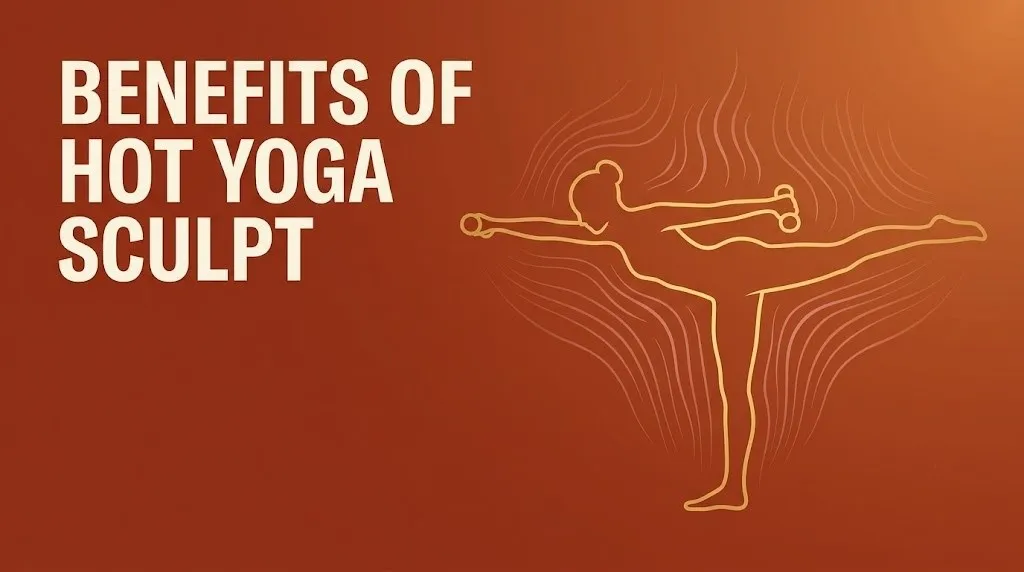
Benefits of Hot Yoga Sculpt
The benefits of hot yoga sculpt span strength, endurance, flexibility, cardiovascular fitness, and mental health, making it one of the more genuinely complete workout formats available to home and studio practitioners.
The heat is not incidental to these benefits. Practicing in a room heated to 35 to 40 degrees Celsius increases blood flow to working muscles, raises core body temperature, and amplifies the cardiovascular demand of every movement. When you add resistance training through hand weights to that already-elevated physiological state, the body responds more intensely than it would to the same movements performed at room temperature.
Key benefits supported by research and practitioner experience include:
- Improved lean muscle tone, particularly in the lower body, core, and shoulders
- Elevated caloric expenditure compared to unheated yoga, ranging from 400 to 600 calories per 60-minute session depending on body size and effort
- Enhanced cardiovascular endurance through sustained elevated heart rate
- Increased flexibility, as warm connective tissue responds more readily to stretching
- Reduced cortisol levels and improved mood through movement-induced neurochemical release
- Better balance and proprioception from single-leg and stability-based resistance work
- Improved muscular endurance through high-repetition, lower-weight training patterns
According to the International Journal of Yoga, regular heated yoga practice over 12 weeks produced improvements in lower body strength, balance, and cardiovascular fitness markers compared to sedentary controls. Adding resistance work to that equation amplifies the strength-related outcomes further.
No single workout format suits every body. Hot yoga sculpt asks more of your cardiovascular system than standard yoga and more of your connective tissue than standard strength training. That is precisely what makes it effective, and also what requires thoughtful entry for certain populations.
What Is Yoga Sculpt
Yoga sculpt is a heated yoga class format that combines traditional yoga postures with light to moderate hand weights, bodyweight resistance exercises, and cardio interval bursts to create a full-body conditioning workout.
The format was popularized by CorePower Yoga, the largest yoga studio chain in the United States, though independent studios worldwide now offer equivalent classes under various names. The defining elements are consistent: a heated room, a flowing yoga sequence, resistance training integrated directly into yoga poses, and cardio segments like squat jumps, burpees, or mountain climbers inserted between yoga flows.
Think of yoga sculpt as yoga wearing strength training clothes. A standard Vinyasa yoga class flows through postures using bodyweight only. Yoga sculpt takes those same postures and adds external resistance, turning Utkatasana (Chair Pose) into a weighted squat, Virabhadrasana I (Warrior I) into a shoulder press sequence, and Virabhadrasana III (Warrior III) into a posterior deltoid fly. The yoga alignment principles remain central; the resistance load is layered on top.
Classes typically run 60 minutes, though some studios offer 75-minute or 90-minute formats. The room is heated to between 35 and 40 degrees Celsius. Most classes use hand weights ranging from 1 to 5 kilograms (2 to 10 pounds), depending on the movement and the practitioner’s strength level.
Pose Tip:
- The yoga alignment always comes first; weights are secondary to form
- Drop the weights immediately if your posture breaks down
- Beginners can hold the postures without weights until the sequences feel familiar
How Is Yoga Sculpt Different from Regular Yoga
Yoga sculpt differs from regular yoga by adding external resistance through hand weights, cardio burst intervals, and a higher-intensity cardiovascular demand, while still using yoga postures as the structural foundation of the class.
In a standard Hatha or Vinyasa yoga class, resistance comes entirely from bodyweight and the practitioner’s own muscular effort to hold alignment. The goal is breath-linked movement, flexibility, and mindfulness. The heart rate rises moderately. The primary physiological adaptation is increased flexibility, balance, and core stability.
Yoga sculpt preserves all of that and adds a metabolic layer. The heart rate in a yoga sculpt class typically reaches 60 to 85 percent of maximum heart rate during cardio burst intervals, which is solidly within the aerobic and lower anaerobic training zones defined by the American College of Sports Medicine for meaningful cardiovascular conditioning.
| Feature | Regular Yoga (Vinyasa/Hatha) | Hot Yoga Sculpt |
|---|---|---|
| Room temperature | Room temperature (20 to 22°C) | Heated (35 to 40°C) |
| Resistance | Bodyweight only | Hand weights plus bodyweight |
| Cardio intensity | Low to moderate | Moderate to high |
| Calorie burn (60 min) | 200 to 350 kcal | 400 to 600 kcal |
| Primary adaptation | Flexibility, balance, mindfulness | Strength, endurance, flexibility |
| Heart rate range | 40 to 60% max HR | 60 to 85% max HR |
| Muscle hypertrophy potential | Low to moderate | Moderate |
| Skill floor for beginners | Lower | Moderate |
The key distinction for results-focused practitioners: yoga sculpt builds the cardiovascular and muscular endurance adaptations that regular yoga cannot fully reach, while still producing the flexibility, joint mobility, and stress-reduction outcomes that make yoga superior to pure strength training for overall wellbeing.
Key Takeaway: Hot yoga sculpt is not yoga with a weight attached to it. It is a genuinely distinct training format that produces physiological outcomes neither yoga nor strength training produces as efficiently on their own.
Yoga Sculpt Muscles Worked
Hot yoga sculpt targets the quadriceps, glutes, hamstrings, core stabilizers, posterior deltoids, biceps brachii, triceps, and erector spinae through a combination of yoga-based movement patterns and resistance training.
Most yoga sculpt classes organize their movements in a lower-body dominant flow, an upper-body resistance sequence, a core-focused floor series, and a cardio burst interval. Each section targets specific muscle groups with both the yoga posture and the weighted movement layered together.
Primary muscles worked by movement zone:
- Lower body: Quadriceps and glutes during Utkatasana (Chair Pose) squat sequences; hamstrings and glutes in Virabhadrasana I and II (Warrior I and II) lunge patterns; hip abductors in lateral band or clamshell variations
- Upper body: Posterior deltoids and mid-trapezius in Virabhadrasana III (Warrior III) fly variations; biceps brachii in curl sequences during standing postures; triceps in overhead extensions and Chaturanga Dandasana (Four-Limbed Staff Pose) sequences
- Core: Transverse abdominis and erector spinae in all standing balance work; rectus abdominis and obliques in Navasana (Boat Pose) and floor-based core sequences
- Stabilizers: Ankle stabilizers, hip abductors, and shoulder rotator cuff muscles activated continuously through heated single-leg balance work
The heat amplifies muscle recruitment. Warm muscle tissue contracts more efficiently and fatigues at a slightly different rate than cold tissue. This means your muscles are doing more meaningful work earlier in the class than they would in a room-temperature setting.
Modification: Anyone with shoulder impingement should skip overhead pressing movements and work with arms at or below shoulder height. Drop the weights entirely if shoulder discomfort appears during any movement.
Yoga Sculpt Cardiovascular Benefits
Hot yoga sculpt produces genuine cardiovascular conditioning by combining sustained elevated heart rate from the heat environment with repeated cardio burst intervals that push the body into moderate to vigorous aerobic intensity.
The heat alone elevates resting heart rate before a single movement begins. A room at 38 degrees Celsius increases cardiac output as the heart works harder to pump blood to the skin for cooling. Add flowing movement sequences and cardio bursts, and the cardiovascular demand of a yoga sculpt class approaches that of a moderate-intensity cycling or rowing session.
According to a 2015 study published in the Journal of Strength and Conditioning Research, hot yoga practitioners showed improvements in cardiovascular endurance markers, including reduced resting heart rate and improved aerobic capacity, after eight weeks of consistent practice. The addition of resistance intervals in yoga sculpt provides an additional cardiovascular stimulus beyond what standard hot yoga produces.
The cardio burst structure matters for cardiovascular adaptation. Alternating between yoga posture flows at 60 to 70 percent max heart rate and cardio bursts at 75 to 85 percent max heart rate creates an interval training effect. The American College of Sports Medicine identifies interval-based training as one of the most time-efficient methods for improving cardiovascular fitness in adults.
What cardiovascular changes regular yoga sculpt practitioners typically report:
- Lower resting heart rate after six to eight weeks of consistent practice
- Improved recovery between cardio bursts (heart rate returns to baseline faster)
- Reduced breathlessness during everyday physical activity
- Improved heat tolerance through cardiovascular and thermoregulatory adaptation
Modification: If you have a history of heart arrhythmia or uncontrolled hypertension, the combination of heat and high-intensity interval bursts requires a conversation with the cardiologist managing your care before attending.
Does Yoga Sculpt Build Muscle
Yoga sculpt builds muscular endurance and lean muscle tone effectively, though it produces less absolute muscle hypertrophy than progressive heavy resistance training programs designed specifically for mass gain.
Understanding this distinction matters for managing expectations honestly. Muscle hypertrophy, the actual increase in muscle fiber cross-sectional area, requires progressive overload: increasingly heavier loads over time. Yoga sculpt classes typically use 1 to 5 kilogram weights and emphasize high repetitions over maximal load. That training pattern is excellent for muscular endurance, lean muscle development, and metabolic rate support, but it will not produce the same hypertrophic effect as a barbell back squat program.
What yoga sculpt does produce is the kind of lean, functional muscle tone that improves body composition, daily movement quality, and metabolic rate without the joint loading of heavy barbell work. For many practitioners, that is exactly the outcome they want.
According to research published in Complementary Therapies in Medicine, yoga-based resistance practices performed three to four times per week for 12 weeks produced measurable increases in lean muscle mass and decreases in body fat percentage in previously sedentary adults. The heated environment enhanced these outcomes compared to the room-temperature control group.
Muscle building in yoga sculpt is most noticeable in the glutes, quadriceps, posterior deltoids, and core stabilizers, all of which are heavily recruited in the signature standing balance and lower-body sequences that form the core of most yoga sculpt classes.
Modification: To progress muscle development within the yoga sculpt format, gradually increase weight by 0.5 to 1 kilogram increments over six to eight weeks rather than jumping weight too quickly, which risks form breakdown.
Key Takeaway: Hot yoga sculpt builds real, visible lean muscle and measurable cardiovascular fitness, but it produces different adaptations than heavy strength training. Know what you are training for and the format delivers.
How Many Calories Does Yoga Sculpt Burn
A 60-minute hot yoga sculpt class burns approximately 400 to 600 calories for most adults, with the heated environment and cardio burst intervals accounting for meaningfully higher expenditure than unheated yoga.
That range is wide because caloric expenditure depends on body weight, muscle mass, fitness level, exercise intensity, and individual thermoregulatory efficiency. A heavier practitioner with more muscle mass working at maximum effort burns toward the higher end. A lighter practitioner in their first few weeks burns toward the lower end.
The heat contributes to caloric expenditure in two ways. First, maintaining body temperature regulation in a 38-degree room requires energy. Second, elevated core temperature increases the metabolic rate of working muscles. Research from the American College of Sports Medicine confirms that exercise in heated environments produces meaningfully higher caloric expenditure than the same exercise performed at room temperature, typically an increase of 10 to 15 percent.
| Class Type | Estimated Calories Burned (60 min, 68kg adult) |
|---|---|
| Hatha yoga (unheated) | 190 to 250 kcal |
| Vinyasa yoga (unheated) | 280 to 360 kcal |
| Hot yoga (no weights) | 330 to 450 kcal |
| Hot yoga sculpt | 400 to 600 kcal |
| HIIT (moderate intensity) | 450 to 550 kcal |
| Strength training (moderate) | 300 to 420 kcal |
One important caveat: some of the caloric expenditure during hot yoga is from thermoregulation, not from muscular work itself. This means post-class hunger may be higher than post-strength-training hunger. Replacing caloric expenditure entirely through increased eating negates the weight-
/management benefit. Hydration, electrolyte replacement, and a moderate post-class meal manage this effectively.
Yoga Sculpt Mental Health Benefits
Hot yoga sculpt supports mental health through cortisol reduction, mood elevation via endorphin and BDNF release, improved body awareness, and the psychological benefit of structured, achievable physical challenge.
The heat plays a specific neurological role here. Passive heat exposure has been studied as a mood-regulating intervention. In a yoga sculpt class, that heat combines with vigorous movement, which stimulates brain-derived neurotrophic factor (BDNF), sometimes described by neuroscientists as fertilizer for the brain. BDNF supports neural plasticity, learning, and mood regulation.
According to the National Center for Complementary and Integrative Health, regular yoga practice has been shown across multiple clinical trials to reduce self-reported anxiety, lower cortisol levels, and improve scores on standardized depression screening measures in adults. The resistance training element of yoga sculpt adds to these outcomes: the Journal of Alternative and Complementary Medicine has published findings showing that combined yoga and resistance practices produce stronger mood improvements than either approach practiced separately.
Mental health benefits commonly reported by regular yoga sculpt practitioners:
- Reduced perceived stress and anxiety within four to six weeks of regular practice
- Improved sleep quality, likely through parasympathetic nervous system activation after class
- Stronger sense of body confidence and physical self-efficacy
- Improved focus and cognitive clarity in the hours following class
- Reduced emotional reactivity, supported by the breath-centered nature of the practice
The structured nature of a class also matters psychologically. When the workout has a clear beginning, progression, and end, the sense of accomplishment is concrete and repeatable. That predictability supports motivation and habit formation in ways that unstructured workouts do not always produce.
Yoga Sculpt Before and After: What Results to Expect
Realistic yoga sculpt before-and-after results include improved muscle tone and reduced body fat percentage, better cardiovascular endurance, increased flexibility, and measurable mood improvements, all occurring gradually over weeks of consistent practice.
Honesty matters here. The before-and-after images circulating on social media often represent months of dedicated practice combined with dietary changes. Yoga sculpt alone, practiced once or twice per week while eating at a caloric surplus, will not produce dramatic body composition changes. Practiced three to four times per week alongside reasonable nutrition, the results are genuinely meaningful and research-supported.
What practitioners typically experience by timeframe:
- Weeks 1 to 2: Heat acclimatization, initial muscular soreness, improved sleep quality
- Weeks 3 to 4: Noticeably better cardiovascular endurance; less breathlessness during cardio bursts; reduced muscle soreness between sessions
- Weeks 6 to 8: Visible improvement in muscle tone, particularly glutes, quadriceps, and shoulders; improved posture from thoracic strengthening work
- Weeks 10 to 12: Measurable changes in body composition if frequency and nutrition support it; improved strength in weighted movements; stronger sense of body control
The flexibility gains are often the first thing practitioners notice. Warm connective tissue responds to stretching more readily than cold tissue, and consistent exposure to the heat accelerates flexibility adaptation significantly compared to room-temperature yoga.
Modification note: If you are returning from an injury or postpartum recovery, starting with two classes per week and building gradually over four to six weeks protects the connective tissue from overloading during the adaptation phase.
Key Takeaway: Yoga sculpt before-and-after results are real and research-supported, but they follow a timeline of weeks, not days. Consistency at three to four sessions per week is the variable that separates meaningful results from none.
Yoga Sculpt Results Timeline
Most practitioners begin noticing yoga sculpt results within two to four weeks, with body composition changes becoming visible around eight to twelve weeks of consistent practice at three or more sessions per week.
The early results are physiological, not cosmetic. Cardiovascular efficiency improves first. By week three or four, most practitioners recover faster between cardio bursts, feel less overheated during class, and report noticeably better energy levels throughout the day. These are real adaptations happening at the cellular and cardiovascular level.
A study published in the International Journal of Yoga found that participants practicing heated yoga four times per week for 12 weeks showed statistically measurable improvements in body fat percentage, resting heart rate, and lower-body muscular endurance. These results were not visible at four weeks but were clearly present at twelve. The pattern is consistent across yoga-resistance research: early functional improvements, later compositional changes.
Yoga sculpt results timeline by category:
| Result Type | Expected Timeframe |
|---|---|
| Improved heat tolerance | 1 to 2 weeks |
| Better cardiovascular recovery between bursts | 3 to 4 weeks |
| Reduced muscle soreness between sessions | 3 to 5 weeks |
| Visible muscle tone improvement | 6 to 10 weeks |
| Measurable body composition change | 10 to 16 weeks |
| Significant strength increase in weighted movements | 8 to 12 weeks |
| Sustained mood and sleep improvements | 4 to 8 weeks |
Frequency is the single most influential variable. Practitioners attending once per week will experience results on a much slower curve than those attending three times per week. The research consistently supports three to four sessions weekly for optimal adaptation.
What Weights Should I Use for Yoga Sculpt
Most yoga sculpt beginners should start with 1 to 2 kilogram (2 to 5 pound) weights and progress to 3 to 5 kilograms (5 to 10 pounds) as strength and movement familiarity develop.
Weight selection in yoga sculpt follows a different logic than traditional strength training. The goal is not maximal load. It is maintaining yoga alignment under resistance for repeated movements. A weight that feels manageable for ten bicep curls at a standing desk may feel completely different when you are performing those same curls in Utkatasana (Chair Pose) in a 38-degree room with your heart rate already elevated.
The standard rule that yoga teachers and physical therapists generally recommend: choose a weight that allows you to maintain perfect form for the entire set. If the elbows flare, the wrists collapse, or the spine rounds, the weight is too heavy for that movement in that context.
Weight selection guide by movement type:
| Movement Type | Beginner Weight | Intermediate Weight | Advanced Weight |
|---|---|---|---|
| Bicep curls (standing) | 1 to 2 kg | 2 to 3 kg | 3 to 5 kg |
| Shoulder press (overhead) | 1 to 2 kg | 2 to 3 kg | 3 to 4 kg |
| Posterior deltoid fly (Warrior III) | 1 kg | 1 to 2 kg | 2 to 3 kg |
| Tricep extensions | 1 to 2 kg | 2 to 3 kg | 3 to 4 kg |
| Lateral raises | 1 kg | 1 to 2 kg | 2 to 3 kg |
Drop the weights immediately if form breaks down. Practicing a movement correctly with no weight builds the neural pathway that makes added resistance productive. Practicing a movement incorrectly with weight reinforces dysfunction.
Modification: People with wrist pain, recent wrist fractures, or carpal tunnel syndrome should work with resistance bands looped around the upper arms instead of hand weights, which removes the wrist loading while preserving the upper-body training stimulus.
Key Takeaway: In yoga sculpt, lighter weights with perfect form in a heated room produce better results than heavier weights with compromised alignment. The heat does enough work. Let the form do the rest.
Is Yoga Sculpt Good for Beginners
Yoga sculpt is accessible to beginners, but it is not the easiest entry point into yoga. A moderate baseline of physical fitness and at least a few yoga classes for foundational pose familiarity make the experience significantly safer and more productive.
The challenge for complete beginners is managing multiple simultaneous demands: learning yoga alignment, coordinating breath with movement, regulating the response to heat, and adding resistance. That is a genuinely complex skill set to develop all at once in a 60-minute class. Most yoga teachers recommend new practitioners attend three to five standard hot yoga or Vinyasa classes before their first yoga sculpt session.
That said, most yoga sculpt classes welcome beginners and teachers will offer modifications throughout. The key is being honest with yourself and your teacher about your experience level before the class starts.
What beginners should know before their first yoga sculpt class:
- Arrive 10 to 15 minutes early to acclimate to the room temperature
- Start with no weights for the first one or two sessions; use the class to learn the movement patterns
- Child’s Pose (Balasana) is always available and always appropriate; use it freely
- Drink at least 500ml of water in the two hours before class
- Expect the first class to feel hard; the second to feel slightly more manageable; the fourth or fifth to start feeling genuinely good
According to yoga teachers and movement researchers, the heat acclimatization process for most healthy adults takes four to six sessions. The discomfort of the first few classes is primarily from thermoregulation, not from the poses or weights.
Yoga Sculpt for Seniors
Yoga sculpt can be appropriate for healthy active seniors aged 60 and older, provided the class temperature, weight selection, and movement intensity are adapted to account for age-related changes in thermoregulation and connective tissue resilience.
The balance and lower-body strengthening components of yoga sculpt are particularly relevant for older adults. The Harvard T.H. Chan School of Public Health has documented that yoga-based balance training significantly reduces fall risk in adults over 65, and the lower-body resistance work in yoga sculpt adds meaningful bone-loading stimulus for that same population.
The heat requires specific caution. Thermoregulatory efficiency declines with age. Older adults sweat less effectively, meaning the body’s primary cooling mechanism is less reliable in a heated room. Seniors attending yoga sculpt should choose studios offering 35-degree classes rather than 38 to 40-degree formats initially.
Safe modifications for senior yoga sculpt practitioners:
- Use 0.5 to 1 kilogram weights initially; weight selection for seniors prioritizes form over resistance
- Take balance postures near a wall or the back of a chair rather than free-standing
- Skip overhead pressing movements if cervical spine or shoulder issues are present
- Hydrate more aggressively than younger practitioners: 750ml to 1 liter before class
- Choose 60-minute formats over 90-minute classes to limit total heat exposure time
- Rest in Balasana (Child’s Pose) or lie flat whenever needed without hesitation
Seniors taking blood pressure medications, diuretics, or heart rate-modulating drugs should discuss hot exercise classes with the prescribing physician, as these medications can impair the body’s thermoregulatory and cardiovascular responses to heat stress.
Yoga Sculpt Modifications and Safety
Yoga sculpt is safe for most healthy adults when practiced with appropriate weight selection, adequate hydration, and attention to individual physical limits, but certain conditions require specific adjustments or exclusion from the heated format.
Safety in yoga sculpt is primarily about two things: alignment under resistance and heat management. Both require honest self-assessment throughout the class. The ego that refuses to drop weights when form breaks down is the most common source of injury in the format.
Conditions requiring specific modifications:
- Shoulder impingement or rotator cuff injury: Skip overhead pressing and lateral raise movements; perform curls and posterior fly work only within a pain-free range
- Knee pain or recent knee surgery: Reduce depth in all squat and lunge patterns; use a block under the hips in floor postures; avoid deep knee flexion
- Low back pain: Engage the core before all loaded movements; avoid deep forward folds under resistance; reduce load significantly
- Wrist pain or carpal tunnel syndrome: Use resistance bands instead of hand weights; avoid weight-bearing on the hands in Chaturanga Dandasana (Four-Limbed Staff Pose); use fist position to reduce wrist extension
- Pregnancy: Heated yoga classes are not recommended during pregnancy. The elevated core body temperature from sustained heat exposure creates physiological risks, particularly in the first trimester. Seek prenatal yoga classes specifically designed for that stage of life.
- Cardiovascular conditions: The combined heat and interval intensity requires clearance from a cardiologist before participation.
Signs to stop immediately during class:
- Sudden dizziness or nausea
- Visual disturbance or tunnel vision
- Chest pressure or palpitations
- Feeling faint or losing coordination
How Often Should You Do Yoga Sculpt to See Results
Practicing hot yoga sculpt three to four times per week produces the most consistent results for body composition, cardiovascular fitness, and strength, based on both the research on resistance training frequency and the specific demands of the heated format.
Once per week maintains basic fitness and is a reasonable starting point. Twice per week begins producing measurable cardiovascular and flexibility adaptation. Three times per week is where body composition changes and lean muscle development become consistently documented in the research. Four times per week is appropriate for experienced practitioners with full heat acclimatization.
According to the American College of Sports Medicine, optimal training frequency for muscular endurance and body composition improvement in adults is three to four sessions per week, with at least one full rest day between sessions to allow muscular repair and nervous system recovery. This recommendation applies directly to yoga sculpt given its resistance training component.
Frequency guide for yoga sculpt practitioners:
| Experience Level | Recommended Sessions Per Week | What to Expect |
|---|---|---|
| Complete beginner | 1 to 2 | Heat acclimatization; initial endurance gains |
| 1 to 3 months experience | 2 to 3 | Cardiovascular improvement; early muscle tone |
| 3 to 6 months experience | 3 to 4 | Visible body composition change; strength increase |
| 6 months or more | 3 to 5 | Advanced strength adaptation; sustained results |
Rest days are not optional. The muscular repair that happens between sessions is where adaptation actually occurs. Practicing five to seven days per week in a heated environment without recovery days increases injury risk and blunts the adaptation response. Two to three rest or gentle recovery days per week, with light walking or unheated gentle yoga, produces better long-term results than daily high-intensity attendance.
Key Takeaway: Three sessions per week is the research-supported sweet spot for yoga sculpt results. More is not always better when heat adds cumulative physiological stress to every session.
Frequently Asked Questions About Hot Yoga Sculpt
What are the main benefits of hot yoga sculpt compared to regular yoga?
Hot yoga sculpt produces stronger cardiovascular conditioning, greater caloric expenditure, and more meaningful lean muscle development than regular unheated yoga because it adds hand weights, cardio bursts, and a heated room to the yoga posture framework.
Regular yoga excels at flexibility, mindfulness, and joint mobility, while yoga sculpt builds on those benefits and adds a resistance and cardiovascular training stimulus that unheated yoga cannot match.
For practitioners wanting both strength and flexibility outcomes from a single workout, yoga sculpt covers more physiological ground per session than either yoga or strength training practiced separately.
How many calories does a hot yoga sculpt class burn?
A 60-minute hot yoga sculpt class burns approximately 400 to 600 calories for most adults, with variation based on body weight, fitness level, and effort intensity.
The heated room contributes an estimated 10 to 15 percent increase in caloric expenditure compared to the same workout at room temperature, according to American College of Sports Medicine research on exercise in heat.
Calorie estimates from wearable devices are often inaccurate for heated classes; treat any device reading as a rough guide rather than a precise measurement.
Can beginners do yoga sculpt with no prior yoga experience?
Beginners can attend yoga sculpt classes, but having three to five standard yoga classes first makes the experience considerably safer and more productive.
The simultaneous demands of yoga alignment, breath coordination, heat management, and hand weights create a high cognitive and physical load for someone completely new to yoga movement patterns.
Most studios offer modifications and beginners are encouraged to start with no weights until the pose sequences feel familiar.
How long before you see results from yoga sculpt?
Most practitioners notice improved cardiovascular endurance and heat tolerance within three to four weeks of consistent practice.
Visible muscle tone changes typically appear between six and ten weeks for practitioners attending three or more sessions per week.
Body composition changes, including measurable reductions in body fat percentage, are generally documented between ten and sixteen weeks in the research on heated yoga resistance practices.
Is hot yoga sculpt good for weight loss?
Hot yoga sculpt supports weight loss as part of a broader lifestyle approach, burning 400 to 600 calories per session and building lean muscle tissue that raises the resting metabolic rate over time.
A study published in Complementary Therapies in Medicine found that heated yoga resistance practice three times per week for 12 weeks produced measurable reductions in body fat percentage and waist circumference compared to a control group.
Weight loss outcomes depend on total caloric balance. Yoga sculpt creates a meaningful caloric deficit when combined with reasonable nutrition, but it does not override a diet that consistently exceeds caloric needs.
Show Up, Stay Consistent, Trust the Process
Three sessions per week is the number the research consistently supports for real yoga sculpt results. Start there. Use lighter weights than you think you need in the first few weeks. Let the heat do its work, let the postures teach your body, and add resistance progressively as your form and heat tolerance improve.
Pick your first class, arrive early, bring water, and drop the weights when your form tells you to. The results you are looking for are built in the repetition, not in the first session.
Your body adapts to what you consistently give it. Give it yoga sculpt three times a week for twelve weeks and you will have data of your own to work with.