Trap Yoga: Poses, Benefits, and How to Start in 2026
Trap yoga is a Vinyasa-based yoga practice set to hip-hop and trap music, blending traditional pose sequences with high-energy rhythmic sound. It is a real, structured yoga format with measurable physical and mental benefits, not just a playlist swap.
Research published in the Journal of Alternative and Complementary Medicine has found that music during exercise can reduce perceived exertion and improve performance consistency. Yoga Alliance data from 2024 also shows that younger adults cite “relevance to their lifestyle” as the top barrier to starting a yoga practice, which is exactly the gap trap yoga addresses.
This article covers what trap yoga actually is, how the music functions within the practice, the specific poses most commonly used, and how to start safely at home. It also includes modifications for beginners, seniors, and anyone working around a physical limitation.
What Is Trap Yoga
Trap yoga is a yoga practice that uses trap and hip-hop music as its rhythmic and energetic foundation, typically structured as a Vinyasa flow class. The poses themselves are drawn from traditional Hatha and Vinyasa yoga lineages. What changes is the sensory environment: high-energy music replaces ambient sound or silence, and instructors often use the beat to cue transitions between poses.
The practice did not emerge from a single studio or branded program. It grew organically from urban wellness communities, particularly in Atlanta, New York, and Los Angeles, as yoga teachers sought to make the practice more culturally accessible and less exclusive-feeling.
Trap yoga is not a separate yoga style with its own philosophy the way Iyengar or Kundalini yoga are distinct disciplines. Think of it as Vinyasa yoga with a specifically curated musical container. The core anatomical and alignment principles remain the same. The experience of getting there feels very different.
Key features of trap yoga:
- Vinyasa-based flow structure with breath-to-movement synchronization
- Music tempo typically ranging from 130 to 175 beats per minute (BPM)
- Poses drawn from Hatha, Vinyasa, and sometimes Yin traditions
- Class environments often described as inclusive, high-energy, and culturally welcoming
- Offered in studios, community centers, parks, and online platforms
Trap Yoga History and Origins
Trap yoga emerged as part of a broader hip-hop wellness movement that began gaining traction in the early 2010s. The practice grew directly from communities that felt traditional yoga spaces were culturally narrow, economically inaccessible, or aesthetically disconnected from their everyday lives.
Teachers in Atlanta and other Southern cities began holding outdoor and community-space classes set to trap and Southern rap music. These classes attracted people who had never attended a studio yoga class before. The format spread through social media, particularly Instagram and YouTube, where short clips of flows set to recognizable hip-hop tracks reached wide audiences quickly.
The movement accelerated after roughly 2017, when several urban wellness brands began formally offering trap yoga as a named class type. The COVID-19 pandemic then pushed much of this practice into home-based and online formats, which expanded its reach to practitioners who had no access to a studio offering this format.
Trap yoga’s origins are rooted in cultural accessibility, not novelty. Understanding that context matters when you practice. This is yoga that was intentionally designed to feel like it belongs to you.
How Trap Music Changes Your Yoga Practice
Trap music changes your yoga practice by giving movement a rhythmic external anchor that traditional yoga classes do not typically provide. In a standard Vinyasa class, breath is the primary pacer. In trap yoga, the music’s beat and the breath work together as a dual timing system.
Trap music as a genre is characterized by its specific BPM range (typically 130 to 175 BPM), heavy bass lines, syncopated hi-hat patterns, and a repetitive rhythmic structure. That repetition is functionally useful in yoga. When a musical phrase repeats, your body can anticipate the transition cue and move more fluidly.
Psychologically, familiar or high-energy music reduces the conscious effort required to stay present. You stop negotiating with the discomfort of Chair Pose (Utkatasana) because part of your attention is tracking the beat. Sports science research published in the International Journal of Sport Psychology notes this effect as “dissociative focus,” where external stimuli reduce awareness of physical discomfort during effort.
How trap music functions within your practice:
| Musical Element | How It Functions in Trap Yoga |
|---|---|
| High BPM (130 to 175) | Drives transition pacing between poses |
| Repetitive hi-hat patterns | Creates micro-timing cues for breath and movement |
| Heavy bass drops | Often used as a cue for holding a challenging pose |
| Verse-to-chorus structure | Mirrors build-and-release structure of a yoga sequence |
| Familiar lyrical content | Reduces mental fatigue during sustained holds |
Key Takeaway: Trap yoga is traditional Vinyasa yoga with hip-hop music as a functional timing and motivational tool, not a separate philosophy or style. The music changes the experience, not the anatomy of the poses.
Trap Yoga Benefits for the Body
Trap yoga builds the same physical benefits as any well-structured Vinyasa flow practice, including strength, flexibility, and cardiovascular conditioning. The high-energy music environment tends to extend the duration practitioners stay in challenging poses and complete more transitions per session.
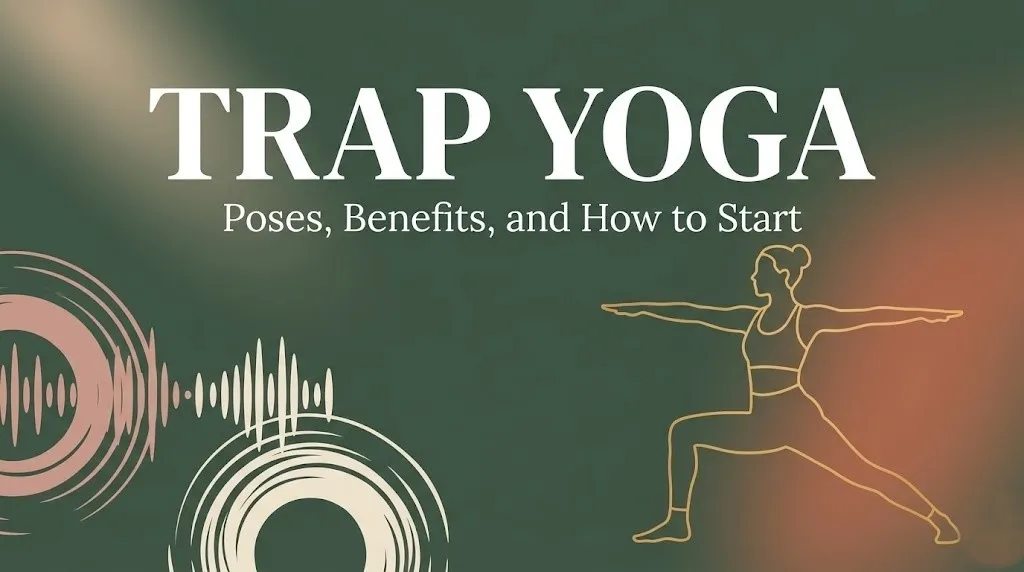
A well-designed trap yoga class engages the quadriceps, glutes, core (transverse abdominis and obliques), hamstrings, shoulder girdle, and hip flexors across a single 45 to 60-minute session. The dynamic nature of Vinyasa-style transitions means both muscular strength and aerobic capacity are trained simultaneously.
The American College of Sports Medicine recognizes yoga as contributing to muscular endurance, flexibility, and balance when practiced consistently at least three times per week. The physical demands of trap yoga, particularly the inclusion of held standing poses and repeated Chaturanga Dandasana (Four-Limbed Staff Pose) transitions, meet the criteria for moderate-intensity physical activity.
Physical benefits associated with consistent trap yoga practice:
- Muscular endurance: Standing poses held for multiple breath cycles build lower-body and core stamina
- Flexibility: Hip-opening poses target hip flexors and hamstrings, which are chronically shortened from long periods of sitting
- Spinal mobility: Forward folds and backbend variations maintain lumbar and thoracic range of motion
- Balance and proprioception: Single-leg poses train stabilizing muscles in the ankle, knee, and hip
- Cardiovascular conditioning: Fast-paced transitions between poses elevate heart rate into moderate aerobic zones
Pose Tip:
- In Virabhadrasana II (Warrior II), track your front knee directly over your second toe to protect the knee joint.
- Keep your shoulders stacked over your hips, not leaning forward.
- Beginners: Shorten your stance by 6 inches to reduce hip flexor strain.
Trap Yoga Benefits for Mental Health and Stress
Trap yoga reduces stress by combining the well-documented psychological effects of yoga with the mood-regulating effects of music. These two inputs work on overlapping but distinct biological pathways.
Yoga’s effects on the sympathetic nervous system (the body’s stress-response system) are well documented. The National Center for Complementary and Integrative Health (NCCIH) reports that yoga practice is associated with reduced cortisol levels, lower heart rate, and improved markers of parasympathetic nervous system activity. These effects occur during both quiet, meditative yoga and more dynamic Vinyasa practices.
Music adds a second channel. Listening to preferred music during exercise has been shown to reduce self-reported anxiety and improve mood state in multiple controlled studies. When the music is culturally familiar, the emotional resonance deepens those effects. For practitioners who have felt alienated from traditional yoga spaces, trap yoga can remove a significant social stressor just by feeling like a space that was designed for them.
The combination of physical movement, rhythmic music, and breath awareness also produces what psychologists sometimes call a flow state, a mental condition of full engagement where self-critical thinking decreases. This is part of why trap yoga classes consistently report high participant satisfaction even among complete beginners.
What Research Says About Music-Assisted Yoga
Research consistently supports the use of music during yoga and movement-based exercise to improve performance, mood, and adherence. A study published in the Journal of Alternative and Complementary Medicine found that music during yoga practice increased participants’ rate of perceived exertion tolerance, meaning they worked harder without feeling like they were working harder.
A separate meta-analysis published in Complementary Therapies in Medicine reviewed 17 studies on music during exercise and found that synchronous music (music matched to movement tempo) produced greater improvements in motor coordination and session duration compared to asynchronous or no-music conditions. Vinyasa yoga, which is explicitly built on breath-to-movement synchronization, is structurally well-suited to synchronous music application.
The Harvard T.H. Chan School of Public Health has also noted, in its public health resources on yoga, that yoga’s stress-reduction benefits are mediated partly through vagal nerve stimulation and HRV (heart rate variability) improvement. Both of these effects are enhanced by positive emotional states, and music is one of the most consistent inducers of positive affect in exercise research.
What this means practically: the music in trap yoga is not decoration. It is doing real physiological work by improving effort tolerance, extending session duration, and enhancing the stress-reduction effects of the underlying yoga practice.
Key Takeaway: Research in multiple journals confirms that synchronous music during yoga-style movement improves both physical performance and mood. Trap yoga is applying a well-studied mechanism to a traditional movement system.
Core Trap Yoga Poses Used in Class
Trap yoga classes draw primarily from the Vinyasa and Hatha yoga pose libraries, with an emphasis on standing sequences, hip openers, and strength-building transitions. The specific poses vary by teacher, but several appear consistently across most trap yoga formats.
Most classes are structured around a repeating flow that moves through standing, balancing, and grounding phases in sync with the music’s verse-and-chorus structure.
Core poses found in most trap yoga sequences:
| Pose (English Name) | Sanskrit Name | Primary Focus |
|---|---|---|
| Mountain Pose | Tadasana | Alignment and breath baseline |
| Downward-Facing Dog | Adho Mukha Svanasana | Full-body stretch and reset |
| Warrior I | Virabhadrasana I | Hip flexor opening, leg strength |
| Warrior II | Virabhadrasana II | Hip stability, shoulder endurance |
| Chair Pose | Utkatasana | Quad and glute strength |
| Garland Pose / Squat | Malasana | Deep hip opening, ankle mobility |
| Four-Limbed Staff Pose | Chaturanga Dandasana | Upper body and core strength |
| Corpse Pose | Savasana | Integration and nervous system reset |
Modification Note: Chaturanga Dandasana (Four-Limbed Staff Pose) is demanding on the rotator cuff and wrists. Beginners and anyone with wrist pain should lower their knees to the mat before descending.
How to Build a Trap Yoga Sequence at Home
A home trap yoga sequence follows the same structural logic as a studio class: warm-up, peak sequence, and cool-down. The music carries the pacing.
To practice a basic 30-minute trap yoga flow at home:
- Set your playlist to 130 to 145 BPM tracks for the warm-up phase. Start in Tadasana (Mountain Pose), taking 5 slow breaths to settle your attention.
- **Begin with *Adho Mukha Svanasana (Downward-Facing Dog)*, holding for 5 breath cycles. Pedal your heels alternately to warm the hamstrings and calves.
- Move into a standing flow. Step your right foot forward into Virabhadrasana I (Warrior I). Hold for 3 breaths. Open into Virabhadrasana II (Warrior II). Hold for 3 breaths. Repeat on the left side.
- **Add *Utkatasana (Chair Pose)* as your peak hold** during a high-energy section of your playlist. Aim for 5 full breath cycles at your deepest comfortable position.
- Transition into hip openers. From standing, lower into Malasana (Garland Pose). Hold for 8 to 10 breaths. This is your cooling phase.
- **Drop into *Chaturanga Dandasana (Four-Limbed Staff Pose)* transitions** between standing sequences only if your shoulder and wrist strength supports it. Otherwise, use a modified push-up with knees lowered.
- **Close with *Savasana (Corpse Pose)* for 3 to 5 minutes.** Let the playlist wind down to a lower BPM or silence. This is not optional. The nervous system needs the reset.
Beginner modification: Replace Chaturanga with a slow Child’s Pose (Balasana) between standing sections. You get the rest and the transition without the wrist load.
Trap Yoga for Beginners: What to Expect
Beginners can absolutely do trap yoga, and most trap yoga teachers design their classes with inclusivity as an explicit goal. Expect a dynamic, music-driven environment that is more energizing than a traditional studio yoga class and less focused on silence or meditative stillness.
In your first few classes, the biggest adjustment is not physical. It is learning to pace yourself within the music. Because the beat is engaging, beginners often push through fatigue signals they would normally heed. Notice that. Use the music for motivation, but let your breath be the real governor of your effort.
Most trap yoga instructors offer pose modifications throughout the class, either verbally or by demonstrating a modified version alongside the primary pose. If you are practicing at home with a recorded class, look for instructors who include visual modification demonstrations on screen.
What beginners should know before their first trap yoga session:
- You do not need to know the Sanskrit names of poses. Most trap yoga teachers use English cues.
- Expect to sweat. The music tempo and the Vinyasa structure combine for a moderately aerobic session.
- Wear breathable, close-fitting clothing. Loose fabric can interfere with balance poses.
- Bring a non-slip mat. The transitions happen quickly and you need grip underfoot.
- Start with a 30-minute class before attempting 60-minute sessions.
Key Takeaway: Beginners should let their breath, not the beat, set their actual effort level. Trap yoga’s music is energizing, but your nervous system and joints still need to adapt gradually to a dynamic flow practice.
Trap Yoga Modifications for Limited Mobility
Trap yoga is accessible to people with limited mobility when the right modifications are applied. The key is substituting high-load poses with equivalent alternatives that train the same muscle groups through a smaller range of motion.
People managing chronic lower back pain, knee discomfort, tight hip flexors (common in desk workers), or recovering from an injury can benefit significantly from a modified trap yoga practice. A physical therapist or registered yoga teacher with a 500-hour credential can help you identify which specific modifications apply to your situation.
Common modifications for limited mobility:
| Standard Pose | Modification | Why It Helps |
|---|---|---|
| Virabhadrasana I (Warrior I) | Shorten stance by 6 to 8 inches | Reduces sacroiliac joint stress |
| Utkatasana (Chair Pose) | Sit on a block or chair seat | Removes knee flexion load |
| Adho Mukha Svanasana (Downward-Facing Dog) | Use fists or forearm variation | Protects wrists and carpal tunnel |
| Malasana (Garland Pose) | Place a folded blanket under heels | Accommodates limited ankle dorsiflexion |
| Chaturanga Dandasana | Lower knees before descending | Reduces rotator cuff and wrist strain |
If a pose causes sharp pain anywhere (as opposed to the expected muscular sensation of effort), come out of the pose immediately. Sharp or electric-feeling pain during yoga, especially in the neck, lower back, or wrists, warrants evaluation by a physical therapist or orthopedic specialist before continuing.
Trap Yoga for Seniors: Is It Appropriate
Trap yoga is appropriate for many seniors when the class is structured for their pace and the poses are properly modified. The high-energy music and Vinyasa pacing of standard trap yoga classes may need to be slowed or adapted for practitioners over 65 or those managing chronic conditions.
The physiological benefits of yoga for older adults are well established. The National Center for Complementary and Integrative Health (NCCIH) notes that yoga practice in older adults is associated with improved balance, reduced fall risk, better sleep quality, and lower self-reported pain levels. All of these benefits apply to a modified trap yoga format, provided the transitions between poses are not rushed past the individual’s comfortable pace.
Seniors who want to try trap yoga should look for classes explicitly labeled “gentle,” “chair yoga,” or “slow flow” that also happen to use hip-hop or trap music. These exist and are growing in availability, particularly online.
For home practice, seniors can:
- Reduce the BPM of their playlist to 90 to 110 BPM, still rhythmically engaging but more manageable
- Practice all standing poses near a wall or chair for balance support
- Replace floor transitions entirely with standing or seated chair sequences
- Skip Chaturanga Dandasana (Four-Limbed Staff Pose) entirely and use Child’s Pose as the transition
Older adults with osteoporosis should avoid poses that involve deep forward flexion of the spine (such as forward folds that round the back) and should let their healthcare provider know they are beginning a new movement practice.
Key Takeaway: Seniors can practice trap yoga safely with modified sequences, a slower playlist tempo, and chair or wall support for standing poses. The music’s cultural energy is a benefit regardless of pace.
Trap Yoga Safety and Who Should Use Caution
Trap yoga is safe for most healthy adults when practiced with attention to alignment and appropriate modifications. The primary safety concern is not the music. It is the tempo-driven tendency to move faster than form allows.
Because the music creates momentum, some practitioners rush transitions and sacrifice alignment for pace. That pattern, sustained over multiple sessions, is where overuse injuries develop, particularly in the wrists, lower back, and sacroiliac joint.
The American College of Sports Medicine recommends that anyone beginning a new yoga-based exercise program who has a cardiovascular condition, joint replacement, osteoporosis, or a recent injury discuss the activity type with their managing clinician before starting.
Who should use specific caution in trap yoga:
- Wrist injuries or carpal tunnel syndrome: Avoid full-palm pressure poses; use fist or forearm modifications
- Sacroiliac joint dysfunction: Shorten stances in all Warrior poses; avoid deep twists
- Knee osteoarthritis: Reduce depth in Utkatasana (Chair Pose) and skip deep squatting poses
- Third-trimester pregnancy: Avoid lying flat on the back; use supported side-lying for Savasana; skip deep core compression
- Acute disc herniation: Avoid forward folds and deep backbends without clearance from a spine specialist
- Uncontrolled high blood pressure: Avoid inversions and sudden transitions from floor to standing
Safety Rule for All Practitioners: If the beat is making you rush past a transition you can’t perform with control, slow down or take Child’s Pose. The music is a tool, not a mandate.
Props That Improve Your Trap Yoga Practice
Props make trap yoga safer and more effective, particularly during fast-paced sequences where alignment can slip. The right prop at the right moment is not a sign of weakness. It is the difference between a sustainable practice and a short-lived one.
A study published in Complementary Therapies in Medicine found that prop use in yoga classes significantly improved pose duration and reduced injury-related dropouts among beginner and intermediate practitioners. Experienced teachers have said this for decades. The research is catching up.
Essential props for a home trap yoga practice:
| Prop | Best Use in Trap Yoga |
|---|---|
| Yoga blocks (2) | Support hands in forward folds; raise floor in standing poses; sit on for Chair Pose modification |
| Yoga strap | Bridge the gap in forward folds; maintain Warrior I alignment when hip flexors are tight |
| Non-slip yoga mat | Foundational. Do not practice on carpet or slippery flooring during dynamic flows |
| Yoga bolster | Support in Savasana; under knees for lower back protection during floor sequences |
| Sturdy chair | Balance support for seniors; seated modifications for standing poses |
| Folded blanket | Under heels in Malasana; under knees in seated or kneeling poses |
You do not need all of these. Start with a quality non-slip mat and two blocks. Add others as your practice develops and you identify your personal needs.
How to Build a Trap Yoga Playlist
A trap yoga playlist is not just a collection of songs you like. It is a structured arc of musical energy designed to mirror the warm-up, build, peak, and cool-down structure of your yoga session.
Tempo is your primary tool. Use BPM to guide intensity across the session:
| Session Phase | Target BPM Range | Musical Feel |
|---|---|---|
| Warm-Up (5 to 10 min) | 90 to 115 BPM | Slow trap, chill hip-hop |
| Building Phase (10 to 20 min) | 115 to 145 BPM | Mainstream trap, R&B crossover |
| Peak Sequence (15 to 20 min) | 145 to 175 BPM | High-energy trap, Southern hip-hop |
| Cool-Down (5 to 10 min) | 70 to 90 BPM | Lo-fi hip-hop, mellow rap, instrumental |
Most music streaming platforms now have BPM data embedded in their algorithms. Searching for “yoga hip-hop” or “trap yoga flow” on major platforms will return curated playlists already structured on this arc.
Build your own by starting with a 3 to 5 song warm-up block, a 5 to 8 song main sequence block, and a 2 to 3 song cool-down block. Total session length of 30 to 60 minutes requires roughly 12 to 20 tracks depending on average song length.
Key Takeaway: Your trap yoga playlist should mirror your session’s energy arc. BPM goes up as the practice builds and drops during cool-down. Let the music structure guide the practice, not override your alignment.
Trap Yoga vs. Traditional Vinyasa Yoga
Trap yoga and traditional Vinyasa yoga share the same anatomical foundation and movement logic. The difference is primarily environmental, experiential, and cultural, not technical.
In traditional Vinyasa yoga, the cue for movement is the teacher’s voice and your own breath. Transitions are deliberately paced to ujjayi breath rhythm, typically 4 to 6 counts per inhale and exhale. The atmosphere is usually quiet, focused, and internally directed.
Trap yoga shifts that environment outward. The music provides a rhythmic anchor that supplements breath as a timing cue. The classroom culture is typically more social, high-energy, and vocal. Many practitioners report that this external structure actually makes it easier to stay present, particularly if they find silent yoga classes mentally difficult.
From a physical standpoint, the poses are equivalent. A Virabhadrasana II (Warrior II) held in a trap yoga class engages the same muscles, loads the same joints, and requires the same alignment precision as one held in a traditional Vinyasa class. The music does not change the anatomy.
| Feature | Traditional Vinyasa | Trap Yoga |
|---|---|---|
| Primary timing cue | Breath (ujjayi) | Music + breath |
| Music | Ambient, instrumental, or silent | Hip-hop and trap |
| Cultural tone | Contemplative, inward-focused | High-energy, social, inclusive |
| Pose library | Hatha/Vinyasa poses | Same Hatha/Vinyasa poses |
| Class atmosphere | Studio yoga norms | Urban wellness norms |
| Modification availability | Varies by teacher | Generally high emphasis on inclusion |
| Suitable for beginners | Yes, with guidance | Yes, with guidance |
| Research base | Well-established | Music component well-studied |
Neither format is superior. The best yoga practice is the one you will actually do consistently. For many practitioners, trap yoga removes the cultural barriers that made traditional yoga feel inaccessible.
Frequently Asked Questions About Trap Yoga
What is trap yoga and is it real yoga?
Trap yoga is a legitimate yoga practice that uses hip-hop and trap music as the rhythmic foundation for a Vinyasa-based flow class.
The poses, alignment principles, and breathing techniques are drawn from the same Hatha and Vinyasa traditions as any other yoga class.
The music changes the sensory environment, not the anatomical requirements of the practice.
Can beginners do trap yoga at home?
Yes, beginners can do trap yoga at home with a non-slip mat, two yoga blocks, and a playlist structured from low to high BPM.
Start with 30-minute beginner-friendly recordings rather than attempting advanced flows without guidance.
Let your breath, not the beat, determine how deeply you go into each pose.
What kind of music is used in trap yoga?
Trap yoga uses hip-hop, trap, Southern rap, and R&B music, typically ranging from 90 to 175 beats per minute depending on the session phase.
The tempo is structured to increase during the main flow sequence and decrease during the cool-down.
Most streaming platforms offer curated trap yoga or yoga hip-hop playlists already organized on this arc.
Is trap yoga good for weight loss?
Trap yoga supports weight management as part of a consistent exercise routine, but it is not a standalone weight-loss intervention.
A typical 45 to 60-minute Vinyasa-based session burns roughly 200 to 400 calories depending on body weight, intensity, and individual metabolic rate, according to ACSM estimations for moderate-intensity yoga.
Combined with a balanced diet and practiced at least three times per week, it contributes meaningfully to energy expenditure and muscle tone.
How is trap yoga different from regular yoga?
Trap yoga differs from traditional yoga primarily in its musical environment and cultural atmosphere, not in its pose library or movement principles.
Traditional Vinyasa classes use silence, ambient music, or quiet instrumental sound to maintain an inward focus.
Trap yoga uses high-energy hip-hop music to externalize the rhythm, making the practice more socially energizing and culturally accessible for practitioners who find traditional yoga settings alienating.
Closing
Trap yoga works because it combines two well-researched tools: the physical and psychological benefits of Vinyasa yoga, and the performance-enhancing effects of synchronous, high-energy music. Neither element is decoration. Both are doing real work on your body and your nervous system.
Start with one 30-minute session this week. Use a playlist structured from 90 BPM up to 145 BPM and back down. Pick three poses you already know, like Warrior II (Virabhadrasana II), Chair Pose (Utkatasana), and Downward-Facing Dog (Adho Mukha Svanasana), and repeat them to the music. Notice what the rhythm does to your willingness to stay in the pose.
That is the practice. You can build from there.