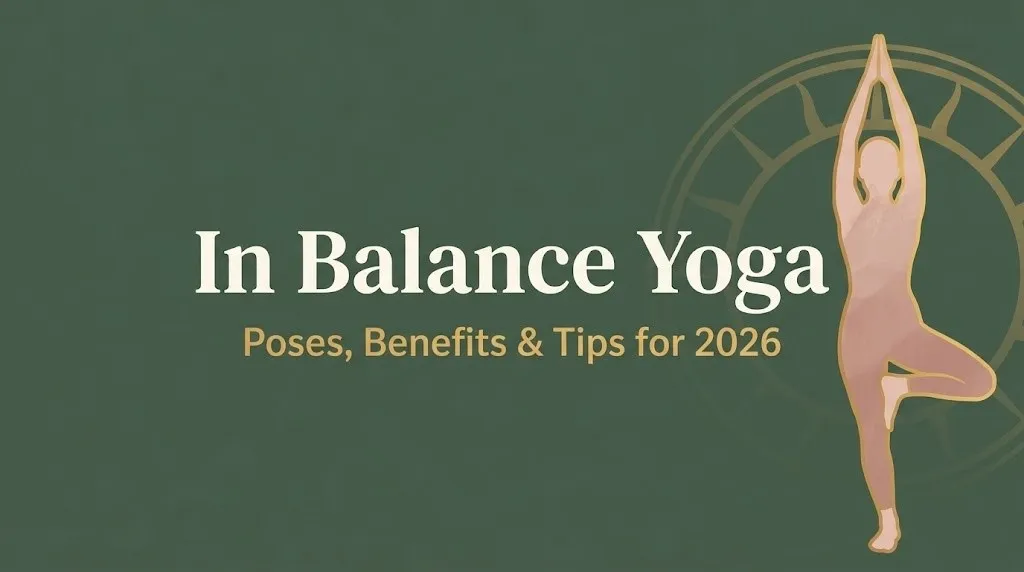
In Balance Yoga: Poses, Benefits & Tips for 2026
In balance yoga is a practice approach that uses specific poses, breath techniques, and focused attention to build the physical and neurological skills that keep you steady on your feet. Whether you are exploring it at a local studio like the one in Blacksburg, Virginia or building a home practice, the research behind balance-focused yoga is genuinely worth your attention.
The stakes are higher than most people realize. The Centers for Disease Control and Prevention reports that falls are the leading cause of injury-related death among adults 65 and older, and that one in four adults over 65 falls each year. Yoga’s emphasis on single-leg stability, coordinated movement, and proprioceptive training directly addresses the physical contributors to fall risk.
This guide covers what in balance yoga actually involves, which styles and poses are most effective, what the research says about balance training outcomes, how to modify practice for seniors and people with joint concerns, and how to build a functional home balance sequence starting today.
In Balance Yoga
In balance yoga refers to any yoga practice specifically structured to develop physical balance, postural stability, and the neuromuscular coordination that keeps the body upright during both static positions and dynamic movement. It is both a descriptive term for a type of practice and the name of at least one well-regarded studio in Virginia.
The practice is not a single yoga style. It draws from Hatha, Iyengar, and Vinyasa traditions depending on the studio or teacher, combining standing balance poses with core strengthening work and deliberate breathwork. What unifies these approaches is the intentional focus on stability as the primary training goal rather than flexibility or cardiorespiratory fitness.
Balance in yoga is trained through two overlapping methods. The first is static balance, holding a single-leg pose like Vrksasana (Tree Pose) for multiple breath cycles while the body makes continuous micro-adjustments to stay upright. The second is dynamic balance, moving through a sequence like a slow Vinyasa flow where the body shifts weight and transitions between shapes without losing postural control.
- What sets in balance yoga apart from general yoga:
- Primary training goal is stability and postural control, not flexibility alone
- Poses are selected and sequenced specifically to challenge the ankle, hip, and core stabilizers
- Breathwork and focused gaze (drishti) are used to enhance proprioceptive awareness
- Classes typically include both static holds and slow controlled movement transitions
- Modifications are built in from the start, making the practice accessible across fitness levels
Yoga Blacksburg
Yoga in Blacksburg, Virginia serves a community shaped by Virginia Tech’s presence, a health-conscious faculty and student population, and a strong surrounding outdoor recreation culture. Studios in Blacksburg, including those offering in balance yoga programs, tend to draw practitioners ranging from college-age athletes to retired adults managing age-related physical changes.
The Blacksburg yoga community benefits from being in a university town where awareness of evidence-based health practices tends to be higher than in similarly sized cities. Teachers in this area frequently bring advanced certifications, including Yoga Alliance RYT-500 credentials, therapeutic yoga training, or backgrounds in kinesiology and physical therapy that inform how they approach balance-specific sequencing.
The American College of Sports Medicine identifies yoga as a meaningful component of an older adult’s exercise program, specifically for improvements in balance, flexibility, and fall risk reduction. Studios in Blacksburg that align their programming with this evidence base offer something more substantial than a general fitness class.
For newcomers to yoga in Blacksburg, the practical advice is straightforward. Look for a studio that explicitly describes a beginner or therapeutic focus in its class descriptions, lists instructor credentials publicly, and caps class sizes at 15 or fewer students. Small class sizes matter most in balance-focused practice, where individual alignment feedback prevents the compensatory patterns that reinforce instability rather than correct it.
Pose Tip:
- Ask any Blacksburg studio whether their instructors have specific training in balance or therapeutic yoga before enrolling.
- Confirm that the studio provides props including blocks, straps, and chairs, all of which are standard tools in balance-focused yoga.
- If you have a vestibular condition or recent orthopedic history, mention it before your first class so the instructor can plan specific adjustments.
What Does Balance Mean in Yoga Practice
Balance in yoga refers to the body’s ability to maintain a controlled, stable position during both stillness and movement, drawing on input from three body systems simultaneously: the visual system, the vestibular system in the inner ear, and the proprioceptive system in the muscles, tendons, and joints. All three must communicate clearly for the body to stay upright without effort.
Most people think of balance as a leg or core strength issue. It is those things, but it is also a neurological skill. The cerebellum, the brain region responsible for coordinating movement, continuously processes incoming data from the eyes, inner ear, and body sensors. Yoga trains the cerebellum to process this information more efficiently by repeatedly placing the body in positions where that coordination is required and then gradually withdrawn. When you close your eyes in Tadasana (Mountain Pose), for example, you remove visual input and force the other two systems to carry more of the load.
This is exactly why balance improves with consistent yoga practice. Research published in the Journal of Alternative and Complementary Medicine found that adults who practiced yoga for eight weeks showed measurable improvements in functional balance assessments compared to control groups. The improvement came not just from stronger legs but from better neuromuscular communication throughout the whole postural system.
| Balance System | Role in Stability | How Yoga Trains It |
|---|---|---|
| Visual system | Horizon reference, spatial orientation | Drishti (fixed gaze point) practice |
| Vestibular system | Inner ear detects head position and movement | Slow transitions, head position changes |
| Proprioceptive system | Joint and muscle position sensing | Single-leg poses, uneven weight shifts |
| Cerebellum | Coordinates all three inputs | Repeated balance challenge and correction |
Key Takeaway: Balance is a neurological skill, not just a strength issue. Yoga trains all three systems (vision, inner ear, and body sensors) simultaneously, which is why consistent practice produces real measurable improvement in postural control.
Yoga for Balance and Stability
Yoga improves balance and stability by strengthening the specific muscle groups responsible for postural control while simultaneously training the nervous system to coordinate those muscles more efficiently during movement and stillness. Strength and neural coordination together produce stable movement. Either alone is insufficient.
The muscles most directly responsible for standing balance are not the large movers most people train in a gym. Gluteus medius, the hip stabilizer on the outer hip, is the primary controller of lateral stability during single-leg weight bearing. The peroneal muscles along the outer ankle and the tibialis anterior along the shin manage ankle-level stability. The transversus abdominis, the deepest layer of core muscle, acts as a corset that stabilizes the lumbar spine throughout every standing balance pose.
Think of these muscles like the guy wires on a tent pole. The central pole, your skeleton, stays upright not because of its own rigidity but because the wires around it maintain even tension in all directions. When one wire is slack, the pole wobbles. Yoga specifically challenges and strengthens each of these stabilizing “wires” through single-leg poses, slow weight shifts, and positions that require constant micro-adjustment.
The National Center for Complementary and Integrative Health (NCCIH) identifies yoga among the evidence-supported practices for improving physical function and reducing fall risk in adults, particularly those over 60.
Modification note: Practitioners with hypermobility in the ankles or hips may find single-leg poses feel unstable despite good strength. Practicing near a wall and engaging the muscles more firmly, rather than locking joints, produces better stability outcomes for hypermobile practitioners.
Best Yoga Style for Balance Training
Iyengar yoga is the most effective yoga style for developing balance because it uses props, precise alignment cues, and extended hold times to train the postural system with exceptional specificity. It is the style most frequently recommended by physical therapists for patients rebuilding balance after injury or neurological events.
Hatha yoga is the most accessible starting point for balance training. Its slower pace allows beginners to find alignment in each pose before moving on. Holds of three to five breath cycles per pose give the neuromuscular system enough time to respond and adapt. Most in balance yoga programs at community studios use a Hatha framework as their foundation.
Vinyasa yoga offers dynamic balance training by requiring the body to transition between poses with control and coordination. The challenge is that the pace of a standard Vinyasa class moves too quickly for a beginner to maintain safe alignment in balance-demanding poses. A slow or mindful Vinyasa format, sometimes called “slow flow,” bridges this gap effectively.
| Yoga Style | Balance Training Quality | Best For | Pace |
|---|---|---|---|
| Iyengar | Very high, precision-focused | Injury rehab, serious alignment work | Slow, held |
| Hatha | High, accessible | Beginners, seniors, all ages | Slow to moderate |
| Slow Vinyasa | High, dynamic | Intermediate practitioners | Moderate |
| Restorative | Low direct balance training | Recovery, nervous system reset | Passive |
| Chair Yoga | Moderate, supported | Limited mobility, fall risk | Slow, safe |
Yin yoga, though valuable for connective tissue release, does not directly train balance. Its floor-based passive approach serves a different purpose. Pairing two to three Hatha or Iyengar sessions with one Yin or Restorative session weekly creates a well-rounded weekly practice that addresses both active balance training and tissue recovery.
Hatha Yoga for Balance
Hatha yoga is a foundational practice style that develops balance through slow, individually held poses paired with deliberate breath awareness and attentive body positioning. It is the style most practiced at community balance-focused studios, including those in the Blacksburg area.
In a Hatha balance class, poses are introduced one at a time with careful alignment instruction before the practitioner moves on. This sequencing approach matters for balance training specifically because the neuromuscular system learns stability patterns through repetition and attention, not speed. A practitioner who holds Vrksasana (Tree Pose) with full attention for five breath cycles trains the stabilizing system more effectively than one who passes through the same pose in a flowing sequence.
Breath use in Hatha balance practice goes beyond relaxation. Coordinating breath with postural effort, specifically exhaling as you press firmly through the standing foot, engages the core stabilizers reflexively. This automatic core engagement is one of the reasons Hatha yoga produces balance improvements that transfer to daily life activities like walking on uneven ground or stepping off a curb.
A 2016 study published in the International Journal of Yoga found that a 12-week Hatha yoga intervention produced statistically meaningful improvements in static and dynamic balance measures in healthy older adults compared to a non-exercise control group.
Modification for beginners: In any Hatha balance pose, a hand resting lightly on a wall or the back of a chair provides enough external stability reference to allow the neuromuscular system to build the internal stability patterns that will eventually make the support unnecessary. Remove the support gradually, one finger at a time, as your confidence builds.
Key Takeaway: Hatha yoga is the best starting style for balance training because its slow pace and individual pose holds give the nervous system enough time to actually learn the stability patterns that carry over into daily movement.
Best Yoga Poses for Balance
The best yoga poses for building balance are those that challenge single-leg weight bearing, require coordinated hip and ankle stabilization, and can be safely modified for a wide range of bodies. These poses work the body’s stabilizing system directly rather than indirectly.
Vrksasana (Tree Pose) is the most commonly taught balance pose for good reason. It isolates the standing leg’s stabilizers, specifically the gluteus medius, peroneal muscles, and deep ankle stabilizers, while the arms and raised leg create a counterbalancing shape. The key instruction most beginners miss: the raised foot should rest either above or below the inner knee, never directly against the knee joint itself, to avoid lateral pressure on that joint.
Virabhadrasana III (Warrior III) is a more advanced single-leg balance that adds a forward hip fold to the challenge. The entire posterior chain, hamstrings, glutes, and erector spinae, engages to support the lifted leg while the standing leg’s stabilizers manage the ground contact. This pose transfers directly to activities like climbing stairs, picking up objects from the floor, and walking on inclines.
Garudasana (Eagle Pose) trains balance differently by crossing the limbs, which slightly narrows the base of support and requires the ankle stabilizers to work harder than in a wider-stance pose. The cross-body wrap also creates a mild compression and release through the hip and shoulder girdle that many practitioners find helps release held tension in those joints.
- Core balance poses with Sanskrit and English names:
- Vrksasana: Tree Pose, single-leg hip and ankle stability
- Virabhadrasana III: Warrior III, full posterior chain balance
- Garudasana: Eagle Pose, narrow-base ankle and hip stability
- Ardha Chandrasana: Half Moon Pose, lateral balance and hip opening
- Utkatasana: Chair Pose, bilateral leg strength and postural endurance
- Utthita Hasta Padangusthasana: Extended Hand-to-Big-Toe Pose, advanced single-leg stability
Standing Balance Poses in Yoga
Standing balance poses in yoga are poses performed on one or both legs where maintaining an upright or stable position requires active engagement of the ankle, hip, and core stabilizing muscles throughout the hold. They form the core of any in balance yoga practice.
Ardha Chandrasana (Half Moon Pose) is one of the most demanding standing balance poses in a beginner-to-intermediate practice. The body extends sideways with one hand on the floor or a block, one leg lifted parallel to the ground, and both hips stacked. The demand on the standing hip’s stabilizers, particularly the gluteus medius, is substantially greater than in forward-facing balance poses. It also trains spatial awareness in a lateral plane of motion that most daily activities do not.
Utkatasana (Chair Pose) is technically a bilateral balance pose, both feet remain on the floor, but it is highly effective for developing the quadriceps and ankle endurance that underpin single-leg balance. Think of it as prerequisite training. Practitioners who cannot sustain Chair Pose for five breath cycles are often not yet ready for the single-leg demands of Warrior III or Half Moon.
Safety note for all standing balance poses: Never lock the standing knee. A micro-bend of three to five degrees keeps the joint protected and actually activates the surrounding musculature more effectively than a locked position, which transfers load to the ligaments rather than the muscles.
Pose Tip:
- In Ardha Chandrasana, use a block under the lower hand to bring the floor closer rather than rounding the spine to reach the ground.
- In Garudasana, if the legs cannot fully wrap, cross the thighs and press the top knee down into the bottom knee for the same hip stabilizer engagement.
- In Utkatasana, keep the weight in the heels and the shins as vertical as possible to protect the knees.
Key Takeaway: Standing balance poses do not require perfect form from day one. Using a block, a wall, or a chair for support while you build the underlying strength is not a shortcut. It is the correct way to train the stabilizing muscles without injury.
Yoga Balance Sequence for Beginners
A yoga balance sequence for beginners is a structured series of poses practiced in a specific order to progressively challenge the body’s stabilizing systems, starting with lower-intensity bilateral poses and moving toward single-leg challenges as the body warms up and prepares.
The sequence below uses poses named in both Sanskrit and English, progresses from grounded to standing to single-leg challenges, and includes built-in options for practitioners who need additional support.
To practice a beginner balance sequence:
- Begin in Tadasana (Mountain Pose): Stand with feet hip-width apart. Press all four corners of each foot into the floor. Breathe here for 5 full cycles.
- Move to Utkatasana (Chair Pose): Bend the knees, shift the hips back as if sitting onto a chair. Hold for 4 breath cycles. Rise back to standing.
- Practice Vrksasana (Tree Pose) on the right leg: Place the left foot above or below the right inner knee. Fix your gaze on a still point at eye level. Hold for 5 breaths. Switch sides.
- Transition to Virabhadrasana II (Warrior II): Step one foot back 3 to 4 feet. Bend the front knee over the ankle. Hold for 4 breaths each side.
- Try Virabhadrasana III (Warrior III) with support: From standing, hinge forward at the hip and lift one leg back. Use a chair or wall for balance support. Hold for 3 breaths each side.
- Finish in Tadasana (Mountain Pose): Return to standing. Close the eyes. Notice the legs, ankles, and feet. Breathe for 5 cycles before moving to a seated cool-down.
Modification: Practitioners new to single-leg balance can keep the toes of the raised foot lightly touching the floor throughout Vrksasana and Warrior III rather than fully lifting the foot. This reduces the stability demand while preserving all the alignment and muscle engagement of the full pose.
How Long Should You Hold Balance Poses in Yoga
Most yoga teachers and movement researchers recommend holding balance poses for 3 to 5 breath cycles for beginners, which translates to roughly 15 to 30 seconds per side depending on breathing pace. This duration is long enough to challenge the stabilizing system without exceeding the neuromuscular fatigue threshold that causes compensatory wobbling.
Longer holds, from 45 seconds to 2 minutes, are appropriate for intermediate and advanced practitioners and are specifically used in Iyengar yoga and therapeutic yoga contexts where the goal is deep neuromuscular re-education. These extended holds require significantly more focused attention and are not appropriate for beginners who have not yet built the foundational muscular endurance.
The right hold time also depends on why you are practicing. If your goal is fall prevention and functional daily balance, shorter holds performed with complete attention and full muscular engagement are more effective than long holds performed sloppily. The quality of the neuromuscular effort matters more than the duration.
| Practitioner Level | Recommended Hold Time | Purpose |
|---|---|---|
| Complete beginner | 3 breaths, roughly 15 seconds | Build awareness, initial muscle recruitment |
| Beginner, 4 to 8 weeks in | 5 breaths, roughly 25 to 30 seconds | Develop sustained stability |
| Intermediate | 30 to 60 seconds | Deeper neuromuscular training |
| Advanced or Iyengar | 60 to 120 seconds | Re-education, therapeutic depth |
| Seniors, supported holds | 10 to 20 seconds with support | Safety-first balance development |
Yoga for Fall Prevention
Yoga is one of the most evidence-supported non-pharmacological interventions for reducing fall risk in adults over 60, with multiple randomized controlled trials showing meaningful reductions in both fall frequency and fear of falling following structured yoga programs. The mechanisms are specific and well-documented.
The Centers for Disease Control and Prevention reports that approximately 36 million falls occur among older adults in the United States each year, resulting in more than 32,000 deaths and millions of emergency department visits. Balance-training interventions, including yoga, are consistently identified by the CDC’s STEADI (Stopping Elderly Accidents, Deaths, and Injuries) initiative as effective fall prevention strategies.
Yoga addresses fall risk through four distinct pathways. First, it strengthens the hip abductors and ankle stabilizers that prevent lateral sways during walking. Second, it improves reaction time in the postural muscles, the speed with which the body corrects an unexpected shift in balance. Third, it reduces fear of falling, which independently predicts future falls by causing older adults to restrict movement in ways that further weaken balance. Fourth, it trains the coordination between the visual, vestibular, and proprioceptive systems.
A study published in Age and Ageing found that older adults who participated in a yoga program twice weekly for 12 weeks showed a 48% reduction in reported falls compared to a control group. These were not highly trained athletes. They were community-dwelling older adults with no prior yoga experience.
- Yoga practices with the strongest fall prevention evidence:
- Chair yoga: supported standing and seated balance work, appropriate for high fall-risk individuals
- Gentle Hatha with balance focus: standing poses with wall or chair support as needed
- Iyengar yoga: precision alignment work that directly trains the stabilizers most involved in preventing falls
- Tai Chi-influenced slow flow: emphasizes weight shifting and dynamic balance
Key Takeaway: Yoga is not just a nice complement to fall prevention programs. It is one of the most studied and most effective non-pharmacological strategies for reducing both the physical risk of falling and the fear of falling that compounds that risk.
Yoga for Seniors Balance
Yoga for seniors specifically targeting balance requires a modified approach that accounts for reduced bone density, slower neural response times, changes in joint mobility, and the higher consequences of a fall compared to younger practitioners. The goal is effective balance training within a safety-first framework.
Chair yoga is the most appropriate starting point for seniors who have any of the following: recent fall history, hip or knee replacement, significant balance impairment, or low confidence about standing on one leg. In chair yoga, the chair provides a stable external reference that allows the body to train the stabilizing muscles without the fall risk of unsupported single-leg poses. Over weeks of practice, many seniors can progress from fully supported to partially supported to independent balance poses.
For seniors who are mobile and physically active but want to specifically address age-related balance decline, a standard gentle Hatha class with balance emphasis is appropriate, provided the instructor is informed of any orthopedic history and props are available throughout. The wall is the most underused prop in senior yoga. Using the wall for every standing balance pose in the first four to six weeks of practice is smart, not a sign of limitation.
According to a review published in Complementary Therapies in Medicine, yoga interventions lasting 8 to 24 weeks consistently improved balance scores in adults over 60 across multiple standardized assessment tools, including the Berg Balance Scale and the Timed Up and Go test.
| Senior Yoga Format | Fall Risk Level | Benefits | Equipment Needed |
|---|---|---|---|
| Chair yoga | High to moderate | Core stability, hip strength, confidence | Sturdy chair |
| Gentle Hatha with wall | Moderate | Standing balance, ankle strength | Wall, mat, blocks |
| Iyengar with props | Low to moderate | Precision alignment, deep stability | Blocks, straps, wall |
| Restorative | Any level | Recovery, sleep, nervous system | Bolster, blanket |
Yoga for Proprioception and Coordination
Yoga trains proprioception, the body’s internal sense of where it is in space, by repeatedly placing the body in positions that require accurate joint position sensing and then gradually reducing external supports so the nervous system must rely increasingly on its own signals. This is not a metaphor. It is a specific training mechanism.
Proprioceptors are sensory receptors embedded in muscles, tendons, and joint capsules throughout the body. They send continuous signals to the cerebellum about joint angle, muscle length, and tension. When you stand on one leg, the proprioceptors in your ankle, knee, and hip are firing constantly, and the cerebellum is using that information to make tiny adjustments that keep you upright.
Yoga improves this system because it consistently creates proprioceptive challenges: uneven weight distributions, slow transitions between positions, closed-eye variations of standing poses, and poses that require the body to sense alignment without visual feedback. Each of these challenges trains the proprioceptive-cerebellar loop to respond faster and more accurately.
Coordination is proprioception expressed in movement. A practitioner who can move from Virabhadrasana II (Warrior II) to Ardha Chandrasana (Half Moon Pose) with control demonstrates that their proprioceptive system and motor output are working in close communication. This kind of coordinated movement transfers directly to real-world physical tasks: catching yourself before a stumble, stepping over an obstacle, or adjusting on an uneven surface.
- How yoga specifically trains proprioception:
- Single-leg poses: high proprioceptive demand at the ankle and hip
- Slow transitions: requires precise joint position sensing throughout movement
- Eyes-closed variations: removes visual input, forces proprioceptive reliance
- Uneven surface practice (folded blanket): increases ankle proprioceptor activation
- Long holds with small alignment adjustments: refines the feedback loop over time
Yoga for Ankle and Knee Stability
Yoga builds ankle and knee stability by strengthening the specific muscles that control joint position during weight-bearing movement and by training the nervous system to activate those muscles quickly when the joint is challenged. Both effects together produce the stability that prevents sprains, strains, and falls.
The ankle is the first line of defense against balance loss. The peroneal muscles along the outer lower leg are the primary ankle evertors, the muscles that resist the inward roll that causes lateral ankle sprains. Yoga’s single-leg standing poses place consistent demand on these muscles in a weight-bearing position, which is the most effective context for building functional stability strength.
The knee does not have the same muscular architecture as the ankle. It relies heavily on the quadriceps and hamstrings for frontal stability and on the hip abductors, specifically the gluteus medius, for lateral stability. When the gluteus medius is weak, the knee tends to collapse inward during single-leg weight bearing, a pattern that increases ACL stress and patellar tracking problems. Yoga poses like Utkatasana (Chair Pose), Virabhadrasana II (Warrior II), and Vrksasana (Tree Pose) directly train the gluteus medius in the position most relevant to injury prevention.
Safety note for anyone with recent ankle sprain or knee surgery: Practice all single-leg balance poses within a pain-free range, and work with a physical therapist alongside your yoga practice to ensure the loading demands are appropriate for your specific healing timeline. A yoga teacher, even a skilled one, is not a substitute for physical therapy guidance during active rehabilitation.
- Yoga poses most effective for ankle and knee stability:
- Vrksasana (Tree Pose): peroneal muscle and ankle stabilizer activation
- Utkatasana (Chair Pose): quadriceps and gluteus medius endurance
- Virabhadrasana II (Warrior II): gluteus medius and lateral hip stabilization
- Virabhadrasana III (Warrior III): full posterior chain and ankle proprioception
- Garudasana (Eagle Pose): peroneal muscles under narrow-base challenge
Key Takeaway: The ankle and hip stabilizers are the two most important muscle groups for fall prevention and injury protection. Yoga trains them together in the context of real weight-bearing movement, which is exactly how they need to be trained.
Home Yoga Practice for Balance
A home yoga practice for balance is a structured personal routine that trains the stabilizing muscles and proprioceptive system without requiring a studio, equipment beyond a mat, or a large dedicated space. Most effective home balance practices run 20 to 35 minutes, three times per week.
The single biggest mistake beginners make in home balance practice is skipping the setup. You need a clear wall within arm’s reach, a sturdy chair for supported poses, and ideally two yoga blocks. These three items cost under $40 combined and transform a potentially risky solo balance session into a safe, progressive training environment.
Start every home balance session with two to three minutes in Tadasana (Mountain Pose) with eyes closed. This baseline assessment tells you where your balance is that day, because proprioceptive capacity varies with fatigue, hydration, and sleep quality. If you feel significantly wobbly with eyes closed, treat that as a signal to stay closer to the wall throughout your session.
The most effective home balance practice structure is three days on with at least one day between sessions. Balance training, like strength training, requires recovery time for the neuromuscular adaptations to consolidate. Practicing every day without variation produces diminishing returns and increases the risk of overuse in the ankle stabilizers.
Research suggests that home-based yoga programs produce comparable balance improvements to studio-based programs when practitioners follow a structured sequence consistently for at least eight weeks. The consistency matters more than the location.
- Recommended home balance practice routine (25 minutes):
- 3 minutes: Tadasana (Mountain Pose), eyes open then closed
- 4 minutes: Utkatasana (Chair Pose), three sets of 5 breath holds
- 6 minutes: Vrksasana (Tree Pose), both sides with wall support available
- 5 minutes: Virabhadrasana II and III (Warrior II and III), both sides
- 4 minutes: Garudasana (Eagle Pose), both sides
- 3 minutes: Savasana (Corpse Pose), lying flat for neuromuscular integration
Modification for home practice: Practitioners with a known high fall risk should always practice within arm’s reach of the wall and begin every new pose with at least one hand on the wall before attempting the unsupported version.
Frequently Asked Questions About In Balance Yoga
What is in balance yoga and is it good for beginners?
In balance yoga is a balance-focused yoga practice that uses specific poses, breath techniques, and neuromuscular training to improve physical stability and coordination.
It is well-suited to beginners because most programs and studios offer chair support, wall support, and modified poses that make single-leg balance work accessible from the very first class.
The key is starting with a specifically beginner-labeled class rather than a general “all-levels” session, where the pace may move faster than a new practitioner can safely follow.
What yoga poses are best for improving balance?
The most effective yoga poses for balance are Vrksasana (Tree Pose), Virabhadrasana III (Warrior III), Ardha Chandrasana (Half Moon Pose), Garudasana (Eagle Pose), and Utkatasana (Chair Pose).
These poses directly train the ankle stabilizers, hip abductors, and core muscles that control posture during single-leg weight bearing.
Beginners should start with supported versions of each pose, using a wall or chair, before progressing to unsupported holds.
Can yoga help prevent falls in older adults?
Yes, yoga is one of the most evidence-supported interventions for reducing fall risk in older adults.
A study published in Age and Ageing found a 48% reduction in reported falls among older adults who practiced yoga twice weekly for 12 weeks compared to a control group.
Chair yoga and gentle Hatha with balance emphasis are the most appropriate starting points for adults with any fall history or high fall risk.
How long should you hold a balance pose in yoga?
Beginners should hold balance poses for 3 to 5 breath cycles, which is roughly 15 to 30 seconds per side.
Intermediate practitioners can extend holds to 30 to 60 seconds, and Iyengar yoga practitioners may hold balance poses for up to 2 minutes for deeper neuromuscular training.
Quality of muscular engagement during the hold matters more than duration, especially when you are starting out.
How often should I practice balance yoga to see results?
Two to three sessions per week is the recommended minimum for meaningful balance improvement.
Research cited by the National Center for Complementary and Integrative Health and multiple yoga intervention studies consistently shows that programs of eight weeks or longer at two to three sessions weekly produce the most reliable improvements in balance and fall risk.
Spacing sessions across the week rather than clustering them allows the nervous system adequate recovery time to consolidate the coordination gains.
Build Your Balance, One Pose at a Time
The research is clear, and the practical path is straightforward. Start with two sessions per week, use a wall or chair for every single-leg pose in your first four to six weeks, and give yourself at least eight weeks before evaluating your progress.
Try Vrksasana (Tree Pose) today. Stand near a wall, rest one hand lightly on it, and bring your raised foot just below the knee. Fix your gaze on a still point. Breathe five times. Switch sides. That is your starting point.
Consistency over intensity, always. Twenty-five minutes of focused balance practice three times a week will produce more real-world stability improvement than occasional hour-long sessions performed with poor form and no support.