Franklin Street Yoga: Styles, Classes, and Tips 2026
Franklin Street yoga studios offer classes across a wide range of styles, from slow beginner-friendly Hatha yoga to dynamic Vinyasa flows and deeply restorative floor practices, making them accessible for students at every level of experience and physical ability. Whether you are walking in for the first time or returning to the mat after years away, understanding how these classes work before you arrive makes the entire experience significantly better.
Yoga is not a niche activity anymore. The National Center for Complementary and Integrative Health (NCCIH), part of the NIH, estimates that over 21 million American adults practice yoga, with research consistently documenting benefits for flexibility, chronic pain, stress, and mental health.
This guide covers what to expect from a Franklin Street yoga studio, how to choose the right class style for your body, what the research actually says about yoga’s effects, and everything you need to show up prepared. No experience required to read it.
Franklin Street Yoga
Franklin Street yoga refers to yoga studios and classes located on or near Franklin Street addresses, offering structured group instruction in multiple yoga styles for students ranging from complete beginners to advanced practitioners.
Franklin Street addresses appear in several cities, including Chapel Hill, NC, Chicago, IL, and San Francisco, CA. In each market, studios on or near Franklin Street tend to attract a community-minded, locally rooted student base that values small class sizes and personalized instruction over large gym-style yoga environments.
What consistently sets dedicated yoga studios apart from gym yoga classes is the depth of instruction. A studio environment allows teachers to offer detailed alignment cues, hands-on adjustments where consented, and modifications tailored to individual students. That difference becomes especially apparent in your first few classes.
What makes a yoga studio on Franklin Street worth choosing:
- Smaller class sizes: Typically 8 to 18 students, compared to 30-plus in gym yoga settings.
- Yoga Alliance registered teachers: Credentialed instructors with a minimum of 200 hours of formal yoga training.
- Multi-style scheduling: Most studios run Hatha, Vinyasa, and Restorative options across the week.
- Prop availability: Blocks, straps, bolsters, and blankets provided at no extra cost.
- Intro pricing: New student packages that let you try multiple classes before committing to a membership.
Before booking, ask about the teacher’s background and which class is most appropriate for your current physical condition. Any quality studio will answer that question directly and without judgment.
Franklin Street Yoga Center Classes
A Franklin Street yoga center typically offers a rotating weekly schedule of classes across multiple yoga styles, plus occasional workshops, teacher training programs, and specialty series for specific populations.
Understanding what a studio’s class menu actually contains prevents the most common beginner mistake: booking a class that is wrong for your body and concluding yoga is not for you. Class names alone (Flow, Restore, Align) do not always communicate pace, physical demand, or experience level.
Standard class formats offered at yoga centers near Franklin Street include:
| Class Name | Style | Pace | Best For |
|---|---|---|---|
| Beginner Yoga | Hatha | Slow | First-timers, all bodies |
| Morning Flow | Vinyasa | Moderate to fast | Active practitioners |
| Deep Stretch | Yin | Very slow, long holds | Hip and fascia mobility |
| Restorative Yoga | Restorative | Still, prop-supported | Stress, illness, injury recovery |
| Chair Yoga | Adapted Hatha | Slow | Seniors, limited mobility |
| Prenatal Yoga | Prenatal-adapted | Slow to moderate | Pregnant practitioners |
| Power Yoga | Ashtanga-inspired | Fast, demanding | Experienced practitioners |
| Gentle Yoga | Gentle Hatha | Slow | Chronic pain, older adults |
Most studios also offer introductory workshops specifically designed to teach the foundational poses and studio etiquette before a student enters a mixed-level class. If that option is available, take it. Three hours of foundational training accelerates your learning curve more than six random drop-in classes.
Pose Tip:
- Always read the full class description, not just the title.
- If the description does not tell you the pace or experience level required, call the studio and ask directly.
- “All levels” does not always mean beginner-appropriate. Clarify before you book.
Yoga Styles at a Franklin Street Yoga Studio
The yoga styles offered at a Franklin Street yoga studio vary in pace, physical demand, and intended outcome, and choosing the correct style for your body is more important than choosing the correct studio.
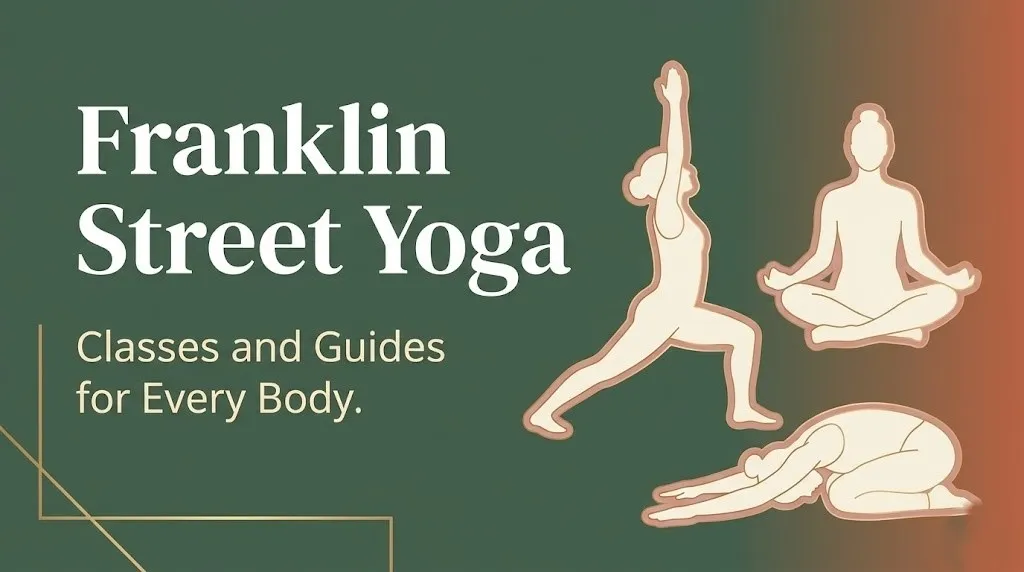
Think of yoga styles the way you would think of exercise types. Running, swimming, and weightlifting all improve physical fitness, but they work differently and suit different bodies and goals. The same logic applies to yoga. Hatha, Vinyasa, Yin, Restorative, and Ashtanga are not interchangeable. Each has a distinct purpose.
Hatha yoga is the foundational style from which most Western yoga formats derive. It focuses on individual poses held with attention to alignment, breath, and body awareness. Sessions are slower and more instructional than Vinyasa classes. Most beginner yoga programs use a Hatha framework.
Vinyasa yoga links poses through breath-driven movement transitions. The pace is faster. A Vinyasa class builds heat and cardiovascular endurance alongside flexibility and strength. It requires more body awareness than Hatha and is best approached after a few beginner sessions.
Yin yoga holds floor poses for 3 to 5 minutes each, targeting the connective tissue, fascia, and joints rather than the muscles. It is slow and meditative but can feel intense. Think of it as the opposite of the tension-and-release patterns of active yoga.
| Style | Typical Class Duration | Props Used | Primary Goal |
|---|---|---|---|
| Hatha | 60 to 75 minutes | Blocks, straps | Alignment, fundamentals |
| Vinyasa | 60 minutes | Mat only, sometimes blocks | Strength, flow, cardiovascular |
| Yin | 60 to 90 minutes | Bolsters, blocks, blankets | Fascia, joints, deep release |
| Restorative | 75 to 90 minutes | Bolsters, blankets, straps | Nervous system, passive rest |
| Ashtanga | 90 minutes | Mat only | Strength, stamina, set sequence |
Restorative yoga is in a category of its own. Unlike active styles, Restorative practice requires no muscular effort. The body is completely supported by props, and poses are held for 5 to 10 minutes each. It is the most effective style for stress recovery, illness, and early-stage injury rehabilitation.
Key Takeaway: The style of yoga you choose matters more than where you practice, and beginners should always start with Hatha or Gentle yoga rather than Vinyasa, regardless of their general fitness level.
Beginner Yoga Classes Near Franklin Street
Beginner yoga classes near Franklin Street are best approached through a dedicated beginner series or a clearly labeled Hatha or Gentle yoga class, not a mixed-level drop-in class that may assume prior experience.
A beginner yoga class is not the same as an “all levels” class. All-levels classes are designed to offer variations for multiple experience levels within a single session. They can work for beginners, but they move faster than a true beginner class and rely on the student already knowing basic pose names and transitions.
A dedicated beginner series, offered over 4 to 8 consecutive weeks, is the most effective entry point. These programs teach foundational poses in a progressive sequence, build vocabulary, and allow students to ask questions freely without slowing down an established class.
What a good beginner yoga program covers:
- Week 1 to 2: Standing poses, Tadasana (Mountain Pose), Virabhadrasana I (Warrior I), basic breath awareness.
- Week 2 to 3: Floor poses, Balasana (Child’s Pose), Setu Bandha Sarvangasana (Bridge Pose), Marjaryasana-Bitilasana (Cat-Cow Pose).
- Week 3 to 4: Balance poses, Vrksasana (Tree Pose) with wall support, seated twists.
- Week 4 to 6: Linking poses through breath, introduction to Adho Mukha Svanasana (Downward-Facing Dog), simple Vinyasa transitions.
- Week 6 to 8: Building sequences, pranayama basics, preparation for mixed-level class participation.
Modification for complete beginners with limited flexibility: In Warrior I, shorten your stance by 6 to 8 inches from the full expression. This keeps the pelvis more level and reduces excessive strain through the hip flexors of the back leg while you are still learning the alignment.
According to Yoga Alliance, beginners represent the fastest-growing segment of new yoga practitioners in the United States. Local studios near Franklin Street have responded to this trend by expanding beginner offerings, introductory workshops, and new-student pricing structures.
What to Expect at Your First Yoga Class
At your first yoga class, you can expect a teacher-led sequence of poses with verbal alignment cues, an opening breath-awareness period, an active movement section, and a final rest in Savasana (Corpse Pose) that lasts between 5 and 10 minutes.
Arriving 10 to 15 minutes early matters more on your first visit than any other. That window gives you time to introduce yourself to the instructor, mention any injuries or health conditions, and get settled on your mat without feeling rushed when the class starts.
The instructor will cue every movement verbally. You will not be tested or singled out. Most first-time students spend a good portion of class watching others for visual reference while also listening to the cues. That is completely expected.
Typical structure of a 60-minute yoga class:
| Phase | Duration | What Happens |
|---|---|---|
| Centering | 3 to 5 minutes | Breath awareness, seated or supine |
| Warm-up | 8 to 12 minutes | Cat-Cow, gentle spinal movement |
| Standing sequence | 15 to 20 minutes | Warrior poses, balance work |
| Floor sequence | 10 to 15 minutes | Bridge, twists, forward folds |
| Cool-down | 5 to 8 minutes | Gentle stretching, transition to rest |
| Savasana | 5 to 10 minutes | Complete stillness, no movement |
One thing surprises almost every new student: Savasana can feel harder than the physical poses. Lying completely still, without fidgeting or mentally reviewing your to-do list, is a practice in itself. Do not leave early. The rest period is when the nervous system integrates everything the body just did.
A published finding worth knowing: A study in the Journal of Alternative and Complementary Medicine found that guided relaxation at the end of a yoga session contributed measurably to reductions in perceived stress and physiological markers of tension. Savasana is not optional recovery time. It is part of the practice.
Hatha Yoga for Beginners
Hatha yoga is the most appropriate starting style for beginners because it teaches individual poses with attention to alignment and breath before any attempt is made to link poses in a flowing sequence.
The word “Hatha” is a Sanskrit term that translates roughly to “sun-moon,” representing the balance of opposing forces in the body. In practical terms, a Hatha yoga class at a Franklin Street yoga studio will move at a deliberate pace, hold each pose for 3 to 6 breath cycles, and offer verbal cues that explain where your weight should be, which muscles to engage, and how your breath should feel.
This pace gives beginners time to actually feel what a pose is doing. Contrast that with a Vinyasa class, where the transitions happen on single breaths and a new student has no time to understand the alignment before moving to the next shape.
To practice a foundational Hatha warm-up sequence:
- Begin in Tadasana (Mountain Pose). Stand with feet hip-distance apart. Press all four corners of both feet into the floor. Lengthen through the crown of the head. Inhale for 4 counts, exhale for 4 counts.
- Move into Marjaryasana-Bitilasana (Cat-Cow Pose). Come to hands and knees, wrists under shoulders, knees under hips. Inhale, drop the belly, lift the gaze (Cow). Exhale, round the spine toward the ceiling, drop the chin (Cat). Repeat 6 to 8 times.
- Transition to Adho Mukha Svanasana (Downward-Facing Dog). Press hands firmly into the mat, lift hips up and back. Bend knees generously if hamstrings are tight. Hold for 5 breaths.
- Walk feet toward hands. Rise slowly back to Tadasana. Pause for 3 breaths.
- Repeat the sequence once more before moving into standing poses.
Modification for wrist sensitivity in Downward-Facing Dog: Make fists with both hands and balance on your knuckles instead of open palms. This distributes the weight differently and significantly reduces compression through the wrist joint. Alternatively, drop to forearms for Dolphin Pose, which provides a similar stretch without any wrist load.
Vinyasa Yoga for Active Practitioners
Vinyasa yoga is a breath-synchronized movement practice that links poses in a continuous flowing sequence, building cardiovascular endurance, muscular strength, and coordination simultaneously.
The defining characteristic of Vinyasa yoga is that every transition between poses is driven by either an inhale or an exhale. There is no pause between movements. This creates a rhythm that experienced practitioners describe as meditative through motion, similar in some ways to how distance runners describe a flow state during long runs.
Because Vinyasa moves quickly, it requires body awareness that beginners typically have not yet developed. A student who does not yet know the basic alignment of Warrior I (Virabhadrasana I) will struggle to execute it correctly when it appears mid-sequence between a lunge and a balancing pose. This is why Hatha experience before Vinyasa is a genuine recommendation, not a gatekeeping rule.
What a standard Vinyasa sequence looks like:
- Sun Salutation A (Surya Namaskar A): The foundational flowing sequence. Consists of Mountain Pose, Forward Fold (Uttanasana), Halfway Lift, Plank, Chaturanga Dandasana (Four-Limbed Staff Pose), Upward-Facing Dog (Urdhva Mukha Svanasana), Downward-Facing Dog. Repeated 3 to 5 times as a warm-up.
- Peak pose sequence: Building toward one or two more complex poses like Bakasana (Crow Pose) or Natarajasana (Dancer’s Pose) through progressive preparatory shapes.
- Cool-down: Forward folds, hip openers, supine twists.
- Savasana: 5 to 8 minutes.
Safety caution for beginners in Vinyasa: Chaturanga Dandasana (the low push-up between poses) is among the most commonly executed incorrectly poses in Western yoga. Dropping the hips too low and allowing the elbows to flare outward places significant stress on the rotator cuff and anterior shoulder capsule. Beginners should drop to their knees in every Chaturanga until shoulder and core strength develops enough to maintain a straight spinal line.
Key Takeaway: Hatha yoga builds the body awareness and alignment vocabulary that makes Vinyasa yoga safe and effective; rushing into Vinyasa without Hatha foundations is the most common and most preventable beginner mistake in yoga.
Restorative and Yin Yoga for Recovery
Restorative yoga and Yin yoga are both slow, floor-based practices, but they work through different mechanisms: Restorative yoga uses full prop support to promote passive nervous system recovery, while Yin yoga applies gentle sustained stress to connective tissue and fascia to improve deep joint mobility.
Both styles are offered at most Franklin Street yoga studios and serve populations that active yoga styles do not reach effectively. People managing chronic fatigue, recovering from illness, processing high stress loads, or rehabilitating from injury often find that Restorative or Yin yoga is the most appropriate entry point to a regular practice.
Restorative yoga holds 3 to 5 poses per session, each for 5 to 10 minutes, with the body entirely supported by bolsters, blankets, and blocks. No muscular effort is required. The parasympathetic nervous system is the target. Think of it as the physical equivalent of a deeply restful sleep that you are conscious for.
Yin yoga holds floor poses for 3 to 5 minutes each, but unlike Restorative, you are working at your edge of sensation. The hip flexors, IT band, hamstrings, and deep hip rotators are the primary targets. The sustained duration of each hold creates a mild stress in the connective tissue that, over time, builds flexibility and range of motion in the joints.
| Feature | Restorative Yoga | Yin Yoga |
|---|---|---|
| Props used | Many: bolsters, blankets, blocks, eye pillows | Some: bolsters, blocks |
| Muscular effort | None | Minimal |
| Sensation during holds | Neutral to pleasant | Mild to moderate intensity |
| Primary target | Nervous system | Connective tissue, fascia, joints |
| Hold duration | 5 to 10 minutes per pose | 3 to 5 minutes per pose |
| Best for | Stress, illness, burnout, injury | Hip mobility, flexibility, joint health |
Modification for Yin yoga students with hypermobility: If you are naturally very flexible, the long holds in Yin yoga can actually create instability rather than benefit. Use props to reduce your range in each pose and focus on creating a sensation of light pressure rather than a deep stretch. A yoga teacher or physical therapist familiar with hypermobility can guide this adjustment.
Yoga for Back Pain
Yoga can reduce chronic low back pain intensity and improve functional movement in adults with non-specific lumbar pain, according to multiple peer-reviewed studies and clinical guidelines.
The American College of Sports Medicine (ACSM) includes yoga in its evidence-based recommendations for managing chronic low back pain, alongside physical therapy and aerobic exercise. This recommendation reflects a body of research showing that yoga’s combination of spinal mobility work, core strengthening, and hip flexibility directly addresses the mechanical contributors to lumbar pain.
The lumbar spine bears most of the load during sitting, standing, and lifting. When the surrounding muscles, particularly the glutes, hamstrings, and erector spinae, are weak or restricted, the lumbar vertebrae compensate by absorbing force they are not designed to manage. Yoga targets this imbalance from both directions: strengthening the underactive muscles and lengthening the overactive ones.
Most effective poses for lumbar back pain:
- Setu Bandha Sarvangasana (Bridge Pose): Lie on your back, bend knees, feet flat on the floor hip-distance apart. Press into feet and lift hips. This strengthens glutes and hamstrings directly. Hold 5 to 8 breaths. Lower slowly. Repeat 3 times.
- Marjaryasana-Bitilasana (Cat-Cow Pose): Promotes segmental spinal mobility through gentle flexion and extension. Do 8 to 10 slow cycles as a warm-up for any back pain sequence.
- Supta Matsyendrasana (Supine Spinal Twist): Lie on back, draw right knee to chest, cross it to the left. Arms wide. This rotates the thoracic and lumbar spine gently and releases paraspinal muscle tension. Hold 5 to 8 breaths per side.
- Balasana (Child’s Pose): Passively decompresses the lumbar vertebrae and lengthens the erector spinae. Use a folded blanket between thighs and calves if the knees feel strained.
Safety note: Anyone with a diagnosed disc herniation, spinal stenosis, or spondylolisthesis should let their yoga instructor know before class. Some poses, particularly deep forward folds and certain twists, may need modification depending on the specific condition. A physical therapist who also teaches yoga can provide the most targeted guidance for these cases.
Yoga for Seniors Near Franklin Street
Yoga for seniors near Franklin Street is most safely and effectively practiced through Chair yoga, Gentle yoga, or Restorative yoga, all of which reduce fall risk, improve joint mobility, and build balance without requiring floor-level transitions that may be difficult or unsafe for older adults.
Harvard Health Publishing documents that yoga improves balance, reduces the risk of falls, and alleviates joint stiffness in adults over 65, making it one of the best-matched low-impact movement practices for an aging body. Fall prevention alone makes a compelling case: the Centers for Disease Control and Prevention (CDC) reports that falls are the leading cause of injury-related death in adults 65 and older.
Balance in yoga works the same way it works in everyday life. Standing on one leg in Vrksasana (Tree Pose) trains the same neuromuscular pathways that prevent a stumble on an uneven sidewalk. The difference is that yoga practice builds those pathways intentionally, with a safe mat beneath you and an instructor present.
Chair yoga equivalents for common standing poses:
| Standing Pose | Chair Yoga Equivalent | Primary Benefit |
|---|---|---|
| Virabhadrasana I (Warrior I) | Seated Warrior, arms raised | Hip flexor length, shoulder mobility |
| Vrksasana (Tree Pose) | Seated Tree, foot resting on chair leg | Balance awareness, hip external rotation |
| Uttanasana (Forward Fold) | Seated forward fold, hands to shins | Hamstring and spinal lengthening |
| Utkatasana (Chair Pose) | Seated hip lift using armrests | Glute and quadriceps engagement |
A 2016 systematic review in the International Journal of Yoga found that yoga practice was associated with improved static and dynamic balance in adults over 60, with outcomes comparable to tai chi programs. Seniors who are new to yoga should inform their instructor about any joint replacements, osteoporosis, vertigo, or cardiovascular conditions before the first class.
Key Takeaway: For seniors, fall prevention is one of yoga’s most practically important benefits, Chair yoga and Gentle yoga deliver it without requiring floor transitions, and two sessions per week is enough to produce measurable balance improvements within eight weeks.
Prenatal Yoga Classes
Prenatal yoga is a specifically adapted yoga practice for pregnant individuals that modifies standard poses to accommodate a changing body, support pelvic floor health, reduce common pregnancy discomforts, and prepare the breath and nervous system for labor.
Dedicated prenatal yoga classes are offered at many yoga studios near Franklin Street, and the distinction between a dedicated prenatal class and a modified general class matters enormously. A trained prenatal yoga instructor understands which poses to avoid at each trimester, how to use props to support the pelvis and belly, and how to cue breathing patterns safe for pregnancy. That knowledge cannot be improvised by a general yoga teacher.
Poses commonly avoided during pregnancy include any that require lying flat on the back after the first trimester, due to pressure on the inferior vena cava, which can reduce blood flow to the placenta. Deep abdominal compressions, strong inversions, and closed twists are also contraindicated in most prenatal contexts.
Poses commonly included in prenatal yoga:
- Baddha Konasana (Bound Angle Pose): Seated hip opener. Supports pelvic floor awareness, inner thigh flexibility, and comfort in late pregnancy.
- Virabhadrasana II (Warrior II): Standing pose that builds leg strength and endurance. Modified with a wider stance in the second and third trimesters.
- Balasana (Child’s Pose): Modified with knees wide apart to accommodate the belly. A grounding and calming rest pose.
- Supta Baddha Konasana (Reclined Bound Angle Pose): Supported with a bolster under the spine. Appropriate only in the first trimester when lying flat is still comfortable without vascular compromise.
According to a 2015 review published in the Journal of Alternative and Complementary Medicine, prenatal yoga was associated with reduced perceived pain during labor, lower rates of preterm birth in study populations, and decreased pregnancy-related anxiety compared to standard prenatal care without yoga.
If you are pregnant and considering prenatal yoga, discuss your participation with your obstetrician or midwife, particularly if your pregnancy involves any elevated-risk factors, before your first session.
Yoga Benefits Backed by Research
The physical and mental health benefits of yoga are documented across hundreds of peer-reviewed studies, with the strongest evidence supporting improvements in flexibility, balance, chronic pain management, stress hormone reduction, and psychological wellbeing.
The National Center for Complementary and Integrative Health (NCCIH) has reviewed this body of evidence and concluded that yoga shows promise for managing chronic pain, supporting mental health, and improving overall physical function. These are not fringe claims. They appear in journals including Frontiers in Psychology, the International Journal of Yoga, and Complementary Therapies in Medicine.
Research-documented physical benefits of regular yoga practice:
- Flexibility: Multiple randomized controlled trials show meaningful improvements in hamstring, hip, and spinal flexibility within 8 weeks of consistent practice at two to three sessions per week.
- Core and posterior chain strength: Isometric holding of standing and balancing poses develops endurance in the glutes, erector spinae, and deep abdominals over time.
- Cardiovascular health: Adults who practice yoga three or more times per week show improvements in resting heart rate and blood pressure, per findings in Complementary Therapies in Medicine.
- Bone density: Weight-bearing standing poses contribute to bone density preservation, particularly relevant for postmenopausal women, as noted in Topics in Geriatric Rehabilitation.
Research-documented mental health benefits:
- Reduced cortisol levels (the primary stress hormone) measured after single yoga sessions in multiple controlled studies.
- Improved self-reported anxiety and depression symptoms in practitioners who attend consistently for six weeks or more.
- Better sleep quality in older adults who practice gentle yoga before bed, per a study in the Journal of Clinical Sleep Medicine.
These benefits do not require advanced poses or daily two-hour commitments. The research threshold for meaningful outcomes is generally three to four sessions per week, 45 to 60 minutes each, sustained over six to eight weeks.
Yoga for Stress and Mental Health
Yoga reduces physiological stress by activating the parasympathetic nervous system, the body’s built-in counterbalance to the fight-or-flight response, through the combined mechanism of controlled breathing, intentional physical movement, and guided rest.
When the body is under sustained stress, cortisol levels remain chronically elevated. This pattern is associated with disrupted sleep, increased systemic inflammation, impaired immune function, and worsening of anxiety and depressive symptoms. Yoga’s breathing practices interrupt this cycle at the physiological level.
Frontiers in Psychology published a 2020 study demonstrating that even a single yoga session produced measurable reductions in self-reported anxiety and salivary cortisol in participants with no prior yoga experience. That finding is worth sitting with: one class has a detectable effect on your stress hormones, even on day one.
The breathing technique most commonly cued in yoga classes is Ujjayi pranayama, a slow nasal breath with a soft constriction at the back of the throat that creates a gentle ocean-wave sound. Ujjayi breathing slows respiratory rate, which in turn slows heart rate and shifts the autonomic nervous system toward parasympathetic dominance.
Three stress-management practices you can use outside the studio:
- 4-7-8 breath: Inhale through the nose for 4 counts. Hold for 7. Exhale fully through the mouth for 8 counts. Four rounds lowers heart rate within minutes and can be done anywhere.
- Balasana (Child’s Pose) at home: Kneel on carpet or a folded blanket, sit hips back toward heels, fold forward and rest your forehead on stacked fists or a pillow. Stay for 10 slow breaths. The forward fold position has a grounding, calming effect on the nervous system.
- Viparita Karani (Legs-Up-the-Wall Pose): Lie on your back with legs resting vertically against a wall. Stay for 5 to 10 minutes. This gentle inversion reduces lower-limb swelling and calms the nervous system without requiring any active flexibility.
None of these require a studio visit. All three extend the benefits of a regular practice into daily life between sessions.
Key Takeaway: Yoga’s stress-reduction effects begin with the very first class and work through real physiological mechanisms, including cortisol reduction and parasympathetic activation, not through mindset alone.
What to Bring to Your First Yoga Class
To your first yoga class at a Franklin Street studio, bring a yoga mat, comfortable non-restrictive clothing, water, and bare feet, noting that most studios provide all props at no additional charge.
A standard yoga mat is 68 inches long, 24 inches wide, and between 3 mm and 6 mm thick. Beginners and older students generally find thicker mats (5 to 6 mm) more comfortable because the extra cushioning protects the knees, wrists, and ankles during floor poses. Thinner mats (3 to 4 mm) provide better floor contact for balance poses but less joint padding.
Most studios offer mat rental for $2 to $5 if you do not yet own your own. For hygiene reasons, purchasing your own mat after your second or third class is a reasonable investment once you know you will continue.
Complete checklist for your first yoga class:
- Yoga mat: Your own, or ask about studio rental.
- Clothing: Fitted enough to not bunch or fall forward in forward folds. Avoid very loose shorts for the same reason.
- Water bottle: Hydrate before class. Small sips after. Most teachers ask students not to drink loudly during practice.
- Bare feet: Remove socks before stepping on the mat. Bare feet provide grip and proprioceptive feedback that socks eliminate.
- No strong fragrance: Studio environments require shared air. Heavy perfume or cologne disrupts breathwork for everyone.
- Phone on silent, in your bag: The mental benefit of 60 uninterrupted minutes is part of the practice itself.
Props to request at the studio desk:
- Two yoga blocks: These bring the floor closer in standing poses when hands do not comfortably reach the ground.
- One yoga strap: Used to extend reach in forward folds or shoulder stretches without forcing the body beyond its current range.
- One blanket: Used under knees in kneeling poses or draped over the body during Savasana for warmth.
You do not need to buy any props before your first visit. Once you commit to regular practice, owning your own blocks and strap is worthwhile because you will use them for years.
How Often Should You Do Yoga as a Beginner
Beginners should practice yoga two to three times per week, with at least one rest day between sessions, to allow the body to adapt to new movement patterns without overuse strain.
This frequency recommendation is consistent across yoga teachers and physical therapists. Two to three sessions per week is frequent enough to build muscle memory, vocabulary, and flexibility. It is also infrequent enough to prevent the soreness and fatigue that discourage continuation in the early weeks.
Harvard Health Publishing notes that even one yoga session per week produces measurable mental health improvements, including reduced anxiety and better mood regulation. Two to three sessions per week produces stronger physical changes, including flexibility gains and balance improvements, typically visible within six to eight weeks.
Recommended beginner weekly schedule:
| Day | Activity | Duration |
|---|---|---|
| Monday | Hatha or Gentle yoga class | 60 minutes |
| Tuesday | Rest or light walking | Any |
| Wednesday | Hatha or Gentle yoga class | 60 minutes |
| Thursday | Rest | Any |
| Friday | Restorative yoga or short home practice | 30 to 60 minutes |
| Saturday | Optional: stretching, yoga walk | 20 to 30 minutes |
| Sunday | Full rest | Any |
Consistency over intensity is the governing principle for beginners. Three steady sessions per week for eight weeks builds more durable physical adaptation and habit than daily intense sessions for two weeks followed by burnout.
Modification for beginners with health conditions or very low baseline fitness: Starting with one session per week for the first two to three weeks is entirely appropriate. Let muscle soreness guide your pacing. Soreness lasting longer than 48 hours after a session signals that more recovery time is needed before the next class. Add a second weekly session only when your body has clearly adapted to the first.
Frequently Asked Questions About Franklin Street Yoga
What classes does Franklin Street Yoga offer?
Franklin Street yoga studios typically offer Hatha, Vinyasa, Yin, Restorative, Gentle, Chair, and Prenatal yoga classes across their weekly schedule.
Most also run beginner series, workshops, and occasional specialty programs for specific populations like seniors or prenatal students.
Contact the specific studio for their current class menu and schedule.
Is Franklin Street Yoga good for complete beginners?
Yes, yoga studios on Franklin Street generally offer beginner-designated classes and introductory packages specifically designed for students with no prior experience.
A Hatha or Gentle yoga class is the recommended starting point because poses are held long enough for a new student to understand the alignment.
Inform the instructor before class of any injuries or physical limitations so appropriate modifications can be offered throughout the session.
What should I bring to my first yoga class?
Bring a yoga mat (or ask about studio rental), comfortable non-restrictive clothing, a water bottle, and bare feet.
Most studios provide blocks, straps, and blankets at no additional cost, so no prop purchases are needed before your first visit.
Arrive 10 to 15 minutes early to introduce yourself to the teacher and mention any physical concerns before the class begins.
How many times a week should I do yoga as a beginner?
Two to three sessions per week is the standard recommendation for beginners, based on guidance from yoga teachers and physical therapists.
That frequency builds habit and physical adaptation without generating the overuse soreness that stops many new practitioners.
Start with one session per week if you have a very low fitness baseline or are managing a health condition, then build gradually.
Can yoga help with back pain or chronic stress?
Yes, yoga is supported by research for both conditions.
The American College of Sports Medicine includes yoga in its guidelines for chronic low back pain management, and the NCCIH documents yoga’s effects on cortisol reduction and stress relief.
Tell your yoga teacher about your back condition or stress history before class so they can guide appropriate modifications and pose selections throughout the session.
The most practical thing you can do after reading this guide is choose one class and book it. Not two, not a full month’s package. One class.
Pick a Hatha or Gentle session, arrive early enough to speak to the teacher, grab two blocks from the prop shelf, and let the rest unfold. You do not need to be flexible to start. You just need to show up.
Come back twice in the same week if the first class felt right. That repetition is where the real learning begins.