Hot Yoga Poses: Complete 26 and 2 Series Guide 2026
The hot yoga poses most people encounter in class are the 26 and 2 series from Bikram yoga: 26 specific postures and 2 breathing exercises practiced in a room heated to approximately 105 degrees Fahrenheit (40.5 degrees Celsius) with 40 percent humidity. Every pose in the series has a name, a specific sequence position, a target area, and a hold time, none of which most introductory articles actually explain.
Hot yoga has attracted serious research attention in recent years. A study published in Experimental Physiology found that 12 weeks of Bikram yoga practice produced measurable improvements in arterial stiffness, lower body strength, and cardiovascular fitness in sedentary middle-aged adults. That is a specific, peer-reviewed result, not a general wellness claim.
This guide covers exactly what hot yoga is, how it differs from other yoga styles and from other hot yoga formats, every pose in the 26 and 2 series with its Sanskrit name and target area, the real benefits and the real risks, and how to prepare if you are walking into your first heated class.
Hot Yoga Poses: What They Are and Why They Matter
Hot yoga poses are the specific yoga postures performed in a deliberately heated environment, most commonly the 26 and 2 sequence of Bikram yoga or a variation used in other heated yoga formats.
The heat is not incidental. It is the central design element of the practice. At around 105 degrees Fahrenheit, the surrounding air temperature raises skin temperature and superficially warms muscle tissue, which can increase tissue extensibility before load is applied. Think of it like warming wax before you bend it. Cold wax snaps. Warmed wax bends. Your connective tissue responds to heat in a broadly similar way, though the effect is more nuanced than popular explanations suggest.
The 26 and 2 series is always performed in the same order. That fixed sequence is intentional. Each pose prepares the body for the next one. This is not arbitrary tradition. It reflects an understanding of how the joints, muscles, and nervous system need to be activated progressively.
Pose Tip:
- The 26 postures are divided into a standing series (first half of class) and a floor series (second half).
- Hold times vary by pose: some are held for 10 seconds, others for 30 to 60 seconds per set.
- Each posture is typically performed twice (two sets), with a brief rest in Savasana (Corpse Pose) between sets in the floor series.
What Is Hot Yoga and How Does It Work?
Hot yoga is a yoga practice performed in a room artificially heated to between 80 and 105 degrees Fahrenheit (27 to 40.5 degrees Celsius), depending on the specific style, to increase sweating, muscle pliability, and cardiovascular demand.
The physiological effect of practicing in heat is more complex than “you sweat more.” Your body’s thermoregulation system activates immediately. Heart rate rises faster than in a temperate room, even during the same physical effort. Blood is redirected to the skin for cooling, which means less is available to working muscles. That is why hot yoga feels harder than a room-temperature class at the same pose difficulty.
Over time, regular heat exposure creates heat acclimatization: the body becomes more efficient at cooling itself, plasma volume increases, and the cardiovascular system handles the added thermal load with less strain. The first few classes are always the hardest for this reason.
According to the American College of Sports Medicine, exercising in high heat significantly increases cardiovascular demand, and practitioners should reduce intensity expectations during the first two to four weeks of heat exposure.
Modification: First-time practitioners should plan to rest in Savasana (Corpse Pose) whenever they need to, without pressure to complete every pose. Lying still in the heated room still produces heat adaptation benefits.
Hot Yoga vs Bikram Yoga: What Is the Difference?
Bikram yoga is a specific, fixed sequence of 26 postures and 2 breathing exercises always performed in the same order in a room at 105 degrees Fahrenheit. “Hot yoga” is a broader term for any yoga practiced in a heated room, using various sequences and temperatures.
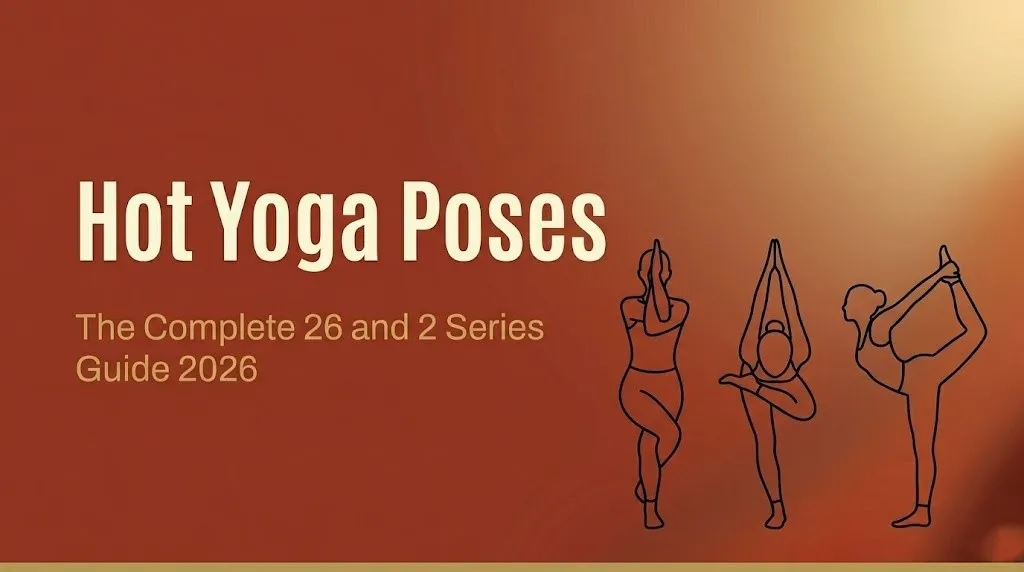
This distinction matters practically. If you walk into a class called “Hot Flow” or “Hot Vinyasa,” you will not do the 26 and 2 series. You will likely do a flowing sequence chosen by the teacher, possibly at a lower temperature, around 85 to 95 degrees Fahrenheit. Some studios use infrared heat rather than forced air, which warms the body differently and feels less humid.
| Feature | Bikram Yoga (26 and 2) | Hot Vinyasa / General Hot Yoga |
|---|---|---|
| Room temperature | 105°F (40.5°C) | 80 to 95°F (27 to 35°C) |
| Humidity | 40% | Varies |
| Sequence | Fixed: always 26 poses + 2 breaths | Varies by teacher |
| Class length | 90 minutes | 60 to 90 minutes |
| Breathing style | Specific techniques named in series | Ujjayi pranayama or teacher-directed |
| Style classification | Hatha-based, fixed sequence | Vinyasa-based or style-dependent |
| Props | Typically none | Blocks, straps common |
Other popular heated formats include Modo yoga (formerly Moksha), practiced at around 95 degrees Fahrenheit with an eco-focused philosophy, and CorePower yoga, which uses heat alongside a strength-focused Vinyasa structure.
Modification note: Practitioners who find 105 degrees Fahrenheit prohibitive can begin with a warm yoga class at 85 to 90 degrees and progress the heat level gradually as acclimatization develops.
Key Takeaway: “Hot yoga” covers many heated formats at varying temperatures and sequences. Bikram yoga is one specific fixed system at 105 degrees Fahrenheit. Know which one you are walking into before your first class.
The 26 and 2 Yoga Poses: The Complete Bikram Series in Order
The 26 and 2 series consists of 26 specific postures and 2 pranayama breathing exercises, always practiced in the same fixed order during a 90-minute class.
Here is the complete series with Sanskrit names, English names, and primary target areas:
| # | Sanskrit Name | English Name | Primary Target |
|---|---|---|---|
| 1 | Pranayama | Standing Deep Breathing | Lungs, respiratory system |
| 2 | Ardha Chandrasana with Pada Hastasana | Half Moon Pose with Hands to Feet | Spine, obliques, hamstrings |
| 3 | Utkatasana | Awkward Pose (3 parts) | Quadriceps, knees, ankles |
| 4 | Garudasana | Eagle Pose | Joints of the body (12 major) |
| 5 | Dandayamana Janushirasana | Standing Head to Knee Pose | Hamstrings, core, hip flexors |
| 6 | Dandayamana Dhanurasana | Standing Bow Pulling Pose | Spine, hip flexors, shoulder |
| 7 | Tuladandasana | Balancing Stick Pose | Cardiovascular system, full body |
| 8 | Dandayamana Bibhaktapada Paschimotthanasana | Standing Separate Leg Stretching Pose | Hamstrings, sciatic nerve |
| 9 | Trikanasana | Triangle Pose | Full body, cardiovascular |
| 10 | Dandayamana Bibhaktapada Janushirasana | Standing Separate Leg Head to Knee Pose | Thyroid, abdominals |
| 11 | Tadasana | Tree Pose | Hip joint, knee alignment |
| 12 | Padangustasana | Toe Stand Pose | Balance, knee, ankle |
| 13 | Savasana | Dead Body (Corpse) Pose | Recovery, nervous system |
| 14 | Pavanamuktasana | Wind Removing Pose | Colon, hip flexors |
| 15 | Sit-up | Sit-up | Abdominal strengthening |
| 16 | Bhujangasana | Cobra Pose | Lumbar spine, thoracic extensors |
| 17 | Salabhasana | Locust Pose (Half Locust) | Lower back, glutes |
| 18 | Poorna Salabhasana | Full Locust Pose | Thoracic spine, entire posterior chain |
| 19 | Dhanurasana | Bow Pose | Full spine, hip flexors |
| 20 | Supta Vajrasana | Fixed Firm Pose | Knees, quadriceps, lumbar |
| 21 | Ardha Kurmasana | Half Tortoise Pose | Thoracic spine, shoulders |
| 22 | Ustrasana | Camel Pose | Thoracic and lumbar extension |
| 23 | Sasangasana | Rabbit Pose | Cervical spine, thoracic flexion |
| 24 | Janushirasana with Paschimotthanasana | Head to Knee Pose with Stretching | Hamstrings, sciatic nerve, kidney |
| 25 | Ardha Matsyendrasana | Spine Twisting Pose | Rotational spinal mobility |
| 26 | Kapalbhati in Vajrasana | Blowing in Firm Pose (breathing) | Exhalation muscles, abdominals |
Modification: Beginners should not worry about achieving the full expression of each pose in early classes. Sitting in Savasana between poses is a legitimate and safe choice in the first several sessions.
Hot Yoga Poses Chart: Pose Names, Targets, and Hold Times
A hot yoga poses chart gives practitioners a reference for what each pose demands before they arrive in the heated room.
Hold times in the 26 and 2 series are specifically prescribed and are part of what makes the practice distinct from free-form classes. Each pose is performed for a set duration, repeated for a second set, and the timing is called by the teacher.
| Pose | Sets | Hold Time Per Set | Difficulty for Beginners |
|---|---|---|---|
| Pranayama (Standing Deep Breathing) | 2 | 6 breath cycles | Accessible |
| Ardha Chandrasana (Half Moon) | 2 | 10 seconds each side | Moderate |
| Utkatasana (Awkward Pose) | 3 parts, 2 sets | 10 to 30 seconds | Moderate to challenging |
| Garudasana (Eagle Pose) | 2 | 10 seconds each side | Moderate |
| Dandayamana Janushirasana (Standing Head to Knee) | 2 | 30 to 60 seconds | Challenging |
| Dandayamana Dhanurasana (Standing Bow) | 2 | 10 to 20 seconds | Challenging |
| Tuladandasana (Balancing Stick) | 2 | 10 seconds | Moderate |
| Trikanasana (Triangle) | 2 | 20 seconds each side | Challenging |
| Savasana (Corpse Pose, floor series) | Multiple | 20 seconds between poses | Accessible |
| Ustrasana (Camel Pose) | 2 | 30 seconds | Challenging for beginners |
| Ardha Matsyendrasana (Spine Twisting) | 2 | 20 seconds each side | Moderate |
Safety note: Hold times feel significantly longer in a 105-degree Fahrenheit room than they do at room temperature. Beginners should hold each pose for a shorter duration and come out early if they feel dizzy, nauseated, or faint.
Modification: For any standing balance pose, a wide-stance modification or placing one hand lightly on the wall provides immediate stability without disrupting the class.
Standing Series Hot Yoga Poses: The First 12 Postures
The standing series comprises the first 12 postures of the Bikram sequence and forms the most cardiovascularly demanding portion of the class.
Practicing 12 progressively demanding standing poses in a room at 105 degrees Fahrenheit places the cardiovascular system under consistent load for approximately 50 to 55 minutes of the 90-minute class. Heart rate during the standing series can reach 60 to 85 percent of maximum heart rate for many practitioners, which is comparable to moderate-to-vigorous aerobic exercise.
The standing series builds progressively in challenge. It begins with breathwork (Pranayama) and lateral spinal movement (Ardha Chandrasana), moves through knee-strengthening (Utkatasana), joint compression and release (Garudasana), and then into the most demanding single-leg balancing postures.
Dandayamana Dhanurasana (Standing Bow Pulling Pose) is frequently cited by practitioners and teachers as the most cardiovascularly intense pose in the series. The simultaneous forward lean and backward leg kick creates a tourniquet effect on the circulatory system that the body must compensate for rapidly.
Primary muscles engaged across the standing series:
- Quadriceps: Loaded heavily in Utkatasana, Standing Head to Knee, and Balancing Stick
- Hamstrings: Lengthened in Standing Separate Leg Stretching and Standing Head to Knee
- Gluteus medius and hip abductors: Stabilize every single-leg balance pose
- Spinal extensors: Active in Standing Bow, Balancing Stick, and Triangle
- Shoulder stabilizers: Engaged during every arm-extended pose
Modification for beginners: In all single-leg balance postures, keep the standing knee softly bent rather than locked. This protects the joint and allows better balance calibration.
Key Takeaway: The standing series is the cardiovascular core of the hot yoga practice. It runs for roughly 50 minutes at high heat, and managing your effort in the first half of class determines how well you perform in the second half.
Floor Series Hot Yoga Poses: The Final 14 Postures
The floor series covers postures 13 through 26 and shifts the emphasis from cardiovascular endurance to spinal strengthening, hip flexibility, and deep parasympathetic recovery between poses.
After the standing series, practitioners come to the floor and remain there for the rest of class. The shift is immediately noticeable. Savasana (Corpse Pose) is practiced briefly between each pose throughout the floor series, which allows the cardiovascular system to partially recover and gives the nervous system regular reset points.
The floor series targets the posterior chain aggressively. Bhujangasana (Cobra Pose), Salabhasana (Locust Pose), Poorna Salabhasana (Full Locust Pose), and Dhanurasana (Bow Pose) appear in sequence, each demanding progressively more thoracic and lumbar extension. This four-pose backbend sequence is one of the most concentrated spinal strengthening segments in any yoga tradition.
To practice Bhujangasana (Cobra Pose) in the Bikram format:
- Lie flat on the stomach with legs together, forehead on the mat.
- Place the hands under the shoulders, fingers pointing forward, elbows close to the body.
- On an inhale, press into the hands and lift the chest, keeping the elbows slightly bent.
- Pull the shoulders back and down, away from the ears.
- Hold for 10 seconds per set. Lower slowly on the exhale.
Modification: People with lumbar disc issues should limit the lift height so no compression or pain is felt in the lower back. A smaller cobra with elbows remaining bent and hips staying on the floor is the appropriate modification.
Ustrasana (Camel Pose) later in the floor series is often the most emotionally intense pose in the class. The deep thoracic backbend combined with heat and accumulated fatigue creates a genuine physiological and psychological challenge. It is normal to feel a strong autonomic response, including dizziness or nausea, in this pose. Coming out early and resting in Savasana is always the right choice.
Hot Yoga Poses for Beginners: What to Expect in Your First Class
For beginners, hot yoga poses will feel more difficult than they look on paper, not because the poses are complex, but because the combination of heat, humidity, and physical effort creates a total-body load unlike most other exercise formats.
The most important mindset for your first class is permission to rest. Every experienced teacher in a 26 and 2 class will tell you the same thing: staying in the room and lying down in Savasana counts as practice. The heat acclimatization still happens. The nervous system is still adapting.
What most beginners are not told is that the first class will likely feel overwhelming and the second class often feels significantly harder. This is a documented phenomenon in heat acclimatization: as the body begins to recognize the heat environment, it begins sweating earlier and more profusely, which can feel more intense than the first session even though the body is actually adapting appropriately.
A 2013 study cited by the Journal of Strength and Conditioning Research found that novice practitioners of Bikram yoga showed measurable improvements in balance, lower body strength, and flexibility after only eight weeks of twice-weekly practice, even when they modified or skipped poses in early sessions.
Beginner priorities for the first three classes:
- Hydration before class: Drink at least 500 ml of water in the two hours before class. Arrive hydrated, not just hoping to catch up during class.
- Electrolytes: Plain water alone is insufficient after heavy sweating. A drink with sodium, potassium, and magnesium before and after class prevents cramping.
- Clothing: Minimal, moisture-wicking clothing. The more skin exposed, the more efficiently the body can cool itself.
- Rest permission: Sit or lie down whenever needed. No judgment. No pressure.
Modification: Any beginner who feels dizzy, lightheaded, or nauseated at any point should immediately come to the floor, lie in Savasana, and stay there until symptoms resolve. If symptoms persist after two to three minutes of rest, leaving the room to cool down is the appropriate response.
Hot Yoga Benefits Backed by Research
Hot yoga produces documented benefits including improved cardiovascular fitness, increased lower body strength, enhanced flexibility, and reduced stress markers, with the heat environment contributing to several of these outcomes.
The research base for hot yoga has grown steadily since 2010. A study published in Experimental Physiology found that 12 weeks of Bikram yoga practice reduced arterial stiffness and improved cardiovascular fitness in previously sedentary middle-aged adults. Arterial stiffness is an independent risk marker for cardiovascular disease, which makes this finding more than just a fitness metric.
The International Journal of Yoga has published multiple studies examining yoga’s effects on flexibility, bone mineral density, and psychological wellbeing. While most of these studies examine yoga broadly, the heat element in hot yoga appears to accelerate some flexibility gains by allowing connective tissue to move through greater ranges of motion during the class session.
Documented benefits of regular hot yoga practice include:
- Improved cardiovascular fitness (VO2 max and arterial compliance)
- Increased lower body muscular strength (quadriceps, hamstrings, gluteal groups)
- Greater spinal range of motion in flexion, extension, and rotation
- Reduced perceived stress and anxiety scores
- Improved static and dynamic balance
- Measurable gains in bone mineral density in some practitioner populations
- Better glycemic control in practitioners with type 2 diabetes risk factors, based on research reviewed by the NCCIH
Important context: Benefits are tied to consistent practice. Research findings generally reflect practitioners attending class two to three times per week over eight to twelve weeks minimum. One class per month does not produce the same outcomes.
Key Takeaway: Hot yoga’s benefits are real and research-supported, but they require consistent practice at two to three sessions per week for at least eight weeks before measurable changes appear.
Hot Yoga and Cardiovascular Health: What the Science Says
Hot yoga places a measurably higher demand on the cardiovascular system than room-temperature yoga at the same pose difficulty, making it both a potential benefit and a potential risk depending on the individual.
The American College of Sports Medicine classifies exercise in environments above 95 degrees Fahrenheit as high-heat exercise requiring modified intensity guidelines. In a 105-degree Fahrenheit Bikram class, heart rate can reach levels comparable to moderate jogging even during poses that feel relatively static. This happens because the cardiovascular system is simultaneously managing physical effort and thermoregulation cooling demand.
For people with healthy cardiovascular systems, this added load produces adaptation over time. Cardiac output increases. Plasma volume expands. The heart becomes more efficient at managing the dual demand of exercise and heat. These are the same adaptations seen in endurance athletes who train in warm conditions.
For people with pre-existing cardiovascular conditions, including uncontrolled hypertension, recent cardiac events, or arrhythmias, the thermal cardiovascular load can be excessive. A cardiologist familiar with heat-based exercise should review the specific cardiovascular profile of anyone with diagnosed heart disease before they begin hot yoga practice, as the combination of heat, exertion, and potential dehydration creates a specific risk pattern that differs from room-temperature exercise.
A study in Complementary Therapies in Medicine found that blood pressure in hot yoga practitioners was acutely elevated during class but showed a training-related reduction in resting blood pressure after eight weeks of consistent practice. This suggests that hot yoga may benefit mildly hypertensive practitioners over time, but the acute class-level elevation warrants caution for anyone with unmanaged high blood pressure.
Modification: Practitioners with any cardiovascular condition should begin with a cooler yoga format (85 to 90 degrees Fahrenheit) and progress to full Bikram temperatures only after at least four weeks of consistent warmer-room practice.
Hot Yoga Safety: Heat, Hydration, and When to Stop
Hot yoga is safe for most healthy adults when practiced with proper hydration, appropriate heat acclimatization, and the willingness to rest or exit when warning signs appear.
The primary safety risks in hot yoga are dehydration, heat exhaustion, and hyponatremia (low sodium from excessive water intake without electrolyte replacement). These are not rare events in hot yoga classes. They are the most common reasons practitioners feel unwell during or after class.
Key warning signs that require immediate action:
- Dizziness or lightheadedness: Lie down immediately in Savasana.
- Nausea: Come to the floor. Do not try to push through.
- Muscle cramping: Usually signals electrolyte depletion. Rest and consider electrolyte intake.
- Cessation of sweating despite feeling very hot: This can indicate heat exhaustion. Exit the room immediately and cool down.
- Confusion or disorientation: Exit the room immediately. This may indicate serious heat illness requiring medical attention.
- Chest pain or irregular heartbeat: Exit the room and seek medical attention immediately.
Hydration guidelines from the American College of Sports Medicine recommend drinking 500 ml of fluid approximately two hours before heat-based exercise, and replacing fluids lost during exercise at a rate that prevents more than two percent body weight loss. For a 90-minute hot yoga class, most practitioners will need 500 ml to 1 liter of fluid replacement during and after class, supplemented with electrolytes.
Safety note on hot rooms and medications: Several common medications affect heat tolerance, including diuretics, antihistamines, beta-blockers, and some antidepressants. Anyone taking these medications should discuss their specific heat tolerance with a prescribing physician before attending hot yoga classes.
Who Should Avoid Hot Yoga and Hot Yoga Contraindications
Several populations should avoid the 105-degree Fahrenheit Bikram yoga format or practice only with specific medical clearance.
The heat element of hot yoga creates contraindications that do not apply to room-temperature yoga. Someone who practices regular yoga safely may still face real risks in a heated environment, particularly if they have conditions that impair thermoregulation or cardiovascular response.
| Population | Contraindication | Recommended Alternative |
|---|---|---|
| Pregnant individuals (any trimester) | Core temperature elevation risk to fetus | Prenatal yoga at room temperature |
| People with multiple sclerosis | Heat worsens MS symptoms reliably | Room-temperature gentle yoga |
| Uncontrolled hypertension | Acute cardiovascular load from heat | Cooler yoga format, medical review first |
| Recent cardiac event (within 6 months) | High thermal cardiovascular demand | Cardiac rehabilitation program first |
| Kidney disease | Dehydration risk with impaired filtration | Room-temperature yoga, medical guidance |
| Heat intolerance disorders | Thermoregulation impairment | Any room-temperature yoga format |
| Severe anemia | Reduced oxygen-carrying capacity under load | Room-temperature gentle yoga |
| Children under 12 | Thermoregulation is less efficient in children | Room-temperature kids yoga |
Hot yoga is also not appropriate during an active fever or any acute illness, regardless of prior hot yoga experience.
Note on pregnancy: The heat risk in Bikram yoga for pregnant individuals is not theoretical. Research reviewed by the NCCIH indicates that sustained elevation of core body temperature above 102 degrees Fahrenheit during the first trimester carries documented risks. The heated room alone can raise core temperature to that range without any physical effort.
Modification: Most of the pose benefits of the 26 and 2 series can be obtained in a room-temperature Hatha yoga class. Practitioners who are medically contraindicated for heat can practice the same postures safely at ambient temperature.
Key Takeaway: The heat in hot yoga creates its own category of contraindications separate from the poses themselves. Pregnancy, multiple sclerosis, and uncontrolled cardiovascular conditions are the highest-priority reasons to skip the heated room entirely.
How to Prepare for Your First Hot Yoga Class
Preparing for a first hot yoga class begins 24 to 48 hours before you arrive, not in the parking lot.
Hydration is the single most controllable variable in your first-class experience. Most people who feel terrible in their first hot yoga class are dehydrated before the class even begins. Coffee, alcohol, and low fluid intake in the day before class all worsen the experience predictably.
Practical preparation checklist:
- 48 hours before: Increase water intake. Avoid excessive alcohol and caffeine.
- Day before: Eat normally. Do not arrive with a empty stomach but also avoid heavy meals within two hours of class.
- Morning of class: Drink at least 500 ml of water before leaving home.
- What to bring: Non-slip yoga mat, large absorbent towel (to cover the mat), second smaller towel for sweat, minimum 1 liter of water, electrolyte tablets or drink.
- Clothing: Minimal moisture-wicking fabric. Shorts and a sports bra or fitted top for any body. Cotton holds moisture and becomes heavy. Synthetic moisture-wicking fabrics are preferable.
- Arrive early: Get into the room 5 to 10 minutes early to begin heat acclimatization before class starts. This alone reduces the shock of the first pose in full heat.
After class, rehydration is equally important. Replace fluids and electrolytes within 30 minutes of finishing. Food within one to two hours supports recovery. Many practitioners report that appetite is suppressed immediately after class due to the heat response, which is normal.
Modification for beginners: Plan to attend your first three classes within a single week if possible. Back-to-back early attendance accelerates heat acclimatization dramatically. The third class in a week typically feels noticeably more manageable than the first.
Hot Yoga Modifications for Seniors and People With Injuries
Older adults and practitioners with specific injuries can participate in hot yoga formats, but the heat element requires additional individualization beyond what standard yoga modifications address.
For seniors, thermoregulation efficiency declines with age. Older adults generally sweat less efficiently and have reduced plasma volume, which means they are more susceptible to heat stress at the same ambient temperature as younger practitioners. The American College of Sports Medicine recommends that adults over 65 who are new to heat-based exercise begin at lower temperatures (85 degrees Fahrenheit) and progress slowly.
| Injury or Condition | Problematic Poses | Recommended Modification |
|---|---|---|
| Lower back disc herniation | Full Cobra, Standing Separate Leg Stretching | Reduce depth; keep spine long |
| Knee osteoarthritis | Fixed Firm Pose (Supta Vajrasana) | Sit on a folded blanket; reduce knee flexion |
| Cervical disc issues | Rabbit Pose (Sasangasana) | Skip full neck flexion; keep a neutral neck |
| Hamstring strain | Standing Head to Knee, Standing Bow | Bend standing knee; reduce forward lean |
| Shoulder impingement | Eagle Pose arm variation | Reduce arm binding; cross arms at forearm only |
| Sacroiliac joint instability | Standing Bow, Triangle | Reduce depth; avoid hyperextension of the hip |
| Recent knee surgery | Toe Stand Pose (Padangustasana) | Skip the pose; stay in Tree Pose |
For seniors specifically: The floor series is generally more accessible than the standing series for older adults, because the balance and cardiovascular demands are lower. Focusing on the floor series in early classes while building heat tolerance is a practical approach.
Any practitioner managing a specific injury should tell the teacher before class begins. In a traditional Bikram yoga setting, teachers circulate and provide verbal cues. Knowing which students need modifications allows the teacher to offer specific guidance during the class.
Hot Yoga Sequence: How the 26 and 2 Flows as a Complete Practice
The 26 and 2 hot yoga sequence is designed as a complete system where the order of poses, the transitions between them, and the structured rest periods in Savasana work together to produce specific physiological and neurological outcomes.
The sequence follows a deliberate pattern. The standing series opens the cardiovascular system and heats the body from the inside through muscular effort. The floor series then uses a prone (face-down) backbend sequence to strengthen the posterior chain, followed by supine (face-up) postures for hip flexibility and spinal rotation, then deep forward folds, and finally the closing breathwork of Kapalbhati in Vajrasana.
This arc is not arbitrary. It mirrors the classical understanding in Hatha yoga of working from gross (large muscular effort) to subtle (breath and nervous system focus). The 90-minute class that feels like pure physical challenge at the start ends with breathwork specifically designed to reset the autonomic nervous system toward parasympathetic (rest and digest) dominance.
The sequence also creates a therapeutic compression and traction pattern. Poses alternate between spinal extension (Cobra, Bow, Camel) and spinal flexion (Rabbit, Head to Knee, Half Tortoise), which systematically compresses and decompresses the intervertebral discs. This alternating pressure pattern is the basis of the claim, often repeated in Bikram circles, that the series benefits the spine. The mechanical reality supports the basic premise: alternating compression and decompression improves disc nutrition through fluid exchange.
Pose Tip:
- The Savasana rest between floor poses is not optional. It is when the nervous system integrates the work of the previous pose.
- Skipping Savasana to “save time” reduces the therapeutic effect of the series.
- One full breath cycle of conscious relaxation in Savasana is the minimum. Twenty seconds is the traditional prescription.
Modification: Practitioners with a tight schedule can practice a shortened version using 12 to 15 poses from the series, but should maintain the Savasana rest between each pose regardless of how abbreviated the session is.
Frequently Asked Questions About Hot Yoga Poses
What are the 26 hot yoga poses in order?
The 26 Bikram yoga poses begin with Pranayama (Standing Deep Breathing) and end with Kapalbhati in Vajrasana (Blowing in Firm Pose), with 24 postures in between practiced in a fixed sequence.
The series moves from standing breathwork through 11 standing postures, transitions to the floor with Savasana (Corpse Pose), and then progresses through backbends, forward folds, and spinal twists before closing breathwork.
The full ordered list with Sanskrit names and English names appears in the table in the “26 and 2 Yoga Poses” section of this article.
How hot is the room in a Bikram yoga class?
A traditional Bikram yoga class is practiced in a room heated to 105 degrees Fahrenheit (40.5 degrees Celsius) with 40 percent humidity.
Other hot yoga formats vary from 80 to 95 degrees Fahrenheit, depending on the studio and style.
The humidity level matters as much as the temperature: high humidity reduces the body’s ability to cool itself through sweat evaporation, which is why 105 degrees Fahrenheit at 40 percent humidity feels more intense than dry heat at the same temperature.
Is hot yoga safe for complete beginners?
Hot yoga is safe for most healthy beginners who hydrate adequately, arrive with realistic expectations, and give themselves permission to rest during class.
The biggest risk for beginners is not the poses but the heat: dehydration and heat exhaustion are the most common issues in first-time practitioners.
Beginners with cardiovascular conditions, pregnancy, or heat-sensitivity disorders should discuss the specific thermal load with a physician before attending.
How is hot yoga different from regular yoga?
Hot yoga is practiced in a deliberately heated room, which increases cardiovascular demand, promotes greater sweating, and may increase tissue extensibility compared to room-temperature yoga.
The poses themselves can be identical to room-temperature classes, as in the Bikram format, or they can be a separate flowing sequence, as in hot Vinyasa.
The heat creates a physiological load that amplifies both the benefits and the risks of the practice, requiring specific preparation and safety awareness that room-temperature yoga does not.
How much water should you drink before a hot yoga class?
The American College of Sports Medicine recommends drinking approximately 500 ml (about 17 ounces) of water in the two hours before heat-based exercise.
During a 90-minute hot yoga class, most practitioners lose between 1 and 2 liters of sweat, which needs to be replaced with water and electrolytes during and after class.
Plain water alone is insufficient for replacement after heavy sweating. Adding sodium, potassium, and magnesium through an electrolyte supplement or drink prevents cramping and hyponatremia.
Start With One Class, One Pose at a Time
If you are preparing for your first hot yoga class, do one thing before anything else: hydrate today. Not tomorrow, not two hours before class. Start now.
The 26 and 2 series rewards consistency above everything else. Your first class will be challenging. Your fifth class will feel manageable. Your twentieth class is when the poses start to feel genuinely yours.
Pick one pose from the standing series to study before you go. Garudasana (Eagle Pose) is a good choice: it is accessible, it works every major joint in the body, and mastering it gives you a reference point for the rest of the series.