Yoga Block Sizes: Complete Size & Material Guide 2026
Yoga block sizes come in two primary options: the standard block at 9 x 6 x 4 inches and the large block at 9 x 6 x 5 inches, and choosing the wrong one for your body or practice style can undermine the alignment benefits a block is designed to provide. Most beginners default to whatever is cheapest or most available, but a one-inch height difference genuinely changes how a pose works for your spine, hips, and hamstrings.
Props are not beginner training wheels. The Iyengar Yoga Association of the United States, which pioneered the systematic use of yoga props starting in the 1960s with B.K.S. Iyengar, emphasizes that blocks allow practitioners of all levels to achieve correct anatomical positioning rather than compensating with incorrect form. Research reviewed by the National Center for Complementary and Integrative Health consistently shows that proper spinal alignment during yoga practice directly affects outcomes for back pain, joint health, and injury prevention.
This guide covers the exact dimensions of each block size, how to match size to your body and practice goals, the practical differences between foam, cork, and wood blocks, step-by-step instructions for using a block in the poses that need it most, and specific guidance for seniors, people with back pain, and practitioners with very tight hamstrings. By the end, you’ll know exactly what to buy and why.
Yoga Block Sizes
Yoga blocks come in two standard sizes: the standard block measuring 9 x 6 x 4 inches and the large block measuring 9 x 6 x 5 inches, with the one-inch height difference creating a meaningfully different experience for practitioners with limited flexibility or larger body frames.
Most studios stock the standard size. Most beginners buy the standard size without researching alternatives. The result is that practitioners with tight hamstrings, long torsos, or limited hip mobility often find the standard block still leaves them straining to reach it, defeating the purpose of the prop entirely.
The two measurements that matter most are the height options available when you orient the block differently. Both standard and large blocks can be used in three orientations: flat (shortest height), on the medium edge, and on the tall end. For a standard block, those three heights are approximately 3 inches, 4 inches, and 6 inches. For a large block, they’re approximately 4 inches, 5 inches, and 9 inches.
Think of a yoga block like a step stool that comes in three heights depending on which way you turn it. A taller step stool matters more the higher the shelf you’re trying to reach. A practitioner whose hamstrings are very tight essentially has a higher “shelf” to reach in forward folds. The large block gives them more step-stool height to work with.
| Block Size | Dimensions | Three Height Orientations | Best For |
|---|---|---|---|
| Standard | 9 x 6 x 4 in | 3 in / 4 in / 6 in | Average to flexible adults |
| Large | 9 x 6 x 5 in | 4 in / 5 in / 9 in | Taller practitioners, very tight flexibility |
Standard Yoga Block Size Dimensions
The standard yoga block measures 9 inches long, 6 inches wide, and 4 inches tall, making it the most widely available size in studios and retailers and the appropriate starting point for most adults of average height and moderate flexibility.
These dimensions were not arbitrarily chosen. The 9 x 6 base provides a stable platform for hand placement in standing poses and wide enough support for the sacrum in restorative postures. The 4-inch height in its medium orientation is specifically designed to close the gap between the floor and a moderately flexible practitioner’s hand in Trikonasana (Triangle Pose), the pose for which block use was arguably most systematically developed in Iyengar yoga practice.
The standard block weighs approximately 250 to 350 grams for foam and 500 to 700 grams for cork, depending on material density. These weights matter more than most buying guides acknowledge, particularly for older practitioners or anyone with reduced grip strength who will be picking up and repositioning blocks frequently during a class.
Standard-size blocks work well for:
- Adults 5’2″ to 5’10” with average to moderate flexibility
- Standing pose hand support in Triangle, Half Moon, and Warrior variations
- Under-hand support in seated forward folds
- Under-head support in restorative poses
- Under-foot support for standing balance adjustments
Modification note: If you find your hand barely touches a standard block in standing poses without your spine rounding or your chest rotating toward the floor, the block height is insufficient for your current flexibility. Size up or rotate the block to its tall orientation rather than compensating with poor alignment.
Large Yoga Block Size: Who Needs It
The large yoga block measures 9 x 6 x 5 inches and is the better choice for practitioners taller than 5’10”, people with very tight hamstrings, those with limited hip mobility, and anyone who consistently finds the standard block still leaves them straining in standing poses.
That extra inch of height sounds trivial. In practice, it is not. A one-inch difference in block height can be the difference between a practitioner maintaining a neutral spine in Trikonasana (Triangle Pose) and one who is dumping into lumbar flexion just to reach the support. Lumbar flexion under load in a standing asymmetrical pose is exactly the compensation pattern that leads to lower back strain over time.
Large blocks are standard equipment in many Iyengar yoga studios, where precision of alignment is the defining principle of the practice. The Iyengar Yoga Association of the United States notes that proper prop height is as important as proper prop type: a block that requires the practitioner to sacrifice alignment to reach it has failed its purpose.
Large blocks are also preferred for:
- Restorative yoga and Yin yoga where the block supports the body for extended holds of 3 to 10 minutes and comfort matters more than in active standing poses
- Seated meditation where the extra height under the hips can make a significant difference for practitioners with tight hip flexors or limited external hip rotation
- Men with very limited flexibility who are new to yoga and often have significantly less hamstring and hip mobility than their body height alone would suggest
Modification note: If you practice primarily restorative or Yin yoga, large blocks are generally preferable regardless of your height, because the greater surface area and height provide more stable, comfortable support during long passive holds.
Key Takeaway: Standard blocks suit most adults of average height and flexibility, but large blocks are worth the minor price difference for anyone taller than 5’10”, anyone with very tight hamstrings, or anyone doing primarily Restorative or Yin yoga where comfort during long holds matters as much as height.
What Size Yoga Block Do I Need?
The right yoga block size depends primarily on your height, hamstring and hip flexibility, and practice style, with taller practitioners and those with tighter flexibility generally needing a large block and shorter or more flexible practitioners working well with a standard block.
Start with height as your first filter. If you’re shorter than 5’4″ with average or above-average flexibility, a standard block is almost certainly sufficient. If you’re taller than 5’10” or have genuinely tight hamstrings, start with a large block. Between 5’4″ and 5’10”, flexibility becomes the primary deciding factor.
Test before you buy if possible. Stand in a forward fold, keeping your knees soft and your spine as long as possible. Hold your hands at the height where they naturally want to land without forcing the spine to round. Measure that distance from the floor. If it’s more than 5 inches, you need a large block.
| Your Profile | Recommended Block Size | Recommended Orientation Start |
|---|---|---|
| Under 5’4″, flexible | Standard | Flat (3 in) or medium (4 in) |
| Under 5’4″, tight hamstrings | Standard or large | Tall orientation (6 to 9 in) |
| 5’4″ to 5’10”, average flexibility | Standard | Medium (4 in) |
| 5’4″ to 5’10”, tight hamstrings | Large | Medium or tall |
| Over 5’10”, any flexibility | Large | Medium to tall |
| Restorative / Yin focus, any height | Large | Flat to medium |
| Seniors with joint limitations | Large | Flat, for stability |
Yoga teachers and physical therapists generally recommend starting with two blocks in the size appropriate for your body, rather than one, because many standing sequences and all restorative poses work better with bilateral prop support.
Yoga Block Material Comparison
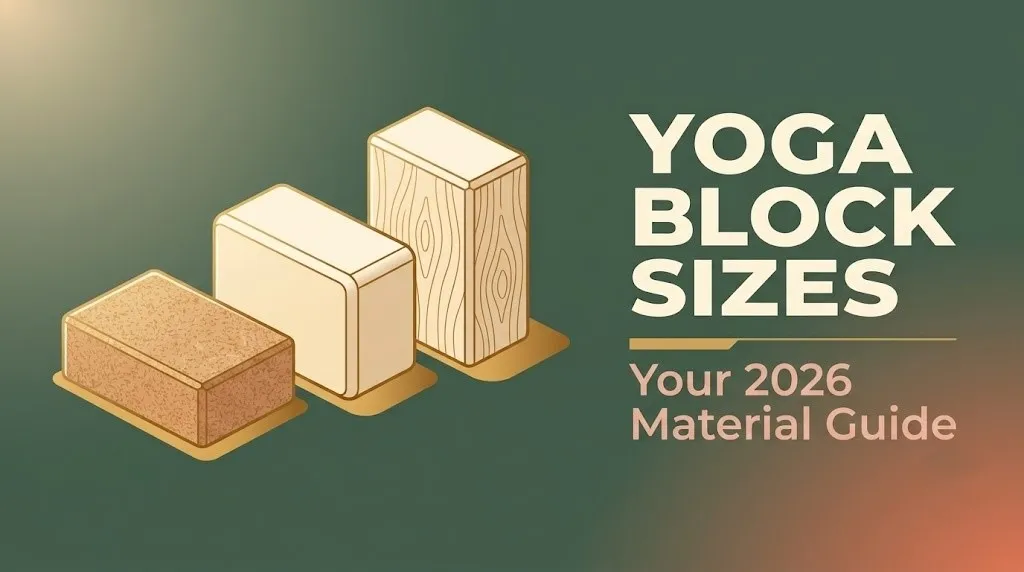
Yoga blocks are made primarily from EVA foam, natural cork, or wood, with each material offering a meaningfully different combination of grip, firmness, weight, durability, and price that affects which type suits your practice best.
The material question is not simply a comfort preference. It affects how stable the block feels under load, how well it grips the floor and your hands when you’re sweating, how the block responds when you use it for seated or restorative poses requiring prolonged contact, and how long it lasts through regular use.
Here is a direct comparison of all three primary materials:
| Feature | EVA Foam | Natural Cork | Wood |
|---|---|---|---|
| Weight | Lightest (250-350g) | Medium (500-700g) | Heaviest (600-900g) |
| Grip (dry hands) | Good | Excellent | Good |
| Grip (sweaty hands) | Poor to moderate | Excellent | Moderate |
| Firmness | Soft to medium | Firm | Very firm |
| Durability | Moderate (compresses over time) | High | Very high |
| Eco-friendliness | Lower (petroleum-based) | High (renewable) | High (if sustainably sourced) |
| Price range | $8 to $20 per block | $15 to $35 per block | $20 to $45 per block |
| Best for | Beginners, budget-conscious, home practice | Hot yoga, all-around use | Iyengar yoga, long-term investment |
No single material is best for everyone. The right material depends on how you practice, how your hands respond to different textures, and what your budget allows.
Foam Yoga Block: Pros, Cons, and Best Uses
EVA foam yoga blocks are the most widely available and least expensive option, made from ethylene vinyl acetate, a closed-cell foam that provides a lightweight, cushioned surface ideal for beginners and restorative practice.
Foam blocks have several genuine advantages. Their light weight, typically under 350 grams, makes them easy to stack, carry, and reposition during a flowing practice without interrupting your sequence. Their cushioned surface feels comfortable during prolonged contact in restorative poses, where a firm cork or wood block pressing into the sacrum for 10 minutes becomes genuinely uncomfortable for many practitioners.
The main weakness of foam is grip degradation when hands sweat. In a hot yoga class or any vigorous Vinyasa session, a foam block placed under the hand can slide on a smooth mat surface, which is both disruptive and potentially unsafe in a balance pose like Ardha Chandrasana (Half Moon Pose). Foam blocks also compress over time with repeated use, particularly along the edges, which can create an uneven surface that affects stability.
Key benefits of foam blocks include:
- Lowest price point: Typically $8 to $20 per block, making two-block sets affordable for budget-conscious beginners.
- Lightest weight: Ideal for seniors or practitioners with reduced grip strength who are repositioning blocks frequently.
- Cushioned surface: Most comfortable for restorative poses involving prolonged contact with the sacrum, spine, or head.
- Widely available: Found at most sporting goods stores and yoga studios for immediate purchase.
Modification for hot yoga practitioners: If you practice in a heated studio and prefer foam blocks, look for foam blocks with a non-slip textured surface or use a grip towel under the block to prevent sliding on smooth mat surfaces.
Cork Yoga Block: Pros, Cons, and Best Uses
Natural cork yoga blocks are made from the bark of the cork oak tree, producing a firm, grippy, moisture-resistant block that improves in grip as hands sweat, making it the preferred material for hot yoga, active Vinyasa, and practitioners who prioritize sustainability.
Cork’s grip behavior is the opposite of foam’s. While foam becomes more slippery when wet, cork actually grips better with slight moisture, because the natural microporous surface of cork creates more friction when moist than when bone dry. This makes cork the superior choice for any practice style that generates significant sweat.
Firmness is cork’s other key advantage. Cork provides a stable, non-compressible surface that maintains its shape and edges over years of daily use. For poses where the block is weight-bearing, such as using a block under the hand in a deep Trikonasana (Triangle Pose) or under the sacrum in a restorative backbend, cork’s firmness provides more reliable support than foam.
The downsides are weight and price. Cork blocks are roughly twice the weight of foam, at 500 to 700 grams, which matters for practitioners with limited grip strength. They’re also significantly more expensive, typically $15 to $35 each.
Sustainability consideration: Natural cork is harvested without cutting down the tree, making it one of the more genuinely renewable materials in yoga equipment. The cork oak tree is not harmed during bark harvesting and continues producing bark for decades. For practitioners prioritizing environmental impact, cork is a meaningfully better choice than petroleum-based EVA foam.
Modification for seniors or those with limited grip: If you prefer cork’s firmness but find standard cork blocks heavy, some manufacturers produce lighter hollow-core cork blocks that reduce weight by approximately 30% while maintaining surface grip.
Key Takeaway: Foam blocks win on price and comfort for restorative practice; cork blocks win on grip, durability, and sustainability for active and heated yoga; and the right choice is the one that matches your practice style rather than the one that costs less upfront.
Wood Yoga Block: Pros, Cons, and Best Uses
Wood yoga blocks are the firmest, most durable, and heaviest option, traditionally used in Iyengar yoga practice where precise, stable, long-term support is prioritized over cushioning or portability.
B.K.S. Iyengar originally specified wood blocks because they provide an absolutely stable, non-compressible surface that doesn’t shift under body weight, doesn’t degrade over time, and offers predictable height maintenance across thousands of uses. For a practitioner holding a supported pose for several minutes with body weight resting on the block, the difference between a firm wood block and a slightly spongy foam block is felt immediately in the quality of the support.
Wood blocks are typically made from birch, maple, or balsa wood. Birch and maple are dense, heavy, and extremely durable. Balsa wood is lighter than those options but still firmer than foam and more stable than cork. Sustainably sourced and FSC-certified wood blocks are available from several manufacturers.
The practical limitations of wood blocks are weight and floor impact. A typical wood block weighs 600 to 900 grams, which is noticeably heavy to reposition repeatedly during a flowing class. Wood blocks also create a hard surface that is less comfortable for prolonged contact without additional padding, such as a folded blanket between the block and a bony prominence like the sacrum or spine.
Best uses for wood blocks include:
- Iyengar yoga practice where precise alignment support takes priority
- Seated meditation where a solid, non-compressible surface under the hips maintains height consistently
- Standing pose support where a completely stable platform under the hand is needed
- Long-term home practice investment where durability over years matters more than initial cost
Safety note: Wood blocks with smooth, unfinished surfaces can be slippery under wet hands. Look for wood blocks with a lightly textured or beveled edge finish.
How to Use a Yoga Block: The Three Height Positions
Every yoga block, regardless of size or material, can be used in three distinct height orientations: flat (lowest), medium (middle height), and tall (highest), and selecting the correct orientation is as important as selecting the correct block size.
Most beginners use their block only in the flat or medium position because those feel more stable. But the tall orientation, which many practitioners instinctively avoid, is frequently the most useful for standing poses where a shorter block doesn’t actually close the reach gap enough to allow proper spinal alignment.
The three orientations for a standard 9 x 6 x 4-inch block are:
- Flat orientation: Block lies on its largest face (9 x 6 surface). Height: approximately 4 inches. Most stable base. Best for restorative poses, under the sacrum, or under the head.
- Medium orientation: Block stands on its medium edge (9 x 4 surface). Height: approximately 6 inches. Good balance of stability and height. Best for seated forward folds and most restorative applications.
- Tall orientation: Block stands on its smallest face (6 x 4 surface). Height: approximately 9 inches. Least surface area but maximum height. Best for standing poses where significant height is needed.
To use a block correctly in Trikonasana (Triangle Pose):
- Stand with feet wide apart, right foot turned out 90 degrees, left foot slightly inward.
- Place the block on the floor outside the right foot. Start in the tall orientation if your flexibility is limited.
- Extend both arms parallel to the floor. Reach the right arm forward before side-bending, then hinge at the hip.
- Place the right hand lightly on the block surface. The block should feel supportive, not strained.
- Rotate the chest toward the ceiling. The left arm extends upward. Hold 5 breaths.
- Adjust block height: if the chest is rotating toward the floor, raise the block to a higher orientation. If the block feels too tall and you’re hiking the side body, lower one step.
- Release, switch sides.
Modification: Use two blocks, one under each hand, in wide-legged standing forward folds (Prasarita Padottanasana) for practitioners who cannot comfortably reach one block placed centrally.
Yoga Block for Tight Hamstrings and Forward Folds
A yoga block placed under the hands in standing and seated forward folds brings the floor up to meet the practitioner’s hands without forcing the lumbar spine into flexion, which is the most common compensation pattern when tight hamstrings limit hip hinge depth.
Tight hamstrings are the single most common reason new practitioners struggle with forward folds. The hamstrings attach at the sitting bones (ischial tuberosities) and cross the knee joint, which means they limit both hip hinge depth and knee extension simultaneously. Forcing a deeper fold without a block doesn’t stretch the hamstrings more effectively. It simply transfers the load to the lumbar spine, producing the characteristic rounded lower back that teachers correct constantly in beginner classes.
Think of it this way: if your hamstrings are at their limit when your trunk is still 8 inches from your thighs, reaching for the floor means your spine bends the remaining 8 inches instead of your hips. The block closes that 8-inch gap so the spine can stay long while the hamstrings work at their actual limit.
To use blocks in Uttanasana (Standing Forward Fold) with tight hamstrings:
- Stand with feet hip-width apart. Soften the knees slightly.
- Place two blocks on the floor in front of your feet, set to the height you need (tall, medium, or flat).
- Hinge forward from the hips, not the waist. Keep the spine long from tailbone to crown.
- Place both hands on the blocks. The blocks should feel like a natural landing, not a reach.
- Breathe into the back of the thighs. Hold 8 to 10 breaths.
- Over weeks and months, gradually lower the blocks one orientation at a time as flexibility improves.
Safety note: Avoid full forward folds with blocks if you have an active lumbar disc herniation. A physical therapist familiar with your specific diagnosis can guide appropriate modifications.
Key Takeaway: Using a block in forward folds isn’t a shortcut or a sign of limited ability: it’s the biomechanically correct approach that keeps the hamstrings working at their actual limit while protecting the lumbar spine from compensatory flexion.
Yoga Block for Hip Openers and Seated Poses
A yoga block placed under the hips in seated poses raises the pelvis above the level of the knees, which allows the hip flexors to release tension, reduces compression in the lumbar spine, and makes external hip rotation significantly more accessible for practitioners with tight hips.
The hip flexors, particularly the iliopsoas, are notoriously overworked in people who sit at desks or drive frequently. When these muscles are shortened, sitting cross-legged on the floor with a neutral pelvis feels impossible. The knees splay outward and downward only partway before the hip flexors pull the pelvis into posterior tilt, creating a rounded lower back that defeats the purpose of seated meditation or pranayama practice.
A block under the sitting bones solves this mechanically. Elevating the hips by 3 to 5 inches tilts the pelvis into a neutral or slightly anterior position, releasing the pull of the hip flexors and allowing the knees to drop toward the floor naturally.
To use a block in Sukhasana (Easy Pose) for hip tightness:
- Sit on the flat or medium surface of the block, with the block beneath both sitting bones.
- Cross the legs comfortably in front of you. The block should feel stable beneath you.
- Allow the knees to release toward the floor naturally. Do not force them down.
- Lengthen the spine upward from the hips. Relax the shoulders.
- If the knees are still significantly higher than the hips, switch to the tall block orientation or add a second block beneath the first.
- Hold for 2 to 5 minutes in meditation or pranayama practice.
For Supta Baddha Konasana (Reclined Bound Angle Pose) in Restorative yoga, blocks placed under each knee allow the inner thigh muscles (adductors) to release passively without the discomfort of holding the legs up without support.
Modification for practitioners with knee pain: If placing blocks under the knees in reclined poses creates knee joint discomfort, use a rolled blanket instead, which provides a more graduated, curved support than a flat block surface.
Yoga Block for Back Pain and Spinal Support
A yoga block used correctly in Setu Bandha Sarvangasana (Bridge Pose) and supported backbend positions can reduce compressive load on the lumbar spine, support the sacrum, and allow the thoracic spine to open passively without muscular effort, which is why many physical therapists include prop-supported yoga poses in back pain rehabilitation protocols.
The key word is “correctly.” A block used incorrectly under the sacrum in Bridge Pose can compress the lumbar spine rather than decompress it. The block must be placed under the sacrum, the flat triangular bone above the tailbone, not under the lumbar vertebrae. Misplacing the block by even two inches toward the waist places it directly under the lumbar curve, which increases spinal compression rather than reducing it.
According to a review of yoga-based interventions for chronic low back pain published in the Journal of Alternative and Complementary Medicine, supported yoga poses using props, including blocks, consistently produced greater pain reduction and functional improvement than unsupported poses for participants with chronic non-specific low back pain.
To use a block for supported Bridge Pose:
- Lie on your back with knees bent, feet flat on the floor hip-width apart.
- Press through both feet and lift the hips.
- Slide the block under the sacrum. The block should sit directly on the sacrum, below the lumbar vertebrae and above the tailbone. The lumbar spine should feel gently decompressed, not pressed.
- Start with the flat orientation (lowest height). If the spine feels neutral and comfortable, hold for 3 to 5 minutes.
- If the flat orientation creates any lumbar compression, this pose is not appropriate; discontinue and discuss with a physical therapist.
- To release, press through the feet, lift the hips, slide the block out, and lower the spine slowly to the floor.
Safety note: Anyone with spinal stenosis, active disc herniation, or sacroiliac joint dysfunction should work with a physical therapist or Iyengar-trained yoga teacher before using blocks in any spinal support capacity.
Yoga Block for Seniors and Limited Mobility
For seniors and practitioners with limited mobility, a yoga block is most effectively used as a height extension tool that reduces the distance between the body and the floor, allowing access to standing poses, seated poses, and restorative positions that would otherwise require ranges of motion the body no longer has.
Aging brings predictable changes in flexibility, joint mobility, and balance. The hip flexors and hamstrings typically shorten. The thoracic spine loses some extension capacity. Balance becomes more variable. Blocks address all three of these by reducing the reach requirement in standing poses, elevating the hips in seated poses, and providing a stable additional contact point for balance in standing poses.
Yoga Alliance educational standards for seniors yoga training consistently emphasize prop use as a core component of safe senior practice, not an accommodation for weakness but a fundamental tool for maintaining access to yoga’s benefits as the body changes over time.
Specific block applications for seniors include:
- Under the hands in standing poses to reduce the balance and flexibility demand simultaneously
- Under the hips in seated poses to relieve hip flexor tension and allow neutral pelvic alignment
- Under the forehead in Balasana (Child’s Pose) to eliminate the neck strain of reaching the head to the floor
- As a hand grip support in chair-based yoga poses for those transitioning between floor and standing
- Under the sacrum in supported Bridge Pose to decompress the lumbar spine without active muscular effort
Material recommendation for seniors: Foam blocks are generally preferable for senior practitioners because their lighter weight reduces the effort of repositioning and their softer surface is more comfortable during prolonged contact in restorative poses. Large-size foam blocks provide more stable surface area, which matters for practitioners with balance concerns.
Key Takeaway: For seniors, blocks aren’t about doing less yoga: they’re about doing yoga correctly and safely as the body changes, and using a large foam block under the hips in seated poses is one of the highest-value single adjustments a senior practitioner can make to their home practice.
How Many Yoga Blocks Do I Need?
Most practitioners need two yoga blocks rather than one, because the majority of standing poses, seated forward folds, and restorative positions require bilateral support under both hands, both knees, or both sides of the body simultaneously.
The assumption that one block is sufficient is one of the most common beginner purchasing mistakes. You can practice with one block, but you’ll quickly encounter situations where one hand has support and the other reaches awkwardly for the floor, creating exactly the lateral spinal imbalance that the block was meant to prevent.
Two blocks are specifically needed for:
- Wide-legged standing forward folds (Prasarita Padottanasana): One block under each hand maintains bilateral symmetry.
- Supported restorative backbends: One block under the shoulder blades and one under the head, or one under each knee in reclined poses.
- Seated forward folds: Two blocks stacked or placed side by side support both forearms evenly.
- Partner or balancing poses: Two blocks provide a stable platform when both hands need support simultaneously.
- Restorative Chest Opener: Two blocks stacked horizontally support the thoracic spine along the entire width of the upper back.
One block is technically sufficient for beginners practicing basic Trikonasana (Triangle Pose) and simple forward folds. But purchasing two blocks of the same size from the start is the recommendation of virtually every experienced yoga teacher, because you’ll need the second block within your first month of regular practice.
Price consideration: Two standard foam blocks typically cost $16 to $40 for the pair, making the two-block investment accessible even on a budget. Two cork blocks in standard size typically run $30 to $70 for the pair.
Yoga Block Buying Guide: Grip, Weight Capacity, and Eco Options
When choosing yoga blocks beyond size and material, three additional factors determine long-term satisfaction: grip surface texture, weight-bearing capacity, and environmental sourcing.
Grip surface matters more than most buyers investigate before purchasing. A block with a smooth, featureless surface is noticeably more likely to slide under a wet hand or on a smooth mat than one with a beveled edge, a textured surface, or a natural material that increases friction under moisture. Cork’s natural texture performs best in this category. Foam blocks with a patterned or textured surface outperform those with a flat smooth finish.
Weight-bearing capacity is relevant whenever you’re using a block to support body weight directly, such as placing a block under the sacrum in Bridge Pose or using a block as a seated meditation platform. Most standard foam blocks support up to 250 to 300 pounds of body weight without compression. Cork and wood blocks typically support more, often up to 350 to 400 pounds, making them the safer choice for practitioners who weigh more or who use blocks in load-bearing restorative applications.
Eco-conscious buyers have several legitimate options:
- Natural cork blocks: Cork is harvested from living trees without felling them, making it one of the most genuinely renewable yoga materials available.
- Recycled EVA foam blocks: Some manufacturers produce blocks from recycled or reclaimed foam materials, reducing petroleum use.
- FSC-certified wood blocks: Look for wood blocks certified by the Forest Stewardship Council, confirming sustainable forestry sourcing.
- Bamboo blocks: An emerging option. Bamboo grows rapidly and requires no pesticides, though bamboo blocks are currently less widely available.
Pose Tip:
- Check whether your blocks have a non-slip bottom surface before purchasing. Some blocks are smooth on all six faces, which creates sliding risk on hardwood or tile floors.
- For home practice on carpet, surface grip matters less; for studio floors or hardwood, it matters considerably more.
- Blocks with beveled edges are more comfortable for prolonged hand, forearm, or body contact than those with sharp right-angle edges.
Frequently Asked Questions About Yoga Block Sizes
What is the standard yoga block size in inches?
The standard yoga block measures 9 inches long, 6 inches wide, and 4 inches tall in its default upright orientation.
Used in its three possible orientations, a standard block offers heights of approximately 3 inches (flat), 4 inches (medium), and 6 inches (tall).
The large yoga block measures 9 x 6 x 5 inches and offers slightly more height in each orientation.
Are cork or foam yoga blocks better?
Neither cork nor foam is universally better: cork is better for grip, durability, and sustainability, while foam is better for cushioning, light weight, and price.
If you practice in a heated studio or sweat heavily, cork’s grip improvement with moisture makes it the more practical choice.
For restorative practice, gentle home yoga, or if you’re a senior with limited grip strength, foam’s lighter weight and softer surface are genuine advantages.
Do I need one or two yoga blocks?
Most practitioners need two yoga blocks because the majority of standing poses, restorative positions, and seated forward folds require bilateral support under both hands or both sides of the body.
One block is technically usable for basic Triangle Pose and simple seated poses, but you’ll quickly encounter limitations within your first few weeks of practice.
Two blocks of the same size and material purchased together is the standard recommendation from most yoga teachers.
What size yoga block is best for beginners?
Beginners of average height (5’4″ to 5’10”) with average flexibility do well starting with a standard 9 x 6 x 4-inch block.
Beginners who are taller than 5’10”, have very tight hamstrings, or plan to do primarily Restorative or Yin yoga should start with a large 9 x 6 x 5-inch block.
When in doubt, choosing the large size is lower risk than choosing the standard: you can always use a large block in a lower orientation, but you can’t add height to a block that’s too small.
Can I use a yoga block if I have back pain?
Yes, yoga blocks are frequently used to reduce spinal compression and support correct alignment in people with back pain, particularly in Setu Bandha Sarvangasana (Bridge Pose) and supported restorative backbends.
The block must be placed precisely under the sacrum, not the lumbar spine, to decompress rather than compress the lower back.
Anyone with a specific spinal diagnosis, including disc herniation, stenosis, or sacroiliac dysfunction, should work with a physical therapist or Iyengar-trained yoga teacher to determine which block-supported poses are appropriate for their condition before practicing independently.
Start with two blocks in the size that matches your body: standard if you’re average height and moderately flexible, large if you’re tall, tight, or planning a restorative-heavy practice. Don’t let anyone tell you one block is enough.
Use the tall orientation in standing poses until your flexibility allows a lower orientation without your spine rounding. Adjust the height based on what your spine is doing, not what the pose “should” look like in photos.
If you’re choosing material for the first time, cork is the more durable and versatile long-term investment. Foam is a perfectly reasonable starting point if budget is the deciding factor.