Goat Yoga: Benefits, Poses, and What to Expect in 2026
Goat yoga is a real yoga practice that takes place alongside live goats, typically held outdoors on a farm or in a pen, where the animals roam freely among participants during class. It is not a gimmick: it combines genuine yoga movement with the documented psychological benefits of human-animal contact.
This matters more than it might first appear. The National Center for Complementary and Integrative Health recognizes animal-assisted activities as a legitimate area of wellness research, with studies showing that contact with animals can lower cortisol levels and activate the parasympathetic nervous system. That is the same nervous system response that yoga itself is designed to support.
This article covers what goat yoga is, where it came from, what the science actually says about its benefits, which poses are typically practiced, and how beginners and seniors can approach a class safely. You will also find a clear breakdown of goat yoga versus a standard studio class, safety tips, and practical guidance for finding a class near you.
What Is Goat Yoga?
Goat yoga is a yoga class held in the presence of live goats, where the animals are free to walk across, climb on, or nuzzle participants during practice.
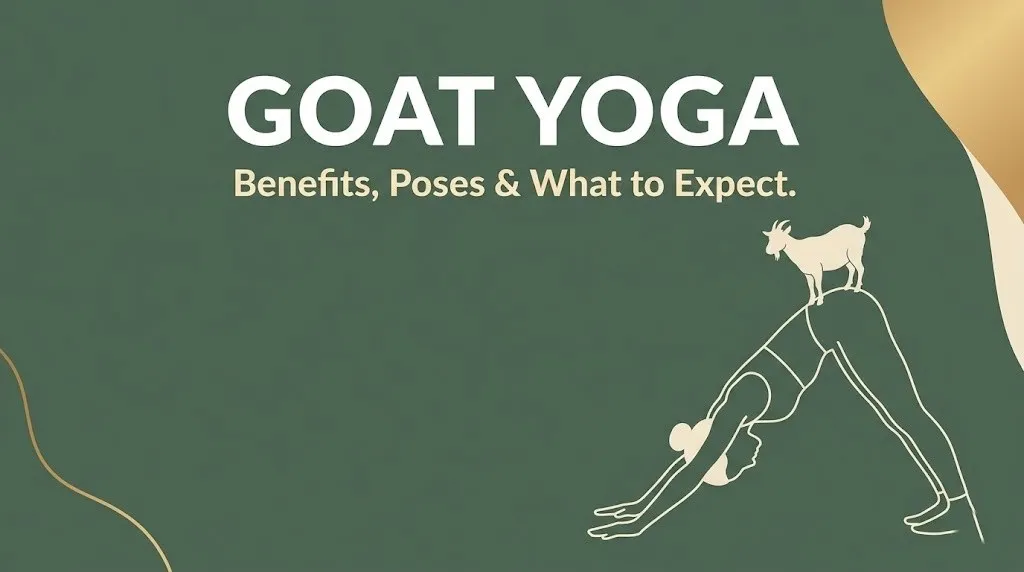
The class follows a real yoga format, usually a gentle or Hatha-style sequence on mats placed on grass or soft ground. The goats, typically small breeds like Nigerian Dwarf goats, are not restrained. They move freely through the class, sometimes sitting on participants’ backs during poses like Adho Mukha Svanasana (Downward-Facing Dog) or resting beside someone in Balasana (Child’s Pose).
The yoga instruction itself is led by a certified teacher. Participants follow cues, hold poses, and breathe intentionally. The goats simply add an unpredictable, tactile, and often humorous layer to the experience.
This blend of structured movement with animal contact and natural outdoor setting is what separates goat yoga from both a conventional studio class and a simple farm visit. It draws from the wellness principles of ecotherapy, social connection, and mindful movement at once.
Quick Summary:
- Setting: farm, pasture, or outdoor pen
- Class style: typically gentle or Hatha yoga
- Animals: usually small goat breeds, safe and socialized
- Instruction: led by a qualified yoga teacher
- Class length: usually 45 to 60 minutes
The History of Goat Yoga
Goat yoga was created by Lainey Morse in Albany, Oregon, in 2016, when she began hosting informal yoga sessions on her farm and invited participants to practice among her Nigerian Dwarf goats.
Morse was going through a difficult personal period and found that spending time with her goats significantly improved her mood. She invited a yoga teacher friend to hold a class on the farm, and the response was immediate. The concept went viral within months of its first event.
By 2017, goat yoga had spread across the United States, with farms from Arizona to Maine offering their own versions. Media coverage in The New York Times, NPR, and dozens of regional outlets accelerated its popularity. International versions appeared in the UK, Australia, and New Zealand by 2018.
As of 2026, goat yoga is an established segment of the wellness tourism and experiential fitness market. It has moved from novelty to a recognized entry point for people who are curious about yoga but find a traditional studio intimidating. That accessibility is a core part of its continued appeal.
What Is the Purpose of Goat Yoga?
The purpose of goat yoga is to make yoga more approachable and joyful by combining physical practice with the mood-lifting, stress-reducing effects of animal contact in a natural setting.
Yoga at its core aims to connect breath, body, and mind. Goat yoga adds a layer of spontaneity and laughter that many people find disarming. For someone who feels stiff, self-conscious, or intimidated by a studio environment, a goat wandering into the picture changes the emotional atmosphere entirely.
There is also a social dimension. Goat yoga classes tend to generate shared laughter and conversation. Research published in the International Journal of Environmental Research and Public Health has documented the social bonding effects of shared novel experiences, and an outdoor animal encounter during a yoga class certainly qualifies.
Beyond fun, the purpose extends to genuine wellness outcomes. Instructors guide participants through real yoga sequences. The movement, breathwork, and mindfulness elements are present and functional. The goats do not dilute the yoga; they reframe the stakes around it.
Key Takeaway: Goat yoga is not just a cute trend. It is a functional yoga class that lowers the emotional barrier to entry while delivering real movement and animal-contact benefits simultaneously.
What Are the Benefits of Goat Yoga?
Goat yoga offers the standard physical benefits of a yoga class plus the measurable psychological benefits of animal-assisted interaction, making it a multi-layered wellness activity.
On the physical side, even a gentle 45-minute yoga session builds flexibility, activates stabilizing muscles, and improves postural awareness. The quadriceps, hamstrings, glutes, core, and shoulder girdle all engage across a basic standing and floor pose sequence.
Contact with animals triggers the release of oxytocin, sometimes called the bonding hormone. Research from the American Psychological Association’s Human-Animal Interaction section notes that petting or physical contact with an animal is consistently associated with reduced cortisol and lowered heart rate.
Outdoor settings add their own layer. Harvard T.H. Chan School of Public Health researchers have documented that time in green or natural environments is independently associated with reduced psychological stress and improved mood. Combining yoga movement, animal contact, and outdoor exposure creates three converging wellness inputs in one class.
Goat Yoga Benefits at a Glance:
| Benefit | Mechanism | Research Basis |
|---|---|---|
| Stress reduction | Cortisol lowering via animal contact | American Psychological Association |
| Improved mood | Oxytocin release through touch | Human-Animal Interaction research |
| Flexibility and strength | Yoga pose sequences | Standard yoga physiology |
| Social connection | Shared laughter, group setting | Environmental health research |
| Nature exposure benefits | Outdoor green-space setting | Harvard T.H. Chan School of Public Health |
| Mindfulness practice | Breath cues, present-moment focus | NCCIH yoga research |
Goat Yoga and Mental Health
Goat yoga supports mental health through a combination of mindful movement, the parasympathetic activation that yoga provides, and the mood-elevating effects of human-animal interaction.
Standard yoga has a well-documented relationship with mental health outcomes. A 2021 review published in the Journal of Alternative and Complementary Medicine found that regular yoga practice was associated with reductions in perceived stress and improvements in self-reported well-being across diverse adult populations.
Add animal contact to that framework and the benefits compound. The act of a small goat resting on your back or nuzzling your hand during practice introduces a moment of pure, unscripted warmth. That kind of contact is difficult to manufacture in a conventional studio setting.
Laughter is also relevant here. Spontaneous laughter during a yoga class, which goat yoga reliably produces, has been associated with decreased cortisol and increased endorphin activity. This is sometimes referenced in the context of laughter yoga, a separate but related practice, and the physiological mechanism applies here regardless of the formal category.
For people managing mild depression, burnout, or chronic low-level stress, the combination of outdoor movement, social laughter, and animal contact offers a genuinely distinct therapeutic texture compared to a quiet indoor class.
Is Goat Yoga Good for Anxiety?
Goat yoga can support anxiety management because it combines breathwork and mindful movement with tactile animal contact, both of which have independently shown anxiety-reducing effects in published research.
The National Center for Complementary and Integrative Health notes that yoga, broadly defined, has shown promise in reducing symptoms of anxiety in multiple clinical and community-based studies. The breathwork component, specifically diaphragmatic breathing cued by a teacher during class, directly activates the parasympathetic nervous system and down-regulates the fight-or-flight stress response.
Animal-assisted interventions have their own anxiety literature. Studies reviewed in the Human-Animal Interaction Bulletin indicate that brief contact with animals, including in group settings, can reduce self-reported anxiety scores before and after the session.
That said, goat yoga is not a clinical treatment for anxiety disorders. If anxiety is significantly affecting your daily life, a registered mental health professional should be part of your care team alongside any complementary wellness activity you choose.
For mild, situational anxiety or general stress, the combination of a gentle yoga sequence, outdoor air, shared laughter, and the grounding presence of animals makes goat yoga a genuinely supportive option.
Key Takeaway: Goat yoga works on anxiety through three separate pathways at once: yogic breathwork, oxytocin from animal contact, and the mood lift of outdoor group laughter. That is a meaningful combination.
Animal-Assisted Yoga Benefits
Animal-assisted yoga refers to any yoga practice where trained or socialized animals are present, and research on this format consistently points to enhanced stress reduction and emotional engagement compared to solo practice.
The broader category of animal-assisted activities has been studied across healthcare settings. A systematic review published in Frontiers in Psychology found that animal-assisted interventions across varied populations produced consistent reductions in anxiety, depression, and perceived stress. Goat yoga fits within this category as an informal but structured version of that same principle.
The tactile element is significant. When a goat stands on your back during Adho Mukha Svanasana (Downward-Facing Dog), the gentle pressure creates a proprioceptive input. Proprioceptive stimulation, the sensory awareness of body position, is used in occupational therapy to promote nervous system regulation. In this context, it happens naturally and playfully.
The unpredictability of animals also keeps practitioners mentally present. In a standard class, it is easy to drift mentally while holding Virabhadrasana I (Warrior I). When a goat is chewing your ponytail, your attention is very much in the present moment. That incidental mindfulness is a genuine benefit, not just a funny side effect.
Animal-assisted yoga benefits compared to solo indoor yoga:
| Factor | Indoor Solo Yoga | Animal-Assisted Goat Yoga |
|---|---|---|
| Oxytocin activation | Minimal | High (via animal contact) |
| Laughter frequency | Low | High |
| Mindfulness prompts | Instructor-cued | Instructor + spontaneous animal interaction |
| Cortisol reduction | Moderate | Potentially enhanced |
| Social connection | Variable | Built-in, group setting |
| Nature exposure | None | Present in most classes |
What Happens in a Goat Yoga Class?
A goat yoga class follows a standard yoga sequence structure, typically 45 to 60 minutes long, held outdoors or in a covered farm space, with socialized goats moving freely through the group throughout the session.
You arrive, sign a waiver, and are shown to your mat space. Mats are typically placed on grass, rubber matting, or a clean farm surface. Small goats, often kids or Nigerian Dwarf breed adults, are brought into the space before class begins.
The class itself opens with a grounding breath exercise. The teacher then guides participants through a gentle warm-up, moving into standing poses, floor poses, and a closing relaxation. Common poses include Tadasana (Mountain Pose), Adho Mukha Svanasana (Downward-Facing Dog), Balasana (Child’s Pose), and Savasana (Corpse Pose).
Throughout the class, goats roam at will. They may climb on participants’ backs, stand beside mats, or simply graze nearby. There is almost always laughter. There are occasional surprises. The teacher keeps guiding the sequence regardless of what the animals are doing.
Classes typically end with 10 to 15 minutes of unstructured time to interact with the goats, take photos, and connect with other participants. Some farms offer optional goat feeding after class.
What to expect, step by step:
- Arrive 10 to 15 minutes early for check-in and waiver signing.
- Set up your mat in the designated space, usually in a pen or pasture area.
- Meet the goats during a brief pre-class introduction.
- Follow the teacher’s yoga sequence, typically gentle or Hatha-style.
- Expect goat visits during floor poses and quieter moments.
- Enjoy post-class open time with the animals.
Goat Yoga Poses
Goat yoga classes typically use accessible, floor-friendly Hatha yoga poses that are stable enough to hold while a goat may be sitting on or near you.
The pose selection in goat yoga is deliberate. Instructors choose shapes that are safe if interrupted, hold-able for longer durations, and accessible to mixed-ability groups. You will not typically find advanced arm balances or inversions in a goat yoga class.
Commonly practiced goat yoga poses:
| Pose (English) | Sanskrit Name | Why It Works in Goat Yoga |
|---|---|---|
| Downward-Facing Dog | Adho Mukha Svanasana | Flat back surface; goats love to climb on it |
| Child’s Pose | Balasana | Floor-level; passive hold; goats rest nearby |
| Mountain Pose | Tadasana | Standing; stable; used for transitions |
| Warrior I | Virabhadrasana I | Strong standing pose; good for group flow |
| Seated Forward Fold | Paschimottanasana | Floor-based; calming; goats often nuzzle during this |
| Corpse Pose | Savasana | Final rest; goats sometimes rest beside participants |
Pose Tip:
- In Adho Mukha Svanasana (Downward-Facing Dog), keep a micro-bend in the knees to protect the hamstrings.
- If a goat stands on your lower back, breathe normally and maintain your spinal alignment rather than collapsing.
- In Balasana (Child’s Pose), place a folded blanket between your thighs and calves if your knees are uncomfortable on the ground.
Key Takeaway: The poses in a goat yoga class are chosen for accessibility and stability. Even if you have never done yoga before, the sequence is designed to be manageable and interruptible.
Goat Yoga for Beginners
Goat yoga is well-suited for beginners because the informal, outdoor environment reduces self-consciousness, the poses are gentle and accessible, and the presence of goats shifts the group’s focus away from perfect form.
For someone stepping onto a yoga mat for the first time, the biggest barrier is often not physical. It is the fear of looking inexperienced in a room full of practiced yogis. Goat yoga dissolves that fear completely. When a goat is eating someone’s hair, nobody is watching how you get into Virabhadrasana I (Warrior I).
Most goat yoga instructors teach to a beginner baseline. They offer verbal modifications throughout class. Pose instructions are generally given with alignment cues and alternatives, making it easy to follow even without prior yoga experience.
Beginner preparation checklist:
- Wear comfortable, form-fitting clothing you do not mind getting dirty or covered in goat hair.
- Bring your own mat if possible, as rental mats may be limited outdoors.
- Arrive hydrated; outdoor classes can be warm depending on the season and location.
- Tell the instructor before class if you have any joint injuries or physical limitations.
- Keep a sense of humor. Things will go sideways. That is the point.
Modification note: If you are brand new to yoga and have tight hamstrings, use a slight knee bend in any forward fold. Keep transitions slow. You do not need to match anyone else’s depth or timing. The goats certainly won’t judge you.
Goat Yoga for Seniors
Goat yoga can be a safe and genuinely enjoyable option for older adults, provided the class format is gentle, the ground surface is stable, and participants disclose any mobility or balance limitations to the instructor beforehand.
Many goat yoga classes attract older participants specifically because the format is low-pressure and the natural setting is pleasant. The gentle Hatha sequences typically practiced do not require significant flexibility or prior conditioning.
That said, seniors should assess a few practical factors before booking. Getting up and down from a floor mat repeatedly can be challenging for those with hip or knee replacements, significant arthritis, or balance concerns. Some farms offer chair-accessible areas or can accommodate participants who need to stay seated for floor-based portions of class.
Goat Yoga Suitability for Seniors:
| Consideration | Details |
|---|---|
| Ground surface | Grass or rubber matting; ask the farm what surface is used |
| Chair modifications | Some farms offer seating alternatives for floor poses |
| Balance support | Bring a yoga block to assist with getting up and down |
| Physical demands | Low to moderate; comparable to a gentle Hatha class |
| Heat exposure | Outdoor morning classes are cooler; avoid midday summer sessions |
| Animal safety | Small goats are lightweight; 20 to 40 lbs typical |
Yoga Alliance guidelines suggest that instructors teaching older populations modify or offer alternatives for any pose involving significant spinal flexion or deep hip rotation. A good goat yoga instructor will do this naturally as part of a well-run class.
Goat Yoga vs. Regular Yoga
Goat yoga and regular studio yoga share the same foundational movement principles, but they differ substantially in setting, atmosphere, predictability, and the type of student they tend to attract.
A conventional Hatha or Vinyasa class in a studio is controlled, quiet, and focused. The teacher cues, you move, and the room’s energy is deliberately calm. Goat yoga is the opposite of controlled. It is warm, noisy, spontaneous, and social. Both experiences are genuinely valuable, and neither is a substitute for the other.
From a physical output standpoint, a studio Vinyasa class will typically offer a more challenging cardiovascular and strength workout than a goat yoga session. Goat yoga is closer in intensity to a gentle Hatha or Restorative yoga class. The focus is presence and accessibility, not progressive intensity.
Goat Yoga vs. Regular Yoga Comparison:
| Factor | Goat Yoga | Regular Studio Yoga |
|---|---|---|
| Setting | Outdoor farm or pen | Indoor studio |
| Pose difficulty | Beginner to moderate | Beginner to advanced |
| Atmosphere | Playful, social, loud | Calm, focused, quiet |
| Predictability | Low (animals involved) | High |
| Mindfulness style | Spontaneous, sensory | Structured, breath-led |
| Typical class length | 45 to 60 minutes | 60 to 90 minutes |
| Best for | Beginners, social wellness, fun | Progressive skill, deep practice |
| Weather dependent | Yes | No |
If you practice yoga regularly, goat yoga makes a wonderful occasional complement to your routine. It reawakens the playfulness that a serious practice can sometimes lose. If you are brand new, it is a genuinely excellent first step.
Key Takeaway: Goat yoga is closer to a gentle Hatha class than a dynamic Vinyasa practice. It is not a replacement for a regular yoga routine, but it is a genuinely worthwhile complement, especially for beginners and anyone who needs to laugh more.
Goat Yoga Safety Tips
Goat yoga is generally safe for healthy adults, but a few specific precautions reduce the risk of a negative experience for both the participant and the animals.
The most common mishap in goat yoga is not yoga-related at all. It is getting surprised by a goat, losing balance, and landing awkwardly. Small Nigerian Dwarf goats weigh between 20 and 40 pounds, but even that amount of unexpected weight on your back during Adho Mukha Svanasana (Downward-Facing Dog) can shift your alignment. Keep your core engaged and your breath steady when a goat climbs on you.
Animal allergies are a real consideration. If you have known sensitivities to animal dander, hay, or outdoor grasses, take appropriate steps before class. Antihistamines taken beforehand may help. Severe animal allergies are a reason to reconsider the activity entirely.
Pregnant participants should discuss attendance with their obstetric care provider, particularly for the later trimesters, as floor poses and the unpredictability of animal movement carry specific considerations during pregnancy.
Goat yoga safety checklist:
- Inform the instructor of any physical injuries, balance issues, or health conditions before class.
- Do not pull, lift, or restrain the goats; they roam freely and should remain free.
- Avoid wearing loose jewelry or dangling items that may attract goat chewing.
- Keep sunscreen and water accessible for outdoor sessions.
- If a goat position makes a pose feel unsafe, simply transition out calmly.
- People with severe animal allergies should avoid or consult an allergist first.
- Those with wrist conditions should use forearm plank modifications instead of full weight-bearing hand positions during Adho Mukha Svanasana (Downward-Facing Dog).
Goat Yoga Near Me
Finding goat yoga near you in 2026 is straightforward because the practice has expanded to farms, retreat centers, and agritourism venues in most U.S. states and across multiple countries.
Search terms like “goat yoga near me,” “farm yoga classes,” or “baby goat yoga” in your area will surface local farm event pages and booking platforms. Many farms run classes seasonally, particularly in spring when baby goats, called kids, are most plentiful and their smaller size makes them even more popular with participants.
Arizona remains one of the most active states for goat yoga, with multiple farms in the Gilbert, Scottsdale, and Phoenix metro areas offering weekly or weekend classes. Lainey Morse’s original Oregon operation, now branded as Arizona Goat Yoga, sparked much of the national growth. Nationally, goat yoga is now available in Texas, California, New York, Florida, the Pacific Northwest, and across the Midwest.
What to look for when booking a class:
| Factor | What to Look For |
|---|---|
| Class format | Led by a certified yoga instructor, not just a farm tour |
| Animal welfare | Goats should appear healthy, well-socialized, and not distressed |
| Group size | Smaller groups of 10 to 20 participants mean more goat interaction |
| Surface and setting | Grass or stable matting; shaded options for summer classes |
| Class level noted | Listed as beginner-friendly or all levels |
| Reviews | Look for mentions of instructor quality, not just cute goats |
Baby goat yoga classes, specifically held during kidding season (typically late winter through spring), tend to sell out quickly. If baby goats are important to you, book well in advance for February through May sessions.
Frequently Asked Questions About Goat Yoga
What is the point of goat yoga?
The point of goat yoga is to combine real yoga practice with the mood-lifting, stress-reducing effects of animal contact in an outdoor setting.
It lowers the emotional barrier to yoga for beginners while also delivering documented psychological benefits from human-animal interaction.
The result is a class that is physically beneficial, mentally supportive, and far more enjoyable for many people than a quiet indoor studio session.
What are the benefits of doing yoga with goats?
Yoga with goats offers the physical benefits of a Hatha-style yoga class alongside the oxytocin release and cortisol reduction associated with animal contact.
Research from the American Psychological Association’s human-animal interaction division links contact with animals to measurable reductions in stress hormones and improvements in mood.
The outdoor setting and shared laughter of the group add additional layers of emotional and social benefit.
What should I wear to a goat yoga class?
Wear comfortable, form-fitting athletic clothing that you do not mind getting dirty, covered in goat hair, or occasionally chewed at the edges.
Avoid flowing fabrics, dangly accessories, or anything with strong food smells that might make you an especially interesting target for curious goats.
Closed-toe shoes are best for arrival; you will remove them when you step onto your mat.
Is goat yoga good for beginners?
Goat yoga is an excellent choice for yoga beginners because the outdoor, informal setting removes the performance pressure of a traditional studio class.
The poses are kept at a gentle to moderate level, instructions are given with beginner-friendly cues, and the presence of the goats naturally redirects attention away from worrying about whether you are doing the pose correctly.
Tell the instructor before class that you are new, and they will give you appropriate modifications throughout.
Are there any risks or downsides to goat yoga?
The main risks are minor: unexpected animal movement can disrupt balance, outdoor conditions may be hot or muddy, and animal dander can affect allergy sufferers.
People with serious knee or hip conditions should check whether the class surface and floor-based poses are appropriate for their situation before booking.
Pregnant participants should discuss attendance with their obstetric care provider before class, particularly during the second and third trimesters.
Start Simple, Show Up Ready
Goat yoga asks nothing complicated of you. Wear clothes you can move in, bring water, leave your perfectionism in the car, and let a small goat teach you something a studio never quite can: that the practice does not need to be serious to be good for you.
If you are curious but nervous, book a morning class in a small group. Tell the instructor you are a beginner. Let the animal chaos do its work on your nervous system.
Yoga has always been about showing up fully. Goat yoga just adds hooves.