Acro Yoga: Beginner’s Guide to Poses, Roles, and Safety
Acro yoga is a partner practice that blends traditional yoga postures, acrobatics, and therapeutic bodywork into a single shared movement system. If you’ve seen someone gracefully balanced on another person’s feet and wondered what that was, you’ve seen acro yoga in action.
The practice has expanded considerably since AcroYoga International was co-founded by Jason Nemer and Jenny Sauer-Klein in 2003. The National Center for Complementary and Integrative Health recognizes partner-based movement practices as having documented benefits for physical conditioning, stress reduction, and interpersonal trust, all areas where acro yoga has genuine application.
This guide covers what acro yoga actually is, the two main traditions within it, the three roles every practitioner needs to understand, the physical requirements for safe practice, beginner poses with real alignment cues, and the safety information that most other guides skip entirely. By the end, you’ll know whether acro yoga is right for your body and where to begin.
What Is Acro Yoga
Acro yoga is a partner-based movement practice that combines yoga, acrobatics, and healing arts to create a shared physical experience between two or more people. One person (the base) supports another person (the flyer) using their feet, hands, or a combination of both, while a third person (the spotter) monitors safety throughout.
The practice was formalized in 2003 when Jason Nemer and Jenny Sauer-Klein co-founded AcroYoga International in San Francisco. Their framework drew from traditional Hatha yoga alignment principles, circus acrobatics, and Thai massage to create a practice that was simultaneously athletic and restorative.
Acro yoga differs from solo yoga in one fundamental way: it is never done in isolation. Every pose requires communication, weight-sharing, and mutual attention between at least two people. This interdependence is not incidental to the practice. It is the practice.
| Element | Solo Yoga | Acro Yoga |
|---|---|---|
| Number of participants | 1 | Minimum 2 (ideally 3 with spotter) |
| Load on body | Own bodyweight | Shared, includes partner’s weight |
| Communication required | Internal | Active verbal and physical |
| Injury risk level | Low to moderate | Moderate to high without instruction |
| Props commonly used | Blocks, straps, bolsters | Crash mat, spotter, shared touch |
The practice attracts people from varied backgrounds. Solo yoga practitioners find it extends their physical range into new dimensions. Gymnasts and acrobats find a slower, more breath-centered approach to movement. Complete beginners find it more social and dynamic than a solo mat practice.
Acrobatic Yoga vs Traditional Yoga: How They Differ
Acrobatic yoga, or acro yoga, differs from traditional yoga primarily in its reliance on partner interaction, shared bodyweight loading, and the physical skills it requires from practitioners. Traditional solo yoga builds strength, flexibility, and mindfulness within one person’s own body. Acro yoga builds all of those things while simultaneously requiring trust, communication, and the ability to support or be supported by another person’s weight.
Traditional yoga postures are grounded in hundreds of years of codified practice. Styles like Hatha yoga, Iyengar yoga, and Ashtanga yoga have detailed alignment systems, named poses in Sanskrit, and extensive modification frameworks for different bodies and abilities. Acro yoga is a much younger practice. Its pose names (Bird, Throne, Folded Leaf, Star) come from AcroYoga International’s developed vocabulary, not Sanskrit tradition.
Think of the difference between learning to ride a bicycle alone and learning to ride a tandem bicycle. Both develop balance, coordination, and cardiovascular fitness. The tandem version adds a layer of coordination with another person that a solo bike simply cannot replicate.
The skill sets required also differ in important ways:
- Traditional yoga: Flexibility, body awareness, breath control, single-body strength
- Acro yoga: All of the above, plus shoulder and wrist stability under load, proprioception under novel weight distribution, partner communication, and fall safety awareness
- Overlap: Core strength, hip flexibility, present-moment focus, and breath awareness serve both practices equally well
Practitioners who already have a strong solo yoga foundation often transition into acro yoga more smoothly than complete beginners because their body awareness is already developed.
The Two Traditions of Acro Yoga: Solar and Lunar
Acro yoga contains two distinct practice traditions, called Solar and Lunar, which have different physical characters, goals, and appropriate practitioners. Understanding the difference helps beginners choose where to start.
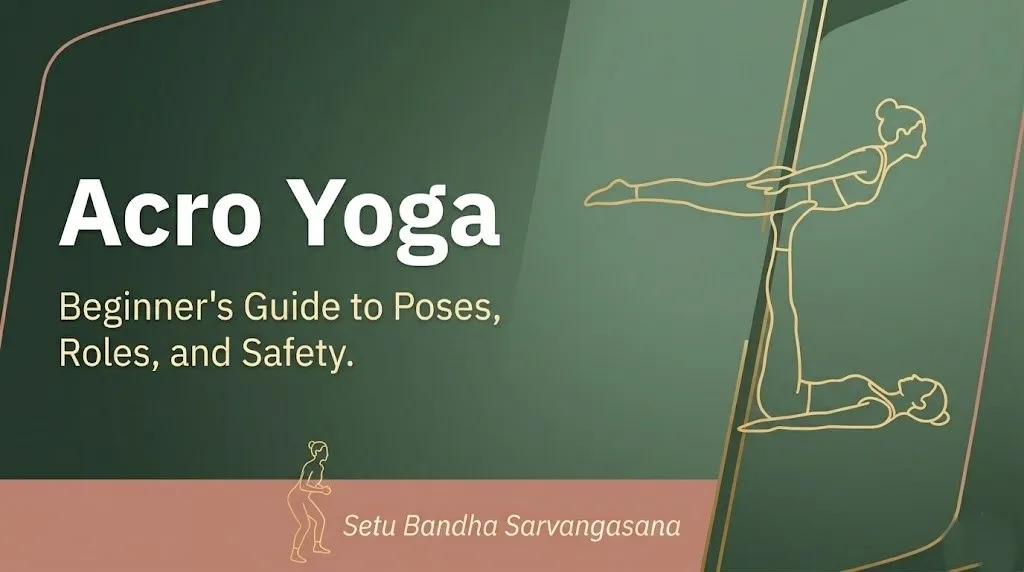
Solar acro yoga is the athletic, dynamic tradition. It draws from gymnastics and circus acrobatics. Solar practice involves active flyers performing poses mid-air, dynamic transitions between shapes, and sequences that build progressively toward more challenging acrobatic feats. Solar acro yoga requires physical strength, coordination, and confidence from both the base and flyer.
Lunar acro yoga, also called therapeutic flying, is the restorative tradition. It draws from Thai massage and healing bodywork. In lunar practice, the flyer is passive and receptive, draped over the base’s feet in supported shapes designed to decompress the spine, open the hips, and release tension throughout the body. The base acts as a skilled bodyworker using feet and legs rather than hands to provide traction and compression.
| Feature | Solar Acro Yoga | Lunar Acro Yoga |
|---|---|---|
| Physical demand | High (athletic) | Low to moderate (therapeutic) |
| Flyer role | Active, engaged | Passive, receptive |
| Draws from | Gymnastics, acrobatics | Thai massage, healing arts |
| Best for | Athletic practitioners | People seeking therapeutic bodywork |
| Beginner accessibility | Requires foundational strength | More accessible for deconditioned beginners |
| Injury risk if done incorrectly | Higher | Lower |
Most acro yoga classes taught today blend both traditions within a single session. Beginners are well-served by a predominantly Lunar entry point before exploring Solar poses.
Key Takeaway: Acro yoga has two traditions. Solar is athletic and dynamic; Lunar is therapeutic and restorative. Most beginners benefit from starting with Lunar therapeutic flying before attempting Solar acrobatic poses.
Acro Yoga Roles Explained: Base, Flyer, and Spotter
Every acro yoga practice involves three distinct roles: the base, the flyer, and the spotter. Understanding each role before stepping onto the mat is not optional. It is the foundation of safe practice.
The base is the practitioner who remains in contact with the ground throughout the practice. The base most often lies on their back with legs raised, using their feet to support the flyer’s weight through stable skeletal contact points on the flyer’s hips or torso. Being a good base requires more strength and body awareness than it visually appears to require. The base must stabilize their own position while tracking the flyer’s balance and adjusting micro-positioning constantly.
The flyer is the person elevated off the ground, supported by the base. Contrary to popular assumption, being a flyer does not require being small or light. It requires the ability to hold a strong body line, engage core muscles actively, and communicate clearly about what feels stable or unsafe. A flyer who goes completely limp creates an unpredictable load that is much harder for the base to manage than a physically engaged flyer of greater bodyweight.
The spotter stands beside the base and flyer throughout the practice. Their job is to prevent falls, guide the flyer safely to the ground if a pose collapses, and provide verbal cues about alignment. According to the American College of Sports Medicine, supervised partner exercise significantly reduces injury incidence compared to unsupervised partner activity. In acro yoga, no beginner should practice without a qualified spotter present.
Spotter responsibilities include:
- Standing within arm’s reach of the flyer at all times
- Watching the flyer’s head and neck as the highest priority protection points
- Not catching the base: the base is on the ground; the spotter protects the flyer
- Calling out alignment issues they observe from their external vantage point
- Guiding the flyer down in a controlled manner if the pose begins to fail
Physical Benefits of Acro Yoga
Acro yoga offers a wide range of physical benefits that come from the combination of active strength work, passive stretching, and the novel demand of managing weight-sharing with another person. These benefits apply to both the base and the flyer, though the specific physical systems engaged differ by role.
For the base, the primary physical demands are core stabilization, leg strength through the hip extensors and quadriceps, and shoulder and arm strength when hands are used to support the flyer. Bases develop functional strength in positions that resemble loaded hip extension patterns, which physical therapists and strength coaches associate with improved posterior chain resilience.
For the flyer, the primary physical demands are core engagement to maintain a rigid body line, shoulder stability in positions where the arms are used for balance or support, and hip flexor and hamstring flexibility in poses that require hip extension in the air. Flyers also develop proprioception, the body’s sense of its own position in space, at a rate that solo yoga cannot easily replicate because the flyer is processing balance cues in an entirely unfamiliar spatial orientation.
A study published in the Journal of Alternative and Complementary Medicine found that partner yoga practices improve both upper body strength and flexibility more effectively over an 8-week period than equivalent solo yoga practice, attributed to the added load and novel movement demands of partner work.
Physical benefits that practitioners across both roles commonly report:
- Improved core strength: Both roles demand sustained core engagement
- Shoulder stability: Base and flyer roles both load the shoulder girdle in functional patterns
- Hip and spinal mobility: Therapeutic flying poses create spinal traction and hip opening not achievable in solo practice
- Balance and proprioception: Flyers develop spatial awareness rapidly in novel positions
- Upper body endurance: Bases develop holding strength; flyers develop pushing strength
- Grip and forearm strength: Relevant to both roles during connected poses
Acro Yoga for Beginners: What You Need to Know First
Acro yoga for beginners is absolutely accessible, but it requires more preparation and more structure than most other yoga styles because you are not only managing your own body. You are sharing physical responsibility with at least one other person.
The single most important thing beginners need to understand is this: acro yoga is not something to attempt from a YouTube video alone, without a trained teacher or qualified spotter present. This is not overcaution. It is the standard position of AcroYoga International and experienced teachers across the global acro yoga community.
Starting acro yoga correctly means beginning with three essentials:
- Find a class with a certified or experienced acro yoga teacher. A teacher who has trained in both Solar and Lunar traditions can assess your baseline strength, explain biomechanics, and correct alignment before bad habits form.
- Choose a reliable practice partner. Beginners should practice with someone of similar height and similar strength-to-weight ratio when possible. This is not a rigid rule, but it eases the initial learning curve considerably.
- Practice on a crash mat or thick yoga mat. A standard 4 mm yoga mat is insufficient cushioning for acro yoga. A minimum 10 mm mat or dedicated gymnastics crash pad is appropriate for beginner floor-level base work.
The National Center for Complementary and Integrative Health notes that yoga practices involving partner assistance require clear communication protocols between participants to maintain safety. In acro yoga, this means establishing verbal check-in language (“ready,” “flying,” “down”) before the first practice session, not during it.
Beginners should expect to spend their first two to four sessions in base and low-flyer positions before attempting any elevated poses.
Key Takeaway: Acro yoga is beginner-accessible but not self-teachable. Your first sessions should be in a class with a qualified teacher, a reliable partner, and a crash mat, not at home from a video.
Physical Prerequisites for Acro Yoga: Strength and Flexibility Needs
Acro yoga has real physical prerequisites that most introductory articles ignore entirely. Attempting acro yoga without meeting these baseline requirements increases injury risk for both the base and the flyer.
For the base role, yoga teachers and physical therapists who work with acro yoga beginners generally recommend:
- Ability to hold a supported bridge position for at least 30 seconds without lower back strain
- Ability to press both legs straight up against gentle resistance without the knees collapsing inward
- Core strength sufficient to hold a tabletop abdominal brace while the legs are in the air
- No active wrist, elbow, or shoulder injury on the side that will bear weight in connected base positions
For the flyer role, baseline requirements include:
- Ability to hold a plank position for 30 seconds with a neutral spine and no sagging hips
- Ability to perform a standing single-leg balance for at least 10 seconds on each side, indicating baseline proprioception
- No active fear of heights sufficient to prevent relaxing in an elevated position
- No active shoulder instability on the side used for arm-balance connection points
Flexibility is relevant but secondary to strength for acro yoga safety. A practitioner with moderate flexibility and strong core and shoulder stability is safer in both roles than a highly flexible practitioner with little functional strength.
According to the American Council on Exercise, proprioceptive ability, the body’s capacity to sense its position in space, is the primary predictor of success and safety in partner balance activities. This can be developed through solo balance practice before beginning acro yoga.
Acro Yoga Safety: How to Prevent Injuries
Acro yoga injuries are preventable in the large majority of cases when beginners follow structured safety protocols. The most common injuries in acro yoga, based on reports from AcroYoga International instructors and physical therapists working with the acro community, are wrist sprains in bases, shoulder strains in flyers, lower back strain in bases, and impact injuries from falls in flyers.
Every one of these injury types becomes significantly less likely with three non-negotiable safety practices.
First: always use a spotter until both partners have demonstrated consistent success with a pose at least 10 consecutive times. Ten is the benchmark most experienced acro yoga teachers use before removing the spotter from a beginner pair.
Second: establish a fall protocol before every session. Flyers should know how to land feet-first or shoulder-roll safely before they are elevated more than a foot off the ground. This is taught in every well-run beginner acro yoga class and should not be skipped.
Third: never practice when fatigued. The American College of Sports Medicine notes that neuromuscular fatigue significantly impairs proprioception and reaction time. In partner balance practice, a fatigued base whose leg gives way under the flyer creates a fall scenario that a rested base would never produce.
Safety protocol summary for every session:
- Warm up both partners’ wrists, shoulders, and hips before any base or flyer work
- Establish verbal communication signals (“ready to fly,” “coming down,” “stop”) before beginning
- Use a crash mat under and around the practice area
- Start every session with poses already mastered before attempting new ones
- End any practice session if either partner reports pain, dizziness, or excessive fatigue
Who Should Not Do Acro Yoga
Some practitioners should approach acro yoga with significant caution, and others should avoid it entirely until a healthcare provider familiar with their specific condition has confirmed that the physical demands are safe for their body.
Practitioners who should avoid the flyer role without first consulting a physician or physical therapist include:
- People with osteoporosis or low bone density: Flyer falls, even from low heights, carry fracture risk that is not present in ground-level yoga.
- People with vertigo or vestibular disorders: Elevated positions and the movement of being lifted and lowered can trigger episodes that make safe landing impossible.
- People with uncontrolled high blood pressure: Inverted flyer positions create cardiovascular demands that require physician clearance for anyone with active hypertension.
- People in their second and third trimesters of pregnancy: Elevated positions, fall risk, and abdominal compression in flyer poses create risks that outweigh benefits during pregnancy.
- People recovering from shoulder surgery or rotator cuff repair: Flyer poses load the shoulder in ways that can stress healing tissue.
Practitioners who should avoid the base role without clearance include:
- People with active lower back conditions, including herniated discs: Base work loads the lumbar spine in extension under an external load.
- People with wrist fractures or sprains in the acute or sub-acute recovery phase.
- People with knee replacement history: Discuss with your orthopedic surgeon before attempting base work that loads the knee joint under a flyer’s weight.
For practitioners in any of these categories, Lunar therapeutic flying in the passive flyer role with an experienced base and no elevated positions can sometimes be appropriate, but it requires qualified teacher supervision and, where indicated, guidance from a physical therapist who understands the specific practice demands.
Key Takeaway: Wrist and shoulder injuries, vertigo, osteoporosis, uncontrolled blood pressure, and mid-to-late pregnancy are all real reasons to pause before attempting acro yoga until you have appropriate professional guidance.
Beginner Acro Yoga Poses with Step-by-Step Instructions
Beginner acro yoga practice starts on the ground, with the base lying on their back and the flyer positioned at hip height before any elevation occurs. The two foundational beginner poses are Front Plank and Bird, both developed within the AcroYoga International framework.
Front Plank is the base entry pose for all Solar acro yoga work. The base lies on their back. The flyer stands at the base’s hips and the base places their feet on the flyer’s hip bones. Both partners hold the same hand position.
To practice Front Plank:
- Base lies flat on their back, knees bent, feet flat on the floor.
- Flyer stands at the base’s hips, facing the base’s head.
- Base places the balls of both feet against the flyer’s hip bones (the anterior superior iliac spine, or AISC).
- Both partners clasp hands: flyer reaches down, base reaches up, grip at the wrist for security.
- Flyer leans their bodyweight into the base’s feet as the base presses their legs upward slowly.
- Base straightens legs to approximately 80 to 90 degrees, not fully locked.
- Flyer engages core and glutes, maintaining a straight body line from head to heels.
- Hold for 3 to 5 breath cycles. Spotter stands at the flyer’s shoulders throughout.
- To release: flyer bends knees, base lowers legs, flyer steps back to the ground.
Modification for beginners: Keep the base’s knees at 60 degrees rather than extended fully. This reduces load on the base’s core and gives the flyer a lower starting height to build confidence.
Do not attempt Front Plank without a spotter present during the learning phase.
Easy Acro Yoga Poses for First-Time Partners
The most accessible acro yoga poses for first-time partners are ground-level or low-elevation poses that build partner communication and weight-sharing awareness before any significant height is involved.
Throne is the most beginner-accessible acro yoga pose. It requires no elevation and builds the weight-sharing awareness that elevated poses depend on.
To practice Throne:
- Base sits cross-legged on the mat in Sukhasana (Easy Pose).
- Flyer stands behind the base, facing the same direction.
- Flyer places their hands on the base’s shoulders for initial balance.
- Base places their hands on the flyer’s shins as the flyer steps one foot onto each of the base’s thighs.
- Flyer brings feet to rest on the base’s thighs with weight distributed evenly.
- Both partners breathe and communicate about comfort and stability.
- Hold for 5 breath cycles, then flyer steps carefully back to the ground.
Modification: Flyer can practice standing on one thigh first, keeping the other foot on the ground, before attempting both feet simultaneously.
Bird is the first elevated acro yoga pose most teachers introduce. It builds on the body-line awareness developed in Front Plank.
Pose Tip:
- Base feet should contact the flyer’s hip bones, not the lower abdomen or upper thighs
- Flyer engages their core throughout: a limp body is harder to balance than a toned one
- Spotter stands at the flyer’s head and shoulders, not at the base’s feet
- Beginners should hold Bird for no more than 3 breath cycles before their first ten successful repetitions
Acro Yoga Warm-Up Exercises Before You Fly
Warming up before acro yoga is not optional preparation. It is the single most effective injury prevention tool available to beginner practitioners. Wrist, shoulder, and hip preparation specifically target the joints most commonly stressed in both base and flyer roles.
The warm-up serves two purposes simultaneously. It prepares the joints and muscles for the demands of the practice. It also builds the communication pattern between partners before weight-sharing begins, which experienced teachers describe as “tuning in” to each other’s movement quality and rhythm.
A complete pre-session acro yoga warm-up should include:
Wrist preparation (5 minutes):
- Wrist circles in both directions, 10 repetitions each
- Tabletop wrist flexion and extension, pressing palms flat then lifting fingers
- Prayer position wrist stretches held for 30 seconds each direction
- Knuckle pushups (base role practitioners), 10 repetitions
Shoulder preparation (5 minutes):
- Shoulder rolls, 10 forward and 10 backward
- Cross-body shoulder stretch, 30 seconds each side
- Thread-the-needle stretch in tabletop, 5 breaths each side
- Puppy pose (Anahatasana, or Extended Puppy Pose) held for 1 minute to open the chest and anterior shoulder
Hip and core preparation (5 minutes):
- Supta Pavanamuktasana (Wind-Relieving Pose), 5 breaths each side
- Bridge lifts, 10 repetitions with core braced (base role preparation)
- Plank hold, 30 seconds (flyer role preparation)
- Navasana (Boat Pose) held for 5 breaths (bilateral core activation)
According to the American Council on Exercise, a structured warm-up that includes both joint mobility and muscle activation reduces soft tissue injury incidence in partner exercise by preparing neuromuscular response patterns before load is applied.
Key Takeaway: A 15-minute warm-up targeting wrists, shoulders, and hips is the most practical injury prevention step for every acro yoga session, not just the first one.
Advanced Acro Yoga Poses: What to Work Toward
Advanced acro yoga poses are the visible expressions of years of foundational skill building in both roles. They are not starting points. They are destinations that become available to practitioners who have mastered the mechanical and communication skills developed through hundreds of repetitions of foundational poses.
The most recognized advanced Solar acro yoga poses include:
| Pose Name | Description | Prerequisite Skills Required |
|---|---|---|
| Star | Flyer balances on base’s feet in a standing split orientation | Solid Bird, strong flyer hip flexors |
| High Flying Whale | Flyer inverted, base feet on flyer’s sacrum | Flyer comfortable inverted; base strong hip extension |
| Reverse Star | Flyer faces away from base in a Star orientation | Star mastered; strong bilateral shoulder stability in flyer |
| Supported Handstand | Flyer performs handstand on base’s feet | Solo handstand competency; advanced base leg stability |
| Icarian (dynamic passing) | Base tosses and catches flyer between positions | Multiple advanced poses mastered; intensive spotter presence |
No practitioner should attempt these poses without direct supervision from a certified acro yoga teacher. The American College of Sports Medicine classifies partner balance activities at this level as high-risk exercises requiring qualified instruction and spotter presence at all times.
The realistic progression timeline for an adult beginner practicing twice per week:
- Months 1 to 3: Throne, Front Plank, Bird, Folded Leaf (Lunar)
- Months 4 to 6: Whale, Star, basic transitions between grounded poses
- Months 7 to 12: High Star, Reverse Star, dynamic transitions
- Year 2 and beyond: High Flying Whale, Icarian progressions, handstand work
Individual timelines vary based on existing strength, proprioception, and the quality of instruction received.
Acro Yoga for Couples and Partner Yoga
Acro yoga for couples offers a distinct set of benefits that differ from what either partner experiences in solo yoga practice. Partner yoga in the broader sense includes seated partner poses, mirrored standing sequences, and assisted stretching. Acro yoga specifically adds the dimension of one partner supporting another’s full bodyweight.
Research published in the Journal of Alternative and Complementary Medicine suggests that partner yoga and touch-based movement practices improve both interpersonal trust and stress response regulation between participants, with effects measurable after just four weeks of regular practice. The communication demands of acro yoga, specifically the need to verbalize feelings of stability, discomfort, and readiness in real time, build a relational skill that transfers beyond the mat.
Couples beginning acro yoga together should know:
- Height similarity matters less than assumed. A 5’4″ base can support a 5’10” flyer in many foundational poses. Strength relative to the flyer’s bodyweight is more relevant than the base’s absolute size.
- Weight difference is not a barrier in Lunar practice. Therapeutic flying works with gravity in ways that make the absolute weight of the flyer less relevant than in Solar acrobatic poses.
- Starting with Lunar therapeutic flying is often better for couples than starting with Solar acrobatics, because the Lunar approach is slower, more communicative, and focuses on giving and receiving care.
- Ego is the most common obstacle. Both partners must be willing to learn, to be clumsy, and to give feedback honestly without it becoming a relationship tension point.
For couples where one partner has prior yoga experience and one does not, the experienced practitioner does not automatically make the better base. Base skill is specific to acro yoga and develops independently of solo yoga experience.
How to Find an Acro Yoga Class or Community
Finding qualified acro yoga instruction is the most important step any beginner can take before attempting the practice. An acro yoga class with a certified teacher is genuinely different from a general yoga class that occasionally incorporates partner poses.
Qualified acro yoga teachers have typically completed training through AcroYoga International’s certification program or through recognized teacher training programs that include acrobatics safety, spotting technique, and therapeutic flying protocols. When evaluating a class or teacher, Yoga Alliance recommends looking for teachers who can clearly articulate their specific training background and who prioritize safety protocols in every session.
What to look for when finding a class:
- Teacher training: Ask whether the teacher has completed an AcroYoga International or equivalent certification. A general yoga teacher certification does not automatically include acro yoga competency.
- Class size: Smaller classes (under 12 participants) allow teachers to spot multiple pairs effectively. Large open-level acro classes are not ideal for beginners.
- Spotter availability: A quality beginner class always has dedicated spotters, either assistant teachers or advanced students, available for every new pair attempting elevated work.
- Progression structure: The best beginner classes spend the first several sessions entirely on ground-level communication and body mechanics before any elevation occurs.
- Crash mat availability: Any studio teaching acro yoga should have appropriate crash padding for beginner work.
If no local classes are available, many AcroYoga International certified teachers offer online skill-building programs specifically designed to develop the prerequisite strength and body awareness needed before in-person partner practice begins.
Acro yoga festivals and community jams are wonderful for experienced practitioners but are not appropriate settings for beginners’ first exposure. Find a structured beginner course first.
Frequently Asked Questions About Acro Yoga
What is acro yoga and how is it different from regular yoga?
Acro yoga is a partner practice combining yoga, acrobatics, and healing arts, where one person (the base) supports another (the flyer) using their feet and hands.
Regular yoga is a solo practice focused on individual poses, breath, and mindfulness without the weight-sharing or partner communication that acro yoga requires.
The key distinction is that acro yoga is inherently relational and physically interdependent, while traditional yoga is practiced within one person’s own body.
Do I need to be strong or flexible to start acro yoga?
You need a baseline level of functional strength more than exceptional flexibility to begin acro yoga safely.
Specifically, you should be able to hold a plank for 30 seconds (flyer role) or support a bridge position for 30 seconds (base role) before your first session.
Flexibility helps but is secondary to core stability, shoulder control, and the proprioceptive awareness needed to manage an unfamiliar bodyweight load.
What are the three roles in acro yoga?
The three roles in acro yoga are the base (who supports the flyer from the ground using feet and hands), the flyer (who is elevated and balanced by the base), and the spotter (who stands beside both to prevent falls and guide alignment).
Every beginner session requires all three roles to be present and understood by every participant.
Skipping the spotter role in beginner practice is the single most common safety error in acro yoga.
Is acro yoga safe for beginners?
Acro yoga is safe for beginners when practiced in a class setting with a certified teacher, a reliable partner, and a qualified spotter.
Without these three elements, the injury risk for both the base and the flyer is meaningfully higher than in any solo yoga practice.
Learning correct fall technique and verbal communication protocols before attempting elevated poses is what makes beginner acro yoga safe rather than risky.
What are the easiest acro yoga poses to start with?
The easiest acro yoga poses for first-time partners are Throne (a ground-level seated balance), Folded Leaf (a passive Lunar pose where the flyer rests draped over the base’s legs), and Front Plank (the foundational elevated base pose).
Throne requires no elevation at all and builds the weight-sharing awareness that all elevated poses depend on.
Most certified acro yoga teachers recommend spending at least two full sessions on Throne and Folded Leaf before attempting Front Plank or Bird.
Start on the Ground, Not in the Air
The most common beginner mistake in acro yoga is rushing to elevation before the communication and body mechanics are solid. Start with Throne. Practice it ten times until stepping onto your partner’s thighs feels natural and calm. Then move to Front Plank with a spotter. Let the progression happen at the pace your body and your partner’s body actually need.
Find a certified teacher for your first sessions. That one investment will shape every session that follows.
Acro yoga rewards patience with something no solo practice can offer: the genuine physical experience of trust made visible between two people.