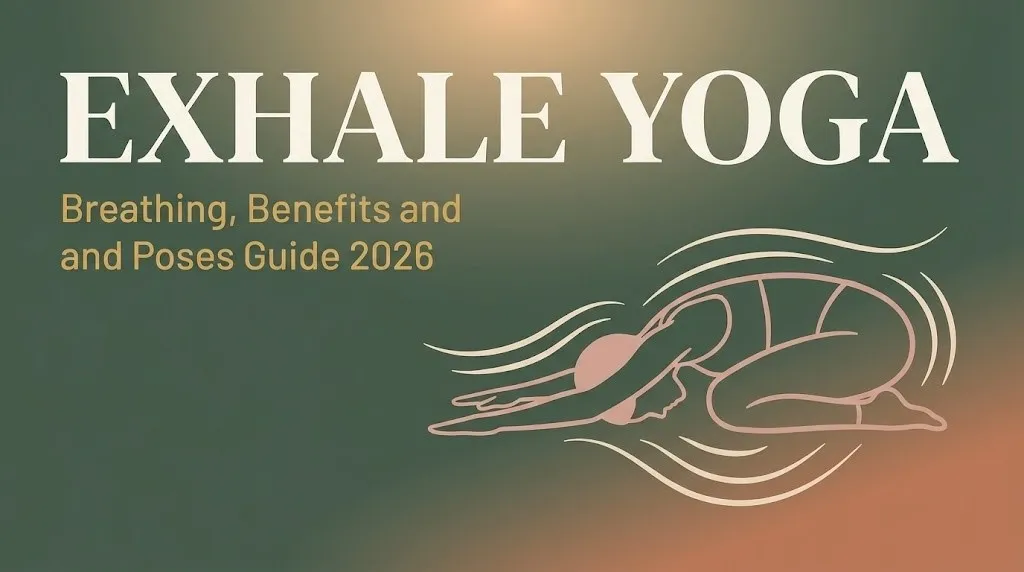
Exhale Yoga: Breathing, Benefits and Poses Guide 2026
Exhale yoga refers to any yoga practice that places intentional emphasis on the quality, length, and timing of the exhale breath, and it is one of the most well-researched approaches to reducing stress and improving body mechanics through movement. Whether you have heard “exhale yoga” as a breathing concept, encountered it in a Vinyasa class, or are looking for information about Exhale Yoga Louisville specifically, this guide covers the full picture.
The breath is not a background detail in yoga. The National Center for Complementary and Integrative Health identifies yoga’s breath-movement integration as one of its primary mechanisms of benefit, distinguishing it from other forms of exercise that do not systematically train respiratory patterns. Research published in the International Journal of Yoga has found that breath-focused yoga practice is associated with measurable reductions in anxiety, improved heart rate variability, and better self-reported stress management.
This guide covers what exhale yoga means as a practice concept, the specific breathing techniques used, how the exhale connects to individual poses, the science behind it, what it does for your nervous system and back health, and what a first-timer should know about Exhale Yoga Louisville. You will leave with both the understanding and the practical tools to apply exhale-focused breathing today.
Exhale Yoga: What It Is and Why It Matters
Exhale yoga is a breath-centered approach to yoga practice in which the exhale is used consciously to deepen poses, activate the parasympathetic nervous system, and create a rhythm that connects movement to breath in a purposeful way. It is not a single yoga style. It is a foundational concept that applies across Hatha, Vinyasa, Yin, and Restorative yoga.
The exhale is the release half of the breathing cycle. When you exhale, the diaphragm relaxes upward, the ribcage drops, the transverse abdominis gently engages, and the body naturally enters a state of relative physical and neurological softening. Yoga teachers have used this mechanical fact for thousands of years to time poses and transitions.
In practice, this means forward folds, twists, and spinal flexion poses are consistently cued on the exhale. That timing is not arbitrary. The body’s natural biomechanical response to the exhale makes these movements feel more accessible and more anatomically appropriate.
Understanding exhale yoga as a concept changes how you practice. Instead of treating breath as something that happens in the background while you focus on your limbs, you begin using it as the actual driver of the practice. That shift produces better results in flexibility, relaxation, and body awareness than focusing on the physical shapes alone.
Quick Summary:
- Exhale yoga emphasizes using the exhale consciously in movement and breathwork
- It applies across yoga styles, not limited to one method
- The exhale activates the parasympathetic nervous system and supports spinal flexion
- Intentional exhale timing improves pose depth and reduces injury risk
What Is Exhale Yoga and Why Does It Matter for Your Practice?
Exhale yoga matters because the exhale is the half of the breath cycle that directly activates your body’s calming system, and most people breathe shallowly and passively rather than using the exhale as an active, intentional tool. Most yoga practitioners underuse the exhale. Teaching it changes everything downstream.
The vagus nerve is the primary pathway through which the exhale affects the nervous system. When you exhale slowly and completely, the vagus nerve signals the heart to slow down, the digestive system to activate, and the body’s overall tension to decrease. This is the physiological basis of what yoga teachers call “the calming breath.”
The practical implication is straightforward. A three-second exhale has a different physiological effect than a six-second exhale. Extending the exhale duration, even by two to three seconds, measurably shifts the body toward a parasympathetic state. This is why exhale-focused yoga sequences are particularly effective for people managing anxiety, sleep difficulties, or chronic stress.
The structural importance is equally practical. A full exhale creates space for the next inhale to be deeper. Practitioners who exhale incompletely before the next inhale chronically breathe with a shallower oxygen exchange cycle. Over a 60-minute yoga class, incomplete exhales add up to a considerably less effective breath practice.
According to research published in Frontiers in Human Neuroscience, slow, controlled exhalation consistently produces greater heart rate variability improvements than inhalation-focused breathing patterns. Higher heart rate variability is a well-established marker of autonomic nervous system health and stress resilience.
Modification for beginners: If consciously extending the exhale feels effortful or produces lightheadedness, return to natural breathing and simply notice the exhale without controlling it. Breath control develops gradually with practice.
The Science Behind the Exhale in Yoga
The science behind the exhale in yoga connects respiratory physiology, neuroscience, and biomechanics in a way that explains why breath-movement coordination is so central to yoga’s documented health effects. This is not spiritual language. It is measurable physiology.
During the exhale, carbon dioxide leaves the lungs. Blood pH rises slightly. The heart rate slows. The parasympathetic branch of the autonomic nervous system becomes more dominant. This is called the respiratory sinus arrhythmia response. It is the same mechanism that makes slow breathing, mindfulness meditation, and certain forms of biofeedback effective for stress reduction.
On a muscular level, the exhale engages the internal intercostal muscles and the deep abdominal wall, particularly the transverse abdominis. This gentle core activation during exhalation provides natural spinal support. It is one reason why breathing correctly during challenging yoga poses creates more stability than bracing with held breath.
The thoracic spine flexes more freely on the exhale than on the inhale. The lumbar spine also decompresses during a full exhalation. These facts explain the yoga teacher’s instruction to “release deeper into the pose on your exhale.” That cue is anatomically accurate. The body actually has more mechanical range at the end of the exhale than at the end of the inhale.
A 2017 meta-analysis published in the Journal of Alternative and Complementary Medicine found that yogic breathing practices, including those emphasizing extended exhalation, were associated with statistically meaningful reductions in salivary cortisol, a primary biomarker of stress response, across multiple study populations.
Key Takeaway: The exhale is not passive. It actively shifts your nervous system toward calm, compresses CO2 out of the lungs, engages deep core muscles, and creates mechanical space for deeper movement in yoga poses.
Exhale Yoga Breathing Techniques
The main exhale-focused breathing techniques in yoga are Ujjayi pranayama, Brahmari pranayama (Humming Bee Breath), Sitali pranayama (Cooling Breath), extended exhale ratio breathing, and Nadi Shodhana (Alternate Nostril Breathing) with an extended exhale phase. Each produces a distinct effect.
Exhale breathing techniques are the most underteached element of beginner yoga instruction. Most introductory yoga classes in Louisville and nationally focus on poses and alignment, covering breath briefly and moving on. That gap means many practitioners never develop the breath control that would make their physical practice more effective.
The simplest starting technique is extended exhale ratio breathing. The standard starting ratio is 4 counts inhale, 6 counts exhale. No specific technique, no throat constriction, no breath retention. Just breathing in for four counts and out for six. This ratio immediately shifts the autonomic balance toward parasympathetic dominance.
| Technique | Inhale | Exhale | Best Use | Avoid If |
|---|---|---|---|---|
| Extended exhale ratio | 4 counts | 6 to 8 counts | Stress, anxiety, pre-sleep practice | Active dizziness or hyperventilation history |
| Ujjayi pranayama | Constricted throat | Constricted throat exhale | Vinyasa flow, heated practice | Throat conditions, severe sinus congestion |
| Brahmari (Humming Bee Breath) | Natural | Humming tone | Anxiety, headache, emotional regulation | Ear infection, pregnancy (some sources advise caution) |
| Nadi Shodhana | Alternate nostril | Alternate nostril, extended | Balancing, focus, pre-meditation | Nasal obstruction, respiratory illness |
| Sitali | Curled tongue inhale | Natural nose exhale | Cooling, summer practice, overheating | Very cold environments |
Modification for beginners: Start with the 4-count inhale, 6-count exhale ratio without any nasal or throat constriction before attempting Ujjayi. Simple ratio breathing is both effective and accessible before adding technique complexity.
Ujjayi Exhale: How to Practice It Correctly
Ujjayi pranayama, often called Ocean Breath or Victorious Breath, is the most widely used exhale technique in Vinyasa and Hatha yoga, and the exhale component is where most beginners make technique errors. Correct Ujjayi is a gentle, audible constriction at the back of the throat, not a forced nasal sound.
The exhale in Ujjayi is produced by slightly narrowing the glottis, the space between your vocal cords. Think of the gentle sound you make when fogging a mirror, but with your mouth closed. The result is a soft, ocean-like sound on both inhale and exhale. The exhale in Ujjayi is typically slightly longer than the inhale in most yoga contexts.
To practice Ujjayi breath:
- Sit or lie comfortably. Close your eyes and relax your jaw.
- Inhale naturally through the nose for 4 counts.
- On the exhale, gently constrict the back of the throat. Let a soft hissing or ocean sound emerge.
- Exhale fully for 5 to 6 counts through the nose with the throat constriction maintained.
- Pause briefly at the end of the exhale before initiating the next inhale.
- Repeat for 8 to 10 breath cycles before applying to movement.
The exhale in Ujjayi serves multiple functions. It lengthens the breath. It creates internal heat. It provides an auditory anchor for the mind, which reduces distraction during challenging sequences.
Modification for people with throat sensitivity or vocal strain: Practice the exhale through a slightly open mouth first, as if whispering “haah.” Once the throat sensation is familiar, close the mouth and recreate the same constriction with lips sealed.
Safety note: Ujjayi should never feel forced or strained. If the throat feels tight or the breath feels labored, release the constriction and return to natural breathing.
Extended Exhale Breathing for Anxiety and Stress
Extended exhale breathing is a technique in which the exhale is deliberately lengthened to be longer than the inhale, and it is one of the most well-supported non-pharmacological approaches to reducing acute anxiety and stress response. The ratio matters. The length matters.
Starting with a 4:6 ratio (four counts inhale, six counts exhale) and progressing toward 4:8 as comfort increases produces measurable results within a single session. Research does not require weeks of practice to show an effect. Even a five-minute session of extended exhale breathing has been shown to reduce heart rate and self-reported anxiety.
According to research published in Frontiers in Human Neuroscience, breathing patterns with exhale-to-inhale ratios of 1.5:1 or greater were associated with greater improvements in heart rate variability than equal-ratio breathing in healthy adults. Heart rate variability is directly associated with the body’s ability to regulate stress response.
Extended exhale breathing is particularly well-suited to Restorative and Yin yoga classes, where long pose holds create the time and stillness needed to practice it. In faster Vinyasa sequences, the exhale naturally extends as practitioners become more experienced with breath control.
A practical five-minute extended exhale practice:
- Lie in Savasana (Corpse Pose) or sit comfortably with a supported spine.
- Close your eyes. Let the body settle for three natural breath cycles.
- Inhale for 4 counts through the nose.
- Exhale slowly for 6 counts through the nose.
- Repeat without pause between cycles for 5 minutes.
- Return to natural breathing and observe the change in body state.
Modification for seniors or those with respiratory conditions: Begin with a 3:5 ratio rather than 4:6 if breath control feels effortful. Lying down during practice reduces diaphragmatic demand and makes breath extension more accessible.
Key Takeaway: Extending your exhale to be one and a half to two times longer than your inhale is one of the most accessible and research-backed tools for reducing anxiety, and it works within a single five-minute practice session.
When to Exhale in Yoga Poses
In yoga, the exhale is paired with forward folds, spinal flexion, twists, and any movement that involves the body contracting or releasing downward, and the inhale is paired with spinal extension, backbends, and any movement that creates length and lift. This pairing is not stylistic preference. It reflects the body’s mechanical reality.
During the exhale, the ribcage drops and the abdominal wall gently compresses. This means the body naturally has more room to fold forward and rotate. Trying to go deeper into a forward fold on the inhale works against the ribcage expanding and pushing back against the movement.
The classic teaching example is Marjaryasana-Bitilasana (Cat-Cow Pose). Cat rounds the spine upward on the exhale, following the natural contraction of the abdominal wall. Cow arches the spine into extension on the inhale, following the natural expansion of the chest and lungs. This alternating sequence teaches breath-movement pairing at its most accessible.
| Movement Type | Breath | Why |
|---|---|---|
| Forward fold (Uttanasana) | Exhale | Ribcage drops, hamstrings release under reduced tension |
| Spinal flexion (Marjaryasana/Cat Pose) | Exhale | Abdominal contraction supports the spinal curve |
| Twist | Exhale | Emptying the lungs creates space for the rotational movement |
| Backbend (Bhujangasana/Cobra) | Inhale | Lung expansion supports the spinal extension |
| Rising from a fold | Inhale | Chest expansion and lift support the upward movement |
| Releasing into Child’s Pose | Exhale | Body softens and descends on exhale naturally |
Modification for beginners: If tracking breath-movement pairing feels overwhelming at first, simply notice the exhale during forward folds without trying to control it. Awareness of the natural connection develops before deliberate coordination does.
Exhale Yoga Poses for Beginners
The best exhale yoga poses for beginners are those where the exhale’s role in deepening the pose is immediately felt, making the breath-body connection tangible rather than conceptual. These poses teach the exhale as a tool through direct physical experience.
Balasana (Child’s Pose) is the single most effective pose for learning exhale-based release. Every exhale in Child’s Pose naturally softens the hips further toward the heels and allows the forehead to settle more completely toward the mat. No forcing required. The breath does the work.
Foundational exhale yoga poses for beginners:
- Balasana (Child’s Pose): Exhale releases the hips and softens the lower back. Hold for 5 to 8 breath cycles. Modification: Place a folded blanket between thighs and calves for knee comfort.
- Uttanasana (Standing Forward Fold): Each exhale allows a small additional release in the hamstrings. Keep a slight bend in the knees. Hold for 5 to 6 breaths.
- Marjaryasana (Cat Pose): Exhale rounds the spine from tailbone to crown. Repeat with Bitilasana (Cow Pose) on the inhale for 8 to 10 cycles.
- Paschimottanasana (Seated Forward Fold): Exhale lengthens the spine forward over the legs. Use a strap around the feet if the hands cannot reach. Hold for 5 breaths.
- Janu Sirsasana (Head-to-Knee Forward Fold): One leg extended, one bent. Exhale forward over the extended leg. Use a strap if needed. Hold 5 breaths each side.
- Supta Baddha Konasana (Reclined Bound Angle Pose): Passive exhales deepen the hip opening over time. Hold for 10 breaths minimum. Place blankets under knees for sensitive hips.
Safety note: In any forward fold, stop the movement if you feel sharp sensation in the lower back or behind the knee. Exhale should deepen a pose gently, not force it past comfortable range.
Exhale Yoga Flow Sequence
An exhale yoga flow sequence is a short series of poses connected by deliberate exhale cues, designed to build both breath awareness and physical ease in a single 15 to 20-minute practice. It is suitable for beginners and experienced practitioners alike.
The following sequence is designed specifically around exhale-timed movement. Each transition happens on the exhale. Each hold uses the exhale to progressively release.
To practice this exhale yoga flow:
- Begin in Tadasana (Mountain Pose). Stand with feet hip-width apart. Take three natural breaths.
- Exhale: forward fold into Uttanasana (Standing Forward Fold). Bend the knees as needed.
- Inhale: lengthen the spine halfway, flat back.
- Exhale: step back to hands and knees. Come to a neutral tabletop position.
- Exhale: round the spine into Marjaryasana (Cat Pose). Hold the shape for the full exhale.
- Inhale: arch into Bitilasana (Cow Pose).
- Repeat Cat-Cow 6 times, always exhaling into Cat.
- Exhale: lower hips back into Balasana (Child’s Pose). Stay for 5 breaths.
- Inhale: come up to seated.
- Exhale: fold forward into Paschimottanasana (Seated Forward Fold). Hold for 5 breaths.
- Inhale: sit upright. Exhale: twist gently to the right for 3 breaths, then left for 3 breaths.
- Inhale: lie back. Exhale: settle into Savasana (Corpse Pose) for 5 minutes.
Modification for limited mobility: Replace the floor-based transitions with a chair-seated version. Fold forward over the legs from a seated chair position on the exhale. Use the chair back for supported twists.
Key Takeaway: An exhale-focused yoga sequence does not require advanced poses. Pairing any forward fold, twist, or resting pose with a conscious, lengthened exhale produces measurable relaxation and improves breath awareness within a single session.
Exhale Yoga for Back Pain and Spinal Health
Exhale yoga is particularly effective for back pain management because the exhale directly engages the deep core muscles that support the spine, and it does so without the bracing or holding patterns that often aggravate back conditions. This is a meaningful distinction.
The transverse abdominis, the deepest layer of the abdominal wall, activates reflexively on the exhale. This muscle wraps around the spine like a corset. Its engagement during exhalation provides natural spinal support. Building breath awareness and exhale-specific practice trains this muscle without any crunching, bracing, or loaded movement.
According to the NCCIH, yoga is among the most evidence-supported complementary approaches for chronic low back pain, with multiple clinical trials demonstrating meaningful reductions in pain intensity and functional disability. Breath-integrated yoga, which emphasizes the exhale in spinal movements, is the format that most consistently appears in back pain research protocols.
The exhale-spine connection is most applicable in Marjaryasana (Cat Pose), where the exhale-driven spinal flexion gently mobilizes each vertebral segment. For people with lumbar stiffness or disc-related back sensitivity, this gentle, breath-driven mobilization is far less provocative than passive stretching or forceful manual manipulation.
Pose pairing for back pain relief using the exhale:
- Marjaryasana (Cat Pose): Exhale into spinal flexion. Repeat 8 to 10 times.
- Apanasana (Knees-to-Chest Pose): Exhale as you draw both knees toward the chest. Release on the inhale slightly. Repeat 8 cycles.
- Supta Matsyendrasana (Supine Twist): Exhale as the knees lower to one side. Hold for 5 breaths.
Safety note: Anyone with a known disc herniation or acute lumbar injury should discuss which spinal movements are appropriate with their treating physical therapist or spine specialist before attempting any back-focused yoga sequence.
Exhale Yoga for Seniors
Exhale yoga is one of the most appropriate yoga approaches for seniors because it prioritizes breath over intensity, requires no advanced physical ability, and directly addresses several health concerns most common in older adults, including anxiety, sleep disturbance, and reduced respiratory capacity. The practice scales to any level of mobility.
Research published in the International Journal of Yoga found that older adults who practiced breath-focused yoga over 12 weeks showed measurable improvements in lung function, specifically in forced vital capacity and forced expiratory volume. Both measures reflect the lungs’ ability to exhale effectively. Age-related changes in respiratory muscle strength and ribcage flexibility gradually reduce exhale efficiency, and yoga-based exhale training works directly against that decline.
For seniors, exhale yoga is best practiced in seated or reclined positions where fall risk is zero and the body is fully supported. A chair, a bed edge, or a yoga mat with a bolster support are all appropriate starting environments.
Senior-appropriate exhale yoga practices:
- Seated extended exhale breathing: 3 counts inhale, 5 counts exhale, practiced for 5 minutes daily
- Seated Cat-Cow variation: with hands on thighs, exhale to round the spine, inhale to lengthen
- Reclined Apanasana (Knees-to-Chest Pose): exhale to draw knees in gently for lumbar release
- Seated Supta Baddha Konasana (Reclined Bound Angle Pose) variation: recline in bed with knees butterflied, breathe into extended exhale for 10 breath cycles
| Senior Practice | Position | Duration | Primary Benefit |
|---|---|---|---|
| Extended exhale ratio breathing | Seated or lying | 5 to 10 minutes | Anxiety, sleep, nervous system |
| Seated Cat-Cow exhale | Chair seated | 8 to 10 cycles | Spinal mobility, breath coordination |
| Knees-to-Chest exhale | Lying | 5 minutes | Lumbar decompression |
| Extended exhale in Savasana | Lying | 10 minutes | Full-body relaxation, cortisol reduction |
Safety note for seniors: Breath retention, Kumbhaka, is not appropriate for seniors managing high blood pressure or cardiac conditions. Extended exhale without breath holding is safe and produces the same parasympathetic benefit.
Key Takeaway: For seniors, daily extended exhale breathing practice of five to ten minutes produces measurable benefits for sleep, anxiety, and lung function without requiring any physical poses at all.
Exhale Yoga for the Nervous System
Exhale yoga works on the nervous system by specifically activating the parasympathetic branch of the autonomic nervous system through vagal stimulation, reducing the dominance of the sympathetic “fight or flight” response that chronic stress keeps chronically elevated. This mechanism is well documented and is the primary reason exhale yoga is recommended for stress and anxiety management.
The vagus nerve, the longest cranial nerve in the body, runs from the brainstem through the neck, chest, and abdomen. It carries calming signals from the brain to the organs. Slow, complete exhalation stimulates the vagus nerve more effectively than any other voluntary breathing pattern available without equipment or training.
Think of your nervous system like a seesaw, with the sympathetic system on one side and the parasympathetic on the other. Chronic stress, poor sleep, and shallow breathing keep the sympathetic side weighted down. Each slow, complete exhale adds weight to the parasympathetic side. Enough weight, practiced consistently, tips the balance back toward calm.
According to a 2018 review published in Frontiers in Human Neuroscience, voluntary slow breathing practices, particularly those emphasizing exhalation duration, produced consistent improvements in vagal tone and heart rate variability across healthy adults, people with anxiety disorders, and people with hypertension.
The nervous system response begins within a single exhale and builds cumulatively with regular practice. This is not a placebo effect. The physiological measurements, including heart rate, skin conductance, and blood pressure changes, have been replicated across multiple study populations.
Quick Summary of nervous system benefits:
- Parasympathetic activation begins within the first extended exhale
- Consistent practice increases baseline vagal tone over weeks
- Heart rate variability improves with regular exhale-focused breathing
- Cortisol levels show measurable reduction after sustained practice
Exhale Yoga Louisville: What to Expect
Exhale Yoga Louisville is a yoga studio in Louisville, Kentucky offering classes across multiple yoga styles, with scheduling and class offerings that suit beginners, working adults, and experienced practitioners seeking community practice in the area. If you are a Louisville resident, here is what a first visit typically looks like.
Most Louisville yoga studios, including Exhale Yoga, offer introductory class packages for new students. These typically run for 30 days at a reduced rate and give you time to sample different class formats before committing to a membership. Asking about these packages when you arrive is the most practical first step.
For the exhale-focused breathing content in this guide, the good news is that most yoga styles taught at Louisville studios incorporate exhale cuing as a standard part of class instruction. Hatha, Vinyasa, and Restorative classes all use breath-movement pairing, and any qualified teacher will help you understand the exhale’s role in the poses you practice.
What to bring to your first class at a Louisville yoga studio:
- A yoga mat (studios usually have rentals if you do not own one yet)
- Comfortable workout clothes that allow free movement
- A water bottle
- Socks or bare feet (check studio policy; most practice barefoot)
- No strong fragrances (shared studio space)
What to tell your instructor before class:
- That it is your first time at that studio
- Any physical conditions, injuries, or limitations
- Whether you are completely new to yoga or returning after time away
That conversation before class allows the teacher to offer you relevant modifications throughout the session, which makes a meaningful difference in your first experience.
Exhale Yoga for Beginners: Where to Start
Exhale yoga for beginners is best approached by first learning to notice the exhale without controlling it, then gradually extending it, then pairing it with simple movements. Trying to control the breath before understanding it naturally causes tension rather than release.
Most yoga beginners are told to breathe without being told how, when, or why. That gap is the single most common reason beginners feel disconnected from their breath during a class. The exhale is always the best starting point because it is the active, voluntary half of the breathing cycle. You can extend it, slow it, and use it deliberately without any special training.
The sequence for building exhale awareness as a beginner:
- Spend one week simply noticing the exhale during daily activities. Notice where it goes, how long it lasts, whether it feels complete.
- In week two, practice 5 minutes of 4:6 exhale ratio breathing each morning or evening. No movement required.
- In week three, begin pairing the exhale with Balasana (Child’s Pose) and Marjaryasana (Cat Pose) during home practice.
- In week four, take a beginner yoga class and apply exhale awareness to every forward fold and twist the teacher cues.
According to Yoga Alliance, breath instruction is a required element of all 200-hour registered teacher training programs. This means any RYT-200 teacher at a Louisville studio is trained to guide students through exhale-focused breathing. Ask them for help. That is what they are trained for.
Modification for anxiety sufferers: If consciously focusing on the exhale initially increases anxiety rather than reducing it, practice with eyes open and in a seated position with back support. The goal is a gentle awareness, not rigid control.
Exhale Yoga Benefits: What the Research Shows
The documented benefits of exhale yoga include reduced anxiety, lower cortisol levels, improved heart rate variability, better sleep quality, reduced chronic pain perception, improved respiratory function, and greater emotional regulation. These are not general wellness claims. They are findings from peer-reviewed research.
A 2019 systematic review published in the Journal of Alternative and Complementary Medicine found that yoga interventions incorporating breathwork, including exhale-focused techniques, were associated with statistically meaningful reductions in anxiety symptoms across 12 randomized controlled trials. The review included participants with clinical anxiety diagnoses as well as healthy adults with elevated stress.
On the physiological side, extended exhale breathing has been studied specifically in the context of heart rate variability. Higher heart rate variability reflects a more adaptive autonomic nervous system. It is associated with better cardiovascular health, improved stress resilience, and better sleep regulation.
For back pain specifically, the NCCIH has identified yoga, including breath-focused yoga, as one of the most evidence-supported complementary approaches for chronic low back pain management. The core engagement produced by the exhale is part of the mechanism.
| Benefit | Supporting Evidence | Timeframe |
|---|---|---|
| Anxiety reduction | Multiple RCTs; Journal of Alternative and Complementary Medicine | 4 to 8 weeks |
| Cortisol reduction | Meta-analysis; Journal of Alternative and Complementary Medicine | 6 to 12 weeks |
| Heart rate variability improvement | Frontiers in Human Neuroscience review | Single session onward |
| Sleep quality improvement | Research suggests; multiple studies | 4 to 6 weeks |
| Chronic back pain reduction | NCCIH; multiple clinical trials | 8 to 12 weeks |
| Respiratory function in seniors | International Journal of Yoga | 12 weeks |
These benefits are not guaranteed outcomes for any individual. They reflect trends across study populations. Individual results vary based on consistency, technique, and underlying health status.
Frequently Asked Questions About Exhale Yoga
What is exhale yoga?
Exhale yoga refers to yoga practice that places deliberate emphasis on the quality, length, and timing of the exhale breath to deepen poses and activate the parasympathetic nervous system.
It is not a single yoga style but a foundational breath concept applied across Hatha, Vinyasa, Yin, and Restorative yoga.
It also refers to Exhale Yoga studios, including Exhale Yoga Louisville, which are physical studio locations offering multi-style yoga classes.
Why do yoga teachers tell you to exhale on certain poses?
Yoga teachers cue the exhale for forward folds, twists, and spinal flexion poses because the exhale causes the ribcage to drop and the abdominal wall to gently compress, making these movements mechanically easier and safer.
The body has greater range of motion and less muscular resistance at the end of a full exhale than at any other point in the breath cycle.
This is not stylistic preference. It reflects the body’s actual biomechanics and has been consistent across yoga traditions for thousands of years.
What breathing technique is used in exhale yoga?
The most commonly used exhale-focused technique in yoga is Ujjayi pranayama, a slow, throat-constricted breathing method that produces an audible ocean-like sound on both inhale and exhale.
Extended exhale ratio breathing, using a 4-count inhale and 6 to 8-count exhale, is the most accessible technique for beginners and requires no special throat technique.
Brahmari pranayama (Humming Bee Breath) is another exhale technique, particularly useful for anxiety and emotional regulation, involving a humming tone on the exhale.
Is exhale yoga good for anxiety?
Yes, exhale-focused yoga breathing is one of the most well-researched non-pharmacological tools for reducing anxiety.
A 2019 systematic review in the Journal of Alternative and Complementary Medicine found meaningful anxiety reductions associated with yogic breathwork across 12 randomized controlled trials.
The mechanism is the activation of the vagus nerve during slow exhalation, which shifts the autonomic nervous system toward a parasympathetic, calmer state within a single session.
What should I expect at Exhale Yoga Louisville as a first-timer?
At Exhale Yoga Louisville, first-timers can expect a welcoming environment with classes available at multiple levels, from beginner-accessible formats to more physically demanding flows.
Arrive 10 to 15 minutes early, introduce yourself to the instructor as a new student, and mention any physical limitations so they can offer appropriate modifications.
Most Louisville yoga studios offer introductory packages that give new students 30 days to sample classes at a reduced rate before committing to a regular membership.
Your Next Exhale Is the Starting Point
Start tonight. Lie on your back, place one hand on your belly, and breathe out for six counts. That is it. That is exhale yoga in its most fundamental form, and it works.
From that single starting point, you can add the poses in this guide, try a class at Exhale Yoga Louisville, or explore a five-minute extended exhale sequence in the morning. The practice builds from one breath at a time.
The research is clear. The technique is simple. The only thing required is consistent practice with a breath you already take thousands of times each day