Easy Yoga Poses for 2: A Complete Partner Yoga Guide 2026
The best easy yoga poses for 2 are floor-based, require no prior yoga experience, and work with two bodies of nearly any fitness level. You do not need matching flexibility, identical body types, or a studio setting to make partner yoga genuinely useful and enjoyable.
Partner yoga is not a fringe trend. According to the National Center for Complementary and Integrative Health, yoga practice is one of the fastest-growing complementary health approaches among American adults, and research increasingly documents that social exercise contexts, where two people move together, improve adherence, reduce perceived effort, and lower stress markers more effectively than solo practice.
This guide covers what partner yoga actually is, how to do the most accessible two-person poses correctly, how to communicate safely with your partner during practice, and how to build a short beginner sequence at home. It addresses couples, friends, parents with kids, and seniors with equal specificity.
Easy Yoga Poses for 2: What Are They and Where Do You Start?
Easy yoga poses for 2 are modified yoga postures practiced simultaneously or cooperatively by two people, typically seated or standing, using each other’s weight or presence for support, balance, or assisted stretching.
The word “easy” here needs a genuine qualifier. What feels accessible to one body may feel demanding to another. A seated forward fold assisted by a partner, for example, is comfortable for someone with flexible hamstrings and intense for someone whose hamstrings have never been challenged. The ease of any pose depends on your specific flexibility, strength, and movement history.
That said, the poses in this guide were specifically chosen because they place no significant demand on either partner’s balance, upper body strength, or prior yoga training. They are all ground-supported or wall-supported, and they have clear modifications for different ranges of motion.
What makes a two-person yoga pose genuinely beginner-friendly:
- Neither partner bears the other’s full body weight
- Both partners can stop or back out of the pose independently at any moment
- The pose targets large muscle groups rather than requiring fine motor precision
- Instructions can be followed without a teacher present
- The pose has a safe, straightforward exit strategy
What Is Partner Yoga and How Does It Work?
Partner yoga is a yoga practice style in which two practitioners work together through assisted poses, mirrored movements, or cooperative physical contact to deepen stretches, build balance, or create connection through shared breath and movement.
It is distinct from Acro yoga, which requires one partner to base and one to fly, often involving significant weight transfer and aerial positions. The easy partner yoga covered here is closer to assisted Hatha yoga or Restorative yoga: grounded, supported, and designed for bodies that have never practiced yoga before.
Partner yoga works through several physical mechanisms. A partner’s gentle applied pressure deepens a passive stretch beyond what gravity alone achieves. A shared surface or back-to-back contact provides proprioceptive feedback, meaning the body receives information about its own position from the other body, which can improve postural alignment. Synchronized breathing between two people creates a measurable calming response in both nervous systems.
Research published in Frontiers in Psychology found that synchronized movement between partners activates social bonding pathways and reduces cortisol levels more effectively than solo movement. The two bodies doing yoga together create a physical context that supports the nervous system differently than practicing alone.
Quick Summary:
- Partner yoga is assisted or cooperative yoga practice between two people
- It is not the same as Acro yoga, which involves weight-bearing and aerial elements
- Both partners remain grounded in beginner partner yoga
- Shared movement and breath are the primary tools, not acrobatic skill
Partner Yoga Benefits Backed by Research
Partner yoga produces well-documented physical and psychological benefits that go beyond what solo yoga practice delivers on its own, particularly in the areas of stress response, flexibility gains, and social connection.
According to the Journal of Alternative and Complementary Medicine, partner-assisted stretching produces greater range of motion gains than self-directed stretching in the hamstrings and hip flexors across multiple study populations. The reason is mechanical: a partner can apply sustained, calibrated pressure that the practitioner cannot reproduce alone, enabling a deeper passive stretch over the hold duration.
The psychological layer is equally documented. Research in Complementary Therapies in Medicine found that group and partner yoga practices reduced anxiety scores more than solo yoga practice in participants with moderate anxiety. The proposed mechanism is social co-regulation: the presence of a trusted person during a vulnerable physical practice signals safety to the nervous system more effectively than being alone.
Key documented benefits of partner yoga practice:
- Greater hamstring and hip flexor range of motion compared to solo stretching
- Reduced cortisol levels through synchronized breathing and movement
- Improved balance and proprioception through back-to-back contact poses
- Higher practice motivation and adherence when practicing with another person
- Reduced perceived exertion during equivalent physical work in a social context
- Documented improvements in relationship satisfaction and trust in couples who practice together
Key Takeaway: Partner yoga is not just more fun than solo practice. It is physically more effective for flexibility and measurably better for stress reduction, which makes it worth doing even when you both feel like beginners.
Easy Seated Partner Yoga Poses
Seated partner yoga poses are the most accessible starting point for any two people because both bodies remain on the floor throughout, eliminating balance demands entirely.
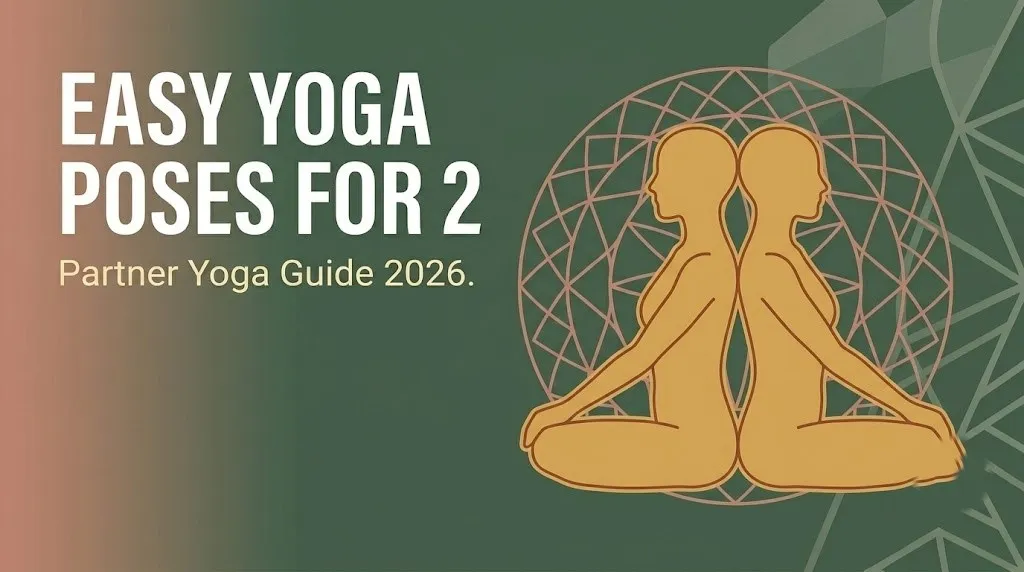
Sukhasana Back-to-Back (Easy Pose, back-to-back) is the standard entry point. Both partners sit cross-legged facing opposite directions, backs resting against each other. Spines stack vertically. The contact provides immediate postural feedback. Both partners feel where they are rounding or collapsing without needing a mirror.
To practice back-to-back Sukhasana:
- Both partners sit cross-legged on the floor, facing opposite directions.
- Bring your backs together gently. Let the contact be light at first.
- Inhale together and feel the backs expand against each other.
- On the exhale, let the spines settle and the shoulders drop away from the ears.
- Hold for 8 to 10 synchronized breaths, approximately 60 to 90 seconds.
- Release by both partners leaning forward simultaneously.
Dandasana (Staff Pose) seated facing each other builds on the back-to-back warmup:
- Both partners sit facing each other, legs extended straight forward.
- Flex the feet toward each other. The soles may press together or inner ankles can touch.
- Each partner reaches forward and grasps the other’s wrists or forearms.
- One partner inhales and sits tall while the other gently leans back, creating a light assist.
- Hold 5 breaths, then switch roles.
- Release slowly, never abruptly.
Modification: If hamstrings are tight, both partners sit on folded blankets to tilt the pelvis forward. Bending the knees slightly is always acceptable.
Safety caution: Never pull a partner suddenly. The assist should feel like a gentle invitation, not a tug.
Easy Standing Partner Yoga Poses
Standing partner poses add a balance and strength dimension to partner yoga, and the beginner versions are designed so that each partner remains independently stable rather than relying entirely on the other.
Vrksasana (Tree Pose), side-by-side variation: Both partners stand side by side, inner arms linked at the elbow or hands joined at shoulder height. Each lifts their outer leg into Tree Pose. The inner contact point provides a shared balance reference without creating full dependency.
To practice side-by-side Vrksasana:
- Stand side by side, shoulders about 6 inches apart.
- Join inner hands at hip height, fingers interlaced or palms pressed.
- Both partners shift weight to the inner foot simultaneously.
- Lift the outer foot and place it on the inner calf or above the knee, never directly on the knee joint.
- Find a fixed gaze point at eye level. Hold for 5 to 8 breaths.
- Lower the foot together, then switch sides.
Utkatasana (Chair Pose), back-to-back variation: Both partners stand back-to-back, feet hip-width apart, and walk feet forward together while sliding down each other’s backs into a seated position.
To practice back-to-back Utkatasana:
- Stand back-to-back, bodies lightly touching from shoulders to hips.
- Both partners walk their feet forward simultaneously, about 12 to 18 inches.
- Slowly bend knees and lean into each other’s backs as you lower toward a seated position.
- Stop when thighs are roughly parallel to the floor, or wherever feels stable.
- Hold for 5 breaths. Press into each other to rise together on the inhale.
Modification: Do not descend past a 45-degree knee bend if either partner has knee discomfort. The benefit occurs at any angle where the quadriceps are engaged.
Partner Yoga Breathing and Communication
Partner yoga breathing means intentionally synchronizing your inhale and exhale with your partner’s, and it is the single most underused technique in beginner partner yoga practice.
Think of synchronized breathing like a metronome two musicians share. When both partners breathe at the same pace, the nervous systems begin to co-regulate, meaning each body’s stress-response system synchronizes with the other’s. This is not a metaphor. It is a documented physiological process in which breathing patterns between people in proximity genuinely influence each other’s autonomic nervous system state.
To synchronize breath during partner yoga, start by sitting back-to-back in Sukhasana. Without speaking, both partners inhale for a count of 4, pause for 1 count, and exhale for a count of 6. The extended exhale activates the vagus nerve and supports parasympathetic nervous system dominance in both partners simultaneously.
Communication during poses is equally important and is often what separates a safe partner session from an uncomfortable one. Before starting, agree on a simple signal for “ease up” or “stop.” A tap on the floor, a spoken word like “ease,” or a squeeze of the hand all work. Neither partner should silently tolerate discomfort hoping it will resolve.
Communication ground rules for partner yoga:
- Establish a stop signal before the first pose
- Check in verbally before applying any pressure to a partner’s body
- Ask “is this okay?” and wait for a clear verbal yes before deepening any assist
- Never surprise your partner with sudden pressure or movement changes
- If uncertain about a position, return to neutral together before adjusting
Key Takeaway: Synchronized breathing and a pre-agreed stop signal are the two most important safety tools in partner yoga, and they take less than one minute to set up before practice begins.
Easy Two Person Yoga Sequence for Beginners
A complete beginner two-person yoga sequence takes 20 to 25 minutes and requires only two yoga mats placed side by side and one folded blanket per person.
The sequence below moves from floor-based poses to one gentle standing balance and back to the floor, giving both partners a full-body experience without any balance-dependent or weight-bearing complexity.
The Beginner Partner Yoga Sequence (20 to 25 minutes):
- Back-to-back Sukhasana (Easy Pose): 2 minutes. Synchronized breathing. Both partners inhale 4 counts, exhale 6 counts.
- Seated wrist-grasp Dandasana (Staff Pose), assisted forward fold: 90 seconds each direction. One partner sits tall while the other receives a gentle forward assist. Switch roles.
- Baddha Konasana (Bound Angle Pose), seated facing each other: 2 minutes. Soles of feet together, knees falling to the sides. Partners hold hands across the space between them. No pressure applied. Simply share the position.
- Back-to-back lateral stretch: 60 seconds each side. From Sukhasana, one partner leans gently to the right while the other leans left. Feel the side body open against the partner’s back.
- Side-by-side Vrksasana (Tree Pose): 5 breaths each side. Use the instructions from the standing section above.
- Back-to-back Utkatasana (Chair Pose): 5 breaths. Use the instructions from the standing section above.
- Supta Matsyendrasana (Reclined Spinal Twist), mirrored: 90 seconds each side. Both partners lie on their own mats, mirroring each other’s twist. No partner contact needed. Simply move together in time.
- Savasana (Corpse Pose), side by side: 5 minutes. Hands may touch lightly at the pinky fingers. Breathe naturally.
Modification: Any pose can be skipped or held shorter if one partner is fatigued. The sequence flows whether you do all eight steps or only four of them.
Partner Yoga for Couples
Partner yoga for couples uses the same foundational poses as general partner yoga but with the additional context of physical trust, emotional vulnerability, and the documented effect of shared movement on relationship quality.
Research published in Frontiers in Psychology found that couples who engaged in coordinated physical activities, including synchronized yoga-style movement, reported higher relationship satisfaction scores and increased feelings of closeness immediately after the activity compared to couples who completed individual tasks in the same room. The shared physical attunement, particularly through touch and synchronized breath, activates neural bonding pathways in both partners.
For couples who are newer to physical touch in a non-romantic-but-intentional context, the back-to-back poses are the natural starting point. They provide continuous physical contact without the face-to-face proximity that can feel self-conscious for some people in a new activity.
The seated wrist-grasp forward fold is particularly well-suited for couples. It requires eye contact, physical trust, and verbal or non-verbal communication about depth and pace. Those three elements together create a context of attunement that extends beyond the yoga mat itself.
Poses that work especially well for couples:
- Back-to-back Sukhasana with synchronized breath: low vulnerability, high connection
- Seated facing Dandasana with wrist hold and assisted fold: requires trust and communication
- Side-by-side Tree Pose: requires shared balance and steady mutual attention
- Savasana with hand contact: intentional rest together after physical effort
Partner Yoga for Friends and Non-Romantic Pairs
Partner yoga for friends works equally well as for couples, and the non-romantic context actually removes a layer of self-consciousness that some people feel when practicing physical closeness with a partner.
Friendships that include physical activity together are documented to be stronger and more resilient than purely social friendships. The American College of Sports Medicine notes that social exercise contexts improve long-term adherence to physical activity habits, and the specific factor most associated with sustained participation is having a consistent practice partner.
For friend pairs, the back-to-back poses and standing side-by-side poses are the most comfortable starting points because they involve contact without face-to-face proximity. The assisted forward fold works well once both friends are comfortable with the practice and have established their communication system.
One practical consideration for friends versus couples: body size differences are often more variable between friends than between romantic partners who have self-selected based on some physical compatibility. The modifications for different body types in a later section address this directly. The key principle is that neither person should feel physically overwhelmed or in an unstable position because of the size or weight of the other.
Quick Summary:
- Partner yoga is equally effective and appropriate for friends as for couples
- Back-to-back and side-by-side poses are the most comfortable starting points for platonic pairs
- Establish communication signals before practice regardless of the relationship type
- Size and weight differences between friends require specific modifications, covered below
Key Takeaway: Whether you are doing partner yoga with a romantic partner, a close friend, or a sibling, the communication setup before the first pose is more important than any physical warm-up.
Partner Yoga for Kids and Parents
Partner yoga for kids and parents is one of the most naturally accessible forms of partner yoga because children are typically smaller, lighter, and more naturally flexible than adults, which removes most of the physical complexity from paired poses.
The most appropriate partner yoga approach for children aged 5 to 12 with an adult is mirrored movement rather than assisted stretching. Both partners do the same pose on their own mats, facing each other, and mimic each other’s movements. This removes all weight-bearing or pressure concerns while still creating the social bonding and shared movement benefits of partner yoga.
According to the Yoga Alliance, yoga for children supports proprioceptive development, emotional regulation, and body awareness. When practiced with a parent, these benefits extend to include co-regulation of the child’s stress response and improved parent-child attunement through non-verbal physical communication.
For kids aged 10 and up, the gentle seated assists such as the back-to-back Sukhasana breathing exercise and side-by-side Tree Pose are appropriate with these modifications:
- The parent does not lean body weight into the child in any back-to-back pose
- The parent adapts their own range of motion to match the child’s pace
- The child always leads on how deep any stretch goes
- Skip all standing balance poses with contact for children under age 8
For teens, most beginner partner poses are appropriate with the same communication guidelines used for adults.
Partner Yoga for Seniors and Limited Mobility
Partner yoga for seniors is both safe and beneficial when poses are adapted to eliminate floor-to-ceiling transitions, reduce joint loading, and prioritize supported positions throughout.
The primary modification for seniors in partner yoga is working from a chair rather than the floor. Back-to-back seated breathing can be done in two chairs placed back-to-back. Assisted forward folds can be performed in a seated position with both partners on chairs facing each other. Side-by-side Tree Pose becomes a side-by-side standing leg lift near a wall, with one hand on the wall and the inner hand joined with the partner.
Research published in the International Journal of Yoga found that chair-based yoga practice in older adults produced measurable improvements in balance, lower body strength, and self-reported wellbeing over eight weeks without adverse events in any study participant. Partner yoga in a chair context delivers the additional benefit of social engagement, which is independently associated with reduced cognitive decline risk in older adults.
Chair-modified partner yoga for seniors:
- Back-to-back chair breathing: two chairs placed back-to-back, spines lightly touching, synchronized breath for 2 to 3 minutes
- Seated facing wrist hold: both partners seated in chairs facing each other, holding wrists, one partner gently sitting back as the other leans forward
- Side-by-side seated lateral stretch: both partners seated, inner hands joined, outer arms reaching up and over to the side
- Standing near-wall Tree Pose variation: both standing near a wall, one hand on the wall, inner hands joined, one foot lifted to calf height
Safety note for seniors: A physical therapist or certified yoga teacher with senior yoga training can advise on which modifications are appropriate for specific conditions including osteoporosis, hip replacement, or recent cardiac events.
Partner Yoga Modifications for Different Body Types
Partner yoga works across different body sizes and proportions when both partners understand that the goal is never a specific shape but rather a specific sensation of shared movement or assisted stretching.
The most common practical challenge in partner yoga between two people of different sizes is weight distribution in back-to-back poses. If one partner is significantly heavier or taller, the back-to-back contact will be uneven. The taller or heavier partner should not lean body weight into the smaller partner. The contact should be mutual and light, like two people sharing a bench, not one person resting against the other.
For the assisted seated forward fold in Dandasana (Staff Pose), height differences matter. If one partner is much taller, their reach to the other’s wrists will create an uneven pull angle. The fix is simple: both partners bend their knees slightly to equalize the reaching angle, or they use a yoga strap held between them instead of a direct wrist grip.
Modifications by body type consideration:
- Height difference: use a yoga strap between partners instead of direct wrist contact in forward folds
- Weight difference: back-to-back contact is light mutual support, not leaning. The heavier partner maintains their own upright position.
- Flexibility difference: the less flexible partner sets the depth of any assisted stretch. The more flexible partner adapts downward to match.
- Strength difference: standing partner poses work best when the stronger partner takes a slightly wider stance for greater stability
- Joint pain or hypermobility: skip any pose that involves a direct assist to the affected joint. Focus on mirrored movement instead.
Key Takeaway: In partner yoga, the less flexible, smaller, or more mobile-limited person always sets the depth and pace of every pose. The other partner adapts to them, not the other way around.
Partner Yoga Props and What You Actually Need
Partner yoga requires almost no equipment, and most of what helps can be found in any home without purchasing a single yoga-specific product.
The core requirement is floor space. Two people need roughly a 6 by 10 foot area of clear floor space to practice the beginner sequence comfortably. That fits in most living rooms, bedrooms, or outdoor spaces. Two yoga mats are helpful for cushioning and defining each person’s space, but a carpeted floor works fine for the floor-based poses.
Beyond that, one or two folded blankets per person are genuinely useful. A blanket under the hips in Dandasana (Staff Pose) tilts the pelvis forward and allows the spine to lengthen correctly when hamstrings are tight. A blanket under the knees in Baddha Konasana (Bound Angle Pose) removes inner groin strain for practitioners with less hip opening.
A yoga strap, or any equivalent household item like a bathrobe tie or a necktie, is worth having for the assisted forward fold variation when partners have significant height differences.
| Prop | Purpose in Partner Yoga | Household Substitute |
|---|---|---|
| Yoga mat (2) | Floor cushioning and personal space boundary | Exercise mat, carpet, folded blanket |
| Folded blanket (1 to 2 per person) | Hip elevation, knee support | Any firm folded blanket or towel |
| Yoga strap | Bridging height difference in wrist-hold poses | Belt, bathrobe tie, necktie |
| Wall | Balance support in standing poses | Any solid wall in the home |
| Chair (2) | Full practice modification for seniors | Any stable chair without wheels |
You do not need blocks, bolsters, or eye pillows for beginner partner yoga. Those add comfort but are not required for the foundational poses in this guide.
Partner Yoga for Tight Hips and Lower Back
Partner yoga is particularly effective for releasing tight hips and lower back because an assisting partner can apply sustained, gentle pressure that produces a deeper passive stretch than the practitioner achieves alone.
Tight hips are often a function of chronically shortened hip flexors from prolonged sitting combined with underused hip external rotators. Partner yoga addresses both simultaneously. The assisted version of Baddha Konasana (Bound Angle Pose) targets the inner groin and adductors. A gentle partner hand placed on the outer thighs, not pressed but resting, provides proprioceptive feedback that helps the hip external rotators release more completely than in solo practice.
For lower back tightness, the back-to-back lateral stretch in Sukhasana (Easy Pose) decompresses the lumbar spine laterally while the partner’s back provides a firm anchor. The Supta Matsyendrasana (Reclined Spinal Twist) done in a mirrored format on individual mats creates thoracolumbar fascia release without any partner-applied pressure.
Partner-assisted poses for tight hips:
- Baddha Konasana with partner hand resting on outer thighs: hold 3 to 5 minutes, letting gravity and the light contact do the work
- Seated facing Paschimottanasana (Seated Forward Fold) with wrist hold and gentle back press: hold 3 breaths each direction
- Back-to-back seated lateral flexion: hold 5 breaths each side
Safety note: The assisting partner should never apply sudden or bouncing pressure during any hip or back stretch. Steady, sustained, and gentle is the operative principle. If either partner feels sharp or radiating pain, return to neutral immediately and skip that pose for the session.
Partner Yoga Safety: What to Know Before You Start
Partner yoga safety depends on four core principles: clear communication, gradual depth progression, mutual consent before any contact, and knowing which pose categories to avoid for specific physical conditions.
The most common injury in beginner partner yoga is an overstretched hamstring or a strained lower back from a partner applying too much pressure too quickly in a forward fold assist. Both of these are entirely preventable. The rule is simple: the receiving partner controls all depth. The assisting partner applies only as much pressure as the receiving partner actively invites.
Before the first pose, take two minutes to run through the following checklist together:
- Identify any current injuries, joint pain, or areas of acute sensitivity.
- Agree on a verbal stop signal. “Ease” or “stop” works for most pairs.
- Agree on a check-in question: “How is this?” Both partners should use it freely throughout practice.
- Confirm that neither partner will apply sudden or bouncing pressure in any stretch.
- Agree to return to neutral together before adjusting any position.
Poses to approach with caution or skip based on condition:
- Active lumbar disc herniation: skip all forward folds with partner pressure applied to the back
- Acute knee injury: skip Utkatasana (Chair Pose) and Tree Pose
- Shoulder impingement: modify all poses where the arm is raised above shoulder height
- Pregnancy (second and third trimester): skip all poses that involve lying flat on the back or sustained forward compression on the abdomen
- Osteoporosis: avoid all poses with partner-applied pressure to the spine. Mirrored movement only.
A yoga teacher certified in therapeutic yoga or senior yoga can provide individualized guidance for practitioners managing specific health conditions before beginning a partner practice.
Key Takeaway: Two minutes of communication before the first pose prevents nearly every injury that happens in beginner partner yoga. Set your stop signal and check-in question before you move.
Frequently Asked Questions About Easy Yoga Poses for 2
What are the easiest yoga poses to do with another person?
The easiest two-person yoga poses are back-to-back Sukhasana (Easy Pose) with synchronized breathing, seated facing Dandasana (Staff Pose) with a wrist hold, and side-by-side Vrksasana (Tree Pose).
All three require no prior yoga experience, keep both partners on the floor or standing independently, and can be modified immediately if either person feels discomfort.
Start with the back-to-back breathing exercise first because it establishes the breath connection before any physical assist is introduced.
Can two people do yoga together with no experience?
Yes. The beginner partner yoga poses in this guide require zero prior yoga training from either person.
Floor-based seated poses like back-to-back Easy Pose and facing Staff Pose are accessible to any two people who can sit on the floor and breathe intentionally.
The most important preparation is not physical: it is taking two minutes before you start to agree on a stop signal and a check-in question.
How do you communicate with your partner during yoga?
Effective partner yoga communication starts before practice, not during it. Agree on a verbal stop signal and a check-in phrase before your first pose.
During practice, the assisting partner always asks “how is this?” before deepening any stretch, and the receiving partner responds with a clear yes or requests an adjustment.
Silent signals like a floor tap work well when speaking during a pose breaks concentration, but a verbal backup should always be in place.
Is partner yoga safe for seniors?
Partner yoga is safe for most seniors when adapted to chair-based or wall-supported positions that eliminate floor-to-ceiling transitions.
Back-to-back chair breathing, seated facing wrist holds, and near-wall standing leg lifts are all appropriate for most older adults without acute joint conditions.
A yoga teacher with senior yoga or therapeutic yoga certification can advise on adaptations for specific conditions including osteoporosis, hip replacement, or balance disorders.
Do you need special equipment for two-person yoga poses?
Two-person yoga poses require no specialized equipment beyond two yoga mats and one or two folded blankets per person.
A yoga strap or any household equivalent like a belt or robe tie is useful when partners have a height difference in forward fold assists.
Two stable chairs replace all floor-based poses for practitioners who cannot comfortably sit on or rise from the floor.
Start with the back-to-back breathing exercise today. Sit with a partner, backs touching, and breathe together for ten breaths. That is a complete and genuinely useful partner yoga session, even if you never add another pose.
Once that feels natural, add one seated forward fold. Then try side-by-side Tree Pose. The sequence builds itself as comfort and trust between partners develop.
The poses matter. The breath matters more. The communication between the two of you is what makes it work.