Benefits of Power Yoga: Strength, Science, and Results 2026
The benefits of power yoga go well beyond flexibility: this practice builds genuine muscular strength, improves cardiovascular fitness, reduces cortisol levels, and can support body composition changes when practiced consistently. Unlike gentler yoga styles, power yoga treats the mat as a training ground, not just a recovery space.
Research backs this up. According to the American College of Sports Medicine, vigorous yoga styles like power yoga can meet the threshold for moderate-intensity aerobic activity when performed at a sustained pace. A study published in the Journal of Alternative and Complementary Medicine found that regular dynamic yoga practice improved muscular endurance, flexibility, and self-reported stress levels compared to sedentary controls.
This guide covers what power yoga actually is, how it compares to other styles, what the science says about each of its physical and mental benefits, which poses drive those benefits, and who needs to approach it with caution. You will walk away knowing whether power yoga fits your goals, your body, and your schedule.
Benefits of Power Yoga: What the Research Actually Shows
The documented benefits of power yoga include improved muscular strength and endurance, increased cardiovascular fitness, enhanced flexibility, reduced stress hormones, better sleep, and improved focus and mood.
These are not vague wellness claims. The research distinguishes between yoga styles, and vigorous dynamic styles consistently show different physiological outcomes than passive or gentle practices. Power yoga, because it combines sustained muscular effort with breath-linked movement and minimal rest between postures, drives adaptations in multiple body systems simultaneously.
Key benefits supported by research:
- Muscular strength and endurance: Standing poses, Plank holds, and Chaturanga-based transitions load the upper body, core, and lower body in ways that produce measurable strength gains over time.
- Cardiovascular conditioning: Sustained dynamic sequences raise and maintain heart rate in the moderate-intensity range, improving aerobic capacity.
- Flexibility and joint mobility: The warm-up effect of continuous movement allows greater range of motion than cold stretching, and consistent practice produces lasting flexibility improvements.
- Cortisol reduction: According to the National Center for Complementary and Integrative Health, yoga practices that include mindful breath work show measurable reductions in cortisol, the body’s primary stress hormone.
- Improved body composition: Research in the Journal of Alternative and Complementary Medicine found associations between regular vigorous yoga practice and reduced body fat percentage over twelve weeks.
- Better sleep quality: Studies published in Complementary Therapies in Medicine indicate that regular yoga practice improves sleep onset and duration, particularly in adults with stress-related sleep disruption.
- Enhanced cognitive function: Harvard T.H. Chan School of Public Health research notes connections between regular aerobic-intensity exercise, including vigorous yoga, and improved attention, memory, and mood regulation.
Power Yoga Meaning: What It Is and Where It Came From
Power yoga is a Western, fitness-oriented adaptation of Ashtanga yoga that removes the fixed pose sequence, increases the pace, and prioritizes athletic conditioning alongside traditional yoga philosophy.
The term was coined in the mid-1990s by American yoga teachers Bryan Kest and Beryl Bender Birch, both of whom had trained in Ashtanga yoga under K. Pattabhi Jois. Their goal was to make the physical rigor of Ashtanga accessible to gym-goers and athletes who were not necessarily interested in the traditional Sanskrit sequencing rules.
What separates power yoga from its Ashtanga parent is the freedom of sequencing. In Ashtanga, you practice the same series of poses in the same order every time. In power yoga, the teacher designs the sequence. That freedom makes power yoga more varied and more adaptable to different populations.
The word “power” is accurate in a literal sense. Power yoga demands muscular output, sustained breath control, and body weight management across a series of poses that rarely give you a true rest. A well-taught 60-minute power yoga class produces the kind of neuromuscular fatigue you feel after a resistance training session, not a light stretch.
| Feature | Power Yoga | Standard Gym Workout |
|---|---|---|
| Primary training mode | Body weight resistance plus cardiovascular | Weighted resistance or cardio machine |
| Flexibility component | Integrated throughout | Minimal unless added |
| Breath integration | Mandatory, continuous | Optional, often ignored |
| Stress response | Reduces cortisol through mindful breath | Depends on intensity and type |
| Recovery demand | Moderate to high | Variable |
What Is Power Vinyasa Yoga?
Power Vinyasa yoga is a specific subset of power yoga that emphasizes fluid, breath-synchronized transitions between poses, creating a continuous moving meditation with an athletic intensity level.
“Vinyasa” refers to the practice of linking movement to breath. Every inhale opens or extends the body. Every exhale folds or grounds it. In Power Vinyasa specifically, this breath-movement link is never broken. Transitions between major poses are as choreographed and intentional as the poses themselves, which is what distinguishes Power Vinyasa from simply moving quickly between shapes.
Baptiste Power Yoga, developed by Baron Baptiste, is the most widely recognized Power Vinyasa system. It combines a specific sequence structure, heat (either a heated room or the heat generated internally by the practice), and a commitment to constant breath engagement. Many studio “power flow” classes are directly influenced by the Baptiste methodology.
What Power Vinyasa adds over standard power yoga is an emphasis on the quality of transitions. In a less structured power yoga class, transitions may be passive. In Power Vinyasa, moving from Virabhadrasana I (Warrior I) to Virabhadrasana II (Warrior II) through a Vinyasa (the sequence of Plank, Chaturanga Dandasana (Four-Limbed Staff Pose), Urdhva Mukha Svanasana (Upward-Facing Dog), and Adho Mukha Svanasana (Downward-Facing Dog)) is itself a strength training event.
Modification note: In any Power Vinyasa class, teachers should offer a “half vinyasa” option where students lower from Plank directly to their belly rather than performing full Chaturanga, reducing the shoulder and wrist load while maintaining the flow.
Key Takeaway: Power yoga is not just a faster yoga class. It is a strength-plus-cardiovascular system built on Ashtanga principles, delivered with sequencing freedom, and supported by measurable research on its physical and mental outcomes.
Power Yoga Class Description: What to Expect
A power yoga class is typically 45 to 75 minutes long, begins with a warm-up sequence to build internal heat, moves through a series of progressively demanding standing and balancing poses, and closes with floor work and a final relaxation period.
If you have never attended a power yoga class, the pacing may surprise you. There is rarely a pause where everyone rests. The rest is built into the transitions, with Adho Mukha Svanasana (Downward-Facing Dog) serving as a semi-active reset posture between sequences. You will sweat. Your arms will fatigue. Your core will be working throughout.
A typical power yoga class structure:
- Centering and breath awareness: 2 to 3 minutes seated or supine. Establishes breath rhythm before movement begins.
- Warm-up Sun Salutations (Surya Namaskar): 3 to 5 rounds. Progressively builds heat, warms the spine, and opens the hips and shoulders.
- Standing pose series: Warrior sequences, balance poses, lateral standing postures. Typically 20 to 30 minutes.
- Peak pose or challenging sequence: One or two demanding poses (arm balances, inversions, or deep backbends) that require the accumulated warm-up to access safely.
- Floor work: Core strengthening, hip openers, or backbend deepening. 10 to 15 minutes.
- **Cool-down and **Savasana (Corpse Pose): Mandatory 5 to 10 minutes. Allows the nervous system to absorb the practice.
What to bring: a non-slip yoga mat, a water bottle, and a small towel if the room is heated. Most power yoga rooms are kept between 80 and 95 degrees Fahrenheit, though unheated versions exist.
Power Yoga vs Vinyasa Yoga: What Is the Actual Difference?
Power yoga and Vinyasa yoga are related but distinct: power yoga prioritizes athletic conditioning and muscular intensity, while Vinyasa yoga prioritizes breath-movement synchronization and can range from gentle to vigorous depending on the class level.
This distinction matters practically. A “Vinyasa flow” class could be a calm, beginner-friendly session or a demanding athletic practice. The word Vinyasa describes the method (breath-linked movement), not the intensity. Power yoga, by contrast, always implies a higher intensity threshold.
| Feature | Power Yoga | Vinyasa Yoga |
|---|---|---|
| Intensity range | Moderate to high (consistent) | Low to high (varies by class) |
| Sequencing structure | Teacher-designed, non-fixed | Teacher-designed, non-fixed |
| Heat focus | Often heated room or self-generated | Usually room temperature |
| Primary goal | Athletic conditioning plus yoga | Mindful movement plus fitness |
| Beginner accessibility | Requires some baseline fitness | More beginner-accessible overall |
| Breath focus | Strong Ujjayi breath emphasis | Breath-linked but variable intensity |
| Closest relative | Ashtanga yoga (parent style) | Hatha yoga (parent style) |
The practical takeaway: if you are looking for a yoga practice that functions more like a workout, power yoga is the more consistent choice. If you want the flexibility to practice at different intensities on different days, a Vinyasa class gives you more range.
Power Yoga for Strength and Muscle Tone
Power yoga builds functional strength by using body weight resistance across sustained isometric holds and dynamic transitions, targeting the upper body, core, and lower body within a single session.
Think of power yoga poses like weighted exercises with your own body as the load. Chaturanga Dandasana (Four-Limbed Staff Pose) functions as a slow-lowering push-up that trains the triceps, pectorals, and anterior deltoids under significant eccentric load. Held Virabhadrasana II (Warrior II) isometrically loads the quadriceps, glutes, and hip abductors in the same way a wall sit does, but with additional rotational challenge through the torso.
According to the American College of Sports Medicine, body weight resistance training at moderate to high intensity can produce muscular strength and endurance gains comparable to light-to-moderate weighted resistance training, particularly in individuals who are new to structured exercise or returning after a break.
Muscle groups most targeted in a power yoga session:
- Upper body: Triceps, pectorals, anterior deltoids, serratus anterior (from Chaturanga and Plank variations)
- Core: Transverse abdominis, obliques, rectus abdominis (from Plank, Navasana (Boat Pose), and standing balance poses)
- Lower body: Quadriceps, hamstrings, glutes, hip flexors (from Warrior sequences, lunges, and squats)
- Posterior chain: Erector spinae, glutes, hamstrings (from backbend postures and Virabhadrasana III (Warrior III))
Modification for beginners: Replace full Chaturanga with a knees-down lowering to build tricep and chest strength before loading the full body weight through the standard version.
Key Takeaway: Power yoga builds real muscular strength through body weight loading, not just flexibility. The Chaturanga-based transition alone is one of the most demanding upper-body exercises in any yoga style.
Power Yoga for Weight Loss and Calorie Burn
Power yoga burns approximately 300 to 500 calories per 60-minute session for a moderately sized adult, depending on body weight, room temperature, individual effort, and the specific sequence structure.
These estimates come from metabolic equivalency (MET) data, which the American College of Sports Medicine uses to classify exercise intensity. Vigorous yoga practices register at approximately 5 to 7 METs, placing them in the moderate-to-vigorous intensity category alongside cycling, jogging, and swimming at a moderate pace.
The calorie burn is real, but it is not power yoga’s most useful weight management tool. The more durable benefit is the effect on resting metabolic rate. Increasing lean muscle mass through the strength component of power yoga raises the number of calories the body burns at rest over time. This is a longer-game benefit but more sustainable than calorie burn per session.
A study published in the Journal of Alternative and Complementary Medicine found that participants who practiced vigorous yoga three or more times per week over twelve weeks showed reductions in body fat percentage and waist circumference compared to a sedentary control group.
Calorie burn comparison by yoga style (60-minute class, 150 lb adult, approximate):
| Yoga Style | Approximate Calories Burned |
|---|---|
| Restorative yoga | 100 to 150 |
| Hatha yoga | 175 to 250 |
| Vinyasa yoga | 250 to 380 |
| Power yoga | 300 to 500 |
| Bikram/26 and 2 yoga (heated) | 330 to 460 |
Note: individual variation is large. These are approximate ranges, not precise measurements.
Power Yoga for Flexibility
Power yoga improves flexibility through a mechanism that differs from passive stretching: the muscular heat generated during dynamic movement allows deeper range of motion into poses than cold-tissue stretching, and consistent practice gradually extends this range permanently.
The difference between active and passive flexibility matters here. In Yin or Restorative yoga, flexibility is developed through long-held passive postures that target connective tissue. In power yoga, flexibility is developed through warmed, active movement that primarily targets muscle extensibility. Both approaches work, but through different tissues and different time scales.
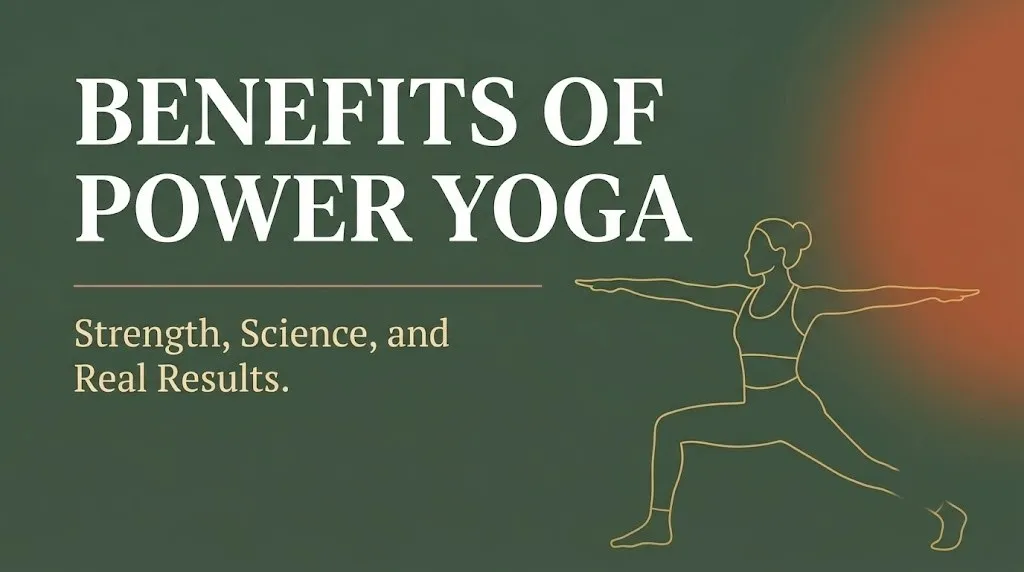
For the hamstrings, the forward fold positions in Sun Salutations and the standing pose transitions provide repeated, warmed lengthening that reduces chronic hamstring tightness common in people who sit for long hours. Think of cold hamstrings like a refrigerated rubber band: they resist lengthening and snap back quickly. Warm hamstrings stretch more readily and retain more of the change.
The hip flexors, thoracic spine, and shoulder girdle all see consistent mobility work through a standard power yoga sequence. Backbending postures like Urdhva Mukha Svanasana (Upward-Facing Dog) open the anterior chest and hip flexors. Lateral postures like Utthita Parsvakonasana (Extended Side Angle Pose) open the lateral ribcage and inner thighs.
Modification for people with hamstring tightness: In all standing forward folds, keep a generous bend in the knees to protect the lower back and allow the spine to lengthen rather than rounding. Never force range of motion through pain.
Power Yoga for Stress and Mental Health
Power yoga reduces psychological stress through three simultaneous mechanisms: cortisol regulation via breath-focused movement, increased production of mood-stabilizing neurotransmitters through aerobic-intensity exercise, and the attentional focus required to hold challenging poses.
The breath is the first mechanism. Ujjayi pranayama (victorious breath, the soft throat-constricted breathing used throughout power yoga) activates the vagus nerve and increases parasympathetic nervous system tone even during physically demanding movement. This is what makes power yoga different from a standard gym workout at the same intensity: the breath instruction keeps the nervous system partially in recovery mode even when the muscles are working hard.
According to research published in the International Journal of Yoga, eight weeks of vigorous yoga practice produced measurable reductions in perceived stress scores and anxiety symptoms, with participants reporting improved emotional regulation and reduced reactivity to stressors.
The second mechanism is exercise-induced neurochemistry. Vigorous physical activity increases brain-derived neurotrophic factor (BDNF), dopamine, and serotonin, all of which contribute to improved mood, reduced anxiety, and better cognitive function. Power yoga delivers this through sustained aerobic effort.
The third mechanism is attentional absorption. Holding Bakasana (Crow Pose) or balancing in Virabhadrasana III (Warrior III) requires complete present-moment focus. There is no mental bandwidth left for rumination. This forced attentional shift is one of the reasons practitioners report feeling mentally clearer after a demanding power yoga session than after a passive stretching class.
Key Takeaway: Power yoga’s stress reduction effect comes from three simultaneous sources: vagal activation through Ujjayi breath, exercise-induced neurotransmitter release, and the attentional absorption of physically demanding poses. No one mechanism alone explains why it works as well as it does.
Power Yoga Poses for a Home Workout
A power yoga home workout can be built from six to eight foundational poses that together target the full body, require no equipment, and can be sequenced in 20 to 45 minutes depending on the number of rounds.
You do not need a studio or a heated room to get the physical benefits of power yoga. What you need is a non-slip mat, enough floor space to extend your arms in all directions, and willingness to maintain the breath connection throughout.
Core power yoga poses for a home practice:
- Adho Mukha Svanasana (Downward-Facing Dog): Full body engagement. Shoulder, hamstring, and calf lengthening with active arm pressing.
- Chaturanga Dandasana (Four-Limbed Staff Pose): Upper body strength. Triceps, chest, shoulders, and core loaded simultaneously.
- Virabhadrasana I (Warrior I): Hip flexor opening combined with lower body strength. Front quadricep and glute engagement.
- Virabhadrasana II (Warrior II): Hip abductor strength. Lateral leg and inner thigh stability with rotational torso opening.
- Utkatasana (Chair Pose): Intense quadriceps and glute loading. The yoga equivalent of a squat hold.
- Navasana (Boat Pose): Core and hip flexor strength. Challenges the transverse abdominis and erector spinae simultaneously.
- Bakasana (Crow Pose): Arm balance for upper body and core integration. Optional progression for intermediate practitioners.
- Savasana (Corpse Pose): Non-negotiable closing rest. Five to ten minutes minimum for nervous system recovery.
Modification for home beginners: Practice Bakasana with a yoga block under the feet and the forehead close to the floor rather than attempting the full arm balance. Build confidence with the shape before adding the weight shift.
Power Yoga Sequence for Beginners
A beginner power yoga sequence should run 20 to 30 minutes, include three to five rounds of Surya Namaskar (Sun Salutation), move through two to three standing pose pairs, and close with core work and Savasana.
The common beginner mistake in power yoga is attempting the most advanced version of every pose immediately. Power yoga rewards patience in the foundational shapes. A clean, aligned Virabhadrasana I (Warrior I) is more beneficial than a collapsed version of Virabhadrasana III (Warrior III).
Beginner power yoga sequence (25 minutes):
- Balasana (Child’s Pose): Two minutes. Establish breath rhythm. Let the body arrive on the mat.
- Marjaryasana-Bitilasana (Cat-Cow Pose): Ten rounds. Warm the spine and synchronize breath to movement.
- Surya Namaskar A (Sun Salutation A): Three rounds. Use knees-down Chaturanga on rounds one and two. Add full Chaturanga on round three if the upper body feels ready.
- Virabhadrasana I and II (Warrior I and Warrior II) sequence: Three breaths each pose, both sides. Step back to Downward Dog between sides.
- Utkatasana (Chair Pose): Five breath holds, twice. Rest in Uttanasana (Standing Forward Fold) between rounds.
- Navasana (Boat Pose): Three rounds of five breaths. Lower the feet to the floor between rounds to rest the hip flexors.
- Supta Matsyendrasana (Supine Spinal Twist): Two minutes each side. Release the lower back and hips.
- Savasana (Corpse Pose): Five minutes minimum. No skipping.
Modification for wrist sensitivity: Place the forearms on the floor in Plank rather than the full wrist-bearing position. A folded blanket under the heels of the hands also reduces wrist extension angle.
Power Yoga for Athletes
Power yoga benefits athletes specifically by improving the flexibility deficits that strength training creates, building functional core stability that transfers to sport, and providing a structured recovery practice that does not require complete rest.
Athletes in strength-dominant sports (weightlifting, football, rugby) often develop significant hamstring, hip flexor, and thoracic spine tightness as a byproduct of their training. Power yoga addresses all three directly. It is not gentle enough to be purely a recovery tool, but at a reduced intensity (slower pace, fewer Vinyasas, longer holds), it functions as active recovery that maintains cardiovascular base while working on mobility.
The core stability developed through power yoga is worth noting separately. The type of core engagement in Navasana (Boat Pose), Plank holds, and Chaturanga Dandasana is rotational and isometric, which trains the transverse abdominis and obliques in ways that traditional gym exercises like crunches do not. This transfers directly to rotational sport performance: tennis, golf, rowing, baseball, and martial arts all demand this type of core stability.
Recommended integration for athletes:
| Sport Type | Power Yoga Role | Recommended Frequency |
|---|---|---|
| Endurance sports (running, cycling) | Hip flexor and thoracic mobility | 2 sessions per week |
| Strength sports (weightlifting, rugby) | Active recovery, flexibility restoration | 1 to 2 sessions per week |
| Rotational sports (golf, tennis, rowing) | Core stability and spinal mobility | 2 sessions per week |
| Team sports (soccer, basketball) | Balance, coordination, injury prevention | 1 to 2 sessions per week |
Key Takeaway: Athletes do not need to choose between strength training and yoga. Power yoga’s rotational core work and mobility sequencing fills the exact gaps that most strength training programs leave open.
Power Yoga Modifications for Beginners
The most important power yoga modifications for beginners address wrist load, shoulder stability, and hip flexibility, because those are the three areas most likely to limit safe access to a standard power yoga class.
Modifications are not a lesser version of the practice. They are the appropriate version for where you are right now. A knees-down Chaturanga that keeps the spine aligned and the shoulders safe builds more strength over time than a collapsed full version that creates injury risk.
Essential beginner modifications:
- Chaturanga Dandasana: Lower knees to the floor before lowering the chest. Keep the elbows close to the ribs. This reduces the load by approximately 40 to 50 percent while maintaining the movement pattern and building the necessary strength.
- Adho Mukha Svanasana (Downward-Facing Dog): Keep a generous bend in the knees if the hamstrings are tight. The priority is a long spine, not straight legs.
- Virabhadrasana I (Warrior I): Shorten the stance to reduce hip flexor demand. A shorter distance between the feet is more stable and more teachable for newer practitioners.
- Utkatasana (Chair Pose): Limit the squat depth to 45 degrees rather than aiming for thighs parallel. Increase depth gradually over weeks as quad strength develops.
- Navasana (Boat Pose): Keep the knees bent and shins parallel to the floor rather than extending the legs fully. Bend your knees as much as needed to keep the spine long.
- Bakasana (Crow Pose): Place a block under the feet and keep the forehead close to the floor. Do not attempt the full arm balance until the wrist and core strength can genuinely support it.
Pose Tip for beginners:
- Prioritize breath over depth in every pose
- Choose the modification that keeps your spine neutral over the version that sacrifices alignment for range
- Use a block under each hand in standing poses to reduce hamstring demand and keep the chest lifted
Who Should Not Do Power Yoga
Power yoga is not appropriate for everyone, and the populations most likely to experience harm from an unsupported power yoga practice include those with active wrist or shoulder injuries, unmanaged cardiovascular conditions, recent surgery, advanced osteoporosis, or current pregnancy.
This is not about exclusion. It is about matching the practice to the body. Most of these populations can practice yoga safely in gentler styles like Restorative yoga, Yin yoga, or chair-adapted Hatha yoga. The issue is specifically the load, pace, and intensity demands of power yoga.
Who should pause before starting power yoga:
- Wrist injuries or carpal tunnel syndrome: The Chaturanga-based transitions place significant load on the wrist joints. Forearm modifications help but do not eliminate the issue entirely. A physical therapist’s clearance is worth getting before starting.
- Shoulder impingement or rotator cuff tears: Overhead loading in Warrior sequences and Plank-based transitions can aggravate shoulder impingement. Get a professional assessment of the specific injury before practicing.
- Unmanaged high blood pressure or cardiovascular conditions: The sustained effort and heated room environments in power yoga can raise heart rate significantly. Anyone with an unmanaged cardiovascular condition should discuss appropriate exercise intensity with a cardiologist before beginning.
- Advanced osteoporosis: Poses that load the wrists or require spinal flexion under load (forward folds with a rounded back, full Chaturanga) carry fracture risk in people with very low bone density.
- Pregnancy (second and third trimester): The supine poses, twists, deep abdominal engagement, and heated room environments are contraindicated in most pregnancy guidelines after the first trimester.
- Recent abdominal or spinal surgery: The core loading demands of power yoga require full tissue healing before being safe to reintroduce. Physical therapist guidance on timeline is essential.
How Often Should You Do Power Yoga?
Most yoga teachers and exercise physiologists recommend practicing power yoga three to four times per week for noticeable physical results, with at least one to two rest or lighter practice days between sessions.
Power yoga is a demanding practice. It generates muscular fatigue comparable to a moderate resistance training session, which means the body needs recovery time to adapt and strengthen. Practicing every day without adequate recovery can lead to overuse injuries, particularly in the wrists, shoulders, and knees.
The optimal frequency depends on your goal:
| Goal | Recommended Frequency | Notes |
|---|---|---|
| General fitness and flexibility | 2 to 3 times per week | Pair with one lighter practice day |
| Strength and body composition | 3 to 4 times per week | Ensure 48 hours between sessions |
| Stress management and mental health | 3 to 5 times per week | Can include shorter 20-minute sessions |
| Athletic cross-training | 1 to 2 times per week | Supplement existing training program |
| Beginner building base fitness | 2 times per week to start | Increase gradually over 4 to 6 weeks |
Rest days do not mean no movement. A Yin yoga session, a walk, or gentle stretching on off days supports the recovery that makes power yoga more effective, not less. Pushing through fatigue and practicing power yoga daily without rest is the most common reason new practitioners develop overuse injuries in the first month.
According to Yoga Alliance’s teacher training standards, instructors are guided to communicate rest day importance and to offer modifications within every class to support appropriate recovery across student populations.
Frequently Asked Questions About Benefits of Power Yoga
What are the main benefits of power yoga?
The main benefits of power yoga include improved muscular strength and endurance, increased cardiovascular fitness, greater flexibility, reduced cortisol and stress levels, better sleep quality, and improved mood and focus.
These benefits come from the combination of sustained body weight resistance, aerobic-intensity movement, and breath-focused practice that distinguishes power yoga from gentler styles.
Research published in the Journal of Alternative and Complementary Medicine supports measurable improvements in strength, flexibility, and stress markers over twelve weeks of consistent practice.
Is power yoga good for beginners?
Power yoga can be practiced by beginners who have some baseline physical fitness, with appropriate modifications for Chaturanga, Plank, and standing poses.
Completely sedentary beginners or those with joint concerns may find it more practical to start with Hatha or gentle Vinyasa yoga before transitioning to power yoga.
The key is attending classes where the teacher offers clear modification options and does not pressure students to keep pace at the expense of form.
How many calories does power yoga burn?
Power yoga burns approximately 300 to 500 calories per 60-minute session for a moderately sized adult, depending on body weight, room temperature, and effort level.
This places it in the moderate-to-vigorous intensity category alongside activities like cycling and light jogging, according to metabolic equivalency data referenced by the American College of Sports Medicine.
The calorie count varies widely between individuals, and the long-term metabolic benefit of increased lean muscle mass is a more reliable outcome than single-session calorie estimates.
How is power yoga different from regular yoga?
Power yoga is more intense, faster-paced, and more physically demanding than most general yoga classes, which typically emphasize flexibility and relaxation over athletic conditioning.
The main structural difference is the continuous movement and minimal rest between poses, which keeps the heart rate elevated and the muscles under sustained load throughout the session.
Regular or “standard” yoga covers a wide spectrum. Power yoga consistently sits at the vigorous end of that spectrum.
How often should I do power yoga to see results?
Most practitioners see measurable results in strength, flexibility, and stress levels after three to four weeks of practicing power yoga three times per week.
Beginners should start with two sessions per week to allow the body to adapt, adding a third session after four to six weeks when baseline recovery improves.
Rest days between sessions are not optional. The body adapts and strengthens during recovery, not during the practice itself.
Start Where You Are, Build From There
Power yoga works because it asks something real from you every session. The strength gains are real. The calorie burn is real. The stress reduction is real and supported by named research. None of those outcomes require you to be advanced.
Start with the beginner sequence in this guide. Practice it twice this week. Pay close attention to the breath: the Ujjayi connection is what makes power yoga yoga rather than just a fast workout. If Chaturanga feels too much, lower from your knees every single time until your upper body is ready. That is not a shortcut. That is the correct progression.
Three sessions per week, with rest days in between, is the formula. Give it four weeks before evaluating whether it is working.