Cow Pose Yoga: Benefits, Steps, and Modifications 2026
Cow Pose yoga, known in Sanskrit as Bitilasana, is a gentle spinal extension pose practiced on hands and knees that mobilizes the lumbar and thoracic spine, opens the chest, and coordinates breath with movement. It is one of the most accessible and therapeutically useful poses in all of yoga, and it is almost always paired with Marjaryasana (Cat Pose) in a flowing sequence.
The National Center for Complementary and Integrative Health (NCCIH) has identified yoga-based spinal mobilization as an evidence-supported approach for managing chronic low back pain, which affects roughly 80 percent of adults at some point in their lives. Cow Pose is one of the most direct poses for accessing gentle, controlled lumbar extension without loading the spine with body weight.
This guide covers everything a practitioner needs to know: the pose’s anatomy and biomechanics, the breath mechanics that make it work, how to modify it for different bodies and health conditions, and how to fit it into a regular practice. Whether you are brand new to yoga or looking to refine a pose you have practiced for years, there is detail here that will change how you approach it.
What Is Cow Pose Yoga?
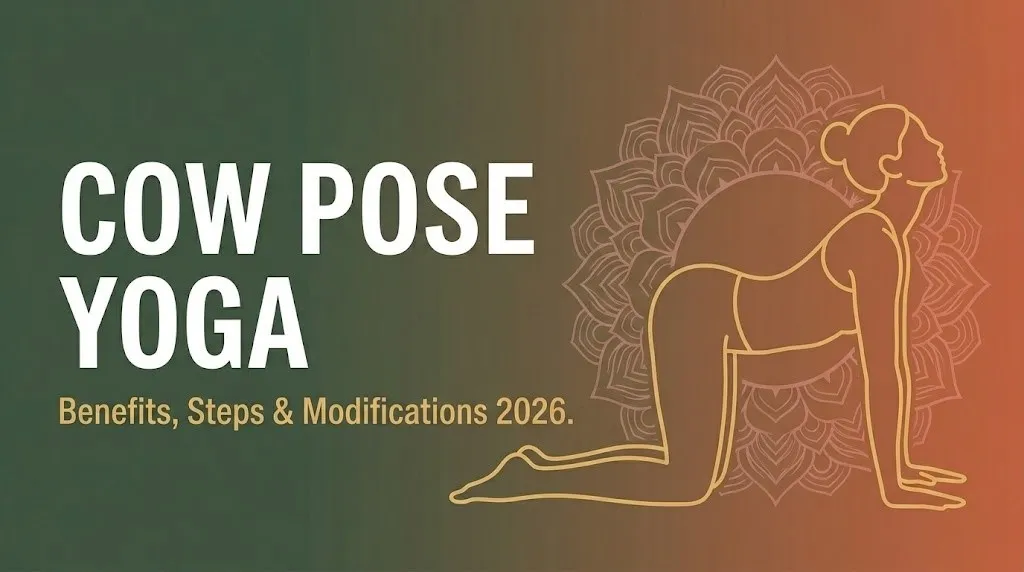
Cow pose yoga is a foundational, floor-based yoga pose in which the practitioner begins on hands and knees, then inhales to drop the belly, lift the tailbone, and raise the gaze, creating a gentle arch through the entire spine.
The pose is categorized as a spinal extension movement. It creates a mild backbend through the lumbar, thoracic, and cervical vertebrae simultaneously. Unlike deeper backbends such as Urdhva Mukha Svanasana (Upward-Facing Dog) or Bhujangasana (Cobra Pose), Cow Pose is supported on four points of contact: both hands and both knees. This makes it one of the most mechanically safe ways to introduce spinal extension into a practice.
It is practiced across virtually every yoga style. In Hatha yoga, it appears as a held pose with extended breath focus. In Vinyasa yoga, it flows continuously with Cat Pose in a breath-linked sequence. In Restorative yoga and Yin yoga, a supported version using props is sometimes used to gently open the thoracic spine. In children’s yoga classes and senior yoga programs, it is often one of the first poses taught because of its accessibility and the immediate body feedback it provides.
Who benefits most from Cow Pose:
- Beginners: The four-point base makes it stable and non-threatening. Range of motion demands are adjustable.
- People with lower back stiffness: Gentle lumbar extension restores movement in a direction many sedentary adults have lost.
- Seniors: With appropriate modifications, it can be practiced from a chair or on a bed.
- Practitioners with desk-based posture patterns: Counteracts the thoracic rounding that prolonged sitting produces.
- Prenatal practitioners: Modified versions support spinal mobility safely in pregnancy.
What Is Cow Pose? Bitilasana Explained
Bitilasana (Cow Pose) is a kneeling quadruped yoga posture in which the spine moves into extension through a coordinated movement of the pelvis, lumbar vertebrae, thoracic cage, and cervical spine, all timed to a full inhalation.
The name “Bitilasana” comes from the Sanskrit word “Bitila,” meaning cow, and “asana,” meaning posture or seat. The visual reference is the shape of a cow’s back, which naturally arches downward in the middle when the animal stands. In the yoga pose, the practitioner mirrors this shape: tailbone rises, belly drops, chest opens, and the gaze lifts gently upward.
Anatomically, this is a controlled anterior pelvic tilt combined with spinal extension from sacrum to skull. The pelvis tips forward, which initiates a curve in the lumbar spine. That curve continues upward through the thoracic vertebrae as the chest opens, and the cervical spine follows as the chin moves slightly forward and upward.
Understanding this sequential movement is what separates practitioners who get the most out of Cow Pose from those who create unnecessary compression. The movement should travel through the spine like a wave, from the tailbone upward, not as a simultaneous crunch of the lower back.
Pose Tip:
- The pelvis leads the movement. Tip the tailbone up first, and let the lumbar curve follow.
- Do not yank the head back. Let the gaze rise naturally as the chest opens.
- Keep both elbows with a soft micro-bend, not locked.
Cow Pose Sanskrit Name and Meaning
The Sanskrit name for Cow Pose is Bitilasana, pronounced bih-tee-LAH-sah-nah, where “Bitila” refers to a cow and “asana” means posture.
Some teachers and traditions refer to the Cat-Cow sequence together as Chakravakasana, which translates roughly to “bird pose” or is associated with a mythological bird in certain yogic texts. This creates occasional confusion in studio settings. Bitilasana as a standalone term refers specifically to the extension (Cow) position, while Marjaryasana refers to the flexion (Cat) position.
The cow holds a specific significance in yogic and Hindu tradition, symbolizing nurturing, abundance, and the earth. The pose name connects the gentle, grounded nature of the movement to these qualities. Whether or not the cultural symbolism resonates with a practitioner, the naming is useful because it provides a clear image: the rounded, broad back of a cow standing at rest.
In contemporary yoga teaching, particularly in Western studio contexts, many teachers use only the English names. Both naming conventions are valid. For practitioners studying yoga more deeply or working with different lineages and traditions, knowing the Sanskrit name allows them to recognize the pose across different teaching contexts and written resources.
Key terminology reference:
| Term | Sanskrit | Pronunciation | Meaning |
|---|---|---|---|
| Cow Pose | Bitilasana | bih-tee-LAH-sah-nah | Cow posture |
| Cat Pose | Marjaryasana | mar-jar-ee-AH-sah-nah | Cat posture |
| Cat-Cow Sequence | Marjaryasana-Bitilasana | Combined | Cat-Cow paired movement |
| Alternative sequence name | Chakravakasana | chah-krah-vah-KAH-sah-nah | Used in some traditions |
| Posture | Asana | AH-sah-nah | Seated position, posture |
Key Takeaway: Cow Pose (Bitilasana) is a spinal extension movement driven from the pelvis upward. Understanding it as a wave-like sequential movement, rather than a simultaneous lumbar crunch, is what makes the pose both safer and more effective.
How to Do Cow Pose Yoga: Step-by-Step
To practice Cow Pose correctly, begin in a neutral tabletop position on hands and knees, then inhale to simultaneously tip the pelvis forward, drop the belly, open the chest, and let the gaze rise gently.
Alignment before entering the pose matters as much as the pose itself. In tabletop, the wrists should be directly under the shoulders and the knees directly under the hips. The spine is parallel to the floor. This neutral starting position prevents compensations that make Cow Pose less effective or potentially uncomfortable.
Modification for wrist sensitivity: Place fists on the floor instead of flat palms. This reduces the angle of wrist extension and is recommended by yoga teachers and physical therapists generally for practitioners with carpal tunnel syndrome or wrist injuries.
To practice Bitilasana (Cow Pose):
- Start in tabletop position: hands under shoulders, knees under hips, spine neutral and parallel to the floor.
- Spread your fingers wide. Press evenly through the base of each finger and the heel of the hand.
- Keep a soft micro-bend in both elbows. Do not lock the joints.
- Begin your inhale. As you breathe in, tip the tailbone upward first.
- Allow the belly to drop gently toward the floor as the lumbar curve deepens.
- Continue the wave upward: let the chest open forward and the sternum move slightly away from the spine.
- Allow the gaze to rise naturally. The chin moves forward and slightly upward. Do not crank the head sharply backward.
- Hold for the full length of your inhale, approximately 3 to 5 seconds.
- On the exhale, return to neutral tabletop, or continue into Marjaryasana (Cat Pose) by reversing the spinal curve.
- Repeat for 5 to 10 breath cycles at the start of a practice session.
Modification for knee sensitivity: Place a folded blanket under both knees before beginning. This reduces pressure on the knee joints and is especially helpful for practitioners with patellar sensitivity or bursitis.
Cow Pose Muscles Worked and Anatomy
Cow Pose primarily engages the erector spinae and multifidus muscles of the back in active contraction, while lengthening the rectus abdominis, hip flexors, and anterior chest muscles under the extension movement.
The erector spinae runs the length of the spine in three columns: the iliocostalis, longissimus, and spinalis. These muscles contract to create and maintain the spinal extension in Cow Pose. The multifidus, a deep stabilizing muscle that runs between individual vertebrae, plays an especially important role in controlling the quality of the extension. Think of the multifidus as the fine-tuning mechanism: where the erector spinae creates the gross movement, the multifidus maintains the segmental control that prevents any single spinal level from being over-compressed.
The rhomboids and middle trapezius retract the shoulder blades during the chest-opening phase of the pose. The serratus anterior stabilizes the shoulder blades against the ribcage from the inside. Together, these muscles open the front of the chest and the anterior shoulder region, which is where most sedentary adults hold chronic tightness from desk work and screen time.
The hip flexors, particularly the iliopsoas complex, are also active in Cow Pose. The anterior pelvic tilt that initiates the pose requires the hip flexors to engage and the hip extensors to allow relative lengthening. This is why Cow Pose feels noticeably different after a long day of sitting: the hip flexors are already in a shortened position, and the anterior pelvic tilt comes more readily.
Key muscles engaged and lengthened:
| Muscle | Role in Cow Pose | Action |
|---|---|---|
| Erector spinae | Primary spinal extensors | Active contraction |
| Multifidus | Deep spinal stabilization | Active contraction |
| Rhomboids | Scapular retraction | Active contraction |
| Middle trapezius | Shoulder blade stabilization | Active contraction |
| Serratus anterior | Shoulder girdle stabilization | Active stabilization |
| Iliopsoas (hip flexors) | Anterior pelvic tilt initiation | Active shortening |
| Rectus abdominis | Lengthens under extension | Passive lengthening |
| Pectorals | Chest opening | Passive lengthening |
Cow Pose Benefits for the Body and Mind
Cow Pose offers documented benefits for spinal mobility, posture awareness, breath capacity, and the regulation of the nervous system, making it one of the most practically useful poses for everyday practitioners.
The most immediate benefit is spinal mobilization. The lumbar, thoracic, and cervical segments all move through extension in a single breath cycle. According to the American College of Sports Medicine, controlled spinal mobility exercises performed regularly support the health of intervertebral discs by encouraging the circulation of nutrients through the disc tissue. Spinal discs have limited blood supply and rely partly on movement-driven fluid exchange for nutrition and waste removal.
Chest opening is a second well-documented benefit. The anterior chest and shoulder region opens passively as the thoracic spine extends. This counteracts the posture adaptation that occurs from prolonged sitting and forward-facing screen use, which tends to shorten the pectoral muscles and round the thoracic spine into kyphosis (an excessive forward curve). Regularly practiced spinal extension through Cow Pose applies a gentle counterforce to this pattern.
The nervous system effect of Cow Pose is closely tied to its breath mechanics. The full inhalation that drives the pose activates the diaphragm fully, which stimulates the vagus nerve and supports parasympathetic nervous system activation. Research published in the Journal of Alternative and Complementary Medicine has found that breath-synchronized movement practices reduce self-reported stress and anxiety scores across multiple studied populations.
Key benefits:
- Spinal mobility: Gentle extension through lumbar, thoracic, and cervical spine in a supported position
- Disc health: Movement-driven nutrient exchange in intervertebral discs
- Posture improvement: Counteracts thoracic kyphosis from sedentary postures
- Breath capacity: Full diaphragmatic inhalation expands thoracic volume
- Nervous system regulation: Vagal stimulation through breath-movement pairing
- Hip flexor engagement: Maintains anterior pelvic mobility often lost in sedentary adults
- Body awareness: The four-point position provides clear proprioceptive feedback for beginners
Key Takeaway: Cow Pose is not just a warm-up. Its combination of spinal mobilization, chest opening, and vagal breath stimulation produces real physiological benefits when practiced consistently, not just as a casual transition between other poses.
Cow Pose for Back Pain: Does It Actually Help?
Cow Pose can help relieve certain types of lower back pain, particularly pain driven by lumbar stiffness, muscle tension, and prolonged static postures, but it is not appropriate for all back pain presentations and should be avoided during acute disc-related flare-ups.
The NCCIH has reviewed multiple randomized controlled trials showing that yoga-based interventions, including spinal mobility sequences that feature Cat-Cow movements, produce statistically measurable reductions in chronic lower back pain and functional disability over 8 to 12 week programs. The gentle, active spinal extension of Cow Pose is specifically well-suited to the type of low back stiffness that accumulates from extended periods of sitting or physical inactivity.
The mechanism behind this effect involves several overlapping pathways. Controlled spinal extension activates the deep multifidus muscles, which are the primary stabilizers of individual lumbar vertebrae. Research published in the Spine Journal has shown that multifidus muscle atrophy is associated with chronic low back pain and recurrence risk, and that targeted activation exercises for this muscle group are clinically beneficial. Cow Pose provides this activation in a low-load, accessible position.
However, Cow Pose can aggravate pain when the underlying cause is lumbar spinal stenosis (narrowing of the spinal canal), spondylolisthesis (vertebral slippage), or an acute herniated disc at the lumbar level. In these conditions, lumbar extension increases pressure in the posterior spinal structures and can worsen symptoms. Practitioners with diagnosed lumbar stenosis or disc herniation should discuss spinal extension exercises with their physical therapist or spine specialist before including Cow Pose in regular practice.
Back pain guidance summary:
| Back Pain Type | Cow Pose Appropriate? | Notes |
|---|---|---|
| General lumbar stiffness | Yes | Primary use case; practice daily |
| Muscle tension from sitting | Yes | Excellent for desk workers |
| Sacroiliac joint discomfort | Often yes, with care | Reduce pelvic tilt range if painful |
| Thoracic stiffness | Yes | Focus extension in upper back |
| Lumbar disc herniation (acute) | No | Extension may aggravate posterior disc |
| Lumbar spinal stenosis | Usually no | Extension narrows the spinal canal |
| Spondylolisthesis | No without guidance | Vertebral slippage risk; discuss with specialist |
Cow Pose Breath Mechanics: Why the Inhale Matters
In Cow Pose, the inhalation is not just a timing cue: it is the mechanical driver of the spinal extension movement, because the breath and the spinal shape are physiologically linked through the diaphragm and its connections to the thoracic and lumbar vertebrae.
Here is what actually happens during the inhalation in Cow Pose. As you breathe in, the diaphragm contracts and descends. This creates negative pressure in the thoracic cavity and draws air into the lungs. Simultaneously, the descent of the diaphragm exerts a gentle downward and outward pressure on the abdominal contents, which facilitates the relaxation of the abdominal wall. This relaxation is what allows the belly to drop naturally in Cow Pose without forced effort.
At the spinal level, full diaphragmatic inhalation creates a slight lateral expansion of the lower ribcage. This expansion is associated with a small degree of thoracic extension, which means the breath itself supports the opening of the thoracic spine that Cow Pose requires. The spinal extension and the inhalation work together rather than the pose shape being imposed on top of a neutral breath.
Think of the relationship between breath and spinal shape in Cow Pose as a hand fitting into a glove. The inhalation is the hand, and the Cow Pose shape is the glove. When the two match, the movement feels natural and generative. When practitioners try to force the Cow Pose shape on an exhale or without coordinating the breath, the movement feels effortful and mechanical because the diaphragmatic support is absent.
Breath mechanics guide for Cow Pose:
- Inhale: Signals the body to enter Cow Pose. Diaphragm descends, belly drops, pelvis tips forward, spine extends, chest opens, gaze rises.
- Hold briefly at the top: Optional. One to two seconds at the peak of the inhalation extends the thoracic opening.
- Exhale: Transition to Marjaryasana (Cat Pose) or return to neutral tabletop. Abdominal muscles engage, spine rounds, pelvis tilts posteriorly.
- Breath pace: Match the breath to the movement, not the movement to a count. Natural breath duration, roughly 4 to 6 seconds per phase, is more effective than rushed cycling.
Cow Pose vs. Cat Pose: Understanding the Pair
Cow Pose (Bitilasana) creates spinal extension on the inhale, while Cat Pose (Marjaryasana) creates spinal flexion on the exhale, and the two together form a complete, complementary mobilization sequence for the entire spine.
The Cat-Cow pairing works because the spine benefits from movement in both directions. Pure extension without flexion can compress posterior spinal structures. Pure flexion without extension can create anterior disc pressure. Alternating between the two movements pumps fluid through the intervertebral discs, mobilizes the facet joints through their full range, and trains the intrinsic spinal muscles to control movement in both directions.
In Marjaryasana (Cat Pose), the pelvis tilts posteriorly, the lumbar spine rounds, the thoracic spine rounds, and the chin drops toward the chest. The rectus abdominis and transverse abdominis engage actively. The erector spinae lengthens. The movement is the exact anatomical opposite of Cow Pose, which is why the pairing is so effective as a spinal health tool.
Practiced as a flowing sequence, the two poses together take less than two minutes per set of five to ten cycles. Yet they cover the full available range of spinal motion in a supported, low-load position. For practitioners with limited time or limited practice experience, the Cat-Cow sequence delivers more spinal health benefit per minute than almost any other yoga movement.
Cat vs. Cow Pose: a direct comparison:
| Feature | Cow Pose (Bitilasana) | Cat Pose (Marjaryasana) |
|---|---|---|
| Breath phase | Inhale | Exhale |
| Spinal direction | Extension (backbend) | Flexion (forward round) |
| Pelvis movement | Anterior tilt (tailbone up) | Posterior tilt (tailbone down) |
| Abdominals | Passive lengthening | Active engagement |
| Erector spinae | Active contraction | Passive lengthening |
| Gaze direction | Forward and slightly up | Toward the navel |
| Primary sensation | Chest and abdominal opening | Mid and upper back stretching |
Key Takeaway: Cat and Cow Pose are not interchangeable or optional with each other. They are a matched pair that covers complementary spinal directions. Using both together is what produces the full range-of-motion and disc health benefits that either pose alone cannot deliver.
Cow Pose Modifications for Beginners
Beginners can modify Cow Pose by reducing the range of spinal extension, using props under the knees or wrists, and focusing on the pelvic tilt initiation before attempting the full-spine shape.
The most common beginner error in Cow Pose is trying to create the full arched shape all at once, by forcing the lower back to arch dramatically without the movement originating from the pelvis. This produces a compression feeling in the lumbar region and often causes beginners to report that the pose “hurts their lower back.” The modification is simple: reduce the overall range and focus specifically on feeling the tailbone tip upward as the primary action.
For practitioners new to weight-bearing on the wrists, the fist grip modification works well. Make a fist with each hand and press the knuckles into the floor. This reduces the angle of wrist extension from roughly 90 degrees to a more manageable 45 degrees and distributes the weight through the knuckles rather than through the base of the extended palm. Physical therapists and yoga teachers generally recommend this for any practitioner with wrist sensitivity.
For practitioners who find the tabletop position uncomfortable at the knees, a folded yoga blanket placed under both knee joints reduces direct pressure on the patella and the soft tissue around the knee. If knee discomfort persists even with a blanket, the seated or standing forward-fold Cow modification described in the seniors section provides an alternative.
Beginner modifications at a glance:
- Reduce range: Small, controlled pelvic tilt rather than dramatic full-spine arch
- Fist grip: Knuckles on the floor instead of flat palms, for wrist sensitivity
- Blanket under knees: Reduces patella and soft tissue pressure
- Eyes down: Keep gaze toward the floor rather than lifting the chin, for neck sensitivity
- Prop under belly: A bolster placed loosely under the abdomen can guide the direction of the movement without loading the wrists or knees
Cow Pose for Seniors and Limited Mobility
Seniors and practitioners with limited mobility can practice Cow Pose effectively from a chair or on a bed, achieving the spinal extension and chest-opening benefits without requiring the ability to kneel on the floor.
The floor-based tabletop position assumes comfortable kneeling with weight on the hands and knees. Many older adults have knee arthritis, hip replacement restrictions, wrist limitations, or difficulty transitioning to and from the floor. For these practitioners, the pose is not off-limits. It requires a different starting position.
Chair Cow Pose is performed seated at the front edge of a stable chair with feet flat on the floor. From this position, place both hands on the thighs. On the inhale, tip the pelvis forward as you would in the floor version, allowing the lumbar curve to deepen, the chest to open, and the sternum to rise. The movement is identical to the floor version; only the base of support changes. The chair provides stability for practitioners who cannot manage the floor position safely.
Bed Cow Pose is an option for practitioners who wake with significant morning stiffness or who are managing conditions that limit their ability to get to the floor. On a firm mattress, assume a hands-and-knees position as you would on a floor mat. The reduced height from the floor makes getting into and out of the position easier. A very soft mattress, however, reduces the stability of the wrist and knee contact surfaces and may make alignment cues harder to apply accurately.
According to the International Journal of Yoga, adapted yoga programs for older adults that include gentle spinal mobilization sequences show measurable improvements in functional range of motion, balance confidence, and self-reported pain levels after 8 weeks of twice-weekly practice.
Senior modification options:
| Starting Position | What Is Modified | Best For |
|---|---|---|
| Standard tabletop (floor) | None | Seniors without knee, wrist, or floor limitations |
| Blanket under knees | Knee pressure reduced | Knee arthritis, patella sensitivity |
| Fist grip | Wrist extension angle reduced | Wrist arthritis, carpal tunnel |
| Chair seated | No floor required | Hip replacement, severe knee issues, balance concerns |
| Firm bed | Lower floor height | Morning practice, extreme floor difficulty |
Cow Pose for Pregnancy: Safe Practice Guide
Cow Pose is generally considered safe during pregnancy and is often recommended by prenatal yoga teachers, because the hands-and-knees position takes the weight of the uterus off the lumbar spine and the gentle spinal extension helps relieve the postural strain of a growing belly.
As pregnancy progresses, the growing uterus shifts the body’s center of gravity forward. This creates increased lumbar extension in standing positions and a corresponding increase in erector spinae muscle tension. The hands-and-knees position used in Cow Pose suspends the abdominal contents between the support of the arms and legs rather than compressing them against the lumbar spine. Many prenatal practitioners find this position provides immediate relief from the lower back ache that accumulates through the day.
Yoga Alliance and most prenatal yoga teacher training programs include Cat-Cow as a standard component of prenatal practice through all three trimesters. Modifications in the later trimesters include widening the knee stance slightly to accommodate the belly and reducing the amplitude of the extension movement as the lumbar lordosis naturally increases.
Safe prenatal practice notes:
- Wrist sensitivity in pregnancy: Fluid retention during pregnancy can increase carpal tunnel-like symptoms. The fist grip modification is particularly useful for pregnant practitioners.
- Knee position: Widen knees slightly in the second and third trimesters to create space for the belly between the arms.
- Range of extension: Reduce the depth of the lumbar arch in the third trimester. The lumbar curve is already increased. A small, gentle extension is sufficient.
- Avoid lying prone after the first trimester. Cow Pose in tabletop is appropriate. Any prone (face-down) positions are not.
- Dizziness: If dizziness occurs in any position during pregnancy, exit the pose immediately and rest in a seated or left-side-lying position.
Safety note: Pregnant practitioners with placenta previa, symphysis pubis dysfunction, or other pregnancy-specific complications should discuss all physical activity, including yoga, with their obstetric care provider before continuing or beginning any yoga practice.
Key Takeaway: Cow Pose is one of the most pregnancy-friendly yoga poses available because the hands-and-knees position naturally offloads lumbar strain. With minor adjustments for knee width and extension depth, it remains accessible and beneficial through all three trimesters.
Cow Pose Contraindications and Who Should Skip It
Cow Pose should be avoided or significantly modified by practitioners with acute lumbar disc herniation, lumbar spinal stenosis, spondylolisthesis, or acute wrist injuries, because the combination of lumbar extension and wrist weight-bearing can aggravate each of these conditions.
The lumbar extension in Cow Pose closes the posterior space in the lumbar spine. For practitioners with conditions where posterior compression is already a problem, this movement can increase symptoms rather than relieve them. Lumbar spinal stenosis, a narrowing of the spinal canal, is aggravated by extension. Spondylolisthesis, in which one vertebra slips forward on the one below, can be destabilized by extension movements. Both conditions warrant professional guidance before any lumbar extension yoga is practiced.
For the wrists, Cow Pose places approximately 20 to 30 percent of body weight through each wrist joint in a tabletop position with wrists extended to roughly 90 degrees. Practitioners with carpal tunnel syndrome, wrist fracture recovery, TFCC (triangular fibrocartilage complex) injuries, or acute wrist tendinopathy should use the fist grip modification or the chair variation rather than the standard tabletop position.
Neck conditions also require attention. In Cow Pose, the cervical spine extends as the gaze rises. For practitioners with cervical stenosis, facet joint irritation at the neck, or recent cervical disc issues, keeping the gaze directed toward the floor rather than lifting the chin removes the cervical extension component while preserving all lumbar and thoracic benefits.
Complete contraindications and modifications list:
- Acute lumbar disc herniation: Skip or use chair variation with minimal extension
- Lumbar spinal stenosis: Skip floor version; discuss with physical therapist
- Spondylolisthesis: Avoid without direct physical therapy guidance
- Acute wrist injury or post-fracture: Use fist grip or chair variation
- Carpal tunnel syndrome: Use fist grip modification
- Cervical stenosis or disc issues: Keep gaze to floor; do not lift chin
- Acute knee injury: Use blanket prop or chair variation
- Severe osteoporosis: Discuss with healthcare provider before floor weight-bearing poses
Cow Pose in Sequence: Warm-Ups, Flows, and Routines
Cow Pose most commonly appears at the beginning of a yoga practice as a spinal warm-up, where it prepares the lumbar and thoracic vertebrae for the movement demands of the session ahead, but it is also effective as a standalone therapeutic movement and as a transitional pose within flow sequences.
In a standard Hatha yoga class, the Cat-Cow sequence is one of the first movements after centering. Five to ten cycles performed slowly and with full breath awareness raise the temperature of the paraspinal muscles, introduce synovial fluid circulation in the spinal facet joints, and provide the teacher with a visible read of each student’s current spinal range and any asymmetries that need addressing in the class ahead.
In Vinyasa yoga, Cat-Cow often appears as a warm-up before moving into Adho Mukha Svanasana (Downward-Facing Dog) and Plank Pose (Phalakasana). The mobilized spine from Cat-Cow translates directly into better spinal awareness in these more demanding positions.
As a standalone therapeutic routine, five minutes of slow Cat-Cow cycling is a well-regarded approach for managing morning lumbar stiffness. Yoga teachers and physical therapists generally recommend beginning in a modified tabletop on a firm surface first thing in the morning before standing, particularly for practitioners with chronic non-specific low back pain.
Sample warm-up sequence featuring Cow Pose:
| Pose | Duration | Purpose |
|---|---|---|
| Sukhasana (Easy Pose): centering | 1 to 2 minutes | Breath awareness, arrival |
| Marjaryasana-Bitilasana (Cat-Cow) | 5 to 10 cycles | Spinal warm-up, breath coordination |
| Balasana (Child’s Pose) | 5 to 8 breaths | Spinal flexion, nervous system settling |
| Adho Mukha Svanasana (Downward-Facing Dog) | 5 breaths | Full-body lengthening from warmed spine |
| Transition to standing sequence | As appropriate | Active practice begins from mobilized base |
How Many Times a Day Should You Do Cow Pose?
Practicing Cow Pose 5 to 10 repetitions once or twice daily is the standard recommendation from yoga teachers and physical therapists for general spinal health and back pain management, though practitioners with specific therapeutic goals can practice more frequently.
Frequency depends on why you are practicing. For general spine maintenance and posture support, one session of 5 to 10 breath cycles in the morning is sufficient for most adults. The movement takes roughly two to four minutes at a comfortable pace and can be performed on a yoga mat, a blanket on the floor, or beside the bed immediately after waking.
For practitioners using Cat-Cow as part of a therapeutic back pain management program, twice daily practice, once in the morning and once in the evening, is commonly recommended. The Journal of Alternative and Complementary Medicine has reported that yoga programs for chronic low back pain using twice-daily home practice in addition to weekly class sessions produce better pain reduction outcomes than class attendance alone.
There is no meaningful risk of overdoing Cow Pose at these frequencies for most healthy practitioners. The movement is low-load and operates within a small range that does not tax the spinal structures. The main risk of excessive frequency is performing the movement without adequate attention to form, which reduces the benefit and may allow poor movement habits to become ingrained.
Daily frequency guide:
- General wellness: 5 to 10 cycles, once daily, as part of a morning routine
- Back pain management: 5 to 10 cycles, twice daily, morning and evening
- Yoga warm-up: 5 to 10 cycles before any practice session
- Stress relief: 3 to 5 slow cycles with extended breath focus, any time of day
- Maximum beneficial frequency: Research and clinical practice suggest twice daily is sufficient; more frequent practice offers diminishing returns for most practitioners
Frequently Asked Questions About Cow Pose Yoga
What is cow pose in yoga?
Cow Pose, known in Sanskrit as Bitilasana, is a kneeling quadruped yoga pose in which the spine moves into extension on an inhalation.
Starting on hands and knees, the practitioner tips the tailbone upward, drops the belly, opens the chest, and lets the gaze rise gently forward.
It is almost always paired with Marjaryasana (Cat Pose) in a flowing breath-linked sequence that mobilizes the full spine.
What muscles does cow pose work?
Cow Pose primarily engages the erector spinae and multifidus muscles of the back in active contraction to create spinal extension.
The rhomboids, middle trapezius, and serratus anterior activate to open the chest and stabilize the shoulder girdle.
The rectus abdominis and pectoral muscles lengthen passively under the extension movement.
Is cow pose good for back pain?
Cow Pose is helpful for lower back pain caused by lumbar stiffness, muscle tension, and prolonged sitting, based on research reviewed by the NCCIH.
It is not appropriate for all back pain types: practitioners with acute lumbar disc herniation, spinal stenosis, or spondylolisthesis should avoid lumbar extension movements until they have guidance from a physical therapist.
For the most common type of non-specific lower back pain, regular practice of Cat-Cow is one of the most evidence-supported yoga-based interventions available.
How do you do cow pose correctly?
Start in tabletop with wrists under shoulders and knees under hips, spine neutral.
On your inhale, tip the tailbone upward first, allow the belly to drop, let the chest open, and allow the gaze to rise gently forward without yanking the head back.
Hold for the full length of your inhale, roughly 3 to 5 seconds, then return to neutral or transition to Marjaryasana (Cat Pose) on the exhale.
Can you do cow pose while pregnant?
Yes, Cow Pose is generally safe and recommended during pregnancy when practiced with appropriate modifications.
The hands-and-knees position offloads the weight of the growing uterus from the lumbar spine, providing relief from back tension that increases as pregnancy progresses.
Pregnant practitioners should widen the knee stance in the second and third trimesters, reduce the depth of lumbar extension, and use the fist grip modification if wrist sensitivity develops.
Start Where You Are, Move From There
Cow Pose is one of those poses that looks so simple it is easy to underestimate. Two minutes of slow, breath-coordinated Cat-Cow cycles first thing in the morning does more for spinal health than most people realize, especially if you spend your days seated.
Start there. Hands and knees, blanket under your knees if you need it, five slow rounds with full breath. Notice how the spine feels when you stand afterward compared to rolling straight out of bed.
From that foundation, everything else in this guide becomes available to you, whether that means adding it to a longer practice, adapting it for a health condition, or teaching it to someone else.