Baptiste Yoga: Complete Guide to Practice and Benefits 2026
Baptiste yoga is a style of heated power vinyasa yoga created by Baron Baptiste that combines vigorous physical sequencing, breath work, and mental focus to create a practice that is both athletically demanding and philosophically grounded. It differs from generic hot yoga or Vinyasa classes because every element, the heat, the sequence structure, the breathing pattern, and the focus cues, serves a specific, intentional purpose laid out in Baron Baptiste’s five-pillar framework.
The NCCIH reports that yoga is practiced by more than 21 million American adults, with strength building and stress management consistently cited as the top two reasons people start. Baptiste yoga directly targets both through its heated, flow-based format.
This guide covers who Baron Baptiste is, what the five pillars actually mean in practice, which poses form the foundation of the method, how to build a beginner sequence at home, and what the research says about the specific benefits and risks of heated power yoga. You’ll also find modifications, safety notes, and what teacher training involves.
What Is Baptiste Yoga
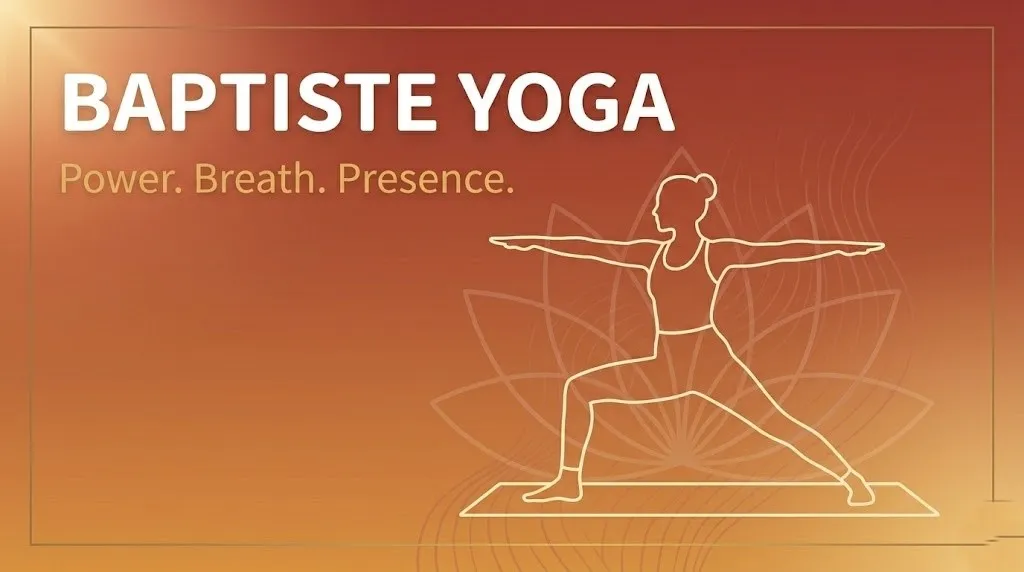
Baptiste yoga is a heated power vinyasa yoga system built around five core principles: heat, breath, gaze, tapas (discipline), and a continuous flowing sequence that integrates physical strength, flexibility, and meditative focus. It was developed by Baron Baptiste and formalized in his 2002 book “Journey into Power.”
The practice is taught in a room heated to approximately 90 to 95 degrees Fahrenheit. Unlike Bikram yoga, which follows a fixed 26-pose sequence, Baptiste yoga uses a structured but adaptable sequence framework. Teachers are trained to hold the sequence structure while personalizing cues for the room they are teaching.
What makes it distinct from a generic power yoga or Vinyasa class is the philosophical scaffold. Every class element, from the temperature setting to the specific gaze points used in each pose, is a deliberate practice tool, not an aesthetic choice.
Key defining features of Baptiste yoga:
- Heated room at approximately 90 to 95 degrees Fahrenheit
- Structured but non-fixed sequence based on Baron Baptiste’s core series
- Integration of breath, gaze (drishti), and movement as simultaneous tools
- Five-pillar framework applied to every class
- Emphasis on mental focus and internal observation alongside physical practice
- Accessibility: the sequence is scalable for multiple fitness levels in one room
Who Is Baron Baptiste: The Founder and His Philosophy
Baron Baptiste is an American yoga teacher, author, and entrepreneur who developed the Baptiste Power Vinyasa system after decades of study under some of the most influential yoga teachers of the 20th century. His background distinguishes his method from many branded yoga systems.
Baron Baptiste studied with B.K.S. Iyengar, Sri K. Pattabhi Jois, and his own parents, both established yoga teachers in California from the 1960s onward. This lineage gives his system genuine roots in traditional Indian yoga methodology, filtered through a distinctly American pragmatic lens.
His philosophy centers on the idea that yoga is a practice of authentic self-inquiry, not performance. He frequently distinguishes between practicing for appearance and practicing for internal experience. This distinction is built into the five pillars and taught explicitly in Baptiste teacher training programs.
Baron Baptiste’s key philosophical contributions to the practice:
- The five-pillar framework that structures every Baptiste class
- The “Journey into Power” sequence as a complete physical and mental practice system
- The concept of “being a beginner” as a permanent, valuable posture toward one’s own practice
- The integration of leadership and self-awareness development into teacher training beyond pose instruction
- A deliberate emphasis on inclusivity: the method is designed to work for non-athletes and experienced practitioners in the same room
Baron Baptiste founded the Baptiste Institute, which oversees teacher training certification and maintains curriculum standards internationally.
Baptiste Yoga vs Other Yoga Styles: How It Compares
Baptiste yoga sits closest to Ashtanga yoga and Vinyasa yoga in its physical demands, but its heated environment, five-pillar philosophy, and flexible sequence structure set it apart from both. Understanding these differences helps you choose the right practice for your body and goals.
Compared to Ashtanga yoga, Baptiste yoga uses heat and a more adaptable sequence. Ashtanga follows a fixed series of poses in a fixed order, always at room temperature. Baptiste classes vary the sequence within a structured framework and heat the room deliberately.
Compared to Bikram yoga (26 and 2), Baptiste yoga is significantly more varied. Bikram uses exactly 26 poses and 2 breathing exercises in the same order in every class, at a higher heat of 105 degrees Fahrenheit and 40% humidity. Baptiste yoga is cooler, more sequence-flexible, and philosophically distinct in its approach to breath and mental engagement.
| Feature | Baptiste Yoga | Ashtanga Yoga | Bikram/26&2 | Vinyasa Yoga |
|---|---|---|---|---|
| Room Temperature | 90 to 95°F | Room temperature | 105°F | Room temperature |
| Sequence Structure | Structured, adaptable | Fixed series | Fixed 26 poses | Variable |
| Breath System | Ujjayi, specific cues | Ujjayi throughout | Specific Bikram breath | Variable |
| Gaze (Drishti) | Explicit tool | Traditional drishti points | Not formally taught | Varies by teacher |
| Philosophy Framework | Five pillars | Ashtanga eight limbs | Script-based | Teacher-dependent |
| Difficulty Level | Moderate to vigorous | Vigorous | Vigorous | Variable |
Safety note: Both Baptiste yoga and Bikram yoga carry heat-related risks. People with cardiovascular conditions, heat intolerance, or those who are pregnant should work with their cardiologist or obstetrician to determine whether heated yoga is appropriate before their first class.
The Five Pillars of Baptiste Yoga Explained
The five pillars of Baptiste yoga are: heat, breath, gaze (drishti), tapas (discipline and intensity of focus), and being present. These five elements function as a unified framework that distinguishes a Baptiste class from a generic heated flow class.
Heat is the first pillar and the most visible. The room is warmed to approximately 90 to 95 degrees Fahrenheit. Baptiste’s rationale is that heat increases tissue pliability, supports muscular engagement, and accelerates the detoxification process through perspiration. This differs from Bikram’s higher heat, which Baptiste has described as excessive for the purpose of yoga practice.
Breath is the second pillar. Ujjayi pranayama runs through the entire class. The breath is not background music; it is the primary navigation tool. If the breath stops or becomes ragged, that is the signal to ease the intensity of the shape.
Gaze (drishti) is the third pillar. Each pose has a specific focus point: the extended hand, the floor, the horizon. Maintaining the gaze reduces external distraction and builds the single-pointed concentration that Baptiste describes as the heart of the practice.
Tapas, the fourth pillar, is a Sanskrit term meaning heat, austerity, or disciplined effort. In the Baptiste context, it refers to showing up fully for the challenge of the practice without backing away at the first moment of discomfort. It is different from forcing or straining.
Being present is the fifth pillar. This is the mental practice that runs underneath all four physical tools. It is the instruction to observe your experience without judgment rather than planning the next pose or evaluating how you look.
Key Takeaway: Baptiste yoga is not a hot Vinyasa class with a famous name behind it. The five-pillar framework is a specific and intentional system that, when understood, changes how every pose feels and functions.
Why Baptiste Yoga Uses Heat
Baptiste yoga uses a room temperature of approximately 90 to 95 degrees Fahrenheit because heat increases muscular pliability, supports deeper ranges of motion, and creates a physiological challenge that amplifies the mental focus demands of the practice. The heat is a training tool, not a selling point.
Warm muscle tissue moves more freely than cold muscle tissue. This is a basic physiological principle: the viscosity of muscle fibers decreases as temperature rises, which allows greater extensibility. In practice, this means that shapes like Trikonasana (Triangle Pose) and deep hip opening poses are more accessible in a heated room than in a room-temperature environment.
The perspiration response to heat also produces a mental challenge. Practicing through mild physical discomfort, in this case warmth rather than pain, trains the nervous system’s tolerance for sustained effort. This is the “tapas” pillar expressed physiologically.
According to the American College of Sports Medicine, exercising in heated environments requires adequate pre-hydration and a gradual acclimatization period for new practitioners. The ACSM recommends that individuals new to heated exercise allow the body at least one to two weeks of shorter, lower-intensity sessions before engaging in full-length heated yoga classes.
Hydration guidance for a Baptiste yoga class:
- Drink at least 500ml of water in the two hours before class
- Avoid large meals within 90 minutes of practice
- Bring a full water bottle to class and drink during standing rest periods
- Rehydrate with water or electrolyte drinks within 30 minutes of finishing
Safety note: Do not practice Baptiste yoga in a heated room if you have a current fever, heat-related illness, or any condition that impairs your body’s ability to regulate temperature. A physician familiar with your cardiovascular history can clarify safe exercise temperature ranges for your situation.
The Baron Baptiste Journey Into Power Sequence
The Journey into Power sequence is Baron Baptiste’s foundational yoga series, originally published in his 2002 book of the same name. It is the structural blueprint that most Baptiste-trained teachers use as the basis for their classes.
The sequence is organized into phases: a centering opening, a standing series, balancing poses, hip openers, a backbend sequence, a twisting series, an inversion or forward fold phase, and a closing with Savasana (Corpse Pose). Each phase has a physical purpose that connects to the five-pillar framework.
Think of the Journey into Power sequence like a well-designed strength circuit. Each section warms the body for what comes next. The standing series builds heat and lower body strength. The balance poses demand the focused gaze and presence the early phases develop. The backbends open the anterior body after the forward-fold-dominant standing work. The sequence is internally logical, not randomly assembled.
The Journey into Power sequence phases and their primary purposes:
| Phase | Example Poses | Physical Purpose |
|---|---|---|
| Centering | Seated breath work | Activates Ujjayi, establishes focus |
| Warm-Up | Surya Namaskar (Sun Salutation) | Builds heat, links breath to movement |
| Standing Series | Virabhadrasana I, II (Warriors I, II), Utkatasana (Chair Pose) | Lower body strength, hip stability |
| Balancing | Virabhadrasana III (Warrior III) | Core stability, single-leg strength |
| Hip Openers | Parsvakonasana (Side Angle Pose) | Hip flexor lengthening, lateral stretch |
| Backbends | Ustrasana (Camel Pose), Setu Bandha (Bridge Pose) | Anterior body opening, spinal extension |
| Twists | Supine and seated twists | Spinal mobility, compression and release |
| Closing | Savasana (Corpse Pose) | Nervous system integration |
Modification: Beginners can replace Ustrasana (Camel Pose) with a supported Setu Bandha Sarvangasana (Bridge Pose) using a block under the sacrum. This maintains the backbend principle without the cervical spine load that Camel creates.
Baptiste Yoga Poses Every Practitioner Should Know
The foundational Baptiste yoga poses span standing strength shapes, balance poses, backbends, and a closing rest. Knowing these by name and by feel before your first class reduces the learning curve and lets you focus on the breath rather than the instructions.
Virabhadrasana I (Warrior I) builds quadriceps and glute strength while lengthening the hip flexors of the back leg. The arms reach overhead, the chest lifts, and the gaze is forward and slightly upward. It appears repeatedly in the standing series.
Utkatasana (Chair Pose) is the most challenging standing pose in the sequence for most beginners. The hips sit back and down as if into a chair while the arms reach overhead. The erector spinae and core stabilizers work to prevent the torso from collapsing forward.
Adho Mukha Svanasana (Downward Facing Dog) is the primary transition pose and rest position in Baptiste yoga. The body forms an inverted V shape, with the hamstrings, gastrocnemius, and deltoids actively engaged.
Core Baptiste yoga poses and their primary muscle targets:
- Virabhadrasana I (Warrior I): quadriceps, glutes, hip flexors
- Virabhadrasana II (Warrior II): quadriceps, hip abductors, shoulder stabilizers
- Utkatasana (Chair Pose): quadriceps, glutes, erector spinae
- Trikonasana (Triangle Pose): hamstrings, hip abductors, lateral trunk stabilizers
- Adho Mukha Svanasana (Downward Facing Dog): hamstrings, gastrocnemius, deltoids, serratus anterior
- Chaturanga Dandasana (Four-Limbed Staff Pose): triceps, pectorals, core stabilizers
- Urdhva Mukha Svanasana (Upward Facing Dog): erector spinae, pectorals, wrist extensors
- Savasana (Corpse Pose): full body release, nervous system integration
Modification: In Virabhadrasana II (Warrior II), beginners who experience knee discomfort should reduce lunge depth so the front thigh is above parallel rather than at 90 degrees, which reduces patellofemoral joint load.
Key Takeaway: The Journey into Power sequence and the Baptiste five pillars are not abstract concepts. Every physical pose expresses at least one pillar, and understanding that connection makes the practice more effective on day one.
Baptiste Yoga Sequence for Beginners Step by Step
A beginner Baptiste yoga sequence uses the same structural logic as the full Journey into Power series but at a slower pace, with longer holds and explicit modification options at each stage. This version runs approximately 30 to 35 minutes.
Before starting, set the room temperature if possible. Practicing at 75 to 80 degrees is a reasonable introduction for beginners not yet acclimatized to the full 90 to 95 degree environment. Establish Ujjayi breath before any movement begins.
To practice the beginner Baptiste sequence:
- Sit in Sukhasana (Easy Seated Pose) for 2 minutes. Establish Ujjayi breath: 4-count inhale, 4-count exhale through the nose.
- Come to hands and knees. Perform Bitilasana Marjaryasana (Cat-Cow) for 8 rounds. Match each spinal movement to one breath.
- Press back into Adho Mukha Svanasana (Downward Facing Dog). Hold for 5 breaths. Bend knees generously if hamstrings are very tight.
- Walk feet to hands. Rise through a halfway lift. Stand in Tadasana (Mountain Pose) for 5 breaths.
- Sweep arms overhead into Urdhva Hastasana (Upward Salute) on an inhale. Exhale and fold into Uttanasana (Standing Forward Fold).
- Step the right foot back into a low lunge. Square hips. Rise into Virabhadrasana I (Warrior I). Hold 5 breaths. Transition: open into Virabhadrasana II (Warrior II). Hold 5 breaths.
- Return to Tadasana. Repeat step 6 on the left side.
- From Tadasana, bend knees and sit into Utkatasana (Chair Pose). Hold 5 breaths. Beginners: keep the torso more upright and reduce depth.
- Come to the floor. Lower into Chaturanga Dandasana with knees down. Press into Bhujangasana (Cobra Pose) for 3 breaths. Press back to Adho Mukha Svanasana for 5 breaths.
- Sit back into Balasana (Child’s Pose) for 1 minute.
- Lie on your back. Hug knees to chest. Take Supta Matsyendrasana (Supine Spinal Twist) for 5 breaths each side.
- Rest in Savasana (Corpse Pose) for 3 to 5 minutes. Eyes closed. Body completely still.
Modification: Replace Chaturanga Dandasana with a full lowering from knees-to-floor until shoulder and core strength develops sufficiently to support the full form safely.
Baptiste Yoga Breathing Techniques
The primary breathing technique in Baptiste yoga is Ujjayi pranayama (Ocean Breath), a nasal breath with a slight glottal constriction at the back of the throat that produces a soft, audible ocean-like sound on both the inhale and the exhale. This breath runs continuously throughout the entire Baptiste class.
Ujjayi breath performs multiple functions simultaneously within a Baptiste practice. It regulates breath rate, keeping it from accelerating into shallow chest breathing during vigorous sequences. The sound serves as a continuous attention anchor, the auditory expression of the “being present” pillar. When you can hear your breath, your attention is on the practice, not the clock.
A 2021 study published in the International Journal of Yoga found that Ujjayi breathing practice during yoga reduced heart rate and perceived effort during moderate-to-vigorous intensity sessions compared to unregulated nasal breathing. For a practice as physically demanding as Baptiste yoga, this effect directly supports longer, more focused sessions.
To practice Ujjayi breath before your first Baptiste class:
- Sit comfortably. Close the mouth.
- Breathe in through the nose with a slight constriction at the back of the throat, as if fogging a mirror with your mouth closed.
- Exhale through the nose with the same constriction. Both inhale and exhale should be audible to you but not to someone across the room.
- Aim for a 4-count inhale, 4-count exhale cycle. Extend to 5 counts as the breath settles.
- Maintain this breath throughout your entire practice session.
Modification: If Ujjayi breath causes tension in the throat or jaw, relax the constriction slightly. The sound should feel like a whisper at the throat, not a forced restriction. Dizziness is a sign to return to natural nasal breathing and rest before continuing.
Baptiste Yoga Benefits for the Body
Baptiste yoga builds functional strength, cardiovascular endurance, and full-body flexibility through its heated, sequenced, breath-linked format. The combination of these three physical elements in one practice is what sets it apart from stretching-focused or strength-only yoga styles.
The standing series (Warriors I and II, Chair Pose, Triangle) places sustained isometric and isotonic load on the quadriceps, glutes, and hip stabilizers. Holding these poses for five or more breaths in a heated room creates a muscular training stimulus comparable to bodyweight strength training. Research suggests that regular yoga practice incorporating long-hold standing poses produces measurable improvements in lower body strength and endurance over 8 to 12 weeks.
The inversion and upper body weight-bearing elements, particularly Chaturanga Dandasana (Four-Limbed Staff Pose) and Adho Mukha Svanasana (Downward Facing Dog), develop shoulder girdle stability through the serratus anterior, deltoids, and rotator cuff musculature. Most desk-based adults have pronounced weakness here, which contributes to chronic shoulder and neck tension.
The American College of Sports Medicine notes that flexibility training performed in warmer environments produces greater range-of-motion improvements than equivalent stretching in room-temperature conditions, which supports the Baptiste rationale for heating the practice room.
Physical benefits of a consistent Baptiste yoga practice:
- Lower body strength from sustained standing pose holds
- Shoulder and upper back stability from repeated weight-bearing transitions
- Cardiovascular conditioning from continuous heated flow
- Improved spinal mobility through backbend and twist sequences
- Hip flexor lengthening from lunge-based standing series
- Enhanced proprioception and balance from single-leg poses
Safety note: If you experience sharp joint pain, not muscular fatigue, during any pose, exit the shape immediately and rest in Balasana (Child’s Pose). Joint pain during exercise warrants evaluation by an orthopedic specialist before continuing.
Baptiste Yoga and Mental Health: What Research Says
Heated power yoga practices, including Baptiste-style classes, consistently show positive effects on self-reported anxiety, stress, and mood in peer-reviewed research, primarily through two mechanisms: regulated breath and sustained physical challenge.
The National Center for Complementary and Integrative Health identifies yoga as one of the most evidence-supported mind-body practices for stress and anxiety reduction, with the strongest effects found in practices that combine breath regulation, physical movement, and mental focus simultaneously. Baptiste yoga’s five-pillar framework addresses all three.
The “being present” pillar directly trains the attentional mechanism that mindfulness research identifies as the primary driver of anxiety reduction. When attention is repeatedly returned to the breath, the gaze point, and the physical sensation of the pose, the default-mode rumination that underlies anxiety has less opportunity to run. This is not a vague claim: it is the mechanism that underlies both formal mindfulness-based stress reduction (MBSR) and Baptiste yoga practice.
A 2022 study published in Complementary Therapies in Medicine found that 8-week heated yoga programs produced greater reductions in perceived stress and depression scores than non-heated yoga programs of equivalent duration, though the researchers noted that the physical intensity, not solely the heat, likely contributed to the difference.
Mental health effects supported by research:
- Reduced self-reported anxiety through breath regulation and focused attention
- Improved mood following vigorous physical yoga sessions via endorphin and serotonin pathways
- Reduced cortisol markers after 8-week yoga interventions (NCCIH-cited studies)
- Improved sleep quality in adults practicing yoga 3 or more times weekly
Key Takeaway: Baptiste yoga’s mental health benefits come from three simultaneous mechanisms: regulated breath, sustained physical effort, and trained present-moment attention. The five pillars are not marketing language; they are the practice tools that create these documented effects.
Baptiste Yoga for Back Pain and Injury Recovery
Baptiste yoga can support back pain management when practiced with appropriate modifications, because its core sequence builds the lumbar stabilizers, glutes, and thoracic spine mobility that most back pain sufferers lack. It is not, however, a generic back pain remedy, and the heated environment and vigorous pace require careful modification for people managing active spinal conditions.
A 2017 clinical trial published in the Annals of Internal Medicine found that yoga was as effective as physical therapy for reducing pain and disability in adults with chronic low back pain over 12 weeks. While this study used a general yoga protocol, the poses involved closely overlap with the Baptiste standing and floor series.
The most back-pain-relevant elements of Baptiste yoga are the repeated spinal extension in the backbend sequence, which counters the flexion dominance of most daily postures, and the hip-opening standing series, which addresses the hip flexor shortening that contributes to anterior pelvic tilt and lumbar loading.
Modifications for practicing Baptiste yoga with low back pain:
- Replace Chaturanga Dandasana with a modified push-up to knees to protect the lumbar spine from sagging
- Use a block under the sacrum in Setu Bandha Sarvangasana (Bridge Pose) if full bridging creates discomfort
- Avoid deep backbends like Ustrasana (Camel Pose) during acute flare-up periods
- Reduce stance width in Virabhadrasana I (Warrior I) to decrease the pelvic rotation demand
- Exit any pose immediately if pain radiates down the leg rather than remaining local to the back
A physical therapist with yoga knowledge can review your specific movement patterns before you begin if you are managing a diagnosed spinal condition. This collaboration often produces better outcomes than attempting self-modification without a professional baseline assessment.
Baptiste Yoga Modifications and Props for Beginners
Baptiste yoga is designed to be practiced by multiple fitness levels in the same room simultaneously, and the modification tools built into the system make this possible without disrupting the class. Props are not signs of weakness; they are precision instruments that allow you to access the correct shape and the correct muscular engagement without force.
The four most useful props for Baptiste yoga beginners are yoga blocks, a yoga strap, a non-slip yoga mat, and a non-slip towel. The towel is specific to heated practice: it goes over the mat, absorbs perspiration, and prevents slipping as the session progresses and the mat surface becomes wet.
Beginners who arrive prepared with two blocks and a towel can access every pose in the beginner sequence without straining. Most studios supply blocks and straps; bring your own towel and mat if possible for hygiene reasons.
| Prop | Primary Use in Baptiste Practice | Budget Alternative |
|---|---|---|
| Yoga Block (2) | Supports hands in forward folds and low lunge | Firm hardcover books |
| Yoga Strap | Extends reach in hamstring work and shoulder stretches | Bathrobe belt or necktie |
| Non-Slip Mat | Grip surface for standing and floor poses | None adequate for heated practice |
| Non-Slip Towel | Covers mat when perspiration builds | Full-size microfiber towel |
| Yoga Blanket | Cushions knees in kneeling poses | Folded bath towel |
Modification guide for common challenge points:
- Tight hamstrings in forward folds: place blocks under hands at any height; bend the knees as much as needed
- Wrist sensitivity in Downward Dog: shift to fists or use a yoga wedge under the palms
- Shoulder weakness in Chaturanga: lower knees to the floor before the descent
- Balance difficulty in Warrior III: use a wall or chair back as a stabilizing anchor
How Hard Is Baptiste Yoga for Beginners
Baptiste yoga is moderately to highly demanding for most beginners, more so than a standard Hatha or gentle Vinyasa class, primarily because of the heat, the physical pace, and the sustained standing pose sequences that challenge lower body endurance. Most people find their first class harder than expected.
That said, the system is built for mixed levels in one room. A trained Baptiste teacher provides simultaneous cues for full expression and modification. You are never expected to match the practitioner next to you on your first class. The instruction is to work at your edge without pushing past it, which is the tapas pillar in practice.
Most beginners report three points of particular challenge in their first several Baptiste classes:
First is heat adaptation. The room is significantly warmer than most exercise environments. Most bodies take two to four sessions to begin adapting to the heat component. Feeling lightheaded or needing to rest in Balasana (Child’s Pose) in your first class is normal and appropriate.
Second is Chaturanga Dandasana (Four-Limbed Staff Pose). This pose requires triceps and serratus anterior strength that most beginners have not yet developed. Lowering the knees first is the correct beginner approach, not a compromise.
Third is the pace of breath-movement linking. Following Ujjayi breath while also moving, gazing, and maintaining pose alignment simultaneously is a coordination skill. It takes three to five sessions before it begins to feel integrated rather than overwhelming.
Realistic expectations for beginners in the first 4 weeks:
- Week 1 to 2: Focus on staying in the room and maintaining breath continuity
- Week 2 to 3: Poses begin to feel more familiar; begin reducing modifications gradually
- Week 3 to 4: The sequence structure becomes predictable; focus shifts to alignment depth
- Week 4 onward: The mental focus pillar becomes accessible once the physical pattern is familiar
Baptiste Yoga Teacher Training: What to Expect
Baptiste yoga teacher training is offered through the Baptiste Institute, the organization Baron Baptiste founded to standardize curriculum, certify teachers, and maintain the integrity of the method. Most foundational programs lead to a 200-hour certification recognized by Yoga Alliance.
The Baptiste teacher training curriculum differs from generic 200-hour programs in its explicit emphasis on leadership development alongside yoga instruction. Students study the five-pillar framework in depth, practice teaching under supervision, study anatomy relevant to the Baptiste sequence, and complete a personal practice requirement that runs throughout the training.
Yoga Alliance is the primary certification body for yoga teacher standards in the United States and internationally. A Baptiste Institute 200-hour certification meets Yoga Alliance’s Registered Yoga Teacher (RYT-200) requirements, which means graduates can register independently with Yoga Alliance after completing the program.
What to expect from a Baptiste Institute teacher training:
- Duration: typically 9 to 12 days for intensive residential format; longer for online or modular formats
- Curriculum: five pillars, Journey into Power sequence, anatomy, pranayama, philosophy, teaching methodology, supervised practicum
- Prerequisite: regular yoga practice for at least 6 months; prior Baptiste class experience strongly recommended
- Format: residential intensives at Baptiste campuses or online hybrid programs
- Cost: ranges from approximately $2,500 to $4,500 depending on format and location in 2026
- Outcome: Baptiste Institute certification plus eligibility for Yoga Alliance RYT-200 registration
Note on choosing a program: Verify independently that any Baptiste teacher training program you consider is currently affiliated with the Baptiste Institute and is listed as a Registered Yoga School (RYS) with Yoga Alliance. Program offerings and affiliations can change between publication and enrollment.
Key Takeaway: Baptiste teacher training produces instructors prepared to teach the specific five-pillar system, not just generic yoga classes. The leadership and self-inquiry components are as prominent as the pose instruction curriculum.
Baptiste Yoga Safety and Contraindications
Baptiste yoga carries specific safety considerations that go beyond standard yoga precautions because of its heated environment and vigorous physical demands. Understanding these before your first class or home practice protects your long-term participation in the method.
The most documented risk in heated yoga practices is heat-related illness: heat exhaustion and, in rare cases, heat stroke. The NCCIH notes that people new to exercise in heated environments should allow gradual acclimatization and should never practice through dizziness, nausea, or a racing heart. These are signals to exit the heated room immediately, not to push through.
The second major risk area is shoulder injury from Chaturanga Dandasana performed with poor form at volume. The rotator cuff is the primary stabilizer of the glenohumeral joint during the lowering phase. When practitioners lower with elbows flared wide rather than hugging the ribs, the rotator cuff is exposed to shear forces it is not designed to manage repeatedly. A shoulder specialist can evaluate any pre-existing rotator cuff pathology before you begin.
Conditions that require modification or medical clearance before Baptiste yoga:
- Cardiovascular disease or uncontrolled high blood pressure: heated vigorous yoga requires cardiology clearance because of the combined heart rate and temperature demands
- Pregnancy: heated yoga is generally not recommended beyond the first trimester; a certified prenatal yoga teacher can provide appropriate alternatives
- Active lumbar disc herniation: the forward fold and Chaturanga volume should be reduced; a spine-focused physical therapist can guide a modified Baptiste practice
- Glaucoma or retinal conditions: inversions including Downward Facing Dog raise intraocular pressure; an ophthalmologist can specify safe positions
- Recent surgery: clearance from the operating surgeon is necessary before any vigorous exercise practice
- Heat intolerance or hyperhidrosis: these conditions increase the risk of electrolyte imbalance in heated practice environments
Safety note: The rest pose in Baptiste yoga is Balasana (Child’s Pose), not the lobby. If you need to rest during class, come to Child’s Pose on your mat, maintain your Ujjayi breath, and rejoin the sequence when ready. Leaving the heated room abruptly and entering cold air can cause a rapid cardiovascular response; remain in the room and rest whenever possible.
Frequently Asked Questions About Baptiste Yoga
What is baptiste yoga and how is it different from regular yoga?
Baptiste yoga is a heated power vinyasa system built around five specific pillars: heat, breath, gaze, tapas, and being present.
It differs from generic yoga classes because every element of the class, including the room temperature, the sequence structure, the breathing pattern, and the focus cues, is intentionally tied to this five-pillar framework.
Most general yoga classes do not apply this level of philosophical structure to their physical format.
Is baptiste yoga good for beginners with no yoga experience?
Baptiste yoga is accessible to complete beginners when they use the provided modifications, particularly lowering to knees in Chaturanga and using blocks in forward folds.
The heated environment and physical pace make it harder than a beginner Hatha class, and most new practitioners need three to five sessions before the sequence and breath coordination feel manageable.
Starting with a shorter or cooler introductory session, if your studio offers one, significantly reduces the adaptation challenge in the first week.
Why does baptiste yoga use heat and how hot does it get?
Baptiste yoga rooms are heated to approximately 90 to 95 degrees Fahrenheit to increase muscular pliability, support deeper ranges of motion, and create a physical challenge that amplifies the mental focus demands of the practice.
This is cooler than Bikram yoga, which uses 105 degrees Fahrenheit and higher humidity.
The Baptiste rationale is that the heat should enhance the practice without overwhelming the body’s thermoregulatory capacity.
How many times a week should I practice baptiste yoga?
Yoga teachers and movement researchers generally recommend 3 to 4 sessions per week for practitioners building a consistent Baptiste yoga practice.
Beginners should start with 2 sessions weekly and allow full recovery days between heated sessions while the body adapts to the temperature and physical demands.
The American College of Sports Medicine recommends at least one full rest or light activity day per week even for experienced practitioners of vigorous exercise.
What do I need to bring to my first baptiste yoga class?
Bring a non-slip yoga mat, a large non-slip towel to place over the mat, a full water bottle, and moisture-wicking clothing to your first Baptiste yoga class.
Most studios supply blocks and straps, but calling ahead to confirm is worthwhile.
Arrive at least 10 minutes early, introduce yourself to the teacher as a beginner, and tell them if you have any injuries or physical limitations so they can offer specific cues during class.
Start Where You Are and Use What You Have
The single most practical thing you can do before your first Baptiste class is practice Ujjayi breath for 5 minutes today. Sit down, close your mouth, constrict slightly at the back of the throat, and breathe. That breath is the practice. Everything else builds from it.
If you are practicing at home, run the beginner sequence in this guide three times this week. Use blocks in every forward fold. Lower your knees in Chaturanga. Maintain the breath, even when the pose is challenging.
The five pillars are a compass, not a report card. Show up with breath and attention. The strength follows.