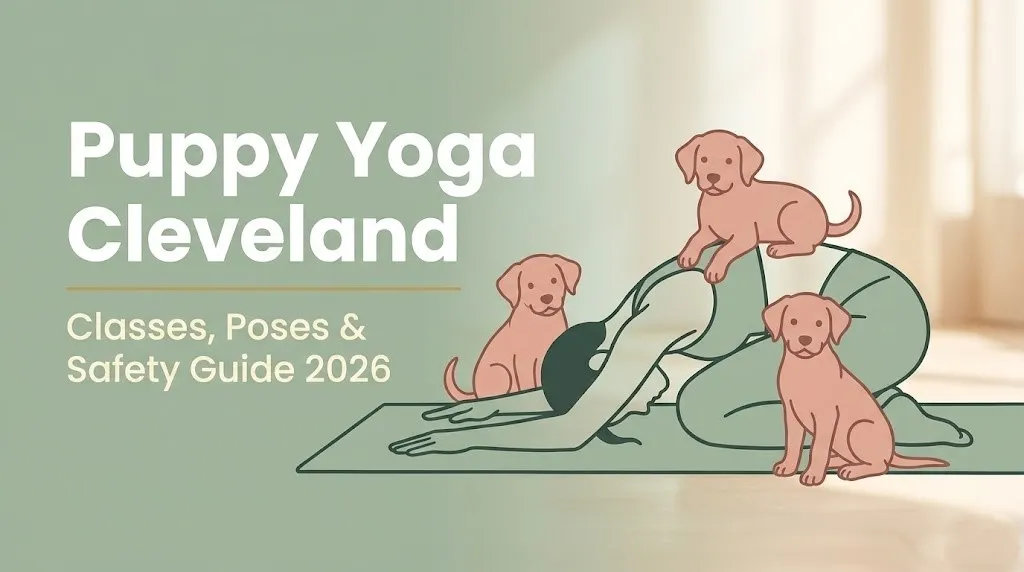
Puppy Yoga Cleveland: Top Classes, Poses & Safety 2026
Puppy yoga Cleveland events combine a beginner-friendly yoga class with time spent with rescue or shelter puppies, creating a uniquely approachable wellness experience that works for nearly every body and fitness level. If you have been looking for a low-pressure, genuinely enjoyable way to start a yoga practice, this is one of the better entry points available in Northeast Ohio.
The pairing of yoga with animal interaction is not just fun. It is backed by documented physiological responses. According to the Human Animal Bond Research Institute, interaction with dogs measurably reduces cortisol levels and activates the parasympathetic nervous system, the same state that yoga breathing intentionally targets.
This guide covers everything a Cleveland-area searcher needs: what puppy yoga actually involves, which poses are typically practiced, the science of animal-assisted wellness, maternity yoga options nearby, and practical preparation tips for your first class.
Puppy Yoga Cleveland: What It Is and Where to Find It
Puppy yoga Cleveland refers to yoga events held throughout the Cleveland metro area where participants practice a gentle yoga sequence while rescue or shelter puppies roam freely around and across the mats.
Events are typically organized through local yoga studios, animal rescue organizations, or independent event companies in partnership with shelters. The puppies used are almost always from area rescue groups, with attendance fees sometimes benefiting the sponsoring shelter directly. This community-benefit structure has made puppy yoga particularly popular in Northeast Ohio’s active rescue and adoption scene.
Classes are held at various venues across Cuyahoga County and surrounding areas, including studio spaces, outdoor parks during warmer months, and community event venues. Event frequency varies by organizer, with some studios running monthly sessions and others hosting quarterly or seasonal events.
Puppy yoga Cleveland at a glance:
| Feature | Typical Format |
|---|---|
| Location | Cleveland metro, Cuyahoga County |
| Class style | Gentle Hatha or beginner flow |
| Puppies present | Rescue or shelter dogs, usually 8 to 16 weeks |
| Class duration | 60 to 75 minutes |
| Experience level | All levels, no yoga experience required |
| Typical cost | $25 to $45 per person |
| Booking method | Advance reservation usually required |
To find current events, search local yoga studio websites, Cleveland-area event calendars, and rescue organization social pages for upcoming dates. Classes book out quickly, particularly weekend morning sessions.
What Is Puppy Yoga and How Does a Class Work
Puppy yoga is a structured yoga class, typically in a Hatha or gentle beginner format, during which young puppies are brought into the studio space to interact with participants throughout the session.
The class follows a real yoga sequence. An instructor leads participants through poses with verbal cues and alignment guidance. The puppies are not a distraction from the yoga. They are woven into the experience. Some participants set an intention to simply practice while puppies climb on them. Others welcome the interruptions as part of the joy.
Most puppy yoga sessions run between 60 and 75 minutes. The first 15 to 20 minutes are usually a standing warm-up. The middle portion moves through seated and floor-based poses where puppy interaction is most natural. The final 10 minutes typically include a gentle cool-down and a longer Savasana (Corpse Pose), during which puppies often settle and curl up beside or on participants.
Typical puppy yoga class structure:
| Phase | Duration | What Happens |
|---|---|---|
| Welcome and warm-up | 10 to 15 minutes | Standing poses, gentle stretching |
| Core sequence | 30 to 40 minutes | Seated, kneeling, floor poses with puppies |
| Cool-down | 10 minutes | Gentle forward folds, hip openers |
| Savasana | 10 minutes | Full rest with puppies settling |
| Post-class free time | 10 to 15 minutes (varies) | Free puppy play and socialization |
The experience is intentionally low-pressure. If a puppy climbs on you mid-pose, you adjust. If you need to pause and pet a dog, you pause. This is the structural permission that makes puppy yoga so accessible to people who are nervous about yoga classes.
Puppy Yoga Benefits: What the Science Says About Animals and Stress
Puppy yoga produces measurable wellbeing benefits through two distinct mechanisms: the documented effects of yoga itself, and the separately documented effects of positive human-animal interaction.
Research published in the Human Animal Bond Research Institute’s review literature consistently shows that brief interactions with dogs reduce cortisol, the body’s primary stress hormone, and increase oxytocin, the bonding neurochemical associated with feelings of safety and connection. This effect occurs within minutes and does not require prolonged exposure.
Yoga’s stress-reduction mechanisms are separately well-documented. According to the National Center for Complementary and Integrative Health (NCCIH), regular yoga practice is associated with reduced perceived stress, lower anxiety scores, and improved mood, with effects observable even after a single session. Combining both mechanisms in one class amplifies the overall parasympathetic response.
Documented benefits of puppy yoga:
- Cortisol reduction: Brief dog interaction measurably lowers stress hormone levels
- Oxytocin activation: Physical contact with animals triggers bonding neurochemicals
- Reduced anxiety: Yoga breathing activates the vagus nerve and parasympathetic system
- Improved mood: Both yoga and animal interaction are associated with elevated mood states
- Social connection: Group class setting reduces isolation, itself a documented health risk
- Physical movement: Even a gentle 60-minute class improves circulation and joint mobility
- Lowered blood pressure: Both yoga and calm dog interaction are associated with temporary blood pressure reduction
One honest note: the research on combined animal-assisted yoga specifically is still limited. Most studies examine animal-assisted therapy and yoga separately. The combined effects are real but the specific research base for “puppy yoga” as a defined therapeutic format is still emerging.
Key Takeaway: Puppy yoga combines two independently research-supported stress-reduction mechanisms: human-animal interaction and yoga breathing. The result is a genuinely effective mood and stress intervention, not just a cute trend.
Puppy Yoga vs. Regular Yoga: How the Class Differs
Puppy yoga differs from a standard yoga class in three meaningful ways: pace, expectation, and class atmosphere.
The pace of a puppy yoga class is deliberately slower than most studio yoga. Instructors build in pauses for puppy interaction. Transitions between poses are gentler than a Vinyasa flow would allow. The sequence stays accessible to complete beginners because the puppies themselves make precision alignment less of a priority.
Standard yoga classes, by contrast, build an expectation of continuous practice. Even a gentle Hatha class asks participants to hold focus and follow the teacher’s instruction with minimal interruption. The learning environment is structured and intentional.
Side-by-side comparison:
| Factor | Regular Yoga Class | Puppy Yoga Class |
|---|---|---|
| Pace | Instructor-set | Flexible, puppy-adjusted |
| Poses practiced | Full class sequence | Beginner-accessible floor poses |
| Focus required | High | Low to moderate |
| Atmosphere | Calm, focused | Playful, social |
| Benefits | Full yoga benefits | Yoga plus animal interaction benefits |
| Who thrives here | All yoga practitioners | Beginners, anxious practitioners, dog lovers |
| Spiritual/meditative depth | High | Low to moderate |
This comparison is not meant to suggest puppy yoga is a lesser form of practice. It is a different form of practice, optimized for accessibility, joy, and low-stakes entry. Many practitioners attend puppy yoga for months before transitioning to a more structured studio practice. The gateway function is genuinely valuable.
What to Expect at Your First Puppy Yoga Class in Cleveland
Your first puppy yoga class in Cleveland will feel warmer and more chaotic than a standard yoga class. That chaos is the whole point.
When you arrive, the studio will likely be set up with mats arranged in a circle or loose grid rather than the traditional rows-facing-forward studio layout. Participants usually socialize before class begins. The puppies are typically brought in at the start of class rather than being present during the pre-class gathering, which helps manage their energy levels.
During class, expect interruptions. A puppy will climb onto your back during Balasana (Child’s Pose). Another will lick your face during Adho Mukha Svanasana (Downward-Facing Dog). This is not a disruption. It is the designed experience. The instructor will cue poses and offer gentle modifications, but the overall energy is forgiving and lighthearted.
First-class preparation checklist:
- Arrive 15 minutes early to settle in, sign waivers, and meet the space
- Wear clothes you do not mind getting puppy paw prints or light dog hair on
- Remove jewelry or accessories that could accidentally catch a puppy or scratch them
- Bring a yoga mat if you have one; most events provide them but personal mats are preferable
- Bring a small water bottle for between poses
- Leave strong scents, including heavily scented lotions or perfumes, at home; puppies are sensitive to strong smells
- Know that you may be asked to sit out if you have a dog allergy that has not been medically managed
Modification note for anxious practitioners: If you are nervous about the yoga portion of the class, tell the instructor before class starts. Most puppy yoga teachers are trained for beginners and will offer verbal modifications throughout. You can also simply sit cross-legged on your mat and play with puppies during any pose that feels inaccessible. No one in a puppy yoga class is watching your technique.
Puppy Yoga Poses for Beginners
Puppy yoga classes typically use a beginner-accessible sequence drawn from Hatha yoga, with emphasis on floor and low-to-the-ground poses that allow natural interaction with the puppies.
The most commonly practiced poses in puppy yoga sessions are the ones where your body is at puppy level: kneeling, seated, and supine positions. Standing poses appear in the warm-up but take a backseat to floor work once the puppies settle into the session’s rhythm.
Core poses in a typical puppy yoga sequence:
To practice Marjaryasana-Bitilasana (Cat-Cow Pose):
- Begin on hands and knees, wrists under shoulders, knees under hips.
- On an inhale, drop the belly, lift the chest and tailbone into Cow.
- On an exhale, round the spine toward the ceiling, tuck chin and tailbone into Cat.
- Repeat for 5 to 8 breath cycles, moving with the breath.
- Return to a neutral tabletop to release.
Modification: Place a folded blanket under the knees if kneeling is uncomfortable. Pregnant practitioners keep the neck long and neutral rather than dropping the head fully.
Balasana (Child’s Pose):
- From kneeling, bring the big toes together and widen the knees to hip-width or wider.
- Fold the torso forward, reaching arms long or resting them alongside the body.
- Let the forehead rest on the mat or on a block.
- Hold for 5 to 10 breath cycles.
- Press through the hands to rise back to kneeling.
Modification: For pregnant practitioners or those with knee discomfort, widen the knees significantly and place a bolster under the torso for support.
Baddha Konasana (Bound Angle Pose):
- Sit upright with soles of the feet together and knees falling to the sides.
- Hold the outer edges of the feet or ankles.
- Lengthen the spine upward on each inhale, release any excess tension on each exhale.
- Hold for 5 to 8 breaths without forcing the knees toward the floor.
- Release the feet and extend the legs to exit.
Modification: Sit on a folded blanket to tilt the pelvis forward. This reduces strain on the lower back and makes the hip opener more accessible for beginners.
Key Takeaway: Puppy yoga poses are beginner-accessible by design. Cat-Cow, Child’s Pose, and Bound Angle Pose are the backbone of most sessions because they bring your body to the puppies’ level and hold safely for extended periods.
Puppy Yoga for Anxiety and Mental Wellness
Puppy yoga is one of the more effective entry-level interventions for anxiety-related reluctance to try yoga, because the puppies remove the self-consciousness that keeps many people off the mat.
One of the most common barriers to beginning a yoga practice is performance anxiety. New practitioners worry about doing poses incorrectly, looking inflexible, or not keeping up with the class. A puppy yoga class dissolves that barrier structurally. When a puppy is sitting on someone’s back in Child’s Pose, the entire room is focused on the puppy. Nobody is watching your alignment.
The neurochemical explanation for this effect is straightforward. According to the Journal of Alternative and Complementary Medicine, animal-assisted interventions are associated with reduced situational anxiety and improved mood across a range of clinical and community settings. The mechanism involves both the physical touch of the animal and the cognitive shift in attention that pet interaction creates.
Mental wellness benefits supported by research:
| Mechanism | Effect | Source Type |
|---|---|---|
| Dog interaction, oxytocin release | Feelings of safety and bonding | Human Animal Bond Research Institute |
| Yoga breathing, vagus nerve activation | Reduced anxiety, heart rate lowering | NCCIH research base |
| Social group class | Reduced isolation and loneliness | Harvard T.H. Chan School of Public Health |
| Attentional shift toward puppies | Reduced self-monitoring anxiety | Journal of Alternative and Complementary Medicine |
| Physical movement | Improved mood via endorphin release | American College of Sports Medicine |
For practitioners managing generalized anxiety disorder or social anxiety, puppy yoga can serve as a practical first step toward a regular yoga practice. The social format is structured enough to feel safe and unstructured enough to feel non-threatening.
Puppy Yoga for Kids and Families in Cleveland
Puppy yoga is one of the most genuinely family-friendly wellness activities available in Cleveland, provided the event specifically welcomes children.
Not all puppy yoga events are designed for kids. Some are adult-only due to insurance requirements or the nature of the puppy handling protocols. Before booking for a family, confirm the minimum age requirement with the organizer. Many Cleveland-area events welcome children aged seven and above when accompanied by an adult.
For children who do attend, the benefits extend beyond the yoga practice itself. Direct, supervised interaction with rescue animals teaches empathy, gentle touch, and emotional regulation. The yoga component introduces body awareness and breath practice in a context that feels genuinely playful rather than instructional.
Family puppy yoga considerations:
- Confirm minimum age requirements before booking for children
- Children should understand how to interact gently with young puppies before attending
- Poses are simplified further for family classes; the sequence is almost entirely floor-based
- Parents should practice poses alongside children rather than supervising from the side
- Children with dog allergies or fear of dogs should not be brought to puppy yoga events regardless of encouragement
Kid-friendly poses in a family puppy yoga class:
- Bitilasana (Cow Pose): Children find this pose intuitive and enjoy mooing while the puppies investigate
- Balasana (Child’s Pose): Natural resting position that puppies are drawn to
- Viparita Karani (Legs Up the Wall Pose): Accessible, calming, and a puppy magnet
- Savasana (Corpse Pose): Children often find this the highlight when puppies curl up beside them
Puppy Yoga for Seniors: Is It Safe and Suitable
Puppy yoga is suitable for most seniors and often better tolerated than standard yoga classes, because the playful format reduces performance pressure and the poses are consistently beginner-accessible.
The physical demands of a puppy yoga class are generally low. Floor poses dominate the second half of the sequence. Standing work in the warm-up is gentle and brief. The pace is slow, with frequent natural pauses. For seniors who have been reluctant to try yoga due to concerns about keeping up, puppy yoga’s built-in flexibility addresses that concern directly.
There are two practical considerations specific to seniors. First, getting down to the floor and back up repeatedly requires some baseline mobility. Seniors who cannot comfortably transition between standing and seated floor positions should look for chair yoga versions of puppy events, which some Cleveland-area organizations have begun offering.
Second, the puppies themselves are unpredictable. Young dogs jump, scratch, and move suddenly. For seniors with balance concerns, osteoporosis, or thin skin that bruises easily, being jumped on by an enthusiastic puppy during a standing pose is a genuine safety consideration.
Senior suitability guide for puppy yoga:
| Consideration | Recommendation |
|---|---|
| General mobility intact | Excellent candidate for puppy yoga |
| Balance concerns during standing | Stay near a wall or chair during warm-up |
| Difficulty with floor transitions | Look for chair-adapted puppy yoga events |
| Osteoporosis | Avoid forward folds with spinal flexion; modify all twists |
| Thin or fragile skin | Be aware of puppy claws; wear long sleeves for protection |
| Dog allergy (managed) | Confirm with allergist before attending |
According to a review published in the International Journal of Yoga, chair-based and gentle yoga programs for adults over 65 are associated with improved balance, reduced fall risk, and improved quality of life measures. Puppy yoga in a chair-adapted format carries these same baseline benefits.
Key Takeaway: Puppy yoga works well for most seniors, but the transition from standing to floor and back is the key mobility check. If floor transitions are a challenge, look for chair-adapted puppy yoga events in Cleveland.
Maternity Yoga Near Me: What Cleveland-Area Prenatal Yoga Offers
Maternity yoga, also called prenatal yoga, is yoga practice specifically designed for pregnant bodies, focusing on pelvic floor support, breath awareness, and poses that accommodate a growing belly without compressing the abdomen or stressing the sacroiliac joints.
Cleveland-area prenatal yoga classes are offered at several studios throughout Cuyahoga County and the surrounding suburbs. Classes are typically structured for practitioners in their second or third trimester, though some instructors offer trimester-specific series starting from the first trimester with appropriate modifications.
The distinction between maternity yoga and general yoga is not just about which poses you skip. It is about the entire biomechanical orientation of the class. Prenatal yoga teaches practitioners to breathe in ways that support the pelvic floor, a set of muscles that undergoes considerable change during pregnancy and childbirth. It also addresses common pregnancy-specific discomforts including round ligament pain, sacroiliac joint dysfunction, and thoracic tightness from postural changes.
What Cleveland-area maternity yoga typically includes:
| Class Element | Why It Matters for Pregnancy |
|---|---|
| Pelvic floor breathing | Supports labor preparation and postpartum recovery |
| Supported side-lying poses | Safe for all trimesters after the first |
| Hip-opening poses | Addresses sacroiliac joint mobility changes |
| Thoracic mobility work | Counters forward-rounding from growing belly weight |
| Modified standing balance | Maintains proprioception as center of gravity shifts |
| Breath practice (pranayama) | Teaches controlled breathing useful during labor |
When searching for “maternity yoga near me” in Cleveland, verify that the instructor holds a prenatal yoga certification, which is distinct from general yoga teacher training. The Yoga Alliance recognizes prenatal yoga as a specialty requiring additional training beyond the standard 200-hour certification.
Prenatal Yoga Poses That Are Safe in the First and Second Trimester
Safe prenatal yoga poses are those that avoid deep abdominal compression, supine positions after the first trimester, deep unsupported twists, and poses that challenge balance beyond the practitioner’s current stability.
The American College of Obstetricians and Gynecologists (ACOG) advises that low-impact exercise including yoga is generally safe throughout a healthy pregnancy, with modifications becoming progressively more important as pregnancy advances. The first trimester allows the widest range of movement, though nausea and fatigue often limit what feels comfortable in practice.
First trimester safe poses (with notes):
- Marjaryasana-Bitilasana (Cat-Cow Pose): Safe and therapeutic for lower back. Keep neck neutral.
- Balasana (Child’s Pose): Widen knees to accommodate the belly even when it is not yet visible.
- Baddha Konasana (Bound Angle Pose): Sit on a folded blanket for pelvic tilt support.
- Virabhadrasana I (Warrior I Pose): Strengthen legs and open hips; watch balance carefully.
- Adho Mukha Svanasana (Downward-Facing Dog): Full version is safe early; modify to wall version as belly grows.
Second trimester additions and modifications:
- Avoid supine poses (lying flat on the back) for extended periods as the uterus grows; use a bolster under the right hip to tilt the pelvis
- Supta Baddha Konasana (Reclined Bound Angle Pose): Use a bolster under the spine and a blanket under each knee
- Side-lying Savasana (Corpse Pose): Replace supine Savasana with a side-lying version using a bolster between the knees
- Deep twists: Replace full spinal twists with open twists that rotate away from the belly rather than compressing it
Modification note: Any practitioner experiencing bleeding, preterm labor signs, preeclampsia, or placenta previa should receive clearance from their obstetric provider before attending any yoga class, including prenatal-specific sessions.
Maternity Yoga Benefits: What the Research Says for Pregnant Practitioners
Prenatal yoga produces well-documented benefits for both the pregnant practitioner’s physical comfort and her emotional preparation for labor and postpartum recovery.
A study published in the Journal of Alternative and Complementary Medicine found that women who practiced prenatal yoga reported lower perceived pain during labor, reduced anxiety scores in the third trimester, and improved sleep quality compared to control groups. The breath practices taught in prenatal yoga appear to be particularly relevant during labor, providing a practical tool for managing contractions.
Physical benefits are equally documented. Prenatal yoga builds strength in the gluteus medius, quadriceps, and deep core muscles that support the changing pelvis during pregnancy. Hip-opening poses maintain mobility in the sacroiliac joints and hip external rotators as the hormone relaxin increases joint laxity throughout the body.
Research summary for prenatal yoga benefits:
| Benefit | Evidence | Source |
|---|---|---|
| Reduced labor pain perception | Moderate evidence | Journal of Alternative and Complementary Medicine |
| Lower third-trimester anxiety | Moderate evidence | International Journal of Yoga |
| Improved sleep quality | Moderate evidence | Research in pregnancy yoga populations |
| Pelvic floor preparation | Strong theoretical basis | American College of Obstetricians and Gynecologists |
| Reduced lower back pain | Moderate evidence | Physical therapy and yoga literature |
| Social support and community | Well-established | Harvard T.H. Chan School of Public Health |
One honest caveat: most prenatal yoga research involves small sample sizes. The evidence base is positive but not as extensive as the research behind general yoga practice. What is clear is that prenatal yoga carries very low risk when taught by a certified instructor and practiced with appropriate trimester-specific modifications.
How to Prepare for Puppy Yoga or Maternity Yoga Class
Preparation for a puppy yoga class and a maternity yoga class share some common ground and diverge in important ways specific to each format.
For puppy yoga, the preparation is primarily practical and environmental. For maternity yoga, preparation involves both physical readiness and a conversation with your obstetric provider if you have any pregnancy complications that need to be considered before beginning exercise.
Shared preparation steps:
- Eat a light meal or snack two to three hours before class, not immediately before
- Arrive 10 to 15 minutes early to complete any waivers, get oriented, and settle the nervous system before class begins
- Bring a water bottle. Both formats are more active than they appear from the outside
- Wear comfortable, movement-friendly clothing that you do not mind getting slightly disheveled
Puppy yoga specific:
- Wear clothes you are comfortable getting dog hair or muddy paw prints on
- Remove rings and bracelets that could accidentally scratch a puppy
- Bring your own mat if possible; personal mats are more hygienic in multi-use animal-inclusive spaces
- Leave strongly scented products at home
Maternity yoga specific:
- Bring a bolster or large pillow if the studio does not provide them; many do, but confirming ahead saves frustration
- Wear a supportive sports bra and avoid any waistband that sits tightly across the lower abdomen
- Tell the instructor your current trimester and any specific discomforts before class begins
- Bring a yoga blanket or towel for under the knees and for side-lying Savasana support
Modification reminder for maternity yoga: Never force a range of motion that creates sharp or pulling pain. Round ligament discomfort is common; sharp pelvic pain, pubic symphysis pain, or any pain that does not ease within one or two breaths warrants stopping and informing the instructor.
Puppy Yoga Safety and What to Watch Out For
Puppy yoga is a low-risk activity, but three specific safety areas deserve attention before you book: allergen exposure, animal behavior unpredictability, and physical class demands.
Allergen exposure is the most overlooked safety issue. Dog dander is a genuine allergen, and a room full of active puppies generates significant airborne exposure. Practitioners with diagnosed dog allergies should discuss attendance with their allergist before going, because antihistamine management that works for brief dog encounters may not be sufficient for a 75-minute enclosed-space session.
Animal behavior unpredictability is most relevant for seniors, children, and pregnant practitioners. Puppies jump, scratch with their nails, and move suddenly. Most puppy yoga organizers keep nails trimmed and supervise the animals throughout class, but unexpected movement is always possible. During standing balance poses, this is worth factoring in.
Physical class demands are low but real. Even a gentle 60-minute yoga class involves kneeling, floor transitions, and sustained held positions. Practitioners with knee conditions, wrist injuries, or mobility limitations should notify the instructor before class and ask about seated or supported variations of floor poses.
Puppy yoga safety checklist:
- Confirm dog allergy status before booking
- Inform the instructor of any physical injuries or mobility limitations
- For seniors: stay near a wall during standing poses for balance support
- For pregnant practitioners: see the prenatal yoga safety notes in the preceding section
- For children: supervise gentle touch protocols before the class begins
- Never attend puppy yoga if you are actively fearful of dogs. The experience will not be therapeutic and may be genuinely distressing
According to the Yoga Alliance, studios hosting animal-inclusive events are responsible for ensuring animal welfare and participant safety. Ask your event organizer about their animal care protocols before attending. Reputable events work with licensed rescue organizations and veterinarian-supervised animals.
Frequently Asked Questions About Puppy Yoga Cleveland
What is puppy yoga and how does it work?
Puppy yoga is a beginner-friendly yoga class where rescue or shelter puppies roam freely among participants during the session.
A certified instructor leads the class through a gentle sequence, typically in a Hatha or beginner-flow format, while the puppies interact naturally with participants throughout.
Most sessions run 60 to 75 minutes and end with a free-play period where participants can spend time with the puppies off the mat.
Is puppy yoga good for beginners?
Puppy yoga is one of the best formats for yoga beginners because the playful atmosphere reduces performance pressure and self-consciousness.
The sequences used in puppy yoga classes are intentionally beginner-accessible, with floor-based poses that are approachable without prior yoga experience.
If a pose feels too difficult, you can simply sit on your mat and interact with the puppies without any expectation to continue.
Is puppy yoga safe during pregnancy?
Puppy yoga can be safe during pregnancy in the first and early second trimester with appropriate modifications, but requires extra awareness of balance and animal unpredictability.
Pregnant practitioners should inform the instructor of their trimester before class, avoid supine poses after the first trimester, and be mindful of puppies jumping during standing poses.
Anyone with pregnancy complications including placenta previa, preterm labor risk, or preeclampsia should receive clearance from their obstetric provider before attending any yoga class.
What should I bring to a puppy yoga class?
Bring a yoga mat, a water bottle, and comfortable clothing you do not mind getting dog hair or paw prints on.
Remove jewelry and avoid strongly scented lotions or perfumes, as puppies are sensitive to strong smells and jewelry can accidentally scratch them.
Arrive 15 minutes early to complete waivers, settle in, and get oriented before the session begins.
Is there maternity yoga near me in the Cleveland area?
Prenatal yoga classes are offered at multiple yoga studios throughout Cleveland and the surrounding Cuyahoga County suburbs.
Look for instructors who hold a prenatal yoga specialty certification recognized by the Yoga Alliance, which requires training beyond a standard 200-hour teacher certification.
Trimester-specific class series are available at some studios and are worth prioritizing if you are in the first trimester or managing any pregnancy-specific physical discomforts.
Ready to Get on the Mat
Puppy yoga in Cleveland is a genuinely accessible, research-supported wellness activity for beginners, families, seniors, and anyone who needs a low-stakes on-ramp to a regular yoga practice. Book one class, show up comfortable and early, and let the puppies do what they do.
If you are pregnant and searching for maternity yoga near you in Cleveland, look for a prenatal-certified instructor and tell them your trimester on day one. The modifications are straightforward, and the community of prenatal yoga practitioners in Northeast Ohio is welcoming and well-established.
One class at a time. That is all it takes to start.