Mysore Yoga: How It Works, Benefits, and Getting Started
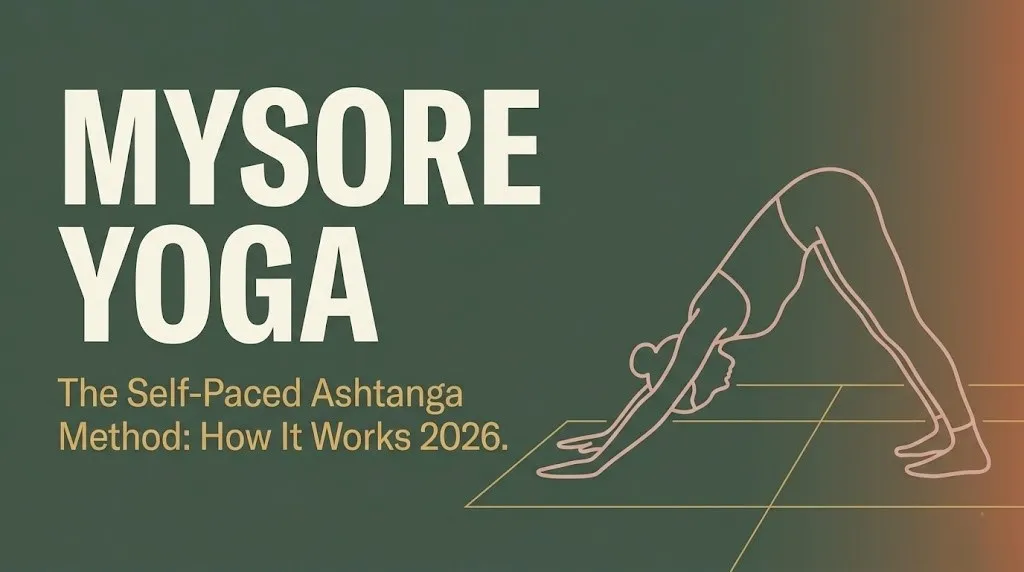
Mysore yoga is a self-paced teaching method rooted in the Ashtanga yoga tradition, where each student practices their individual sequence simultaneously in a shared room while a teacher moves between students offering personalized instruction and hands-on assists. It’s one of the most rigorous and most misunderstood approaches in all of contemporary yoga.
Interest in structured, individualized yoga methods has grown steadily. A 2019 study published in the International Journal of Yoga found that regular Ashtanga practitioners showed measurable improvements in flexibility, core strength, and self-reported stress management compared to baseline, with benefits appearing within eight weeks of consistent practice.
Here you’ll find a clear explanation of how the Mysore method works, its historical roots, the technical framework that makes it distinct, what happens in the room, how to prepare as a beginner, and a practical safety guide for people with injuries or limited mobility.
What Is Mysore Yoga?
Mysore yoga is a teaching format within Ashtanga yoga in which students practice a memorized sequence at their own pace, in the same room together, while a teacher circulates to offer individual guidance and physical adjustments.
The word “Mysore” refers to the city in Karnataka, India (now spelled Mysuru) where Sri K. Pattabhi Jois taught for decades at his institute. The practice that emerged from that shala (yoga studio) became known as the Mysore method, or Mysore style, to distinguish it from led Ashtanga classes where all students move through the sequence in unison.
What sets Mysore yoga apart from every other group yoga format is this: there is no teacher standing at the front calling poses. Each student arrives knowing their personal portion of the sequence and works through it independently. The teacher assists, corrects, and occasionally adds new poses when a student is ready. The room is active but largely silent, filled only with the sound of breath.
This format produces an unusually deep relationship between teacher and student. The teacher sees the same body practicing the same sequence day after day, over months and years. Adjustments and progressions are made based on genuine, longitudinal knowledge of each practitioner.
Quick Summary:
- Mysore yoga is the traditional self-paced teaching method of Ashtanga yoga
- All students practice individually but simultaneously in a shared room
- The teacher circulates and offers personalized adjustments, not group instruction
- Practice is memorized and self-led; no one calls the poses aloud
Mysore Yoga History and Origins
Mysore yoga originated in the teaching of Sri K. Pattabhi Jois (1915 to 2009) at his institute in Mysore, India, where the format of individualized, simultaneous self-practice became the standard method of transmitting Ashtanga yoga.
Pattabhi Jois studied under the legendary yoga teacher Sri T. Krishnamacharya (1888 to 1989) from the age of 12. Krishnamacharya’s teaching in Mysore during the 1930s and 1940s is documented as a foundational period in the development of the Ashtanga vinyasa system. The specific format of students practicing individually while the teacher moved between them appears to have developed pragmatically as a way to teach students at varying levels simultaneously.
Pattabhi Jois founded the Ashtanga Yoga Research Institute in Mysore in 1948, later renamed the K. Pattabhi Jois Ashtanga Yoga Institute (KPJAYI). Western students began traveling to Mysore in significant numbers from the 1970s onward. The method spread globally through students who learned directly from Jois and returned to teach in their home countries.
Since 2009, the institute has been led by Sharath Jois, Pattabhi Jois’s grandson, who continues to authorize teachers in the lineage globally. The KPJAYI authorization system remains the primary credential structure within the traditional Mysore teaching community.
| Key Figure | Role | Period |
|---|---|---|
| Sri T. Krishnamacharya | Teacher of Pattabhi Jois; systematized Ashtanga vinyasa | 1888 to 1989 |
| Sri K. Pattabhi Jois | Founder of KPJAYI; developed the Mysore method | 1915 to 2009 |
| Sharath Jois | Current director of KPJAYI; lineage holder | 1971 to present |
How Mysore Yoga Works: The Self-Paced Method
Mysore yoga works by having each student memorize and independently practice their assigned portion of the Ashtanga sequence, while a teacher moves through the room providing real-time instruction and physical assists tailored to each individual.
There is no set “class” in the traditional sense. Students arrive within a designated time window, typically 6:00 to 9:00 a.m. in traditional Mysore rooms, begin their practice independently, and finish when they have completed their sequence. A student who knows only the first 10 poses of the Primary Series practices those 10 poses with the same discipline and breath-count integrity as an advanced practitioner doing the full sequence.
New poses are given by the teacher, not chosen by the student. This is one of the most misunderstood aspects of the Mysore method. You don’t advance yourself. The teacher decides when your current poses are stable enough to add the next one. That structure prevents ego-driven progression and dramatically reduces the risk of injury from attempting poses before the body is ready.
Think of it like learning a language with a personal tutor in a room full of other students working with the same tutor. Each person is at a different level. The tutor addresses each one directly. Nobody waits for anyone else to finish.
Pose Tip:
- Always arrive at a Mysore room having memorized your current sequence; asking the teacher to “show you” poses is not the format
- Practice at a consistent pace driven by your breath count, not by watching others in the room
- If you finish before others, move directly to your closing sequence and Savasana (Corpse Pose)
Key Takeaway: Mysore yoga is not a drop-in class where you follow the teacher; it’s a daily committed practice where you show up knowing your sequence and the teacher meets you exactly where you are.
Mysore Yoga vs Led Ashtanga Class
A Mysore yoga class and a led Ashtanga class both use the same sequence of poses, but they differ fundamentally in who controls the pace, the breath count, and the instruction delivery.
In a led Ashtanga class, the teacher calls every pose and every breath count aloud for the entire group simultaneously. All students move together. The pace is set by the teacher. This format is useful for calibrating breath-to-movement ratio and experiencing the sequence as a unified whole, but it offers no individual instruction.
In a Mysore class, each student is the conductor of their own practice. The breath sets the pace. The teacher observes and intervenes individually. One student might be working at Navasana (Boat Pose) while another is in Bhujapidasana (Shoulder Pressing Pose) ten poses later. This is not chaos. It’s a sophisticated, intentional teaching environment.
Most Ashtanga teachers recommend that students practice primarily in Mysore format and attend led classes occasionally, perhaps once a week, to recalibrate their breath count and transition precision. Led classes are not considered a substitute for daily Mysore practice within the traditional lineage.
| Feature | Mysore Yoga | Led Ashtanga Class |
|---|---|---|
| Pace | Set by each student’s breath | Set by the teacher for all |
| Individual instruction | Yes, throughout the session | No; same cues for everyone |
| Memorization required | Yes | No |
| Level differentiation | Each student at their own place | All students do the same sequence |
| Frequency recommendation | Daily practice | Weekly supplement |
| Teacher role | Moving guide and adjuster | Front-of-room leader |
The Tristhana Method: Breath, Bandha, and Drishti in Mysore Yoga
The Tristhana method is the integrated technical framework of Mysore yoga, combining three simultaneous elements: Ujjayi pranayama (Victorious Breath), Bandha (energetic body locks), and Drishti (fixed gaze points), all maintained throughout every pose and every transition.
“Tristhana” comes from Sanskrit: “tri” meaning three, and “sthana” meaning place. The idea is that these three elements create three points of stability simultaneously: the breath, the internal energetic engagement, and the external gaze. When all three are operating together, the mind has less room to wander and the body moves with greater precision.
Ujjayi pranayama is a nasal breathing technique with a gentle constriction at the back of the throat, producing a soft, audible sound similar to the breath of someone deeply asleep. In Mysore yoga, the breath is not background. It is the metronome. Each vinyasa (movement) takes one breath. Each seated pose is held for a minimum of five breaths, usually counted as five full cycles.
Bandhas are internal muscular engagements used throughout Ashtanga practice. The two primary bandhas are:
- Mula Bandha (Root Lock): A gentle contraction of the pelvic floor muscles, maintained continuously throughout practice
- Uddiyana Bandha (Abdominal Lock): A drawing-in of the lower abdomen, slightly below the navel, maintained alongside Mula Bandha
Drishti refers to specific, designated gaze points for each pose. There are nine official Drishti in Ashtanga yoga: the nose, the thumb, the navel, the third eye (between the brows), the hands, the toes, the right side, the left side, and the sky. Practicing with the correct Drishti stabilizes the nervous system and reduces distraction.
Modification: Learning all three elements of Tristhana simultaneously is not realistic for beginners. Focus first on the breath (Ujjayi). Add awareness of Mula Bandha after several weeks. Drishti can be introduced gradually as the sequence becomes familiar.
Mysore Yoga Primary Series: What It Includes
The Ashtanga Primary Series, traditionally called Yoga Chikitsa (meaning “yoga therapy” in Sanskrit), is the foundational sequence practiced in Mysore yoga and consists of a fixed order of standing poses, seated poses, backbends, inversions, and a closing sequence.
The Primary Series contains approximately 75 poses and vinyasas (breath-linked transitions), beginning with Surya Namaskar A (Sun Salutation A) and Surya Namaskar B (Sun Salutation B), moving through a standing sequence, then a long seated sequence, backbends, and a closing series. The total sequence, practiced at proper breath pace by an intermediate-level practitioner, takes approximately 90 minutes.
The series is described as “yoga therapy” because it is designed to detoxify and realign the physical body before more advanced practices are introduced. The seated sequence in particular emphasizes forward folding, hip opening, and spinal mobility. Key poses include:
- Dandasana (Staff Pose): The foundational seated posture
- Paschimottanasana (Seated Forward Fold): Long hamstring and lumbar release
- Trikonasana (Triangle Pose): Lateral hip and spinal lengthening
- Marichyasana A, B, C, D (Sage Marichi’s Poses A through D): Progressive forward folds and twists
- Navasana (Boat Pose): Core strengthening held five times for five breaths each
- Bhujapidasana (Shoulder Pressing Pose): The first arm balance in the series
- Supta Kurmasana (Sleeping Tortoise Pose): One of the most demanding hip-opening poses in the series
Modification: In Mysore yoga, beginners never learn the full Primary Series at once. A new student typically begins with the opening chant, five repetitions of Surya Namaskar A, then five of Surya Namaskar B, then the standing sequence, and the closing sequence. Additional poses are added gradually as the existing ones stabilize.
Key Takeaway: The Ashtanga Primary Series is not a beginner sequence dumbed down for newcomers; it is a complete, demanding therapeutic system that takes most practitioners months to years to practice in full.
Surya Namaskar in Mysore Yoga
Surya Namaskar (Sun Salutation) serves as the warm-up and vinyasa foundation of every Mysore yoga session, and it exists in two distinct forms: Surya Namaskar A and Surya Namaskar B.
Surya Namaskar A consists of nine vinyasas (breath-movement links). Surya Namaskar B consists of 17 vinyasas and adds Virabhadrasana I (Warrior I Pose) on each side. Together, these two sequences mobilize every major joint, elevate core temperature, synchronize breath with movement, and establish the Ujjayi breathing rhythm that carries through the entire practice.
In traditional Mysore practice, students perform five repetitions of Surya Namaskar A followed by five repetitions of Surya Namaskar B at the start of every session. These repetitions are not optional and are not abbreviated even after years of practice. They function as both warm-up and as a daily recalibration of the breath-movement relationship.
To practice Surya Namaskar A in Mysore style:
- Stand in Tadasana (Mountain Pose) at the front of the mat. Feet together. Hands at the sides.
- Inhale: lift the arms overhead, palms together. Samasthitih (equal standing) to Urdhva Hastasana (Upward Salute).
- Exhale: fold forward into Uttanasana (Standing Forward Fold). Hands to the floor.
- Inhale: lift the chest halfway to Ardha Uttanasana (Half Standing Forward Fold).
- Exhale: step or jump back to Chaturanga Dandasana (Four-Limbed Staff Pose). Elbows at 90 degrees, body in a plank line.
- Inhale: roll over the toes into Urdhva Mukha Svanasana (Upward-Facing Dog Pose). Thighs off the floor.
- Exhale: lift the hips into Adho Mukha Svanasana (Downward-Facing Dog Pose). Hold for five breaths.
- Inhale: step or jump to the front of the mat and lift the chest.
- Exhale: fold into Uttanasana. Inhale: rise to stand.
Modification: If wrists are sensitive, lower the knees in Chaturanga or place fists on the mat. If jumping is not accessible, step the feet instead. The breath count matters more than the jump.
Mysore Yoga Teacher Adjustments and Assists
Teacher adjustments in Mysore yoga are hands-on physical interventions used by the instructor to deepen a pose, correct alignment, or help a student access a position they cannot yet reach independently.
Adjustments are one of the most defining features of the Mysore method and also one of its most debated elements. A skilled Mysore teacher uses touch to provide proprioceptive feedback, help a student feel a correct alignment they have never experienced before, and safely assist in poses that require external help (such as being moved into a deeper backbend or having the teacher support a student through a binding position).
The spectrum of Mysore adjustments ranges from a light touch on the shoulder to redirect alignment, to a deeply physical assist where the teacher actively moves the student’s body significantly. The depth of the adjustment should always match the student’s breath and body response. If the student’s breathing tightens or stops, the adjust is too deep.
Every student in a Mysore yoga room has the right to decline any physical adjustment. This is not a challenge to the teacher’s authority. Reputable Mysore teachers welcome students communicating their preferences. Placing a hand on your own body (rather than leaving it open) signals in many Mysore rooms that you prefer not to be adjusted at that moment. Many studios also use consent cards or verbal check-ins.
Safety caution: Forced or overly aggressive adjustments have been documented as a cause of injury in Ashtanga practice. A 2019 survey published in the International Journal of Yoga Therapy found that injuries in yoga most commonly occur during poses involving spinal flexion and rotation, and that teacher-assisted adjustments were a contributing factor in a subset of cases. If an adjustment causes sharp pain, speak up immediately.
Modification: Students with acute injuries, osteoporosis, recent surgery, or joint instability should inform the teacher before class begins, so the teacher can adjust their approach or skip physical contact in specific areas.
Key Takeaway: Teacher adjustments in Mysore yoga can accelerate your development significantly, but you always retain the right to decline them, and a good teacher will respect that without question.
Mysore Yoga Benefits for Body and Mind
Mysore yoga produces a broad range of physical and psychological benefits through the combination of daily aerobic exertion, sustained flexibility training, breath regulation, and the meditative focus of self-directed practice.
The physical benefits accumulate systematically because the practice is designed for daily repetition. Unlike drop-in classes that vary in content, the fixed sequence of Mysore practice means the body encounters the same demands consistently, creating progressive adaptation over time.
Key documented and widely reported benefits include:
- Increased cardiovascular fitness: The continuous vinyasa format elevates heart rate into a sustained aerobic zone throughout practice
- Improved joint mobility: Daily hip, shoulder, and spinal work produces measurable range-of-motion increases over weeks and months
- Greater core strength and stability: Bandha engagement and arm balance sequences build deep abdominal and spinal stabilizer strength
- Reduced stress and cortisol levels: The breath-regulation system of Ujjayi pranayama activates the parasympathetic nervous system, reducing baseline sympathetic arousal
- Improved body composition: The caloric demand of a full Primary Series practice (estimated at 400 to 600 calories per 90-minute session) contributes to body composition changes in consistent practitioners
- Enhanced concentration and mental discipline: The memorization requirement and self-directed nature of Mysore practice build attentional capacity that extends beyond the mat
- Better sleep quality: Yoga teachers and researchers consistently note improvements in sleep in regular Ashtanga practitioners, particularly in those who practice in the morning
According to the National Center for Complementary and Integrative Health (NCCIH), yoga practices that combine physical postures, breath regulation, and meditative focus have documented positive effects on anxiety, depression, and chronic pain management.
Mysore Yoga and Science: What Research Shows
Research on Ashtanga yoga, the tradition within which Mysore yoga is taught, documents measurable physiological and psychological improvements in regular practitioners across multiple published studies.
A 2018 study published in the Journal of Alternative and Complementary Medicine followed Ashtanga yoga practitioners over eight weeks and found statistically meaningful improvements in flexibility, perceived stress, and self-reported sleep quality compared to a control group. The study used a self-paced practice format, making its findings directly applicable to Mysore-style practice.
On the cardiovascular side, research published in Complementary Therapies in Medicine found that experienced Ashtanga practitioners demonstrated significantly higher aerobic capacity (measured by VO2 max) compared to age-matched non-practitioners. The sustained, vinyasa-linked breathing demands of the practice appear to provide genuine cardiovascular training stimulus.
The psychological benefits align with what the broader meditation and breath-regulation research literature predicts. According to the American College of Sports Medicine, mind-body exercise practices that include breath awareness and sustained movement produce measurable reductions in self-reported anxiety and cortisol levels in healthy adults. Ashtanga yoga, with its Tristhana method of simultaneous breath, bandha, and drishti, meets those criteria more fully than most yoga styles.
One area where the research picture is less straightforward involves injury rates. Studies suggest that Ashtanga practitioners report higher injury rates than practitioners of gentler yoga styles, with the wrists, lower back, and hamstrings being the most commonly affected areas. This underscores the importance of the Mysore format specifically over self-practice without guidance, since a skilled teacher prevents the most common errors before they become injuries.
What to Expect at Your First Mysore Yoga Class
Your first Mysore yoga class will feel different from any other yoga class you have attended, and knowing what to expect reduces the anxiety that often prevents people from attending.
Most Mysore rooms have an open door during their scheduled window. You arrive, sign in, roll out your mat in any available space, and begin. No one welcomes you with a group stretch. No music plays. The room already has people in various stages of their practice. This is normal. Don’t be thrown by it.
A teacher or assistant will come to you relatively quickly. They’ll likely ask what your experience with Ashtanga is, and based on your answer they’ll show you where to begin. For complete beginners, that’s usually the opening chant (optional), five repetitions of Surya Namaskar A (Sun Salutation A), and the closing sequence. That may feel short. It isn’t. Learning the breath, the transitions, and the foundational mechanics of Surya Namaskar properly takes weeks.
What you’ll notice in the room:
- Students practicing at different points in the sequence simultaneously
- A near-silence broken only by breath sounds and occasional whispered instruction
- The teacher moving constantly between students
- Some students in advanced poses; this is irrelevant to your practice
- A warm room temperature, since Ashtanga practice generates significant internal heat
Pose Tip:
- Arrive 15 minutes early for your first session to speak with the teacher before the room fills
- Don’t watch what other students are doing; focus on your own breath and movement
- Bring a towel; Mysore practice produces considerable perspiration
How to Start Mysore Yoga as a Beginner
Starting Mysore yoga as a beginner means learning the foundational movements before attending your first class, so the teacher can focus on refining your technique rather than teaching you every pose from scratch.
The most practical preparation for a first Mysore class involves learning Surya Namaskar A well enough to move through it five times with controlled breath. You don’t need to perfect it. You need to have practiced it enough that your attention can go to the breath rather than trying to remember which foot goes where.
A practical beginner preparation sequence:
- Learn Samasthitih (Equal Standing): feet together, standing tall at the front of the mat.
- Learn Surya Namaskar A from a qualified teacher or reliable video source. Practice it 5 times daily for two weeks.
- Learn the Ashtanga closing sequence: three backbends from the floor, Sarvangasana (Shoulderstand), Halasana (Plow Pose), and Savasana (Corpse Pose). These end every Mysore session.
- Establish a consistent morning practice time. Mysore yoga is traditionally a morning practice.
- Find a studio with a qualified Mysore teacher rather than attempting to learn the full sequence independently.
Yoga Alliance recommends that practitioners learning self-paced methods work with an experienced teacher from the start, since the individualized correction a qualified Mysore teacher provides is what distinguishes the format from simply doing yoga alone.
Modification: If you have a consistent home practice but have never done Ashtanga, a few private lessons before your first Mysore class are worth the investment. You’ll spend your first group sessions practicing rather than being guided through logistics.
Key Takeaway: Show up to your first Mysore class knowing Surya Namaskar A well enough to breathe through it five times, and the teacher will build your practice from there with everything else you need.
Mysore Yoga for Seniors and People With Injuries
Mysore yoga is accessible to older adults and people with injuries when practiced under qualified guidance, with appropriate modifications, and with a teacher who understands how to adapt the Ashtanga sequence to different physical realities.
The individual nature of the Mysore format is actually an advantage for people with physical limitations. Because no one is calling poses for the whole room, a teacher can give a senior practitioner or someone with a shoulder injury a completely different version of poses than the person next to them, without disrupting anyone else.
Common modifications applied in Mysore yoga for specific conditions:
| Condition | Pose to Modify | Modification |
|---|---|---|
| Wrist injury | Chaturanga Dandasana | Lower knees; use fists or forearm plank |
| Lower back pain | Paschimottanasana | Bend knees; use a strap; reduce forward fold depth |
| Tight hamstrings | All forward folds | Generous knee bend; strap around feet |
| Sacroiliac joint dysfunction | Deep hip poses (Marichyasana) | Reduce rotation; skip deep twisting temporarily |
| Knee pain | Lotus or cross-legged positions | Use Dandasana (Staff Pose) or a chair for seated work |
| Shoulder impingement | Urdhva Mukha Svanasana | Substitute Bhujangasana (Cobra Pose) with elbows bent |
The American College of Sports Medicine recommends that adults over 65 engage in flexibility and balance training at least two days per week. The Primary Series, when appropriately modified, addresses both requirements simultaneously.
Seniors attending Mysore classes should disclose any recent surgeries, joint replacements, or cardiovascular conditions to the teacher before beginning, so the teacher can make informed decisions about which poses and adjustments are appropriate.
Mysore Yoga at Home: Building a Self-Practice
Mysore yoga at home refers to practicing your assigned portion of the Ashtanga sequence independently, using the same format, breath count, and pose order you have established with a teacher, in your own space.
The self-practice dimension of Mysore yoga is one of its most valued aspects for experienced practitioners. Once a sequence is deeply memorized and the Tristhana method is established, the practice becomes genuinely portable. You need a mat, enough floor space to extend your arms and legs fully, and approximately 60 to 90 minutes of uninterrupted time.
Home practice works best as a complement to regular studio attendance, not a replacement. The teacher’s eye catches errors that self-practice cannot. Without periodic correction, small alignment compensations accumulate into patterns and eventually into discomfort. Most experienced Mysore practitioners aim for four to six home sessions per week with one to two studio sessions to maintain teacher contact.
Setting up home Mysore practice:
- Dedicate a consistent space with enough room for a full yoga mat (68 by 24 inches minimum, ideally 72 by 24 inches for taller practitioners)
- A Mysore rug (a cotton rug used over the mat) is traditional and increases traction in a heated practice
- Practice at the same time each morning to build the habit pattern that sustains the method
- Keep a simple practice log noting which poses felt different day to day
Modification: When practicing at home without teacher oversight, stay within the poses you have already been given and are confident practicing safely. Don’t self-advance into unfamiliar poses without a teacher’s guidance.
Mysore Yoga Safety and Contraindications
Mysore yoga is a physically demanding practice, and certain health conditions, injuries, and life stages require specific modifications or mean that certain elements of the practice should be skipped or postponed entirely.
The practice generates significant heat, places repeated load on the wrists and shoulders through the vinyasa system, and includes deep forward folds, backbends, and inversions. These demands are safe for most healthy adults when introduced gradually under qualified guidance. They require careful consideration for people with specific conditions.
Conditions that require medical clearance or teacher discussion before beginning Mysore yoga:
- Acute disc herniation or spinal stenosis: Deep forward folds and backbends may aggravate nerve compression. A physical therapist familiar with yoga can help identify which poses are safe.
- Wrist injuries or carpal tunnel syndrome: The vinyasa system places repeated load through the wrists in Chaturanga and Downward Dog. Forearm modifications reduce but don’t eliminate this load.
- Unmanaged high blood pressure or cardiovascular disease: The intensity of a full Primary Series practice elevates heart rate substantially. Medical clearance is appropriate before beginning.
- Osteoporosis (moderate to severe): Deep forward folds, loaded spinal flexion, and inversions carry increased fracture risk. A bone health specialist should be involved in practice decisions.
- Pregnancy: Traditional Ashtanga guidelines advise against beginning a new Ashtanga practice during pregnancy. Established practitioners may continue a modified version under qualified prenatal yoga guidance.
- Glaucoma: Inversions (Sarvangasana, Sirsasana) increase intraocular pressure and should be avoided without ophthalmologist clearance.
Safety caution: Never attempt poses beyond your current level without teacher authorization. The Mysore system’s pose-by-pose progression exists specifically to prevent the injuries that arise from attempting advanced poses on an unprepared body.
Pose Tip:
- Sharp pain anywhere is an immediate signal to stop and communicate with your teacher
- Dull muscular soreness after practice is normal, particularly in the first weeks
- Moon days (new and full moon days) are traditionally rest days in Ashtanga practice; many practitioners find that honoring this rhythm reduces overuse injury
Frequently Asked Questions About Mysore Yoga
What is mysore yoga and how is it different from a regular yoga class?
Mysore yoga is a self-paced teaching method within Ashtanga yoga where each student practices their individual sequence simultaneously in a shared room while the teacher moves between students providing individual guidance.
Unlike a regular group yoga class where the teacher leads everyone through the same sequence at the same time, in Mysore style each student is at a different point in the sequence and receives personal instruction.
The format requires memorization of your sequence and a consistent daily commitment that most drop-in classes don’t ask for.
Is mysore yoga suitable for complete beginners?
Yes. Mysore yoga is appropriate for complete beginners when a qualified teacher is present to introduce the practice systematically.
Beginners typically start with just Surya Namaskar A (Sun Salutation A), Surya Namaskar B (Sun Salutation B), the standing sequence, and the closing series, adding poses gradually over weeks and months.
The individualized nature of the Mysore format actually makes it more beginner-friendly than a fast-paced led class, since the teacher adjusts instruction entirely to your current level.
How long does a mysore yoga session last?
A Mysore yoga session varies by the practitioner’s level and assigned sequence, typically ranging from 45 minutes for beginners to 90 minutes or more for practitioners doing the full Primary Series.
Experienced practitioners working into the second (Intermediate) or third series may practice for 2 hours or longer.
The self-paced nature means you practice at the speed your breath dictates, not at a clock-determined pace.
What is the Ashtanga Primary Series and do I need to know it before attending?
The Ashtanga Primary Series, called Yoga Chikitsa in Sanskrit, is a fixed sequence of approximately 75 poses and vinyasas that constitutes the foundational level of Ashtanga yoga practice.
You do not need to know the full series before attending a Mysore class; the teacher will introduce poses progressively based on your ability and readiness.
Most beginners spend six months to two years learning the full Primary Series before being introduced to any poses from the next series.
Are teacher adjustments in mysore yoga safe and can I decline them?
Teacher adjustments in Mysore yoga are generally safe when delivered by a qualified, experienced teacher who reads the student’s breath and body response carefully.
Every student has the right to decline any physical adjustment, and reputable Mysore teachers respect this without question; many studios use consent cards or clear verbal protocols to establish preferences.
Safety caution: If an adjustment causes sharp pain or compresses a known injury site, communicate clearly and immediately rather than tolerating discomfort.
The single most useful thing you can do before your first Mysore session is learn Surya Namaskar A well enough to move through it five times without thinking about the order. Practice it daily for two weeks. Let the breath lead each movement.
When you walk into the room, tell the teacher your experience level honestly. They’ll show you exactly where to begin. Come back the next morning and do it again.
Consistency is the whole practice. The sequence is just the vehicle.