Acro Yoga Poses: Beginner’s Complete Guide 2026
Acro yoga poses combine partner balance, acrobatic movement, and traditional yoga alignment into a practice you can start learning even without prior acrobatics experience. Most beginners can safely try foundational acro yoga positions with a partner, a spotter, and about 30 minutes of guided preparation.
Partner-based movement practices like acro yoga have attracted growing attention in the wellness research community. According to the National Center for Complementary and Integrative Health (NCCIH), mind-body practices that integrate physical coordination, breath awareness, and social connection show measurable benefits for stress reduction, proprioception, and musculoskeletal function.
This guide covers everything a first-time practitioner needs: the three roles in acro yoga, beginner-friendly poses with step-by-step instructions, muscle engagement breakdowns, safety modifications, and the warm-up sequence to do before every session. You’ll also find a section on solo acro yoga options for days when no partner is available.
What Is Acro Yoga
Acro yoga is a partner-based practice that blends yoga postures, acrobatics, and elements of Thai massage into a physical discipline built on trust, communication, and shared body weight. One person acts as the stable base on the ground. The other is lifted, balanced, or supported in the air.
The practice was co-developed by Jason Nemer and Jenny Sauer-Klein in 2003 and has since grown into a globally recognized discipline with certified teachers in over 60 countries, according to Yoga Alliance records.
Unlike Vinyasa or Hatha yoga, acro yoga is always relational. The physical outcome depends on two people working in coordination, not one person on a mat alone. That relational quality is precisely what makes it distinct and what draws many practitioners to it.
Acro yoga sits at the intersection of three disciplines:
- Yoga: Breath awareness, alignment principles, and postural focus
- Acrobatics: Counterbalancing, dynamic lifting, and structural body stacking
- Thai massage: Therapeutic touch, passive stretching, and supported release
| Element | What It Contributes to Acro Yoga |
|---|---|
| Yoga | Breath cues, alignment, mindfulness |
| Acrobatics | Balance, lifting mechanics, dynamic movement |
| Thai massage | Partner trust, passive stretch, therapeutic touch |
This combination makes acro yoga more demanding than solo yoga and more accessible than traditional acrobatics.
Acro Yoga Poses: What Makes Them Different
Acro yoga poses are structurally different from solo yoga postures because they require two bodies to create one stable shape together. In standard yoga, your stability comes from your own alignment. In acro yoga, stability is a shared construction.
The base person on the ground uses leg strength, hip positioning, and bone-stacking to create a stable platform. The flyer uses core engagement and body awareness to maintain balance above the base. This shared architecture means alignment errors by either person affect the whole structure.
According to a study published in the International Journal of Yoga, partner-based yoga practices activate proprioceptive feedback loops more intensively than solo practice. Proprioception, your body’s ability to sense its own position in space, improves with repeated partner contact and weight-sharing challenges.
What this means practically: acro yoga trains your nervous system alongside your muscles. Your body learns to read another person’s weight and adjust in real time.
Pose Tip:
- The base must establish a stable hip-socket position before the flyer steps onto their feet
- The flyer keeps their gaze forward and core engaged throughout, not looking down
- Beginners should never attempt a new pose without a designated spotter present
The Three Roles in Acro Yoga: Base, Flyer, and Spotter
Every acro yoga session assigns three distinct roles, and understanding each one is non-negotiable before attempting any pose. These roles are not interchangeable mid-pose.
The Base is the person who lies on the ground or stands in a stable position and provides the structural support for the flyer. Bases use their legs, feet, and hands as contact points. Strong hip flexors, stable shoulder joints, and active core engagement are essential for this role.
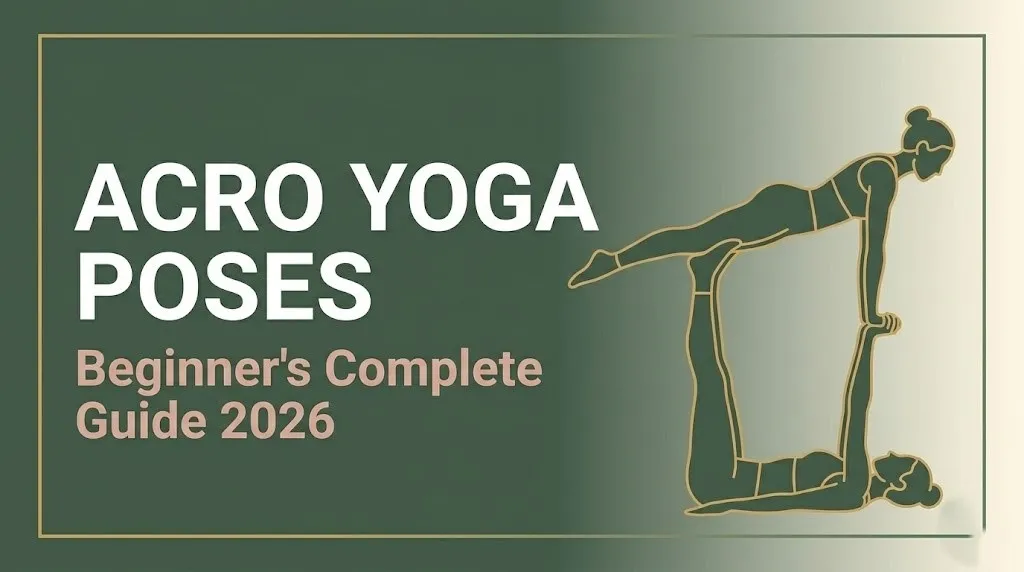
The Flyer is the person lifted or balanced above the base. Flyers need body awareness more than raw strength. They must hold a strong core position, keep their limbs active, and communicate clearly when something feels unstable.
The Spotter stands beside the pair and watches for imbalance. The spotter’s job is to catch the flyer if they fall and to call out alignment corrections. No beginner session should proceed without a spotter.
| Role | Primary Physical Demand | Position | Key Skill |
|---|---|---|---|
| Base | Leg and core strength, hip stability | Ground-level, supine or standing | Stillness and structure |
| Flyer | Body awareness, core engagement | Elevated, balanced above base | Trust and active alignment |
| Spotter | Reaction speed, spatial awareness | Standing beside the pair | Observation and quick response |
Yoga teachers and physical therapists generally recommend that beginners rotate through all three roles across multiple sessions. Understanding the base experience makes you a better flyer, and vice versa.
Key Takeaway: Acro yoga is a three-person practice at minimum. Never skip the spotter role, especially when learning new poses.
Beginner Acro Yoga Poses to Learn First
The best beginner acro yoga poses are those that keep the flyer close to the ground, require minimal base strength to hold, and can be exited safely in under two seconds. Starting with ground-level poses builds the communication habits and body awareness needed for elevated work.
These four poses are the standard entry points recommended by certified AcroYoga instructors for first-time practitioners:
- Front Plank (Dandasana variation): The flyer lies face-down on the base’s feet, arms extended. This teaches the flyer’s core engagement and the base’s foot placement. No height involved.
- Throne: The flyer sits on the base’s feet in a seated position. The base holds the flyer’s hands for balance. Low risk, clear exit.
- Folded Leaf: The flyer folds forward over the base’s feet while the base supports their back. This is a passive, Thai-massage-style position, excellent for trust building.
- Star Pose: The flyer stands on the base’s feet (base is supine, legs at 90 degrees) with arms extended. This is the first true balance position and a milestone beginner pose.
| Pose Name | Flyer Height | Skill Focus | Exit Difficulty |
|---|---|---|---|
| Front Plank | Low (feet-level) | Core, body line | Very easy |
| Throne | Low (feet-level) | Balance, trust | Easy |
| Folded Leaf | Low (feet-level) | Passive release, trust | Very easy |
| Star Pose | Medium (above base) | Balance, communication | Moderate |
Beginners should spend at least two to three sessions on these poses before progressing. Rushing through foundational work is the most common cause of avoidable falls.
Basic Acro Yoga Poses Step by Step
Step-by-step instructions matter more in acro yoga than in almost any other yoga form. Vague directions create instability. Here are two foundational poses with full alignment guidance.
Pose 1: Star Pose
To practice Star Pose:
- Base lies on their back, knees bent, feet flexed and parallel, hip-width apart.
- Flyer stands at the base’s hips, facing the base’s head.
- Base places feet on the flyer’s hip bones, not the abdomen. Flyer confirms placement is stable.
- Base extends legs slowly toward vertical. Spotter stands beside the flyer throughout.
- Flyer shifts weight forward onto the base’s feet, leaning chest slightly forward. Hands stay connected to base’s hands initially.
- When balanced, flyer extends arms out to sides. Core stays active. Gaze is forward.
- Hold for 3 to 5 breath cycles. Exit by base bending knees slowly while spotter guides flyer’s descent.
Modification: Keep hands clasped throughout the entire hold. Do not attempt freestanding arm extension until three successful repetitions are completed.
Pose 2: Front Plank
To practice Front Plank (Dandasana partner variation):
- Base lies on their back, legs raised to 90 degrees, feet flexed.
- Flyer stands at the base’s feet, facing away from the base.
- Flyer leans back and places hips on the base’s feet. Base receives the weight slowly.
- Flyer extends body into a plank line: core engaged, legs straight, arms extended forward or clasped behind head.
- Base holds flyer’s hands for stability if needed. Spotter watches the flyer’s alignment.
- Hold for 4 to 6 breath cycles. Exit by flyer bending knees, base lowering feet to floor in a controlled descent.
Modification for tight hamstrings: Flyer may keep a slight bend in the knees throughout the hold. This reduces lumbar load and is always acceptable.
Acro Yoga Moves for Core Strength
Acro yoga moves are among the most effective non-gym methods for building functional core strength. Both the base and the flyer engage their core continuously throughout every pose.
The base role in particular demands isometric core stability. Holding the flyer steady requires the base to resist movement in all directions simultaneously. This is the same demand placed on the core during exercises like planks and Chaturanga Dandasana (Four-Limbed Staff Pose) in traditional Vinyasa sequences.
According to a 2022 review published in the Journal of Alternative and Complementary Medicine, yoga-based partner exercises that require load-bearing and counterbalance show statistically greater core muscle activation than standard solo yoga when measured via surface electromyography (EMG).
For the flyer, holding body lines in the air activates the transverse abdominis, obliques, and spinal erectors simultaneously. This is not passive floating. The flyer is working hard.
Core muscles actively engaged in acro yoga poses include:
- Transverse abdominis: Deep stabilizing layer, most active in held balance positions
- Rectus abdominis: Front-body activation during plank lines and inversions
- Obliques (internal and external): Rotational control during transitions
- Erector spinae: Spinal extension support, especially for the base
- Iliopsoas (hip flexors): Active in both base leg extension and flyer body-line maintenance
Key Takeaway: Both the base and the flyer are working their core the entire time. Acro yoga trains the deep stabilizers that most gym exercises miss entirely.
The Real Benefits of Acro Yoga
Acro yoga offers physical, neurological, and interpersonal benefits that standard solo yoga does not replicate. The partner dynamic creates a unique training environment.
According to the NCCIH, mind-body practices that combine physical coordination with interpersonal trust show measurable reductions in cortisol (the body’s primary stress hormone). Acro yoga, with its communication requirements and shared physical risk, engages this stress-reduction mechanism more intensively than solo breathwork alone.
Physical benefits documented across yoga and partner exercise research include:
- Improved proprioception and balance through repeated weight-sharing challenges
- Increased upper body and shoulder girdle strength, particularly for the base
- Enhanced spinal mobility and thoracic extension in flyer positions
- Greater hip flexor and hamstring flexibility through supported passive stretches like Folded Leaf
- Stronger grip and wrist stability over time with progressive loading
The interpersonal benefit is equally documented. A 2021 paper in Complementary Therapies in Medicine found that partner-based movement practices significantly increased participants’ self-reported sense of social connection and trust within six weeks of regular practice. This result held regardless of whether partners were strangers or established relationships.
Practitioners also report improved communication skills. Acro yoga requires constant verbal and physical feedback. You learn to express discomfort, give instruction, and receive correction in real time.
Easy Acro Yoga Poses for Couples
Easy acro yoga poses for couples are best chosen for low center of gravity, simple communication requirements, and quick exit options. Ease is always relative to the individual bodies involved, but certain poses consistently work well for mixed-experience partner pairs.
Three beginner-friendly couple poses worth starting with:
Double Downward Dog (Adho Mukha Svanasana Partner Variation)
The first partner comes into Adho Mukha Svanasana (Downward-Facing Dog). The second partner places their hands on the floor in front of the first, then walks their feet up onto the first partner’s lower back (not the spine itself). This stacks two Downward Dogs vertically. Both partners feel traction in their spines.
Back-to-Back Seated Breathing
Both partners sit back-to-back in Sukhasana (Easy Seated Pose). They press their spines together and breathe in opposition: one inhales as the other exhales. This is the gentlest possible acro yoga move and is ideal for building partner attunement before attempting balance poses.
Supported Backbend
One partner stands behind the other in a lunge. The front partner leans back into the standing partner’s thigh for a supported backbend. No lifting involved. Good for building comfort with weight sharing.
| Pose | Contact Type | Strength Required | Time to Learn |
|---|---|---|---|
| Double Downward Dog | Feet on lower back | Moderate | 1 to 2 sessions |
| Back-to-Back Breathing | Spine-to-spine pressure | Minimal | First session |
| Supported Backbend | Lean and hold | Minimal | First session |
Acro Yoga Positions With Instructions
Beyond the foundational four, these intermediate acro yoga positions are appropriate once a beginner has established Star Pose and Front Plank with confidence.
Throne Pose to Standing
To practice Throne Pose progression:
- Base lies supine, knees bent at 90 degrees, feet flat and parallel.
- Flyer stands at the base’s feet, facing the base.
- Base places feet on the flyer’s sit bones. Flyer bends knees slightly to allow contact.
- Base presses feet upward slowly. Flyer allows hips to rise, maintaining Navasana (Boat Pose) body shape: hips flexed, spine tall, arms forward.
- When stable, flyer straightens legs if flexibility allows.
- Hold for 3 to 5 breaths. Spotter remains close throughout.
Modification: Flyer keeps knees bent throughout. This reduces hamstring demand significantly and is appropriate for most beginners.
Reverse Warrior Balance
One partner stands in a stable lunge. The other stands on the first partner’s front thigh, one foot at a time, and finds balance. This builds the proprioceptive confidence needed for higher poses.
Pose Tip:
- The standing base keeps a 90-degree bend in the front knee and a braced core
- The flyer focuses gaze on a fixed point (drishti) to stabilize balance
- The spotter holds the flyer’s wrist lightly to prevent sudden falls
Key Takeaway: Progress in acro yoga is earned by mastering exits and communication before attempting new heights. The pose you can safely exit from is the pose you are ready for.
Acrobatic Yoga Poses and Which Muscles They Work
Understanding muscle engagement in acrobatic yoga poses helps you train smarter and prevents overuse injuries. Each role in each pose demands specific muscle groups.
| Pose | Base Muscles Engaged | Flyer Muscles Engaged |
|---|---|---|
| Front Plank | Hip flexors, core, shoulder stabilizers | Core, shoulder retractors, glutes |
| Star Pose | Hip extensors, quads, ankle stabilizers | Core, hip flexors, shoulder abductors |
| Throne / Navasana | Quads, hip flexors, ankle stability | Hip flexors, rectus abdominis, hamstrings |
| Double Downward Dog | Hamstrings, calves, shoulder girdle | Hamstrings, shoulder girdle, core |
| Folded Leaf | Hip flexors, spinal extensors | Passive (hamstrings, lower back receive stretch) |
The shoulder girdle is the most commonly overloaded area for bases in early practice. The rotator cuff muscles (supraspinatus, infraspinatus, teres minor, subscapularis) work hard to stabilize the shoulder joint during lifting and holding.
For flyers, the transverse abdominis is the make-or-break muscle. A flyer who cannot engage this deep core layer will sag in every held position and place excess load on the base’s joints.
According to the American College of Sports Medicine, isometric exercises (held static positions under load) produce measurable strength gains in the muscles involved within four to six weeks of consistent practice. Acro yoga’s long holds function as isometric training for both partners.
Acro Yoga Modifications for Beginners
Acro yoga modifications are not compromises. They are how you make poses safe enough to actually learn from, and every pose in this practice has a modified version worth knowing.
Modification 1: Reduce the height. Nearly every elevated acro yoga pose has a floor-level equivalent. If Star Pose feels unstable at full extension, practice the contact points with the base’s feet only a few inches off the ground.
Modification 2: Keep hand contact. Bases and flyers should maintain hand contact throughout any pose until they have completed it successfully at least five times with a spotter. Letting go of hands too early is the number-one reason beginners fall.
Modification 3: Use a mat stack. Placing two to three yoga mats on the landing side of any elevated pose reduces injury risk during unexpected exits. Certified AcroYoga instructors often use this setup in beginner classes.
Modification 4: Work with a strap. A yoga strap looped between the base’s hands and the flyer’s wrists provides a safety connection that allows both partners to feel more secure without changing the pose shape significantly.
Modifications by condition:
- Wrist sensitivity (base): Use forearm contact instead of hand contact where possible. A wrist wrap or pad under the heel of the hand reduces direct joint load.
- Lower back concerns (base): Keep a slight pelvic tilt (posterior tilt) when extending legs overhead. Avoid full hip extension until spinal stability is confirmed.
- Shoulder instability (flyer): Avoid arm-extended balance positions. Practice all poses with hands on the base’s shoulders instead until shoulder girdle strength improves.
Acro Yoga Safety Tips You Need Before You Start
Acro yoga safety is not optional. The physical risks, while manageable, are real: falls, joint overloading, and communication breakdowns can all result in injury if the practice is approached carelessly.
These safety principles apply to every session, regardless of experience level:
- Always use a spotter. No beginner pair should practice new poses without a third person positioned to catch the flyer.
- Establish verbal signals. Agree on a clear word before you start (many teachers use “down” or “release”) that means the flyer is coming down immediately, no questions asked.
- Warm up for at least 10 minutes. Cold hip flexors and shoulder joints are the most common sites of acro yoga strain. A proper warm-up is covered in the final section of this guide.
- Never attempt a pose while fatigued. Acro yoga requires full neuromuscular attention. Attempting new poses at the end of a tiring session is when most injuries happen.
- Communicate constantly. Both partners should narrate their experience throughout: “I feel stable,” “my wrist is tired,” “I need to come down.” Silence is not a sign of competence.
According to Yoga Alliance, the most commonly reported acro yoga injuries among self-taught beginners involve the wrists (base role), the lower back (base role), and the shoulders and ankles (flyer role). All of these are preventable with proper warm-up and spotter protocol.
Key Takeaway: The safety systems in acro yoga (spotter, verbal signals, warm-up) are not procedures for beginners only. They are standard practice for every level.
Who Should Avoid Acro Yoga
Some people should not practice certain acro yoga poses, and for a small group, the practice is not appropriate at the current time. This is not a reason to dismiss the practice entirely, but it is information that matters.
People who should modify significantly or skip acro yoga temporarily:
- Those with acute wrist injuries or carpal tunnel syndrome: The base role places compressive and shear load on the wrist joint. Until wrist stability is rehabilitated, base positions are not appropriate.
- Those with active lumbar disc herniation or spinal instability: Extended-leg base positions place the lumbar spine in loaded extension. Anyone with an active herniation should work with a yoga therapist or physical therapist before attempting any acro base work.
- Those with shoulder impingement or rotator cuff tears: Bearing another person’s weight through a compromised shoulder joint carries real injury risk. Modified arm positions reduce but do not eliminate this risk.
- Those who are pregnant: The base role is generally contraindicated during pregnancy due to supine positioning concerns in the second and third trimesters, as noted by guidance from the American College of Obstetricians and Gynecologists on exercise during pregnancy. Flyer roles in all elevated positions are also contraindicated.
- Those with significant blood pressure concerns or cardiovascular conditions: Inversions and sudden load shifts can affect blood pressure acutely. Anyone managing hypertension or a cardiac condition should discuss partner yoga suitability with their cardiologist before beginning.
Solo acro yoga variations (covered in the next section) can provide a suitable bridge for practitioners who want to build relevant strength before partner work.
Acro Yoga Warm-Up Poses and Sequences
A proper acro yoga warm-up targets the exact joints and muscle groups that take the most stress during partner poses: the wrists, hips, shoulders, and lumbar spine.
This 10-minute warm-up sequence works for both partners:
- Cat-Cow (Marjaryasana-Bitilasana): 8 slow cycles. Warms the spinal joints and activates the deep core.
- Wrist Circles and Wrist Flexion Stretches: 30 seconds each direction, weight-bearing on hands. Prepares the carpals for load.
- Adho Mukha Svanasana (Downward-Facing Dog): Hold for 5 breath cycles. Warms the hamstrings, shoulder girdle, and Achilles tendon.
- Low Lunge with Hip Flexor Emphasis (Anjaneyasana): 5 breaths per side. Critical for the base role, which demands substantial hip flexor length.
- Shoulder Rolls and Cross-Body Arm Stretches: 10 repetitions each direction. Warms the rotator cuff for both roles.
- Supine Core Activation (partner leg lifts): Both partners lie on their backs and perform 10 slow leg lifts to 90 degrees. Activates the iliopsoas and transverse abdominis.
- Partner back-to-back breathing: 5 rounds of oppositional breath as described in the couples section. Calibrates the partners’ attunement before physical load.
Research published in the Journal of Alternative and Complementary Medicine supports structured yoga warm-up sequences for reducing soft tissue injury risk. Unstructured stretching without joint-specific activation provides significantly less protection.
Acro Yoga Poses for 1 Person
Acro yoga poses for 1 person are solo exercises and postures that build the specific strength, balance, and body awareness needed to thrive in a partner acro yoga practice. You don’t need a partner to get ready for acro yoga.
Solo training for the base role:
The base position is about stable leg extension under load. Solo Navasana (Boat Pose) held for 10 to 20 seconds trains exactly this. Practice with legs fully extended and back straight. Add a 5-kilogram sandbag across the feet to simulate load.
Solo training for the flyer role:
Flyer body awareness comes from extended balance practice. Virabhadrasana III (Warrior III Pose) trains the same hip-to-shoulder body line used in elevated flyer positions. Practicing this against a wall first builds the proprioceptive map your nervous system needs.
Core isolation for both roles:
A 30-second hollow body hold (supine, lower back pressed to floor, arms and legs raised 20 centimeters) directly trains the abdominal engagement pattern used in both base and flyer positions. This is a standard gymnastics conditioning exercise and transfers directly to acro yoga.
| Solo Exercise | Acro Yoga Application | Hold Time |
|---|---|---|
| Navasana (Boat Pose) | Base leg strength and hip flexor endurance | 10 to 20 seconds x 5 |
| Virabhadrasana III (Warrior III) | Flyer body line and proprioception | 5 breaths per side |
| Hollow body hold | Core engagement for both roles | 20 to 30 seconds x 4 |
| Chaturanga Dandasana (Four-Limbed Staff) | Base shoulder stability | 3 to 5 breaths x 4 |
Yoga teachers and physical therapists generally recommend at least four weeks of solo strength preparation for absolute beginners before moving into full partner acro yoga sessions.
Key Takeaway: Solo practice is not a substitute for partner acro yoga, but it is the most effective way to prepare your body for it without needing another person in the room.
Frequently Asked Questions About Acro Yoga Poses
What are the easiest acro yoga poses for absolute beginners?
The easiest acro yoga poses for beginners are Front Plank, Folded Leaf, and Back-to-Back Seated Breathing, because all three keep the flyer close to the ground with simple exit options.
Throne and Star Pose follow once you’ve practiced the ground-level poses successfully three or more times.
Always use a spotter for any pose where the flyer’s feet leave the floor, even at low heights.
Do you need to be strong or flexible to do acro yoga?
You don’t need exceptional strength or flexibility to begin acro yoga, but a basic level of core engagement and hip mobility makes learning faster and safer.
Most certified instructors consider the ability to hold a 20-second Navasana (Boat Pose) independently as a reasonable readiness benchmark for base and flyer roles.
Four to six weeks of solo preparatory exercises will build the specific strength patterns that acro yoga requires.
How long should a beginner practice acro yoga before trying harder poses?
Most yoga teachers and AcroYoga-certified instructors recommend a minimum of six to eight weeks at beginner-level poses before attempting intermediate elevated positions.
Progression should be based on demonstrated skill, not time alone: you’re ready to progress when you can exit your current poses calmly and consistently without spotter intervention.
Rushing progression is the most common cause of preventable acro yoga falls among beginners.
Can you do acro yoga poses alone, without a partner?
You cannot practice true partner acro yoga poses alone, but a substantial solo training program builds the same foundational strength and body awareness that acro yoga requires.
Exercises like Navasana (Boat Pose), Virabhadrasana III (Warrior III Pose), hollow body holds, and Chaturanga Dandasana (Four-Limbed Staff Pose) all target the specific muscle patterns used in acro yoga roles.
Solo preparation also makes you a safer, more capable partner when you do practice with someone.
Is acro yoga safe for people with back or wrist problems?
People with active lower back conditions such as lumbar disc herniation should avoid the base role in acro yoga until cleared by a physical therapist or spine specialist, because the position places the lumbar spine under load in extension.
Those with wrist sensitivity can reduce base-role wrist strain by using forearm contact, wrist wraps, or folded mat padding, but should not practice through sharp or acute wrist pain.
Consult a physical therapist familiar with yoga if you have either condition and want to develop a modified entry plan for this practice.
Start Where You Are
Acro yoga rewards patience more than athleticism. The practitioners who progress fastest are not the strongest or most flexible. They’re the ones who master their exits, communicate clearly, and don’t rush the fundamentals.
Start with the solo exercises this week. Build your Boat Pose, your Warrior III, your hollow body hold. When you practice with a partner, begin with Back-to-Back Breathing and Front Plank before anything leaves the ground. Use a spotter every single time.
The poses in this guide are a starting point, not a checklist. Move through them as your body and your partnership are ready, not before.