Resume Yoga: How to Return Safely After Any Break 2026
When you’re ready to resume yoga after a break, the single most important thing to understand is that your body has changed, and that is not a problem. It is simply where you start.
Research consistently shows that flexibility, neuromuscular coordination, and muscular endurance all decrease during periods of inactivity, but they respond faster to retraining in people who have trained before. According to the American College of Sports Medicine, previously active individuals regain fitness levels substantially faster than people training for the first time, a phenomenon driven by muscle memory at the cellular level.
This guide covers the specific challenges of returning to yoga after injury, illness, pregnancy, and long gaps, along with a structured plan for rebuilding breath, strength, and flexibility in the right order. You’ll find step-by-step poses, a weekly schedule, modification options, and the research behind why your body responds the way it does when you return to practice.
Resume Yoga Practice After a Break
Resuming yoga practice after a break means starting where your body actually is, not where it was before you stopped. This requires a different mindset than beginning yoga for the first time: you have the body memory and the conceptual knowledge, but the physical capacity has shifted.
The most common mistake returning practitioners make is treating the first session like a test. They attempt the poses they held confidently before the break and interpret their current limitations as failure. This is a physiological misunderstanding, not a character flaw. Deconditioning is a measurable biological process that affects everyone who stops moving, regardless of their prior level of practice.
A smarter approach treats the return as a new phase of the same practice, not a reset to zero. The goal of the first two to four weeks back is not to regain what you had. It is to re-establish the communication pathways between your nervous system and your muscles, rebuild breath capacity, and create structural readiness for progressive loading.
Three principles guide every safe yoga return:
- Start with breath first, poses second. The breath practice is the fastest way to reconnect with the practice body before the movement body needs to perform
- Use props without apology. A returning practitioner who uses a block in Trikonasana (Triangle Pose) is practicing correctly, not compensating
- Honor delayed onset muscle soreness (DOMS). Expect to feel muscle soreness 24 to 48 hours after the first few sessions. This is normal adaptation, not injury
The timeline for your return depends heavily on why you took the break and how long you were away. The sections that follow address each scenario specifically.
Why It Feels Hard to Resume Yoga After Time Away
Returning to yoga feels harder than expected because of two simultaneous losses: physical deconditioning in the muscles, and proprioceptive deficit in the nervous system. Both are real and both are reversible.
Proprioception is the body’s internal sense of where its parts are in space. In yoga, this shows up as the ability to feel whether your hips are level, whether your spine is neutral, or whether your foot is bearing weight evenly. Proprioceptive awareness improves with consistent practice and degrades during periods of inactivity. When you return to the mat, familiar poses feel unfamiliar not because your muscles have forgotten them, but because the sensory feedback loop has gone quiet.
Think of it like a phone that has been in airplane mode for months. The information is all still there. The apps are intact. But reconnecting to the network takes a moment, and the first few transmissions are slow.
The psychological dimension compounds this. Many returning practitioners carry guilt about the gap, anxiety about how they’ll perform compared to their previous level, or frustration that their body “isn’t doing what it used to.” The National Center for Complementary and Integrative Health notes that psychological resistance to exercise resumption is one of the primary barriers to sustained return, and that framing the return as a new beginning rather than a recovery of losses significantly improves adherence.
Pose Tip:
- On your first session back, practice only Balasana (Child’s Pose), Marjaryasana-Bitilasana (Cat-Cow), and Savasana (Corpse Pose). This is a complete and appropriate first session
- Notice what your breath does in each pose. That information is more useful than how deep the stretch goes
- Skip comparison entirely. Your practice from before the break is reference data, not a standard to meet immediately
Returning to Yoga After Injury
Returning to yoga after injury requires a phased approach that prioritizes structural stability before flexibility, and pain-free range of motion before full range of motion, regardless of how long the healing process took.
The most common injuries that interrupt yoga practice include wrist and shoulder soft tissue injuries, lumbar disc problems, hamstring strains, and knee ligament issues. Each of these affects different poses differently, which means a blanket “go slow” instruction is insufficient. The specific poses to modify, skip, or reintroduce in sequence depend entirely on what was injured and what was affected in its healing.
A general return-to-yoga framework after injury follows this order:
- Medical clearance: Before returning to any physical yoga practice, confirm with the treating physician or physical therapist that weight-bearing activity is appropriate for the specific injury
- Breath and ground-level work only (weeks 1 to 2): Supine poses, seated poses, and breath work with no weight-bearing on the injured area
- Partial weight-bearing introduction (weeks 3 to 4): Add standing poses with modifications. Use a wall or chair for support
- Progressive loading (weeks 5 to 8): Reintroduce the full range of yoga movements with close attention to any pain signals. Pain during a pose means that pose is not yet appropriate
- Return to full practice with monitoring (week 9 and beyond): Resume normal sequencing but continue to monitor for delayed-onset discomfort after sessions
People managing wrist injuries specifically should substitute forearm plank for Kumbhakasana (Plank Pose) and use fists rather than flat palms in any weight-bearing arm positions. Shoulder injuries typically require avoiding external rotation loading until the rotator cuff tendons have fully healed, which means modifying or skipping Gomukhasana (Cow Face Pose) arms and Garudasana (Eagle Pose) arm variations.
Key Takeaway: Returning to yoga after injury works best as a five-phase process, starting with breath and ground-level work before any weight-bearing resumes, regardless of how eager you feel on day one.
Returning to Yoga After Illness or Surgery
Returning to yoga after illness or surgery requires particular attention to fatigue management, immune system recovery load, and any surgical site or organ system restrictions that standard yoga instructions do not anticipate.
Illness-related breaks are often underestimated in their physical impact. Even a two to three week illness involving fever, respiratory involvement, or gastrointestinal disruption produces measurable deconditioning in cardiovascular endurance and muscular strength. Post-COVID recovery, in particular, has introduced a new and well-documented category of exercise resumption challenge: post-exertional malaise, where activity that feels manageable during the session produces disproportionate fatigue and symptom worsening in the 12 to 48 hours afterward.
For anyone returning after a significant illness, the American College of Sports Medicine recommends a graded return-to-exercise protocol that begins at 25 to 50% of previous exercise volume and increases no more than 10% per week. Applied to yoga, this means:
- Week 1: 15 to 20 minutes of breath work and restorative poses only
- Week 2: Add 10 minutes of gentle Hatha yoga movement
- Week 3: Build to 30 minutes of active practice if no symptom exacerbation occurs
- Week 4 and beyond: Progress at your body’s pace, not a preset timeline
After abdominal surgery, poses that create intra-abdominal pressure, including all deep twists, deep forward folds, and any pose requiring sustained Mula Bandha (Root Lock) engagement, should be avoided until the surgical team confirms full internal healing. The timeline for this varies widely depending on the procedure.
After cardiac surgery or cardiac events, heated yoga environments and breath retention techniques like Kumbhaka (Breath Retention) are contraindicated until explicit cardiologist clearance is obtained, because both elevate cardiovascular demand beyond standard exercise levels.
Returning to Yoga After Pregnancy
Returning to yoga after pregnancy is one of the most nuanced return-to-practice scenarios because the body undergoes structural changes during pregnancy that do not fully reverse by the time a practitioner feels ready to resume.
The two primary physical considerations are pelvic floor recovery and diastasis recti (the separation of the rectus abdominis muscles along the linea alba). Both are common after pregnancy and both affect which yoga poses are appropriate and safe in the early return period. Pelvic floor dysfunction, which includes both weakness and hypertonicity, affects an estimated 30 to 40% of postpartum women according to research in the Journal of Alternative and Complementary Medicine, and can be worsened by high-load core exercises, including some common yoga poses, before proper pelvic floor rehabilitation.
Poses to approach with caution or avoid entirely until pelvic floor and core function are assessed:
- Deep core-loading poses like Navasana (Boat Pose) without pelvic floor support
- Poses that increase intra-abdominal pressure, including strong Uddiyana Bandha (Abdominal Lock) practices
- Any pose that causes “coning” or “doming” at the midline of the abdomen, which indicates unresolved diastasis recti
The minimum recommended waiting period before resuming active yoga postures is 6 weeks postpartum for vaginal birth and 8 to 12 weeks for cesarean section, pending obstetric clearance. A pelvic floor physical therapist assessment before resuming practice is the most informed starting point.
Appropriate early postpartum yoga includes gentle diaphragmatic breathing, Balasana (Child’s Pose) with wide knees and elevated hips, and supine hip openers like Supta Kapotasana (Reclined Pigeon) when comfortable.
Yoga Muscle Memory and Physical Deconditioning
Yoga muscle memory refers to the neuromuscular adaptations that develop through consistent practice and that persist at a cellular level even during periods of inactivity, allowing returning practitioners to regain previous skill levels faster than when they first learned them.
The science behind this involves two mechanisms. First, myonuclei, the nuclei within muscle cells that facilitate protein synthesis and growth, accumulate during periods of training and persist for months to years after training stops. This cellular infrastructure makes muscle regrowth faster upon resumption of training. Second, motor patterns, the neural pathways between the brain and specific muscle activation sequences, retain their structure during inactivity and reactivate more quickly than they originally formed.
A study published in the International Journal of Yoga found that practitioners who returned to yoga after a 12-month break regained their pre-break flexibility and balance performance levels approximately twice as fast as participants learning the same skills for the first time. This finding aligns with exercise science literature on muscle memory in strength and skill-based training.
Physical deconditioning works on a predictable timeline:
| Duration of Break | Expected Physical Changes | Recovery Timeline |
|---|---|---|
| 2 to 4 weeks | Mild flexibility loss, slight cardiovascular decrease | 1 to 2 weeks of regular practice |
| 1 to 3 months | Noticeable flexibility and strength loss, reduced endurance | 3 to 6 weeks of regular practice |
| 3 to 12 months | Substantial deconditioning across all physical parameters | 6 to 12 weeks of structured practice |
| 1 year or more | Return close to beginner physical baselines, but faster regain | 3 to 6 months of consistent practice |
Key Takeaway: Your body remembers yoga at a cellular level even after years away, which means your return will be faster than your initial learning curve, but only if you give the rebuilding process the time it actually needs.
How Long Does It Take to Regain Yoga Flexibility
Most returning practitioners begin to notice measurable flexibility improvements within 3 to 6 weeks of consistent practice at two to three sessions per week, with more substantial regain happening in the 8 to 12 week range.
The timeline varies significantly based on three factors: how long the break lasted, how consistent the new practice schedule is, and whether the practitioner is using breath correctly to facilitate tissue release. Flexibility is not purely a mechanical property of muscle and connective tissue. It is also a nervous system response. The stretch reflex, a protective mechanism that causes muscles to contract when pulled beyond a safe range, relaxes over time with regular, breath-supported holds.
Connective tissue, including fascia and tendons, responds more slowly to flexibility training than muscle does. Research in sports medicine suggests that meaningful connective tissue adaptation requires a minimum of 8 weeks of consistent targeted work at appropriate intensity. Yoga’s emphasis on long, breath-supported holds, particularly in Yin yoga, targets connective tissue specifically and is more effective for this purpose than short dynamic stretching.
The most common reason returning practitioners plateau in their flexibility recovery is skipping Savasana (Corpse Pose) and the cool-down phase of practice. The nervous system’s release of protective muscle tension, called the autonomic nervous system downshift, happens primarily during and after the rest phase. Cutting Savasana short reduces the neurological benefit of the entire preceding session.
For hamstring flexibility specifically, which is typically the first and most noticeable flexibility loss during a break, Paschimottanasana (Seated Forward Fold) practiced with a strap around the feet and a 90-second hold produces faster results than deeper but shorter holds without support.
How to Rebuild Yoga Strength Safely
Rebuilding yoga strength after a break follows the same progressive overload principle that governs all strength training: start below your previous capacity, increase load and duration gradually, and allow adequate recovery between sessions.
The muscle groups that typically show the fastest strength loss during a yoga break are the upper body stabilizers (triceps, serratus anterior, and rotator cuff muscles used in arm-balancing and plank positions), the hip extensors (glutes and hamstrings used in backbends and standing poses), and the deep core stabilizers (transverse abdominis and multifidus). These are also the groups that respond fastest to retraining because they are recruited in almost every yoga pose.
A safe strength-rebuilding sequence prioritizes these muscle groups in this order:
- Core stability first: Begin with Marjaryasana-Bitilasana (Cat-Cow) and Kumbhakasana (Plank Pose) holds of 10 to 15 seconds before building to 30 seconds
- Hip extensor loading: Setu Bandha Sarvangasana (Bridge Pose) held for 5 breaths, repeated 3 times, before progressing to single-leg variants
- Upper body stability: Forearm plank before full plank, building shoulder endurance before adding Chaturanga Dandasana (Four-Limbed Staff Pose)
- Full integration: Standing sequences like Virabhadrasana I (Warrior I) and Virabhadrasana II (Warrior II) that require simultaneous core, hip, and shoulder engagement
People with a history of shoulder impingement should avoid Chaturanga Dandasana entirely in the early return period and build upper body strength through forearm plank and supported backbend variations instead. Any shoulder pain during a pose is a signal to modify immediately, not to push through.
Yoga Breathing Techniques for Returning Practitioners
Breath retraining is the most underused and most effective first step for anyone resuming yoga practice, because the breath is what connects the nervous system to the movement body and what makes the practice feel like yoga rather than stretching.
After a break from yoga, the breath pattern often reverts to habitual shallow chest breathing. This is the default respiratory pattern for most adults under stress. Reconnecting to diaphragmatic breathing before adding poses restores the internal environment that makes yoga different from generic flexibility work.
Ujjayi pranayama is the primary breath technique for active yoga sequences. The soft glottal constriction that creates its ocean-wave sound serves three functions on a return: it slows the breath rate, which activates the parasympathetic nervous system; it creates internal focus, which replaces the mental chatter of comparison and self-criticism; and it provides audible feedback, allowing the practitioner to hear when they are holding the breath during challenging poses.
To relearn Ujjayi breath for returning practice:
- Lie on your back with knees bent and feet flat.
- Place one hand on the chest and one on the belly.
- Inhale slowly through the nose, directing the breath to the belly first.
- Exhale through the nose with a slight constriction at the back of the throat, as if fogging a mirror with a closed mouth.
- Practice 10 full breath cycles before sitting up. Repeat this lying-down breath practice at the start of every session for the first two weeks.
According to a study published in Complementary Therapies in Medicine, consistent Ujjayi breath practice over 8 weeks was associated with measurable reductions in perceived stress and improvements in respiratory efficiency in adult practitioners.
For people returning after respiratory illness, begin with shorter breath cycles of 3 to 4 counts per inhale and exhale, rather than the 5 to 6 counts used in standard practice. Build breath capacity gradually, the same way you build pose capacity.
Key Takeaway: Breath retraining before pose retraining is the most efficient path back into yoga because it recalibrates the nervous system first, making every physical element of the returning practice safer and more effective.
Best Yoga Poses to Restart Your Practice
The best yoga poses for restarting practice after a break are those that reconnect the practitioner to body awareness, open the breath, and gently re-engage the primary muscle groups without demanding strength or flexibility that has not yet been rebuilt.
Seven poses form the ideal foundation for any returning practice, regardless of why or how long the break was:
| Pose (Sanskrit + English) | Primary Focus | Modification for Return |
|---|---|---|
| Tadasana (Mountain Pose) | Body awareness, postural reset | Practice near a wall for proprioceptive feedback |
| Marjaryasana-Bitilasana (Cat-Cow) | Spinal mobility, breath reconnection | Limit range to pain-free movement only |
| Balasana (Child’s Pose) | Rest, lumbar release, breath expansion | Use a bolster under the chest if hips are tight |
| Adho Mukha Svanasana (Downward-Facing Dog) | Full-body integration, hamstrings | Generous knee bend; pedal the heels gently |
| Setu Bandha Sarvangasana (Bridge Pose) | Glute and spine strengthening | Keep arms on the floor; avoid full wheel |
| Supta Kapotasana (Reclined Pigeon) | Hip external rotator release | Keep the foot flexed; use a blanket under the hip |
| Savasana (Corpse Pose) | Nervous system recovery | Place a bolster under knees if lower back is sensitive |
Each of these poses is accessible to a returning practitioner without requiring the flexibility or strength of an established practice. They also provide honest feedback: if Adho Mukha Svanasana reveals hamstring tightness or shoulder fatigue, that information guides the pace of progression.
Beginner Return-to-Yoga Sequence
A structured return-to-yoga sequence follows the same arc as a well-designed class: grounding and breath awareness, progressive warming, moderate peak effort, and full recovery. The difference for returning practitioners is that every phase is shorter and more deliberate than it was before the break.
To practice this returning practitioner sequence:
- Seated breath practice: Sit comfortably and take 10 Ujjayi breaths, establishing the breath before any movement begins.
- Tadasana (Mountain Pose): Stand still for 5 breaths. Feel all four corners of each foot on the floor. Notice what postural habits the body has developed during the break.
- Marjaryasana-Bitilasana (Cat-Cow): On hands and knees, 8 slow breath-synchronized repetitions. Exhale to Cat; inhale to Cow. Move within a comfortable range only.
- Adho Mukha Svanasana (Downward-Facing Dog): Hold for 5 breaths with generous knee bend. Alternate pedaling the heels to release the calves.
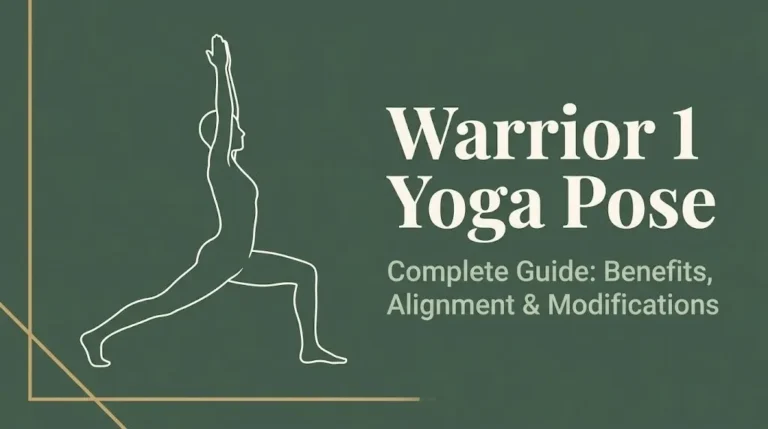
- Virabhadrasana I (Warrior I): Step the right foot forward. Hold 3 to 5 breaths per side. Use a shorter stance than you remember needing before.
- Setu Bandha Sarvangasana (Bridge Pose): Lie on your back, feet flat. Lift the hips on an inhale. Hold 5 breaths. Lower slowly on an exhale. Repeat twice.
- Supta Kapotasana (Reclined Pigeon): Lie on your back and cross the right ankle over the left thigh. Hold 8 breaths per side. Let gravity do the work.
- Savasana (Corpse Pose): Rest for a minimum of 5 minutes. This is non-negotiable on a return session. The recovery phase matters as much as the active phase.
Total time: 25 to 35 minutes. Practice this sequence two to three times per week for the first four weeks before adding new poses or extending session length.
Yoga Modifications for Returning Practitioners
Yoga modifications for returning practitioners address the gap between what the body remembers conceptually and what it can physically execute at this moment. Using modifications is not regression. It is accurate practice.
The most commonly needed modifications in a return practice relate to three areas: reduced range of motion due to flexibility loss, reduced upper body strength for weight-bearing poses, and reduced endurance for sustained holds.
Key modifications by body area:
- Hamstrings: Use a strap in Paschimottanasana (Seated Forward Fold) and bend the knees generously in Adho Mukha Svanasana (Downward-Facing Dog). Never force length that is not available
- Wrists: Practice plank poses on fists or forearms rather than flat palms until wrist extensors rebuild. This is especially important after a break involving wrist injury or prolonged desk work
- Lower back: Avoid deep backbends in the early return period. Bhujangasana (Cobra Pose) on the forearms is more appropriate than full Urdhva Mukha Svanasana (Upward-Facing Dog) until lumbar stability is re-established
- Shoulders: Skip Chaturanga Dandasana (Four-Limbed Staff Pose) and substitute a knees-down push-up variation. This builds the same muscle groups without the joint stress of unsupported descent
- Hip flexors and groin: Shorten the stance in all lunging poses. Hip flexors that have shortened during a sedentary break cannot safely accommodate a deep lunge on day one of returning
A general rule: if you need to hold your breath to maintain a pose, the pose is currently too demanding for your return phase. Return to a modified version where the breath stays smooth.
Yoga Props for Returning to Practice
Yoga props for a return practice are not beginner tools. They are precision instruments that allow returning practitioners to access the correct alignment and body experience of a pose while the strength and flexibility to hold it fully are being rebuilt.
The four most valuable props for a returning practice are:
- Yoga block (2): Brings the floor closer in standing forward folds, supports the sacrum in bridge variations, and elevates the sit bones in seated poses when hamstring tightness prevents a neutral lumbar spine
- Yoga strap: Extends reach in seated forward folds and hamstring stretches, preventing the rounding of the lumbar spine that occurs when practitioners force depth without the flexibility to support it
- Bolster: Supports the chest in a prone resting position, the lumbar spine in Savasana (Corpse Pose), and the hips in a wide-knee Balasana (Child’s Pose). Restorative poses with a bolster are particularly appropriate in the early return period
- Blanket (folded firm): Cushions the knees in kneeling poses, supports the sit bones in seated practice, and modifies supine poses where hip or back sensitivity is present
Props allow the nervous system to experience correct alignment without muscular compensation. A returning practitioner who holds a forward fold correctly with a strap learns more about their actual hamstring response than one who pushes into depth with a rounded spine. The prop is providing accurate practice, not easier practice.
Yoga Alliance recommends that certified yoga teachers consistently offer prop options for every pose in every class, a standard that returning practitioners should apply to their own home practice with equal consistency.
Key Takeaway: Props in a return practice are the difference between practicing correctly at your current level and practicing incorrectly at a level you used to have. Use them for every session in your first four to six weeks back.
How to Build a Consistent Yoga Schedule After a Break
Building a consistent yoga schedule after a break works best when it is designed around the minimum effective dose rather than an ambitious ideal that fails within two weeks. Consistency outperforms intensity every time in exercise resumption research.
The American College of Sports Medicine recommends that returning practitioners begin at two sessions per week and hold that frequency for a minimum of four weeks before adding a third session. This frequency is enough to produce neuromuscular adaptation and measurable physical change while avoiding the overuse soreness that drives many returning practitioners off the mat in week two.
A practical 12-week return schedule:
| Weeks | Sessions Per Week | Session Length | Primary Focus |
|---|---|---|---|
| 1 to 2 | 2 | 20 to 25 minutes | Breath work and foundational poses only |
| 3 to 4 | 2 | 25 to 35 minutes | Add standing poses, continue modifications |
| 5 to 6 | 2 to 3 | 30 to 40 minutes | Progress pose depth, reduce modification reliance |
| 7 to 9 | 3 | 40 to 50 minutes | Full sequence with active and restorative elements |
| 10 to 12 | 3 | 50 to 60 minutes | Return to pre-break practice length and variety |
Habit research consistently identifies same time, same place as the two environmental anchors most predictive of long-term exercise consistency. Choosing a specific time of day and a dedicated practice space, even a corner of a bedroom with a rolled-out mat, reduces the decision-making friction that derails returning practitioners.
Rest days between sessions in the early return period are not gaps in the plan. They are part of the plan. Neuromuscular adaptation, the process by which the body learns to perform yoga movements efficiently, occurs during rest, not during practice. Treating rest days as intentional parts of the schedule rather than missed sessions changes the psychological relationship with the practice.
Frequently Asked Questions About Resuming Yoga
How do I resume yoga after a long break without hurting myself?
Start with breath work and gentle ground-level poses for the first one to two sessions before adding any standing or weight-bearing practice.
Use modifications and props for every pose where you notice your breath tightening or your form compensating, and treat any sharp or joint-based pain during a pose as a signal to stop and modify rather than push through.
A returning practitioner who practices two sessions per week with full modifications is building a safer and faster path back than one who attempts their pre-break practice level and sustains an overuse injury in week one.
How long does it take to get back to where you were in yoga after a break?
Most returning practitioners regain pre-break flexibility and strength levels in half the time it originally took to build them, due to the muscle memory effect at the cellular level.
A 3-month break typically requires 3 to 6 weeks of consistent practice to return to previous levels; a 1-year or longer break may take 3 to 6 months of two to three sessions per week.
The timeline shortens significantly when the return practice is structured, consistent, and includes breath work alongside physical poses rather than only physical poses.
Can I return to yoga after surgery or a serious injury?
Yes, most people can return to yoga after surgery or injury with appropriate modifications and a phased reintroduction, but the timeline and specific pose restrictions depend entirely on the type and location of the surgery or injury.
Confirm with the treating surgeon or physical therapist that weight-bearing physical activity is appropriate before beginning any active yoga practice, and communicate your yoga practice specifically, since recommendations vary by pose category.
A certified yoga therapist with experience in rehabilitation settings can help design a return sequence that works within the specific restrictions of your recovery.
What is the best type of yoga to start with when returning after a break?
Hatha yoga or Restorative yoga is the most appropriate starting point for returning practitioners because both prioritize alignment, breath awareness, and pose hold time over pace and intensity.
Yin yoga is also highly beneficial in the early return phase for its focus on connective tissue mobility and parasympathetic nervous system activation, which supports both physical and psychological recovery.
Vinyasa yoga and Ashtanga yoga are better reintroduced after four to six weeks of foundational practice has re-established body awareness and rebuilt baseline strength.
How often should I practice yoga when returning after a long time off?
Start with two sessions per week for the first four weeks, with at least one full rest day between sessions, to allow muscle recovery and neuromuscular adaptation.
This frequency meets the American College of Sports Medicine minimum recommendation for flexibility and strength training while keeping soreness and overuse risk at manageable levels for a returning body.
Add a third weekly session after four consistent weeks at two sessions, and continue building from there at a pace guided by how your body responds between sessions, not by an arbitrary timeline.
Your practice is not lost. It is waiting. The body that practiced yoga before remembers more than it shows in the first session or two, and the evidence is clear that returning practitioners regain what they had faster than they built it initially.
Start with the return sequence in this guide. Two sessions per week. Breath first. Modifications always. Give it four weeks of honest, consistent practice before evaluating where you are.
That is the whole plan. Come back to the mat, and let the mat do its part.