Yoga Pillow: Complete Guide to Types, Uses and Benefits
A yoga pillow, most commonly called a yoga bolster, is a firm, densely filled cushion designed to support the body in restorative, Yin, and meditation practices, reducing muscular effort so the body can release more fully into poses. Choosing the right one and knowing how to use it correctly makes a measurable difference in what your practice delivers.
The National Center for Complementary and Integrative Health identifies restorative yoga, the practice most closely associated with bolster use, as one of the most-studied mind-body interventions for stress reduction and sleep improvement in adults. That research base gives a yoga pillow more practical weight than most people expect from a cushion.
This guide covers every angle of yoga pillow use: the difference between pillows and bolsters, how to choose the right type and filling for your body and practice, step-by-step poses for beginners, and specific guidance for people managing back pain, pregnancy, or age-related mobility changes.
What Is a Yoga Pillow and What Is It Used For?
A yoga pillow is a firm, supportive cushion used in yoga practice to hold the body in a position that the muscles cannot comfortably sustain on their own, allowing passive stretching and nervous system relaxation.
Unlike a decorative or sleeping pillow, a yoga pillow is engineered for density and shape retention. It does not compress flat under body weight. That firmness is the point: it creates a stable surface the body can genuinely rest on, not just sink into.
The primary uses for a yoga pillow in practice include:
- Supporting the spine in backbend-style restorative poses
- Elevating the hips in seated poses to reduce lumbar strain
- Cushioning the knees and ankles in kneeling positions
- Propping under the knees in Savasana (Corpse Pose) to release the lower back
- Supporting the chest and belly in prone (face-down) rest positions
- Providing height under the sacrum in hip-opening poses
The practice style most associated with yoga pillow use is Restorative yoga, which involves holding supported poses for five to twenty minutes per shape. Yin yoga also uses bolsters, though for shorter holds of three to five minutes targeting the fascia and connective tissue. Meditation practitioners use smaller, rounder versions for seated position support.
Yoga Pillow vs Yoga Bolster: Is There a Difference?
“Yoga pillow” and “yoga bolster” refer to the same category of prop, though “bolster” is the more precise and widely used term among yoga teachers and studios.
The word “pillow” tends to appear in consumer product searches and retail listings, while “bolster” is the standard professional and instructional term. If you walk into a yoga studio and ask for a bolster, the teacher will immediately understand. If you ask for a yoga pillow, they’ll likely hand you the same thing.
There is one practical distinction worth noting. Some manufacturers market smaller, softer versions of these props as “yoga pillows” for meditation or gentle use, while reserving “bolster” for the larger, denser versions used in active restorative practice. The functional difference is firmness and size.
| Term | Common Use | Typical Size | Firmness |
|---|---|---|---|
| Yoga bolster | Restorative, Yin, Hatha | 24 to 26 inches long | Firm to very firm |
| Yoga pillow | Meditation, gentle support | 14 to 20 inches long | Medium to firm |
| Pranayama pillow | Breathwork, chest opening | 8 to 12 inches long | Firm |
| Zafu cushion | Seated meditation | Round, 14 inches diameter | Medium firm |
When a yoga teacher or this guide says “yoga pillow,” we mean the bolster-style prop: firm, supportive, and built for sustained positional support during held poses.
Types of Yoga Bolsters: Round, Rectangular, and Pranayama
Three primary bolster shapes exist in yoga practice, and each serves a distinct biomechanical purpose based on the curve of the spine, the angle of the hips, and the type of support needed.
Rectangular bolsters are the most common type. Their flat top surface provides stable support for spinal extension in backbend-based restorative poses and sits securely under the knees in Savasana. Most beginners start here because the flat surface feels predictable and easy to position.
Round bolsters have a circular cross-section. This shape creates a deeper, more pronounced curve when used under the spine, making it better suited for practitioners who want more chest opening in poses like Matsyasana (Fish Pose) variation or supported backbends. The round shape also works well under the knees in hip-opening positions.
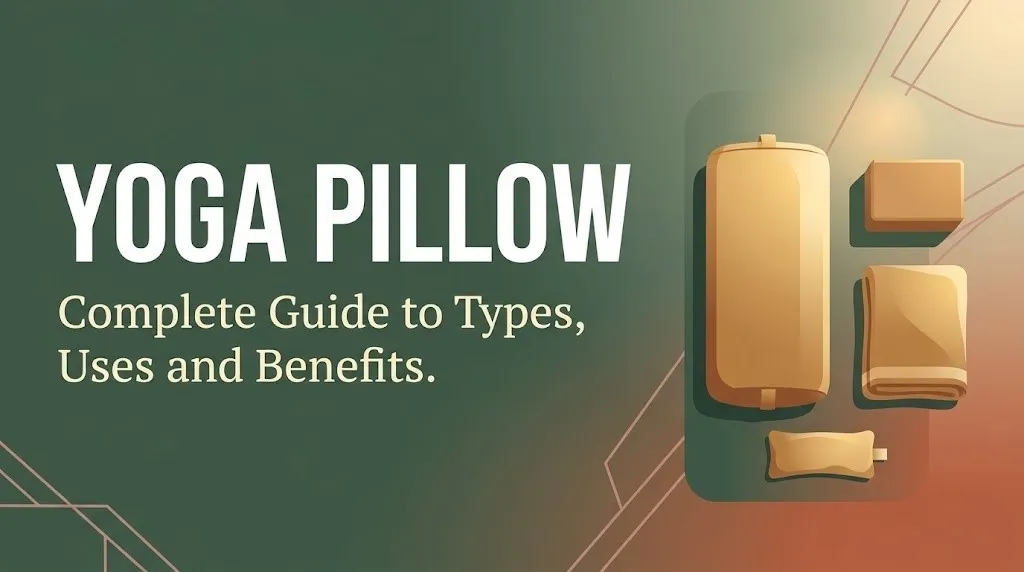
Pranayama bolsters are the narrowest and lowest of the three. They are specifically designed for breathwork (pranayama) practice, where lying over the bolster opens the chest and ribcage to allow fuller diaphragmatic expansion. Their low profile also makes them useful for practitioners with a sensitive lumbar spine who find taller bolsters too deep.
| Bolster Type | Shape | Best For | Avoid If |
|---|---|---|---|
| Rectangular | Flat top, squared edges | Beginners, spinal support, knee cushioning | No significant contraindications |
| Round | Circular cross-section | Chest opening, deeper backbends | Sensitive lumbar spine |
| Pranayama | Low, narrow, flat | Breathwork, mild chest opening | Shoulder impingement in overhead positions |
| Zafu (meditation) | Round, seated | Meditation, Sukhasana support | Not suitable for lying poses |
Key Takeaway: A rectangular bolster is the best starting point for most beginners and people with back concerns. Round bolsters offer more chest opening for those ready for deeper spinal curves.
What Filling Is Best for a Yoga Bolster?
The best filling for a yoga bolster depends on your firmness preference, weight sensitivity, and commitment to sustainable materials, with buckwheat and kapok leading the field for professional-grade support.
Each filling material behaves differently under body weight and over time. Some compress more than others. Some retain shape indefinitely. Some are significantly heavier, which matters if you’re moving props around a studio or traveling with your practice.
Common yoga bolster filling types and their properties:
- Buckwheat hull: Very firm, heavy, excellent shape retention, conforms slightly to body contours, natural material. Preferred by Iyengar-trained practitioners for precise support.
- Kapok: Natural plant fiber, medium-firm, lighter than buckwheat, resists compression well over time, hypoallergenic. A popular choice for sustainable-minded practitioners.
- Recycled cotton: Firm, heavier than kapok, eco-friendly, tends to compress more over years of use. Good value for home practice.
- Memory foam: Softer, conforms to body shape, retains heat, may feel too cushioned for restorative holds requiring stable support.
- Polyester fiberfill: Lightest option, most affordable, compresses faster over time, less preferred for therapeutic restorative use.
Research from exercise science and physical therapy suggests that support firmness in passive stretching affects the quality of connective tissue release. A surface that compresses under body weight does not provide the consistent, predictable support that allows the nervous system to fully release tension.
How to Choose the Right Yoga Pillow for Your Practice
Choosing the right yoga pillow means matching the bolster’s size, shape, weight, and filling to your body proportions, practice style, and specific physical goals.
Start with your body. A practitioner who is taller than 5’9″ may find a standard 24-inch bolster too short for full spinal support in lying poses. Some manufacturers offer longer options at 26 or 28 inches. Conversely, smaller practitioners may find a standard bolster too wide for comfortable kneeling positions.
Consider your primary practice style next. Restorative yoga demands the firmest, most stable support available. A buckwheat or kapok fill rectangular bolster suits this best. Yin yoga, which targets deeper tissue but holds poses for shorter durations, is more forgiving of filling choice. Meditation practice benefits from a lighter, portable option.
Yoga Alliance certified teachers generally recommend that home practitioners start with one rectangular bolster before purchasing additional shapes. One well-chosen rectangular bolster covers the majority of restorative and Yin poses and serves as a reliable knee cushion in seated practice.
Key selection criteria:
- Length: 24 to 26 inches for most adults
- Width: 12 to 14 inches for a stable spinal support surface
- Height: 6 to 8 inches for a rectangular bolster in backbend positions
- Weight: 4 to 7 pounds for buckwheat or cotton fill; 2 to 4 pounds for kapok or polyester
- Cover material: Removable, machine-washable covers are a practical non-negotiable for home and studio use
Yoga Pillow Benefits for the Body and Nervous System
A yoga pillow supports the body so the muscles can stop working, and that is exactly when the parasympathetic nervous system takes over and the body begins its deepest recovery.
Think of it this way. When you lie flat on the floor, your muscles are still making micro-adjustments to maintain position. When a bolster takes over that job, the muscles genuinely switch off. That signal of safety travels up the spinal cord to the brain’s stress response centers, and the body shifts from sympathetic activation (alert, defended) to parasympathetic recovery (calm, restorative).
According to the National Center for Complementary and Integrative Health, restorative yoga practices have been associated with reductions in cortisol, improved self-reported sleep quality, and reduced anxiety symptoms in multiple clinical studies involving adult practitioners.
A study published in Complementary Therapies in Medicine found that an eight-week restorative yoga program, which relies heavily on bolster support, produced statistically measurable reductions in perceived stress and improvements in sleep onset time compared to a stretching-only control group.
Physical benefits of regular yoga pillow use include:
- Passive lengthening of the psoas and iliopsoas muscles, which shorten with prolonged sitting
- Decompression of the lumbar spine in supported backbend positions
- Improved mobility in the thoracic spine through gentle chest-opening poses
- Reduced tension in the piriformis muscle and surrounding hip rotators in supported seated poses
- Better diaphragmatic breathing capacity when the chest is supported in an open position
How to Use a Yoga Bolster in Restorative Yoga
Using a yoga bolster in restorative yoga means positioning it to fully support a specific body region so you can hold a pose passively for five to fifteen minutes without muscular effort.
The key principle of restorative yoga is that the props do the work. The practitioner’s only task is to breathe, stay still, and allow gravity and time to do the releasing. A bolster that is incorrectly placed will cause the muscles to keep working to compensate, which defeats the entire purpose.
To practice a basic supported backbend with a bolster:
- Place a rectangular bolster lengthwise on your mat.
- Sit at the short end of the bolster, facing away from it.
- Lower your back onto the bolster so the bolster sits between your shoulder blades and tailbone.
- Let the head rest gently on the mat or on a folded blanket if it does not comfortably reach the floor.
- Extend the legs long or bring the soles of the feet together in Supta Baddha Konasana (Reclining Bound Angle Pose) with the knees falling open.
- Rest the arms at the sides with palms facing up.
- Breathe slowly through the nose for 8 to 15 minutes. Use an eye pillow to reduce light stimulation.
- To exit, roll gently to one side and use the hands to push up slowly.
Modification for lumbar sensitivity: Place the bolster horizontally under the mid-back only, keeping the lower back and sacrum on the mat. This reduces the degree of lumbar extension significantly.
Key Takeaway: A yoga pillow works by removing muscular effort from the equation entirely. The bolster holds the position; your body uses that support to activate the parasympathetic nervous system and release tension passively.
Best Yoga Bolster Poses for Beginners
The best yoga bolster poses for beginners are those that feel immediately supportive rather than demanding, building confidence in the prop and in the practice of staying still.
Here are five foundational bolster-supported poses with step-by-step instructions and one modification each.
1. Supta Baddha Konasana (Reclining Bound Angle Pose)
To practice Supta Baddha Konasana with a bolster:
- Sit at the short end of a lengthwise bolster, sacrum touching the bolster’s near edge.
- Bring the soles of the feet together and let the knees fall open to the sides.
- Recline back onto the bolster, supporting the head with a folded blanket if needed.
- Place a yoga block or folded blanket under each knee for support if the inner groin feels strained.
- Rest the arms wide, palms up, and breathe slowly for 5 to 10 minutes.
Modification: Keep the legs extended rather than in the bound angle position if inner thigh or knee discomfort arises.
2. Viparita Karani (Legs Up the Wall Pose) with Bolster
To practice Viparita Karani with a bolster:
- Place a bolster 4 to 6 inches from a wall.
- Sit sideways on the bolster’s edge, then swing the legs up the wall as you lower the back to the mat.
- The sacrum and lower back rest on the bolster; the shoulders rest on the mat.
- Adjust position so the lower back feels supported, not compressed.
- Hold for 5 to 15 minutes with slow nasal breathing.
Modification: Move the bolster farther from the wall to reduce the angle if hamstrings feel tightly pulled.
3. Setu Bandha Sarvangasana (Supported Bridge Pose)
To practice Setu Bandha Sarvangasana with a bolster:
- Lie on your back with knees bent, feet flat on the mat, hip-width apart.
- Press the feet down, lift the hips, and slide a bolster horizontally under the sacrum.
- Lower the sacrum onto the bolster and let the legs relax with feet flat or extended long.
- Arms rest alongside the body or extend overhead for a gentle chest opener.
- Hold for 5 to 10 minutes, then press the feet down, lift the hips slightly, and slide the bolster out before lowering.
Modification: Use a lower-profile prop, such as a folded blanket, if the bolster creates uncomfortable lumbar compression.
4. Balasana (Child’s Pose) with Bolster
To practice Balasana with a bolster:
- Kneel with the bolster between your thighs, long edge facing you.
- Bring the big toes to touch, widen the knees to bolster width.
- Fold forward, resting the torso and head on the bolster.
- Turn the head to one side and let the arms drape alongside the bolster.
- Hold for 3 to 8 minutes, switching head direction halfway through.
Modification: Place an additional folded blanket under the hips if the knees are uncomfortable or if the hips do not reach the heels.
5. Savasana (Corpse Pose) with Bolster Under Knees
To practice Savasana with bolster support:
- Lie on your back with legs extended.
- Place the bolster horizontally under the knees so the legs rest over it.
- Let the feet fall naturally apart and the arms rest at the sides, palms up.
- Close the eyes and breathe naturally for 5 to 15 minutes.
Modification: For people with cervical (neck) tension, add a thin folded blanket under the head to bring the chin slightly toward the chest.
Yoga Pillow for Back Pain: How Bolsters Support the Spine
A yoga pillow placed strategically under the spine or sacrum reduces compressive load on the lumbar vertebrae and allows the muscles along the spine to stop contracting, which is the primary physical mechanism behind bolster-assisted back pain relief.
The lumbar spine is the most commonly affected region in yoga-related back pain and in everyday chronic discomfort. Most adults spend the majority of their day in positions that load the lumbar spine: seated at a desk, standing asymmetrically, or lying in positions that don’t support the spine’s natural curves.
A bolster under the sacrum in Supported Bridge Pose tilts the pelvis into a gentle posterior position, which takes compressive force off the posterior disc space of the lumbar vertebrae. Research published in the Journal of Alternative and Complementary Medicine found that restorative yoga practices, including bolster-supported positions, were associated with reduced self-reported back pain intensity in adults with chronic non-specific lower back pain over a ten-week intervention period.
Safety note: People with acute lumbar disc herniation, spinal stenosis, or who have had recent spinal surgery should work with a physical therapist or knowledgeable yoga therapist to determine appropriate bolster heights and positions before practicing independently.
Bolster positions specifically helpful for back pain:
- Horizontal under sacrum: Supported Bridge variation, reduces posterior lumbar compression
- Lengthwise under spine: Supported backbend, opens thoracic extension and chest
- Under knees in Savasana: Removes the hip flexor tension that causes the lower back to arch away from the mat
- Under chest in prone position: Gentle lumbar decompression for people who cannot tolerate lying flat
Yoga Bolster for Hip Opening and Flexibility
A yoga bolster placed under the outer hip, sacrum, or inner thigh allows the hip rotators and adductors to release passively over time, making it one of the most effective tools for improving hip mobility without strain.
Hip tightness is among the most common physical complaints among adults who practice yoga. The hip complex involves the iliopsoas, piriformis, gluteus medius, adductors, and the hip joint capsule itself. Stretching all of these simultaneously with active effort is difficult. A bolster removes the effort, allowing each layer to soften sequentially over the course of a long hold.
To practice a bolster-supported hip opener in Supta Baddha Konasana (Reclining Bound Angle Pose), use the instructions from the beginner poses section, but extend the hold to 10 to 15 minutes for a deeper fascial response.
For a supported Eka Pada Raja Kapotasana (Pigeon Pose) variation at the wall:
- From hands and knees, bring the right shin forward parallel to the front of the mat.
- Place a bolster lengthwise under the right hip and outer thigh.
- Fold the torso over the bolster, resting the forehead on the hands or directly on the bolster.
- Hold for 3 to 5 minutes per side.
- Exit by pressing the hands down and returning to hands and knees.
Modification: If the hip does not reach the bolster, add a folded blanket on top of the bolster until the hip is fully supported without tilting to one side.
According to research in the International Journal of Yoga, Yin yoga practices involving sustained passive holds targeting the hip region showed measurable improvements in hip range of motion after eight weeks of twice-weekly practice.
Key Takeaway: For hip tightness, a bolster under the hip in Pigeon Pose variation or under the knees in Reclining Bound Angle is more effective than active stretching for most adults, because passive support lets the fascia release over time rather than triggering a protective muscular contraction.
Yoga Pillow for Pregnancy and Prenatal Practice
A yoga pillow used during pregnancy provides positional support that standard prenatal yoga cannot safely offer without a prop, particularly in the second and third trimesters when lying flat on the back becomes contraindicated.
After approximately 20 weeks of gestation, lying flat on the back is generally discouraged because the weight of the uterus can compress the inferior vena cava, reducing blood return to the heart. A bolster placed lengthwise under the torso and head, elevating the upper body at a 30 to 45 degree angle, maintains a supported reclined position without the supine contraindication.
Common bolster uses in prenatal yoga:
- Elevated side-lying: Bolster behind the back for stability in lateral rest positions
- Supported forward fold in seated: Bolster in front of the torso in wide-legged seated poses, supporting the chest and belly as the body leans forward
- Elevated backrest: Bolster under torso for a semi-reclined position in relaxation poses after 20 weeks
- Hip support in seated practice: Bolster under the hips in cross-legged positions to reduce sacroiliac joint strain, which becomes more common as relaxin levels increase in the third trimester
Safety note: Pregnant practitioners experiencing placenta previa, pelvic girdle pain, or other pregnancy-specific complications should discuss any yoga practice, including bolster use, with their obstetric care provider, as specific positions may be inappropriate based on individual circumstances.
Yoga Bolster for Seniors: Modifications and Support
A yoga bolster is one of the most practically useful props for older adults because it reduces the range of motion and strength demands of floor-based poses, making a broader range of yoga shapes accessible regardless of joint stiffness or reduced flexibility.
Seniors often face three specific challenges in yoga: getting down to and up from the floor safely, maintaining comfortable positions once on the floor, and finding poses that benefit the joints without stressing already compromised structures. A bolster addresses all three.
Research published in Frontiers in Psychology found that mind-body practices including yoga with props improved balance, self-reported quality of life, and functional mobility in adults over 65 compared to non-exercising control groups over a 12-week period.
Senior-specific bolster adaptations:
| Challenge | Bolster Solution | Additional Prop Needed |
|---|---|---|
| Tight hips in seated | Sit on bolster edge in Sukhasana | Blanket under knees |
| Difficulty reaching floor in forward fold | Rest chest on bolster in seated forward bend | None |
| Uncomfortable Savasana | Bolster under knees to release lower back | Blanket under head |
| Floor transitions (getting up and down) | Use bolster as step to lean on during transitions | Wall or chair nearby |
| Shoulder tension in lying poses | Bolster under thoracic spine with blanket under head | Eye pillow |
The bolster-under-knees modification for Savasana is particularly valuable for seniors. Many older adults cannot lie completely flat without low back discomfort. Elevating the knees on a bolster restores the natural lumbar curve and removes the hip flexor tension that pulls the lower back up from the mat.
Can You Use a Regular Pillow Instead of a Yoga Bolster?
A regular bed pillow is not an adequate substitute for a yoga bolster in most practice scenarios because it compresses under body weight, loses shape within minutes, and cannot provide the consistent, stable support that restorative and Yin yoga poses require.
The functional difference is density. A standard sleeping pillow is designed to compress softly around the head for comfort. A yoga bolster is designed to resist compression and maintain its shape under sustained body weight for up to twenty minutes. When you lie over a bed pillow in a supported backbend, it collapses and shifts. Your muscles then engage to compensate. The entire point of the pose is lost.
That said, a bed pillow is better than nothing for a few specific situations: supporting the head in Savasana, providing light cushioning under the knees in a gentle seated practice, or offering modest hip elevation in seated cross-legged positions for someone who does not yet own a bolster.
Honest comparison:
| Use Case | Bed Pillow | Yoga Bolster |
|---|---|---|
| Spinal support in backbends | Inadequate, collapses | Excellent, stable |
| Knee cushioning in Savasana | Acceptable short-term | Better over long holds |
| Hip elevation in seated poses | Works briefly | Preferred for 5+ minute holds |
| Support in Reclining Bound Angle | Compresses too quickly | Ideal, holds shape fully |
| Prenatal torso elevation | Not reliable | Appropriate with proper positioning |
If purchasing a yoga bolster is not immediately feasible, a tightly rolled firm blanket secured with a yoga strap or belt is a more effective interim substitute than a bed pillow.
Key Takeaway: A regular pillow can briefly substitute for basic bolster tasks like knee cushioning, but a tightly rolled firm blanket is a better interim option for spinal support. For sustained restorative holds, only a true yoga bolster provides adequate firmness.
Wholesale Yoga Bolsters: What Studios Need to Know
Studios purchasing wholesale yoga bolsters should prioritize durability, washability, and filling longevity over unit price, because a bolster that compresses after three months of daily use creates a false economy that costs more in replacements than a quality initial purchase.
Wholesale yoga bolsters are available through yoga equipment distributors, direct-to-studio manufacturers, and sustainability-focused yoga prop companies. Studio-grade bolsters differ from consumer versions in three meaningful ways: heavier-duty cover fabric, higher-density filling, and covers designed to withstand repeated machine washing between classes.
What studio managers should evaluate before placing a wholesale order:
- Filling type for studio use: Kapok and recycled cotton hold shape through high-frequency use. Polyester fiberfill is cheaper but compresses significantly faster under daily multi-class use.
- Cover durability: Look for cotton canvas or recycled cotton canvas covers rated for frequent washing. Microfiber covers may be softer but pill and wear faster in studio laundering cycles.
- Certifications: Some wholesale suppliers offer bolsters made with OEKO-TEX certified materials, meaning the fabric and fill have been tested for harmful substances. Relevant for studios serving pregnant clients or those with chemical sensitivities.
- Minimum order quantities: Most wholesale suppliers require 10 to 50 units minimum. Calculate your studio’s class cap and bolster-per-student ratio before ordering.
- Replacement cycle: Quality studio bolsters last three to five years with regular use and proper care. Budget for replacement cycles accordingly.
Yoga Alliance registered studios should also confirm that prop purchasing aligns with their studio’s sustainability and accessibility commitments, as some Yoga Alliance continuing education programs now include prop accessibility as an equity consideration in studio standards.
How to Clean and Care for Your Yoga Pillow
Clean your yoga pillow’s removable cover after every two to three uses in a studio setting and weekly in home practice. The bolster insert itself requires spot cleaning rather than full immersion.
Most yoga bolster covers are machine washable in cold water on a gentle cycle. Always check the manufacturer’s care label before washing, as some outer fabric blends require hand washing or air drying to prevent shrinkage. Cover zippers should be closed before washing to prevent snags on other laundry.
The bolster insert should never be submerged in water. Buckwheat and kapok fillings, in particular, can mold if saturated and not dried completely. For spot cleaning the insert, use a damp cloth with a diluted white vinegar solution or an unscented gentle soap, wipe the affected area, and allow to air dry completely before replacing the cover.
Care and maintenance guidelines:
- Air the insert weekly: Remove the cover and leave the insert in a well-ventilated area for two to four hours. This prevents moisture buildup and maintains filling loft.
- Store flat or hanging: Storing a bolster upright on its end for extended periods can cause the filling to shift and compress unevenly.
- Rotate bolsters in studio use: If you own multiple bolsters, rotate them so no single bolster bears the load of every class.
- Replace when compressed: A bolster that has lost more than one inch of its original height is no longer providing adequate support. Replace it rather than compensating with folded blankets on top.
- Avoid direct sunlight for storage: UV exposure degrades fabric and some natural fillings over time. Store in a cool, shaded area.
Frequently Asked Questions About Yoga Pillows
What is the difference between a yoga pillow and a yoga bolster?
A yoga pillow and a yoga bolster refer to the same category of prop, though “bolster” is the standard professional term used by yoga teachers and studios.
Some retailers market smaller, softer versions as “yoga pillows” for meditation use, while “bolster” typically describes the larger, firmer version used in restorative and Yin yoga.
For practical purposes, when buying a prop for restorative yoga, search for “yoga bolster” to find the firm, supportive options your practice requires.
Can I use a regular bed pillow instead of a yoga bolster?
A regular bed pillow is not an adequate substitute for a yoga bolster because it compresses under body weight and loses shape too quickly to provide stable support.
For short-term home practice, a tightly rolled firm blanket secured with a strap is a more effective interim option than a bed pillow for spinal support poses.
Investing in a quality bolster makes a measurable difference in the effectiveness and comfort of restorative yoga holds lasting five minutes or longer.
What size yoga bolster should I buy for home practice?
Most adults do well with a rectangular bolster measuring 24 inches long, 12 to 14 inches wide, and 6 to 8 inches tall for a versatile home practice bolster.
Taller practitioners over 5’9″ may benefit from a 26-inch length to ensure full spinal support in lying poses.
Start with one rectangular bolster before purchasing additional shapes; it covers the majority of restorative and Yin poses effectively.
Is a yoga bolster good for back pain?
A yoga bolster supports the spine in positions that reduce muscular effort and decompress the lumbar vertebrae, which many people with chronic back discomfort find relieving.
Research published in the Journal of Alternative and Complementary Medicine found that restorative yoga, which relies on bolster support, was associated with reduced back pain intensity over a ten-week practice period in adults with non-specific lower back pain.
Anyone with acute disc herniation, spinal stenosis, or recent spinal surgery should work with a physical therapist to identify safe bolster positions before practicing independently.
How do I use a yoga pillow in restorative yoga?
Place the bolster lengthwise on your mat, sit at one short end, and recline back so the bolster supports your spine from the sacrum to the upper back.
Let the arms fall open, the legs extend or relax into a bound angle position, and breathe slowly through the nose for 8 to 15 minutes.
The goal is complete muscular passivity; if you feel effort in any muscle group, adjust the bolster position or add a folded blanket until the body fully surrenders to the support.
Closing
Your yoga pillow does one thing exceptionally well. It takes the work away from your muscles and gives the nervous system permission to recover.
Start with a supported backbend or Savasana with the bolster under your knees. Set a timer for ten minutes. Breathe slowly. Notice what your body does when it is genuinely held rather than holding itself.
That’s the practice. And a good bolster makes it accessible from day one.