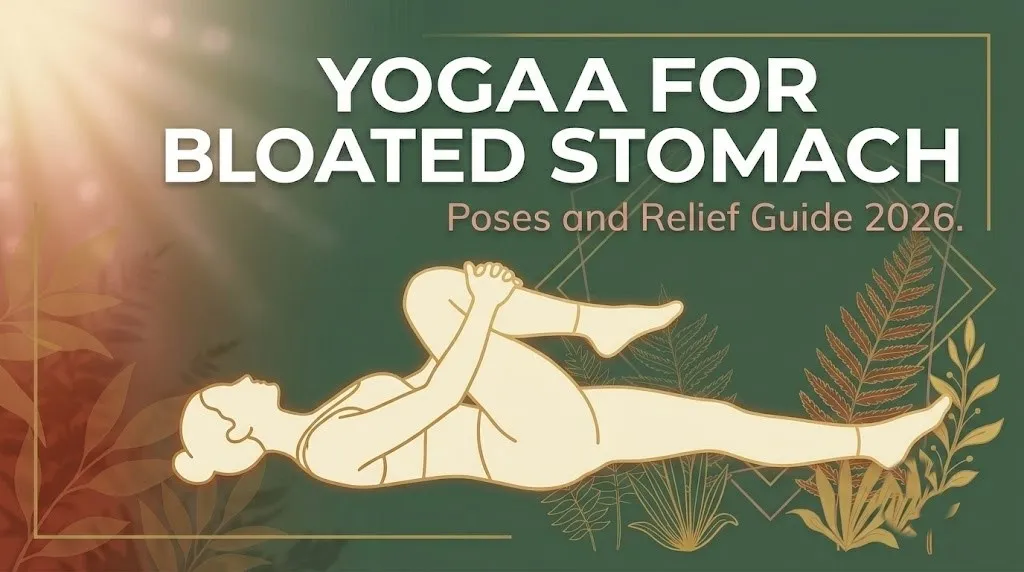
Yoga for Bloated Stomach: Poses and Relief Guide 2026
Specific yoga poses can relieve a bloated stomach by physically compressing the abdominal cavity, stimulating intestinal movement, and activating the parasympathetic nervous system. Yoga for a bloated stomach is not a vague wellness recommendation. It works through real, documented physiological mechanisms.
According to Harvard Medical School, the gut and brain communicate continuously through the vagus nerve, a two-way highway that connects emotional state to digestive function. Research published in the Journal of Alternative and Complementary Medicine found that regular yoga practice measurably improved gastrointestinal symptoms in adults with irritable bowel syndrome compared to a control group receiving standard dietary advice.
This guide covers fifteen specific areas: the science behind yoga’s digestive effects, step-by-step instructions for the most effective poses, condition-specific guidance for IBS, period bloating, and stress-related gut tension, plus a complete sequence you can use right now. Start with one section or read straight through. Either approach gives you something to practice today.
Yoga for Bloated Stomach: What It Actually Does
Yoga relieves a bloated stomach by combining three distinct physical mechanisms: abdominal compression, spinal movement, and parasympathetic nervous system activation.
Abdominal compression happens when a pose draws the knees toward the chest or folds the torso forward. This external pressure against the abdominal wall mimics the kind of manual stimulation that gastroenterologists and physical therapists use to move trapped gas through the colon.
Spinal movement, particularly twisting and forward folding, stretches the tissues surrounding the large intestine. Think of the colon like a garden hose that has been kinked. Rotational movement helps straighten and mobilize the tube so contents can move more freely.
Parasympathetic activation is perhaps the most underappreciated mechanism. When the body enters a “rest and digest” state through slow breath and supported poses, intestinal peristalsis, the wave-like contractions that move food through the gut, becomes more consistent and efficient.
Key effects yoga produces on a bloated stomach:
- Mechanical stimulation of the ascending, transverse, and descending colon through abdominal compression
- Increased intestinal motility via parasympathetic nervous system engagement
- Reduction in cortisol, which, when chronically elevated, suppresses healthy gut motility
- Stretching of the abdominal fascia, reducing the sensation of tightness and pressure
- Improved diaphragm mobility, which directly affects the transverse colon below it
How Does Yoga Help With Bloating?
Yoga helps with bloating by mechanically stimulating the digestive tract, reducing stress hormones that slow gut function, and improving the coordination between breath and abdominal movement.
The large intestine traces a specific path through the abdominal cavity: up the right side (ascending colon), across the top (transverse colon), down the left side (descending colon), and into the sigmoid colon before the rectum. Yoga poses that compress the abdomen in a deliberate sequence can follow this anatomical path and physically encourage gas to move in the correct direction.
According to the National Center for Complementary and Integrative Health (NCCIH), yoga’s effects on the autonomic nervous system are well-documented. Sustained slow breathing during yoga shifts the body from sympathetic dominance (fight-or-flight) toward parasympathetic dominance, and it is in the parasympathetic state that the digestive system operates most efficiently.
A study published in Neurogastroenterology and Motility found that psychological stress directly reduces gut motility and increases visceral hypersensitivity, meaning the gut becomes more sensitive to normal amounts of gas and food. Yoga addresses this stress-gut link more directly than most digestive interventions.
Pose Tip:
- Practice yoga poses in the anatomical order of the colon: start on your right side, move to poses that compress across the upper abdomen, then shift to your left side.
- This follows the natural direction of gas travel and makes each pose more mechanically effective.
- Combine slow exhale breath with each compression to increase abdominal pressure gently.
Yoga for Digestive Health: The Gut-Body Connection
Yoga supports digestive health by reducing the chronic stress load that dysregulates gut function and by directly mobilizing the tissues surrounding the gastrointestinal tract.
The enteric nervous system, sometimes called the second brain, contains approximately 500 million neurons lining the digestive tract. It operates semi-independently from the central nervous system but responds strongly to signals from the vagus nerve. Slow, rhythmic breathing during yoga stimulates the vagus nerve and supports the communication between brain and gut.
Harvard Medical School researchers have noted that the gut-brain axis plays a central role in conditions like IBS, functional dyspepsia, and stress-induced bloating. Yoga is one of the few physical interventions that addresses both the structural (muscular, fascial) and neurological (vagal, autonomic) contributors to poor digestive function simultaneously.
Consistent yoga practice also appears to affect the microbiome environment indirectly. By reducing cortisol levels and improving intestinal motility, yoga creates conditions less favorable to gas-producing bacterial overgrowth, though researchers note this is an area of ongoing study rather than a firmly established cause-and-effect relationship.
| Body System | How Yoga Affects It | Digestive Benefit |
|---|---|---|
| Parasympathetic nervous system | Activated by slow breath and supported poses | Increases intestinal peristalsis |
| Vagus nerve | Stimulated by diaphragmatic breathing | Improves gut-brain communication |
| Abdominal fascia | Stretched by twisting and folding | Reduces pressure and tightness |
| Diaphragm | Mobilized by breath work | Massages the transverse colon indirectly |
| Cortisol axis | Reduced by parasympathetic activation | Removes stress inhibition on gut motility |
Key Takeaway: Yoga does not just stretch you. It literally shifts your nervous system into the state where digestion works best, and it does this through breath, not willpower.
Yoga Poses to Debloat: The Core Sequence
The most effective yoga poses to debloat include a small set of foundational shapes that compress, rotate, and open the abdominal region in a logical anatomical order.
Every debloating yoga practice should begin on the floor. Supine positions reduce gravitational resistance on the gut and allow the abdominal wall to relax completely, making compression far more effective than standing attempts.
The five foundational debloating poses, in practice order:
- Marjaryasana-Bitilasana (Cat-Cow Pose) as a warm-up to mobilize the lumbar spine and gently knead the abdominal organs
- Apanasana (Knee-to-Chest Pose) to compress the ascending colon on the right and sigmoid on the left
- Pawanmuktasana (Wind-Relieving Pose) for deeper single-leg abdominal compression
- Supta Matsyendrasana (Supine Spinal Twist) to rotate the colon and stimulate peristalsis
- Balasana (Child’s Pose) for forward compression and parasympathetic cool-down
Modification for beginners: Practice each pose with the back fully supported on a yoga mat or a folded blanket. Place a bolster under the knees in supine poses if the lower back feels strained.
Modification for seniors or people with knee sensitivity: In Pawanmuktasana, hold behind the thigh rather than over the shin. This reduces knee joint stress while maintaining abdominal compression.
People with active hernia, recent abdominal surgery, or severe GERD should not practice deep forward compression poses without guidance from a gastroenterologist or physiatrist familiar with yoga mechanics.
Best Yoga Poses for Trapped Gas
Pawanmuktasana (Wind-Relieving Pose) is the single most directly targeted yoga pose for trapped gas because it compresses the ascending and descending colon with deliberate, controlled pressure.
The Sanskrit name tells you exactly what this pose is designed to do. “Pavana” means wind or gas. “Mukta” means released or freed. “Asana” means pose. It is an ancient acknowledgment of a very modern problem.
To practice Pawanmuktasana (Wind-Relieving Pose):
- Lie flat on your back on a yoga mat. Extend both legs fully.
- Inhale deeply and lengthen the spine along the mat.
- On an exhale, draw your right knee toward your chest. Hold behind the thigh or over the shin.
- Keep the left leg active and flat on the mat. Do not let it lift.
- Hold for 5 to 8 breath cycles, roughly 30 to 50 seconds. Breathe slowly throughout.
- On an exhale, switch to the left knee. Repeat for 5 to 8 breath cycles.
- Draw both knees to the chest simultaneously. Hold for 5 breath cycles.
- Release both legs slowly to the mat on an exhale.
Modification for tight hip flexors: If the lower back lifts aggressively when drawing the knee in, place a folded blanket under the sacrum. This reduces the compressive demand on the lumbar spine while maintaining abdominal contact.
Modification for pregnancy: After the first trimester, replace this pose with a seated version. Sit tall and draw one knee toward the chest from a chair or the edge of the mat. Avoid full supine compression of the lower abdomen.
Yoga Twists for Digestion
Yoga twists support digestion by rotating the spine and creating a wringing effect on the tissues surrounding the large intestine, which encourages gas and intestinal contents to move through the colon.
A useful analogy: imagine wringing out a wet towel. The twisting motion compresses the fabric from outside, forcing moisture through. Spinal twists do something mechanically similar to the abdominal cavity, applying external rotational pressure that helps move stubborn gas pockets along the colon.
Ardha Matsyendrasana (Half Lord of the Fishes Pose) is the most well-known seated digestive twist. It rotates the thoracic and lumbar spine simultaneously while the bent knee provides an anchoring compression point against the abdomen.
To practice Ardha Matsyendrasana (Half Lord of the Fishes Pose):
- Sit on the mat with both legs extended.
- Bend the right knee. Cross the right foot over the left leg. Plant the right foot flat on the mat beside the left knee.
- On an inhale, lengthen the spine upward. Sit as tall as possible.
- On an exhale, rotate the torso to the right. Place the left elbow outside the right knee.
- Look gently over the right shoulder without straining the neck.
- Hold for 6 to 8 slow breath cycles. Keep the spine tall throughout. Do not slump.
- Unwind slowly on an inhale. Repeat on the left side.
Modification for tight hips or limited spinal rotation: Sit on a folded blanket to elevate the hips. This reduces the demand on hip external rotation and allows the spine to rotate more freely.
Safety note: Anyone with acute lumbar disc herniation should keep the twist range very shallow and stop if there is any radiating sensation into the legs.
Supine Yoga Poses for Gas Relief
Supine yoga poses are the most accessible and often the most effective for gas relief because lying on the back allows the abdominal wall to fully relax, making compression and movement more direct.
When the body is horizontal, the abdominal muscles disengage their postural holding patterns. The gut literally hangs more freely. This means that even gentle compression in a supine pose can reach deeper into the abdominal cavity than a standing compression with twice the force.
Supta Matsyendrasana (Supine Spinal Twist) is the most versatile supine pose for gas and bloating. It reaches the entire length of the colon through rotational movement without requiring any active core strength.
To practice Supta Matsyendrasana (Supine Spinal Twist):
- Lie on your back. Draw both knees toward your chest briefly.
- Extend the right arm out to the side at shoulder height. Palm faces down.
- On an exhale, let both knees drop slowly to the left side of the body.
- Place the left hand gently on the top (right) knee. Do not force the knee toward the floor.
- Turn the head to the right if the neck is comfortable. Keep the right shoulder on the mat.
- Hold for 8 to 10 slow breath cycles, roughly 60 to 90 seconds.
- On an inhale, draw the knees back to center. Repeat on the opposite side.
Modification for SI joint sensitivity: Place a bolster or folded blanket between the knees when they drop to the side. This reduces the rotational stress on the sacroiliac joint while preserving the abdominal twist.
Modification for seniors: Practice this pose in bed rather than on the floor if getting down to a mat is difficult. A firmer mattress works well. The mechanics are identical.
Key Takeaway: Supine poses work faster for gas relief than standing ones. Get on the floor, let the abdominal wall relax, and let gravity help the compression do its job.
Yoga Sequence for Bloating Relief: Full Practice Guide
A complete yoga sequence for bloating relief should take 15 to 20 minutes, follow the anatomical path of the colon, and integrate breath cues throughout every transition.
Most people with a bloated stomach want results in one session, not after a month of daily practice. This sequence is designed for immediate use. It begins with spinal warm-up, moves through targeted compression and twisting, and closes with a supported cool-down.
Full 15 to 20 Minute Bloating Relief Sequence:
- Marjaryasana-Bitilasana (Cat-Cow Pose): 8 to 10 rounds. Inhale into Cow (spine drops, belly lowers). Exhale into Cat (spine rounds, belly lifts). Warms the lumbar spine and begins gentle abdominal movement.
- Balasana (Child’s Pose): Hold for 1 minute. Knees wide. Torso draped over thighs. This compresses the lower abdomen gently and shifts the body into parasympathetic mode.
- Apanasana (Knee-to-Chest Pose): Both knees drawn to chest. Hold for 5 to 8 breath cycles. Rock gently side to side if comfortable.
- Pawanmuktasana (Wind-Relieving Pose): Right knee first for 8 breath cycles. Left knee for 8 breath cycles. Both knees for 5 breath cycles.
- Supta Matsyendrasana (Supine Spinal Twist): Right side first for 8 to 10 breath cycles. Left side for 8 to 10 breath cycles.
- Setu Bandha Sarvangasana (Bridge Pose): Hold for 5 breath cycles. Lifts the intestines away from the pelvic floor and stimulates the lower digestive tract. Lower slowly. Repeat twice.
- Malasana (Garland Pose / Yogi Squat): Hold for 8 to 10 breath cycles. Opens the pelvic floor and creates downward pressure that supports elimination. Use blocks under heels if they don’t reach the floor.
- Savasana (Corpse Pose): 3 to 5 minutes. Allows the nervous system to integrate all the movement and complete the parasympathetic response.
Modification for anyone who cannot get to the floor: Complete steps 1 through 5 in a chair version. Seated Cat-Cow with hands on knees. Seated knee-to-chest. Seated spinal twist. Seated forward fold. The mechanisms are similar even without full supine compression.
Yoga for Gastric Problem and Chronic Gas
Yoga for gastric problems including chronic gas, bloating, and indigestion works best as a consistent daily practice rather than an emergency intervention used only when symptoms spike.
Chronic gastric problems often involve a combination of factors: bacterial imbalance in the gut, reduced intestinal motility, heightened visceral sensitivity, and stress dysregulation of the enteric nervous system. No single yoga session fixes all of these. But daily practice creates cumulative improvements across all of them.
According to a study published in the International Journal of Yoga, a 12-week yoga intervention significantly reduced gastrointestinal symptoms including gas, bloating, and bowel irregularity in adults with functional digestive complaints compared to a lifestyle modification control group.
The most effective poses for chronic gastric issues focus less on intense compression and more on consistent daily movement:
- Marjaryasana-Bitilasana (Cat-Cow Pose): 2 to 3 minutes daily to maintain lumbar mobility and abdominal movement
- Malasana (Garland Pose): 1 to 2 minutes daily to maintain pelvic floor openness and support regular elimination
- Paschimottanasana (Seated Forward Bend): 1 to 2 minutes per side to compress the lower abdominal organs and stretch the posterior digestive cavity
- Viparita Karani (Legs-Up-the-Wall Pose): 5 to 10 minutes to shift the body into parasympathetic mode and reduce cortisol-driven gut tension
Modification for people with chronic GERD or hiatal hernia: Avoid strong forward folds and full inversion poses. Focus on supported reclined poses and gentle twists that do not increase intraabdominal pressure above the stomach level.
Yoga for IBS Bloating
Yoga is one of the most studied non-pharmacological interventions for irritable bowel syndrome (IBS), and bloating is among the IBS symptoms most likely to respond to regular practice.
IBS bloating differs from simple gas bloating because it involves visceral hypersensitivity: the gut’s pain-sensing nerves interpret normal amounts of intestinal gas as painful distension. This is not a structural problem. It is a signaling problem. And that is exactly where yoga’s effect on the enteric and autonomic nervous systems becomes relevant.
A randomized controlled trial published in the Journal of Alternative and Complementary Medicine found that participants with IBS who practiced yoga twice weekly for eight weeks reported measurably lower IBS symptom severity scores, including reduced bloating, compared to the dietary counseling group.
The best yoga styles for IBS bloating are Restorative yoga and Hatha yoga. Both minimize physical exertion and maximize parasympathetic engagement, which is precisely what the IBS gut needs. High-intensity styles like Ashtanga or Power yoga can temporarily worsen IBS symptoms by elevating cortisol and sympathetic tone.
Specific guidance for IBS-related bloating:
- Avoid deep abdominal compression during a pain flare. Wait until symptoms have softened before practicing poses like Pawanmuktasana.
- Supta Matsyendrasana (Supine Spinal Twist) is generally well-tolerated even during moderate flares because it uses rotation rather than direct compression.
- Practice in a room with a comfortable temperature. Cold environments can trigger IBS-related intestinal cramping.
- Keep sessions to 15 to 20 minutes during flares. Longer sessions can fatigue the nervous system and temporarily worsen symptoms.
Key Takeaway: For IBS bloating, Restorative and Hatha yoga twice a week for eight weeks is more likely to reduce your symptoms than any single emergency pose session. Consistency is the mechanism.
Yoga for Period Bloating
Yoga for period bloating works by reducing the prostaglandin-driven uterine contractions that affect neighboring intestinal tissue, and by shifting the nervous system away from the heightened pain sensitivity common in the premenstrual and menstrual phases.
Period bloating is physiologically distinct from food-related bloating. Rising progesterone levels in the luteal phase slow intestinal transit time, allowing more gas to accumulate. Prostaglandins released during menstruation cause smooth muscle contractions in the uterus that can also affect the adjacent large intestine and create cramping-type bloating distinct from simple trapped gas.
Restorative yoga is the most appropriate style during menstruation. Supported, passive shapes reduce the demand on an already-taxed body and provide relief without increasing physical stress load.
Most effective poses for period bloating:
- Supta Baddha Konasana (Reclined Bound Angle Pose): Recline with soles of feet together, knees falling open. Place a bolster under the spine and a blanket under each knee. Hold for 5 to 10 minutes. This opens the pelvic region and reduces cramping-type tension around the lower colon.
- Viparita Karani (Legs-Up-the-Wall Pose): Legs resting vertically against a wall. Hold for 5 to 10 minutes. Reduces lower abdominal pressure and encourages lymphatic drainage from the pelvis.
- Balasana (Child’s Pose): Knees wide, torso folded forward. Compresses the lower abdomen gently and supports parasympathetic downregulation.
Modification for heavy flow days: Avoid inverted poses. Keep all practice horizontal or seated. The supine and supported shapes above are entirely appropriate and well within most practitioners’ comfort during menstruation.
Note: Some traditional yoga schools advise against inversions during menstruation due to Ayurvedic principles around Apana Vayu, the downward energy that governs elimination and menstrual flow. This is a philosophical position rather than a medical one.
Yoga for Stress-Related Bloating
Stress-related bloating occurs when elevated cortisol and sustained sympathetic nervous system activation suppress intestinal motility and increase visceral sensitivity, making the gut feel full, tight, and painful even without excess gas.
This type of bloating does not respond well to aggressive abdominal compression. Forcing a stressed gut through intense poses often makes it worse. The approach here must begin with the nervous system before anything mechanical.
Restorative yoga and slow Hatha yoga are the appropriate styles for stress-related bloating. The goal is parasympathetic activation first, mechanical relief second.
Sequence for stress-related bloating:
- Begin with 5 minutes of diaphragmatic breathing lying on your back. Hand on belly. Inhale to expand. Exhale slowly for twice the length of the inhale.
- Viparita Karani (Legs-Up-the-Wall Pose) for 5 to 8 minutes. This is the single fastest way to shift from sympathetic to parasympathetic mode with zero muscular effort.
- Supta Baddha Konasana (Reclined Bound Angle Pose) supported by a bolster under the spine. Hold for 5 minutes.
- Supta Matsyendrasana (Supine Spinal Twist) gently and without forcing the range. 6 to 8 breath cycles per side.
- Savasana (Corpse Pose) for 5 minutes to consolidate the parasympathetic response.
A 2019 study published in Complementary Therapies in Medicine found that an eight-week restorative yoga program reduced perceived stress scores and self-reported gastrointestinal complaints in adults with stress-related digestive symptoms compared to a stretching-only control group.
Modification for acute stress episodes: If the mind is racing and lying still feels impossible, begin with 3 to 5 minutes of gentle walking before coming to the mat. Physical movement for a few minutes can burn off enough adrenaline to make the restorative poses accessible.
Yoga After Meals for Digestion
Yoga practiced immediately after eating should be gentle, minimal, and focused on breath rather than active movement. The worst thing you can do for post-meal bloating is intense abdominal compression on a full stomach.
Gastric emptying, the process by which the stomach moves food into the small intestine, takes 2 to 4 hours depending on meal composition. Vigorous yoga practice during this window can trigger nausea, acid reflux, and genuine digestive distress rather than relief.
The most appropriate yoga for the first 30 to 60 minutes after eating:
- Vajrasana (Thunderbolt Pose / Kneeling Pose): Sitting on the heels directly after a meal is one of the few poses that research and traditional Ayurvedic practice both support for post-meal digestion. A study in Ancient Science of Life found that Vajrasana improved post-meal gastric acid secretion patterns in healthy adults. Hold for 5 to 10 minutes.
- Seated diaphragmatic breathing: Sit comfortably and breathe slowly. Inhale for 4 counts. Exhale for 6 to 8 counts. Five minutes of this after eating measurably increases vagal tone and digestive enzyme activity.
- Gentle seated Cat-Cow: Hands on knees, very small movement. Avoids compression of the full stomach while mobilizing the spine.
Wait at least 90 minutes after a full meal before practicing any pose that involves forward compression, inversion, or strong abdominal engagement.
Modification for people who eat desk lunches: Vajrasana is available to anyone with a yoga mat behind their desk. Two minutes of kneeling post-lunch has measurable digestive benefit and requires no studio, no changing, and no equipment.
Key Takeaway: Post-meal yoga means breath and Vajrasana for the first 90 minutes. Save the compression and twisting for later. Respect the stomach’s emptying timeline and you’ll avoid making bloating worse.
Yoga Breathing for Gas Relief
Diaphragmatic breathing is the most direct breathing intervention for gas and bloating because the diaphragm sits directly above the transverse colon and functions as a natural abdominal massage with every breath cycle.
When the diaphragm descends on each inhale, it gently presses downward on the abdominal organs. When it rises on the exhale, it creates a slight upward suction. Repeated over dozens of slow breath cycles, this rhythmic pumping action stimulates intestinal movement in a way no pose alone can replicate.
Apana Vayu is the yogic concept describing the downward and outward flow of energy governing elimination, including gas release. Practices that strengthen Apana Vayu through specific breathwork have been used in traditional yoga systems for thousands of years to support digestive function.
To practice diaphragmatic breathing for gas relief:
- Lie on your back or sit comfortably with the spine tall.
- Place one hand on the belly, just below the navel. Place the other hand on the chest.
- Inhale slowly through the nose for 4 counts. The belly should rise. The chest should stay relatively still.
- Exhale slowly through the nose for 6 to 8 counts. Feel the belly fall completely.
- After 5 to 6 breath cycles, begin to extend the exhale by 1 to 2 counts per round.
- Practice for 5 to 10 minutes. This is sufficient to shift autonomic balance measurably.
Kapalabhati pranayama (Skull-Shining Breath) uses rapid, forceful exhales through the nose to create rapid abdominal pumping. Yoga teachers often teach this for digestive stimulation. However, people with high blood pressure, active acid reflux, hernia, or pregnancy should avoid Kapalabhati entirely and stay with slow diaphragmatic breathing.
Modification for people with anxiety: Fast breathwork techniques like Kapalabhati can increase anxiety rather than relieve it. Stick with extended exhale breathing (exhale twice as long as inhale) if anxiety is a factor.
Yoga for Stomach Pain: When to See a Doctor
Yoga is appropriate for functional bloating, gas, and mild stomach discomfort. It is not a replacement for medical evaluation when stomach pain has specific warning characteristics.
The distinction matters. Most bloating is functional: it comes from gas, diet, stress, or digestive sluggishness and resolves with movement, breath, and time. But some abdominal pain signals something that requires a clinician’s assessment.
Stop yoga practice and seek evaluation from a gastroenterologist or primary care physician if stomach pain or bloating is accompanied by:
- Sudden, severe abdominal pain that is unrelated to eating or gas
- Blood in the stool or rectal bleeding of any amount
- Unexplained weight loss alongside persistent bloating over two to four weeks
- Fever combined with abdominal distension
- Vomiting that does not resolve within 24 hours
- Pain that wakes you from sleep consistently
- Bloating that has increased progressively over weeks without dietary explanation
- A noticeable change in bowel habits persisting for more than three weeks
These patterns can indicate conditions including inflammatory bowel disease, ovarian cysts, intestinal obstruction, or celiac disease. A gastroenterologist can differentiate these from functional bloating through appropriate testing.
Yoga is safe and appropriate for the vast majority of people experiencing bloating. For people with diagnosed conditions like Crohn’s disease or ulcerative colitis, a gastroenterologist familiar with integrative approaches can advise on which yoga styles and poses are appropriate during different disease phases.
Pose Tip:
- If a yoga pose makes your stomach pain sharper or creates new pain, stop immediately.
- Yoga should produce a sense of release, not increasing pressure or cramping.
- Mild discomfort from gas moving is normal. Sharp or stabbing pain is not.
Key Takeaway: Yoga is safe for functional bloating and gas. It is not a diagnostic tool. If your bloating is persistent, progressive, or paired with other symptoms, get a clinical evaluation first and use yoga as a complement, not a substitute.
Frequently Asked Questions About Yoga for Bloated Stomach
Which yoga pose is best for relieving gas immediately?
Pawanmuktasana (Wind-Relieving Pose) is the most directly effective pose for immediate gas relief.
It compresses the ascending and descending colon with controlled pressure, physically encouraging trapped gas to move through the large intestine.
Hold each knee individually for 8 breath cycles before drawing both knees in, and breathe slowly throughout the entire pose.
How long should I hold yoga poses for bloating relief?
Most yoga teachers and physical therapists recommend holding debloating poses for 5 to 10 slow breath cycles, roughly 30 to 90 seconds per pose.
Yin-style holds of 2 to 3 minutes are appropriate for poses targeting deeper connective tissue around the colon, such as supine twists.
Shorter holds repeated two to three times are more effective than one very long hold when the goal is mechanical gas movement rather than tissue release.
Can I do yoga right after eating if I’m bloated?
Gentle breath work and Vajrasana (Thunderbolt Pose) are appropriate within 30 to 60 minutes of eating.
Strong abdominal compression, forward folds, and twists should wait at least 90 minutes after a full meal to avoid nausea and acid reflux.
The safest post-meal yoga is seated diaphragmatic breathing for 5 to 10 minutes, which supports gastric emptying without stressing the digestive system.
Does yoga help with IBS bloating?
Yes, yoga is one of the more well-studied non-drug interventions for IBS-related bloating.
A randomized controlled trial in the Journal of Alternative and Complementary Medicine found that twice-weekly yoga for eight weeks reduced IBS symptom severity, including bloating, more effectively than dietary counseling alone.
Restorative yoga and Hatha yoga are the most appropriate styles for IBS; avoid high-intensity styles during symptomatic periods.
What yoga breathing technique helps with gas and bloating?
Diaphragmatic breathing with an extended exhale is the most consistently effective breathwork for gas and bloating.
Inhale for 4 counts through the nose, allowing the belly to rise, then exhale slowly for 6 to 8 counts, feeling the belly fall completely.
This pattern activates the parasympathetic nervous system and uses the natural downward movement of the diaphragm to gently massage the transverse colon with every breath cycle.
Roll Out the Mat and Start Tonight
Pick one pose from this guide and do it before you go to sleep. Pawanmuktasana takes three minutes. Supta Matsyendrasana takes four. You do not need a sequence, a studio, or a warm-up to get started.
If you come back to this article tomorrow with a consistent bloating problem, try the full 15-minute sequence three times this week. Track whether your symptoms shift over 10 to 14 days. Consistency produces more change than intensity.
Your gut responds well to being moved, breathed into, and given time to settle. Start there.