Easy 2 Person Yoga Poses: Beginner Guide 2026
The best 2 person yoga poses for beginners are ones that require zero prior experience, no special equipment, and just enough physical contact to create a genuine shared stretch. You and your partner can start practicing in your living room today with nothing but two yoga mats and a willingness to communicate.
Partner yoga has gained steady attention from researchers and clinicians. According to the National Center for Complementary and Integrative Health (NCCIH), yoga consistently shows measurable effects on flexibility, stress reduction, and nervous system regulation, and practicing with another person adds a layer of social co-regulation that solo practice does not replicate.
This guide covers what partner yoga actually is, why it works differently than practicing alone, the safest beginner poses with step-by-step instructions, how to modify for limited mobility or specific health concerns, and when to progress to more challenging variations.
2 Person Yoga Poses Easy: What You Need to Know Before You Start
The easiest 2 person yoga poses are gentle, low-risk postures where both partners support or mirror each other, creating a stretch or balance challenge neither person could achieve as effectively alone.
Partner yoga is not a separate yoga style with its own lineage. It is a format. You can apply it within Hatha yoga, Restorative yoga, or even gentle Vinyasa flows. The core difference between solo and partner practice is counterbalance: one person’s weight or resistance gives the other something to push or pull against, deepening hip openers, spinal stretches, and standing balances without requiring advanced flexibility.
Think of it like two people pulling opposite ends of a resistance band. Each person gets more range of motion than they would working alone, because there is a stable anchor on the other side.
You genuinely do not need experience to begin. The poses in this guide were selected based on their low injury risk, minimal coordination demand, and high payoff for complete beginners.
Pose Tip:
- Always agree on a verbal signal before you start, something simple like “stop” or “ease up,” so either person can immediately reduce pressure without awkwardness.
- Remove socks. Bare feet on a non-slip mat keep both partners grounded and reduce sliding risk.
- Match your breathing from the beginning. Even one synchronized inhale and exhale before a pose helps both nervous systems settle.
What Is Partner Yoga and How Does It Work?
Partner yoga is a yoga practice where two people work together physically, using each other’s weight, grip, or position to support and deepen poses.
The mechanics are rooted in proprioception, your body’s real-time sense of its position in space. When a second person places hands on your back, holds your wrists, or presses their feet into your hips, your nervous system receives new information about where your body is and what it can safely do. That input often allows muscles to release tension they would otherwise guard against in a solo stretch.
According to research published in the Frontiers in Psychology, physical co-presence during shared physical activity promotes synchrony in the autonomic nervous system. In plain terms: two people breathing and moving together genuinely calm each other down at a physiological level.
Partner yoga also creates external accountability for alignment. A partner can feel when your spine rounds too far. You can feel when their hips shift. That feedback loop works faster and more accurately than a mirror.
| Element | Solo Yoga | Partner Yoga |
|---|---|---|
| Counterbalance | Uses own body weight | Uses partner’s weight or resistance |
| Stretch depth | Limited by own flexibility | Often deeper due to external anchor |
| Alignment feedback | Self-monitored or mirror | Real-time tactile feedback |
| Nervous system effect | Individual regulation | Shared co-regulation |
| Equipment needed | Mat only | Mat only (most poses) |
Benefits of Practicing Easy Partner Yoga Poses
Regular partner yoga practice builds flexibility, improves balance, and reduces perceived stress, often more efficiently than solo practice for beginners.
A study published in the Journal of Alternative and Complementary Medicine found that participants who practiced yoga with social support maintained their practice longer and reported greater subjective wellbeing than those who practiced alone. Consistency is itself a health benefit, and partner accountability drives consistency.
From a physical standpoint, the counterbalance principle in partner yoga allows the hamstrings, hip flexors, thoracic spine, and shoulder girdle to move through a fuller range of motion. Muscles that brace protectively during solo stretching often release more readily when there is a stable external force creating the stretch.
There is also a measurable effect on cortisol, the body’s primary stress hormone. The NCCIH notes that yoga practice broadly is associated with reductions in cortisol levels. Partner yoga adds an interpersonal dimension that amplifies this, because human touch and coordinated breathing both trigger parasympathetic nervous system activation.
Key benefits of easy partner yoga practice include:
- Deeper passive stretching in major muscle groups
- Improved proprioceptive awareness and balance
- Stronger communication and nonverbal attunement with your partner
- Reduced cortisol and perceived stress scores
- Greater practice consistency due to social accountability
- Increased body confidence for beginners who feel self-conscious practicing alone
Key Takeaway: Partner yoga is not just a social activity. The biomechanical counterbalance and nervous system co-regulation between two people produce measurably different outcomes than solo stretching, even at the beginner level.
Beginner Yoga Poses for 2 People to Try at Home
The best beginner yoga poses for two people are seated or gently supported postures that require little coordination but deliver real results for flexibility and tension release.
You do not need a studio, a teacher, or special equipment for these. A firm floor, two mats, and a couple of folded blankets cover everything the following poses require.
Here is a quick-reference breakdown before you begin:
| Pose | English Name | Sanskrit Name | Difficulty | Best For |
|---|---|---|---|---|
| Double Seated Forward Fold | Seated Forward Fold | Paschimottanasana | Beginner | Hamstrings, lower back |
| Partner Child’s Pose | Child’s Pose | Balasana | Beginner | Spinal decompression, hip flexors |
| Back-to-Back Mountain | Mountain Pose | Tadasana | Beginner | Posture, spinal awareness |
| Partner Tree Pose | Tree Pose | Vrksasana | Easy-Intermediate | Balance, hip abductors |
| Wide-Angle Seated Pull | Wide-Angle Forward Fold | Upavistha Konasana | Beginner | Inner thighs, adductors |
Start with back-to-back poses. They require no facing of a partner, no complex coordination, and they are excellent for calibrating your shared breath before moving into anything more involved.
Modification: Anyone with a herniated disc or chronic lower back pain should place a folded blanket under the sitting bones in all seated poses. This tilts the pelvis forward and reduces spinal rounding.
Easy Yoga Poses for Two People: Step-by-Step Instructions
Each of these poses includes alignment cues, breath guidance, and hold times that are realistic for complete beginners.
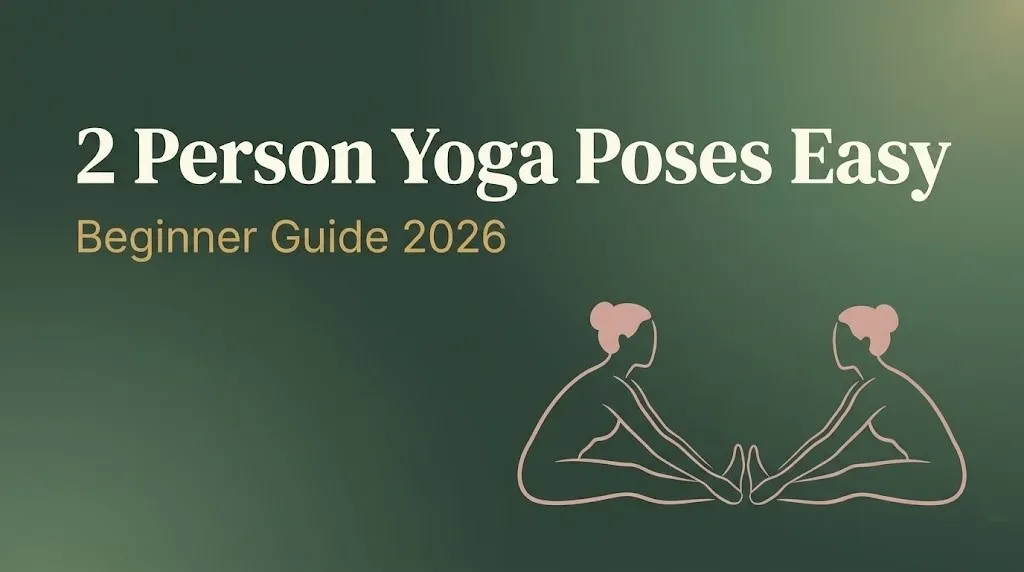
Pose 1: Partner Paschimottanasana (Seated Forward Fold)
To practice Partner Seated Forward Fold:
- Sit facing each other with legs extended straight, feet touching or sole-to-sole.
- Each partner reaches forward and holds the other’s wrists or forearms.
- Person A gently leans back as Person B folds forward, using A’s resistance as an anchor.
- Hold for 4 to 6 breath cycles, approximately 20 to 30 seconds.
- Both inhale together, then Person B eases back upright. Switch roles.
- Release the grip slowly. Never release abruptly when a partner is in a forward fold.
Primary muscles engaged: hamstrings, erector spinae, gastrocnemius (in the folding partner), spinal extensors and posterior shoulder (in the leaning partner).
Modification: If hamstrings are very tight, bend the knees slightly. Loop a yoga strap around both partners’ feet if your arms cannot reach each other’s wrists comfortably.
Pose 2: Partner Balasana (Child’s Pose)
To practice Partner Child’s Pose:
- Person A comes into Balasana, kneeling and folding forward with arms extended.
- Person B stands behind A and gently places their hands on A’s sacrum (the flat triangular bone at the base of the spine).
- B applies gentle, steady downward pressure. No bouncing.
- Hold for 5 to 8 breath cycles, approximately 30 to 40 seconds.
- B slowly releases pressure. A rises on an exhale.
- Switch roles.
Safety note: Person B should never push on the lumbar vertebrae directly. Pressure belongs on the sacrum, not on the lower spinal column.
Simple Partner Yoga Poses for Trust and Communication
Partner yoga works best when both people establish clear communication before, during, and after each pose.
This is not a soft suggestion. Physical contact without ongoing consent creates both discomfort and injury risk. The simplest system is a traffic light: green means more pressure, yellow means hold steady, red means stop immediately and release.
Trust-building poses are specifically designed so that neither partner bears more weight or risk than the other. Back-to-back poses are the gold standard here. Both partners feel the other’s spine, breathing rhythm, and postural shifts without one person being dependent on the other for balance.
Partner Tadasana (Back-to-Back Mountain Pose):
To practice Back-to-Back Mountain:
- Stand back-to-back with your partner. Feet hip-width apart.
- Press your entire spines together, from tailbone to upper back.
- Link arms at the elbows or simply rest your backs against each other.
- Both partners breathe deeply. Notice whether your breath rhythms synchronize naturally.
- Hold for 6 to 10 breath cycles.
This pose requires zero flexibility and is appropriate for literally every body. It is also quietly powerful: most beginners are surprised by how much they learn about their own posture from feeling another spine beside theirs.
Modification for seniors or those with balance concerns: Practice this pose standing near a wall so either partner can reach the wall if needed.
Key Takeaway: Trust and communication are not optional extras in partner yoga. They are the structural foundation that makes the physical practice both safe and effective.
Duo Yoga Poses Easy: Seated and Standing Options
Both seated and standing partner poses offer distinct benefits, and beginners benefit from practicing both categories in the same session.
Seated poses emphasize spinal flexibility, hamstring length, and hip opening. They are the lower-risk category because neither person is managing a balance challenge. Standing poses build balance, leg strength, and the ability to synchronize body weight with another person.
| Category | Best Beginner Pose | Primary Muscles | Hold Time |
|---|---|---|---|
| Seated | Upavistha Konasana (Wide-Angle Forward Fold) | Inner thighs, adductors, spine | 20 to 40 seconds |
| Seated | Paschimottanasana (Seated Forward Fold) | Hamstrings, lower back | 20 to 30 seconds each side |
| Standing | Vrksasana (Partner Tree Pose) | Gluteus medius, hip abductors, core | 20 to 30 seconds per side |
| Standing | Uttanasana (Partner Standing Forward Fold) | Posterior chain, calves | 15 to 25 seconds |
| Transition | Back-to-Back Chair Pose | Quadriceps, glutes, core | 10 to 20 seconds |
Upavistha Konasana (Wide-Angle Seated Forward Fold) partner variation:
To practice Partner Wide-Angle Fold:
- Sit facing each other with legs spread wide in a V shape.
- Touch the soles of your feet together or press the inside of your ankles against each other.
- Reach forward and hold each other’s wrists.
- Person A leans back gently as Person B folds forward from the hips (not the waist).
- Hold for 4 to 6 breath cycles. Switch.
Modification: Anyone with tight inner thighs or a groin strain should reduce the width of their V-stance significantly. Sitting on a folded blanket helps tilt the pelvis forward and makes the fold more accessible.
Easy Couple Yoga Poses for Beginners With No Experience
Complete beginners benefit most from poses that need nothing beyond their own body weight, each other, and a flat surface.
The biggest mistake new couples make is starting too ambitiously. Attempting a flying pose or an acro yoga lift before both people understand each other’s strength and balance creates falls, strained wrists, and one partner ending up on the floor. None of the poses in this section involve lifting.
Partner Baddha Konasana (Bound Angle Pose):
To practice Partner Bound Angle:
- Sit back-to-back with your partner in a cross-legged position.
- Both partners bring the soles of their feet together (butterfly position).
- Press your lower backs and sacrum gently into each other.
- Breathe slowly and feel the gentle spinal support your partner provides.
- Hold for 8 to 10 breath cycles.
Primary muscles: hip adductors, inner groin, pelvic floor, spinal extensors.
This is an ideal first pose because both partners are equally supported and equally active. There is no risk of one person falling into the other.
Modification: Place a folded blanket under both sitting bones if the lower back rounds strongly. For partners with knee pain, support each knee with a rolled blanket instead of letting the knees fall heavily toward the floor.
A 2022 review in Complementary Therapies in Medicine found that breath-synchronized partner movement significantly increased parasympathetic nervous system activity compared to individual yoga practice. Starting with a seated, breath-focused pose primes both partners for more connected movement throughout the session.
Key Takeaway: For absolute beginners, back-to-back seated poses with synchronized breathing are the safest and most effective starting point. Skip the ambitious lifts until you both know how your bodies respond to partner pressure.
Beginner Partner Yoga Poses With Modifications
Every beginner partner yoga pose has at least one modification that makes it accessible regardless of flexibility, age, or injury history.
The modification principle in yoga is not about doing an easier version. It is about finding the version that delivers the intended benefit for your specific body. A wide-stance Upavistha Konasana with a strap is not a lesser pose. It is a correctly calibrated pose.
Here is a practical modifications guide for the most common beginner limitations:
| Limitation | Pose Affected | Modification |
|---|---|---|
| Tight hamstrings | Partner Paschimottanasana | Bend knees, use a strap |
| Lower back pain | All forward folds | Sit on a folded blanket, reduce depth |
| Knee pain | Bound Angle, seated poses | Place blankets under each knee |
| Shoulder tightness | Any grip-based pose | Use a yoga strap between partners |
| Balance difficulty | Partner Tree Pose | Stand near a wall; touch the wall with one hand |
| Wrist pain | Plank-based variations | Skip; substitute seated poses |
| Hip replacement | Wide-angle poses | Keep legs at a narrow angle; no forced external rotation |
A word on hypermobility: People with naturally loose joints, especially the sacroiliac joint, shoulder joint, and knee joint, should be cautious in partner poses where another person applies external pressure. More range of motion is not always better. If a stretch feels painless but extreme, that is not necessarily safe. Yoga teachers and physical therapists generally recommend that hypermobile practitioners engage the muscles around a joint actively rather than passively sinking into a partner-assisted stretch.
Modification for seniors: Any standing partner pose can be practiced while both partners hold the back of a sturdy chair. This eliminates balance risk completely while preserving the shared stretch.
Advanced 2 Person Yoga Poses for When You’re Ready to Progress
Advanced partner yoga poses involve greater balance demands, deeper spinal flexibility, or partial weight-bearing between partners.
These are appropriate only after both people have practiced together consistently for several weeks and have developed reliable communication, baseline strength, and body awareness through easier poses. Attempting advanced partner poses without this foundation is the primary cause of partner yoga injuries.
| Advanced Pose | Sanskrit Name | Primary Challenge | Prerequisite Skill |
|---|---|---|---|
| Double Downward Dog | Adho Mukha Svanasana (stacked) | Shoulder and core strength | Comfortable solo Downward Dog |
| Partner Boat Pose | Navasana | Hip flexor strength, balance | Strong solo Navasana |
| Partner Camel Pose | Ustrasana | Spinal extension, trust | Open thoracic spine, no neck issues |
| Flying Warrior | Virabhadrasana III (supported) | Full body coordination | Strong standing balance |
| Partner Wheel | Urdhva Dhanurasana | Deep spinal extension, shoulder opening | No spinal stenosis or disc issues |
Double Downward Dog is the most commonly practiced intermediate-to-advanced partner pose. Person A comes into Adho Mukha Svanasana (Downward-Facing Dog). Person B places their hands on the mat in front of A, walks their feet up onto A’s lower back (above the sacrum), and presses into their own downward dog shape from this elevated position.
Safety note: Person A must have a strong, stable Downward Dog before any weight is placed on their back. Anyone with wrist injuries, shoulder impingement, or lumbar disc issues should not attempt the base position in Double Downward Dog.
Modification for newer practitioners: Practice the shape with Person B’s feet on the floor beside A, hands on A’s hips for support only. This mimics the stretch without the load.
Partner Yoga for Seniors: Safe and Gentle Options
Partner yoga is particularly well-suited for older adults because another person’s presence provides both physical support and the psychological safety of not practicing alone.
Falls are a primary health concern for adults over 65. The American College of Sports Medicine recommends balance training as a priority intervention for this population. Partner yoga delivers balance work in a lower-risk environment because there is always a second person present to stabilize, catch, or provide a hand-hold.
Research published in the International Journal of Yoga found that older adults who practiced yoga twice weekly for 12 weeks showed measurable improvements in static balance, proprioceptive acuity, and self-reported confidence during daily movement tasks.
Gentle partner poses that work especially well for seniors:
- Back-to-Back Tadasana (Mountain Pose): Both partners stand and breathe together. Develops postural awareness and spinal lengthening with zero balance risk.
- Seated Partner Paschimottanasana with a strap: One partner gently holds the strap’s ends while the other folds. No wrist gripping needed.
- Chair-Supported Partner Vrksasana (Tree Pose): Both partners stand beside a chair. Each lifts one foot to rest on the inner calf of the standing leg. One hand on the chair, inside hands clasped together.
- Partner Balasana (Child’s Pose) with sacral press: As described earlier, this is extremely gentle on the knees and spine when blankets are used.
Modification for osteoporosis: Avoid deep spinal flexion poses (any forward fold that rounds the upper back significantly). Focus on gentle backbends, supported standing poses, and seated hip openers instead.
Key Takeaway: Seniors gain measurable balance and proprioception benefits from partner yoga, and the presence of a second person significantly lowers the psychological and physical risk of falling during balance work.
Easy Group Yoga Poses for Three or More People
Group yoga poses extend the partner concept to three or more people, creating chain stretches, circle formations, and supported balance configurations.
These work particularly well for families, classroom settings, or friend groups. The same communication and consent principles apply, and the same rule about starting with low-risk seated or standing formats holds.
Three-person group poses for beginners:
- Triangle Chain Stretch: Three people stand in a triangle formation, each facing outward. Everyone reaches one arm back to hold the wrist of the person behind them, then folds forward into Uttanasana simultaneously. The triangle provides mutual counterbalance.
- Circle Child’s Pose: Four to six people kneel in a tight circle, all folding forward into Balasana simultaneously. Everyone’s hips rest on their heels. Hands can extend to touch the upper back of the person across from them.
- Group Seated Forward Fold: Three people sit in a line, legs extended. Each person holds the ankles or wrists of the person in front. Person one folds, which draws person two gently, which draws person three. Each person controls their own depth.
Group yoga tip: In a group of three or more, designate one person to lead breath cues. Having one voice counting breaths prevents the coordination confusion of multiple simultaneous instructions.
Modification: Any group pose with wrist-gripping can substitute a yoga strap passed hand-to-hand for participants who have wrist or grip limitations.
How to Stay Safe During Partner Yoga
The foundation of safe partner yoga is verbal communication, matched strength levels, and a clear agreement that either person can pause or stop at any moment without explanation.
The most common partner yoga injuries involve the lower back, wrist, and shoulder joint. These almost always occur when one partner applies pressure too quickly, holds a position while the other person has already tensed up, or attempts a pose beyond both partners’ current strength level.
A study published in the International Journal of Yoga identified that yoga-related injuries most frequently occur at the extremes of range of motion, particularly when external forces (a teacher’s hands, a partner’s weight) push a joint past its comfortable end range. This finding directly applies to partner yoga: the partner is the external force.
Core safety principles for every session:
- Agree on a stop signal before you begin.
- Never force or bounce any stretch. Gradual pressure only.
- Check in verbally at least once per pose: “Is this okay?” or “More or less?”
- Match your session to the less flexible or less strong partner. Their range of motion sets the limit.
- Warm up for at least 5 minutes with solo movement before attempting partner poses.
- If anything produces sharp, stabbing, or joint-specific pain (not the sensation of a stretch), stop immediately.
Who should consult a physical therapist before beginning partner yoga: Anyone with an active herniated disc, a recent surgical recovery, diagnosed osteoporosis, unmanaged rheumatoid arthritis, or a history of joint dislocation should discuss the specific poses with a physical therapist who can review their range of motion and load tolerance before a partner adds any external pressure.
Easy Couples Yoga Warm-Up and Cool-Down Sequence
Every partner yoga session should begin with a 5-minute shared warm-up and end with a 3-minute synchronized cool-down to protect both partners and maximize the benefit of the main poses.
The warm-up prepares the thoracic spine, hamstrings, hip flexors, and shoulder girdle for the demands of partnered movement. The cool-down helps both nervous systems transition out of active effort and into genuine rest.
5-Minute Warm-Up Sequence:
- Stand back-to-back in Partner Tadasana for 10 slow breaths. Feel your spines settle together.
- Both partners roll the shoulders backward three times, then forward three times, staying in contact.
- Both partners take a slow Uttanasana (Standing Forward Fold) independently. Hold 5 breaths.
- Both partners come to seated and hug knees to chest, rocking gently side to side for 30 seconds.
- Come into a simple seated cross-legged position facing each other. Place hands palm-up on your own knees. Breathe together for 5 counts.
3-Minute Cool-Down Sequence:
- Partner Balasana with sacral press: 8 breaths each side.
- Back-to-back Baddha Konasana (Bound Angle Pose): 10 slow breaths.
- Both partners come to lying on their backs, feet together, arms open wide in Shavasana (Corpse Pose). Breathe independently. Let the session settle.
Timing guidance from yoga practitioners and movement specialists: Most yoga teachers recommend holding gentle cool-down poses for 30 to 90 seconds and finishing with at least 2 minutes of Shavasana to allow the nervous system to complete its downregulation response.
Key Takeaway: A proper warm-up and cool-down are not optional extras. They are the structural brackets that protect both partners and make the quality of your main practice significantly better every time.
Frequently Asked Questions About 2 Person Yoga Poses
What are the easiest 2 person yoga poses for complete beginners?
The easiest 2 person yoga poses for beginners are back-to-back seated poses like Partner Baddha Konasana (Bound Angle Pose) and Partner Tadasana (Back-to-Back Mountain Pose).
These require no flexibility, no prior yoga experience, and no lifting or balancing against each other.
Start here for your first two or three sessions before progressing to any forward fold or standing partner pose.
Can you do partner yoga at home with no equipment?
Yes, the large majority of beginner partner yoga poses require only two yoga mats or a clean, non-slip floor.
A folded blanket or firm pillow can substitute for a yoga block in seated poses, and a bathrobe belt can substitute for a yoga strap in forward folds.
The only non-substitutable requirement is a floor clear enough for both partners to lie flat without obstruction.
How long should beginners hold partner yoga poses?
Most beginner partner yoga poses should be held for 4 to 6 breath cycles, which is approximately 20 to 35 seconds for most people.
This is long enough to feel a genuine stretch but short enough that neither partner fatigues or loses form.
Yoga teachers and physical therapists generally recommend not exceeding 60 seconds in any partner pose until both people are consistently comfortable with form and communication.
Is partner yoga safe for people with lower back pain?
Partner yoga can be practiced safely with lower back pain, provided both partners understand which movements to avoid.
Deep forward folds, any pose that rounds the lumbar spine under load, and anything involving a partner pressing on the lower vertebrae directly should be skipped or significantly modified.
Seated poses with a folded blanket under the sitting bones and gentle back-to-back standing poses are generally well-tolerated, but it is worth discussing specific limitations with a physical therapist before beginning if the pain is recurring or severe.
What should you communicate with your partner before trying yoga poses together?
Before beginning any partner yoga session, agree on a verbal stop signal, discuss any current injuries or areas of discomfort, and confirm that either person can pause or exit any pose at any moment.
Discuss your flexibility levels honestly: knowing that one partner has tight hamstrings or a stiff thoracic spine helps you select poses where neither person is strained.
Check in verbally during each pose as well, since comfort levels change as a stretch deepens and what felt fine at 10 seconds may feel too intense at 30.
A Practical Starting Point
Pick one pose from this guide and try it today. Literally just one. Back-to-back Mountain Pose takes under two minutes and requires nothing except the person standing next to you.
Partner yoga does not need to be a formal event. Two people breathing together in a simple seated pose for five minutes still delivers real physiological benefit. Start small, communicate clearly, and let the practice build from there.
If you are practicing with a partner who has any of the physical limitations mentioned in the modifications sections, always adjust to their range. The yoga that works is the yoga both people can do comfortably and consistently.