Partner Yoga Poses: Full Beginner and Couples Guide 2026
The best partner yoga poses work for two people regardless of experience level, and the most effective ones require no acrobatic skill, no prior yoga training, and no specialized equipment. What they do require is clear communication, a willingness to move slowly, and genuine attention to how your partner’s body is responding.
This matters beyond enjoyment. Research published in Frontiers in Psychology found that synchronized physical activity between two people activates social bonding pathways and reduces cortisol levels more effectively than equivalent solo movement. The two-person context is not incidental to the benefit. It is the mechanism.
This guide covers what partner yoga actually is and how it differs from acro yoga, the best poses organized by level, how to breathe and communicate during practice, specific guidance for couples, friends, seniors, and different body types, and a complete beginner sequence you can follow from warmup to cool-down today.
Partner Yoga Poses: What Are They and Where Do You Begin?
Partner yoga poses are yoga postures practiced cooperatively or simultaneously by two people, using shared contact, mirrored movement, or gentle assisted pressure to deepen stretches, build balance, or create physical and psychological attunement.
The beginner entry point is always the floor. Seated back-to-back poses, facing forward folds, and side-by-side standing balances are the foundational tier. None of these require one person to lift, support, or balance the other’s weight. Both practitioners remain independently grounded throughout.
The poses in this guide are drawn from Hatha yoga and Restorative yoga traditions, not from acro yoga or contact gymnastics. That distinction matters enormously for safety and accessibility. If you have never practiced yoga with another person before, the floor-based seated poses in the next sections are the right starting point.
What makes a partner yoga pose appropriate for beginners:
- Both practitioners remain independently supported at all times
- Neither person bears the other’s full body weight
- Either partner can exit the pose independently without warning
- Instructions are clear enough to follow without a teacher present
- The pose has at least one modification for reduced range of motion
What Is Partner Yoga and How Is It Different from Acro Yoga?
Partner yoga is cooperative yoga practiced between two grounded participants using assisted stretches, shared positions, and synchronized breath. Acro yoga is a distinct discipline combining yoga with acrobatics, in which one person (the base) supports another (the flyer) off the ground.
The distinction matters practically. Acro yoga requires specific training for both the base and flyer roles, a spotter for most intermediate and all advanced sequences, and a genuine understanding of weight transfer mechanics. Attempting acro yoga without this foundation creates a real injury risk, particularly to wrists, lower backs, and cervical spines.
Partner yoga, as covered in this guide, keeps both practitioners on the floor or standing independently. No one is lifted. No one serves as a human table or fulcrum. The physical demands are comparable to a gentle Hatha yoga class, adapted for two bodies.
| Feature | Partner Yoga | Acro Yoga |
|---|---|---|
| Both partners grounded | Yes, always | No, flyer is lifted |
| Experience required | None for beginners | Moderate to extensive |
| Spotter needed | No | Yes, for intermediate and above |
| Weight-bearing by one partner | No | Yes, by the base |
| Appropriate for beginners | Yes | Only for very basic poses |
| Primary yoga tradition | Hatha, Restorative | Vinyasa, acrobatics blend |
| Injury risk for beginners | Low | Moderate to high without training |
If a pose requires one person to stand on or be lifted by the other, it is acro yoga regardless of what it is called online. This guide does not cover those poses.
Partner Yoga Benefits: What the Research Actually Shows
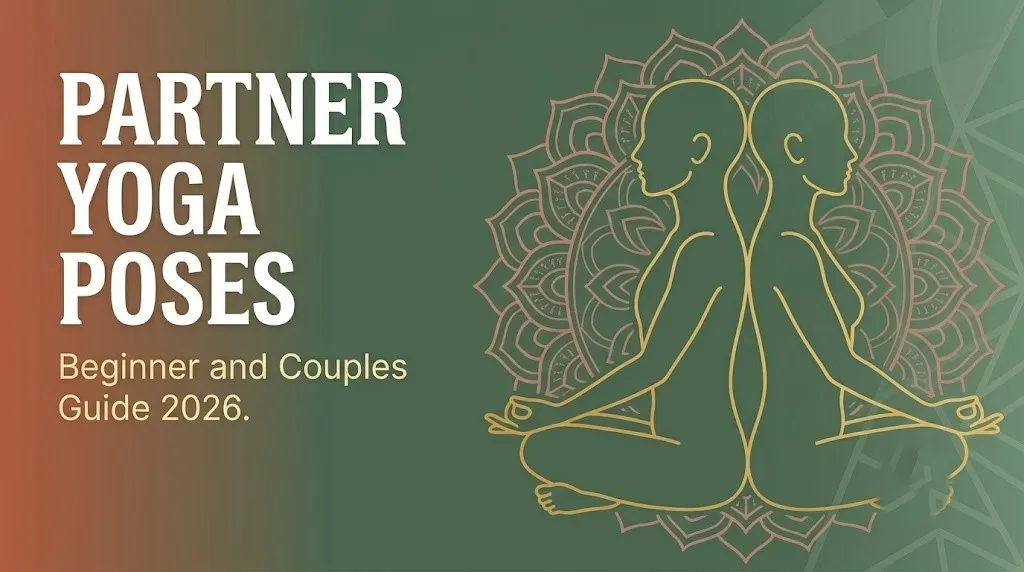
Partner yoga produces documented physical and psychological benefits that differ meaningfully from solo yoga practice, particularly in stress reduction, flexibility gains, and social bonding.
According to the National Center for Complementary and Integrative Health, yoga is associated with reduced anxiety, improved sleep quality, and lower inflammatory markers across multiple study populations. Partner yoga adds a social layer that amplifies several of these effects. The research on shared movement specifically shows outcomes that solo practice does not reliably replicate.
A study published in the Journal of Alternative and Complementary Medicine found that partner-assisted stretching produces greater hamstring and hip flexor range of motion gains than self-directed stretching, with the effect attributable to the sustained, calibrated pressure a partner can apply that the practitioner cannot reproduce independently.
Documented benefits of regular partner yoga practice:
- Greater flexibility gains in the hamstrings and hip flexors compared to solo stretching
- Reduced cortisol levels through synchronized breath and physical co-regulation
- Improved proprioception and postural awareness through back-to-back contact poses
- Higher long-term practice adherence: the American College of Sports Medicine notes that social exercise contexts consistently improve participation rates
- Increased relationship satisfaction in couples who engage in coordinated physical activity together, documented in Frontiers in Psychology
- Measurable reduction in perceived exertion during equivalent physical demands in a social versus solo context
Key Takeaway: Partner yoga is not just more enjoyable than solo practice. It is physiologically more effective for flexibility and measurably better for stress regulation, which gives it genuine clinical value beyond the feel-good factor.
Beginner Partner Yoga Poses to Start With
The best beginner partner yoga poses are back-to-back Sukhasana (Easy Pose) with synchronized breath, seated facing Dandasana (Staff Pose) with a gentle wrist hold, and side-by-side Vrksasana (Tree Pose) with joined inner hands.
These three poses cover the fundamental partner yoga skill set: back-to-back proprioceptive contact, front-facing cooperative stretch, and side-by-side shared balance. Together they form a complete introduction to how two bodies interact in a yoga context without requiring any prior experience from either person.
The word “easy” here requires a genuine qualifier. Ease is body-dependent. A person with very tight hamstrings will find the seated facing position demanding even before any partner assist is applied. Both practitioners should move to their own edge and communicate clearly before any deepening occurs.
Why these three poses work as a beginner foundation:
- Back-to-back Sukhasana: both partners remain fully independent. Contact is light and mutual.
- Seated Dandasana with wrist hold: cooperative rather than one-directional. Neither partner dominates.
- Side-by-side Vrksasana: shared balance point without weight transfer. Each person remains self-supporting.
Modification for beginners with limited floor mobility: All three of these poses have chair-based equivalents. Back-to-back breathing works in two chairs. Seated wrist hold works with both partners in chairs facing each other. Tree Pose becomes a near-wall leg lift with hands joined.
Seated Partner Yoga Poses with Step-by-Step Instructions
Seated partner yoga poses form the most accessible foundation of any partner practice because both bodies remain on the floor throughout, eliminating balance and weight-bearing demands entirely.
Back-to-Back Sukhasana (Easy Pose) with Synchronized Breath:
To practice back-to-back Sukhasana:
- Both partners sit cross-legged on the floor, facing opposite directions.
- Bring your backs together gently. Let the contact be light, like two people sharing a park bench.
- Both partners sit tall, feeling where the spines meet.
- Inhale together for 4 counts. Feel the backs expand against each other.
- Exhale together for 6 counts. Let the spines settle on the exhale.
- Hold for 8 to 10 synchronized breath cycles, roughly 60 to 90 seconds.
- Release by both partners leaning forward simultaneously on the same exhale.
Modification: If sitting cross-legged is uncomfortable, both partners sit with legs extended or one knee bent. Place a folded blanket under each hip to tilt the pelvis forward.
Assisted Paschimottanasana (Seated Forward Fold), facing each other:
To practice facing seated Paschimottanasana:
- Both partners sit facing each other with legs extended forward.
- Flex feet toward each other. Inner ankles may touch if leg lengths allow.
- Each partner reaches forward and holds the other’s wrists or forearms.
- Partner A sits tall on an inhale. Partner B leans gently back on the same inhale, creating a light forward assist for Partner A.
- Hold the assist for 3 to 5 breaths, maintaining steady, gentle traction. No bouncing.
- On an exhale, both return to neutral. Switch roles.
Safety caution: The assisting partner applies only the pressure the receiving partner actively invites. The receiving partner controls all depth.
Modification: Both partners bend their knees slightly if hamstrings prevent a neutral pelvis in the starting position. A yoga strap held between partners instead of a wrist hold accommodates height differences.
Standing Partner Yoga Poses for Balance and Strength
Standing partner yoga poses introduce a balance dimension to the practice and, when done correctly, each partner remains independently stable rather than relying entirely on the other person.
Side-by-Side Vrksasana (Tree Pose):
To practice side-by-side Vrksasana:
- Stand side by side, inner shoulders approximately 6 inches apart.
- Join inner hands at hip height, palms pressed or fingers interlaced.
- Both partners shift weight onto the inner foot simultaneously.
- Each lifts the outer foot and places it on the inner calf or inner thigh, never directly on the knee joint.
- Find a fixed gaze point at eye level. Hold for 5 to 8 breaths.
- Lower the foot together on the same exhale. Turn around and switch sides.
Back-to-Back Utkatasana (Chair Pose):
To practice back-to-back Utkatasana:
- Stand back-to-back, bodies lightly touching from shoulders to lower back.
- Both partners walk feet forward simultaneously, approximately 12 to 18 inches.
- Bend knees slowly together, leaning lightly into each other’s backs as you descend.
- Stop when thighs approach parallel to the floor or wherever is stable for both partners.
- Hold for 5 breaths. Press into each other and rise together on a shared inhale.
Modification: Stop the descent at a 30 to 45 degree knee angle if either partner has knee discomfort. The quadriceps engage at any angle of knee flexion; full descent is not required for benefit.
Safety caution: Neither partner should lean their full body weight into the other. The contact is a shared reference point, not a support structure.
Key Takeaway: In both standing poses, each partner maintains their own structural integrity throughout. The connection is a shared anchor point, not a crutch, and that distinction is what keeps the practice safe.
Intermediate Partner Yoga Poses for Growing Practitioners
Intermediate partner yoga poses involve a deeper range of motion, slightly longer hold times, or more precise alignment requirements than beginner poses, but they remain fully grounded with both practitioners on the floor or independently standing.
Mirrored Virabhadrasana II (Warrior II), facing each other:
To practice mirrored Virabhadrasana II:
- Both partners stand facing each other, approximately 3 to 4 feet apart.
- Both step the right foot forward and the left foot back simultaneously, mirroring each other.
- Bend the front knee to approximately 90 degrees. Front knee tracks over the second toe.
- Extend arms wide in opposite directions. Gaze turns over the front hand.
- Partners may touch fingertips or palms at shoulder height across the space between them.
- Hold for 5 to 8 breaths. Return to standing together. Switch sides.
Parivrtta Sukhasana (Seated Spinal Twist), mirrored opposite directions:
To practice mirrored seated twists:
- Both partners sit cross-legged facing the same direction, side by side.
- Partner A twists to the right. Partner B twists to the left, creating a mirrored shape.
- Each partner’s outer hand rests on the other’s knee for a gentle shared assist.
- Inhale to lengthen the spine. Exhale to deepen the twist.
- Hold for 5 breaths. Unwind on an inhale together. Switch twist directions.
The thoracic spine is the primary mobility target in the seated twist. The erector spinae and obliques engage to create and control the rotation.
Modification: If sitting cross-legged is uncomfortable, both partners sit with legs extended or in chairs. The same twist applies from any seated position.
Partner Yoga Breathing and Communication Techniques
Synchronized breathing is the most effective partner yoga technique for activating the parasympathetic nervous system in both practitioners simultaneously, and it is also the most consistently skipped element in beginner partner yoga practice.
The physiology is straightforward. An extended exhale stimulates the vagus nerve, the primary parasympathetic pathway, and slows the heart rate measurably within 3 to 5 breath cycles. When two people breathe together at the same rate and ratio, their autonomic nervous systems begin to co-regulate, each influencing the other’s stress-response state in a positive direction. Research published in Complementary Therapies in Medicine documented this co-regulation effect in paired relaxation contexts.
The most practical breath pattern for partner yoga is 4-6 breathing: inhale for 4 counts together, exhale for 6 counts together. Start back-to-back in Sukhasana (Easy Pose) where each partner can feel the other’s breath movement before any pose instruction begins.
Communication during poses is equally technical, not just social. Before the first pose, both partners should agree on three things:
- A verbal stop signal: “ease” or “stop” are the most direct choices
- A check-in question: “how is this?” to be used freely by either partner at any point
- A principle: the receiving partner always controls depth, never the assisting partner
Common communication failures in beginner partner yoga:
- Applying pressure without asking first
- Deepening a stretch silently without a verbal check-in
- Tolerating discomfort without signaling to the partner
- Assuming the partner is comfortable because they have not said anything
- Releasing or adjusting a position without warning the other person
Partner Yoga for Couples: Building Trust Through Movement
Partner yoga for couples produces measurably different outcomes than general exercise together because the physical practice requires coordinated vulnerability, active listening through touch, and mutual attention to the other person’s body.
Research in Frontiers in Psychology found that couples who engaged in novel coordinated physical activities reported higher relationship satisfaction immediately after the activity and sustained those improvements over a two-week follow-up period. The novelty factor mattered: familiar activities produced smaller effects. Partner yoga, for most couples, qualifies as a novel physical experience.
The poses that work best for couples new to partner yoga are not the most visually impressive ones. They are the ones that require the most attention between partners. The back-to-back breath synchronization requires genuine listening to the other person’s rhythm. The facing seated forward fold requires one partner to be vulnerable in a stretch while trusting the other to apply gentle pressure rather than force.
Think of partner yoga like a conversation where both people have to listen at the same time to respond well. The physical feedback loop, where you can feel your partner’s breath against your back or feel the resistance in their hamstrings as you hold their wrists, creates a kind of attentiveness that talking side by side does not.
Poses that build couples-specific trust and attunement:
- Back-to-back Sukhasana with 4-6 synchronized breath: establishes shared rhythm before movement
- Facing Paschimottanasana (Seated Forward Fold) with wrist hold: mutual vulnerability and calibrated touch
- Back-to-back Utkatasana (Chair Pose): shared physical effort with a clear common goal
- Savasana (Corpse Pose), side by side with light hand contact: intentional shared stillness
Key Takeaway: The most trust-building partner yoga poses are not the most difficult. They are the ones that require the most careful attention to another person’s body, breath, and signals.
Partner Yoga Poses for Friends and Non-Romantic Pairs
Partner yoga works just as effectively for close friends as it does for couples, and in some respects the non-romantic context makes it easier because social self-consciousness about physical proximity is often lower between established friends.
The American College of Sports Medicine notes that having a consistent exercise partner is one of the most effective behavioral strategies for long-term physical activity adherence. Friends who practice yoga together are more likely to continue practicing than individuals who practice alone or with a rotating group. The specific partner relationship matters less than the consistency and mutual commitment.
For friend pairs, the most comfortable starting point is the mirrored movement approach, where both practitioners do the same pose on their own mats facing each other, without physical contact. This is genuinely useful partner yoga because the visual mirroring creates accountability, shared timing, and the social motivation benefit without any of the physical contact complexity.
From there, the progression to back-to-back contact and then to hand-contact poses follows naturally as both friends develop comfort and trust in the practice context.
A practical progression for friend pairs new to partner yoga:
- Week 1: Mirrored solo poses facing each other. No contact. Build timing synchronization.
- Week 2: Add back-to-back Sukhasana breathing. Light contact only.
- Week 3: Add side-by-side Vrksasana (Tree Pose) with joined inner hands.
- Week 4: Add the seated facing forward fold with wrist hold. Use a yoga strap if needed.
Modification: If either friend is uncomfortable with any level of physical contact, stay in the mirrored movement approach indefinitely. The synchronization and social presence benefits still apply.
Partner Yoga for Seniors: Chair-Based and Supported Variations
Partner yoga for seniors is fully achievable and genuinely beneficial when every pose is adapted to eliminate floor-to-standing transitions, minimize joint loading, and ensure both practitioners remain stably supported throughout.
The primary adaptation is chair-based practice. All the foundational partner yoga poses have chair equivalents that preserve the physiological and relational benefits without requiring practitioners to lower to or rise from the floor. According to a study published in the International Journal of Yoga, chair-based yoga produced measurable improvements in balance, lower limb strength, and wellbeing in older adults over an eight-week period without adverse events.
Chair-adapted partner yoga poses for seniors:
- Back-to-back chair breathing: two chairs placed back-to-back. Both partners sit upright with spines lightly touching. Synchronized 4-6 breath for 2 to 3 minutes.
- Seated facing wrist hold: both partners in chairs facing each other. Each holds the other’s forearms. One partner gently leans back while the other receives a forward-lean assist.
- Seated lateral stretch: both partners seated side by side. Inner hands joined. Outer arms reach up and to the opposite side. Hold 5 breaths each side.
- Near-wall standing leg lift: both standing near a wall, one hand on the wall, inner hands joined. One foot lifts to calf height. Hold 5 breaths each side.
Safety note for seniors: A certified yoga teacher with training in senior or therapeutic yoga can assess which modifications are appropriate for specific conditions. Practitioners managing osteoporosis, recent hip replacement, or balance disorders should seek this guidance before beginning any standing partner pose, even in the modified form.
Partner Yoga Modifications for Different Body Types and Sizes
Partner yoga is effective across different body sizes, heights, and fitness levels when both partners understand that the goal is sensation and shared movement, not geometric symmetry.
Height differences create the most practical challenge in the wrist-hold forward fold. If one partner is significantly taller, the pulling angle becomes asymmetrical and can create lateral lumbar strain in the shorter partner. The fix is simple and effective: use a yoga strap held between both partners instead of a direct wrist grip. Each partner holds one end of the strap, allowing both to adjust their hand position to a comfortable angle regardless of height.
Weight differences matter most in back-to-back poses. The contact between backs is meant to be mutual, light, and information-giving rather than structural support. A heavier or larger partner should maintain their own upright posture independently rather than leaning into the smaller person. Both partners are using the contact as proprioceptive feedback, not as a support system.
Flexibility differences are the easiest variable to accommodate. The rule is universal: the less flexible partner sets the depth of every pose. The more flexible partner reduces their own range of motion to match. There is no benefit to the more flexible partner going deeper while their partner is already at their edge.
| Body Type Difference | Common Challenge | Solution |
|---|---|---|
| Height difference | Asymmetric angle in wrist-hold poses | Use a yoga strap between partners |
| Weight difference | Uneven pressure in back-to-back poses | Both maintain independent upright posture |
| Flexibility difference | One partner pushed past their edge | Less flexible partner always sets the depth |
| Strength difference | Unstable standing poses | Stronger partner widens stance for stability |
| Joint pain in one partner | Discomfort in specific pose positions | Mirrored movement only, no contact at affected joint |
Key Takeaway: The less flexible, smaller, or more mobility-limited partner always sets the depth and pace of every partner yoga pose. Adapting downward to match your partner is the most important practical skill in this practice.
Partner Yoga Props: What Helps and What You Can Skip
The only equipment genuinely needed for beginner partner yoga is two yoga mats, one or two folded blankets per person, and a clear floor space of approximately 6 by 10 feet.
Mats serve two purposes: cushioning and spatial clarity. Each mat defines one practitioner’s space, which helps both people feel grounded and centered rather than sharing a single ambiguous surface. A carpeted floor is a workable substitute for mats in most beginner poses.
Folded blankets are the single most useful prop in partner yoga. Placing a folded blanket under the hips in seated poses like Dandasana (Staff Pose) tilts the pelvis forward and allows the spine to lengthen naturally when hamstring tightness would otherwise cause the lumbar spine to round under load. One blanket changes the entire experience of seated forward fold work for practitioners with tight hamstrings.
| Prop | Purpose in Partner Yoga | Household Substitute |
|---|---|---|
| Yoga mat (2) | Floor cushioning and personal space boundary | Exercise mat or carpet |
| Folded blanket (1-2 per person) | Hip elevation in seated poses, knee support | Firm folded towel or blanket |
| Yoga strap (1) | Bridging height difference in forward fold assists | Belt, bathrobe tie, or scarf |
| Wall | Balance support in standing variations | Any solid wall surface |
| Two chairs | Full chair-based adaptation for seniors | Any stable non-wheeled chair |
You do not need bolsters, blocks, or eye pillows for the poses in this guide. Those props add value in solo Restorative yoga contexts but are not required for partner yoga at the beginner or intermediate level.
Partner Yoga for Tight Hips and Lower Back Relief
Partner yoga produces some of its most measurable physical benefits in the hips and lower back, because a partner can apply sustained passive pressure that produces connective tissue release beyond what gravity and solo effort achieve.
The hip flexors and hip external rotators respond to sustained passive load held for 2 to 5 minutes. This is the principle underlying both Yin yoga and Restorative yoga: time under gentle tension changes tissue length more effectively than repetitive short-duration stretches. A partner provides the additional element of calibrated, sustained pressure that most practitioners cannot accurately apply to themselves.
The partner-assisted version of Baddha Konasana (Bound Angle Pose) is the most direct partner yoga approach to hip external rotator release. The receiving partner sits with the soles of the feet together and knees falling to the sides. The assisting partner rests their hands gently on the receiving partner’s outer thighs, applying only the weight of the hands, no pushing. This light proprioceptive contact helps the piriformis and gluteus medius release more completely than in solo practice.
For lower back relief, the back-to-back lateral stretch in Sukhasana (Easy Pose) decompresses the lumbar spine laterally. The mirrored Supta Matsyendrasana (Reclined Spinal Twist) on individual mats releases the thoracolumbar fascia without any partner-applied pressure.
Safety caution: If either partner experiences sharp, electric, or radiating pain during any hip or back pose, return to a neutral position immediately. Radiating sensations down the leg during any forward fold or twist may indicate nerve involvement, and a physical therapist should assess the cause before continuing.
Modification: In the partner-assisted Baddha Konasana, place a folded blanket under each knee if the inner groin creates sharp pulling. The goal is a mild, fading sensation, not acute discomfort.
Partner Yoga Safety: Poses to Approach Carefully and Conditions to Consider
Partner yoga safety depends on four non-negotiable principles: clear pre-practice communication, gradual depth progression, mutual consent before any physical contact, and specific awareness of which health conditions change what poses are appropriate.
The most common beginner partner yoga injuries are hamstring strains from sudden partner pressure in forward folds and lumbar strains from uncontrolled leaning in back-to-back poses. Both are entirely preventable when the receiving partner controls depth and the assisting partner applies only sustained, gentle, invited pressure.
Pre-practice safety checklist (complete together before the first pose):
- Both partners name any current injuries, areas of acute pain, or surgical history relevant to movement.
- Agree on a verbal stop signal and commit to using it without hesitation.
- Confirm: no sudden pressure, no bouncing stretches, no deepening without a verbal check-in.
- Agree to return to neutral together before making any position adjustment.
- Confirm that the receiving partner controls all depth in every assisted pose.
Conditions that change which partner yoga poses are appropriate:
- Active lumbar disc herniation: skip all forward folds with partner pressure at the back. Use mirrored movement only.
- Acute knee injury or recent knee surgery: skip Utkatasana (Chair Pose) and Vrksasana (Tree Pose) on the affected side.
- Shoulder impingement: modify all poses with the arm raised above shoulder height. Skip the extended arm variation of Virabhadrasana II (Warrior II).
- Second or third trimester pregnancy: avoid sustained supine positions. Avoid forward compression of the abdomen. Use elevated upper body positions in all floor poses.
- Osteoporosis: avoid partner-applied pressure to the spine. Focus on mirrored movement and back-to-back breathing only.
- Hypermobility: the hypermobile partner should never be assisted to the end of their range. Stop well before the point of full extension in any joint.
A Simple Partner Yoga Sequence from Warm-Up to Cool-Down
A complete beginner partner yoga sequence runs 25 to 30 minutes and moves systematically from floor-based poses through one standing section and back to the floor for a shared rest.
The Full Beginner Partner Yoga Sequence:
- Back-to-back Sukhasana (Easy Pose) breathing: 3 minutes. Synchronized 4-6 breath. Both partners sit cross-legged, backs touching lightly. This is the warm-up for the nervous system, not just the body.
- Facing Dandasana (Staff Pose) with wrist hold and gentle assist: 90 seconds each direction. One partner sits tall while the other leans gently back. Switch roles. Use a yoga strap if there is a significant height difference.
- Baddha Konasana (Bound Angle Pose) facing each other: 3 minutes. Soles of feet touching or near each other. Partner holds the other’s hands across the space between them. No pressure applied.
- Back-to-back lateral stretch in Sukhasana: 5 breaths each side. Both lean in opposite directions simultaneously, opening the side body against the other’s back.
- Mirrored Parivrtta Sukhasana (Seated Spinal Twist): 5 breaths each direction. Both twist in opposite directions. Outer hands rest lightly on the other’s knee. Inhale to lengthen, exhale to rotate.
- Side-by-side Vrksasana (Tree Pose): 5 breaths each side. Inner hands joined. Each lifts the outer foot. Gaze at a fixed point. Lower together.
- Back-to-back Utkatasana (Chair Pose): 5 breaths. Walk feet forward together. Descend slowly. Rise on a shared inhale.
- Mirrored Supta Matsyendrasana (Reclined Spinal Twist): 90 seconds each side. Both on their own mats. Mirror each other’s twist. No partner contact needed. Simply move in the same rhythm.
- Savasana (Corpse Pose), side by side: 5 to 7 minutes. Optional: pinky fingers touching lightly. Breathe naturally. Let the nervous systems settle together.
Modification: Steps 6 and 7 can be skipped entirely if either partner is not comfortable with standing poses. Move directly from step 5 to step 8 for a fully floor-based session.
Key Takeaway: Starting and ending every partner yoga session with synchronized breathing in Sukhasana (Easy Pose) is the single most reliable way to create the co-regulation effect that makes partner yoga neurologically distinct from solo practice.
Frequently Asked Questions About Partner Yoga Poses
What are the easiest partner yoga poses for complete beginners?
Back-to-back Sukhasana (Easy Pose) with synchronized breath is the easiest entry point for two people with no yoga experience.
The facing seated Dandasana (Staff Pose) with a wrist hold and side-by-side Vrksasana (Tree Pose) are the next two poses to add once back-to-back breathing feels comfortable.
All three require no prior yoga training, keep both practitioners on the floor or standing independently, and have clear modifications for limited flexibility.
What is the difference between partner yoga and acro yoga?
Partner yoga keeps both practitioners grounded throughout, using assisted stretches, mirrored movement, and shared positions without weight transfer.
Acro yoga involves one person (the base) supporting another (the flyer) off the ground, requiring specific training, spotter support, and a clear understanding of weight-bearing mechanics.
Beginners should start with partner yoga only. Acro yoga without proper instruction carries a real risk of wrist, lower back, and neck injury.
How do you breathe together in partner yoga?
The most effective technique is 4-6 synchronized breathing: both partners inhale for 4 counts together and exhale for 6 counts together.
Starting in back-to-back Sukhasana lets each partner feel the other’s breath movement before adding any pose instruction, making synchronization easier and more intuitive.
Extended exhales stimulate the vagus nerve and activate the parasympathetic nervous system in both practitioners simultaneously, which is the primary mechanism behind partner yoga’s stress-reduction effect.
Can two people with very different body sizes do partner yoga?
Yes. Partner yoga is fully workable across different heights, weights, and body proportions when specific modifications are applied.
Use a yoga strap instead of a direct wrist hold in forward fold assists when there is a height difference. In back-to-back poses, the larger partner maintains their own upright posture independently rather than leaning into the smaller person.
The less flexible, smaller, or more mobility-limited partner always sets the depth and pace of every pose.
How often should you practice partner yoga to see benefits?
Research on yoga practice adherence and flexibility gains generally supports two to three sessions per week for measurable physical change over a four to eight week period.
For partner yoga specifically, even one session per week produces the social co-regulation and bonding effects documented in paired movement research, as long as the practice is consistent.
Starting with one 25-minute session per week and building from there is more sustainable than beginning with an ambitious schedule that is hard to maintain.
Start today with just the back-to-back breathing exercise. Sit with your partner, backs lightly touching, and breathe together for ten synchronized breath cycles. That takes less than two minutes and already activates the co-regulation effect that makes partner yoga distinct from solo practice.
From there, add one pose per session. The seated forward fold this week. Tree Pose next time. The sequence builds itself as comfort and communication develop between you.
The breath between two people is where partner yoga actually begins.