Love Story Yoga: Partner Poses, Benefits and How to Start
Love story yoga is a practice built around two people sharing a mat: moving together, breathing together, and supporting each other through poses neither could do as effectively alone. Whether you call it partner yoga, couples yoga, or love story yoga, the format uses physical proximity, synchronized breath, and cooperative movement to build both physical fitness and interpersonal connection.
The interest in shared yoga practice has grown steadily. Research published in the Journal of Alternative and Complementary Medicine found that partner-based mindfulness activities, including shared movement practices, were associated with reduced anxiety and improved relationship satisfaction in adult couples. That is not a small finding for a practice that costs nothing more than two yoga mats and a bit of floor space.
This guide covers what love story yoga actually involves, how it differs from acro yoga, which poses work best for beginners and seniors, what the research says about shared movement and emotional health, and how to build a consistent practice together at home.
What Is Love Story Yoga?
Love story yoga is a general term for any yoga practice designed to be shared between two people, emphasizing cooperation, synchronized breathing, and physical support between partners.
The phrase “love story yoga” is used both by specific studios that brand their partner classes under that name and more broadly by practitioners who describe the experience of deepening a relationship through shared yoga practice. At its core, it refers to the same thing as partner yoga or couples yoga: a format where two people work together in poses rather than practicing side by side independently.
Unlike traditional solo yoga, where your relationship is between you and the mat, love story yoga asks you to maintain awareness of another person simultaneously. Your alignment affects theirs. Their breath influences yours. That mutual awareness is both the challenge and the point.
Love story yoga is distinct from solo yoga in several important ways:
- Partners provide counterbalance in seated and standing poses, allowing deeper range of motion
- Synchronized breathing creates a co-regulation effect between nervous systems
- Physical touch and cooperative effort introduce trust as a practice element
- The social accountability of a partner tends to increase consistency and motivation
This format works for romantic couples, close friends, parent-and-adult-child pairs, or any two people who trust each other enough to share physical space and adjust poses together.
Partner Yoga vs Acro Yoga: What Is the Difference?
Partner yoga and acro yoga both involve two people, but the physical demands, skill requirements, and goals of each practice differ substantially.
Partner yoga is accessible to most adults regardless of fitness level. Poses remain close to the ground, and both partners stay supported by the floor at all times. The focus is on cooperation, counterbalancing weight, and mutual deepening of stretches. Think of two people sitting back-to-back in a seated twist, each using the other’s resistance to rotate further than they could alone.
Acro yoga combines yoga and acrobatics. One partner (the base) supports the other (the flyer) off the ground using their hands and feet. This requires upper body strength, core stability, balance, and significant practice time before it becomes safe. A third person, called a spotter, is standard in acro yoga training.
| Feature | Partner Yoga | Acro Yoga |
|---|---|---|
| Ground contact | Both partners always grounded | Flyer leaves the ground |
| Skill required | Beginner-accessible | Intermediate to advanced |
| Strength needed | Moderate | High (base and flyer) |
| Spotter needed | No | Yes, during learning phase |
| Primary benefit | Flexibility, connection, breath | Strength, balance, trust |
| Injury risk | Low to moderate | Moderate to high |
| Best for | Couples, beginners, seniors | Athletes, trained practitioners |
Love story yoga as a concept aligns much more closely with partner yoga than with acro yoga. If you are starting out, stay grounded.
Benefits of Yoga for Couples
Practicing yoga together as a couple produces benefits that go beyond what either person gains from solo practice, particularly in the areas of emotional attunement, stress management, and physical fitness.
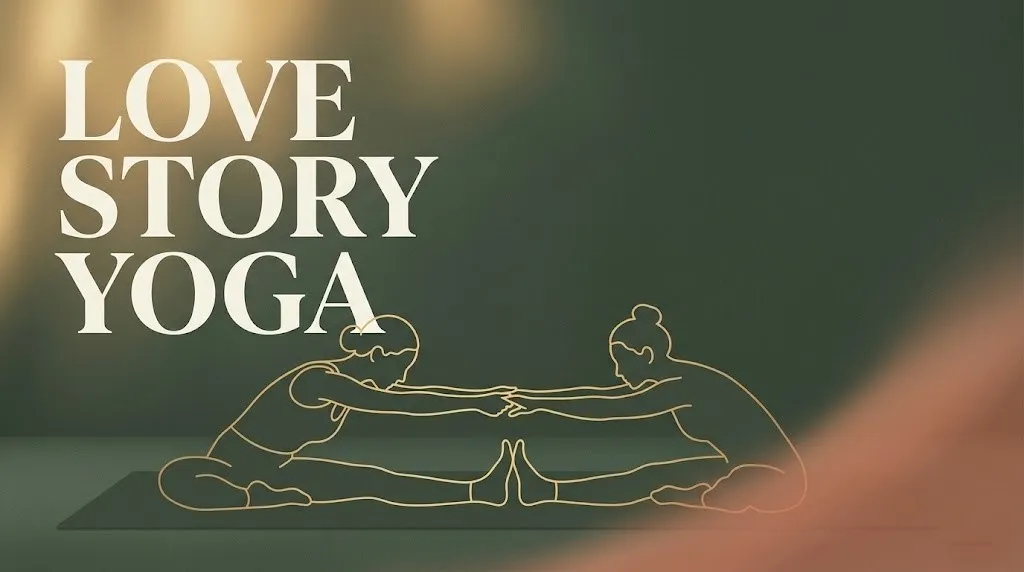
On the physical side, partner yoga allows deeper stretching through cooperative counterbalance. When two people sit facing each other, hold hands, and gently pull back against each other’s weight in Paschimottanasana (Seated Forward Bend), both partners access more length in their hamstrings and spinal extensors than they typically reach in the solo version.
Research-supported benefits of couples yoga practice include:
- Reduced cortisol levels after shared yoga sessions, as noted in studies reviewed by the NCCIH
- Improved perceived relationship quality and closeness in couples who practice mindfulness-based activities together
- Enhanced body awareness and proprioception from working cooperatively with another person’s weight and movement
- Greater practice consistency, since having a partner creates accountability that solo practitioners often lack
- Improved communication skills developed through the non-verbal negotiation required in partner poses
- Physical fitness gains from the added resistance and support that a partner provides
The social element matters more than most yoga marketing acknowledges. According to the American Psychological Association, activities that involve physical touch and shared attention consistently show positive effects on bonding and feelings of closeness between partners.
Key Takeaway: The research on shared yoga practice points to benefits well beyond flexibility. The nervous system regulation, emotional attunement, and accountability effects of practicing together are what make love story yoga genuinely different from two people doing yoga in the same room.
Yoga and Emotional Connection: What the Research Says
Shared physical activity, including yoga, activates specific neurological and hormonal mechanisms that strengthen emotional bonds between two people.
Physical touch during cooperative movement stimulates oxytocin release, often called the “bonding hormone.” Research published in Frontiers in Psychology found that synchronized movement between two people, including synchronized breathing and matched physical effort, increased feelings of closeness and trust, even between strangers. Between established partners, the effect is likely amplified by existing attachment patterns.
The parasympathetic nervous system response plays a central role here. When two people breathe together rhythmically, their heart rate variability patterns tend to synchronize, a phenomenon researchers call physiological co-regulation. The NCCIH notes that yoga’s breathwork component is one of its most documented mechanisms for activating the parasympathetic nervous system, shifting the body out of fight-or-flight states.
What this means practically:
- Ending a stressful week with a 30-minute partner yoga session can shift both people’s nervous systems from arousal states to calmer, more receptive ones
- The non-verbal communication required in partner poses builds attunement: the ability to read another person’s physical cues without words
- Regular shared practice creates what therapists sometimes call a “positive shared experience bank,” which is protective against relationship stress
This is not abstract wellness language. These are documented neurological and psychological processes that shared, mindful movement consistently activates.
Best Partner Yoga Poses for Beginners
The best starting points for partner yoga are grounded, stable poses that require minimal strength but produce clear, immediate benefits for both participants.
Beginners often overthink this. You do not need flexibility, athleticism, or prior yoga experience. You need patience, the willingness to communicate, and two people who are comfortable in each other’s physical space.
Top beginner-friendly partner yoga poses:
- Back-to-Back Breathing in Sukhasana (Easy Seat): Both partners sit cross-legged, back-to-back, spines touching. Breathe together for 5 to 10 slow cycles. Feel the other person’s breath through your back. This is the most accessible starting point in all of partner yoga.
- Partner Paschimottanasana (Seated Forward Bend): Sit facing each other, legs extended, feet touching. Reach for each other’s wrists or forearms. One partner gently leans back while the other folds forward. Hold for 5 to 8 breaths and switch.
- Partner Upavistha Konasana (Wide-Angle Seated Forward Bend): Sit facing each other, legs spread wide, soles touching. Hold each other’s wrists. One partner folds forward while the other leans back slightly, providing gentle traction. Switch after 5 breaths.
- **Double *Adho Mukha Svanasana*** (Downward-Facing Dog): One partner comes into standard Downward Dog. The second partner places their hands on the floor just in front of the first partner’s hands, then walks their feet up to rest on the first partner’s lower back. This variation requires the base partner to have solid Downward Dog form first.
- **Partner *Virabhadrasana II*** (Warrior II): Stand side by side, touching at the inner shoulders. Both come into Warrior II facing opposite directions. Use each other’s presence for balance and alignment feedback.
Modification for beginners: In partner Paschimottanasana, keep both knees generously bent to protect the lower back. The goal is length, not depth.
Key Takeaway: Start with seated, grounded poses where both partners are fully supported. The back-to-back breathing exercise alone, done for five minutes, is a more effective introduction to love story yoga than any ambitious pose.
How to Start a Couples Yoga Practice at Home
Starting a home couples yoga practice requires less setup than most people expect and more honest communication than most people anticipate.
The physical setup is simple. Two yoga mats placed side by side or facing each other on a clean, firm floor surface. A bolster, two yoga blocks, and a yoga strap between you covers most prop needs. You do not need a large room. A cleared living room floor of roughly 8 by 10 feet accommodates most partner yoga poses comfortably.
The communication setup matters more. Before you begin your first session, agree on a few practical things:
- A signal for “stop” or “ease up” that is faster than a sentence (many partners use a simple tap or squeeze)
- Who leads the session, at least to start, to avoid decision paralysis mid-practice
- A shared time commitment: 20 to 30 minutes three times per week is a reasonable starting point for beginners
A simple structure for your first home session:
- Sit back-to-back for 5 minutes of synchronized breathing
- Move through 2 to 3 grounded partner stretches, holding each for 5 to 8 breaths per side
- Close with 3 to 5 minutes of lying side by side in Savasana (Corpse Pose), hands touching
Resist the urge to watch tutorial videos during your first sessions. Learn a small number of poses well before adding more. Consistency over novelty builds the practice.
Step-by-Step Partner Yoga Sequence for Two
This is a beginner-to-intermediate sequence designed to be practiced in 45 to 60 minutes. It progresses from stillness to gentle movement to supported stretching and closes with rest.
Complete partner yoga sequence:
- Back-to-Back Sukhasana (Easy Seat) with synchronized breath: Sit back-to-back. Close your eyes. Breathe together for 10 full cycles. Feel your partner’s ribcage expand against your back.
- Seated Spinal Twist, partner-assisted: Sit cross-legged facing the same direction. Place your right hand on your own left knee and your left hand on your partner’s right knee. Twist together to the right. Hold for 5 breaths. Release and switch sides.
- Partner Paschimottanasana (Seated Forward Bend): Sit facing each other, legs extended, feet touching. Hold each other’s forearms. One folds forward, one leans back gently. Hold 8 breaths. Switch.
- Partner Upavistha Konasana (Wide-Angle Seated Forward Bend): Same structure as above, but with legs spread wide. One folds, one provides traction. Hold 5 breaths each side.
- Partner Baddha Konasana (Bound Angle Pose): Sit back-to-back. Both bring soles of feet together in Butterfly. Breathe together for 8 cycles. The pressure of your backs against each other naturally encourages upright spinal alignment.
- **Supported *Supta Baddha Konasana*** (Reclined Bound Angle Pose): One partner reclines over a bolster with soles of feet together. The other partner sits at their feet and gently provides light pressure on the inner thighs. Hold *2 minutes*. Switch.
- **Double *Balasana*** (Child’s Pose): Both come into Child’s Pose side by side, foreheads resting forward. Rest for *10 breaths*.
- Side-by-Side Savasana (Corpse Pose): Lie flat on your backs, hands touching. Rest for 5 minutes.
Modification: For any seated forward fold, keep knees bent and focus on lengthening through the spine rather than reaching toward the feet.
Yoga Poses for Two People with Limited Mobility
Partner yoga is genuinely accessible for people with limited mobility, and in many cases the partner format makes poses more accessible than the solo version.
The key principle is substitution rather than avoidance. If one partner cannot sit on the floor comfortably, many partner poses adapt to chairs or a raised surface. If one partner has restricted range of motion in the hips, reducing the angle of the pose rather than skipping it entirely maintains the cooperative and breathing benefits.
| Limitation | Standard Pose | Modification for Two |
|---|---|---|
| Tight hamstrings | Paschimottanasana (Seated Forward Bend) | Both partners keep knees generously bent; use a strap between feet |
| Hip restriction | Upavistha Konasana (Wide-Angle Seated Forward Bend) | Reduce leg spread to 45 degrees; no partner pressure on back |
| Lower back pain | Seated twists | Gentle range only; avoid partner-assisted rotation |
| Knee sensitivity | Floor-based poses | Sit on folded blankets; avoid poses requiring deep knee flexion |
| Wrist pain | Weight-bearing poses | Use fists instead of flat palms; avoid Downward Dog variations |
| Shoulder restriction | Overhead arm positions | Keep arms at heart height; modify Warrior sequences accordingly |
According to Yoga Alliance, certified yoga teachers are trained to offer pose modifications for a range of physical limitations. If you or your partner have a specific injury, working with an RYT-certified teacher for even one or two sessions can provide a personalized modification plan that makes home practice much safer.
Key Takeaway: Limited mobility is not a barrier to partner yoga. The cooperative structure of the practice often makes traditionally challenging poses more accessible, not less, because two people can share load, provide support, and reduce the range of motion together.
Props and Equipment for Couples Yoga
The right props make couples yoga both safer and more effective, and most of what you need is inexpensive and multipurpose.
Think of props as conversation facilitators between your body and the pose. A yoga strap held between partners in a seated forward fold lets both people participate fully even if one has shorter arms or tighter hamstrings. Blocks under the hips in seated poses reduce lower back strain for both partners. A bolster transforms a restorative pose into something genuinely restful rather than effortful.
Essential props for a home couples yoga practice:
- Two yoga mats (non-slip, at least 68 inches long): The foundation of any home practice. Each partner needs their own mat even in partner poses.
- One yoga strap (6 to 8 feet long): Used between partners in forward folds and for shoulder opening poses.
- Four yoga blocks (two per person): Support the hips in seated poses, bring the floor closer in standing poses, and reduce strain in supported backbends.
- One bolster: The single most useful prop for restorative partner poses. Supports the spine in reclined positions.
- Two folded blankets: Under the hips in seated poses for people with tight hips or lower back sensitivity. Also used for warmth in Savasana.
- One non-slip rug or exercise mat under both yoga mats if your floor is a smooth hard surface.
A yoga strap connecting two partners in Paschimottanasana (Seated Forward Bend) is one of the most practical applications in all of couples yoga. Loop it around both sets of feet. Hold the two ends. You can now adjust the tension cooperatively without either person straining.
Communication and Trust in Partner Yoga
Partner yoga is a physical practice, and it is also a communication practice. The two are inseparable.
Every partner pose involves a negotiation. How deep does this stretch go? Is your lower back comfortable? Should I ease up or press a little more? In solo yoga, those conversations happen internally. In partner yoga, they happen between two people, in real time, often without words. Learning to read a partner’s physical cues and respond appropriately is the skill that separates safe, beneficial partner yoga from careless assisted stretching.
Practical communication guidelines for partner yoga:
- Establish a clear physical signal for “stop” before you begin. A hand squeeze or double tap works well.
- Check in verbally at the start of each new pose: “Is this pressure okay?” or “Should I ease back?”
- Move into assisted stretches gradually, applying pressure over the course of several breaths rather than immediately
- The person being assisted always controls the final range. The assisting partner never pushes past the resistance they feel.
- If either person feels sharp or stabbing sensation at any point, release immediately and rest
The NCCIH notes that partner-based mindful movement practices are most beneficial when both participants feel psychologically safe. That safety starts with clear, practiced communication, not just physical trust.
Trust in partner yoga builds the same way trust builds in any context: through small, repeated demonstrations of attentiveness. The person who eases up when you tap their hand once is the person you trust with a deeper pose next week.
Yoga and Stress Relief for Couples
Yoga’s stress-reduction effects are well-documented for individuals, and practicing together appears to amplify those effects through shared physiological and psychological mechanisms.
A study published in Complementary Therapies in Medicine found that couples who participated in a shared mindfulness-based activity reported greater reductions in perceived stress than couples who practiced the same mindfulness activities independently. The physical co-presence and synchronized attention appear to add a layer of stress reduction that solo practice does not provide.
The mechanism involves the HPA axis (hypothalamic-pituitary-adrenal axis), which governs cortisol production. Yoga’s combination of controlled breathing, sustained physical attention, and parasympathetic activation consistently reduces cortisol markers, as documented in multiple studies reviewed by the NCCIH. When two people activate this response simultaneously, in physical proximity, the effect appears to be mutually reinforcing.
Stress-reducing partner yoga practices to prioritize:
- Back-to-back breathing for 5 to 10 minutes at the start or end of a stressful day
- Synchronized ujjayi pranayama (victorious breath): both partners breathe with the same audible rhythm
- Supported Supta Baddha Konasana (Reclined Bound Angle Pose) with one partner supported over a bolster while the other holds their feet gently
- Closing every practice with a minimum of 5 minutes of side-by-side Savasana (Corpse Pose) with hands touching
The hand-touching element of Savasana is not incidental. Skin-to-skin contact, even minimal, activates the body’s affiliative nervous system response, further supporting the transition out of stress states.
Key Takeaway: Yoga and stress relief for couples works through documented neurological channels, not just through relaxation. Back-to-back synchronized breathing for five minutes before a difficult conversation activates the same physiological calm that a full yoga class produces, and it takes almost no time.
Restorative Yoga for Couples
Restorative yoga for couples is the quietest, most accessible, and arguably most therapeutic format within the love story yoga framework.
Restorative yoga uses passive, fully supported poses held for 3 to 10 minutes each. The goal is complete physical release rather than effort or stretch. Props do all the structural work. The nervous system, freed from the task of maintaining position, shifts more deeply into parasympathetic activity than in most active yoga styles.
For couples, restorative practice creates a shared space of stillness that is rare in daily life. You are not talking. You are not scrolling. You are breathing, being present, and letting your nervous systems regulate together without any external input or demand.
Simple restorative partner practice (30 minutes total):
- Supported Spinal Release (5 minutes each): One partner lies over a bolster placed crosswise under the mid-back, arms open to the sides. The other partner sits nearby with light hand contact on the resting partner’s shoulder or hand. Switch.
- **Reclined Partner *Baddha Konasana*** (Bound Angle Pose) (5 minutes each): One partner reclines with soles of feet together over a bolster. The other holds their feet lightly. Switch.
- **Side-by-Side *Savasana*** (Corpse Pose) (10 minutes): Both partners lie flat, a single blanket covering both, hands resting palm-to-palm.
Modification for people with lower back sensitivity: Place the bolster under the knees rather than under the mid-back for the Spinal Release pose. This reduces lumbar extension and makes the pose accessible for people with disc sensitivity.
Yoga for Seniors Practicing Together
Partner yoga for seniors is not only possible but offers specific advantages for older adults that solo practice does not provide.
Balance is one of the primary concerns in senior yoga. Partner poses that involve two people touching or counterbalancing provide a natural safety net that reduces fall risk during standing work. Research published in the International Journal of Yoga found that yoga practice in older adults improved balance markers and reduced fear of falling, both of which are significant predictors of fall-related injury in people over 65.
The companionship factor matters in this age group as well. The NCCIH notes that social isolation is a documented health risk in older adults, and partner yoga directly addresses that risk by making physical practice inherently social. Seniors practicing yoga together report higher practice frequency and greater enjoyment than those practicing alone.
Senior-friendly partner yoga guidelines:
- Prioritize seated and supported poses over standing ones
- Use chairs for balance during standing work: both partners rest a hand on the back of a sturdy chair while practicing Virabhadrasana II (Warrior II) variations
- Hold every pose for fewer breaths with more rest between poses than younger practitioners
- Avoid any pose that requires weight on the wrists for partners with osteoporosis in the hands or wrists
- A yoga teacher with senior yoga or chair yoga experience is worth consulting before beginning, particularly for partners with joint replacements or cardiovascular conditions
Safety Tips and Contraindications for Partner Yoga
Partner yoga introduces safety considerations that do not exist in solo practice, and understanding them upfront prevents the majority of avoidable injuries.
The most common injuries in partner yoga are not dramatic. They are gradual: a hamstring pushed a centimeter too far, a shoulder rotated slightly beyond its comfortable range, a lower back that curved when it should have stayed long. These accumulate from enthusiasm and inadequate communication rather than from any single moment.
Safety guidelines for all partner yoga practice:
- Never apply force to another person’s head, neck, or joints
- Never push past resistance. Resistance is information.
- The partner being assisted always controls depth. Always.
- Increase intensity gradually over multiple sessions, not within a single class
- If either partner has a recent injury, surgery, or medical condition, identify that before beginning and choose poses accordingly
Contraindications for partner-assisted poses:
- Recent spinal surgery: avoid all partner-assisted forward folds and twists until cleared by a physician who understands the specific surgical procedure
- Osteoporosis: avoid partner-applied pressure to the back, ribs, or spine
- Pregnancy beyond the first trimester: avoid prone positions, deep twists, and any pose where abdominal compression occurs
- Acute joint inflammation (flare conditions): rest the affected joint entirely; do not practice through swelling or acute pain
- Severe hypertension: avoid inversions and poses with sustained head-below-heart positions
The most protective tool in partner yoga is a genuine willingness to say “not there yet.” No pose is worth rushing.
Key Takeaway: The safety rules in partner yoga all reduce to one principle: the person receiving assistance controls the depth, and the person providing assistance listens to resistance before they listen to enthusiasm.
Love Story Yoga and Building a Shared Practice Over Time
A love story yoga practice builds differently than a solo yoga practice, and understanding that difference helps you stay consistent across months and years rather than weeks.
Solo yoga relies almost entirely on internal motivation. Partner yoga has a built-in accountability structure that research consistently shows increases adherence to wellness behaviors. A study reviewed by the American Psychological Association found that exercise adherence rates were significantly higher when people had a committed partner than when they exercised alone. For a yoga practice, this translates directly: you are more likely to show up on a Tuesday evening when someone else is showing up with you.
The practice evolves naturally over time if you let it. Your first month might be entirely seated poses and synchronized breathing. By month three, you may be attempting standing counterbalances and more complex restorative sequences. By month six, the poses matter less than the shared ritual, the dedicated time carved out of a busy week, the non-verbal attunement you have built through repetition.
How to sustain a long-term love story yoga practice:
- Schedule it like any other appointment: same day, same time, same duration
- Rotate who chooses the sequence each session
- Revisit beginner poses regularly. They deepen with practice in ways you do not expect.
- Celebrate consistency, not difficulty. A month of simple back-to-back breathing sessions is a real practice.
- Introduce one new pose per month rather than trying to master a new sequence every week
The couples who sustain long-term partner yoga practice are not necessarily the most athletic or the most flexible. They are the ones who decided that thirty minutes on the mat together mattered, and kept deciding it week after week.
Frequently Asked Questions About Love Story Yoga
What is love story yoga and is it the same as partner yoga?
Love story yoga is a term used to describe yoga practiced between two people, emphasizing connection, cooperative movement, and synchronized breathing.
It is functionally the same as partner yoga or couples yoga, though some studios use “love story yoga” as a branded class name.
Both terms refer to a ground-based, accessible practice where two people support each other through poses rather than practicing independently side by side.
Can complete beginners do partner yoga together?
Yes, beginners can start partner yoga immediately with grounded, seated poses that require no prior yoga experience.
Back-to-back breathing in a comfortable seated position is the simplest starting point, and it delivers genuine benefits without any pose complexity.
The most important beginner skill is communication, not flexibility or strength.
What are the easiest partner yoga poses to try at home?
The easiest partner yoga pose is seated back-to-back breathing in Sukhasana (Easy Seat), where both partners sit cross-legged with spines touching and breathe together for 5 to 10 slow cycles.
Partner Paschimottanasana (Seated Forward Bend) is the next most accessible: sit facing each other, hold forearms, and gently trade the roles of folding forward and leaning back.
Both poses require no flexibility, no strength, and no prior yoga experience.
Does doing yoga together actually help a relationship?
Research supports that shared mindful physical activity, including partner yoga, is associated with improved relationship satisfaction and reduced perceived stress.
A study published in Frontiers in Psychology found that synchronized movement between two people increased feelings of closeness and trust, even between people who did not know each other beforehand.
The effect appears to be driven by co-regulation of the nervous system through synchronized breathing and cooperative physical attention.
Is partner yoga safe for seniors or people with limited mobility?
Partner yoga is safe for most seniors and people with limited mobility when poses are appropriately modified and communication is clear.
Seated and supported poses on the floor or in chairs are the most appropriate starting points, and a partner naturally provides the balance support that reduces fall risk during standing work.
Anyone with a recent joint replacement, spinal surgery, or acute inflammatory condition should discuss specific pose restrictions with their treating physician before beginning.
Where Two Mats and One Practice Lead
The simplest version of love story yoga is two people sitting back-to-back on the floor, breathing together for five minutes. That is a real practice. It activates everything this article describes: nervous system co-regulation, attunement, presence, and connection.
Start there this week. Add one seated forward fold. Trade roles. Notice the other person’s breath through your back.
The poses get richer over time, but the foundation stays the same. Show up. Breathe together. Listen to each other’s bodies. That is the whole practice.