Purple Yoga: Mats, Meaning, Poses & Gear in 2026
Purple yoga brings together three distinct things: the ancient chakra tradition that assigns purple to the crown of the head, the color psychology research showing how purple affects mood and focus during practice, and the practical question of how to choose the right purple mat, blocks, and props for your body and style of practice. Whether you are drawn to purple for spiritual reasons, aesthetic preference, or because you just like the color, this guide covers what the color actually means in yoga, which poses connect to it, and exactly how to choose equipment that serves your practice.
The equipment side matters more than most people realize. According to the American College of Sports Medicine, inadequate joint cushioning during floor-based exercise is one of the most common causes of knee and wrist discomfort for beginners, and mat thickness is the single most important factor to address it. Choosing any mat for how it looks before checking its thickness, material, and grip is a mistake your knees may remind you of later.
This guide covers the meaning of purple in yoga tradition, the crown chakra and which poses connect to it, color psychology as it applies to your practice environment, and a full equipment breakdown for purple mats, blocks, straps, bolsters, and activewear. It also includes a beginner-friendly purple yoga sequence and guidance on mat care.
What Does Purple Mean in Yoga
Purple in yoga is most directly associated with Sahasrara, the Sanskrit name for the crown chakra, which sits at the top of the skull and is traditionally represented by the colors violet and white in classical chakra system descriptions. It is understood in yogic philosophy as the energy center governing awareness, consciousness, and connection to states beyond ordinary thinking.
The chakra system originated in early Hindu and Tantric texts, including references found in the Vedas and later systematized in the Yoga Upanishads. This is not a modern wellness invention. The seven-chakra model most Western yogis recognize today was largely formalized through texts like the Sat-Chakra-Nirupana, written in the 16th century. Purple became associated with the crown in Western yoga tradition partly through Theosophical interpretations of chakra colors in the late 19th and early 20th centuries.
In practical terms, purple appears in yoga settings as a color intentionally chosen for the practice environment, mat, props, and clothing to evoke a sense of calm, spiritual depth, or meditative focus. It is not a random aesthetic trend.
The connection between purple and the crown is also used in yoga class theming, chakra balancing sequences, and meditation practices where specific colors are visualized during breathwork.
| Chakra | Sanskrit Name | Location | Associated Color | Associated Theme |
|---|---|---|---|---|
| Root | Muladhara | Base of spine | Red | Grounding, safety |
| Sacral | Svadhisthana | Below navel | Orange | Creativity, emotion |
| Solar Plexus | Manipura | Upper abdomen | Yellow | Confidence, will |
| Heart | Anahata | Center of chest | Green | Love, connection |
| Throat | Vishuddha | Throat | Blue | Expression, truth |
| Third Eye | Ajna | Between eyebrows | Indigo | Intuition, clarity |
| Crown | Sahasrara | Top of skull | Violet/White | Awareness, consciousness |
Purple Yoga Mat: How to Choose the Right One
A purple yoga mat is the right choice when its physical specifications match your practice type, body weight, joint needs, and floor surface, with color being a secondary consideration. Mat color has no bearing on grip, durability, or joint protection. What matters is thickness, material, and surface texture.
The three most common mat materials are PVC (polyvinyl chloride), natural rubber, and TPE (thermoplastic elastomer). PVC mats are the most durable and least expensive but are not biodegradable. Natural rubber mats offer superior grip, particularly for active styles like Vinyasa or Ashtanga, and are more environmentally responsible. TPE mats split the difference: they are lightweight, non-toxic, and reasonably grippy, making them a practical choice for home practice beginners.
For most beginners, a TPE or natural rubber mat in a 5mm to 6mm thickness is the most functional starting point. PVC mats in this thickness are also adequate. The decision should come down to how much you sweat, whether you practice on carpet or hard floors, and what your joints need.
Key factors to evaluate before buying any purple yoga mat:
- Thickness: 3mm is standard travel weight. 5mm to 6mm suits most general practice. 8mm or more is needed for significant knee or wrist sensitivity.
- Material: PVC for durability and budget. Natural rubber for grip and sustainability. TPE for lightweight home use.
- Surface texture: Open-cell surfaces absorb sweat for better grip when wet. Closed-cell surfaces wipe clean more easily.
- Size: Standard mats are 68 inches long. Practitioners taller than 5’10” should look for 72-inch to 74-inch options.
- Weight: Travel mats run 1 to 2 pounds. Full-support mats range from 4 to 7 pounds.
Purple Yoga Mat Thickness: What You Actually Need
Purple yoga mat thickness determines the level of joint cushioning you receive during kneeling, seated, and supine poses, and getting this wrong is one of the most common beginner equipment mistakes. More thickness is not always better. It depends entirely on your practice style and physical needs.
A 3mm mat is too thin for floor-based sequences but works for standing balance-focused practices and is ideal for travel. A 5mm mat is the most widely used thickness and suits Hatha, gentle Vinyasa, and most beginner practices on hard floors. A 6mm mat adds meaningful cushioning for knees and wrists without compromising the balance feedback needed for standing poses.
An 8mm mat provides maximum joint cushioning and is the right choice for Restorative yoga, Yin yoga, gentle chair-adjacent floor practice, and anyone managing knee pain, wrist sensitivity, or joint replacement recovery. The tradeoff is reduced ground feedback during balance poses like Vrksasana (Tree Pose), where spongy mats can make the ankle work harder to stabilize.
Pose Tip:
- If you feel your wrists during Plank or Downward Dog, your mat is probably too thin
- Fold the mat double under your knees for Balasana (Child’s Pose) if your 5mm mat still feels hard
- Never buy a mat thinner than 5mm if you practice primarily on hardwood or tile floors
Modification for joint sensitivity: Place a folded blanket under the mat at kneeling positions if your current mat thickness is causing discomfort. This is a free solution while you determine whether a thicker mat is warranted.
Key Takeaway: Choosing a purple yoga mat based on color alone is a setup for joint discomfort. Match your mat thickness to your practice type first: 5mm to 6mm for general practice, 8mm for sensitive joints or restorative work.
Purple Yoga Mat Material, Grip, and Non-Slip Performance
Non-slip performance in a purple yoga mat depends on three factors working together: the material’s inherent surface friction, the open or closed cell structure of the surface, and whether the mat is used wet or dry. Understanding these three factors prevents the frustrating experience of a mat that slides on the floor or lets your hands slip during practice.
Natural rubber provides the highest inherent grip of any yoga mat material. It performs well dry and improves slightly when lightly damp with sweat. The grip comes from the material’s natural texture and density. The limitation: natural rubber mats should not be used by anyone with a latex allergy, and they deteriorate in direct sunlight over time.
PVC mats have a moderate grip that remains consistent dry but can become slippery when wet. They are the most common choice for studio practice because they wipe clean between uses. TPE mats perform similarly to PVC in dry conditions and are a safer choice for anyone wanting to avoid synthetic rubber or latex.
For hot yoga or any practice involving significant sweating, a non-slip towel placed over the mat surface solves most grip problems regardless of material. These towels grip the mat surface beneath and provide a sweat-absorbing layer on top.
| Material | Dry Grip | Wet Grip | Eco-Friendly | Best For | Avoid If |
|---|---|---|---|---|---|
| PVC | Good | Moderate | No | Studio use, durability | Eco-conscious buyers |
| Natural Rubber | Excellent | Excellent | Yes | Active styles, heavy sweaters | Latex allergy |
| TPE | Good | Moderate | Partial | Home practice, beginners | High-sweat active practice |
| Cork Surface | Excellent | Improves when wet | Yes | Hot yoga, sweaty practice | Budget-conscious shoppers |
Purple and the Crown Chakra in Yoga Tradition
Sahasrara, the crown chakra, sits at the very top of the skull and is the seventh and highest energy center in the classical seven-chakra system described in Tantric yoga texts. Its Sanskrit name translates roughly to “thousand-petaled lotus,” referencing the lotus flower with a thousand petals used symbolically in traditional illustrations of this chakra.
In classical yogic philosophy, Sahasrara is not understood as a physical structure but as a point of awareness where individual consciousness is said to meet a state of expanded or universal awareness. Practices associated with it include meditation, pranayama, and poses that either physically bring the crown of the head toward or into contact with the earth, or that create stillness and inward focus.
The color violet or white is assigned to Sahasrara in most Western yoga traditions. This color association came into popular usage through the theosophical writings of Charles Leadbeater in the early 20th century, which mapped Western color theory onto the traditional chakra system. The original Sanskrit texts used symbolic colors that did not always map directly to the Western spectrum.
Practically speaking, a purple yoga mat or environment is often used in classes and home sessions themed around meditation, Yoga Nidra, or crown chakra work. The color choice is intentional rather than decorative: it serves as a visual anchor for the practice’s inward focus.
According to research published in the Journal of Environmental Psychology, environmental color in exercise and relaxation settings influences perceived exertion and mood. Cooler colors, including violet and blue-violet, are consistently associated with lower perceived stress and greater reported calm in controlled settings.
Crown Chakra Yoga Poses Connected to Purple
Crown chakra yoga poses are those that bring awareness to the top of the head, create stillness and inward focus, or symbolically connect the practitioner to a sense of expanded awareness through balance, inversion, or deep meditation postures. They are practiced slowly, with breath attention, not as athletic achievements.
Vrksasana (Tree Pose) is the most accessible crown-chakra-associated balance pose. Standing on one foot with the opposite foot placed on the inner calf or inner thigh (never at the knee joint), the arms can rise overhead with palms together, drawing attention upward through the crown.
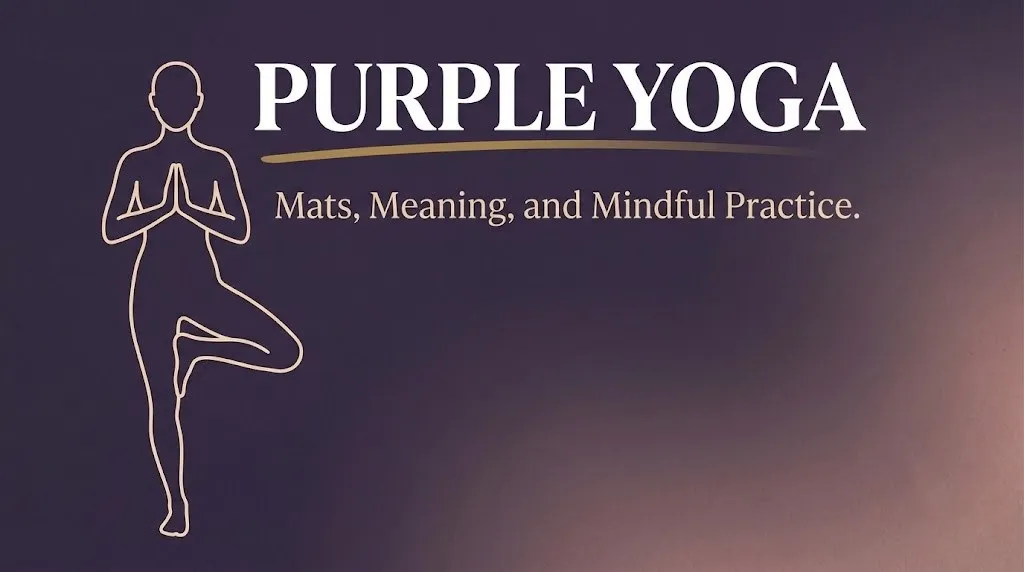
To practice Vrksasana:
- Stand at the front of your mat. Feet hip-width apart. Soften the knees slightly.
- Shift your weight into the left foot. Root down through all four corners of the foot.
- Place the sole of the right foot on the inner left calf or inner left thigh. Avoid placing it against the knee.
- Bring the hands to the heart in Anjali Mudra (prayer position) or extend them overhead.
- Fix your gaze on a single still point at eye level. This is your drishti (focused gaze point).
- Breathe slowly. Hold for 5 to 8 breaths. Switch sides.
Padmasana (Lotus Pose) is the classical meditation seat and the deepest hip-rotation pose associated with crown chakra work. It requires significant hip external rotation and should never be forced.
Modification for Vrksasana: Practice with the back against a wall. Place the raised foot on the inner calf rather than the thigh until balance builds. Use a chair beside you for touch support.
Sirsasana (Headstand) directly places the crown of the head on the earth and is the most physically direct crown chakra pose. It requires significant shoulder and core strength and must be learned progressively. Avoid this pose entirely with neck injury, high blood pressure, glaucoma, or in the first trimester of pregnancy.
Key Takeaway: Crown chakra yoga is about inward focus and awareness, not physical complexity. Tree Pose practiced with full breath attention is more relevant to the crown than a headstand done with strain.
Color Psychology in Yoga: Does Your Mat Color Affect Your Practice
Color psychology applied to yoga suggests that the color of your mat and practice environment can influence mood, perceived effort, and mental focus during a session, though the effect is subtle and individual rather than universal. This is not woo. It is grounded in environmental psychology research.
The Journal of Environmental Psychology has documented that color in a physical environment affects autonomic arousal, with cooler colors (blue, violet, green) associated with lower physiological activation and warmer colors (red, orange, yellow) associated with higher energy states. Applied to yoga, this means a purple mat and low-warm lighting may support a Restorative or meditative practice more effectively than a bright red mat in the same context.
The effect is partly associative. If you have built a mental connection between purple and calm, that association activates as soon as you roll out your mat. That mental cue is real. It is not the color itself doing the work. It is the meaning you have attached to it, which your nervous system responds to through habit and association.
For a physically active Vinyasa practice, mat color matters far less than grip, size, and cushioning. For meditation, Yoga Nidra, or Yin yoga, where mental state is the primary variable, the environment including color, lighting, and scent becomes more relevant.
Pose Tip:
- Pair a purple mat with warm amber or soft white light for meditative practice
- Avoid overhead fluorescent lighting during Yin or Restorative sessions regardless of mat color
- Use an eye pillow during Savasana to remove visual input entirely, making mat color irrelevant at the deepest rest point
Purple Yoga Blocks: How to Choose and Use Them
Purple yoga blocks are a functional practice tool, not decoration, and selecting the right material affects how useful they actually are during practice. The two main options are foam blocks and cork blocks, and they serve different purposes.
Foam blocks are lightweight, soft, and budget-friendly. They work well for Restorative yoga, gentle Hatha, and beginner practice where you are resting body weight on the block at low intensity. They compress under significant body weight, which reduces their effectiveness as a standing surface or a sacrum support in passive bridge.
Cork blocks are denser, heavier, and more stable. They do not compress under body weight, making them the better choice for poses where you stand on blocks, press palms into them, or rest the sacrum on them for Setu Bandha Sarvangasana (Supported Bridge Pose). Cork blocks also have a naturally non-slip surface.
The three standard block heights are 3 inches, 4 inches, and 6 inches, representing low, medium, and tall positions. Most blocks can be used at all three heights depending on which face you place down.
How to use a purple yoga block effectively:
- Under the hands in Trikonasana (Triangle Pose): Place at medium height beneath the lower hand to maintain spinal length without collapsing the torso.
- Under the sacrum in Supported Bridge: Use cork block at lowest height. Place under the flat bony part of the sacrum, not the lumbar spine.
- Under the sitting bones in seated poses: Raises the hips above knee level, reducing lumbar strain in tight-hamstrung practitioners.
- As a head rest in Balasana: Stack two blocks at low height for the forehead if the floor is too far away.
Modification for wrist sensitivity: When placing blocks under the hands, use the block on its lowest, widest face to reduce wrist extension angle.
Purple Yoga Strap, Bolster, and Prop Guide
A purple yoga strap, bolster, and set of blankets form the complete prop system for any home yoga practice, and understanding what each does prevents the common mistake of buying everything at once or skipping props entirely. Each serves a specific mechanical purpose.
The yoga strap extends the reach of the arms when flexibility limits direct grip. In Paschimottanasana (Seated Forward Fold), looping a strap around the feet allows the spine to lengthen without the hamstrings forcing a rounded back. In supine leg stretches, a strap around the foot lets you extend the leg without recruiting the hip flexors to hold it up.
Strap length matters: a 6-foot strap works for most adults. Anyone taller than 6 feet or working with very limited shoulder mobility should choose an 8-foot strap.
The yoga bolster is the signature prop of Restorative yoga. Its firm, dense fill supports the spine in passive backbends, the knees in Savasana, and the chest in prone resting poses. A bolster is not a soft pillow. It needs to hold its shape under body weight for 5 to 10 minutes without compressing significantly.
| Prop | Primary Purpose | Substitute | Best For |
|---|---|---|---|
| Strap | Extend reach in stretches | Belt or bathrobe tie | Hamstring and shoulder stretches |
| Bolster | Passive spinal support | Rolled firm blanket | Restorative and Yin yoga |
| Blanket | Padding, warmth, height | Firm bath towel | Under knees, hips, or head |
| Eye pillow | Light blocking in Savasana | Folded washcloth | Yoga Nidra, deep rest |
For a home purple yoga prop set on a budget, start with one strap, two blocks, and two firm blankets. Add a bolster once you know your practice style warrants it.
Key Takeaway: Props are mechanical tools, not training wheels. A strap lets you practice correct spinal alignment before flexibility arrives. A bolster lets your body rest fully without muscular effort holding it there.
Purple Yoga for Beginners: Setting Up Your First Home Practice
A purple yoga home practice for beginners works best when the space is consistent, the props are functional, and the first few sessions are short enough to build habit without overwhelming the body. Fifteen to twenty minutes three times per week is a more effective starting point than one long session per week.
Begin with the space. You need a floor area approximately 6 feet by 4 feet, ideally near a wall. The wall replaces a teacher’s hands for balance support and makes poses like Viparita Karani (Legs Up the Wall) accessible without any yoga experience at all. A purple mat, two blocks, and a strap are enough to practice a complete beginner sequence safely.
The psychological benefit of a dedicated color scheme, including a purple mat in a consistent spot, is real. Research in behavioral psychology consistently shows that environmental cues act as habit triggers. Rolling out the same purple mat in the same corner of the room creates a sensory signal to the brain that practice is beginning. Over time, that signal reduces the internal resistance to starting a session.
For complete beginners, the first five sessions should focus on breath awareness in still positions rather than flowing sequences. Lie on your mat. Breathe. Feel the floor. Then add one pose at a time.
A practical beginner purple yoga home setup includes:
- Purple mat (5mm to 6mm, TPE or natural rubber)
- Two purple or neutral cork blocks
- One 6-foot yoga strap
- Two firm blankets
- Access to a flat wall
- A way to time your holds (a phone on silent, face down)
Purple Yoga Mat for Seniors and People with Joint Concerns
A purple yoga mat for seniors needs to prioritize joint cushioning, non-slip performance, and ease of rolling up and carrying over any other feature. Seniors and anyone managing knee pain, hip replacements, or osteoporosis require an 8mm mat or a 6mm mat with an additional blanket underneath at kneeling positions.
Weight is a practical issue. A thick natural rubber mat can weigh 5 to 7 pounds, which creates a barrier for seniors with limited grip strength or upper extremity weakness. A thick TPE mat in the 8mm range often weighs 3 to 4 pounds, making it more manageable.
According to the National Center for Complementary and Integrative Health, gentle yoga practices adapted for older adults show consistent evidence of improving balance, reducing fall risk, and supporting functional independence. The mat choice directly affects whether a senior can practice safely on the floor or requires chair adaptations.
Non-slip performance on both the top and bottom surface matters especially for seniors. A mat that grips the floor prevents the mat itself from sliding during transitions. A mat top surface that grips the hands and feet prevents falls during standing poses.
| Concern | Recommended Mat Feature | Suggested Thickness |
|---|---|---|
| Knee pain during kneeling | Extra cushioning, soft surface | 8mm |
| Wrist sensitivity in floor poses | Non-slip surface, reduce extension | 6mm to 8mm |
| Balance challenges in standing | Firm, non-spongy surface | 5mm to 6mm |
| Lower back discomfort on floor | Cushioned, full-length support | 6mm to 8mm |
| Difficulty lifting or carrying mat | Lightweight TPE material | 6mm TPE |
Seniors managing osteoporosis should work with a yoga teacher familiar with bone health before practicing any inversions or deep forward folds. A 8mm mat reduces fall impact but does not replace appropriate pose selection.
Purple Yoga Sequence for Mindfulness and Calm
A purple yoga sequence for mindfulness is built around stillness, breath attention, and poses that activate the parasympathetic nervous system rather than building heat or strength. It is appropriate for beginners and experienced practitioners alike and can be practiced morning or evening.
This sequence is designed around the crown chakra theme: poses that draw awareness inward, invite stillness, and work with the idea of settling rather than striving.
Complete purple yoga mindfulness sequence:
- Seated Breath Awareness: Sit cross-legged or in a chair. Close the eyes. Take 10 slow breaths, counting the exhales from 10 down to 1. This sets the nervous system tone for the session.
- Nadi Shodhana Pranayama (Alternate Nostril Breathing): Practice 5 complete cycles before any movement. See the breathing techniques section for full instructions.
- Balasana (Child’s Pose): Hold for 3 minutes. Use a block under the forehead if the floor is too far. Focus entirely on the breath moving into the lower back.
- Supta Matsyendrasana (Supine Spinal Twist): 2 minutes each side. Arms in a T. Let gravity rotate the spine without forcing.
- Viparita Karani (Legs Up the Wall): 5 minutes. Arms at sides, palms up. This is the centerpiece of the sequence.
- Vrksasana (Tree Pose): 5 breaths each side. Use the wall if needed. Treat it as a moving meditation, not a balance challenge.
- Savasana (Corpse Pose): 8 to 10 minutes minimum. Add an eye pillow. Let the purple mat become a boundary between the session and the rest of the day.
Modification for limited floor access: Replace steps 3, 4, and 5 with their chair-based equivalents. The breath awareness and Tree Pose sections remain unchanged.
Key Takeaway: A purple yoga mindfulness sequence is most effective when you spend more time in each pose than feels comfortable. Stillness is the practice, not the pause between poses.
Purple Yoga Mat Care and Cleaning
A purple yoga mat stays non-slip, hygienic, and color-vibrant longer when cleaned consistently and stored correctly. The cleaning method depends on the mat material, and using the wrong cleaner can degrade both the surface grip and the color.
For PVC mats, a solution of water and mild dish soap applied with a soft cloth, then wiped clean and air-dried, is sufficient after every practice. Avoid submerging PVC mats in water. The edges and foam structure can absorb moisture and develop mildew internally.
Natural rubber mats should never be cleaned with alcohol-based sprays. Alcohol breaks down the rubber surface over time, reducing grip and shortening mat life. Use a gentle mat spray or plain water with a tiny amount of tea tree oil. Air-dry flat or rolled loosely, not folded. Store away from direct sunlight, which degrades natural rubber faster than any cleaning product.
TPE mats are the easiest to maintain. They can be wiped down with a damp cloth after practice and air-dried within 20 to 30 minutes. They resist mildew better than natural rubber and are not sensitive to mild soap solutions.
Key care rules for any purple yoga mat:
- Air-dry your mat completely before rolling it up. Rolling a damp mat traps moisture and creates odor.
- Store unrolled or loosely rolled, not tightly compressed, to prevent permanent creasing.
- Keep rubber and TPE mats out of direct sunlight during storage.
- Deep-clean once per week if you practice daily. After each session, a quick wipe is enough.
- Replace your mat when the surface texture begins to pill, peel, or lose grip even when dry. Grip loss is a safety issue, not just an aesthetic one.
Purple Yoga Pants and Activewear: What to Look For
Purple yoga pants and activewear serve a functional purpose beyond aesthetics: the right fabric allows full range of motion, manages sweat during active practice, and stays in place during inversions and floor transitions. Knowing what to look for prevents common frustrations like waistbands rolling down in forward folds or fabric bunching in seated poses.
The most important fabric property for yoga leggings is a four-way stretch construction, meaning the fabric stretches in both the horizontal and vertical directions simultaneously. This allows uninhibited movement in poses like Malasana (Garland Pose/Yogi Squat) or Anjaneyasana (Low Lunge) where both hip and knee joints move through large ranges of motion.
Moisture-wicking fabric (polyester blends or nylon) is the right choice for active Vinyasa or Hatha practice. Cotton feels comfortable at rest but absorbs sweat and becomes heavy and uncomfortable during active sessions. For Restorative or Yin yoga where sweating is minimal, cotton leggings are perfectly appropriate.
Waistband construction determines whether leggings stay in place during inversions. A wide, high-rise waistband with no drawstring sits stably at the natural waist through all movements. Narrow waistbands or low-rise cuts tend to shift during hip-dominant poses or forward folds.
Key activewear features to check before buying purple yoga pants:
- Four-way stretch fabric construction
- Moisture-wicking material for active styles, cotton for gentle or Restorative
- Wide high-rise waistband for stability in all poses
- Non-transparent fabric (check this before purchasing)
- Flat seams to prevent friction during floor work
- No drawstring at the waist (catches during movements)
Purple Yoga Mat vs Other Colors: Does It Matter
The color of a yoga mat does not affect its physical performance in any measurable way. Grip, thickness, and material are entirely determined by construction, not pigment. That said, color choice is not entirely irrelevant, and dismissing it completely misses the practical role that environment plays in practice quality.
Research in environmental psychology has consistently found that color influences mood and perceived space. A deep purple mat in a dimly lit, quiet room signals calm and inward focus to a brain that has built that association. A bright orange or yellow mat in the same room creates a different psychological starting point. Neither is better. They serve different purposes.
Where color becomes practically relevant is fade resistance. Some dyes, particularly in lower-quality PVC mats, fade quickly with regular use and cleaning. A deep purple mat that turns gray-purple within three months of use is a quality issue, not a color issue. Look for mats described as UV-resistant or colorfast if you practice near windows or store your mat in a sunny space.
| Mat Color | Psychological Association | Best Practice Context | Fade Risk |
|---|---|---|---|
| Purple / Violet | Calm, inward focus, meditation | Yin, Restorative, Yoga Nidra | Moderate (dye-dependent) |
| Blue | Tranquility, space, openness | Hatha, gentle flow | Low to moderate |
| Green | Grounding, balance | All styles | Low |
| Orange / Red | Energy, activation | Vinyasa, Power yoga | Low |
| Black | Neutral, focus | All styles | No visible fade |
| Gray | Neutral, minimal | All styles | No visible fade |
The honest answer: buy the purple mat if that is what makes you want to roll it out every day. Consistency of practice matters far more than any equipment decision, including color.
Key Takeaway: Mat color does not change your yoga. But the associations you build around it, and the habit cues that color creates in your practice space, are real psychological tools worth using.
Frequently Asked Questions About Purple Yoga
What does purple mean in yoga and chakra practice?
Purple in yoga is associated with Sahasrara, the crown chakra, located at the top of the skull and connected to awareness and consciousness in yogic philosophy.
The violet-to-purple color assignment to the crown chakra became standardized in Western yoga largely through early 20th-century theosophical writings interpreting the traditional Tantric chakra system.
Practically, purple is used in yoga environments and on equipment to support a meditative, inward-focused practice atmosphere.
What thickness purple yoga mat should I buy for bad knees?
An 8mm mat is the recommended starting point for anyone with knee pain, knee replacements, or significant joint sensitivity during kneeling poses.
A 6mm mat works for mild knee sensitivity if you also use a folded blanket beneath the knees during poses like Balasana (Child’s Pose) or low lunges.
Anyone with a recent knee surgery or diagnosed joint condition should confirm appropriate weight-bearing activities with their orthopedic surgeon before beginning floor-based yoga.
Does the color of my yoga mat actually affect my practice?
Mat color does not affect grip, cushioning, or physical performance in any way. Those qualities are determined entirely by material and construction.
Research in the Journal of Environmental Psychology shows that color in a practice space influences perceived mood and arousal, with cooler colors like purple associated with greater reported calm.
The real benefit of a consistent mat color is habit formation: the visual cue of rolling out the same mat in the same space acts as a reliable trigger for practice.
What are the best yoga poses for the crown chakra?
The crown chakra is most directly associated with Vrksasana (Tree Pose), Padmasana (Lotus Pose), Sirsasana (Headstand), and Savasana (Corpse Pose) practiced with Yoga Nidra.
Tree Pose is the most accessible of these for beginners and can be practiced at a wall for support.
Headstand should only be approached after significant shoulder and core strength has been built, and never without wall support for beginners; avoid it entirely with neck injury or high blood pressure.
How do I clean and care for a purple yoga mat?
Clean your mat after every practice with a damp cloth and mild soap or a yoga mat spray, then air-dry it completely before rolling it up.
Never use alcohol-based sprays on natural rubber mats, as alcohol degrades the surface grip over time; use plain water or a diluted natural soap solution instead.
Store your mat loosely rolled in a cool, dry place away from direct sunlight to preserve both color vibrancy and material integrity.
Your Purple Practice Starts Here
Roll out your purple mat today. Start with five minutes of seated breath awareness and five minutes of Viparita Karani (Legs Up the Wall). That is a complete session. It is enough to build the habit.
Add one new pose per week from the mindfulness sequence above. Match your mat thickness to your joints, not your color preference. Choose props that match your practice style, not what looks good in a photo.
The mat is just the starting point. What you do on it, consistently, over weeks and months, is the whole thing