Butterfly Yoga Pose: Full Guide to Baddha Konasana 2026
Butterfly yoga refers to Baddha Konasana (Bound Angle Pose), a seated hip-opening pose practiced across virtually every yoga style, from beginner Hatha classes to advanced Yin and Restorative sessions. It is one of the most widely practiced poses in yoga precisely because it addresses the inner thigh tightness, hip stiffness, and pelvic tension that affect so many people regardless of fitness level or age.
Hip tightness is one of the most common physical complaints among adults who sit for extended periods. According to the National Center for Complementary and Integrative Health, yoga practices that include hip-opening poses show consistent, measurable improvements in hip range of motion and associated lower back comfort over eight to twelve weeks of regular practice.
This guide covers everything you need to practice butterfly pose accurately and safely. You will find the correct Sanskrit name and form, numbered step-by-step instructions, the specific muscles engaged, alignment cues, modifications for beginners and seniors, and guidance for pregnant practitioners, athletes, and anyone managing hip pain or anxiety. No previous yoga experience is required to use this guide.
What Is Butterfly Yoga and Butterfly Pose in Yoga?
Butterfly yoga refers to the practice of Baddha Konasana (Bound Angle Pose), a seated yoga pose in which the soles of the feet are pressed together, the knees fall outward toward the floor, and the spine either extends upright or folds forward over the feet. The name “butterfly” comes from the visual shape: bent knees pointing outward like wings, with the feet as the body of the butterfly.
The pose appears in virtually every yoga tradition. In Hatha yoga, it is practiced with an upright spine and active muscular engagement. In Yin yoga, it is practiced as a passive, gravity-driven forward fold held for two to five minutes. In Restorative yoga, the body is fully supported by props in the reclined version. Each application produces different physiological effects, which the later sections of this guide cover in detail.
The name “butterfly pose” is the most common informal English name. The formal English name is Bound Angle Pose, referring to the bound (constrained, defined) angle formed at the hip and knee joints. Both names are used interchangeably in English-language yoga instruction.
Understanding the distinction matters for one practical reason: when you search for a class, a video, or written guidance, you may find the pose listed under any of these names. They all refer to the same fundamental shape.
- Other names you may encounter: Cobbler’s Pose (a reference to the cross-legged sitting position traditional Indian cobblers use), Butterfly Stretch, Seated Butterfly, Hip Opener Pose
- Style-specific labels: in Yin yoga, the seated forward-folded version is often called simply “Butterfly” as a distinct Yin pose name
- In kids’ yoga, the pose is almost universally called Butterfly, and often includes gentle wing-flapping movement to make it accessible and playful for children
Baddha Konasana: The Sanskrit Name and Correct Form
Baddha Konasana is the correct Sanskrit name for butterfly pose. It breaks into three components: Baddha means bound or restrained; Kona means angle; and Asana means pose or seat. Together the name describes a seated pose defined by the specific angle formed where the thigh meets the pelvis and knee in external hip rotation.
The Sanskrit name appears in the classical Hatha yoga text Hatha Yoga Pradipika, which dates to the fifteenth century. That text describes the pose as beneficial for practitioners who hold the position with the spine upright and the pelvis stable. This historical grounding matters because it clarifies that the spine-neutral, upright version is the foundational form of the pose, not a modification of a forward fold.
In the Iyengar yoga tradition, the emphasis on spinal extension in Baddha Konasana is particularly pronounced. B.K.S. Iyengar described the pose as a preparation for pranayama and meditation practice, where the upright spine and open chest allow for full diaphragmatic breath. That context explains why modern teachers consistently cue students to lengthen the spine rather than round it in the classic seated version.
Correct form has four non-negotiable elements:
- Soles of the feet together: The medial edges of both feet press against each other, with the heels drawn toward the pelvis at a distance appropriate for your hip structure
- Neutral or extended lumbar spine: The lower back does not collapse backward. The sitting bones root down and the spine rises from that foundation
- Knees releasing outward naturally: Not forced down by hand pressure. Gravity and breath do the releasing over time
- Gaze soft and forward: Not strained upward or collapsed downward. The neck follows the spine’s natural length
How to Do Butterfly Pose Step by Step
Practicing butterfly pose correctly requires a stable seated foundation and a spine that stays long rather than collapsing. If your lower back rounds heavily when you sit on the floor with straight legs, elevating your hips on a folded blanket before you begin will change the experience completely.
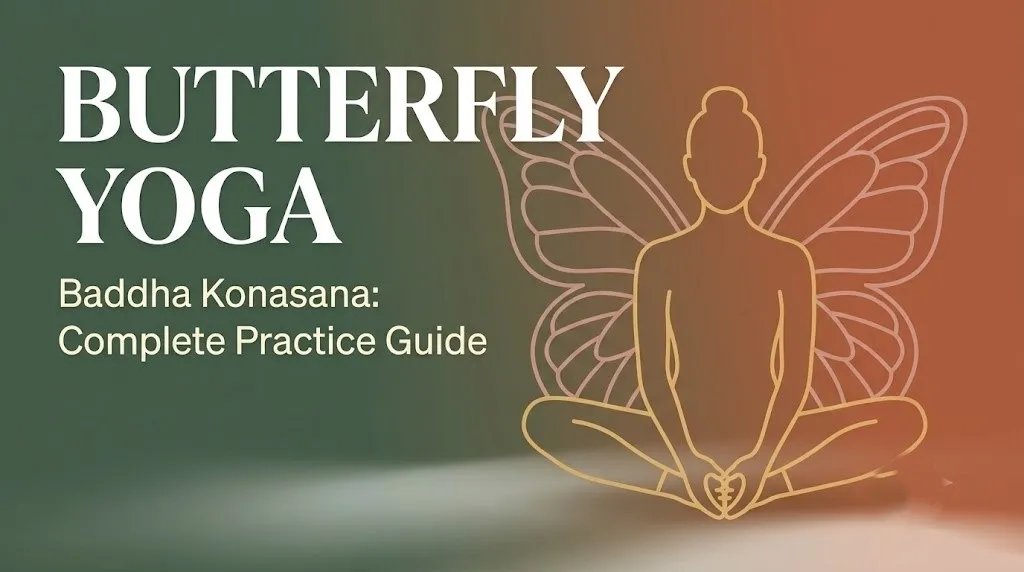
To practice Baddha Konasana (Butterfly Pose / Bound Angle Pose):
- Sit on your mat with your legs extended. Place a folded blanket under your hips if your lower back rounds when seated. This is a setup step that most beginners need, not an optional extra.
- Bend both knees and draw the soles of your feet together. Let your knees fall outward. Position your feet at a comfortable distance from your pelvis. Closer to the pelvis increases intensity; farther away reduces it.
- Sit tall. Press your sitting bones into the mat or blanket. Lengthen your spine from the base up through the crown of your head. Place your hands around your feet or on your ankles. Do not use your hands to pull your knees downward.
- Inhale to lengthen your spine further. On the exhale, maintain that length. Do not collapse the chest or round the upper back in search of a deeper stretch.
- Hold for 5 to 10 breath cycles in the Hatha version. Breathe evenly. With each exhale, allow the inner thighs to release a small amount further. Do not force the process.
- To release, use your hands to gently draw your knees together, then extend both legs forward to return to a neutral seated position.
Modification for beginners: Place a yoga block or folded blanket under each outer thigh if the knees are high above the floor. This removes the sensation of gravity pulling the knees in a direction they are not yet ready to travel.
Muscles Worked in Butterfly Pose
Butterfly pose targets the adductor muscle group along the inner thigh as its primary lengthening target, along with the hip external rotators that sit deeper in the hip and gluteal region. Understanding which muscles are involved helps you practice with more precision and explains why the pose feels different in different bodies.
The adductor group consists of five muscles: adductor magnus (the largest, running from the pubic bone to the lower femur), adductor longus, adductor brevis, gracilis (a long slender muscle that also crosses the knee), and pectineus. All five run along the inner thigh and are responsible for bringing the legs toward the midline. In butterfly pose, they are lengthened because the legs move away from the midline into external rotation.
The hip external rotators are the deeper layer. The piriformis, obturator internus, obturator externus, and the gemelli muscles all rotate the femur outward in the hip socket. These muscles are often chronically shortened in people who sit for long periods, which is why butterfly pose creates a deeply familiar sense of release for desk workers, drivers, and anyone who has not moved their hips through their full range of motion in a long time.
Think of the hip external rotators like a group of rubber bands wrapped around the back of the hip joint. When those bands stay shortened day after day, the joint moves less freely and the lower back often compensates by taking on excess stress. Butterfly pose begins the process of releasing those bands through sustained, breath-supported length.
| Muscle Group | Location | Role in the Pose | Sensation When Tight |
|---|---|---|---|
| Adductor magnus | Deep inner thigh to lower femur | Primary lengthening target | Deep pull along inner thigh |
| Adductor longus and brevis | Upper inner thigh | Secondary lengthening target | Groin tightness |
| Gracilis | Inner thigh, crosses knee | Lengthened; mild knee sensation possible | Inner knee pull |
| Pectineus | Upper inner thigh near pelvis | Lengthened near hip crease | Groin and hip crease sensation |
| Piriformis | Deep gluteal region | Externally rotates hip; lengthened | Deep buttock sensation |
| Obturator group and gemelli | Deep hip | External rotation; lengthened | Deep interior hip sensation |
Key Takeaway: Butterfly pose primarily targets the adductor muscle group along the inner thigh and the deep hip external rotators. Using a folded blanket under the hips is not optional for most beginners; it is what allows the spine to stay upright and the correct muscles to actually be reached.
Butterfly Pose Alignment Cues and Common Mistakes
The most common mistake in butterfly pose is allowing the lumbar spine to collapse into a backward rounding, sometimes called a posterior pelvic tilt. When this happens, the stretch moves from the intended inner thigh and hip area up into the lower back, which is not the target. The lower back is not meant to be stretched here. It is meant to stay long and supported.
The second most common error is pressing the knees toward the floor with the hands. This feels productive but it bypasses the hip joint entirely and puts compressive stress on the medial collateral ligament of the knee. The knees descend through release of the hip external rotators over time. They do not descend through force applied to the knee joint itself. If pressing on your knees feels necessary, it is a sign you need more hip elevation, not more pressure.
The third error is positioning the feet too far from the pelvis in an attempt to make the pose feel “easier.” Moving the feet farther out does reduce intensity, but it also reduces the external rotation demand at the hip, which means the primary target muscles are barely engaged. For most bodies, feet positioned roughly a forearm’s length from the pelvis creates a working but sustainable intensity.
Pose Tip:
- Lengthen your spine before anything else. Alignment starts from the sitting bones up.
- If your knees are high above the floor, that is normal. Support them with blocks or blankets rather than forcing them down.
- Your feet should be actively pressing sole-to-sole, not passively flopped together.
- Avoid craning your neck forward as you settle into the pose. Let it stay in line with your spine.
Butterfly Pose Benefits: Hips, Flexibility, and Lower Back
Butterfly pose produces measurable improvements in hip range of motion, inner thigh flexibility, and lower back comfort when practiced consistently over time. These are not vague wellness claims. They are physiological effects with documented mechanisms.
According to the National Center for Complementary and Integrative Health, yoga practices that include hip-opening poses in a consistent weekly schedule show statistically meaningful improvements in hip joint range of motion compared to non-practicing control groups over eight to twelve weeks. The NCCIH also notes that hip mobility improvements in yoga practitioners correlate with reduced lower back pain reports, which reflects the biomechanical relationship between hip restriction and lumbar compensation.
A study published in the International Journal of Yoga found that practitioners who included seated hip-opening poses (including Baddha Konasana) in twice-weekly sessions showed a 31% average improvement in hip abduction range of motion over ten weeks. That improvement was consistent across age groups from 25 to 65.
The lower back benefit is indirect but real. When the hip external rotators and adductors are chronically tight, the lumbar spine rotates and flexes to compensate for the hip’s reduced mobility. Releasing those hip muscles through poses like butterfly reduces the compensatory demand on the lumbar segments, which over time reduces the fatigue and discomfort that accumulates in the lower back from that compensation.
- Improved hip external rotation range of motion
- Lengthening of the full adductor muscle group
- Reduced compensatory tension in the lumbar spine
- Stimulation of the pelvic floor through the hip joint position
- Calming effect on the nervous system through extended breath holds
- Preparation for deeper hip-opening poses and for seated meditation
Butterfly Pose in Yin Yoga vs Hatha Yoga
Butterfly pose in Yin yoga and butterfly pose in Hatha yoga share the same foundational shape but produce significantly different physiological effects because of differences in hold duration, muscular engagement, and spinal position. Knowing which version you are doing helps you use the pose purposefully rather than accidentally.
In Hatha yoga, butterfly pose is practiced with an upright spine, active muscular engagement to maintain length, and a hold of roughly three to ten breath cycles (approximately 20 to 60 seconds). The primary target is the adductor and hip external rotator muscles. The nervous system effect is mild. The focus is on conscious alignment and breath coordination.
In Yin yoga, the pose is practiced with the spine folding forward over the feet, the body fully surrendering toward gravity, and a hold of two to five minutes. In this version, the muscles relax as completely as possible (rather than engaging to maintain posture), and the sustained duration allows the connective tissue layers, specifically the fascia and joint capsule tissue around the hip, to experience a gentle, sustained load. According to the American College of Sports Medicine, sustained low-load stretching held for more than 90 seconds produces greater long-term connective tissue adaptations than shorter, more intense stretching.
The Yin version also produces a stronger parasympathetic nervous system response due to the longer hold and the forward-folded, internally directed position. Many practitioners report a distinct emotional quality in the Yin butterfly, which is consistent with research suggesting that sustained hip opening can release held physical and psychological tension simultaneously.
| Feature | Hatha Butterfly | Yin Butterfly |
|---|---|---|
| Spine position | Upright, extended | Folded forward |
| Muscular engagement | Active to maintain posture | Passive, fully released |
| Hold duration | 20 to 60 seconds | 2 to 5 minutes |
| Primary target tissue | Muscle (adductors, rotators) | Fascia, joint capsule tissue |
| Nervous system effect | Mild to moderate calming | Strong parasympathetic activation |
| Props typically used | Blanket under hips | Bolster under torso, blocks under knees |
Butterfly Pose for Beginners: Props and Modifications
Butterfly pose is accessible for beginners, but it requires honest prop use to be both safe and effective. The most important modification is elevating the hips, and it is one that experienced teachers use themselves, not just something handed to beginners as a consolation.
A folded blanket or firm cushion placed under the sitting bones tilts the pelvis forward slightly. This single change allows the lumbar spine to remain in a neutral curve rather than collapsing backward. Without it, many beginners spend the entire pose fighting gravity in the lower back rather than releasing the intended hip structures.
Yoga blocks placed under the outer thighs provide support for knees that hover high above the floor. This removes the sensation that the knees are “supposed to” touch the ground (they are not) and allows the muscles to release gradually over multiple sessions rather than being asked to release all at once.
For beginners who find even the supported seated version uncomfortable, the reclined version, Supta Baddha Konasana (Reclined Bound Angle Pose), removes all spinal effort from the equation and is a safer starting point for anyone with lower back sensitivity or significant hip tightness.
| Modification | Props Needed | Best For |
|---|---|---|
| Hip elevation | Folded blanket or firm cushion | Lower back rounding, posterior pelvic tilt |
| Knee support | Two yoga blocks or rolled blankets | High knees, hip tightness, knee discomfort |
| Reclined version | Bolster, blankets | Lower back pain, severe hip restriction |
| Feet farther from pelvis | No prop required | Extreme inner thigh tightness |
| Chair-adapted version | Sturdy chair | Seniors, post-surgery, severe mobility limits |
| Wall support | Wall behind back | Core fatigue, spinal instability |
Key Takeaway: The single most useful modification for butterfly pose is a folded blanket under the hips. It changes the pelvic angle enough to allow the spine to stay long, which is what makes the actual target muscles accessible rather than masked by lower back strain.
Reclined Butterfly Pose and Supine Variations
Supta Baddha Konasana (Reclined Bound Angle Pose) is the supine (lying down) variation of butterfly pose and is one of the most therapeutic poses in yoga for the inner thigh, groin, pelvic floor, and nervous system. In the reclined position, all spinal effort disappears, and the body can release into gravity rather than working against it.
To practice Supta Baddha Konasana:
- Lie on your back on your mat. Bend both knees and place your feet flat on the floor.
- Press the soles of your feet together and allow your knees to fall outward, mirroring the butterfly shape from the floor.
- Place a yoga block or folded blanket under each outer thigh if the inner thigh sensation is too intense or if the knees hover uncomfortably. Prop height determines intensity: higher props mean less stretch, lower props mean more.
- Rest your arms alongside your body with palms facing up, or place your hands on your lower belly.
- Close your eyes. Breathe slowly. Hold for two to five minutes for a Yin or Restorative effect, or five to ten breaths for a Hatha warm-up or cool-down effect.
- To release, use your hands to guide both knees back to center, then press your feet into the mat to stabilize before any other movement.
Modification for sensitive lower back: Place a bolster lengthwise under the spine before beginning, so the entire torso is gently elevated and supported. This reduces any sensation of the lower back pressing into the mat and makes the pose accessible for people with lumbar sensitivity, recent surgery, or late-stage pregnancy.
Modification for intense inner thigh sensation: Slide your feet farther from your pelvis. Even a few inches of distance reduces the stretch considerably.
Butterfly Pose for Seniors and People with Hip Pain
Butterfly pose is one of the most appropriate yoga poses for seniors when practiced with the right modifications, specifically because it works within a seated, floor-level or chair-level range of motion that does not require balance, strength, or complex transitions. The physiological benefits for older adults, including improved hip joint mobility, reduced adductor stiffness, and pelvic floor activation, directly support functional daily movement.
According to the Journal of Alternative and Complementary Medicine, yoga interventions for adults over 65 that include seated hip-opening poses showed measurable improvements in hip range of motion and self-reported ease of daily activities (including walking, climbing stairs, and getting up from seated positions) after eight weeks of twice-weekly practice.
For seniors managing hip osteoarthritis, the approach requires specific care. Osteoarthritis involves changes to the cartilage and joint surfaces within the hip, and forceful stretching can aggravate rather than help the condition. The goal is gentle, supported range of motion rather than pushing to any edge. A bolster under the knees, feet positioned farther from the pelvis, and a hold of no more than five to eight breaths is a sensible starting point. If any sharp, grinding, or clicking sensation occurs in the hip joint, the pose should be stopped and the situation reviewed with the treating orthopedic physician or physical therapist before continuing.
For seniors who cannot comfortably sit on the floor, the butterfly shape can be approximated in a chair:
- Sit in a sturdy chair with feet flat on the floor.
- Turn both feet outward approximately 45 degrees, allowing the knees to follow.
- Rest hands on the thighs. Sit tall.
- Hold for five breaths, allowing a mild inner thigh opening sensation.
Butterfly Pose for Pregnancy and Pelvic Floor
Butterfly pose is widely included in prenatal yoga programs because the hip-open position gently supports the pelvic floor and inner thigh tissues that undergo increasing demand as pregnancy progresses. The seated version and the reclined version are both used in prenatal practice, with modifications for each trimester.
In the first and second trimester, the seated version of butterfly pose is generally well-tolerated. Elevating the hips on a folded blanket is especially important for pregnant practitioners because the ligaments of the pelvis (including the pubic symphysis and the sacroiliac ligaments) soften during pregnancy due to the hormone relaxin. This means joints can move into ranges they would not normally reach, which increases injury risk if the pose is pushed too aggressively.
The pelvic floor benefit is indirect but documented. Research published in Complementary Therapies in Medicine indicates that yoga poses that bring the hip into external rotation and abduction create a gentle lengthening effect on the pelvic floor muscles, specifically the levator ani group. This can support pelvic floor awareness and preparation for labor.
In the third trimester, Supta Baddha Konasana (Reclined Bound Angle Pose) should be modified by elevating the torso on a bolster rather than lying flat. Lying flat on the back in late pregnancy places pressure on the inferior vena cava, which can reduce blood return to the heart. A bolster or wedge that keeps the torso at a 30 to 45-degree angle removes that risk entirely while maintaining the benefits of the pose.
Do not practice any version of butterfly pose in pregnancy without first confirming with your midwife or obstetrician that there are no specific contraindications related to your pregnancy, particularly if you have symphysis pubis dysfunction, placenta previa, or a history of preterm labor.
Butterfly Pose for Athletes and Injury Recovery
Butterfly pose is one of the most effective cross-training tools for athletes in sports involving repetitive lower extremity movement, including running, cycling, swimming, and strength sports. The reason is simple: repetitive lower body movement in a forward plane (running, cycling) consistently creates adaptive shortening in the hip adductors and external rotators, and butterfly pose directly addresses both groups.
Runners specifically develop predictable tightness patterns. The adductor magnus shortens from repeated hip extension with limited abduction. The piriformis becomes overactive as it compensates for hip abductor weakness. The result is a hip that moves efficiently in one direction (forward and back) but becomes progressively restricted in rotation and abduction. Butterfly pose addresses both of those restrictions simultaneously.
According to the American College of Sports Medicine, athletes who include dedicated hip mobility work in their weekly training programs show lower rates of adductor strain and IT band syndrome compared to athletes who skip mobility work entirely. The ACSM recommends incorporating hip-opening poses or exercises at least two to three times per week for endurance athletes.
For injury recovery specifically, butterfly pose should be included in a graduated return-to-activity plan rather than used aggressively in the early healing phase. If you are recovering from a groin strain (adductor tear), the pose should be avoided entirely until the tissue has healed sufficiently and your physical therapist confirms that passive hip abduction and external rotation are safe to resume.
- Runners: Addresses adductor shortening and piriformis tightness from forward-plane repetition
- Cyclists: Opens hip flexors and internal rotators after sustained hip flexion in the saddle position
- Swimmers: Prepares the groin and inner thigh for breaststroke hip mechanics
- Strength athletes: Supports hip mobility needed for full-depth squats and deadlifts
- Equestrian athletes: Releases the adductor tension from sustained gripping in the saddle
Key Takeaway: Athletes who include butterfly pose two to three times per week as part of post-workout recovery see measurable reductions in adductor and piriformis tightness. The key is holding long enough to actually reach the connective tissue layer, which means at least five full breaths minimum.
Butterfly Pose for Stress, Anxiety, and Nervous System
Butterfly pose, particularly the reclined and Yin versions held for extended durations, produces a measurable calming effect on the nervous system through two overlapping mechanisms: breath-coordinated parasympathetic activation and the postural shift that occurs when the body surrenders to a passive, gravity-supported shape.
The breath mechanism is the more immediate one. Extended, slow exhalations practiced while holding butterfly pose activate the vagus nerve, which signals the parasympathetic nervous system to reduce cortisol production, lower heart rate, and decrease muscle tension. Research published in the International Journal of Yoga found that slow diaphragmatic breathing practiced in passive yoga poses reduced self-reported anxiety scores and measurably lowered salivary cortisol in participants over six weeks of twice-weekly practice.
The postural mechanism is subtler but equally real. The hip-open, internally directed quality of butterfly pose (especially the forward-folded Yin version) places the body in a position that is physiologically associated with safety and inwardness rather than vigilance and readiness. Many practitioners report that butterfly pose specifically, among all hip-opening poses, produces a distinct emotional softening during the hold.
For stress and anxiety management, the Yin yoga version of butterfly pose (folded forward, held two to five minutes) is more effective than the upright Hatha version. The longer hold and passive body position allow the parasympathetic shift to deepen in ways that shorter, more active holds do not. Combine the pose with ujjayi breath (slight throat constriction, extended exhalation) for the most consistent calming effect.
Pose Tip:
- For anxiety, begin in reclined butterfly (Supta Baddha Konasana) rather than seated. The horizontal body position activates the parasympathetic nervous system more quickly for anxious nervous systems.
- Place an eye pillow or folded cloth over your eyes. Reducing visual input deepens the internal experience of the pose.
- Set a gentle timer rather than watching a clock. Releasing attention from time is part of the stress-reduction effect.
Butterfly Pose Contraindications and When to Skip It
Butterfly pose is contraindicated or requires significant modification in specific circumstances. Knowing when to skip or adapt the pose is as important as knowing how to practice it.
Groin strain or adductor tear: Any active tear in the adductor muscles makes butterfly pose inappropriate until healing is confirmed by a physical therapist or sports medicine physician. Passive stretching of a recently torn muscle can disrupt the healing tissue and delay recovery. Wait for clearance and begin with the most supported, least intense version first.
Acute knee injury or medial collateral ligament sprain: The external rotation position of butterfly pose places lateral stress on the medial structures of the knee. Any recent knee injury should be assessed before attempting this pose. If knee flexion and external rotation are cleared, use blanket support under the outer thigh to prevent any gravitational pull on the medial knee.
Sacroiliac joint dysfunction: Butterfly pose creates a specific load through the sacroiliac joints, particularly when the hips are in full external rotation and the lumbar spine is asked to maintain neutral. For some people with SI joint instability or active dysfunction, this pose aggravates symptoms. The reclined version with feet positioned farther from the pelvis and blocks under both knees is often tolerable when the seated version is not.
Hip labral tears: The specific combination of hip flexion, external rotation, and abduction in butterfly pose can compress or stress a damaged hip labrum. If you have a confirmed labral tear, speak with your orthopedic surgeon about which yoga poses are appropriate before including butterfly pose in your practice.
- Skip entirely: Active groin strain, acute knee injury, unstable SI joint in acute flare
- Modify significantly: Hip labral tear, hip osteoarthritis with sharp pain, third trimester pregnancy (reclined only on a bolster)
- Proceed with supported props: General SI joint sensitivity, mild knee discomfort, severe hip tightness, seniors with joint stiffness
Butterfly Yoga Sequences: Warm-Ups, Pairings, and Cool-Downs
Butterfly pose works best within a sequence rather than in isolation, because the hip opening it creates becomes more useful when the body is prepared before and given a complementary challenge after. The poses that precede and follow butterfly pose shape how deeply and safely the stretch can be experienced.
As a warm-up for butterfly pose, gentle hip circles in Table Top position, Marjaryasana/Bitilasana (Cat Pose and Cow Pose) cycles, and a few rounds of Malasana (Garland Pose or Yoga Squat) prepare the hip joint and surrounding tissues without demanding more range of motion than the body can safely offer in a cold state.
As companion poses in the same session, butterfly pose pairs well with Upavistha Konasana (Wide-Angle Seated Forward Bend), which targets the adductors from a different angle, and Eka Pada Rajakapotasana (Pigeon Pose), which adds a deeper hip external rotation and flexor stretch to what butterfly started.
As a cool-down following active practice, the reclined version of butterfly pose is one of the most effective choices in any yoga sequence. The body is already warm, the muscles have worked through a range of motion, and Supta Baddha Konasana allows the entire hip complex to settle into a supported release before the final Savasana (Corpse Pose).
| Sequence Position | Pose | Purpose |
|---|---|---|
| Warm-up before butterfly | Malasana (Garland Pose) | Opens hip joint, warms inner thighs |
| Warm-up before butterfly | Cat/Cow (Marjaryasana/Bitilasana) | Mobilizes pelvis and lumbar spine |
| Main pose | Baddha Konasana (Butterfly Pose) | Primary inner thigh and hip opener |
| Pairing (same session) | Upavistha Konasana (Wide-Angle Seated Forward Bend) | Different adductor angle, same goal |
| Pairing (same session) | Pigeon Pose (Eka Pada Rajakapotasana) | Deeper hip external rotation |
| Cool-down after practice | Supta Baddha Konasana (Reclined Butterfly) | Passive release, nervous system settling |
| Final pose | Savasana (Corpse Pose) | Full integration and nervous system rest |
Frequently Asked Questions About Butterfly Yoga
What is butterfly pose called in Sanskrit?
Butterfly pose is called Baddha Konasana in Sanskrit, which translates as Bound Angle Pose.
The name refers to the defined angle formed at the hip and knee when the legs are in external rotation with the soles of the feet pressed together.
It is also sometimes called Cobbler’s Pose in English, referencing the cross-legged seated position traditionally used by Indian cobblers.
How long should you hold butterfly pose?
In Hatha yoga, most teachers recommend holding butterfly pose for 5 to 10 breath cycles, approximately 30 to 60 seconds.
In Yin yoga, the same pose is held passively for 2 to 5 minutes, allowing the connective tissue and fascia to respond to the sustained load.
Start with shorter holds and extend the duration gradually over weeks as your inner thigh and hip tissues adapt.
Is butterfly pose safe for beginners with tight hips?
Yes, butterfly pose is safe for beginners with tight hips when practiced with a folded blanket under the hips and yoga blocks under the outer thighs.
These props adjust the pose to your actual range of motion rather than asking you to perform a range of motion you have not yet developed.
Never force the knees toward the floor. Tight hips respond to breath and time, not pressure.
Can you do butterfly pose when pregnant?
The seated version of butterfly pose is generally safe in the first and second trimester with the hips elevated on a folded blanket.
In the third trimester, use the reclined version (Supta Baddha Konasana) with a bolster under the torso to keep the upper body at a 30 to 45-degree angle rather than lying flat.
Always confirm that any yoga practice is appropriate with your midwife or obstetrician, particularly if you have symphysis pubis dysfunction or any pregnancy complication.
What is the difference between butterfly pose and pigeon pose?
Butterfly pose (Baddha Konasana) is a bilateral, symmetric hip-opening pose practiced seated with both legs in the same position, targeting the adductors and hip external rotators of both hips equally.
Pigeon pose (Eka Pada Rajakapotasana) is a unilateral pose that brings one hip into deep external rotation and flexion while the other hip extends behind the body, creating a more intense single-hip stretch.
Butterfly pose is generally more accessible for beginners; pigeon pose requires greater hip range of motion and is practiced one side at a time.
One Pose, Many Returns
Butterfly pose rewards consistency more than intensity. Sitting in the shape correctly once, with the hips elevated and the spine long, is worth far more than forcing it aggressively without support.
Practice butterfly pose three times per week. Hold it for at least five full breaths in the seated version. When you are ready for more depth, add the reclined version at the end of your practice as a cool-down before Savasana. Within six to eight weeks, you will likely notice the knees descending without any effort at all.
That is not magic. That is patience doing its work.