Private Yoga Teacher: How to Find and Work With One in 2026
A private yoga teacher delivers something no studio class can replicate: instruction built entirely around your body, your goals, and your current physical reality. Whether you’re recovering from an injury, navigating a health condition, or simply wanting to progress faster than a group class allows, one-on-one yoga instruction changes what’s possible.
The demand for personalized yoga instruction has grown steadily since 2020. According to Yoga Alliance’s 2023 Yoga in America Study, over 36 million Americans practice yoga, yet surveys consistently show that beginner dropout rates within the first six months remain high, largely because group class pacing doesn’t match individual needs. A private teacher directly addresses that gap.
This guide covers everything you need to make an informed decision: how private yoga differs from group practice, how to read teacher credentials, what a first session actually looks like, how sessions are adapted for specific conditions, and what realistic pricing looks like in 2026.
What Is a Private Yoga Teacher and What Do They Do?
A private yoga teacher is a certified yoga instructor who delivers one-on-one (or small group) sessions tailored specifically to the individual student’s body, goals, health history, and experience level.
Unlike a studio teacher managing 15 to 30 students simultaneously, a private teacher’s entire attention stays on you. Every cue is specific to your alignment. Every pose modification addresses your actual body, not a hypothetical average student. The session moves at your pace, not the class’s pace.
What a private yoga teacher typically does in practice:
- Conducts an intake assessment covering health history, injuries, goals, and yoga experience
- Selects yoga styles and poses based on that assessment
- Provides real-time alignment corrections and personalized hands-on adjustments when appropriate
- Designs progressive sequences across multiple sessions, building systematically
- Adapts every pose with modifications suited to the individual’s range of motion and capacity
- Teaches breathwork (pranayama) techniques matched to the student’s nervous system goals
- Tracks progress and adjusts the program as the student develops
The distinction from a personal trainer is worth noting. A yoga teacher works within the specific philosophy, tradition, and physical methodology of yoga. A personal trainer focuses on fitness outcomes. A qualified private yoga teacher addresses both the physical body and the breath-mind connection that makes yoga neurologically distinct from standard exercise.
Private Yoga vs. Group Yoga: Which Is Better for You?
Private yoga is better suited to anyone with a specific health condition, injury history, learning preference for individualized attention, or a body that moves differently from the majority of a group class.
Group yoga offers community, energy, and accessibility at a lower cost per session. For healthy adults with a foundational practice already in place, a group Vinyasa or Hatha class delivers real benefit efficiently. The problem arises when the pace, the teacher’s cues, or the physical demands don’t match what a specific body actually needs.
| Factor | Private Yoga | Group Yoga |
|---|---|---|
| Instruction focus | Entirely on you | Divided across 10 to 30 students |
| Pose modifications | Built into every pose | Offered generally, not individually |
| Health condition adaptation | Fully tailored | Limited; teacher cannot track everyone |
| Pace | Set by your body and breath | Set by the class average |
| Style | Chosen for your goals | Predetermined by class format |
| Cost per session | Higher | Lower |
| Best for | Injuries, conditions, beginners, rapid progress | Maintained practice, social motivation |
| Credential relevance | Critical to vet carefully | Less individually impactful |
A practical rule: start with private sessions if you have any injury, chronic pain, structural asymmetry, or have never practiced yoga before. Move into group classes once you have a foundational understanding of how your body moves in key poses. Many experienced practitioners maintain both simultaneously for different purposes.
How to Find a Private Yoga Teacher Near You
Finding a private yoga teacher starts with three sources: Yoga Alliance’s teacher registry, referrals from physical therapists or healthcare providers, and local yoga studios that offer private session bookings.
The Yoga Alliance maintains a searchable directory of all registered teachers worldwide. You can filter by location, credential level, and specialty. This is the most reliable starting point because it confirms that a teacher has met the minimum training standards required for registration.
Steps to find and screen a private yoga teacher:
- Search the Yoga Alliance registry for registered teachers (RYT-200 or above) in your area.
- Check whether the teacher lists specializations relevant to your situation: prenatal, therapeutic, adaptive, senior, or trauma-informed yoga.
- Request a brief introductory call (15 minutes) before committing to sessions. Ask about their teaching style, experience with your specific condition, and typical session structure.
- Ask for references from students with similar goals or conditions to yours.
- Confirm cancellation policies, session length, and whether they bring props or expect you to have your own.
- Attend one trial session before purchasing a package.
Physical therapists, orthopedic surgeons, and chiropractors frequently refer patients to yoga teachers for specific conditions. If you are working with a healthcare provider for an injury or chronic condition, asking that provider for a teacher referral often yields a more clinically aligned match than a general directory search.
Key Takeaway: A private yoga teacher is only as valuable as their credential level and specialization match your specific needs. Start by verifying Yoga Alliance registration before any other evaluation step.
Private Yoga Teacher Credentials: What to Look For
The most important credential to verify in a private yoga teacher is their Yoga Alliance registration level, which indicates the minimum hours of training they have completed in yoga techniques, anatomy, teaching methodology, and practicum.
Understanding the credential levels:
| Credential | Training Hours | What It Signals |
|---|---|---|
| RYT-200 | 200 hours minimum | Entry-level certification; foundational competence |
| RYT-500 | 500 hours minimum | Advanced training; deeper anatomy and methodology |
| E-RYT-200 | 200 hrs training + 1,000 hrs teaching | Significant real-world teaching experience |
| E-RYT-500 | 500 hrs training + 2,000 hrs teaching | Highly experienced; appropriate for complex cases |
| YACEP | Continuing education provider | Authorized to offer CE hours to other teachers |
| Prenatal Yoga Cert | Specialty training (typically 85 hrs) | Trained specifically for pregnancy adaptations |
| Therapeutic Yoga Cert | Specialty training (varies) | Trained for injury, chronic illness, mental health |
An RYT-200 is the minimum standard. For a private teacher working with injuries, chronic conditions, pregnancy, or seniors, an RYT-500 or E-RYT with a relevant specialty certification is a meaningfully higher standard.
Ask directly: “What training do you have in [your specific condition]?” A qualified teacher will answer specifically. A teacher who deflects or speaks vaguely about “knowing how to work with all bodies” without citing specific training is not demonstrating the expertise your situation may require.
According to Yoga Alliance, as of their most recent registry data, there are over 100,000 registered yoga teachers in the United States. Credential level varies enormously. Not verifying before booking is the single most common mistake people make when hiring a private teacher.
What to Expect in Your First Private Yoga Session
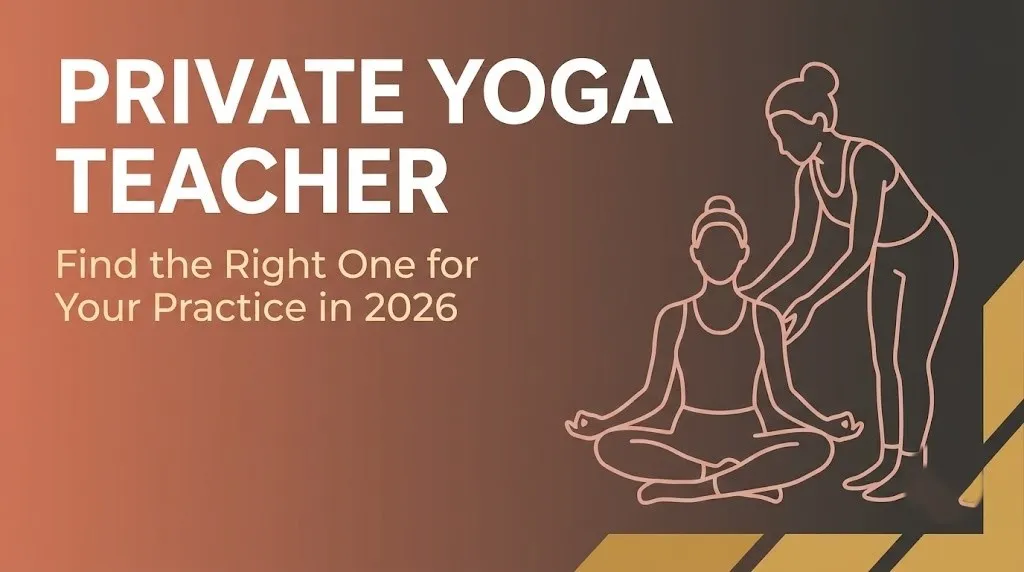
Your first private yoga session will typically begin with a 10 to 20 minute intake conversation rather than immediately moving onto the mat.
A skilled private yoga teacher treats the first session as an assessment, not a performance. They want to understand your history before they introduce any movement. This intake process is one of the primary structural differences between a private session and walking into a studio class.
What the intake typically covers:
- Current physical health and any diagnosed conditions
- Recent or past injuries, surgeries, or joint issues
- Daily movement patterns and occupation (desk work, manual labor, etc.)
- Previous yoga experience and styles practiced
- Primary goals (stress reduction, flexibility, pain management, strength, spiritual practice)
- Any movement that currently causes pain or discomfort
After the intake, the first session typically includes:
- Breath assessment: The teacher observes your natural breathing pattern at rest. Many people breathe primarily into the chest, missing the diaphragmatic range that yoga develops.
- Foundational pose exploration: Usually Tadasana (Mountain Pose), Adho Mukha Svanasana (Downward-Facing Dog), and Balasana (Child’s Pose) to assess your natural alignment and range of motion.
- Gentle guided sequence: A short 20 to 30 minute sequence built from what the intake revealed.
- Closing check-in: Feedback from you, notes from the teacher, and a brief discussion of what the next session will address.
The session length is typically 60 minutes for a first appointment, sometimes 90 minutes if a longer intake is needed.
How a Private Yoga Teacher Customizes Your Practice
A private yoga teacher customizes your practice through three mechanisms: pose selection, sequencing logic, and real-time modification based on what they observe in your body during each session.
Pose selection is not random. A skilled teacher builds their selections from the intake information. If your goal is lumbar spine mobility and you report chronic lower back tension, they will emphasize poses that mobilize the thoracic spine, lengthen the iliopsoas, and strengthen the glutes rather than pushing directly into lumbar extension, which could aggravate rather than help.
Think of it like a tailor fitting a suit. A group class is a suit made for a standardized body. A private teacher takes your measurements first and builds the session around what they find.
Sequencing logic in private yoga follows a clear arc:
- Warm-up phase: Gentle activation of breath and circulation, joint mobility
- Building phase: Progressive poses matched to today’s goal and the student’s current state
- Peak practice: The most challenging or targeted poses for that session
- Integration phase: Cooling down, Yin or Restorative poses, breathwork
- Savasana (Corpse Pose): Closing integration; not optional in skilled teaching
Real-time modification means the teacher watches how your body responds to each cue and adjusts immediately. If your sacroiliac joint shows strain in Virabhadrasana II (Warrior II), a skilled teacher notices it before you feel pain and adjusts your stance width, foot angle, or hip position accordingly. This level of responsiveness is what makes private instruction neurologically and physically safer than navigating complex poses alone.
Key Takeaway: What makes private yoga genuinely different is not just the individual attention. It is the teacher’s ability to observe your body in real time and course-correct before small misalignments become injuries.
Private Yoga Classes at Home: Setting Up Your Space
Private yoga classes at home require a clear, safe, distraction-reduced space where both you and your teacher can move freely and communicate without interruption.
The minimum space requirement for an in-home yoga session is one full yoga mat length plus approximately 2 feet of clearance on all sides. That translates to roughly a 7-by-9-foot open area. Furniture must be moved or a room pre-cleared before the teacher arrives.
Setting up your home space for private yoga:
- Flooring: A non-slip yoga mat on hardwood, tile, or low-pile carpet. Thick shag carpet prevents stable footing and should be avoided or covered.
- Props: Confirm with your teacher in advance what they bring and what you need to supply. At minimum, have two yoga blocks and a strap. A bolster and two folded blankets are helpful additions.
- Lighting: Natural light is best. Avoid having strong light sources directly behind you (toward the teacher’s eyes) or creating shadows that obscure alignment.
- Temperature: 68 to 72 degrees Fahrenheit is a comfortable working range. Hatha and Restorative sessions work better at slightly warmer temperatures. Avoid practicing near open AC vents.
- Noise and distraction: Silence your phone. If pets or children are present, arrange for them to be in another room during the session. Interruptions disrupt both the teacher’s observation and your proprioceptive focus.
- Wall space: Having one clear wall available adds a valuable prop for balance poses, supported inversions, and alignment reference.
Your teacher may also ask for a yoga strap to be affixed to a door handle for certain shoulder or hamstring stretches. A door with a standard lever or knob handle works for this purpose.
Private Yoga Teacher for Beginners
A private yoga teacher is particularly well-suited to beginners, because the individual attention removes the most common beginner barriers: not knowing what the pose should feel like, fear of doing it wrong, and inability to keep up with a class pace.
Group classes are built around a middle ground of experience and ability. A beginner who cannot yet do Adho Mukha Svanasana (Downward-Facing Dog) comfortably is left managing confusion and self-consciousness while the class moves on. A private teacher starts where you actually are.
According to Yoga Alliance’s practitioner research, beginners who start with at least four to six private sessions before joining a group class demonstrate higher retention, better baseline alignment, and lower injury rates in their first year of practice. The foundational investment pays forward into every subsequent class.
What a beginner gains specifically from private instruction:
- Accurate alignment in foundational poses before developing compensatory patterns that become harder to correct later
- A personal understanding of their own breath patterns and breathing tendencies
- Confidence with Sanskrit terminology and pose names before entering a group environment
- A clear sense of which yoga style suits their body and goals
- A modified sequence they can practice independently between sessions
Modification note: beginners should always have a bolster or folded blankets available for seated poses where hamstring tightness pulls the pelvis into posterior tilt. Sitting on a folded blanket raises the hips above the knees and immediately improves spinal length and comfort in any seated posture.
Private Yoga for Back Pain and Injury Recovery
Private yoga is one of the most clinically supported non-pharmacological approaches for managing chronic lower back pain, when delivered by a teacher with specific training in spinal conditions and therapeutic yoga application.
A 2017 study published in the Annals of Internal Medicine found that yoga was as effective as physical therapy for reducing chronic lower back pain and improving function over a 12-week period, with benefits maintained at one-year follow-up. The key qualifier is this: the yoga in that study was individually adapted and supervised. It was not a drop-in group class.
A private yoga teacher trained in therapeutic or Iyengar yoga approaches back pain through a different lens than a general fitness teacher. The focus is on:
- Identifying movement patterns that aggravate the specific pain site
- Building strength in the glutes, transverse abdominis, and multifidus to support the lumbar spine
- Restoring mobility in the thoracic spine and hips to reduce compensatory load on the lumbar region
- Avoiding any pose that produces sharp, shooting, or nerve-referral pain
Safe poses commonly used in private yoga for lower back pain:
- Setu Bandha Sarvangasana (Bridge Pose): Strengthens glutes and posterior chain. Use a block under the sacrum for a fully supported variation with no active muscular effort required.
- Marjaryasana-Bitilasana (Cat-Cow Pose): Gentle segmental mobilization of the lumbar spine. Move slowly; do not force range.
- Supta Matsyendrasana (Supine Spinal Twist): Passive lumbar rotation. Keep both shoulders flat on the mat. Avoid if rotation increases symptoms.
Safety note: Anyone with a herniated disc, spinal stenosis, or nerve pain radiating into the leg should have a diagnosis from their treating orthopedic physician or physiatrist before beginning yoga-based back pain work, so the teacher understands the specific structural issue they are working around.
Key Takeaway: Private yoga for back pain works because the teacher can observe your specific movement patterns and avoid the poses that aggravate your particular condition, not a generic back issue.
Private Yoga for Seniors and Limited Mobility
Private yoga is the most appropriate format for seniors and people with limited mobility, because it eliminates the pace pressure of group classes and allows every single pose to be adapted without holding anyone else back.
A 2021 study in Complementary Therapies in Medicine found that individually adapted yoga programs for adults over 65 produced measurable improvements in balance, functional strength, gait speed, and self-reported quality of life over 8 weeks. Individual adaptation was identified as a key factor in both safety and outcome quality.
For seniors, a private yoga teacher focuses on four primary physical priorities:
| Priority | Why It Matters | Poses and Approaches |
|---|---|---|
| Balance and fall prevention | Falls are the leading cause of injury in adults over 65 (CDC) | Single-leg balance poses with wall or chair support |
| Spinal mobility | Thoracic kyphosis and lumbar stiffness reduce quality of life | Gentle Cat-Cow, seated twists, supported backbends |
| Hip strength and mobility | Hip weakness contributes to fall risk and lower back pain | Chair-supported Warrior poses, reclined hip openers |
| Joint-friendly flexibility | Harsh passive stretching can stress arthritic joints | Slow, movement-based warm-ups; Yin-style passive holds |
Seniors with osteoporosis need specific guidance. Spinal flexion (rounded forward folds), deep spinal rotation, and poses placing compressive load on the spine require careful modification or avoidance. A teacher with E-RYT-500 status and specific senior yoga training is the appropriate credential level for this population.
Supta Baddha Konasana (Reclined Bound Angle Pose), supported with a bolster under the spine and blankets under each outer thigh, is one of the most accessible and restorative poses for older adults. It requires no muscular effort, places no compressive load on joints, and activates the parasympathetic nervous system through gentle passive opening.
Private Yoga for Anxiety and Mental Health
Private yoga addresses anxiety through three simultaneous and well-researched pathways: regulated breathwork, movement-based nervous system downregulation, and the removal of the social performance pressure that group classes can create for anxious practitioners.
According to the NCCIH, yoga is among the most studied complementary interventions for anxiety and depression, with multiple randomized controlled trials demonstrating reductions in self-reported anxiety scores after 8 to 12 weeks of consistent practice. The individual setting of private yoga amplifies these effects by eliminating the social triggers that can make a group class activating rather than calming for people with anxiety.
Specific practices a private yoga teacher uses for anxiety management:
- Nadi Shodhana Pranayama (Alternate Nostril Breathing): Alternating breath through each nostril in a structured ratio. Research published in Frontiers in Psychology has linked consistent Nadi Shodhana practice to reduced cortisol, lower resting heart rate, and improved heart rate variability.
- Extended exhale breathing: Breathing in a ratio where the exhale is longer than the inhale (such as 4 counts in, 8 counts out). This activates the vagus nerve, shifting the autonomic nervous system toward parasympathetic dominance.
- Yin yoga long holds: Holding poses for 3 to 5 minutes in passive positions reduces sympathetic nervous system tone in ways that active movement practice cannot fully replicate.
- Yoga nidra: A guided body scan and visualization practice in Savasana. Practiced regularly, yoga nidra reduces the chronic hyperarousal state common in generalized anxiety.
A private teacher working with anxiety should be informed of any trauma history before sessions begin. Trauma-sensitive or trauma-informed yoga training is a specific credential worth asking about if this is relevant to your situation.
Virtual and Online Private Yoga Sessions
Virtual private yoga sessions deliver most of the benefits of in-person instruction with the added advantages of schedule flexibility, no travel time, and access to teachers with specialized credentials regardless of your location.
The trade-off is clear: a virtual teacher cannot physically assist you into a pose or provide hands-on adjustments. For students with complex injuries or postural issues requiring tactile feedback, in-person instruction is the stronger choice. For students who are reasonably body-aware and primarily working on flexibility, stress, breathwork, or maintaining a home practice, virtual sessions work exceptionally well.
What virtual private yoga requires from you:
- A device (laptop, tablet, or large smartphone) positioned so the teacher can see your full body during standing and floor poses. A laptop propped on a chair or stack of books typically works best.
- A rear-facing camera angle (showing your back) is often more informative for the teacher than a front-facing view for spinal alignment assessment.
- A stable internet connection. Video freezing during a balance pose creates real instability risk.
- The same clear floor space as an in-person session.
- Props available on your end, since the teacher cannot bring them.
Platforms commonly used for virtual private yoga: Zoom, FaceTime, and Google Meet are the most frequently used. Many private yoga teachers also use specialized health and wellness platforms that include session notes, intake forms, and payment processing in one system.
Session effectiveness research supports virtual yoga instruction. A 2020 study in the International Journal of Environmental Research and Public Health found that online yoga participants showed comparable improvements in flexibility, stress, and mood scores to in-person participants over an 8-week period.
Key Takeaway: Virtual private yoga works well for most students and goals. The only situation where in-person instruction is clearly superior is when tactile alignment assistance or manual adjustment is a medically or therapeutically necessary part of your practice.
How Much Does a Private Yoga Teacher Cost?
A private yoga teacher in the United States typically charges between $60 and $200 per session in 2026, depending on the teacher’s credential level, specialization, geographic location, and whether sessions are in-home, studio-based, or virtual.
Pricing varies widely and reflects real differences in training investment, teaching experience, and the teacher’s ability to work with complex populations. An E-RYT-500 with therapeutic yoga certification working with post-surgical clients commands a different rate than a newly certified RYT-200 teaching general wellness sessions.
Typical pricing ranges by context:
| Session Type | Typical Price Range (2026) | Notes |
|---|---|---|
| Virtual session (RYT-200) | $50 to $80 per session | Most accessible entry point |
| Virtual session (E-RYT-500) | $80 to $130 per session | Experienced teacher, specialty training |
| In-home session | $75 to $150 per session | Adds travel time premium |
| Studio-based private | $70 to $120 per session | Studio takes a percentage |
| Therapeutic / medical yoga | $100 to $200 per session | Specialty credential required |
| Small group private (2 to 4 people) | $40 to $70 per person | Cost split; less individual attention |
| Package pricing (6 to 10 sessions) | 10 to 20% discount typical | Most teachers offer packages |
Packages of 6 to 10 sessions almost always offer a per-session discount compared to drop-in rates. If you plan to work with a teacher consistently, buying a package after your trial session is generally the better financial choice.
Health insurance does not typically cover private yoga instruction in the United States unless the teacher is also a licensed physical therapist or the sessions are prescribed as part of a documented medical treatment plan. Health Savings Account (HSA) or Flexible Spending Account (FSA) eligibility varies by plan and should be confirmed with your insurance administrator.
Mobile Yoga Instructor: What It Is and How It Works
A mobile yoga instructor is a private yoga teacher who travels to the client’s home, workplace, or other chosen location to deliver sessions, rather than requiring the student to come to a studio or gym.
The mobile format removes one of the most common barriers to consistent practice: the friction of travel to a class location. For busy professionals, parents of young children, seniors with limited transportation, or people managing health conditions that make travel difficult, having instruction come to them changes what consistency looks like in practice.
What the mobile model involves:
- The teacher typically brings a rolled yoga mat, a small selection of props (blocks, a strap), and any music or instruction materials they use.
- Session setup takes approximately 5 to 10 minutes on arrival. You do not need to own a full props collection, though having your own blocks and blankets allows more flexibility.
- Travel fees or minimum session rates are standard. Many mobile instructors charge a flat travel fee (often $10 to $25 for sessions within a defined radius) on top of the session rate.
- Home sessions require the same clear space requirements outlined in the setup section: roughly a 7-by-9-foot unobstructed area.
Corporate mobile yoga is a growing subset of this model. Companies contract mobile yoga instructors to deliver lunchtime or morning sessions for employees in office conference rooms, outdoor spaces, or on-site wellness rooms. These sessions are typically 30 to 45 minutes and use props minimally given the space constraints.
For seniors or people with mobility limitations, a mobile instructor also removes the physical challenge of navigating stairs, parking, and the walk from a car to a studio, making consistent practice genuinely more accessible.
How to Get the Most Out of Every Private Yoga Session
Getting the most from a private yoga teacher requires active communication before, during, and between sessions, not passive attendance.
The biggest mistake students make is assuming the teacher will figure out what they need through observation alone. Skilled teachers observe a great deal. But they cannot know what you felt in your hip last Tuesday, or that your lower back was tense all week, or that you’ve been sleeping poorly. That information changes what the session should address. Share it at the start of every appointment.
Practices that maximize the value of private yoga instruction:
- Arrive 5 minutes early. Use that time to settle your nervous system rather than rushing in from a stressful commute. A scattered arrival makes the first 10 minutes of every session a recovery from, rather than a beginning.
- Keep a short practice journal. Note what you felt during and after each session: which poses challenged you, which ones felt surprisingly accessible, what lingered in your body afterward. Bring these notes to the next session.
- Practice between sessions. Your teacher may assign a short daily sequence (10 to 15 minutes). Completing it consistently between sessions dramatically accelerates progress compared to relying solely on the weekly appointment.
- Give honest feedback during the session. If a cue isn’t making sense, say so. If a pose is creating discomfort (not to be confused with the appropriate challenge of a stretch), say so immediately.
- Commit to at least 6 sessions before evaluating fit. The first two sessions involve significant intake and adjustment. Real momentum typically builds from sessions three through six onward.
According to the American College of Sports Medicine, the minimum effective dose for measurable physical adaptation in any movement practice is two to three sessions per week over four to six weeks. If budget allows, two private sessions per week for the first month produces faster, more durable results than one session per week for three months.
Frequently Asked Questions About Private Yoga Teachers
What does a private yoga teacher actually do differently from a group class?
A private yoga teacher designs every element of the session around your specific body, goals, and health history rather than a standardized class format.
Every pose is individually cued, every modification is made for your actual range of motion, and the entire sequence changes from session to session based on your progress.
In a group class, one teacher manages 10 to 30 students simultaneously; your alignment and individual needs receive a fraction of that attention.
How do I know if a private yoga teacher is qualified?
Verify that the teacher is registered with Yoga Alliance at the RYT-200 level minimum, and at RYT-500 or E-RYT level if you have a specific health condition, injury, or are a senior.
Ask directly about their training in your specific area of concern: back pain, prenatal yoga, senior yoga, anxiety, or injury recovery each require specialty training beyond a general certification.
A qualified teacher will answer your questions about their credentials specifically and without defensiveness.
How much should I expect to pay for a private yoga instructor at home?
In-home private yoga instruction in the United States typically costs between $75 and $150 per session in 2026, depending on the teacher’s credential level and your location.
Most teachers add a travel fee of $10 to $25 for sessions within a defined local radius, and higher fees for longer distances.
Purchasing a package of 6 to 10 sessions usually reduces the per-session cost by 10 to 20 percent compared to drop-in pricing.
Is private yoga worth it for complete beginners?
Private yoga is particularly well-suited to beginners because it removes the intimidation and pacing pressure of group classes while building accurate foundational alignment from the start.
Yoga Alliance practitioner research indicates that beginners who start with private instruction show higher retention and fewer early-stage injuries than those who begin directly in group classes.
Even four to six initial private sessions before transitioning to group classes produces a measurable difference in how confidently and safely a beginner navigates studio environments.
Can a private yoga teacher help with chronic back pain?
A private yoga teacher with therapeutic training can provide meaningful support for chronic lower back pain through individually adapted sequences that address the specific movement patterns contributing to discomfort.
A 2017 study published in the Annals of Internal Medicine found yoga to be as effective as physical therapy for chronic low back pain over 12 weeks, with effects sustained at one-year follow-up, when the practice was individually supervised and adapted.
Anyone with diagnosed structural spinal conditions, including disc herniation or stenosis, should share their imaging and clinical diagnosis with the teacher so the program is built around what their spine can and cannot safely do.
Closing
The right private yoga teacher meets you exactly where you are. Not where a class assumes you are, and not where you think you should be. That distinction matters enormously for both safety and actual progress.
Start by verifying credentials. One trial session with a teacher registered at RYT-500 or E-RYT level tells you more than any amount of website research. Bring your health history. Be honest about what hurts and what you want.
Commit to at least six sessions before evaluating. The real value of private instruction compounds over time, not in the first 60 minutes on the mat.