Shiva Yoga: Practice, Poses & Philosophy Guide 2026
Shiva yoga is both an ancient philosophical tradition and a living physical and meditative practice rooted in the figure of Shiva, revered in Hindu tradition as the Adiyogi, or first yogi. Whether you’re drawn to the philosophy, the poses, or the meditation techniques, this guide gives you the full picture in practical terms.
Yoga’s connection to Shiva predates most modern practice systems by centuries. According to the Yoga Alliance, yoga’s roots are documented in classical Sanskrit texts, many of which center Shiva as the originating teacher of yogic knowledge. The National Center for Complementary and Integrative Health notes that yoga practices combining movement, breath, and meditation produce measurable health benefits regardless of the philosophical tradition they come from.
This guide covers what Shiva yoga actually is, the traditions that gave rise to it, the specific poses and breathwork associated with it, and a beginner sequence you can practice at home today. You’ll also find guidance on modifications, nervous system effects, and how to approach this practice if you have no background in Hindu philosophy.
What Is Shiva Yoga
Shiva yoga is a practice tradition that draws its principles, poses, meditation methods, and breathwork from the teachings attributed to Lord Shiva as the Adiyogi, the original source of yogic knowledge in the Hindu Shaiva tradition.
The term covers more than one thing, and that’s where most content gets muddled. At its broadest, “Shiva yoga” refers to any yoga practice that consciously situates itself within the Shaiva philosophical tradition. More specifically, it describes lineages like Shaiva Siddhanta and Kashmir Shaivism that developed detailed systems of practice over many centuries.
In contemporary usage, many modern teachers use “Shiva yoga” to describe a practice style that integrates physical postures, meditation, mantra (especially Om Namah Shivaya), and pranayama within a framework that honors Shiva’s symbolic role as the lord of both destruction and regeneration.
This dual symbolism matters for the practice. Shiva represents the dissolution of the ego, the release of what no longer serves, and the stillness beneath all movement. That philosophical orientation shapes the feel of a Shiva yoga session differently from, say, a goal-oriented fitness-focused Vinyasa class.
Key elements that define a Shiva yoga practice:
- Devotional or philosophical orientation toward Shiva as Adiyogi
- Use of mantra, particularly Om Namah Shivaya, as a meditative anchor
- Emphasis on stillness and inner witnessing alongside physical practice
- Inclusion of pranayama and dhyana (meditation) as core components
- Symbolic use of Shiva’s postures, particularly Natarajasana (Lord of the Dance Pose)
Who Is Shiva in Yoga: The Adiyogi Tradition
In the yoga tradition, Shiva is revered as the Adiyogi, the first yogi, the originating source of all yogic knowledge and the teacher who first transmitted the science of yoga to humanity.
The story is told in classical texts and oral traditions alike. According to this account, Shiva first transmitted yogic knowledge to the Saptarishis, the seven sages, on the banks of the Sapta Sarovar lake in the Himalayas. Those seven sages then carried the teachings to different parts of the world, giving rise to the diverse yoga traditions we know today.
This is not a literal historical claim in the Western scientific sense. It is a foundational mythological narrative that situates yoga’s origin in a specific philosophical worldview: one in which consciousness itself is the source of all practice and Shiva is the symbol of pure, unchanging awareness.
For practitioners new to this framework, think of it this way. The Adiyogi narrative functions like the origin story of a lineage. It tells you what the tradition values: stillness, consciousness, the dissolution of the small self into something larger. That orientation is not incidental to Shiva yoga. It is the entire point.
Shiva appears in two forms that are particularly relevant to yoga practice:
- Adiyogi: The meditating yogi, seated in stillness on Mount Kailash, representing pure awareness and inner silence.
- Nataraja: The cosmic dancer, whose dynamic dance (the Tandava) represents the continuous cycle of creation, preservation, and dissolution.
Both forms have practical implications for practice. Adiyogi informs the seated, meditative, and contemplative aspects. Nataraja informs the dynamic, balancing, and movement-based aspects, particularly Natarajasana (Lord of the Dance Pose).
Shiva Yoga Philosophy: Shaivism and the Yoga Path
Shiva yoga philosophy draws from the Shaiva traditions of Indian thought, particularly Shaiva Siddhanta from South India and Kashmir Shaivism (also called Trika philosophy), both of which developed sophisticated frameworks for understanding consciousness, practice, and liberation.
These are distinct traditions with meaningful differences, and conflating them produces the kind of vague content that doesn’t serve anyone.
| Tradition | Origin | Core Teaching | Yoga Emphasis |
|---|---|---|---|
| Shaiva Siddhanta | Tamil Nadu, South India | Dualistic: soul, world, and Shiva are separate until liberation | Devotion (bhakti), ritual, ethical practice |
| Kashmir Shaivism (Trika) | Kashmir, North India | Non-dualistic: all is Shiva, consciousness is everything | Recognition (pratyabhijna), tantra, meditation |
| Pashupata | Ancient, pan-Indian | Shiva as lord of all beings (Pashupati) | Austerity, breath practices, devotion |
| Modern Shiva Yoga | Contemporary, global | Synthesized: movement, meditation, mantra, and philosophy | Physical postures, pranayama, mantra, dhyana |
Kashmir Shaivism is particularly relevant to contemporary yoga because its core teaching, that individual consciousness and universal consciousness are not ultimately separate, aligns closely with the non-dual orientation of many modern yoga teachers and practitioners.
The Vigyan Bhairav Tantra, one of the key texts of Kashmir Shaivism, contains 112 meditation techniques transmitted by Shiva to the goddess Parvati. Many contemporary meditation practices can trace their roots, directly or indirectly, to methods described in this text.
For the practitioner who does not identify with Hindu religious tradition, this philosophy can be engaged with as a framework for understanding the nature of attention, awareness, and presence, rather than as a set of beliefs requiring acceptance.
Key Takeaway: Shiva yoga is not one single thing: it spans ancient Shaiva philosophical traditions, classical texts with 112 documented meditation methods, and contemporary movement practices, all unified by the orientation toward Shiva as the source of yogic knowledge.
Shiva Yoga vs. Other Yoga Styles: Key Differences
Shiva yoga differs from mainstream yoga styles like Hatha, Vinyasa, and Ashtanga primarily in its philosophical orientation, its integration of mantra and devotional practice, and its emphasis on meditation and consciousness as the central goal of practice rather than physical fitness or flexibility.
This distinction matters for the practitioner choosing a path. Hatha yoga, which is the physical foundation of most modern yoga, draws heavily from the Hatha Yoga Pradipika and the Shiva Samhita, both classical texts that invoke Shiva directly. In that sense, all Hatha yoga carries a thread of Shiva yoga within it.
| Feature | Shiva Yoga | Hatha Yoga | Vinyasa Yoga | Kundalini Yoga |
|---|---|---|---|---|
| Primary Goal | Liberation of consciousness | Physical and energetic balance | Strength, flexibility, flow | Awakening Kundalini energy |
| Shiva Reference | Central | Present in source texts | Indirect | Present (Shiva-Shakti framework) |
| Meditation | Central component | Optional in many classes | Minimal in most classes | Central component |
| Mantra Use | Common (Om Namah Shivaya) | Occasional | Rare | Regular |
| Breathwork | Integral | Important | Present | Intensive |
| Pose Emphasis | Contemplative, symbolic | Systematic alignment | Dynamic transitions | Kriyas and repetition |
The overlap with Kundalini yoga deserves mention. Both traditions work with the Shiva-Shakti framework, understanding consciousness (Shiva) and energy (Shakti) as two complementary forces that the practice seeks to balance and ultimately unite. Kundalini yoga, as systematized by Yogi Bhajan in the 20th century, draws on Tantric teachings that themselves carry Shaiva roots.
Modification note for practitioners transitioning from a purely physical yoga style: the meditative and philosophical components of Shiva yoga may feel unfamiliar at first. Starting with just 5 minutes of seated meditation before or after your regular practice is a practical entry point.
Yoga Poses Associated With Lord Shiva
The yoga poses most directly associated with Lord Shiva are Natarajasana (Lord of the Dance Pose), Padmasana (Lotus Pose), and the standing stillness of Tadasana (Mountain Pose), each representing a different aspect of Shiva’s symbolic identity.
Shiva’s two primary iconographic forms map directly onto these postures. The stillness and inward focus of Adiyogi is represented by Padmasana and deep meditative seated postures. The dynamic cosmic dance of Nataraja is embodied in Natarajasana.
| Pose | Sanskrit Name | Shiva Symbolism | Primary Physical Benefit |
|---|---|---|---|
| Lord of the Dance Pose | Natarajasana | Nataraja: cosmic dance of creation and dissolution | Hip flexor opening, balance, spinal extension |
| Lotus Pose | Padmasana | Adiyogi: stillness and pure awareness | Hip external rotation, meditative stability |
| Mountain Pose | Tadasana | Shiva as the still center of all movement | Postural alignment, grounding, breath awareness |
| Tree Pose | Vrksasana | Stillness and rootedness within dynamic life | Balance, concentration, hip external rotation |
| Warrior III | Virabhadrasana III | Virabhadra: Shiva’s powerful emanation | Full-body stability, posterior chain strength |
| Triangle Pose | Utthita Trikonasana | Trika: the threefold nature of reality in Kashmir Shaivism | Lateral stretch, hip opening, thoracic rotation |
Virabhadrasana III (Warrior III) carries a direct Shiva connection. Virabhadra was a fierce being created by Shiva from a lock of his matted hair. The Warrior poses in yoga honor this emanation of Shiva’s energy.
Modification for practitioners new to standing poses: practice Vrksasana (Tree Pose) near a wall or with the raised foot resting against the standing ankle rather than the inner thigh. This modification provides stability while building the balance and concentration central to Shiva yoga practice.
Natarajasana: The Lord of the Dance Pose
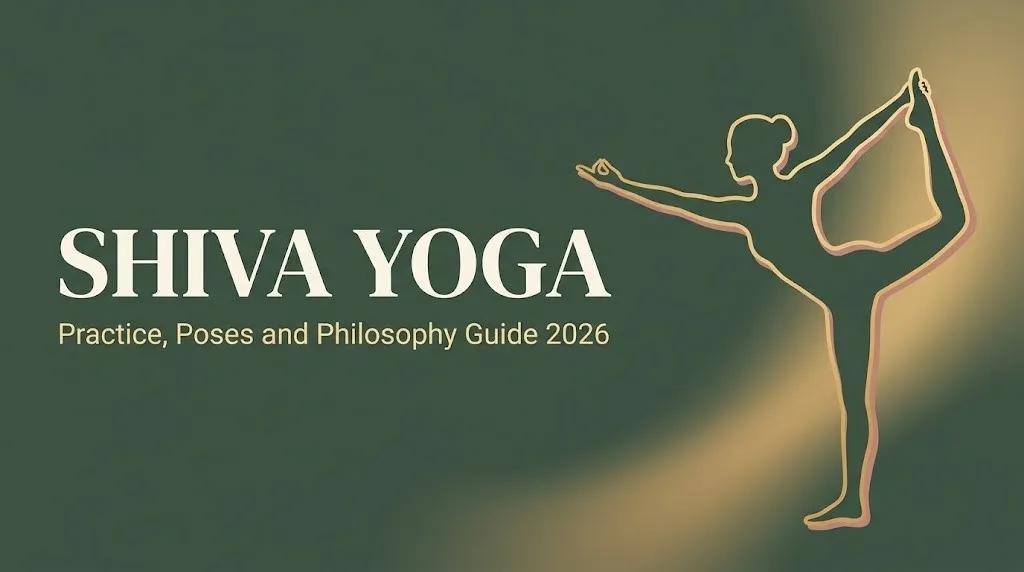
Natarajasana (Lord of the Dance Pose) is a standing balance backbend in which one foot is lifted behind the body, held by the same-side hand, while the other arm extends forward, embodying the dynamic cosmic dance of Nataraja, Shiva’s dancing form.
This is the pose most completely associated with Shiva yoga. Its shape directly mirrors the iconic bronze Nataraja sculptures found across South India and in collections worldwide. The standing leg represents the stillness beneath all movement. The lifted leg represents the dynamic, ever-changing nature of the universe.
To practice Natarajasana (Lord of the Dance Pose):
- Begin in Tadasana (Mountain Pose). Ground all four corners of both feet.
- Shift weight onto the left foot. Find a steady gaze point (drishti) at eye level.
- Bend the right knee. Bring the right foot toward the right buttock.
- Reach the right hand back. Hold the inner arch of the right foot with a firm grip.
- Press the right foot into the right hand. Lift the right leg up and back as the torso tips slightly forward.
- Extend the left arm forward and upward, fingers pointing toward the horizon.
- Keep the lifted knee pointing downward rather than flaring outward to the side.
- Hold for 4 to 5 breaths. Release slowly. Repeat on the left side.
Pose Tip:
- The standing knee must remain soft (slightly bent) rather than locked to protect the joint.
- The backbend in this pose should feel like an opening in the thoracic spine, not a compression in the lower lumbar.
- Modification for beginners or seniors: Stand near a wall. Touch the wall lightly with the extended hand for balance. Keep the lifted leg low, just a few inches off the floor, to build the foundational strength before deepening.
- Safety caution: practitioners with acute lower back pain, knee ligament injuries, or shoulder impingement should skip the full backbend version and practice a wall-supported, minimal-lift variation reviewed by a physical therapist.
Key Takeaway: Natarajasana is the signature pose of Shiva yoga because it physically embodies the two aspects of Shiva: the stillness of the grounded standing leg and the dynamic creative energy of the lifted, extended body.
Shiva Yoga Meditation Techniques
Shiva yoga meditation centers on the practice of Dhyana (sustained meditative awareness) and Dharana (concentrated focus), drawing from the 112 techniques described in the Vigyan Bhairav Tantra, many of which use the breath, sound, light, and space as objects of attention.
The Vigyan Bhairav Tantra describes meditation methods that range from breath observation to the contemplation of infinite space to the use of mantra as a vehicle for dissolving ordinary mental activity into pure awareness. These are among the oldest documented meditation instructions in the yoga tradition.
The most accessible Shiva yoga meditation for beginners uses the mantra Om Namah Shivaya as the anchor.
To practice Om Namah Shivaya mantra meditation:
- Sit comfortably in Sukhasana (Easy Seated Pose) or Vajrasana (Thunderbolt Pose).
- Close the eyes. Take 3 slow breaths to settle the body.
- Begin repeating Om Namah Shivaya silently in the mind, one syllable per natural breath moment.
- When the mind wanders, return to the mantra without self-criticism.
- Continue for 10 to 20 minutes. Close with 3 slow breaths before opening the eyes.
According to a study published in the International Journal of Yoga, mantra-based meditation practiced for 20 minutes daily over 8 weeks produced measurable reductions in perceived stress and improvements in attention regulation in adult practitioners.
Modification for beginners who find silent mantra difficult: speak the mantra quietly aloud for the first 5 minutes before transitioning to silent repetition. The auditory feedback helps anchor attention before the internal practice becomes stable.
Shiva Yoga Breathwork and Pranayama
The breathwork most central to Shiva yoga practice includes Ujjayi pranayama (Victorious Breath), Nadi Shodhana (Alternate Nostril Breathing), and Kapalabhati (Skull-Shining Breath), each of which serves a distinct function within the practice.
Breath in the Shiva yoga tradition is understood as the bridge between the gross physical body and subtler states of awareness. The Shiva Samhita, one of the classical Hatha yoga texts written from Shiva’s perspective as teacher, dedicates substantial instruction to pranayama as an essential component of the complete yoga path.
| Pranayama | Sanskrit Name | Primary Function | Practice Time |
|---|---|---|---|
| Victorious Breath | Ujjayi | Calms the nervous system; anchors attention during movement | Throughout asana practice |
| Alternate Nostril Breathing | Nadi Shodhana | Balances the two hemispheres of the autonomic nervous system | 5 to 10 minutes, seated |
| Skull-Shining Breath | Kapalabhati | Energizes and clears the respiratory tract; activates the sympathetic system | 3 rounds of 30 breaths |
| Three-Part Breath | Dirga Pranayama | Calms anxiety; trains full diaphragmatic breathing | 5 to 10 minutes before meditation |
Nadi Shodhana (Alternate Nostril Breathing) deserves particular attention in a Shiva yoga context. The practice is said to balance the Ida nadi (lunar, cooling, left-side energy channel) and the Pingala nadi (solar, warming, right-side energy channel), bringing the practitioner to a state of equilibrium that makes deeper meditation possible.
To practice Nadi Shodhana (Alternate Nostril Breathing):
- Sit in Sukhasana (Easy Seated Pose). Spine upright.
- Bring the right hand to Vishnu mudra: fold the index and middle fingers to the palm, keeping the thumb, ring finger, and pinky extended.
- Close the right nostril with the right thumb. Inhale slowly through the left nostril for 4 counts.
- Close both nostrils. Hold for 4 counts (omit the retention if you have high blood pressure or heart conditions).
- Open the right nostril. Exhale for 8 counts.
- Inhale through the right nostril for 4 counts. Close both. Hold 4 counts. Exhale left for 8 counts. This is one complete round.
- Practice 5 to 10 rounds.
Modification: practitioners with high blood pressure, anxiety disorders, or respiratory conditions should omit the breath retention (step 4) and simply alternate the nostril without any hold. The breathing pattern alone produces calming effects without the hold.
A Sample Shiva Yoga Sequence for Beginners
A beginner Shiva yoga sequence integrates grounding postures, at least one pose associated with Shiva’s symbolism, a brief pranayama section, and a meditation period, creating a complete practice that honors both the physical and contemplative dimensions of the tradition.
This sequence runs approximately 35 to 40 minutes at a beginner pace. Each pose is held for 4 to 5 breaths unless otherwise noted.
To practice a complete beginner Shiva yoga session:
- Seated centering (Sukhasana, Easy Seated Pose): 3 minutes of natural breath awareness. Set an intention connected to stillness or release.
- Nadi Shodhana (Alternate Nostril Breathing): 5 rounds as described in the previous section.
- Cat-Cow (Marjaryasana-Bitilasana): 8 slow rounds on hands and knees. Link breath to movement.
- Adho Mukha Svanasana (Downward-Facing Dog): 5 breaths. Lengthen through the spine.
- Tadasana (Mountain Pose): 5 breaths. Feel the body as the still center of movement.
- Vrksasana (Tree Pose): 4 breaths per side. Use a wall for support if needed.
- Virabhadrasana III (Warrior III): 3 breaths per side. Keep the standing knee soft.
- Natarajasana (Lord of the Dance Pose): Wall-supported version, 3 breaths per side.
- Balasana (Child’s Pose): 8 to 10 breaths. Complete rest and release.
- Setu Bandha Sarvangasana (Bridge Pose): 5 breaths. Counterpose after backbend emphasis.
- Savasana (Corpse Pose): 5 minutes. Complete stillness.
- Return to seated. Om Namah Shivaya mantra meditation: 10 minutes.
Modification for beginners: reduce the Warrior III and Natarajasana holds to 2 breaths each. Skip Natarajasana entirely in your first two sessions and replace it with an extended Vrksasana (Tree Pose) until balance confidence is established.
Key Takeaway: A complete beginner Shiva yoga session always includes physical postures, at least one pranayama technique, and a period of meditation or mantra, because the practice is architecturally incomplete without all three components working together.
Shiva Yoga Benefits for Body and Mind
Shiva yoga produces measurable physical and mental health benefits through its combination of movement, breath regulation, and meditation, with the strongest research evidence supporting its effects on stress, flexibility, balance, and cognitive function.
The breadth of benefits reflects the breadth of the practice. Because Shiva yoga incorporates physical postures, pranayama, and meditation in each session, it activates multiple physiological systems simultaneously.
Physical benefits supported by research:
- Balance and proprioception: Balancing poses like Natarajasana (Lord of the Dance Pose) and Vrksasana (Tree Pose) train the vestibular and proprioceptive systems. The National Center for Complementary and Integrative Health notes that regular yoga practice reduces fall risk in older adults.
- Flexibility and joint mobility: Sustained hip-opening and spinal extension postures improve connective tissue extensibility over time.
- Respiratory capacity: Pranayama practices, including Ujjayi and Nadi Shodhana, have been shown to increase lung capacity and slow resting respiratory rate in regular practitioners.
- Cardiovascular function: The combination of movement and breath regulation at a moderate intensity supports healthy resting heart rate and blood pressure.
Mental and cognitive benefits:
- Stress reduction: Mantra meditation and pranayama activate the parasympathetic nervous system, reducing cortisol output.
- Attention and focus: According to the International Journal of Yoga, regular meditation practice improves sustained attention and working memory in adult practitioners.
- Emotional regulation: The philosophical framework of Shiva yoga, emphasizing non-attachment and witnessing awareness, provides a cognitive tool for managing emotional reactivity over time.
Shiva Yoga and the Nervous System
Shiva yoga practices directly influence the autonomic nervous system by shifting the practitioner from sympathetic dominance (fight-or-flight) toward parasympathetic activation (rest-and-digest) through slow movement, extended exhalation, and meditative stillness.
This is the physiological mechanism behind what practitioners experience as calm, clarity, or presence after a Shiva yoga session. It is not mystical. It is documented neuroscience applied through ancient practice methods.
The vagus nerve plays the central role here. It is the primary nerve of the parasympathetic system, running from the brainstem through the heart, lungs, and digestive organs. Slow, diaphragmatic breathing, the kind practiced in Ujjayi and Nadi Shodhana, directly stimulates vagal tone. Higher vagal tone is associated with better emotional regulation, lower resting heart rate, and greater resilience to stress.
Think of the autonomic nervous system like a dimmer switch rather than an on-off toggle. Shiva yoga practices, particularly the long-exhale breathwork and extended meditation, gradually turn the stress dial down and the rest dial up over the course of a single session.
A study published in Complementary Therapies in Medicine found that yoga practitioners who combined movement with meditation and pranayama showed greater reductions in salivary cortisol (a primary stress hormone marker) than practitioners who performed physical yoga postures alone. The meditation and breathwork components drove a meaningful portion of the stress-reduction effect.
The seated meditation and mantra components of Shiva yoga also affect the hippocampus, the brain region involved in memory and emotional processing. Research in mindfulness-based practices suggests that regular meditation is associated with increased gray matter density in the hippocampus over time.
Shiva Yoga for Stress and Anxiety
Shiva yoga is particularly effective for stress and anxiety because it combines three evidence-based interventions, physical movement, breath regulation, and meditation, each of which independently reduces anxiety symptoms, and their combined effect is additive.
The sequencing within a Shiva yoga session matters for stress relief. The physical postures discharge accumulated muscular tension from the stress response. The pranayama component shifts the nervous system toward parasympathetic dominance. The meditation component trains the practitioner to observe anxious thoughts without being controlled by them.
A study published in the Journal of Alternative and Complementary Medicine found that an 8-week yoga intervention including physical postures, pranayama, and meditation reduced anxiety scores by a statistically meaningful margin in adults with self-reported anxiety, with the greatest improvements in participants who practiced at least 3 times per week.
For practitioners using Shiva yoga specifically for anxiety, the recommended entry point is the evening sequence: floor-based postures, Nadi Shodhana, and 10 to 20 minutes of mantra meditation before sleep. This combination targets the anxiety cycle at its most physiologically accessible moment, when the body is naturally moving toward rest.
Key practices for stress and anxiety within Shiva yoga:
- Nadi Shodhana (Alternate Nostril Breathing): 5 to 10 minutes before bed
- Om Namah Shivaya mantra meditation: 10 to 20 minutes daily
- Balasana (Child’s Pose): held for 2 to 3 minutes as a calming anchor
- Viparita Karani (Legs-Up-the-Wall Pose): 5 minutes as a restorative counterpose
Safety note: practitioners managing clinical anxiety disorders, panic disorder, or trauma-related conditions should work with a trauma-informed yoga teacher alongside, not instead of, their mental health treatment team.
Key Takeaway: For stress and anxiety, the three-part Shiva yoga structure of movement, pranayama, and mantra meditation is more effective than any single component practiced alone, so always include all three when using this practice for mental health support.
How to Start a Shiva Yoga Practice at Home
Starting a Shiva yoga practice at home requires only a mat, a quiet space, 10 to 20 minutes, and a willingness to begin with the simplest version of each component rather than waiting until you feel “ready enough.”
The most common mistake beginners make with Shiva yoga is treating the philosophy as a prerequisite to the practice. It works the other way around. The practice itself, the breath, the movement, the stillness, is what gradually opens understanding of the philosophy. You don’t need to know anything about Shaivism to begin.
A minimal daily home practice structure for beginners:
- 5 minutes of seated breath awareness (simply observe the natural breath without changing it)
- 5 minutes of gentle movement: Cat-Cow, Tadasana (Mountain Pose), and Vrksasana (Tree Pose) near the wall
- 5 minutes of Nadi Shodhana (Alternate Nostril Breathing)
- 5 minutes of Om Namah Shivaya mantra meditation
- Savasana (Corpse Pose): 2 to 3 minutes of complete rest
This is a 20-minute starting practice. It covers all four components of a complete Shiva yoga session in a time frame that is genuinely achievable before work or at the end of the day.
Props that support a home practice:
- A firm yoga mat for stability in balance poses
- A yoga block to sit on if the hips are tight in seated positions
- A blanket for Savasana (Corpse Pose)
- A wall for support in Natarajasana (Lord of the Dance Pose) and standing balances
Consistency matters more than duration. According to the Harvard T.H. Chan School of Public Health, brief daily mindfulness and movement practices produce greater long-term health benefits than less frequent but longer sessions, because the nervous system adapts through repetition rather than intensity.
Shiva Yoga for Seniors and Beginners: Modifications
Shiva yoga is fully accessible to seniors and beginners when key poses are adapted with props, reduced ranges of motion, and chair-supported alternatives that preserve the philosophical and physical intent of each practice element.
The meditative and breathwork components of Shiva yoga require no physical modification at all. Seated meditation and pranayama are equally accessible regardless of age or mobility. The physical postures are the element that requires thoughtful adaptation.
| Pose | Standard Version | Senior/Beginner Modification | Props Needed |
|---|---|---|---|
| Natarajasana (Lord of the Dance) | Full standing backbend with leg lifted high | Wall-supported, foot lifted only a few inches | Wall, strap optional |
| Vrksasana (Tree Pose) | Free-standing balance | One hand on wall; foot at ankle not thigh | Wall |
| Virabhadrasana III (Warrior III) | Full horizontal torso, arms extended | Hands on chair back, slight torso lean | Chair |
| Padmasana (Lotus Pose) | Full cross-legged floor sit | Sukhasana (Easy Pose) on a block or chair seat | Block or chair |
| Adho Mukha Svanasana (Downward Dog) | Full inversion on mat | Hands on wall at hip height (wall dog) | Wall |
| Nadi Shodhana (Alternate Nostril Breathing) | Full hand mudra with retention | Same mudra, no retention; slower counts | None |
For seniors with osteoporosis, deep forward folds and excessive spinal flexion should be minimized. The meditation and pranayama components can serve as the primary practice, with gentle postures as a brief warm-up rather than the focus.
Chair yoga adaptations of Tadasana (Mountain Pose) and Vrksasana (Tree Pose) maintain the grounding and balance-training benefits while removing the fall risk that standing poses carry for practitioners with balance concerns.
Is Shiva Yoga a Religion, a Philosophy, or a Practice
Shiva yoga is most accurately understood as all three, but in layers: at its foundation it is rooted in the religious tradition of Shaivism, its structural framework is philosophical, and its day-to-day expression is a set of concrete, learnable practices.
This question comes up constantly, and the honest answer is that the three layers cannot be fully separated from each other. But you can engage with each layer to whatever depth makes sense for your own background and intentions.
| Layer | What It Contains | Required for Practice? |
|---|---|---|
| Religious | Hindu deity Shiva, devotional rituals, temple worship, sacred texts as divine revelation | No. Religious observance is personal and optional for yoga practitioners. |
| Philosophical | Shaiva Siddhanta, Kashmir Shaivism, non-dual consciousness, the nature of awareness | Helpful but not prerequisite. Philosophy deepens practice over time. |
| Practical | Poses, pranayama, mantra meditation, sequence structure, breathwork techniques | Yes. This is where yoga practice lives on the mat. |
The Yoga Alliance notes that yoga’s classical roots are embedded in Indian philosophical and spiritual traditions, and that modern yoga practice, as it has spread globally, encompasses a wide spectrum from purely physical practice to deeply devotional practice. Neither end of that spectrum is more “correct” than the other.
A practitioner who uses Shiva yoga techniques, the poses, the breathwork, the mantra, and the meditation, without holding any religious belief about Shiva as a deity is practicing legitimately and drawing genuine benefit. A practitioner who brings full devotional orientation to the same techniques is practicing legitimately too. The practices themselves are the common ground.
What Shiva yoga is not: it is not a single standardized school with one curriculum, one certification, or one agreed-upon sequence. It is a family of related traditions and modern practice styles united by their orientation toward Shiva’s role in the yoga lineage. That breadth is a strength, not a weakness.
Key Takeaway: You don’t need to adopt Hindu religious beliefs to practice Shiva yoga: the poses, pranayama, and meditation techniques stand on their own as effective, evidence-supported practices regardless of whether you engage with the philosophical or devotional layers.
Frequently Asked Questions About Shiva Yoga
What is Shiva yoga and how is it different from regular yoga?
Shiva yoga is a practice tradition that integrates physical postures, pranayama, mantra, and meditation within a framework rooted in the Shaiva traditions of Indian philosophy, with Lord Shiva as the originating teacher (Adiyogi) of all yogic knowledge.
It differs from mainstream modern yoga styles like Vinyasa or Hatha primarily in its explicit philosophical orientation and its consistent inclusion of meditation and mantra as core, non-optional practice components rather than optional additions.
For practitioners familiar with physical yoga only, Shiva yoga asks them to slow down, sit still, and work with the breath and mind as much as the body.
Do I have to be Hindu to practice Shiva yoga?
No. You do not need to be Hindu or to hold any religious beliefs to practice Shiva yoga.
The poses, pranayama, and meditation techniques within the Shiva yoga tradition produce physiological and psychological benefits independently of the practitioner’s religious orientation, as documented by research in the Journal of Alternative and Complementary Medicine and the International Journal of Yoga.
Engaging with the philosophical framework of Kashmir Shaivism or Shaiva Siddhanta is optional and can deepen practice over time, but it is not a prerequisite for beginning.
What is the best pose associated with Shiva yoga?
Natarajasana (Lord of the Dance Pose) is the pose most directly associated with Shiva yoga, as it physically embodies Nataraja, Shiva’s dancing cosmic form.
It combines standing balance, hip flexor opening, thoracic extension, and shoulder engagement in a shape that mirrors the iconic Nataraja bronze sculpture central to Shaiva iconography.
Beginners should practice the wall-supported version with the foot lifted only a few inches before progressing to the full expression of the pose.
Can beginners do Shiva yoga?
Yes. Beginners can practice Shiva yoga using modified versions of the poses, simplified pranayama without breath retention, and short mantra meditation periods of 5 to 10 minutes.
The beginner sequence in this guide, which uses wall support, a block for seated positions, and a 20-minute total session length, is designed specifically as an entry point into the full practice.
The meditative and breathwork components are often easier for beginners than the physical poses, so leaning into those elements from the start is a smart approach.
What breathwork is used in Shiva yoga practice?
The primary pranayama techniques in Shiva yoga are Nadi Shodhana (Alternate Nostril Breathing), Ujjayi (Victorious Breath), and Kapalabhati (Skull-Shining Breath).
Nadi Shodhana is used most often for its balancing effect on the autonomic nervous system and its role in preparing the mind for meditation.
Ujjayi breath is used throughout the physical practice to maintain steady attention and regulate the pace of movement, while Kapalabhati serves as an energizing clearing practice, typically at the beginning of a session rather than the end.
Shiva yoga rewards consistency over complexity. Start with the 20-minute beginner practice described in this guide: five minutes of breath awareness, five minutes of gentle movement, five minutes of Nadi Shodhana, and five minutes of mantra meditation.
Practice that sequence every day for two weeks. Notice what changes in how you move, breathe, and respond to stress. Add poses and extend the meditation period only when the basic structure feels genuinely settled.
The practice will grow with you. Begin where you are.