Best Yoga Mat for Carpet: Your 2026 Home Practice Guide
A yoga mat for carpet needs to solve a problem that standard mats were not designed for: gripping a soft, compressible surface instead of a hard floor. Most yoga mats work beautifully on hardwood or tile but shift, bunch, and slide the moment carpet enters the picture, turning a calming practice into a frustrating one.
Home yoga has grown consistently as a primary practice format. According to the National Center for Complementary and Integrative Health, more than 55 percent of American yoga practitioners report practicing at home at least part of the time. For many, carpeted rooms are the only available space.
This guide covers why carpet creates specific stability and grip problems, which mat materials and thickness levels actually solve them, when a yoga platform makes more sense than any mat, how carpet affects joint alignment in key poses, and what modifications make carpet-based practice safer for beginners, seniors, and people managing joint conditions.
Yoga Mat for Carpet: What Actually Works and Why
A yoga mat designed to work on carpet uses a bottom surface that grips soft fibers rather than a hard floor, which requires a fundamentally different approach to texture and base material than studio mats.
Standard yoga mats have a smooth or lightly textured rubber or PVC bottom. That texture grips hardwood or tile through friction against a firm, even surface. On carpet, the logic reverses. The mat bottom needs to sit on top of compressible, uneven fibers without sliding as weight shifts across it. A mat that is too light will ride the carpet pile. A mat that is too smooth will skate across it.
The most effective mats for carpet share three characteristics. They have a heavier weight, typically 5 to 7 pounds, that resists movement under load. They have a bottom surface with deeper texture, suction-cup patterns, or a grippy rubber compound that catches carpet fibers. They also have enough density to prevent the carpet pile from collapsing unevenly under your feet or hands during poses.
| Mat Bottom Type | Grip on Carpet | Grip on Hardwood |
|---|---|---|
| Smooth PVC | Poor to fair | Good |
| Open-cell natural rubber | Good | Excellent |
| Closed-cell foam (light) | Poor | Fair |
| Textured TPE | Fair to good | Good |
| Cork with rubber base | Fair | Good |
| Heavy suction-cup pattern | Good to excellent | Poor |
Can You Do Yoga on Carpet Without Any Mat at All?
You can do yoga on carpet without a mat, but the absence of a mat creates real problems for joint safety and practice quality that go beyond simple comfort.
Bare carpet offers some natural cushioning for floor-based poses like Balasana (Child’s Pose) and Setu Bandha Sarvangasana (Bridge Pose). For restorative or gentle Yin yoga sequences focused on seated and reclined shapes, some practitioners find bare carpet workable. The problems begin when standing, balancing, or bearing weight through the hands.
Without a mat, bare feet on carpet have no defined contact surface. The carpet pile compresses unevenly under the arch and heel, making it harder for the small stabilizing muscles of the ankle to find a consistent reference point. This is not a theoretical concern. The American Physical Therapy Association notes that proprioceptive feedback, the body’s ability to sense its position in space, depends heavily on a consistent surface signal. Carpet disrupts that signal. For standing poses, wrist-bearing poses, and any balance work, a mat is not optional. It is the tool that makes the practice functionally safe.
- Situations where bare carpet might be acceptable:
- Fully reclined poses with no weight-bearing through hands or feet
- Gentle seated meditation or breathwork
- Savasana (Corpse Pose) at the end of a session
- Balasana (Child’s Pose) used as a rest position between poses
Why Yoga Mats Slide on Carpet and How to Fix It
Yoga mats slide on carpet because the carpet surface is not fixed or firm. It moves.
On a hardwood floor, a rubber mat bottom pushes against a rigid, smooth surface and friction holds it in place. On carpet, the mat bottom pushes against fibers that themselves are attached to a backing that can shift. When you step forward in a lunge or press back into Adho Mukha Svanasana (Downward-Facing Dog), the force you apply travels through the mat into the carpet, and the carpet fibers simply compress and allow movement rather than resisting it.
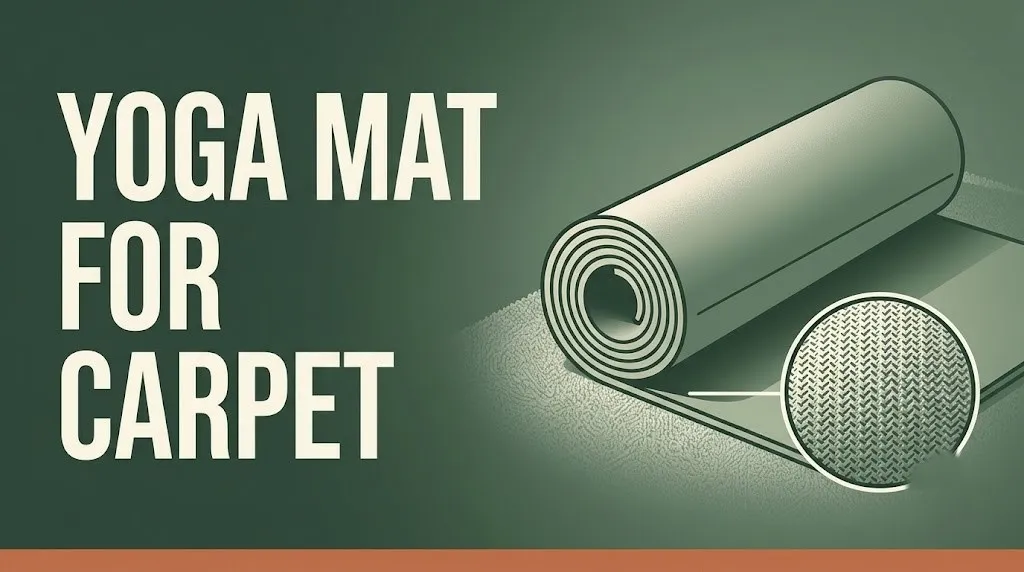
High-pile carpet, like shag or thick area rugs, is the worst offender. The pile is tall enough that the mat sits on top of fiber tips rather than making broad contact with the backing beneath. Think of it like trying to walk steadily on a surface of loosely packed tall grass. Nothing locks in. Low-pile or Berber-style carpet allows more mat contact area and is generally more stable for practice.
- Fixes that actually reduce mat sliding on carpet:
- Choose a mat weighing 5 pounds or more to resist movement under load
- Place a non-slip rug pad (the thin mesh-style type used under area rugs) beneath the mat
- Use a mat with a deep suction or open-cell rubber base designed for soft surfaces
- Avoid lightweight travel mats on any carpet type
- On high-pile carpet, consider a yoga platform board placed under the mat
Key Takeaway: The sliding problem is not about your mat being low quality. It is about physics. A mat designed for hard floors does not work on carpet for the same reason a hiking boot does not work on ice. You need the right tool for the surface you actually have.
What to Look for in the Best Yoga Mat for Carpet
The best yoga mat for carpet is one that prioritizes bottom-surface grip, mat weight, and density over top-surface texture or aesthetic design.
Most mat marketing focuses on the top surface, the part you touch and stand on. For carpet use, the bottom surface is what matters most. Look for a mat that explicitly describes its bottom material as designed for multiple surfaces or specifically mentions carpet compatibility. Mats that use a natural rubber base with an open-cell structure tend to perform best on carpet because the open cells conform slightly to the carpet fibers beneath, creating a broader contact zone.
Density is the second factor. A mat that compresses too easily underfoot adds its compression to the carpet’s compression, creating a double-layer instability problem. Yoga teachers and physical therapists generally recommend a mat with a density rating that keeps compression below 5 to 6 millimeters under typical body weight for carpet use. Very soft, highly cushioned mats marketed for joint protection often create more instability on carpet than they solve.
- Key features to evaluate when buying a yoga mat for carpet:
- Bottom surface material: natural rubber or textured TPE preferred over smooth PVC
- Weight: 5 pounds or more for carpet stability
- Thickness: 4 to 6 mm as the optimal range (explained in the next section)
- Density: firm compression, not soft foam feel
- Width: 26 inches or wider to reduce the chance of stepping off the mat onto carpet
- Length: 72 inches minimum, 74 to 80 inches for taller practitioners
Yoga Mat Thickness for Carpet: How Thick Is Too Thick
4 to 6 millimeters is the optimal thickness range for a yoga mat used on carpet. Going thicker than 6 mm on carpet creates a compounding instability problem that most practitioners do not anticipate.
Here is why: carpet already has give. Your mat adds its own give on top. A 10 mm foam mat on a medium-pile carpet can leave you feeling like you are standing on a mattress during standing poses. Your ankles constantly micro-adjust to compensate for the shifting base, which fatigues the stabilizing muscles of the ankle and lower leg and reduces the precision of your alignment in poses like Virabhadrasana I (Warrior I Pose) and Vrksasana (Tree Pose).
Mats marketed as “extra thick for joint protection” are often 8 to 10 mm thick. They serve a legitimate purpose on hard floors, where they provide cushioning for knees and wrists that would otherwise press against unforgiving tile. On carpet, that purpose is already partly served by the carpet itself. You do not need the extra thickness. What you need is density and grip.
| Mat Thickness | On Hard Floor | On Carpet | Best For |
|---|---|---|---|
| 1 to 2 mm | Good stability | Poor: no cushion | Travel, hot yoga studios |
| 3 to 4 mm | Standard studio feel | Good: stable, light cushion | Most practitioners on carpet |
| 5 to 6 mm | Good cushion | Good: balanced cushion and stability | Beginners, sensitive knees |
| 8 to 10 mm | Excellent cushion | Poor: double instability | Hard floors only |
Best Yoga Mat Materials for Carpet: Rubber, Cork, PVC, and TPE Compared
The material your yoga mat is made from determines how it interacts with carpet fibers, how it responds to moisture and sweat, and how long it holds up under the constant compression and release of home practice.
Natural rubber is the most consistently effective material for carpet use. Its open-cell structure grips surface irregularities rather than sliding over them. Natural rubber mats are also heavier, which helps them stay in place. The trade-off is cost and sensitivity: natural rubber mats should not be left in direct sunlight and are not appropriate for people with latex allergies.
TPE (thermoplastic elastomer) mats are a latex-free, mid-range option. They are lighter than rubber, which is a disadvantage on carpet, but their textured bottom surfaces can provide reasonable grip on low-pile carpet. They are more affordable than natural rubber and more environmentally friendly than PVC.
PVC mats are the most common type sold in gyms and big-box stores. A standard smooth-bottom PVC mat performs poorly on carpet. However, some PVC mats now feature textured or suction-pattern bases that improve carpet performance. Weight them in your hand before buying: a heavier PVC mat will always outperform a lighter one on soft surfaces.
Cork mats have a cork top surface bonded to a rubber base. The cork top provides excellent grip for sweaty hands. The rubber base generally performs well on carpet. The disadvantage is that cork mats can be stiff and require a break-in period.
| Material | Carpet Grip | Weight | Latex Safe | Eco-Friendly | Price Range |
|---|---|---|---|---|---|
| Natural rubber | Excellent | Heavy (5 to 7 lbs) | No | Yes | High |
| TPE | Fair to good | Light to medium | Yes | Yes | Mid |
| PVC (smooth base) | Poor | Light to medium | Yes | No | Low to mid |
| PVC (textured base) | Fair | Medium | Yes | No | Low to mid |
| Cork over rubber | Good | Medium to heavy | No | Yes | Mid to high |
Key Takeaway: For carpet specifically, mat material and weight matter more than brand. A heavy natural rubber mat at a mid-range price point will outperform a lightweight premium-brand mat every time on a soft surface.
Non-Slip Yoga Mat for Carpet: What Makes Grip Work on Soft Surfaces
A truly non-slip yoga mat for carpet does not rely on suction to a hard surface. Instead, it uses weight, base texture, and material density to resist movement on an inherently unstable surface.
The grip mechanism on carpet is different from the mechanism on hardwood. On hardwood, a rubber mat bottom creates a seal-like contact that resists horizontal force. On carpet, that seal-based mechanism does not work because the surface is not flat or firm. Instead, grip on carpet comes from: the mat being heavy enough that its inertia resists movement, the base texture being coarse or open enough to catch in the carpet pile rather than ride on top of it, and the mat being dense enough not to compress into the carpet and lose contact area.
Some mats use a “patterned base” design featuring raised dots, ridges, or hexagonal patterns. These patterns are designed specifically for hard floors. On carpet, they can actually reduce grip because the pattern peaks create a smaller total contact area with the uneven carpet surface. A flat but textured or open-cell rubber base typically outperforms a patterned base on carpet.
Pose Tip:
- Test your mat’s carpet grip by pressing one hand into the mat surface and pushing sideways with moderate force. If the mat slides more than one inch, it will slide during practice.
- A yoga rug or microfiber mat layer placed on top of any bottom mat adds no grip on carpet. The grip solution is always at the bottom surface.
- Placing a thin non-slip rug pad beneath your mat is the fastest, most affordable grip upgrade available for any mat type.
Yoga Platform for Carpet: When a Mat Alone Is Not Enough
A yoga platform for carpet is a rigid, portable board or panel placed directly on the carpet to create a hard, level surface before the yoga mat is placed on top.
Some practitioners and some carpeted spaces genuinely cannot be solved by mat selection alone. Very thick carpet, deep-pile rugs, or carpeted surfaces over uneven subfloors create instability that no mat weight or texture can fully compensate for. For these situations, a portable yoga platform, sometimes called a yoga board or yoga floor panel, provides the hard surface that mat-on-carpet cannot replicate.
Yoga platforms for home use are typically made from high-density polyethylene or rigid composite materials. They measure approximately 24 by 72 inches, matching a standard yoga mat footprint. The practitioner places the platform on the carpet and then places their yoga mat on top of the platform. The result is functionally equivalent to practicing on a hardwood floor.
This solution is particularly relevant for: practitioners doing Iyengar yoga where precise alignment on a stable surface is fundamental, seniors or people with balance conditions who need maximum predictability underfoot, and anyone practicing strong balancing sequences like standing one-leg poses.
- Situations where a yoga platform for carpet is the right call:
- High-pile, shag, or thick area rug surfaces where mats slide regardless of weight
- Balancing pose sequences requiring maximum stability
- Iyengar yoga or any alignment-focused practice where surface precision matters
- Practitioners with ankle instability, vestibular conditions, or balance disorders
- Anyone practicing inversions or arm balances at home on carpeted floors
Doing Yoga on Carpet: Which Poses Work and Which to Modify
Most yoga poses can be adapted for carpet practice. The ones that require the most attention are weight-bearing hand poses, standing balance poses, and any sequence involving precise foot placement.
Floor-based and reclined poses work well on carpet, often better than on a bare hard floor. Poses like Setu Bandha Sarvangasana (Bridge Pose), Balasana (Child’s Pose), and Supta Baddha Konasana (Reclined Bound Angle Pose) benefit from the natural cushioning carpet provides beneath the spine and hips. The carpet absorbs pressure that would otherwise concentrate on bony prominences.
Standing poses require more attention. In Virabhadrasana II (Warrior II Pose), the back foot needs a stable, non-shifting base to anchor the pelvis correctly. On carpet, the back foot can rotate or sink into the pile, which changes the hip alignment and loads the back knee differently. Shortening the stance by two to four inches compared to your studio practice compensates for this reduced stability.
Wrist-bearing poses like Adho Mukha Svanasana (Downward-Facing Dog) and Marjaryasana-Bitilasana (Cat-Cow Pose) are safe on a firm mat over carpet, but wrist alignment requires extra monitoring. If the mat compresses under your hands, your wrists can drift into excessive extension without the usual floor-resistance feedback.
Modification for wrist-bearing poses on carpet: Place a folded blanket or yoga block under the heel of each hand to reduce wrist extension angle. This creates a slight ramp that takes pressure off the wrist joint.
Key Takeaway: Carpet does not make yoga impossible. It simply shifts which poses need modification and how much attention you give your foot and hand placement. Floor poses often feel better on carpet. Standing and balance poses need a firmer mat and sometimes a shortened stance.
Standing Yoga Poses on Carpet and Joint Alignment Risks
Standing yoga poses on carpet create a specific biomechanical challenge: the base of support shifts slightly with every weight transfer. That constant micro-shifting demands more work from the ankle stabilizers, peroneal muscles, and tibialis anterior than a stable hard surface would.
In a studio on hardwood, your foot presses into a firm, predictable surface. The floor does not move. The sensory receptors in your foot and ankle receive a consistent signal and can fine-tune balance efficiently. On carpet, the signal is slightly blurred. The carpet gives a little. The mat gives a little more. The combined compression can reduce proprioceptive clarity, which is the body’s spatial awareness system, enough to increase wobble in standing poses.
For most healthy practitioners, this extra demand is minor and even slightly beneficial. Practicing balance poses on a mildly unstable surface trains the ankle stabilizers similarly to how balance board exercises work in physical therapy. However, for practitioners with ankle injuries, vestibular disorders, or neurological conditions affecting balance, the added instability of carpet can increase fall risk meaningfully.
According to the Journal of Bodywork and Movement Therapies, surface instability during single-leg stance exercises increases ankle and hip muscle activation compared to stable surfaces, with both positive training effects and increased fatigue at higher instability levels.
- Modifications for standing poses on carpet:
- Practice Vrksasana (Tree Pose) near a wall. Touch one finger to the wall for orientation without relying on it for support.
- In Virabhadrasana I (Warrior I), shorten the stride length to reduce the instability zone between front and back foot.
- In Trikonasana (Triangle Pose), place a block under the lower hand instead of reaching all the way to the floor. This reduces lateral load on the carpet-side foot.
Wrist Pain and Knee Pain Doing Yoga on Carpet
Wrist pain and knee pain in carpet-based yoga practice usually share the same root cause: too much surface compression under the joint, which allows the joint to sink beyond its stable range without adequate resistance feedback.
Wrist pain in carpet yoga most often appears in poses that load the wrists with the palm flat on the mat. When the mat and carpet compress together under your hands, the wrist extends further than it would on a hard floor. The extensor tendons of the wrist and the structures of the carpal tunnel experience increased strain at greater extension angles. Practitioners with a history of carpal tunnel syndrome or wrist tendinopathy should be particularly attentive.
The fix is practical. Fold a yoga blanket and place it under the heel of each hand, creating a slight elevation that reduces the extension angle. Alternatively, use yoga wedges specifically designed to reduce wrist extension. Both approaches bring the wrist closer to a neutral position.
Knee pain on carpet typically appears in kneeling poses like Anjaneyasana (Low Lunge) and during transitions to and from the floor. The soft surface allows the kneecap and its surrounding tissue to press unevenly into the mat, especially on a thin mat. A folded blanket placed beneath the knee in any kneeling pose is the most effective solution. Yoga teachers and physical therapists generally recommend at least 6 mm of combined cushioning (mat plus any added padding) beneath any kneeling joint.
Yoga on Carpet for Seniors: Cushioning, Stability, and Safety
Yoga on carpet for seniors requires balancing two competing needs: enough cushioning to protect joints during floor transitions, and enough stability to prevent falls during standing work.
Carpet’s natural cushioning is genuinely beneficial for older practitioners getting down to and up from the floor. The soft surface reduces the jarring impact on knees and hips during transitions like moving from standing to kneeling or sitting. For this reason, many older adults who practice at home on carpet actually experience more comfortable floor transitions than they would in a studio on hardwood.
The stability concern is more pressing. Seniors are at statistically higher risk for fall-related injury, and balance confidence on an unstable surface drops with age due to changes in the vestibular system, proprioceptive sensitivity, and lower limb strength. According to the National Center for Complementary and Integrative Health, yoga practice has been shown to improve balance and reduce fall risk in older adults, but the practice environment must itself be safe.
For seniors, the optimal carpet yoga setup combines a 5 to 6 mm dense mat with a non-slip rug pad beneath it, practice near a wall or sturdy chair for standing poses, and explicit use of a yoga block for any pose requiring hand contact with the floor. Balance poses should always be performed next to a wall during the first several months of carpet-based practice.
| Senior Yoga Need | Carpet Advantage | Carpet Risk | Solution |
|---|---|---|---|
| Joint cushioning in floor poses | Natural carpet padding helps | Mat can slide during transitions | Non-slip rug pad beneath mat |
| Balance in standing poses | None | Increased instability | Wall or chair nearby |
| Getting up and down safely | Soft landing surface | Mat edge can trip | Wide mat, clear edges |
| Knee comfort in kneeling | Carpet adds cushion | Uneven compression | Blanket under knees |
Key Takeaway: For seniors specifically, the carpet environment is a two-sided equation. Use its cushioning advantage fully for floor poses, and actively manage its instability risk for standing and balance work by setting up a wall support system before practice begins.
Yoga on Carpet for Beginners: Setting Up a Safe Home Practice
For beginners, a carpeted home space is often the first and only practice environment available, and that is genuinely fine with the right setup. The goal is creating conditions where attention can go to learning poses rather than managing a sliding mat.
Start with the surface itself. If you are on a thick shag or high-pile carpet, either place a thin rigid board under your mat or choose the lowest-pile carpeted area in your home. A rug pad under the mat is a non-negotiable first purchase, more important than buying an expensive mat.
Next, designate a practice area that gives you at least 2 feet of clearance on all four sides of your mat. Beginners step off mats regularly, especially during balance poses and transitions. Stepping off a mat onto carpet is safe. Stepping off a mat onto carpet and catching your foot on the mat edge is a trip hazard. Keep the surrounding floor area clear.
A yoga block on each side of your mat is the single most useful tool for carpet-based beginners. Blocks bring the floor to you when poses require hand contact, reducing the depth of reach and the wrist extension demanded by carpet-compressed surfaces. Most beginner pose errors on carpet relate to reaching too far to compensate for perceived instability.
- Basic setup checklist for beginners doing yoga on carpet:
- Non-slip rug pad placed beneath the yoga mat
- Dense mat at 4 to 6 mm thickness
- Two yoga blocks within arm’s reach
- Wall within one step for balance pose support
- Clear 2-foot perimeter around the mat on all sides
- A yoga blanket for kneeling poses and Savasana (Corpse Pose)
How to Stop Your Yoga Mat From Sliding on Carpet
Stopping a yoga mat from sliding on carpet requires addressing the mechanical cause, which is that carpet fibers provide no fixed resistance to horizontal force from below the mat.
The most reliable solution combines two things: a heavier, denser mat and a non-slip rug pad beneath it. The rug pad does not need to be expensive or thick. A standard 1 to 2 mm open-weave non-slip rug pad cut to mat size creates enough friction between the carpet backing and the mat bottom to dramatically reduce sliding. These pads are widely available at hardware and home goods stores and cost a fraction of a premium yoga mat.
If you already own a mat you like and do not want to replace it, the rug pad solution is your best first move. Simply place the pad on the carpet, place your mat on top of the pad, and practice as normal. The pad acts as the grip layer between two surfaces that would otherwise allow movement.
For stubborn sliding on very thick carpet, a second option is to place a thin wooden panel or yoga platform board under both the rug pad and the mat. This creates a complete hard-surface sandwich: floor board on carpet, rug pad on board, yoga mat on pad. The result is a stable, non-moving practice surface that functions like a studio floor.
- Ranked solutions for stopping yoga mat sliding on carpet:
- Non-slip rug pad beneath any existing mat (most affordable, most effective for most carpets)
- Heavier mat with a natural rubber or open-cell base (best long-term mat investment)
- Yoga platform board beneath the mat (best for high-pile carpet or balance-sensitive practitioners)
- Double mat layering (placing a rubber-base mat on top of a flat foam base) works on some surfaces but adds height and instability on thick carpet
Yoga on Carpet Without a Mat: Is It Safe or Risky
Practicing yoga on carpet without a mat is safe for some pose categories and genuinely risky for others. The safety depends entirely on which poses you are doing and the condition of your joints.
For fully reclined and seated poses, bare carpet is a functional option for most practitioners. The surface provides cushioning, the body is not asking carpet to resist lateral force, and the proprioceptive demands are low. Practices like Restorative yoga and Yin yoga, which consist primarily of supported, passive holds on the floor, can be done on carpet without a mat using folded blankets for additional joint padding.
The risk category is everything else. Standing poses, balance poses, any weight-bearing through the hands, and any dynamic transitions between poses all require a defined, stable surface boundary. Without a mat’s edge to orient you spatially, beginners and seniors in particular lose the visual and tactile boundary that helps them track foot and hand placement relative to their center of mass.
From a joint safety standpoint, the wrists are the highest-risk area for mat-free carpet practice. In poses like Adho Mukha Svanasana (Downward-Facing Dog) and Marjaryasana-Bitilasana (Cat-Cow Pose), the palm needs firm, consistent resistance beneath it. Bare carpet cannot provide that. The wrist sinks into the pile and extends beyond its comfortable range without the practitioner necessarily noticing until discomfort or injury appears.
- Clear verdict by pose type:
- Reclined and seated poses: Bare carpet is acceptable with blanket padding
- Standing poses: Bare carpet is risky without a mat
- Balance poses: Bare carpet significantly increases fall risk
- Wrist-bearing poses: Bare carpet is unsafe for most practitioners
- Kneeling poses: Bare carpet is acceptable with blanket beneath the knee
Key Takeaway: No mat on carpet is a workable arrangement for gentle floor-based practice. For anything standing, balancing, or weight-bearing through the hands, skipping the mat on carpet is not a shortcut. It is a setup for joint strain or a fall.
Frequently Asked Questions About Yoga Mat for Carpet
What is the best type of yoga mat to use on carpet?
The best yoga mat for carpet is a heavy, dense mat with a natural rubber or open-cell base, ideally weighing 5 pounds or more and measuring 4 to 6 mm thick.
Natural rubber mats grip carpet fibers better than smooth PVC mats because their base conforms slightly to the uneven surface below.
Pair any mat with a non-slip rug pad beneath it for maximum stability on any carpet type.
Can I do yoga on carpet without a mat?
You can practice gentle reclined and seated yoga poses on carpet without a mat, using folded blankets for additional joint cushioning.
For standing poses, balance poses, or any weight-bearing through the hands, practicing without a mat on carpet increases wrist strain and fall risk.
A mat is not just about comfort. It is the stability and proprioceptive feedback tool that makes standing and balance work safe on a soft surface.
Why does my yoga mat keep sliding on carpet?
Your yoga mat slides on carpet because carpet fibers compress and shift under horizontal force rather than providing the fixed resistance that hardwood or tile would.
The most effective fix is to place a thin non-slip rug pad beneath your mat, which creates a friction layer between the mat and the carpet backing.
Switching to a heavier mat with an open-cell rubber base also reduces sliding by increasing the contact area and weight resisting movement.
How thick should a yoga mat be for carpet?
A yoga mat used on carpet should be 4 to 6 mm thick. This range provides adequate cushioning without adding excessive instability to the already-soft carpet surface.
Mats thicker than 6 mm compound the give of the carpet beneath, creating a double-layer instability problem that affects balance in standing poses.
If you need extra joint cushioning for knees or hips, add a folded blanket under the specific joint rather than using an overall thicker mat.
Is it safe to do balance poses on a carpeted floor?
Balance poses on carpet are generally safe for healthy practitioners using a firm, heavy mat placed on a non-slip rug pad, especially near a wall for orientation.
The unstable surface increases demand on ankle stabilizers and slightly blurs proprioceptive feedback, which can be a useful training effect for most people.
Practitioners with ankle injuries, vestibular disorders, or significant balance challenges should practice all single-leg balance poses next to a wall or sturdy chair on carpet.
Your Next Step on the Mat
The right yoga mat for carpet does not need to be the most expensive one in the store. It needs to be the correct weight, the right thickness for your carpet type, and paired with a non-slip rug pad that costs less than most yoga accessories.
Start there. Get a rug pad under whatever mat you already own and notice immediately how much more stable your practice feels. Then, if you want to invest in a mat built for carpet, prioritize weight and base material over brand.
Your carpet is not a problem to overcome. With the right setup, it is a perfectly functional home practice space. One block on each side, a rug pad underneath, and a wall within reach for balance poses. That is all you need to step onto your mat today.