Pilates Mat vs Yoga Mat: Which Do You Need in 2026
A pilates mat vs yoga mat comparison comes down to three things: thickness, grip, and how your body contacts the floor during specific movements. These two mats look nearly identical on the shelf, but they are engineered for genuinely different physical demands.
The distinction matters more than most equipment guides admit. The National Center for Complementary and Integrative Health (NCCIH) reports that roughly 21 million Americans practice yoga and tens of millions more engage in Pilates-based exercise annually. Most of them are buying mats without knowing what separates one from the other.
This article covers exactly that. You’ll learn how mat thickness affects joint protection, why grip behaves differently in yoga versus Pilates, which mat serves specific health needs, and when one mat can replace two.
Pilates Mat vs Yoga Mat: The Core Difference
A Pilates mat is thicker and more densely cushioned than a yoga mat, designed to support spinal rolling movements and protect the spine and hip bones during floor-based exercise. A yoga mat is thinner and grippier, designed to keep you stable when bearing weight through your hands and feet in standing and balancing poses.
Both are rectangular foam or rubber surfaces used on the floor. That’s where the similarity ends.
The functional difference comes from what each discipline asks of your body. Yoga distributes weight across four contact points repeatedly: two hands and two feet. Pilates frequently requires the spine itself to contact the mat, rolling across each vertebra individually. Those are two completely different engineering problems.
Here’s a side-by-side overview:
| Feature | Yoga Mat | Pilates Mat |
|---|---|---|
| Typical thickness | 3mm to 6mm | 8mm to 15mm |
| Primary function | Grip and stability | Cushioning and support |
| Surface texture | Tacky, non-slip | Smooth or lightly textured |
| Primary contact points | Hands, feet | Spine, hips, knees |
| Weight | 1.5 to 3 lbs | 2 to 5 lbs |
| Common materials | Natural rubber, TPE, PVC | High-density foam, PVC |
What Makes a Yoga Mat Different from a Pilates Mat?
A yoga mat is specifically built to create friction between your skin and the surface, preventing slipping during weight-bearing poses and dynamic transitions.
In Hatha, Vinyasa, or Ashtanga yoga, you’re moving in and out of poses like Adho Mukha Svanasana (Downward-Facing Dog) and Urdhva Mukha Svanasana (Upward-Facing Dog), where your palms and the balls of your feet carry your full body weight. Slip even a centimeter and your alignment collapses. Your grip surface is not a nice-to-have. It is load-bearing.
Standard yoga mats are engineered with an open-cell or micro-textured surface that increases static friction as pressure increases. The more you push down, the more they grip. This property is called proprioceptive feedback, and it’s one reason yoga teachers and physical therapists generally recommend thinner mats over thick ones for standing balance work.
Key properties of a yoga mat:
- Surface tack: Prevents hand and foot slippage during weight-bearing poses
- Thickness range: 3mm to 6mm, thin enough to feel the floor through the mat
- Material options: Natural rubber, TPE, PVC, cork
- Closed vs. open cell: Open-cell mats absorb sweat; closed-cell mats resist moisture
- Portability: Thinner mats roll tightly and travel easily
Is a Pilates Mat the Same as a Yoga Mat?
No, a Pilates mat is not the same as a yoga mat, despite looking similar in most fitness stores and online listings.
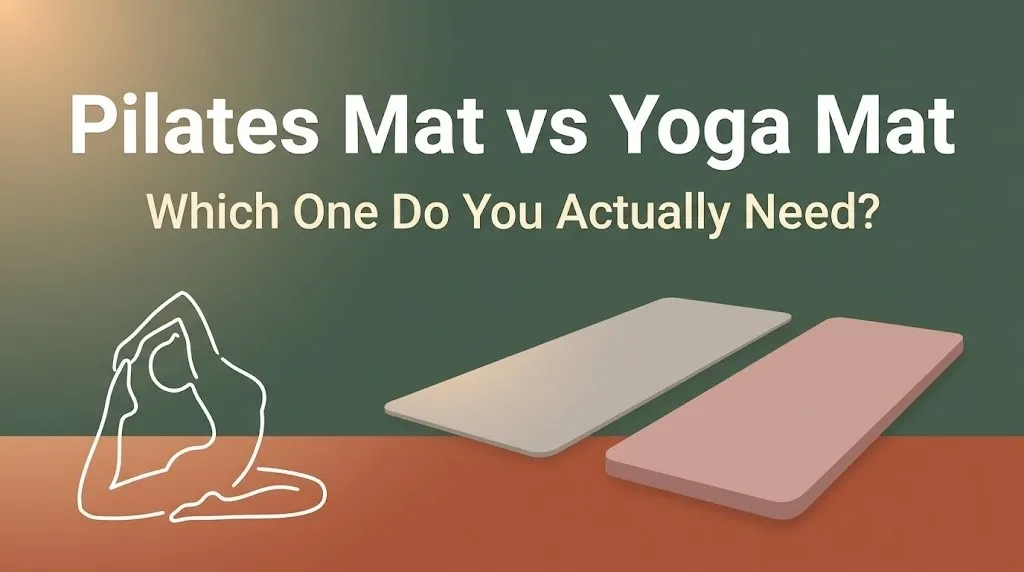
The two mats share a rectangular shape and a foam or rubber construction, but their foam density, thickness, and surface texture are different by design. A Pilates mat is typically two to four times thicker than a standard yoga mat.
This is not a marketing distinction. It reflects a real biomechanical difference. During mat Pilates exercises like rolling like a ball or spine stretch forward, each segment of the vertebral column contacts the mat sequentially. Without adequate cushioning, this creates discomfort at bony prominences: the sacrum, thoracic spinous processes, and coccyx. The American Council on Exercise (ACE) notes that proper equipment selection is part of reducing injury risk in floor-based exercise programs, and cushioning for spinal contact is one of the primary considerations.
Quick Summary:
- A yoga mat prioritizes grip over cushioning
- A Pilates mat prioritizes cushioning over grip
- They are built for different primary contact points: feet and hands vs. spine and hips
- Using the wrong one doesn’t make the practice impossible, but it does change the experience materially
Key Takeaway: The core difference between a Pilates mat and a yoga mat is purpose: one grips, one cushions, and that distinction flows from exactly where your body meets the floor in each practice.
Pilates Mat vs Yoga Mat Thickness: What the Numbers Mean
Thickness is the single most discussed difference between these two mats, and the standard advice you’ll find elsewhere is incomplete.
Most yoga mats range from 3mm to 6mm thick. Most Pilates mats range from 8mm to 15mm thick. But thickness alone tells you less than thickness combined with foam density. A 10mm mat made of low-density foam compresses flat under body weight and offers almost no real cushioning. A 6mm mat made of high-density natural rubber provides more real-world support than that.
The relevant number is not just how thick the mat is. It is how much the mat compresses under load. Yoga teachers and physical therapists generally recommend testing a mat by pressing your knuckle firmly into it. If your knuckle hits floor, the mat is too thin for comfort-sensitive practices.
| Thickness | Best For | Not Ideal For |
|---|---|---|
| 1mm to 2mm (travel mat) | Experienced yogis, travel use | Beginners, joint sensitivity |
| 3mm to 4mm (standard yoga) | Vinyasa, Ashtanga, standing poses | Spinal rolling, knee contact work |
| 5mm to 6mm (thick yoga) | Beginners, moderate cushioning | High-grip precision poses |
| 8mm to 10mm (Pilates) | Mat Pilates, spinal rolling exercises | Standing balance poses |
| 12mm to 15mm (extra cushion) | Restorative yoga, seniors, joint issues | Any pose requiring ground connection |
A 2019 review published in the Journal of Bodywork and Movement Therapies examined how mat surface properties affect proprioceptive feedback in floor-based exercise. The researchers found that excessive cushioning reduces sensory input from the floor, which can compromise balance and joint awareness in standing poses.
Yoga Mat Grip vs Pilates Mat Grip: Why Surface Texture Matters
Grip is the feature that most directly separates how these two mats perform in actual practice.
Yoga mats are built with high-tack surfaces, meaning they resist lateral sliding even when wet or sweaty. Natural rubber mats produce grip through micro-suction. Cork mats become grippier as moisture increases. Both are ideal for yoga because poses like Virabhadrasana II (Warrior II Pose) and Trikonasana (Triangle Pose) involve long lateral foot placement with full body weight behind it. Any slip changes the entire alignment chain.
Pilates mats have a smoother or lightly textured surface. High grip is not a priority because most Pilates exercises are performed lying down, seated, or in tabletop position. You’re not typically bearing weight through your hands with full-body loading the way you are in yoga. The Pilates mat needs to stay put on the floor beneath you, but it does not need to grip your palms the way a yoga mat does.
The practical consequence: if you take a yoga class on a Pilates mat, you will likely feel your hands sliding during poses like Phalakasana (Plank Pose). If you take a Pilates mat class on a yoga mat, you may find the thin surface uncomfortable during spinal rolling or kneeling exercises.
- Yoga mat grip: High tack, essential for hand and foot weight-bearing
- Pilates mat grip: Moderate texture, floor-stabilizing rather than body-gripping
- Sweat factor: Open-cell yoga mats absorb sweat and maintain grip; closed-cell Pilates mats resist absorption but may become slippery when wet
Yoga Mat Size vs Pilates Mat Size: Dimensions and Space
Standard yoga mats measure approximately 68 inches long by 24 inches wide. This covers most body types adequately for standing and seated poses.
Pilates mats are typically 72 to 80 inches long and 24 to 36 inches wide. The extra length accommodates exercises performed lying fully extended, like the Pilates hundred or leg circles, where feet and arms reach simultaneously in opposite directions. The extra width creates a larger movement zone for hip-width leg exercises.
Tall practitioners (above 6 feet) should look for mats at least 72 inches long regardless of which discipline they practice. Standard 68-inch yoga mats leave the feet on cold floor during Savasana (Corpse Pose), which is a minor but persistently annoying problem.
| Dimension | Standard Yoga Mat | Standard Pilates Mat |
|---|---|---|
| Length | 68 inches | 72 to 80 inches |
| Width | 24 inches | 24 to 36 inches |
| Weight | 1.5 to 3 lbs | 2 to 5 lbs |
| Rolled diameter | 3 to 4 inches | 5 to 7 inches |
| Storage | Rolls tightly, bag-friendly | Wider roll, harder to carry |
One practical consideration for home practice: Pilates mats are harder to store neatly. Their density means they don’t compress into a tight roll. If closet space is limited, a high-quality 6mm yoga mat used for both practices is a reasonable trade-off.
Key Takeaway: Pilates mats are longer, wider, and heavier than yoga mats, which matters both for practice comfort and for home storage. Know your ceiling on both before you buy.
What Mat Do You Actually Need for Mat Pilates?
For mat Pilates specifically, you need a mat that is at least 8mm thick with high-density foam construction.
Mat Pilates is not Reformer Pilates. On a Reformer, the carriage and springs absorb force. On a mat, your body contacts the floor directly during every exercise. Exercises like rolling like a ball, the roll-up, shoulder bridge, and single-leg circles involve sustained contact between bony areas (spine, hips, sacrum) and the floor.
The ACE recommends that mat Pilates practitioners use a dedicated Pilates mat rather than a yoga mat specifically because spinal rolling exercises place repeated pressure on the thoracic spine and sacrum. A 3mm or 4mm yoga mat provides inadequate cushioning for these movements, especially for beginners who haven’t yet developed deep core activation to soften the roll.
What to look for in a mat Pilates mat:
- Minimum 8mm thickness with high-density foam that resists compression
- Non-slip bottom layer to prevent the mat from sliding across the floor
- Smooth or lightly textured top surface that allows for controlled clothing-over-mat movement
- Extra length (at least 72 inches) to accommodate fully extended leg work
- Moderate weight (3 to 5 lbs) indicating sufficient foam density
Modification note: If you already own a 4mm to 6mm yoga mat and aren’t ready to buy a second mat, fold it in half lengthwise at the area where your spine contacts the floor during rolling exercises. This doubles the cushioning temporarily. It is not a permanent solution, but it works for occasional practice.
Can You Use a Yoga Mat for Pilates?
Yes, you can use a yoga mat for Pilates, but with real limitations that depend on which exercises you’re doing and how sensitive your joints are.
For Pilates exercises performed seated, standing, or in tabletop position, a yoga mat works adequately. The grip is actually better than most Pilates mats, which helps when exercises like kneeling sidekick series or bird-dog variations require your hands and knees to stay put.
The limitation appears during spinal rolling and floor-lying work. A 3mm to 4mm yoga mat placed on a hard wood or tile floor gives minimal cushioning to the spine during exercises that roll vertebra by vertebra across the surface. For most people, this becomes uncomfortable within a single 45-minute session.
Can you use a yoga mat for Pilates? The honest answer: yes for low-intensity or seated-dominant Pilates formats, and yes with folding or layering for temporary spinal cushioning. No for intensive rolling-based mat Pilates programs if you have any spinal sensitivity, prior back injury, or are working on a hard floor.
A 2022 survey of certified Pilates instructors conducted by a fitness education organization found that roughly 65 percent of instructors recommend that beginners purchase a dedicated Pilates mat within their first month of regular home practice, primarily for spinal comfort and safety.
Mat for Vinyasa Yoga vs Mat for Yin Yoga: Why Your Style Changes Everything
The yoga style you practice changes what your mat needs to do, sometimes more than the pilates-versus-yoga distinction does.
Vinyasa yoga involves continuous movement, frequent transitions, and sustained weight-bearing through hands and feet. Sweat is common. You need maximum grip, moderate cushioning, and a surface that maintains traction under moisture. Natural rubber or open-cell TPE mats in the 4mm to 5mm range are the standard recommendation from yoga teachers and physical therapists for active flow styles.
Yin yoga involves long passive holds, sometimes three to five minutes per pose, with poses like Supta Baddha Konasana (Reclined Bound Angle Pose) and Viparita Karani (Legs-Up-the-Wall Pose). There is almost no weight-bearing through hands. What matters is comfort in sustained contact. A thicker mat (5mm to 6mm) or even a Pilates mat works well here.
Restorative yoga goes further: you’re supported by bolsters, blankets, and blocks, and poses are held for 10 to 20 minutes. The mat is literally just a layer between you and the floor. Cushioning matters more than grip.
| Yoga Style | Key Mat Need | Recommended Thickness | Grip Priority |
|---|---|---|---|
| Vinyasa / Ashtanga | Maximum grip, sweat resistance | 4mm to 5mm | Very high |
| Hatha | Balance of grip and cushion | 4mm to 6mm | High |
| Yin | Cushion for long holds | 5mm to 8mm | Moderate |
| Restorative | Comfort, props support most weight | 6mm to 10mm | Low |
| Hot yoga / Bikram | Sweat-proof grip, easy to clean | 4mm to 5mm | Very high |
The takeaway here is practical: if you practice Yin or Restorative yoga exclusively, a Pilates mat may genuinely serve you better than a standard yoga mat.
Key Takeaway: Your yoga style is as important as whether you practice yoga or Pilates when choosing a mat. A Vinyasa practitioner and a Yin practitioner need genuinely different surfaces.
Yoga Mat for Bad Knees: What to Look For
For people with knee pain, patellar issues, or conditions like osteoarthritis, mat thickness and density at the knee contact point is the most important mat specification.
During kneeling poses like Anjaneyasana (Low Lunge) and Vajrasana (Thunderbolt Pose), the weight of the entire upper body transfers through the patella and tibial tuberosity directly into the mat. According to the American College of Sports Medicine, joint protection during ground-based exercise includes ensuring adequate cushioning at bony contact points, particularly for people with existing joint conditions.
A standard 3mm yoga mat is generally inadequate for people with knee pain. Research suggests that a minimum of 6mm thickness with a dense, non-compressing foam or rubber is the baseline recommendation from physical therapists working with clients in floor-based exercise.
What to look for specifically:
- 6mm minimum thickness (tested by pressing your knuckle in and verifying your knuckle doesn’t touch floor)
- High-density foam or natural rubber that resists full compression under knee loading
- Extra-wide mat (at least 26 inches) to allow slight repositioning if one knee is more sensitive
- Non-slip bottom layer to prevent the mat from shifting during kneeling transitions
Modifications for knee sensitivity:
- Fold a yoga blanket into a 6-inch pad and place it under the kneeling knee only.
- Use a kneeling pad insert (a small secondary pad) within a standard yoga mat setup.
- In any kneeling pose, curl the toes under rather than pointing them to reduce pressure on the top of the foot and shift weight slightly.
People with acute knee injuries, recent knee surgery, or conditions affecting the meniscus should check with a physical therapist before returning to kneeling yoga or Pilates exercises.
Yoga Mat for Wrist Pain: Mat Properties That Help
Wrist pain during yoga is one of the most common complaints from beginners, and mat selection plays a small but real role in managing it.
In poses like Adho Mukha Svanasana (Downward-Facing Dog) and Chaturanga Dandasana (Four-Limbed Staff Pose), the wrists bear load in 70 to 90 degrees of extension. This is a demanding position for the carpal bones and the tendons of the wrist flexors. A slippery mat surface forces the hands to grip harder, increasing muscular tension throughout the forearm and into the wrist.
According to Yoga Alliance guidelines for safe instruction, mat surface traction is one of the environmental factors that yoga teachers should consider when supporting students with wrist discomfort. A high-grip mat reduces the muscular effort required to prevent slipping, which reduces cumulative wrist strain over a full session.
What helps:
- High-tack natural rubber or cork mat that requires minimal gripping effort from the hands
- Avoid very thick mats for wrist-bearing poses: a 10mm mat under the wrists during Downward Dog creates instability and increases wrist extension angle
- Use a mat with textured or lined hand zones that provide directional grip cues
Modifications for wrist pain:
- In Adho Mukha Svanasana (Downward-Facing Dog), press through the first knuckle of each finger rather than letting weight sink into the heel of the hand.
- Place a folded blanket or wedge under the heel of the hand to reduce extension angle by 15 to 20 degrees.
- Substitute forearm variations: Dolphin Pose replaces Downward Dog; forearm plank replaces full Phalakasana (Plank Pose).
People with diagnosed carpal tunnel syndrome, TFCC tears, or post-surgical wrist conditions should work with a physical therapist before attempting weight-bearing yoga poses.
Mat for Seniors Doing Yoga or Pilates: Safety and Comfort First
For older adults, mat selection is genuinely a safety issue. It is not just a comfort preference.
The National Center for Complementary and Integrative Health (NCCIH) includes yoga on its list of mind-body practices with research-backed benefits for older adults, including improved balance, reduced fall risk, and better flexibility outcomes. But those benefits depend on having a safe practice environment. An insufficient mat is one of the most preventable sources of discomfort and injury in senior yoga.
Seniors face three specific mat challenges: harder joints that need more cushioning, balance concerns that require a stable, non-sliding surface, and knees and hips that have less tissue padding than they once did.
Recommendations for seniors:
- Mat thickness: 8mm to 12mm is typically appropriate. This is the Pilates mat range, and it works well for gentle yoga too.
- Non-slip bottom surface: A mat that moves across a hardwood floor is a fall risk during standing poses. Test it before class by pressing down and sliding your foot.
- Low-to-the-ground format: Avoid very thick foam mats that create a wobbly surface during standing poses. Stable density matters as much as thickness.
- Large dimensions: A wider mat (at least 26 to 28 inches) gives more lateral room during side-lying and seated poses.
| Senior Concern | Mat Solution |
|---|---|
| Joint cushioning (knees, hips, spine) | 8mm to 12mm high-density mat |
| Balance instability | High-grip bottom surface, stable density |
| Getting up from the floor | Firm foam that doesn’t sink under load |
| Cold floors in winter | Thicker mat with insulating foam layer |
For seniors newer to yoga or Pilates, a Restorative yoga format or a chair yoga format may reduce the need for extended floor contact entirely, which changes the mat equation significantly.
Key Takeaway: For seniors, joint protection and slip resistance are the two non-negotiable mat features. A Pilates mat thickness with a non-slip bottom layer covers both needs adequately.
Pilates Mat for Beginners: Where to Start
Beginners to mat Pilates are best served by starting with a dedicated Pilates mat rather than improvising with a yoga mat, because early Pilates training involves a high volume of spinal rolling and floor contact work.
The beginner Pilates curriculum almost universally starts with foundational exercises: the hundred, the roll-up, single-leg circles, and rolling like a ball. Every one of these involves either sustained spinal contact with the mat or sequential spinal rolling. This is not incidental. It is the foundation of classical Pilates sequencing, which builds core activation from the floor up.
A beginner who starts these exercises on a 3mm or 4mm yoga mat on a hard floor will likely experience discomfort in the thoracic spine and sacrum within the first two sessions. That discomfort is not about the exercise. It’s about the mat.
What beginners actually need in a Pilates mat:
- 8mm to 12mm thickness with a dense foam core
- Non-slip bottom so the mat stays put during leg circle work
- 72-inch minimum length for full extension
- Easy-to-clean surface: Pilates involves close floor contact, and the mat surface should wipe clean easily
- Budget range: Adequate beginner Pilates mats are available in the $30 to $60 range. You don’t need to spend more to get the right properties.
Modification for beginners using a yoga mat temporarily: Place a folded bath towel under the mat in the thoracic region during rolling exercises. This adds 4mm to 6mm of padding at the most pressure-sensitive area without purchasing a second mat.
Natural Rubber vs TPE vs PVC: Which Mat Material Is Best?
Mat material is the factor most buyers overlook, and it affects performance, longevity, and health more than thickness alone.
Natural rubber is the premium choice for yoga mats specifically. It provides outstanding grip, excellent durability (5 to 10 years with proper care), and superior proprioceptive feedback. It’s biodegradable and produced from a renewable source. The drawback: natural rubber is heavy (up to 7 lbs for a 5mm mat), and people with latex allergies cannot use it.
TPE (thermoplastic elastomer) is the most balanced choice for most home practitioners. It is lighter than natural rubber, free of latex, and partially recyclable. Grip is good but not equal to natural rubber. Durability is moderate, typically three to five years. TPE is the most common material in mid-range Pilates mats.
PVC (polyvinyl chloride) is the most common material in budget mats. It grips well and is extremely durable (some PVC mats last 10 or more years with heavy use). The environmental and health concern: PVC production involves phthalates and other chemical plasticizers. The Harvard T.H. Chan School of Public Health has documented concerns around phthalate exposure from PVC-based consumer products, particularly during close skin contact. A sweaty yoga session with your face near a PVC mat involves real exposure potential. Many practitioners choose to avoid PVC for this reason.
| Material | Grip | Cushioning | Durability | Eco Profile | Price Range | Latex-Free |
|---|---|---|---|---|---|---|
| Natural Rubber | Excellent | Moderate | 5 to 10 years | Biodegradable | $80 to $150+ | No |
| TPE | Good | Good | 3 to 5 years | Partially recyclable | $30 to $80 | Yes |
| PVC | Good | Variable | 5 to 10+ years | Poor | $15 to $60 | Yes |
| Cork (over rubber) | Excellent wet | Moderate | 3 to 7 years | Sustainable | $60 to $120 | No (rubber base) |
Can You Use One Mat for Both Yoga and Pilates?
Yes, one mat can serve both practices, but only if you choose the right specifications and accept a small trade-off in each direction.
The mat that works best for both is a 6mm TPE or natural rubber mat with a high-density foam core and a high-grip top surface. At 6mm, you have more cushioning than standard yoga mats provide, which handles light Pilates floor work adequately. The high-grip surface keeps you stable in yoga poses. This is genuinely the middle ground.
What you give up: A 6mm dual-purpose mat is thinner than an ideal Pilates mat for intensive spinal rolling work. If your Pilates routine includes frequent rolling exercises (roll-up, spine massage, rolling like a ball), a 6mm mat is noticeably less comfortable than a dedicated 8mm to 10mm Pilates mat. You’ll feel it within a session.
The one-mat strategy works best for:
- People who take mixed classes (yoga and Pilates in the same week) and want one mat to carry
- Home practitioners doing light Pilates work without intensive rolling sequences
- Budget-conscious beginners who want to try both practices before committing to separate equipment
- Anyone doing Yin yoga or Restorative yoga alongside Pilates, since both prioritize cushioning over grip
The one-mat strategy works less well for:
- Dedicated mat Pilates practitioners following a classical program
- People with spinal sensitivity who feel discomfort on less-than-8mm surfaces
- Advanced yogis whose practice requires maximum grip precision in standing poses
Pose Tip:
- For yoga, use the full mat surface normally
- For Pilates spinal rolling, fold the mat in half lengthwise at your spine zone for extra cushioning
- Store one yoga blanket nearby for additional padding under knees or the sacrum
Key Takeaway: A 6mm high-density mat in natural rubber or TPE can handle both practices adequately. It’s not perfect for either at an advanced level, but it is a smart, practical starting point.
Frequently Asked Questions About Pilates Mats vs Yoga Mats
What is the main difference between a yoga mat and a Pilates mat?
The main difference is thickness and surface purpose: yoga mats are thinner (3mm to 6mm) with a high-grip surface for weight-bearing poses, while Pilates mats are thicker (8mm to 15mm) with denser foam for cushioning the spine during floor exercises.
Both are rectangular foam or rubber surfaces, but they are engineered around completely different contact points between the body and the floor.
Yoga mats grip your hands and feet; Pilates mats protect your spine and hip bones.
Can I use a yoga mat for Pilates at home?
Yes, a yoga mat can work for Pilates in many situations, especially for exercises performed seated or in tabletop position where spinal rolling is not involved.
For exercises that require rolling along the spine, like roll-ups or rolling like a ball, a standard 3mm to 4mm yoga mat on a hard floor will feel uncomfortable at the spine and sacrum.
Folding the mat in half at the spinal contact area adds temporary cushioning, but a dedicated Pilates mat is worth the investment if you practice mat Pilates more than once a week.
How thick should a Pilates mat be?
A Pilates mat should be at least 8mm thick with high-density foam that does not compress fully under body weight.
Thickness alone doesn’t tell the full story: a 10mm low-density foam mat collapses under load and offers less real cushioning than an 8mm high-density mat.
Test any mat by pressing your knuckle firmly into the surface. If you feel the floor, the mat is too thin for spinal rolling work.
What type of yoga mat is best for bad knees?
The best yoga mat for bad knees is 6mm or thicker with a high-density foam or natural rubber core that resists compression under kneeling load.
Place the mat’s extra cushioning beneath the kneeling knee by folding a section of the mat or adding a blanket, and use poses that reduce knee pressure by curling the toes under rather than pointing them.
People managing chronic knee conditions, including osteoarthritis or post-surgical recovery, should ask a physical therapist which kneeling poses and surface configurations are appropriate for their specific situation.
Is a natural rubber yoga mat better than TPE?
Natural rubber yoga mats outperform TPE mats in grip quality and proprioceptive feedback, making them the preferred choice for active yoga styles like Vinyasa and Ashtanga.
TPE mats are lighter, latex-free, and more affordable, which makes them a better fit for practitioners with latex sensitivity or those who prioritize portability and value.
Both are significantly better environmental choices than PVC mats, which involve chemical plasticizers and do not biodegrade.
Choosing the Right Mat Starts With Knowing What You’re Actually Doing
Match the mat to the movement, not the other way around. A Pilates mat is not a better yoga mat. A yoga mat is not a budget Pilates mat. They are designed around different physical demands.
Start with what you practice most. If your week is mostly yoga, get a 4mm to 6mm mat with high grip. If it’s mostly mat Pilates, get an 8mm to 10mm dense mat with a non-slip base. If you genuinely mix both, a 6mm high-density TPE or natural rubber mat is a reasonable compromise that serves both without perfecting either.
Bring a folded blanket to your first few sessions regardless. It costs nothing and solves nearly every cushioning problem while you figure out which mat truly fits the way you move.