Reach Yoga Pacific Beach: Complete 2026 Guide
Reach Yoga in Pacific Beach is a community yoga studio offering multiple class styles for every experience level, from first-timers who have never touched a mat to practitioners who want a technically demanding Vinyasa flow. Whether you’re a surfer with locked-up hips, a professional carrying chronic stress, or someone rebuilding after injury, understanding what this practice involves before you walk in makes your first class genuinely useful instead of just disorienting.
The National Center for Complementary and Integrative Health reports that yoga participation in the United States has grown consistently across all age groups, with adults citing flexibility, stress management, and pain relief as their primary motivations. That’s not coincidence. The research behind those outcomes is real, and this guide references it directly.
You’ll find everything here: which class style suits your body and goals, what the science says about yoga’s measurable benefits, how to prepare practically, what modifications exist for common physical limitations, and how to build a sustainable frequency that produces lasting change.
Reach Yoga Pacific Beach: What It Is and What to Expect
Reach Yoga Pacific Beach is a boutique community yoga studio located in one of San Diego’s most active coastal neighborhoods, offering a range of class formats in a non-intimidating, accessible environment for all experience levels.
The studio model is deliberate. Boutique community studios like Reach Yoga differ from large gym yoga programs in one important way: class sizes are intentionally smaller. Smaller classes mean teachers can observe your alignment, offer hands-on adjustments when appropriate, and address individual needs in real time. That is not a minor distinction for a beginner or someone returning from injury.
Pacific Beach itself shapes the student community. The neighborhood draws an unusually active population: surfers, paddleboarders, runners along the boardwalk, and outdoor fitness enthusiasts who need a counterbalance to high-impact activity. Yoga at a studio like Reach serves as both a complement to that active lifestyle and a standalone practice for people whose bodies need more support than outdoor movement alone provides.
Walking in for the first time, expect a welcoming reception, a brief conversation with the teacher about your experience and any physical concerns, and the opportunity to settle onto the mat before class begins. Teachers at community studios typically offer modifications throughout class, not just when someone visibly struggles.
Quick Summary: What to Expect at Reach Yoga Pacific Beach
- Class sizes: Smaller than gym yoga programs, more individual attention
- Formats available: Multiple styles across varying intensity levels
- New student experience: Teacher introduction, pose modifications offered throughout
- Community feel: Neighborhood studio atmosphere, regulars who know each other
- Location context: Pacific Beach, steps from the coast and an active outdoor community
Yoga Styles at Reach Yoga: Vinyasa, Hatha, Yin, and More
Reach Yoga Pacific Beach offers multiple yoga styles, and choosing the right one for your body and goals from the start saves weeks of trial-and-error.
Vinyasa yoga is a flowing practice where breath drives movement. Poses link together in continuous sequences. No two classes are identical, which keeps experienced practitioners engaged and challenged. The pace can range from moderate to vigorous depending on the teacher and the class designation.
Hatha yoga is slower and more alignment-focused. Poses are held longer than in Vinyasa, giving the teacher time to offer detailed cues and giving the practitioner time to feel what is happening in the body. Hatha is often the clearest entry point for people new to yoga.
Yin yoga involves passive holds of 3 to 5 minutes per pose, targeting connective tissue rather than muscular effort. The room is quiet, the pace is still, and the goal is depth of release rather than physical exertion. For anyone managing chronic hip tightness, lower back tension, or the kind of whole-body stiffness that builds from years of physical work, Yin is worth scheduling alongside more active formats.
Restorative yoga uses props to fully support the body in passive positions held for 5 to 20 minutes. There is virtually no muscular effort. The goal is nervous system downregulation, and the research supports it as genuinely effective for that purpose.
| Style | Pace | Primary Goal | Best For |
|---|---|---|---|
| Vinyasa | Moderate to vigorous | Strength, flow, breath | Some experience helpful |
| Hatha | Slow to moderate | Alignment, technique | Beginners, all levels |
| Yin | Very slow, passive | Connective tissue, release | Tight bodies, recovery |
| Restorative | Still, supported | Nervous system rest | Stress, injury recovery, seniors |
Vinyasa Yoga Pacific Beach: How the Flowing Style Works
Vinyasa yoga is a breath-synchronized movement practice where each transition between poses is linked to either an inhale or an exhale, creating a continuous, flowing sequence.
The word Vinyasa derives from Sanskrit and refers to the intentional placement of movement and breath together. In practice, this means you are never just moving through a sequence mechanically. Every transition has a breath attached to it, which demands a quality of attention that builds body awareness rapidly.
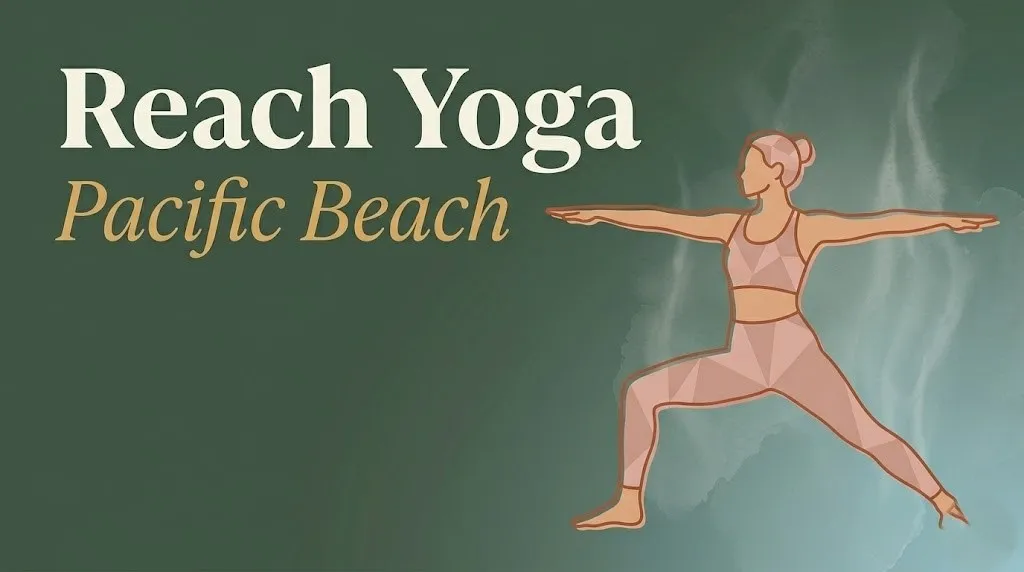
A standard Vinyasa class at a Pacific Beach studio typically opens with a seated or standing centering, builds through a warm-up sequence, progresses to peak poses that require preparation, and closes with cooling poses and Savasana (Corpse Pose). The structure varies by teacher, which is part of what makes Vinyasa appealing to practitioners who want variety.
The physical demand is real. A 60-minute moderate Vinyasa class elevates heart rate to moderate cardiovascular intensity for sustained periods. According to the American College of Sports Medicine, moderate-intensity aerobic activity produces cardiovascular health benefits, and Vinyasa yoga qualifies as moderate-intensity aerobic exercise for most healthy adults.
Modification note: Beginners new to Vinyasa should request the beginner or fundamentals session before attending a general mixed-level class. The pace of a general Vinyasa class can feel overwhelming if you’re still learning where your hands and feet go. There is no shame in starting at the stated skill level.
Pose Tip: Core Vinyasa Alignment
- In Adho Mukha Svanasana (Downward-Facing Dog), press all ten fingers into the mat. Do not let wrists collapse.
- Transition from Down Dog to a lunge by stepping one foot between the hands, placing the foot fully flat.
- Wrist sensitivity: use fists or place blocks under the hands to reduce wrist extension.
Key Takeaway: Choosing the right class style from the beginning matters enormously. Hatha suits new students who want alignment instruction; Vinyasa suits those ready to link movement to breath; Yin and Restorative suit people prioritizing release and nervous system recovery.
Hatha Yoga Pacific Beach: Alignment, Breath, and Stillness
Hatha yoga is a slower, more deliberate practice focused on physical postures and breath, where poses are held long enough for the practitioner to develop genuine understanding of alignment before moving on.
In many ways, Hatha is the foundation from which most modern yoga styles grew. The Sanskrit word “Hatha” refers to the balance of solar and lunar energies, but in practical studio use, it simply describes a class that prioritizes stillness and technique over pace and flow. Poses are held typically for 5 to 10 breath cycles before transitioning, giving both the teacher and the student time to work with alignment in detail.
This format is particularly effective for people who learn best by understanding why a pose is structured a certain way, not just what it looks like from the outside. A good Hatha teacher will explain which muscles should be engaging, which direction the joints are moving, and what sensation signals correct versus incorrect placement.
For Pacific Beach residents who are already physically active but new to yoga, Hatha often reveals compensatory patterns that sports and outdoor activities have built up over years. A surfer who can paddle for three hours but cannot fold forward past the mid-shin is carrying hamstring and hip flexor restriction that Hatha addresses systematically.
According to the International Journal of Yoga, Hatha yoga practiced twice weekly over 12 weeks produced measurable improvements in flexibility, balance, and self-reported physical function in adults across a range of ages and fitness backgrounds.
Modification note: If you cannot comfortably sit cross-legged on the floor without rounding your lower back, sit on a folded blanket or a block to elevate the hips. This is not a limitation. It is correct positioning that protects the lumbar spine during any seated pose.
Yoga Benefits Backed by Research
Yoga produces measurable, documented benefits for the body and mind, and those benefits begin accumulating from the first weeks of consistent practice.
The National Center for Complementary and Integrative Health (NCCIH) reviewed dozens of clinical trials on yoga and found consistent evidence for reduced stress and anxiety, improved sleep quality, decreased lower back pain, and improved physical function in adults across age groups. These are not vague wellness claims. They are outcomes documented in controlled studies with measurable endpoints.
Flexibility is the most immediately noticeable benefit for most new practitioners. Research published in the International Journal of Yoga found that participants who practiced yoga twice weekly for 8 weeks showed statistically measurable improvements in hamstring length and hip range of motion compared to non-practicing control groups.
Beyond flexibility, yoga’s effects on the cardiovascular and nervous systems are well-documented. Regular practice is associated with reduced resting heart rate, lower blood pressure in people with mild hypertension, and improved heart rate variability, a marker of autonomic nervous system health that correlates with stress resilience.
Key benefits with research support include:
- Reduced lower back pain: Documented in multiple studies reviewed by the NCCIH, with effects comparable to physical therapy for non-specific chronic low back pain
- Improved sleep quality: Self-reported and objective measures both improve in consistent practitioners
- Reduced cortisol: The primary stress hormone decreases measurably following yoga sessions in multiple reviewed trials
- Improved balance: Particularly in adults over 50, reducing fall risk
- Better body awareness: Proprioceptive improvement documented across yoga styles
One thing worth saying plainly: the benefits require consistency. A single class produces temporary flexibility increases and an hour of stress relief. Lasting change comes from showing up regularly over weeks and months.
Yoga for Flexibility and Range of Motion
Yoga improves flexibility by applying sustained, controlled stretch to muscles and connective tissue in ways that other forms of exercise rarely replicate.
Think of tight hamstrings like a rubber band that has been stored in a cold drawer for years. Pulling it fast and hard creates risk. Warming it slowly and holding a gentle stretch allows it to lengthen safely and progressively. That is exactly what yoga does, and it does it with the additional benefit of breath, which calms the nervous system’s tendency to contract muscles in response to stretch.
The proprioceptive element matters as much as the stretching itself. Yoga trains the nervous system to allow length, not just the muscles to tolerate it. People who stretch aggressively in gym settings but never gain lasting flexibility are often training the muscle but not the neural pattern that holds the tension. Yoga addresses both simultaneously.
Poses that produce the greatest flexibility gains for most Pacific Beach practitioners include:
- Paschimottanasana (Seated Forward Fold): Targets the entire posterior chain from calves through the lumbar spine
- Anjaneyasana (Low Lunge): Lengthens the hip flexors, chronically shortened in people who sit for work
- Gomukhasana (Cow Face Pose): Opens external hip rotators and the shoulder joint simultaneously
- Uttanasana (Standing Forward Fold): Decompresses the lumbar spine and stretches the hamstrings with gravity’s assistance
- Trikonasana (Triangle Pose): Stretches the hamstrings, obliques, and IT band in a lengthened lateral position
Modification note: In Paschimottanasana (Seated Forward Fold), loop a yoga strap around the feet if the hands cannot reach them. The goal is a flat back hinged forward from the hips, not a rounded spine straining toward the toes.
Yoga for Back Pain and Spinal Health
Yoga is one of the most well-researched non-pharmacological approaches for managing chronic lower back pain, and the evidence is stronger than most people realize.
The Spine Journal published findings showing that yoga produced pain reduction and functional improvement in adults with chronic non-specific lower back pain comparable to physical therapy at 12-week follow-up. The study controlled for expectation effects, making the results more credible than self-reported wellness surveys.
The mechanism works on several levels. Yoga strengthens the deep core stabilizing muscles, including the multifidus and transverse abdominis, that support the lumbar spine during daily movement. Weak core stabilizers force the larger global muscles to compensate, which creates the pattern of chronic back tension that so many desk workers and physically active people in Pacific Beach experience.
Yoga also addresses the hip flexor and hamstring tightness that contributes to lumbar load. Tight hip flexors pull the pelvis into anterior tilt, increasing the lumbar curve and compressing the posterior spinal structures. Lengthening the hip flexors through poses like Anjaneyasana (Low Lunge) and Ustrasana (Camel Pose) reduces this postural stress directly.
To practice Setu Bandha Sarvangasana (Bridge Pose) for spinal health:
- Lie on your back with knees bent and feet hip-width apart, parallel to each other.
- Press your arms flat along the sides of your body, palms facing down.
- Inhale and press through your feet to lift the hips toward the ceiling.
- Keep the knees tracking directly over the second toe. Do not let them splay outward.
- Hold for 5 to 8 breath cycles, then exhale and lower the spine vertebra by vertebra.
- Rest for 2 breath cycles before repeating.
Modification note: Anyone with lumbar disc herniation should lift only to a comfortable height, avoiding any position that increases leg pain or radiating sensation.
Key Takeaway: Yoga’s documented effectiveness for lower back pain comes from two sources: building deep core stability and reducing hip flexor tightness, both of which address the root causes of lumbar stress rather than just the symptoms.
Yoga for Surfers in San Diego: Why It Works
Yoga is exceptionally well-matched to the physical demands of surfing, and the Pacific Beach and Mission Bay surfing community benefits from it in specific, documented ways.
Surfing builds strong pulling muscles in the upper back and shoulders from paddling, tight hip flexors and quadriceps from the pop-up movement, compressed lower back from the arched spine position on the board, and chronic external rotation in the hips from the wide surf stance. Without counterbalancing movement, these patterns accumulate into overuse injuries over months and years.
Yoga addresses every one of those imbalances directly. Shoulder opening poses like Gomukhasana (Cow Face Pose) arms and Adho Mukha Svanasana (Downward-Facing Dog) restore length to the anterior shoulder capsule and pectoral muscles that paddling shortens. Hip flexor work in Anjaneyasana (Low Lunge) and backbend sequences counteracts the chronic hip flexion of the prone paddling position.
Research suggests that yoga’s balance and proprioceptive training translates directly to board sports performance. A study published in the Journal of Alternative and Complementary Medicine found that yoga practice improved dynamic balance measures in athletes, an outcome directly relevant to the constant weight-shifting demands of surfing.
| Surfing Imbalance | Caused By | Yoga Solution |
|---|---|---|
| Tight hip flexors | Prone paddling position | Anjaneyasana (Low Lunge), backbend sequences |
| Anterior shoulder tension | Paddle stroke repetition | Gomukhasana (Cow Face Pose) arms, chest openers |
| Compressed lower back | Arched spine on board | Balasana (Child’s Pose), spinal decompression |
| Limited thoracic rotation | Paddling pattern dominance | Trikonasana (Triangle Pose), seated twists |
| Ankle stiffness | Wide surf stance | Malasana (Garland Pose), ankle circles |
Modification note: Surfers with rotator cuff tendinopathy should skip full Adho Mukha Svanasana (Downward-Facing Dog) and substitute a table-top position or forearm-supported version until the shoulder has been cleared by a physical therapist.
Yoga for Stress and Mental Health
Yoga reduces stress through measurable physiological mechanisms, not just the feeling of having done something calming for an hour.
The breath regulation at the core of yoga practice, particularly ujjayi pranayama (victorious breath), activates the vagus nerve directly. Vagal activation shifts the autonomic nervous system from sympathetic dominance (the stress response) toward parasympathetic dominance (the rest and recovery state). This is not metaphor. It is measurable as changes in heart rate variability, blood pressure, and circulating cortisol levels.
According to the NCCIH, yoga is one of the few mind-body practices with consistent clinical evidence for anxiety symptom reduction. Multiple randomized controlled trials show that participants practicing yoga 2 to 3 times per week report lower perceived stress scores within 4 to 6 weeks.
For San Diego practitioners managing the pressures of demanding careers, family obligations, or the kind of low-grade chronic stress that coastal city living produces despite its apparent ease, yoga’s neurological effect is the most durable benefit. Flexibility and strength come with time. Nervous system regulation begins in the first few classes.
Pose Tip: Stress-Relief Priority Poses
- Savasana (Corpse Pose): The final 5-minute rest is non-negotiable. It is when nervous system integration happens. Never skip it.
- Balasana (Child’s Pose): Use it freely during class whenever the body or mind needs a pause.
- Viparita Karani (Legs-Up-the-Wall Pose): 5 minutes post-class against the studio wall reduces cortisol measurably and costs nothing.
What to Bring to Your First Yoga Class in Pacific Beach
Arriving at your first class at a Pacific Beach yoga studio with the right supplies removes the logistical friction that prevents many people from returning after a first visit.
The single most important item is a yoga mat. Most studios rent mats for a small fee if you don’t own one. Renting works perfectly for a first class. If you decide to practice regularly, investing in a personal mat is worth it for hygiene and grip quality.
Essential items for your first class:
- Yoga mat: Personal mat or studio rental. Non-slip grip matters more than brand.
- Water bottle: Bring at least 16 oz, even for a non-heated class. You’ll want it post-practice.
- Comfortable clothing: Fitted or semi-fitted athletic wear. Loose fabric falls into your face in forward folds.
- Grip socks: Optional, but useful if you tend toward cold feet or slippery mat surfaces.
- Small towel: For perspiration during active classes.
- Light snack for after: Especially if you practice before a meal.
What to leave behind:
- Heavy meals within 90 minutes of class (digestion and movement compete uncomfortably)
- Strong fragrances (other practitioners are close, and scent sensitivities are common in studios)
- Expectations of what your body “should” be able to do in the first class
Pacific Beach has a laid-back, welcoming culture that carries into its yoga studios. No one in the room is watching you. Every person on every mat is focused entirely on their own body and breath.
Key Takeaway: A personal mat, comfortable fitted clothing, and a water bottle cover 90% of first-class preparation. The rest is just showing up and letting the teacher guide you.
What to Expect at Your First Reach Yoga Class
Your first class at Reach Yoga Pacific Beach will feel unfamiliar in the first 10 minutes, manageable by minute 20, and noticeably good by the time you reach Savasana (Corpse Pose).
Arrive 10 to 15 minutes early. This gives you time to introduce yourself to the teacher, mention any injuries or physical concerns, choose a mat placement that feels comfortable (near the back wall if self-consciousness is a factor, near the front if you want to see the teacher’s demonstrations clearly), and let your body settle before movement begins.
The class will open with breath-based centering, move through a physical sequence appropriate to the format, and close with a resting period. That final rest is not filler. It is when the nervous system integrates everything that happened during class. Leaving before Savasana is the yoga equivalent of cooking a meal and skipping the eating.
You do not need to be flexible to attend. You do not need prior experience. You do not need to know any Sanskrit. You need a willingness to follow verbal cues, listen to your body, and take the modification whenever it’s offered.
Common first-class experiences that are entirely normal:
- Not knowing which way to face or where to place your hands
- Feeling physically challenged by poses that look simple
- Brief frustration when the flow moves faster than you can follow
- A sense of unexpected calm or heaviness in the legs following Savasana (Corpse Pose)
That last one is the nervous system doing exactly what yoga asks it to do. It gets more pronounced with consistent practice.
Yoga Props for Beginners: Blocks, Straps, and Bolsters
Yoga props are tools for correct alignment, not signs of limited ability. The most experienced practitioners use them deliberately and often.
A yoga block placed under the hand in Trikonasana (Triangle Pose) is not a cheat. It is the difference between a pose where the chest collapses and the breath is restricted, and a pose where the chest opens fully and the breath moves freely. The second version produces the anatomical benefit. The first does not.
| Prop | Primary Use | When to Use It |
|---|---|---|
| Yoga block (foam or cork) | Brings the floor closer; supports alignment | Standing poses, seated poses, backbend support |
| Yoga strap | Extends reach; maintains joint position | Forward folds, shoulder stretches, leg lifts |
| Bolster | Supports the body in passive positions | Restorative poses, Yin holds, pregnancy modifications |
| Yoga blanket | Padding for joints; elevation for hips | Seated poses, kneeling poses, Savasana warmth |
| Wall | Stability support | Balance poses, inversions, post-class rest |
Most Reach Yoga-style studios provide blocks and straps. Bolsters are typically studio property as well. You do not need to purchase props before your first class.
The most common beginner error with props is refusing to use them. Teachers offer props because they make the pose work correctly. Accepting a block when the teacher offers one is the smart response, not the embarrassing one.
Modification note: For anyone with wrist pain or weakness, yoga wedges placed under the heels of the hands in any weight-bearing wrist extension pose distribute load more effectively and reduce pressure on the carpal bones.
Is Yoga Safe for Beginners and People with Injuries?
Yoga is safe for most healthy beginners and for many people managing injuries or chronic conditions, with appropriate style selection and honest communication with the teacher.
The NCCIH notes that yoga is generally well-tolerated across a wide range of fitness levels, health conditions, and ages. The caveat is that “yoga” encompasses a spectrum from Restorative yoga with essentially no muscular demand to advanced Ashtanga sequences requiring significant strength and flexibility. Choosing the format appropriate to your current body matters.
For people managing specific injuries, these guidelines apply:
- Lower back injury: Begin with Hatha or Restorative. Avoid deep forward folds and twists until core stability improves.
- Knee injury or surgery: Avoid deep flexion in poses like Malasana (Garland Pose). Use blankets under the knee in any kneeling pose. Inform the teacher before class.
- Wrist injury: Modify all weight-bearing poses. Forearm versions of Adho Mukha Svanasana (Downward-Facing Dog) eliminate wrist load entirely.
- Shoulder impingement: Skip overhead arm positions. Work with the arms lower until a physical therapist clears overhead loading.
- Neck injury: Never roll the head in circles. Gentle side-to-side movement is acceptable. Avoid poses requiring the neck to bear weight.
One honest note: yoga done carelessly can cause injury, most commonly to the hamstrings, lower back, wrists, and knees. The protective factors are simple: an experienced teacher who watches the room, clear communication about your limitations before class, and willingness to use modifications rather than forcing a pose to look a certain way.
Yoga for Seniors in San Diego: Modifications and Considerations
Yoga is one of the most beneficial forms of movement available to older adults, and Pacific Beach’s year-round warm climate makes consistent practice more accessible than it is in most parts of the country.
Research published in the International Journal of Yoga found that adults over 60 who practiced yoga consistently showed measurable improvements in balance scores, functional mobility, and self-reported quality of life over 12 weeks. Balance improvement specifically is clinically relevant: falls are the leading cause of injury-related death in adults over 65 in the United States, according to the Centers for Disease Control and Prevention.
For seniors in San Diego considering Reach Yoga or any community studio, the format recommendations are clear:
- Start with Hatha or Gentle yoga: Slower pace, more instruction, time to understand each pose before moving on
- Restorative yoga is ideal: Complete support from props, no muscular demand, strong nervous system benefit
- Chair yoga is an excellent bridge: Allows all the benefits of yoga postures without requiring floor-based transitions that can be difficult with limited mobility or joint pain
Seniors taking medications that affect balance, blood pressure, or fluid regulation should be aware of how those drugs interact with physical exertion. Beta-blockers blunt the heart rate response to exercise, which can mask effort level. Diuretics increase dehydration risk. A brief conversation with the prescribing physician about beginning a yoga practice is appropriate for anyone managing cardiovascular medications.
Modification note: For any standing balance pose like Virabhadrasana II (Warrior II), seniors should practice with a chair placed nearby for stability support. Using the chair when needed is safer than falling trying to avoid it.
Key Takeaway: Yoga is particularly well-suited to older adults because it builds balance and functional mobility simultaneously, two capacities that decline with age and that yoga research consistently shows can be meaningfully preserved through regular practice.
Yoga Modifications for Common Limitations
Every standard yoga pose has a modification that makes it accessible for a body with different needs. Using modifications is not a step backward. It is how yoga actually works.
The most common physical limitations that new Pacific Beach students arrive with include tight hamstrings, limited shoulder mobility, wrist discomfort, lower back sensitivity, and tight hips from prolonged sitting or repetitive sport patterns. Each of these has a clear and effective modification.
To practice Adho Mukha Svanasana (Downward-Facing Dog) with modifications:
- Begin on hands and knees in table-top position, with wrists directly under shoulders.
- Spread fingers wide and press all ten fingertips into the mat.
- Tuck toes under and lift the hips toward the ceiling on an exhale.
- Keep a generous bend in both knees if the hamstrings pull the lower back into a round.
- Press the heels toward the floor without locking the knees.
- For wrist sensitivity: lower to forearms, keeping elbows shoulder-width apart.
- Hold for 5 to 8 breath cycles, then return to table-top on an exhale.
Additional common modifications:
- Tight hamstrings in forward folds: Bend the knees generously. The goal is a flat back, not straight legs.
- Limited shoulder mobility in overhead poses: Keep arms at shoulder height or lower until mobility improves.
- Hip tightness in cross-legged positions: Sit on a folded blanket or block to elevate the hips above the knees.
- Lower back sensitivity in twists: Initiate the twist from the thoracic spine, not the lumbar. Keep the lower back neutral.
Modification note: If any pose produces sharp, pinching, or radiating pain, exit immediately and inform the teacher. Mild muscular sensation during stretching is normal. Pain at a joint is a signal to stop.
How Often Should You Practice Yoga to See Results?
Most yoga teachers and sports medicine practitioners recommend practicing at least two to three times per week to produce measurable, lasting physical and mental benefits.
One session per week maintains awareness and provides a weekly stress reset. Two sessions per week begins producing measurable flexibility improvement after four to six weeks. Three or more sessions per week accelerates physical adaptation and deepens the nervous system regulatory effect.
The American College of Sports Medicine guidelines for flexibility training recommend stretching major muscle groups at least two to three times per week for lasting range-of-motion improvement. Yoga practice at that frequency satisfies this recommendation while adding strength, balance, and breath training simultaneously.
A practical progression for someone new to Reach Yoga Pacific Beach:
- Weeks 1 to 2: One or two sessions per week. Focus on learning the format and building familiarity.
- Weeks 3 to 6: Two sessions per week. Begin noticing specific flexibility and stress improvements.
- Week 7 onward: Two to four sessions per week based on recovery quality, schedule, and goals.
Signs you are ready to add more frequency:
- You are not sore 48 hours after a session
- Your energy after class feels restorative rather than depleted
- You find yourself looking forward to class rather than requiring motivation
Signs to reduce frequency and prioritize rest:
- Persistent muscle soreness that doesn’t improve between sessions
- Declining performance in poses you held comfortably the week before
- Disrupted sleep following evening classes
Yoga adapts the body during recovery. The mat provides the stimulus. Rest provides the change.
Frequently Asked Questions About Reach Yoga
Is Reach Yoga Pacific Beach good for complete beginners?
Reach Yoga Pacific Beach is appropriate for complete beginners, particularly in Hatha or beginner-designated Vinyasa classes.
Arriving 10 to 15 minutes early, telling the teacher you’re new, and accepting every modification offered dramatically improves the first experience.
You do not need prior flexibility, yoga knowledge, or athletic background to benefit from your first class.
What yoga styles does Reach Yoga in Pacific Beach offer?
Reach Yoga Pacific Beach typically offers Vinyasa, Hatha, Yin, and Restorative yoga formats across different time slots.
Vinyasa is breath-linked and flowing; Hatha is slower and alignment-focused; Yin involves long passive holds for connective tissue release; Restorative uses full prop support for nervous system rest.
Checking the current studio schedule and reading each class description helps match the format to your current body and energy level.
Is yoga good for surfers in San Diego?
Yoga is exceptionally well-matched to surfing because it directly addresses the muscle imbalances that paddling, pop-ups, and the surf stance create over time.
Hip flexor tightness, anterior shoulder restriction, compressed lower back, and limited thoracic rotation are all patterns that consistent yoga practice counteracts.
Research published in the Journal of Alternative and Complementary Medicine found that yoga improved dynamic balance in athletes, a key physical quality for board sports performance.
What should I bring to my first yoga class in Pacific Beach?
Bring a yoga mat or plan to rent one at the studio, a water bottle, and fitted athletic clothing that stays in place during forward folds and inversions.
A small hand towel is useful for more active formats, and sandals for walking between the studio and changing room keep bare feet clean.
Leave heavy meals, strong fragrances, and expectations of what your body “should” do outside the studio door.
How often should I practice yoga to get more flexible?
Practicing yoga two to three times per week produces measurable flexibility gains in most people within four to six weeks.
The American College of Sports Medicine recommends stretching major muscle groups at least two to three times per week for lasting range-of-motion improvement, which yoga at that frequency fully satisfies.
Consistency matters more than session length: three 45-minute sessions per week outperforms one 90-minute session in terms of flexibility adaptation.
Show Up This Week
The most useful thing you can do with this information is turn it into a single action: find one beginner-friendly class on the Reach Yoga Pacific Beach schedule and book it for this week. Not next month when “things settle down.” This week.
Bring your mat or rent one at the door. Arrive 10 minutes early. Tell the teacher your name and that it’s your first class. Accept every prop and modification offered.
The practice builds on itself. Each class teaches the body something the previous one prepared it for. Start the sequence now.