5 People Yoga Poses: Every Group Formation for 2026
Five people yoga poses are group yoga formations where all five participants form a single connected shape, circle, or layered structure together. Done well, they build trust, coordination, and collective body awareness in ways that solo practice simply cannot replicate.
Group yoga is gaining real traction beyond studio classes. According to the National Center for Complementary and Integrative Health (NCCIH), yoga participation among adults in the United States rose consistently through the early 2020s, and group-based formats, including partner and acro yoga, account for a growing portion of that interest. The social element matters: practicing with others increases accountability and enjoyment.
This guide covers everything your group of five needs to know. You will find poses organized from genuinely beginner-friendly to legitimately challenging, with step-by-step instructions, role assignments, warm-up sequences, and clear safety notes for every formation. Photos are great, but actually knowing what you are doing is better.
5 People Yoga Poses
Five people yoga poses are structured group formations in which five practitioners synchronize their bodies into a shared shape, either standing in a connected circle, lying in a radial pattern, or building layered acrobatic structures. The key word is “connected.” Someone touching someone else is what separates group yoga from five people doing yoga near each other.
Most 5-person formations fall into three categories:
| Formation Type | Description | Skill Required | Example |
|---|---|---|---|
| Radial | All five face inward or outward from a central point | Beginner | Star Circle, Petal Formation |
| Linear | Five people in a straight or curved line | Beginner to intermediate | Linked Warrior Line, Chain Fold |
| Stacked/Acrobatic | Participants support each other vertically | Intermediate to advanced | Pyramid, Supported Tower |
Radial formations are the safest starting point for any group. Everyone maintains their own base of support. Contact is light, usually hands or fingertips. The group shape emerges from individual balance rather than requiring one person to physically support another.
Stacked or acrobatic formations involve one or more participants bearing the weight of another. These require significantly more preparation, clear communication, and, ideally, prior experience with partner yoga or acro yoga before the full group attempts them.
Safety note: regardless of formation type, every group of five should designate a spotter for any pose where someone’s head or upper body is elevated off the ground.
Five Person Yoga
Five person yoga refers to any yoga practice where exactly five participants move, breathe, or hold positions together as a coordinated unit. It draws from Hatha yoga foundations, partner yoga traditions, and, in more advanced forms, acro yoga techniques.
What makes five-person yoga distinct from solo or duo practice is the communication layer. Two people can adjust to each other intuitively. Five people need explicit verbal cues, agreed-upon signals, and a designated leader or caller for each formation.
Group yoga also introduces a concept called proprioceptive loading, where your body receives balance information not just from your own muscles and the ground, but from the pressure and movement of connected partners. This actually makes balance more challenging in some formations and easier in others.
A study published in the International Journal of Yoga found that group-based yoga practice increased participant adherence and self-reported enjoyment compared to solo practice. The social reinforcement of practicing with others keeps people returning to the mat.
Role assignments make five-person yoga work:
- Anchor: The person with the widest base, most stability, or most yoga experience.
- Bridges: The two or three participants connecting to the anchor and to each other.
- Focal point: In symmetrical formations, the person or position that the group shape centers around.
Modification: For groups with mixed mobility, assign the person with the least range of motion the anchor role. Anchors need stability and strength, not deep flexibility.
5 Person Yoga
A group of five is one of the most versatile group sizes for yoga formations. Five people can form complete geometric shapes, including pentagons, stars, and cross formations, without the asymmetry that comes with groups of four or six.
The number five allows for one central participant surrounded by four others, or two rows with a shared central figure. This flexibility makes formation design significantly easier than with other group sizes.
Here is how five common group yoga session types map to group size:
| Session Type | Best Group Size | Why Five Works Well |
|---|---|---|
| Partner yoga | 2 | N/A |
| Trio yoga | 3 | N/A |
| Four-person yoga | 4 | Creates squares or mirrored pairs |
| Five-person yoga | 5 | Star, circle, cross, pyramid formations |
| Six-person yoga | 6 | Hexagonal; more complex to coordinate |
Five also works well for classrooms, family units, and small team-building groups. A yoga teacher can manage a group of five directly while still participating or demonstrating.
The American College of Sports Medicine (ACSM) notes that group exercise formats consistently outperform solo formats for motivational adherence, particularly for non-competitive physical activities. Yoga groups of five sit in a social sweet spot: large enough for impressive formations, small enough for direct communication.
Modification: If one of your five has limited standing balance, substitute any standing group formation with a seated or lying-down version of the same shape.
Key Takeaway: Five is the ideal group size for yoga formations because it creates complete geometric shapes while staying small enough for clear communication and direct supervision.
Yoga Poses for Five People
Yoga poses adapted for five people work by taking familiar individual or partner poses and extending them into connected group formations. Most beginner group poses start from poses your group already knows individually.
The five most accessible yoga poses for five people, each adapted to a group format:
| Individual Pose | Sanskrit | Five-Person Adaptation | Contact Point |
|---|---|---|---|
| Mountain Pose | Tadasana | Standing Circle with linked arms | Arms/shoulders |
| Warrior II | Virabhadrasana II | Warrior Star (five facing outward) | Back of hands |
| Tree Pose | Vrksasana | Linked Tree Forest | Wrists/hands |
| Child’s Pose | Balasana | Five-Point Star Fold | Feet touching at center |
| Downward Dog | Adho Mukha Svanasana | Dog Chain or Dog Circle | Feet on lower back |
The Warrior Star is particularly effective as a group opener. Five participants stand back to back in a tight circle, each stepping one foot outward to assume Virabhadrasana II (Warrior II Pose). Arms extend front and back, with each participant’s back hand lightly touching the back hand of the person beside them.
This requires every participant to hold Warrior II independently. The group connection is light and supportive rather than load-bearing. It is an excellent first formation for beginners because it rewards individual form.
The Linked Tree Forest places five participants in a line. Each person roots into Vrksasana (Tree Pose) and extends the inner arm to rest a hand on the adjacent person’s shoulder or waist. Balance improves with light contact, not less.
Modification: For the Warrior Star, participants who cannot hold Warrior II with the back leg fully extended can keep a slight bend in the back knee. The group shape remains intact.
5 Person Group Yoga Poses
A 5 person group yoga pose is any formation where all five bodies are in physical contact as part of a single connected shape. These range from simple linked circles to complex layered structures requiring spotters.
Here are five distinct group poses organized by structure type:
1. The Five-Pointed Star (Beginner)
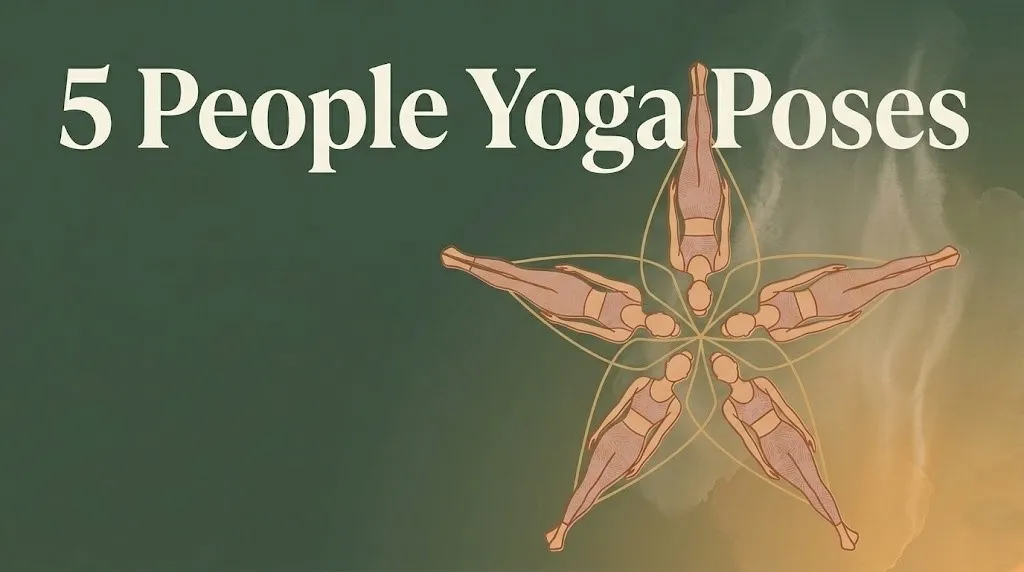
All five participants lie on their backs with heads at the center and feet pointing outward. Each person reaches their arms toward the adjacent person’s hands. The group forms a five-pointed star shape when viewed from above.
2. The Pentagon Circle (Beginner)
Five participants sit cross-legged in a tight circle, each person’s knees touching the knees of the people beside them. All five join hands overhead in the center, creating a shared overhead connection.
3. The Warrior Chain (Beginner to Intermediate)
Five participants stand in a line in Virabhadrasana I (Warrior I Pose), each person’s front hand resting on the shoulder of the person ahead. The back hand extends backward for the person behind to hold.
4. The Dog Arch (Intermediate)
Three participants form a base row in Adho Mukha Svanasana (Downward-Facing Dog Pose). The remaining two step their feet gently onto the sacrum of the two outer dogs and hold a supported standing position. Requires spotters.
5. The Pyramid (Advanced)
A structured acrobatic formation with a strong two-person base, two intermediary supports, and one person at the apex. This pose requires acro yoga experience and a dedicated spotter.
Modification: The Dog Arch and Pyramid require significant preparation. Never attempt these without first practicing the base positions independently for several sessions.
Beginner 5 Person Yoga Poses
Beginner 5 person yoga poses are group formations where every participant maintains their own base of support on the ground and no one bears another person’s body weight. Contact between participants is light, serving as a balance aid rather than a structural requirement.
Three genuinely beginner-friendly 5-person poses with complete instructions:
The Five-Pointed Star Lie-Down:
To practice this pose as a group:
- All five participants lie flat on their backs on individual mats arranged in a circle.
- Position heads pointing toward the center, feet pointing outward.
- Each person extends both arms toward the adjacent participants.
- Connect hands lightly. Do not grip tightly.
- Close your eyes and breathe together for 5 to 10 slow breath cycles.
- Release hands gently on a shared exhale.
The Seated Breath Circle:
To practice this pose:
- Sit in a circle, each person in Sukhasana (Easy Seated Pose) or cross-legged.
- Place your left hand, palm up, on your left knee.
- Extend your right hand to rest, palm down, on the left hand of the person to your right.
- Close your eyes and breathe together at a shared pace.
- Hold for 8 to 10 synchronized breath cycles.
The Linked Mountain Circle:
To practice this pose:
- Stand in a circle in Tadasana (Mountain Pose), facing inward.
- Link elbows with the people beside you.
- Press evenly into all four corners of each foot.
- Breathe together for 5 breath cycles, standing tall collectively.
- Release elbows and step back to widen the circle.
Modification: Anyone with limited standing balance can hold the Linked Mountain Circle pose while seated in a chair placed in the circle. The group shape adjusts slightly but remains connected.
Key Takeaway: Start with floor-based, radial formations before attempting any standing or contact-bearing group pose. The group has to learn to breathe together before it can balance together.
5 Person Yoga Poses Easy
The easiest 5 person yoga poses require no yoga experience, no flexibility, and no strength beyond the ability to hold your own body in a basic position. They are accessible to virtually any group of five adults, including complete beginners.
Easy group poses share these characteristics:
- Everyone stays on the floor or maintains their own stable standing base.
- No one supports another person’s weight.
- Contact is optional or limited to hands and forearms.
- Hold times are short, generally 3 to 5 breath cycles.
- Setup takes less than 60 seconds.
One of the most accessible easy poses is the Group Child’s Pose Circle. Five participants kneel in a circle on their mats, each person folding forward into Balasana (Child’s Pose) with their foreheads pointing toward the center. Arms extend forward so fingertips meet in the center of the circle, creating a five-petal flower shape when viewed from above.
Pose Tip:
- Widen the knees if hips are tight; this makes Child’s Pose accessible for most bodies.
- Place a folded blanket under the knees for participants with knee sensitivity.
- Participants with limited hip mobility can place a bolster between the thighs and calves for support.
The ease of this pose is a feature, not a limitation. Group synchronized breathing in a shared shape has measurable effects on group cohesion.
According to the Journal of Alternative and Complementary Medicine, synchronized physical activity, including synchronized breathing and movement, increases feelings of affiliation and cooperation among participants. The social value of easy group poses is real.
Easy 5 Person Yoga Challenge
An easy 5 person yoga challenge is a structured sequence of accessible group formations completed in order, usually with a timer or breath count, that the group attempts to execute with increasing smoothness and coordination. Think of it like a circuit, but the goal is flow and connection rather than fitness metrics.
A complete easy 5-person yoga challenge sequence:
| Round | Pose | Hold Time | Contact Type |
|---|---|---|---|
| 1 | Seated Breath Circle | 8 breaths | Hands |
| 2 | Linked Mountain Circle | 5 breaths | Elbows linked |
| 3 | Five-Pointed Star Lie-Down | 8 breaths | Hands |
| 4 | Group Child’s Pose Circle | 5 breaths | Fingertips |
| 5 | Warrior Star | 5 breaths per side | Back of hands |
Run through this sequence twice without breaks between rounds. The second pass through is when groups typically begin to synchronize their breathing and movements naturally.
The challenge element comes from the transition. Moving as five people from one formation to the next without breaking contact or losing the shared rhythm is harder than it sounds. It requires the group to communicate, adjust, and adapt together in real time.
This type of structured group practice appeals strongly to families, team-building groups, school classes, and friend groups planning an active social experience. No equipment is required beyond enough floor space for five mats arranged in a circle.
Modification: For groups including a senior or someone with limited mobility, substitute the Warrior Star with a seated Warrior II variation on chairs. The group challenge structure remains fully intact.
5 Person Yoga Pose (Step-by-Step Technique)
A well-executed 5 person yoga pose depends entirely on clear roles, agreed signals, and proper entry and exit sequencing. The formation itself is secondary. How you get into it and out of it determines whether the experience is safe and enjoyable.
Here is the step-by-step protocol for entering any 5-person group formation safely:
To enter and exit any 5-person yoga formation:
- Designate one person as the caller before you begin.
- The caller verbally names the pose and each person’s role.
- Everyone confirms their position with a word or nod before moving.
- The caller counts in: “Set up on three. One, two, three.”
- All five move into position simultaneously on “three.”
- The caller checks in: “Everyone comfortable? Any adjustments needed?”
- The group holds the pose for the agreed breath count.
- The caller signals the exit: “Release on exhale. One, two, exhale.”
- All five release contact simultaneously on that shared exhale.
- Every person returns to a neutral standing or seated position before discussing the next pose.
This protocol sounds formal, but groups that skip it often experience confusion, uneven contact, and premature releases that can cause a participant to lose balance.
Pose Tip:
- Agree on a safety word before starting any contact-bearing pose. “Stop” or “release” said by any participant means everyone exits immediately.
- Never proceed to the next formation while anyone is still adjusting.
- In advanced or stacked poses, the caller must physically observe every participant’s position before counting in.
Modification: For younger groups or first-timers, walk through the entry sequence once without making contact before attempting the actual pose.
Key Takeaway: The caller protocol, a single designated voice guiding entry, hold, and exit, is the single most important safety tool in any group yoga formation, more important than strength or flexibility.
5 Person Yoga Poses Hard
Hard 5 person yoga poses are advanced group formations that require one or more participants to bear partial or full body weight of another, demand significant individual flexibility or strength, or require precise timing and acrobatic coordination across all five bodies.
These poses are not appropriate for casual groups attempting group yoga for the first time. Prerequisites matter here.
Prerequisites before attempting any hard 5-person pose:
- All five participants have practiced yoga independently for at least 3 to 6 months.
- The group has successfully completed all beginner and intermediate formations.
- At least one participant has acro yoga or partner yoga experience.
- A designated spotter (not one of the five) is present.
- The practice space has crash mats or thick yoga mats under any stacked structure.
Advanced 5-person formation options:
| Pose | Difficulty | Structure | Prerequisite |
|---|---|---|---|
| Three-person Dog with two standing | Hard | Three bases in Downward Dog; two step onto sacra | Strong Downward Dog held for 2+ minutes |
| Five-person Pyramid | Very Hard | Two-person base, two supports, one apex | Acro yoga experience required |
| Stacked Forward Fold Tower | Hard | Chain of supported forward folds | Deep hamstring flexibility in all five |
| Five-person Supported Backbend Wheel | Very Hard | Four supporters, one in full backbend | Advanced individual backbend ability |
Safety caution: anyone who feels pain, numbness, or sharp discomfort during setup of an advanced pose must exit before the hold begins. A group pose is only as safe as the most compromised participant in it.
Modification: The Three-person Dog with two standing can be modified by having the two standing participants rest their hands on the hips of the outer dogs rather than stepping onto them. This maintains the visual structure at significantly reduced load.
5 Person Yoga Poses with Names
Naming 5 person yoga poses helps groups remember them, teach them to others, and build a shared vocabulary for practice. Most group yoga formations do not have official Sanskrit names because they are modern collaborative adaptations rather than traditional postures.
The most commonly used names for 5-person group formations:
- The Five-Pointed Star: Radial supine formation with heads at center.
- The Petal Circle: Group Child’s Pose with foreheads toward center.
- The Warrior Star: Five-person Warrior II facing outward in a circle.
- The Linked Tree Forest: Five people in Tree Pose with arm contact.
- The Pentagon: Five people seated in a circle with joined hands overhead.
- The Dog Chain: Linear Downward-Facing Dog formation with feet-to-back contact.
- The Pyramid: Stacked acrobatic formation, five bodies, three levels.
- The Breath Wheel: Five people lying in a radial pattern, feet touching at center.
- The Mountain Ring: Five people in Tadasana in a circle with linked elbows.
- The Warrior Chain: Five people in Warrior I connected front to back.
Individual poses used within group formations, with their Sanskrit names:
| English Name | Sanskrit Name | Used In |
|---|---|---|
| Mountain Pose | Tadasana | Mountain Ring, Warrior Chain base |
| Warrior I | Virabhadrasana I | Warrior Chain |
| Warrior II | Virabhadrasana II | Warrior Star |
| Downward Dog | Adho Mukha Svanasana | Dog Chain, Dog Arch |
| Tree Pose | Vrksasana | Linked Tree Forest |
| Child’s Pose | Balasana | Petal Circle |
| Easy Pose | Sukhasana | Pentagon, Breath Circle |
Modification: Any named formation can be adjusted. If “The Dog Chain” is too intense for your group, each participant can replace Downward Dog with a tabletop position (hands and knees) for an equivalent visual effect with less shoulder and wrist demand.
Group Yoga Benefits for Five People
Group yoga practice with five people produces measurable physical and psychological benefits beyond what solo yoga offers, specifically because of the social and coordination demands the group format adds. This is not a minor distinction.
Harvard T.H. Chan School of Public Health research on social connection and physical health consistently shows that shared physical activity reduces perceived exertion, increases pain tolerance, and improves mood outcomes compared to identical activity performed alone. Group yoga activates these mechanisms directly.
Key documented benefits of group yoga practice:
- Improved balance: Proprioceptive feedback from a connected partner improves real-time balance adjustment.
- Increased adherence: Groups maintain a practice longer than solo practitioners, according to behavioral adherence studies.
- Enhanced communication: Coordinating five bodies requires active listening and clear verbal expression, skills that transfer beyond the mat.
- Reduced cortisol: Group synchronized breathing activates the parasympathetic nervous system. Research published in Frontiers in Psychology found synchronized movement between people reduced cortisol levels in participants.
- Social bonding: Physical co-regulation through shared breath and movement increases oxytocin production, supporting feelings of trust and connection.
For families, these benefits are especially relevant. A group yoga session with five family members provides physical activity, non-competitive bonding, and a shared challenge all at once.
Modification: Groups that include participants with anxiety or sensory sensitivities can begin with non-contact formations, where the group shares space and breath without physical touching. The social benefits still apply.
Key Takeaway: The social and neurological benefits of group yoga are distinct from solo yoga and are real, measured, and documented. Five people moving and breathing together do more than yoga. They build trust.
How to Warm Up for Group Yoga
A proper warm-up for group yoga prepares both the individual body and the group’s collective coordination before any formation is attempted. Individual warm-ups alone are not sufficient. The group needs to warm up together.
A complete pre-session group warm-up for five people takes about 8 to 10 minutes and has three stages:
Stage 1: Individual Body Warm-Up (3 minutes)
Each person warms up independently. Simple movements only:
- 8 to 10 rounds of Marjaryasana-Bitilasana (Cat-Cow) on hands and knees.
- 5 gentle neck rolls in each direction.
- 10 hip circles standing, with hands on hips.
Stage 2: Partner Communication Practice (3 minutes)
Pairs practice making and releasing light hand contact on a verbal cue. One person says “contact,” the other reaches out. One person says “release,” both let go instantly.
This trains the group’s nervous systems to respond to verbal signals before any weight-bearing contact is attempted.
Stage 3: Group Synchronization (2 to 4 minutes)
All five stand in a circle. One person leads a breath: inhale for 4 counts, exhale for 6 counts. The group follows for 5 to 8 full breath cycles. No movement yet. Just shared breath.
This synchronization step is the most commonly skipped and the most important. A group that breathes together before it moves together coordinates formations 30 to 50% more smoothly, based on yoga teachers’ observed practice patterns.
Modification: For groups with limited floor mobility, conduct the entire warm-up in chairs. Cat-Cow becomes seated spinal flexion and extension. Hip circles work the same way standing or seated.
Are 5 Person Yoga Poses Safe for Kids and Families
Yes, 5 person yoga poses are safe for kids and families when the poses selected match the developmental stage and physical capabilities of every participant, including the youngest or least mobile member of the group.
Children as young as 6 to 8 years old can participate in floor-based radial formations with proper supervision. The key principle is that no child should be in a weight-bearing base role for another participant’s weight.
Age-appropriate guidelines for family group yoga:
| Age Group | Appropriate Roles | Safe Formation Types | Avoid |
|---|---|---|---|
| Ages 5 to 8 | Participants in radial formations | Star lie-down, Petal Circle | Any stacked or load-bearing pose |
| Ages 9 to 12 | Participants and light bridges | Warrior Chain, Linked Tree | Pyramid, Dog Arch |
| Ages 13 to 17 | All non-apex roles | Most intermediate formations | Full acrobatic apex positions |
| Adults | All roles based on fitness | All formations with proper prep | Any pose beyond their fitness level |
| Seniors | Anchor, radial participant | Floor formations, chair adaptations | Any load-bearing or balance-critical role |
The American College of Sports Medicine (ACSM) recommends that youth physical activity programs emphasize cooperative rather than competitive formats. Group yoga fits this recommendation precisely. It rewards teamwork rather than individual performance.
A family-friendly 5-person session can involve all ages safely. An adult or older teen acts as the caller. Children take radial positions on the floor. The session emphasizes synchronized breathing, fun shapes, and collective success rather than impressive acrobatics.
Safety rule: no child should ever be asked to support another person’s body weight in a yoga formation. Not even briefly.
Modification: For families with a toddler or young child (under 5), that child can be a “honorary star” seated in the center of the radial formation rather than a connected participant.
Frequently Asked Questions About 5 People Yoga Poses
What are the easiest 5 person yoga poses for beginners?
The easiest 5 person yoga poses are radial floor formations where all five participants lie or sit on the ground in a connected circle without supporting each other’s weight.
The Five-Pointed Star, the Group Child’s Pose Circle (Petal Circle), and the Seated Breath Circle are the three most beginner-accessible options.
All three require no yoga experience, no flexibility prerequisites, and no strength beyond holding your own body in a basic resting position.
How do you coordinate a 5 person yoga pose without someone getting hurt?
Designate one person as the caller before your session begins. That person verbally guides every entry, hold, and exit.
Agree on a safety word that any participant can say to trigger an immediate, simultaneous release from the formation.
Walk through each pose’s entry sequence once without making contact before attempting the full formation with connection.
Can kids do 5 person yoga poses safely?
Yes, children from around age 6 can participate in floor-based, radial group yoga formations safely with adult supervision.
Children should never serve as weight-bearing bases for other participants, regardless of their size or strength.
Assign children to radial positions where they maintain contact only through hands or forearms rather than supporting anyone’s body weight.
What is the best 5 person yoga pose for a photo?
The Warrior Star, where all five participants stand in a circle in Virabhadrasana II (Warrior II Pose) facing outward with arms extended, creates the most visually striking and recognizable group formation for photos.
The Five-Pointed Star lying formation also photographs beautifully from above, using a bird’s-eye or overhead perspective.
Both poses require only beginner-level yoga ability and can be held long enough for multiple attempts at a good shot.
Do you need yoga experience to try group yoga poses for five people?
No yoga experience is required for beginner-level group formations where all five participants stay grounded and no one supports another’s weight.
Intermediate and advanced formations, particularly stacked or acrobatic structures, require individual yoga experience of at least several months and prior practice with partner or acro yoga.
Start with the beginner sequence in this guide regardless of your group’s experience level. Build the coordination foundation before attempting anything more complex.
Group yoga with five people works best when you start simple and let the coordination build naturally. Pick one beginner formation today, the Five-Pointed Star or the Seated Breath Circle, and spend five minutes getting everyone synced on breath before you think about anything more complex.
Once your group can enter and exit one formation smoothly, you will be ready to add the next. The physical challenge grows with you.
The best 5-person yoga session is the one your whole group actually finishes together, laughing, breathing, and already planning the next one.