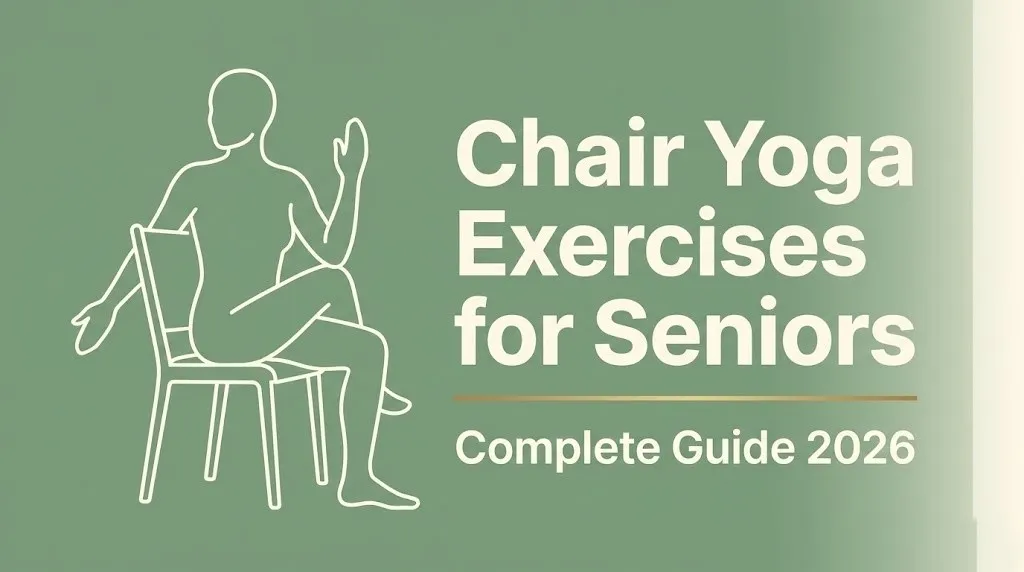
Chair Yoga Exercises for Seniors: Complete 2026 Guide
Chair yoga exercises for seniors are gentle, seated adaptations of traditional yoga poses that can be practiced safely from a sturdy chair, making yoga accessible regardless of balance limitations, joint pain, or mobility restrictions. You do not need a yoga mat, a studio membership, or any prior experience to start benefiting from this practice today.
The stakes are real. The Centers for Disease Control and Prevention (CDC) reports that falls are the leading cause of injury-related deaths among adults 65 and older, and that regular balance and strength training reduces fall risk meaningfully. Chair yoga directly addresses the muscles and movement patterns most involved in fall prevention.
This guide covers what chair yoga is, what the research says about its benefits for older adults, specific adaptations for conditions including arthritis, osteoporosis, hip replacement, and Parkinson’s disease, and a complete step-by-step sequence you can begin at home today. Everything here is free, practical, and designed for real senior bodies.
Chair Yoga Exercises for Seniors: What You Need to Know
Chair yoga exercises for seniors are modified yoga poses performed while seated in a chair or using a chair as a support prop, designed to deliver the strength, flexibility, balance, and breathing benefits of yoga without requiring floor-level mobility or standing balance. This is not a watered-down version of yoga. It is yoga adapted intelligently for the body in front of it.
The practice draws from Hatha yoga and Iyengar yoga traditions, both of which have long used props (blocks, straps, chairs, walls) to make poses accessible without compromising their physiological benefits. Iyengar yoga in particular pioneered the use of chairs as a full practice prop, not a crutch.
What you need to begin is minimal:
- A sturdy, non-rolling chair: A dining chair or armless kitchen chair works well. The seat should allow your feet to rest flat on the floor with your knees at approximately 90 degrees.
- Non-slip mat or rug: Placed under the chair legs to prevent sliding during seated movement.
- Comfortable, non-restrictive clothing: Anything you can move your arms and legs freely in.
- 10 to 20 minutes: That is a sufficient starting duration for most seniors in the first two weeks.
No props beyond the chair are required to begin. Yoga blocks and straps can enhance the practice later, but they are not prerequisites for your first session.
What Is Chair Yoga for Seniors?
Chair yoga for seniors is a style of yoga practice adapted specifically for older adults, using a chair as both a seat and a support tool to allow participation regardless of balance capacity, joint condition, or prior yoga experience. It is practiced either fully seated or standing behind the chair with hands resting on the back for support.
The poses in a chair yoga class are adaptations of traditional yoga postures. A seated spinal twist mirrors the same rotational mechanics as a floor-based twist. A seated forward fold targets the hamstrings and erector spinae the same way a standing fold does. The chair changes the entry point, not the anatomical effect.
Chair yoga belongs to the broader family of Hatha yoga practices. It is not its own separate discipline with unique poses invented for seniors. It is traditional yoga made physically accessible by removing the floor-level and balance demands that prevent many older adults from participating in standard studio classes.
The practice is appropriate for adults of all ages but is particularly well-suited for:
- Adults 65 and older with limited standing balance
- People managing chronic joint conditions including osteoarthritis and rheumatoid arthritis
- Seniors recovering from joint replacement surgery (with appropriate post-surgical clearance)
- People with neurological conditions affecting coordination and movement
- Anyone whose current physical condition makes floor-based or standing yoga inaccessible
According to the National Center for Complementary and Integrative Health (NCCIH), yoga is one of the most widely used complementary health practices among older Americans, with gentle and chair-adapted formats among the fastest growing categories.
Chair Yoga for Seniors Benefits: What Research Shows
Chair yoga for seniors produces documented benefits including improved balance, increased lower body strength, reduced chronic pain, enhanced flexibility, and decreased anxiety and depression scores, all supported by peer-reviewed research in gerontology and yoga science journals. These are measurable outcomes, not general wellness claims.
A study published in the Journal of Alternative and Complementary Medicine found that older adults who completed an 8-week chair yoga program reported reduced pain intensity, improved functional mobility, and decreased fatigue compared to a control group receiving health education only. The chair yoga group also showed improvements in balance scores that are directly associated with fall risk reduction.
Research reviewed in Complementary Therapies in Medicine found that yoga interventions in older adult populations produced statistically meaningful reductions in anxiety and depression scores over 10 to 12 weeks. The combination of breath regulation, gentle movement, and structured attention was identified as the mechanism driving mental health improvements.
Key research-supported benefits of chair yoga for seniors include:
- Reduced chronic pain in the joints, lower back, and hips through gentle mobilization and improved circulation
- Improved balance and proprioception from seated and supported standing balance exercises
- Increased lower body strength in the quadriceps, gluteals, and hip stabilizers through loaded seated poses
- Enhanced spinal flexibility through regular spinal extension, flexion, and rotation exercises
- Reduced anxiety and depression scores through breath-linked movement and structured relaxation
- Improved sleep quality associated with regular gentle yoga practice in older adult populations
- Greater range of motion in the shoulder girdle, hip joints, and thoracic spine
Key Takeaway: Chair yoga for seniors is not a gentle hobby. It is a research-supported practice that reduces fall risk, improves strength and balance, and reduces chronic pain and anxiety in older adults who practice consistently two to three times per week.
Chair Yoga for Seniors and Fall Risk Reduction
Chair yoga reduces fall risk in seniors by strengthening the lower body muscles that stabilize standing and walking, improving the proprioceptive awareness that allows the body to detect and correct balance loss, and increasing the ankle and hip flexibility needed to recover from an unexpected stumble. Each of these mechanisms is distinct and additive.
The CDC identifies falls as the leading cause of both fatal and non-fatal injuries in adults 65 and older. Every year, approximately one in four older adults experiences a fall. Strength and balance training is one of the most evidence-supported interventions for reducing that risk, and chair yoga delivers both in a single accessible practice.
The specific chair yoga exercises that most directly reduce fall risk are:
- Seated ankle circles and heel raises: Strengthen the gastrocnemius, soleus, and ankle stabilizers that respond during balance perturbation
- Seated single-leg extensions: Target the quadriceps femoris, the primary muscle that controls descent and rise from a chair and stabilizes the knee during walking
- Seated to standing transitions (with chair support): Build the gluteus maximus and quadriceps strength needed for the most fall-risky daily movement
- Chair-supported Virabhadrasana I (Warrior I) standing variation: Trains the hip stabilizers and balance systems while the chair back provides safety
- Seated lateral trunk tilts: Strengthen the obliques and erector spinae that maintain upright posture during balance recovery
A study published in the International Journal of Yoga found that seniors who practiced yoga twice weekly over 12 weeks showed improvement in standardized balance tests compared to control groups who received no balance training.
Chair Yoga for Seniors with Arthritis
Chair yoga is one of the most appropriate movement practices for seniors with arthritis because its gentle, low-impact range-of-motion exercises reduce joint stiffness, improve circulation to the affected joints, and build the surrounding muscle strength that reduces compressive load on arthritic cartilage. Movement is medicine for arthritis. The key is appropriate movement.
Arthritis stiffness follows a predictable pattern: joints feel worst after prolonged rest and improve with gentle, graduated movement. Chair yoga fits this pattern precisely. A morning chair yoga session of 10 to 20 minutes addresses the morning stiffness that many arthritis sufferers describe as the hardest part of their day.
The American College of Sports Medicine (ACSM) recommends that adults with arthritis engage in flexibility and gentle strengthening exercises most days of the week, noting that physical inactivity worsens joint function and pain more than moderate movement does. Chair yoga satisfies both the flexibility and strengthening components of this recommendation.
Specific arthritis modifications for chair yoga:
- Reduce range of motion: Move joints only to the edge of comfort, never through pain. Arthritis pain during movement is a signal to back off, not push through.
- Warm up first: 2 to 3 minutes of seated gentle joint circles (wrists, ankles, shoulders) before holding any static pose reduces injury risk.
- Avoid deep knee bend if knee osteoarthritis is present: In seated poses, keep the knee at a comfortable angle rather than aiming for 90 degrees if it produces pain.
- Use a folded blanket under the wrists during any weight-bearing variation: Reduces wrist compression for those with hand or wrist arthritis.
Chair Yoga for Seniors with Osteoporosis
Chair yoga is appropriate for seniors with osteoporosis when practiced with specific modifications that avoid spinal flexion, deep spinal rotation, and any movements that increase the risk of vertebral compression fracture. This is the single most important safety distinction for seniors with low bone density.
Osteoporosis weakens bone structure, particularly in the vertebrae, hips, and wrists. The movements most associated with fracture risk in osteoporosis are deep forward spinal flexion (rounding the lower back), deep rotational twisting, and any loaded impact. Chair yoga eliminates impact entirely, but the flexion and rotation warnings require specific attention.
Poses appropriate for osteoporosis-safe chair yoga:
- Seated cat-cow (Marjaryasana-Bitilasana** seated version):** Use only the extension phase (Cow). Avoid deep forward rounding (Cat) which increases vertebral compression risk.
- Seated spinal extension: Sit tall, place hands on knees, and gently lift the chest and broaden the collar bones. This strengthens the erector spinae without flexion risk.
- Gentle shoulder rolls and chest openers: Safe for all osteoporosis severity levels.
- Seated hip strengtheners (heel slides, leg lifts): Build hip bone density sites without axial loading risk.
Poses to avoid or severely limit for osteoporosis:
- Deep forward folds (any seated toe-reaching that rounds the lumbar spine)
- Full spinal twists (limit rotation to 15 to 20 degrees only)
- Any lateral bending that creates lateral shear force on the vertebrae
Seniors with a confirmed osteoporosis diagnosis should discuss specific range-of-motion restrictions with their physician or physical therapist before beginning a chair yoga program.
Chair Yoga for Seniors After Hip Replacement or Knee Pain
Seniors who have had hip replacement surgery can typically practice chair yoga after receiving surgical clearance, but must observe hip precautions specific to their surgical approach, particularly avoiding positions that bring the knee above the hip or cross the midline. These restrictions vary by surgeon and surgical technique and must be confirmed individually.
Hip replacement precautions commonly include avoiding deep hip flexion beyond 90 degrees, crossing the legs, and rotating the hip inward. Many standard chair yoga poses naturally respect these limits, but some require adjustment:
| Pose | Standard Version | Hip Replacement Modification |
|---|---|---|
| Seated Forward Fold | Hinge forward from hips | Hinge only to 80 degrees; keep torso upright |
| Seated Spinal Twist | Full rotation | Rotate upper spine only; keep hips level |
| Seated Figure-Four Stretch | Cross ankle over knee | Skip entirely if precautions include leg crossing |
| Seated Leg Extension | Extend leg fully forward | Keep foot low; avoid full hip flexion if painful |
| Seated to Standing | Rise fully to standing | Use chair arms for support; move slowly |
For knee pain and knee osteoarthritis specifically, chair yoga reduces compressive load by keeping all seated poses at a comfortable knee angle. Avoid forcing the knee to 90 degrees if that angle produces pain. A slightly wider knee angle (100 to 110 degrees) places less compressive force on the knee joint while still allowing the pose’s benefits.
Key Takeaway: Chair yoga is adaptable for osteoporosis, arthritis, hip replacement, and knee conditions, but each condition has specific movement restrictions that must be respected. Modifying range of motion is not optional for these populations. It is the difference between a safe practice and an injury risk.
Chair Yoga for Parkinson’s Disease and Balance
Chair yoga is specifically beneficial for people with Parkinson’s disease because it addresses the key movement impairments associated with the condition: reduced spinal mobility, decreased arm swing, compromised balance, and muscular rigidity. Research supports yoga’s role in Parkinson’s management alongside (not instead of) medical treatment.
A study published in the Journal of Alternative and Complementary Medicine found that older adults with Parkinson’s disease who participated in a yoga program showed improvements in balance, gait, and quality of life measures compared to a control group. The structured, breath-linked nature of yoga appears particularly well-suited to Parkinson’s motor learning challenges.
The chair provides essential safety during balance-challenged moments. For Parkinson’s students, the chair back serves as a constant support available at any point during the session. This removes the freezing-related fall risk associated with unassisted standing movement.
Specific chair yoga exercises most beneficial for Parkinson’s:
- Seated chest openers and shoulder rolls: Address the stooped posture and reduced arm swing characteristic of Parkinson’s
- Seated spinal extension: Counteracts the forward flexion posture pattern
- Seated alternating leg extensions: Practice the limb coordination patterns affected by Parkinson’s motor symptoms
- Rhythmic breath-linked movement (Marjaryasana-Bitilasana): The rhythmic, repetitive nature of cat-cow seated helps engage the motor circuits that yoga teachers and movement therapists observe respond well to rhythmic cues in Parkinson’s practice
- Voice-loud Ujjayi breath: Research in Parkinson’s movement therapy suggests that vocalizing movement cues (including breath) supports motor timing
Chair Yoga Breathing Exercises for Seniors
**The most beneficial chair yoga breathing exercises for seniors are diaphragmatic breathing, *Ujjayi pranayama* (ocean breath), and a simple 4-count inhale / 6-count exhale ratio, all of which activate the parasympathetic nervous system, reduce resting cortisol, and improve respiratory muscle strength.** Breath is not background to chair yoga. It is half the practice.
Many older adults have developed shallow chest-breathing habits over decades. The diaphragm, like any muscle, weakens with disuse. Consistently practicing deep diaphragmatic breathing restores respiratory function and improves oxygen delivery throughout the body during both rest and activity.
To practice diaphragmatic breathing in a chair:
- Sit at the front edge of the chair with feet flat on the floor, hip-width apart.
- Place one hand on the lower belly and one hand on the chest.
- Inhale slowly through the nose for a count of 4. The lower belly should rise first, then the chest.
- Exhale slowly through the nose for a count of 6. The belly falls first, then the chest.
- Repeat for 8 to 10 breath cycles before beginning any other chair yoga exercise.
- If 6-count exhale is challenging, start with 4-count exhale and lengthen gradually.
Modification for seniors with COPD or reduced lung capacity: Shorten the breath count to a comfortable inhale-exhale ratio rather than forcing the 4-6 pattern. The goal is slower, fuller breath than habitual, not a specific count. Work toward longer exhales gradually over weeks.
According to research reviewed in Complementary Therapies in Medicine, regular pranayama practice was associated with reduced blood pressure, lower resting heart rate, and improved respiratory function in older adults over 10 to 12 weeks.
Chair Yoga Poses for Seniors Step by Step
The most effective chair yoga poses for seniors target the quadriceps, hip flexors, erector spinae, shoulder girdle, and ankle stabilizers because strengthening and mobilizing these specific structures addresses the primary physical declines associated with aging: loss of lower body strength, reduced spinal mobility, and impaired balance. Here are eight foundational poses with complete instructions.
To practice each pose: sit at the front edge of a sturdy, non-rolling chair. Feet flat on the floor, hip-width apart. Spine upright. Breathe through the nose throughout.
1. Seated Marjaryasana-Bitilasana (Seated Cat-Cow):
- Sit upright with hands on knees.
- Inhale: gently arch the lower back, lift the chest, roll the shoulders back (Cow).
- Exhale: gently round the spine, draw the navel slightly in, drop the head (Cat).
- Repeat 5 to 8 times. Reduce the range of motion if any spinal discomfort arises.
2. Seated Ardha Matsyendrasana (Seated Spinal Twist):
- Sit upright. Place the right hand on the outside of the left knee.
- Inhale to lengthen the spine upward.
- Exhale: gently rotate the torso to the left, looking over the left shoulder.
- Hold for 3 breaths. Return to center on an inhale. Repeat on the right side.
- Modification for osteoporosis: rotate 15 to 20 degrees only.
3. Seated Virabhadrasana I (Warrior I), Chair Version:
- Sit sideways on the chair, right hip facing the chair back.
- Step the left foot back behind you, left foot flat on the floor.
- Inhale and raise both arms overhead, palms facing each other.
- Hold for 3 to 5 breaths. Lower arms on exhale. Repeat on the left side.
- Modification: keep one hand on the chair back for balance if needed.
4. Seated Garudasana (Eagle Pose), Arms Only:
- Sit upright. Extend both arms forward at shoulder height.
- Cross the right arm under the left. Bend the elbows and wrap the forearms.
- Lift the elbows to shoulder height. Hold for 3 breaths.
- Unwind and repeat with the left arm under the right.
- Modification: simply cross the forearms without wrapping if shoulder range is limited.
5. Seated Paschimottanasana (Seated Forward Fold):
- Sit at the chair edge. Extend the legs forward, heels on the floor.
- Inhale to lengthen the spine. Exhale and hinge gently forward from the hips.
- Reach the hands toward the shins or feet. Do not round the lower back.
- Hold for 3 to 5 breaths. Inhale to return upright.
- Modification for osteoporosis: hinge only partway forward, keeping the spine long.
6. Seated Ankle Circles and Heel Raises:
- Sit upright with feet flat on the floor.
- Lift the right foot slightly and rotate the ankle in large circles, 5 rotations each direction.
- Lower the foot. Repeat on the left side.
- Then press both heels down and lift both toes up. Then lower toes and lift both heels. Repeat 10 times.
7. Seated Leg Extensions:
- Sit upright. Hold the chair seat with both hands for support.
- Inhale and extend the right leg straight forward, squeezing the quadriceps.
- Hold for 2 to 3 breaths. Lower on exhale. Repeat 5 times per side.
8. Seated Savasana (Corpse Pose) Adaptation:
- Sit back in the chair with full back support.
- Place hands in the lap, palms up. Close the eyes or soften the gaze.
- Breathe naturally for 3 to 5 minutes. Allow the body to rest and integrate the session’s work.
Key Takeaway: Eight poses, performed in sequence three times per week, address the primary physical decline areas of aging: lower body strength, spinal mobility, shoulder function, ankle stability, and balance. You do not need more than this to start.
Chair Yoga Sequence for Seniors at Home
A complete chair yoga sequence for seniors at home should take 20 to 30 minutes, begin with breath awareness, progress through spinal mobilization and standing strength work, and close with a seated rest period. This structure follows the same logic as a full studio class, compressed into a time frame appropriate for home practice.
The sequence below uses the poses from the previous section in a logical, progressive order:
| Step | Exercise | Duration | Target Area |
|---|---|---|---|
| 1 | Diaphragmatic breathing | 2 minutes | Nervous system, respiratory muscles |
| 2 | Seated ankle circles and heel raises | 2 minutes | Ankle stabilizers, calves |
| 3 | Seated Marjaryasana-Bitilasana (Cat-Cow) | 2 minutes | Lumbar and thoracic spine |
| 4 | Seated Ardha Matsyendrasana (Spinal Twist) | 3 minutes | Thoracic rotators, obliques |
| 5 | Seated Garudasana (Eagle Arms) | 2 minutes | Shoulder girdle, trapezius |
| 6 | Seated leg extensions | 3 minutes | Quadriceps, hip flexors |
| 7 | Seated Virabhadrasana I (Warrior I) | 4 minutes | Hip flexors, shoulder girdle |
| 8 | Seated Paschimottanasana (Forward Fold) | 3 minutes | Hamstrings, erector spinae |
| 9 | Seated Savasana (Corpse Pose adaptation) | 5 minutes | Full system recovery |
Total session time: approximately 26 minutes.
This sequence requires no equipment beyond a sturdy chair and flat-soled shoes or bare feet. It can be practiced in a living room, kitchen, or any space with enough room to extend the legs forward comfortably.
For home practice without a teacher present: always move slowly, never force a range of motion, and rest immediately if any sharp pain, dizziness, or shortness of breath occurs.
Chair Yoga for Seniors for Flexibility and Strength
Chair yoga builds functional flexibility and lower body strength in seniors through a combination of dynamic range-of-motion exercises and isometrically loaded static holds that target the muscles most responsible for independent mobility. Functional means the kind of flexibility and strength you use when rising from a chair, stepping over a threshold, or reaching overhead in a cabinet.
Flexibility in the context of senior fitness is not about touching your toes. It is about having enough range of motion in the hips to step up stairs comfortably, enough shoulder flexibility to reach behind your back, and enough spinal rotation to check your blind spot while driving. Chair yoga addresses each of these real-world mobility demands directly.
Think of stiff joints like a door hinge that has not been moved in years. The range narrows gradually. With regular, gentle movement, the range opens back up. This is not a metaphor. Synovial fluid, which lubricates joint surfaces, is distributed more evenly through repeated gentle movement. Regular chair yoga keeps that distribution happening daily.
The poses that most directly build functional strength in seniors:
- Seated leg extensions: Quadriceps femoris, the muscle most responsible for rising from a seated position
- Seated Virabhadrasana I (Warrior I), standing variation: Gluteus maximus and hip stabilizers
- Seated heel raises: Gastrocnemius and soleus, which power walking and stair climbing
- Eagle arms (Garudasana): Posterior shoulder and upper back strength, important for posture maintenance
The ACSM recommends that older adults perform strength training exercises targeting major muscle groups at least two days per week. Chair yoga sequences that include loaded seated poses satisfy this recommendation for many seniors, particularly those who cannot safely use traditional resistance training equipment.
Chair Yoga for Seniors: Mental Health and Stress Relief
Chair yoga reduces anxiety, depression, and perceived stress in seniors through three overlapping mechanisms: breath regulation that activates the parasympathetic nervous system, body-focused attention that interrupts rumination, and the consistent routine of practice that provides structure and a sense of agency. Each mechanism has independent research support.
Social isolation, loss of mobility, chronic pain, and major life transitions all contribute to elevated mental health challenges in the senior population. The NCCIH identifies yoga as one of the most well-supported complementary approaches for anxiety and mild to moderate depression in adults, including older populations.
Research published in the International Journal of Yoga found that a 12-week yoga program in adults over 60 produced measurable reductions in anxiety and depression scores, along with improvements in self-reported quality of life. The breath-movement pairing was identified as the mechanism driving the anxiety reduction effect.
The mental health benefits of chair yoga extend beyond mood. Regular practice is associated with:
- Improved sleep quality through the parasympathetic activation of breath-focused relaxation at the close of each session
- Increased sense of physical competence as strength and range of motion improve over weeks of practice
- Reduced pain catastrophizing in seniors managing chronic pain conditions, noted in yoga-pain research reviewed in Complementary Therapies in Medicine
- Social engagement when practiced in a group setting, which adds relational benefit to the physical and mental practice
The seated Savasana (Corpse Pose) adaptation at the close of every session is not optional for these benefits. It is the period during which the nervous system integrates the session’s breath and movement work. Five minutes of quiet, supported rest after chair yoga practice delivers meaningful parasympathetic recovery.
Chair Yoga for Seniors with Limited Mobility
Chair yoga is specifically designed for seniors with limited mobility because all poses are either fully seated or performed with the chair as a direct support structure, eliminating the floor-level transitions and standing balance demands that prevent many people with mobility limitations from participating in standard yoga classes. Limited mobility is not a barrier to chair yoga. It is the exact reason chair yoga exists.
Limited mobility in seniors encompasses a wide range: people who use walkers or wheelchairs, those recovering from surgery or illness, seniors with severe arthritis or neurological conditions, and those who have not exercised in years. Chair yoga can be modified for every point on this spectrum.
For the most limited mobility situations:
- Wheelchair users: Most seated chair yoga poses transfer directly to wheelchair practice. The chair back may not be available, but seated spinal movements, arm work, and breathing exercises all remain accessible.
- One-sided weakness (post-stroke or hemiplegia): Focus on the unaffected side while doing gentle passive movements on the affected side. A physical therapist familiar with yoga can guide bilateral reintegration.
- Severe balance impairment: Practice all poses seated without attempting any standing variation until balance has improved through consistent seated practice over 4 to 6 weeks.
- Extreme fatigue conditions: Begin with breath exercises only. Add one pose per session as energy allows. There is no minimum pose count. One pose done consistently is more beneficial than ten poses done occasionally.
Pose Tip:
- Always position the chair against a wall before beginning if balance is a concern. This removes fall risk during any moment of inattention.
- Non-slip socks or flat-soled shoes should be worn during all chair yoga practice to prevent foot slipping on smooth floors.
- If using a wheeled chair, lock the wheels before every session.
Key Takeaway: Limited mobility does not exclude anyone from chair yoga. Wheelchair users, post-stroke students, and severely deconditioned seniors can all access meaningful benefits from seated breath work, gentle joint mobilization, and adapted arm and leg exercises. Start with one exercise. Build from there.
How Often Should Seniors Do Chair Yoga?
Most yoga teachers and physical therapists recommend that seniors practice chair yoga three to five times per week for 20 to 30 minutes per session, as this frequency produces measurable improvements in balance, strength, and flexibility over 8 to 12 weeks of consistent practice. Daily shorter sessions (10 to 15 minutes) are also effective and may be easier to maintain as a habit.
The research supporting this frequency recommendation is specific. Studies in yoga and senior populations that showed meaningful outcomes typically used two to three sessions per week as the minimum intervention frequency. One session per week produced minimal results. Daily practice produced the best outcomes but also the highest dropout rates in research settings, suggesting that three to four times per week is the optimal real-world frequency for most seniors.
Here is a practical frequency framework:
| Goal | Recommended Frequency | Session Length | Notes |
|---|---|---|---|
| Beginning chair yoga | 2 to 3 times per week | 15 to 20 minutes | Allow rest days between sessions |
| Fall risk reduction | 3 to 4 times per week | 20 to 30 minutes | Include balance poses every session |
| Arthritis or joint pain management | Daily (gentle) | 10 to 20 minutes | Morning sessions address stiffness best |
| Mental health and stress relief | 3 to 5 times per week | 20 to 30 minutes | Include 5-minute Savasana always |
| Maintaining established practice | 4 to 5 times per week | 20 to 45 minutes | Vary pose selection to maintain engagement |
| Very limited mobility or fatigue | Daily if tolerated | 5 to 10 minutes | Breath exercises count as a complete session |
Rest between sessions is productive, not lost time. The musculoskeletal system repairs and adapts during rest, not during the session itself. For seniors managing inflammation-based conditions, rest days prevent the overuse that can provoke flare-ups.
The most consistent practice is always better than the most ambitious one. Three 20-minute sessions per week for six months produces far better outcomes than daily practice for two weeks followed by abandonment.
Frequently Asked Questions About Chair Yoga Exercises for Seniors
What are the best chair yoga exercises for seniors?
The best chair yoga exercises for seniors target the lower body, spine, and shoulder girdle because these areas most directly affect balance, mobility, and daily function.
Seated leg extensions, seated Cat-Cow (Marjaryasana-Bitilasana), heel raises, Eagle arms (Garudasana), and seated spinal twists (Ardha Matsyendrasana) address the muscle groups most involved in fall prevention and functional independence.
Starting with 5 to 8 of these exercises in a 20-minute session three times per week produces measurable improvements in most seniors within 6 to 8 weeks.
Is chair yoga good for seniors with arthritis?
Chair yoga is one of the most appropriate exercises for seniors with arthritis because it provides gentle joint mobilization and muscle strengthening without the high-impact load that worsens arthritic pain.
The American College of Sports Medicine recommends that adults with arthritis perform gentle flexibility and strengthening exercises most days of the week, and chair yoga satisfies both categories simultaneously.
Seniors with arthritis should reduce their range of motion in all poses to stay within a pain-free range, moving only to the edge of comfort rather than pushing through stiffness.
How long should seniors do chair yoga each session?
Most yoga teachers recommend seniors practice chair yoga for 20 to 30 minutes per session, including a 5-minute breathing warm-up and a 5-minute seated rest at the close.
Research studies that showed meaningful improvements in senior yoga participants used sessions of 20 to 45 minutes, two to three times per week.
Seniors who are very new to exercise or managing significant fatigue should start with 10 to 15 minutes and increase session length gradually over the first four weeks.
Can seniors do chair yoga every day?
Yes, most seniors can practice chair yoga daily when the session is gentle and includes adequate rest at the close.
Daily shorter sessions of 10 to 15 minutes may be more sustainable than longer less-frequent sessions, particularly for seniors managing chronic pain or fatigue conditions.
Seniors who experience joint soreness after daily practice should alternate days or reduce session intensity, as some recovery time between sessions supports the body’s adaptation process.
What are the benefits of chair yoga for seniors?
Chair yoga for seniors improves balance, lower body strength, spinal flexibility, and shoulder mobility while also reducing anxiety, depression, and chronic pain in older adults.
The National Center for Complementary and Integrative Health identifies yoga as one of the most well-supported complementary approaches for chronic lower back pain, stress, and anxiety in adults, with chair adaptations making these benefits accessible regardless of mobility level.
Research published in the Journal of Alternative and Complementary Medicine found that an 8-week chair yoga program reduced pain intensity and improved functional mobility in older adults compared to a health education control group.
Your Chair, Your Practice, Your Pace
The most useful thing you can take from this guide is a simple commitment: pick three days this week and do 20 minutes of chair yoga on each one. Start with the breathing exercise. Do the Cat-Cow. Add the leg extensions. Rest at the end.
That is the whole practice for week one. Not ten poses. Not 45 minutes. Three sessions of breath and three gentle exercises done consistently.
After four weeks, you will notice the difference in how you rise from a chair, how your lower back feels in the morning, and how clearly you can breathe when the day gets hard. The research supports exactly this. So does every yoga teacher who has ever worked with a senior student.