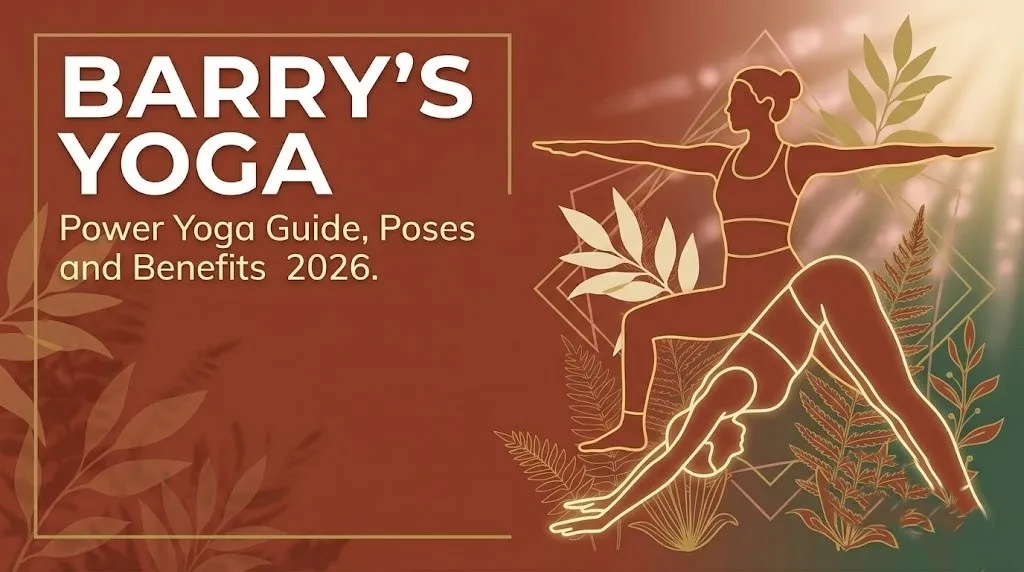
Barry’s Yoga: Power Yoga Guide, Poses and Benefits 2026
Barry’s yoga is a power yoga format practiced at community studios like Barry’s Power Yoga in Greece, NY, offering a vigorous, strength-focused practice that builds cardiovascular endurance, muscular stability, and mental resilience in ways that gentler yoga styles do not. It’s designed for people who want yoga to actually challenge them physically, not just stretch them out.
The National Center for Complementary and Integrative Health (NCCIH) reports that vigorous yoga formats show measurable improvements in muscular strength, aerobic capacity, and stress reduction across adult populations who practice consistently. Those findings apply directly to the kind of dynamic, breath-led yoga that studios like Barry’s power yoga teach.
This article covers what power yoga actually involves at a pose level, how it differs from Vinyasa and Ashtanga, what the research says about its physical and mental benefits, which poses form the core of the practice, and how to start safely whether you are a complete beginner or an experienced athlete. You’ll find step-by-step instructions, contraindication guidance, and a beginner sequence you can try at home.
What Is Barry’s Yoga and Who Is It For?
Barry’s yoga refers to a power yoga studio format that emphasizes strength, dynamic movement, and breath-synchronized sequencing in a community-oriented class environment, designed to serve a wide range of practitioners from motivated beginners to athletic veterans.
The name “Barry’s yoga” most commonly refers to Barry’s Power Yoga, a studio operating in Greece, New York, within the greater Rochester metro area. The format reflects the broader power yoga tradition while incorporating a specific instructor philosophy around accessible challenge: classes are vigorous enough to produce real fitness gains but structured to welcome students who have never practiced before.
Power yoga as a general category is not a trademarked or rigidly defined style. Unlike Bikram yoga with its fixed 26-and-2 sequence, or Ashtanga yoga with its prescribed series, power yoga allows instructors to design their own sequences within the framework of strength-focused, breath-led flow practice. Barry’s yoga reflects this flexibility, offering classes that may vary by instructor while maintaining a consistent emphasis on physical challenge and mindful breath.
Who benefits most from the Barry’s yoga approach:
- Athletes and active adults who want a yoga practice that matches their fitness level without feeling gentle or slow
- Beginners with a fitness background who are comfortable with physical challenge but new to yoga specifically
- People managing stress or anxiety who find that vigorous physical effort combined with breath focus produces better mental calm than passive practices
- Practitioners transitioning from gym-based training who want to add mobility, joint stability, and mindfulness to their existing strength work
- Yoga practitioners looking for a community studio with consistent challenge and instructor variety
What Is Barry’s Power Yoga and How Does It Work?
Barry’s power yoga is a vigorous, fitness-oriented yoga format that uses continuous breath-synchronized movement, strength-demanding postures, and structured flowing sequences to build cardiovascular endurance, muscular strength, and mental focus simultaneously.
The practice works by linking poses through breath, typically using a ratio of one movement per one breath cycle. Inhale to lengthen or prepare. Exhale to fold, lower, or press. This continuous rhythm keeps the heart rate elevated throughout class, producing an aerobic training stimulus that distinguishes power yoga from slower, more static Hatha or Restorative formats.
The physical architecture of a Barry’s power yoga class generally follows this progression:
- An opening breathing and centering period, typically 5 minutes, to establish the breath rhythm before movement begins
- Surya Namaskar A and B (Sun Salutation A and B), the foundational warm-up sequences of most power yoga formats, repeated 3 to 6 rounds to build heat and prepare the joints
- A standing strength series including Warrior poses, balance work, and hip-opening sequences
- A peak pose or peak sequence targeting a specific strength or flexibility challenge for that session
- A cool-down through seated and supine poses
- A closing Savasana (Corpse Pose) of 5 to 10 minutes
The breath used throughout is typically Ujjayi breath, a slow, controlled nasal breathing technique that creates a subtle audible sound on both inhale and exhale. Ujjayi breath regulates pacing, maintains internal heat, and serves as a continuous mindfulness anchor throughout the vigorous physical work.
Pose Tip:
- In power yoga, the breath leads the movement. Never move faster than your breath allows.
- If you lose the breath, slow down or pause. The breath is the practice. The poses are the vehicle.
- New students should prioritize breath rhythm over pose depth in every class.
Barry’s Yoga Greece NY: What to Expect at This Studio
Barry’s Power Yoga in Greece, NY is a community yoga studio serving the Greece area of Monroe County, New York, offering power yoga classes for beginners and experienced practitioners in a locally owned, instructor-led format distinct from large franchise studio chains.
Greece is a suburb of Rochester in western New York, with a fitness-conscious community that has supported independent yoga studios for over a decade. Barry’s yoga occupies the independent community studio segment of this market, emphasizing long-term teacher-student relationships and a curriculum calibrated to real local practitioners rather than trend-driven programming.
What to expect when attending Barry’s yoga Greece NY for the first time:
- Class format: Dynamic power yoga sequences led by an experienced instructor, typically 60 to 90 minutes in length
- Room temperature: Most power yoga studios in the Northeast operate at standard room temperature, unlike heated Bikram studios. Confirm whether Barry’s offers any heated class options when booking.
- Class size: Community studios typically run smaller classes than large urban yoga chains, which means more instructor attention per student
- New student process: Arrive 10 to 15 minutes early. Introduce yourself to the instructor before class begins. Note any injuries or limitations so modifications can be offered during the session.
- What to bring: Yoga mat, mat towel if you sweat heavily, water bottle, and moisture-wicking clothing
The Greece NY studio market is competitive in the Rochester metro area. Barry’s yoga distinguishes itself through instructor personality and community culture rather than branded programming. That distinction matters: a studio where the teacher knows your name and your physical history provides a fundamentally different experience than an anonymous large-format class.
Key Takeaway: Barry’s yoga in Greece NY is a community studio format that emphasizes personal instruction and consistent challenge. Showing up early and telling the instructor your experience level before class one makes the entire experience safer and more productive.
Power Yoga vs Vinyasa and Ashtanga: Key Differences
Power yoga, Vinyasa yoga, and Ashtanga yoga are all breath-synchronized, flowing yoga styles, but they differ meaningfully in structure, sequence rigidity, intensity level, and the instructor’s role in designing the class.
Ashtanga yoga is the most structured of the three. It uses a fixed sequence of poses practiced in an identical order every session, progressing through Primary, Intermediate, and Advanced Series over years of dedicated study. The sequence does not change. The instructor guides students through the same poses every class.
Vinyasa yoga is the most flexible. Vinyasa refers to the breath-synchronized transition between poses, and a Vinyasa class can contain any sequence of postures the instructor chooses. Class intensity varies enormously across Vinyasa instructors and studios, from gentle flow to near-athletic exertion.
Power yoga sits between these two poles. It draws the structural influence of Ashtanga (strong foundation in Sun Salutations, standing poses, and core work) while adopting the sequencing freedom of Vinyasa. Power yoga explicitly emphasizes fitness outcomes: muscular strength, cardiovascular conditioning, and athletic range of motion rather than the spiritual or meditative elements that Ashtanga traditionally centers.
| Style | Sequence | Intensity | Structure | Best For |
|---|---|---|---|---|
| Ashtanga | Fixed every class | High | Teacher-guided same sequence | Dedicated practitioners, athletes |
| Vinyasa | Varies every class | Low to high depending on teacher | Open: instructor designs freely | All levels, variety-seekers |
| Power yoga | Varies, fitness-focused | Consistently high | Semi-structured around core poses | Athletes, fitness-focused practitioners |
| Barry’s power yoga | Instructor-designed, strength-focused | High | Community studio format | All levels wanting real physical challenge |
| Hatha yoga | Varies, slower-paced | Low to moderate | Pose by pose, longer holds | Beginners, therapeutic focus |
The practical difference for a student at Barry’s yoga is that classes will feel vigorous and physically demanding from the first session. The instructor’s design varies. The intensity commitment does not.
Barry’s Power Yoga Benefits: What Research Says
Power yoga produces documented benefits in muscular strength, cardiovascular fitness, flexibility, and stress reduction, and the evidence supporting these outcomes is specific enough to cite rather than summarize vaguely.
A study published in the Journal of Alternative and Complementary Medicine examined vigorous yoga formats including power yoga and found measurable improvements in lower-body strength, core stability, and aerobic capacity after 12 weeks of practice at three sessions per week. The strength gains were comparable to those produced by moderate resistance training in the same time period.
A separate analysis published in Complementary Therapies in Medicine found that dynamic yoga practice improved cardiovascular efficiency markers, including reduced resting heart rate and improved heart rate recovery, in adults who practiced consistently over 8 weeks.
Key benefits supported by research for power yoga practitioners:
- Muscular strength gains in the core, upper body, and lower body, produced by sustained isometric and dynamic loading during poses
- Improved aerobic capacity from continuous elevated heart rate during the class session
- Increased range of motion in the hamstrings, hip flexors, thoracic spine, and shoulder girdle through heat generated by movement
- Reduced perceived stress through physical exertion, breath regulation, and parasympathetic activation during cool-down
- Improved body composition in practitioners who combine power yoga with adequate nutrition, based on research suggesting metabolic effects from sustained vigorous practice
The Harvard T.H. Chan School of Public Health notes that yoga reduces stress hormones including cortisol and that vigorous formats show stronger short-term cortisol reduction than gentle yoga, likely due to the endorphin response from sustained physical effort.
Power Yoga and Strength: How It Builds Muscle and Endurance
Power yoga builds muscular strength and endurance through sustained isometric holds, repeated dynamic loading of the same muscle groups, and the cumulative physical demand of practicing 60 to 90 minutes of continuous movement.
The strength mechanism is more specific than most people expect. Consider Chaturanga Dandasana (Four-Limbed Staff Pose): each time a practitioner lowers from plank to this low push-up position, the triceps, anterior deltoids, and pectorals perform an eccentric contraction, resisting gravity as the body lowers. In a typical power yoga class, this movement repeats 10 to 20 times within Sun Salutation cycles alone. That volume of upper-body pressing work produces genuine strength stimulus.
The lower body receives comparable demand. Virabhadrasana I (Warrior I) and Virabhadrasana II (Warrior II) held for 5 to 10 breath cycles load the quadriceps, gluteus maximus, and hip stabilizers in a sustained isometric contraction. Think of this like a wall sit with additional range-of-motion and proprioceptive demand layered on top.
Navasana (Boat Pose) targets the hip flexors and anterior core with a precision that most gym ab exercises do not match. The hip flexors are among the most undertrained muscle groups in sedentary and moderately active adults. Boat Pose addresses this gap directly.
According to the American College of Sports Medicine, yoga-based strength training is most effective when classes are practiced at least twice per week and when poses are held long enough to produce genuine muscular fatigue. Power yoga at Barry’s meets both criteria when practiced consistently.
Modification: For Chaturanga, keeping the knees on the floor while maintaining the lowering movement reduces shoulder and wrist load by approximately 40 percent. This is the correct modification for anyone with shoulder impingement, rotator cuff sensitivity, or wrist pain.
Key Takeaway: Power yoga builds real muscular strength through repeated pose loading and sustained holds, not just flexibility. The triceps, core, quadriceps, and glutes receive consistent training stimulus across every well-designed class.
Power Yoga and Flexibility: What Actually Changes
Power yoga improves flexibility through a combination of dynamic stretching during flow sequences, heat generated by sustained cardiovascular effort, and the progressive range-of-motion demands of advancing through pose sequences over weeks and months.
The flexibility mechanism in power yoga differs from Yin or Restorative yoga. In Yin yoga, long passive holds of 3 to 7 minutes target connective tissue and fascia at a structural level. In power yoga, the flexibility gains come primarily from the repeated dynamic movement through ranges of motion combined with the internal heat that sustained effort generates. Think of warming clay: the material becomes more workable not because someone pushed it for 5 minutes but because heat made it receptive throughout the session.
The hamstrings, hip flexors, and thoracic spine show the most consistent flexibility improvement in power yoga practitioners. This reflects the frequency with which these areas are loaded in standing forward folds, lunge sequences, and the spinal extension demands of backbend transitions.
A study published in the International Journal of Yoga found that vigorous yoga practiced three times per week for 8 weeks produced measurably greater hamstring and hip flexibility improvements than twice-weekly practice at the same intensity. Frequency of exposure matters as much as intensity within each session.
The flexibility gains from power yoga are most durable when practitioners include cool-down holds of 30 to 90 seconds per pose after the vigorous portion of class. Flexibility improvements built during active practice can dissipate partially without the consolidating effect of the cool-down phase.
Modification: If hamstring tightness limits forward fold depth in standing poses, bend the knees generously and place hands on blocks rather than forcing a straight-legged position that rounds the lower back excessively.
Power Yoga Mental Health Benefits and Stress Relief
Power yoga reduces stress, anxiety, and depressive symptoms through a combination of vigorous physical exertion, structured breathwork, physical accomplishment, and the parasympathetic relaxation response that follows intense sustained movement.
The mental health pathway in power yoga involves multiple simultaneous mechanisms. Physical exertion at moderate to high intensity releases endorphins and reduces circulating cortisol. Ujjayi breath, maintained throughout class, activates the vagus nerve through its rhythmic stimulation of the pharynx and diaphragm. The parasympathetic nervous system activation this produces begins during class and deepens substantially in the final Savasana phase.
A 2023 study published in JAMA Psychiatry found that vigorous yoga practiced once weekly for 8 weeks produced measurable reductions in depressive symptoms in adults with moderate depression. The researchers noted the effect size was comparable to what some antidepressant interventions produce at the same time interval. That does not mean power yoga replaces psychiatric care, but it does establish a neurological effect that extends beyond vague “feel better” claims.
The cognitive component adds a distinct benefit. Power yoga demands continuous present-moment attention. Following an instructor’s cues, coordinating breath with movement, and managing the physical challenge of a 60-minute vigorous class leaves minimal mental bandwidth for rumination, abstract worry, or the cycling negative thought patterns associated with anxiety and stress.
For practitioners managing anxiety specifically, the predictability of a familiar studio like Barry’s yoga and the social presence of a consistent class community add additional calming factors that solo exercise lacks. Research on social exercise consistently finds that group physical activity produces greater mood improvements than equivalent solo activity.
Power Yoga Poses for Beginners
The most important power yoga poses for beginners are those that appear most frequently across sequences, carry manageable entry-level demands, and build the foundational strength that more advanced positions require.
Adho Mukha Svanasana (Downward Facing Dog) is the most recurring pose in any power yoga class. It bridges standing and floor poses, provides an active rest position, and strengthens the shoulder stabilizers, hamstrings, and calves while creating spinal traction.
To practice Adho Mukha Svanasana (Downward Facing Dog):
- Begin on hands and knees with wrists under shoulders, knees under hips.
- Spread the fingers wide. Press through the base of the index finger and thumb.
- Tuck the toes and press the hips upward and back toward the ceiling.
- Keep the knees bent initially. Focus on lengthening the spine rather than straightening the legs.
- Gradually begin to straighten the legs while maintaining the long-spine position.
- Hold for 5 to 8 breath cycles. Breathe through the nose using Ujjayi breath.
- Lower the knees to return to table position on an exhale.
Modification: People with wrist sensitivity should practice on fists or perform Dolphin Pose on the forearms as a direct substitute. Bending the knees generously in Downward Dog protects the lower back for those with hamstring tightness.
Utkatasana (Chair Pose) is the foundational lower-body strength pose of power yoga, loading the quadriceps, gluteus maximus, and erector spinae simultaneously.
Pose Tip:
- Keep the knees tracking over the second toe in Chair Pose. Inward collapse of the knees is the most common beginner alignment error in this position.
- Reduce the depth of the squat until knee alignment is consistent before increasing range.
- Arms overhead in Chair Pose are optional: hands at heart center is a valid beginner variation.
Key Takeaway: Downward Dog and Chair Pose appear in virtually every power yoga class. Mastering their alignment before your first Barry’s yoga session gives you a meaningful physical foundation for everything that follows.
Barry’s Power Yoga Sequence: A Beginner Flow to Try
A beginner power yoga sequence follows the same structural logic as a full class but at reduced complexity, using foundational poses to build heat, strength, and breath rhythm without the coordination demands of advanced transitions.
This sequence works on a standard yoga mat at home or as a preparation before attending a first Barry’s yoga class. Complete it three times through at your own pace.
Round 1: Establish the breath (5 minutes)
- Begin in Sukhasana (Easy Pose). Close your eyes. Take 10 rounds of Ujjayi breath: slow nasal inhale for 4 counts, exhale for 4 counts. Feel the breath before moving.
- Come to hands and knees. Marjaryasana-Bitilasana (Cat-Cow Pose): 5 rounds, syncing movement precisely to inhale and exhale.
Round 2: Build heat (10 minutes)
- Press back to Adho Mukha Svanasana (Downward Facing Dog). Hold 5 breaths.
- Step the right foot forward into a low lunge. Rise to Virabhadrasana I (Warrior I). Hold 5 breaths.
- Open to Virabhadrasana II (Warrior II). Hold 5 breaths.
- Lower back through Downward Dog. Step the left foot forward. Repeat Warrior I and II on the left side.
- Return to Downward Dog. Lower knees. Rest briefly in Balasana (Child’s Pose) for 5 breaths.
Round 3: Strengthen and close (10 minutes)
- From table, tuck toes and press to plank. Hold for 5 breaths, engaging the core fully.
- Lower to the floor. Press into Bhujangasana (Cobra Pose) on an inhale. Lower on the exhale. Repeat 3 times.
- Roll to your back. Setu Bandha Sarvangasana (Bridge Pose): lift hips on inhale, hold 5 breaths, lower on exhale. Repeat twice.
- Extend into Savasana (Corpse Pose) for 5 minutes. Do not skip this.
Modification: Replace plank with a knees-down version. Replace Warrior I with a chair-supported half lunge if balance is difficult.
Power Yoga Safety Tips and Who Should Be Cautious
Power yoga is safe for most healthy adults when practiced with appropriate preparation and an instructor who provides modifications, but the format’s intensity level requires more careful entry than gentle or Restorative yoga formats.
The most common injuries in power yoga involve the wrists, shoulders, lower back, and hamstrings. These typically occur when practitioners attempt poses before building the prerequisite strength for safe execution, when the breath is abandoned in favor of forcing a position, or when rest breaks are ignored in pursuit of keeping up with more experienced students.
Key safety practices for every Barry’s yoga or power yoga class:
- Never sacrifice breath for poses. If you cannot breathe smoothly through a position, come out of it immediately.
- Build Chaturanga progressively. This pose requires significant shoulder girdle strength. Practice the knees-down version for weeks or months before attempting the full expression.
- Signal the instructor before class if you have wrist, shoulder, or lower back sensitivity. A good instructor adjusts cues in real time for students with flagged limitations.
- Take Child’s Pose whenever needed. This is not a sign of weakness. It is correct practice behavior in every power yoga tradition.
- Warm up before class if arriving cold. A 5-minute walk or light movement before entering the studio reduces acute injury risk for practitioners who arrive directly from sedentary work.
The appropriate pace for building a power yoga practice is slower than most beginners expect. Three months of consistent twice-weekly practice produces a body that is genuinely ready for the full intensity of a standard Barry’s yoga class.
Power Yoga Contraindications: Conditions to Know Before Starting
Power yoga is not appropriate for everyone in its standard form, and the conditions that require modification or avoidance are more specific than most studio intake forms communicate.
The NCCIH advises that people with serious cardiovascular conditions, recent surgeries, acute musculoskeletal injuries, or conditions affecting balance and coordination discuss vigorous exercise programs with a qualified physician before participating. Power yoga’s intensity level specifically warrants this guidance because the cardiovascular demand during active sequences can equal or exceed moderate aerobic exercise.
Conditions requiring modification or clearance:
| Condition | Guidance for Power Yoga |
|---|---|
| Rotator cuff injury or shoulder impingement | Avoid full Chaturanga; use knees-down lowering or skip entirely |
| Wrist injuries or carpal tunnel syndrome | Practice on fists or forearms; avoid weight-bearing wrist extension |
| Herniated lumbar disc | Avoid deep forward folds and twists; modify all spinal loading poses |
| Uncontrolled hypertension | Reduce class intensity; avoid prolonged inversions; confirm with cardiologist |
| Knee injuries (meniscus, ACL, patellofemoral) | Avoid deep squatting poses; reduce lunge depth; use chair support |
| Pregnancy (second trimester onward) | Modify all prone poses, twists, and deep backbends; consider prenatal-specific class |
| Hypermobility or Ehlers-Danlos syndrome | Avoid locking joints; focus on muscular engagement rather than range of motion |
| Active fever or acute infection | Do not practice vigorous yoga during illness regardless of severity |
People with well-managed chronic conditions including stable type 2 diabetes, mild hypertension, or a history of musculoskeletal injury can often practice power yoga with modifications. The conversation with a treating physician should focus specifically on intensity tolerance, not just whether yoga in general is appropriate.
Key Takeaway: The contraindications for power yoga are more specific than most studios communicate upfront. Knowing your limitations before class one allows your instructor to modify appropriately from the start rather than retroactively.
Power Yoga Props and What You Actually Need
Power yoga requires fewer props than Restorative or Yin yoga, but the props that matter in a vigorous practice serve specific functional purposes rather than decorative ones.
The yoga mat is the most important equipment decision in any power yoga practice. Power yoga generates significant sweating even in a non-heated room. A mat with strong grip and moisture management, specifically designed for dynamic practice, performs substantially better than a standard sticky mat during vigorous sessions. Cork mats and open-cell rubber mats both maintain grip when damp. Standard PVC mats become dangerously slippery.
A mat towel placed over the full mat surface is a practical and lower-cost alternative to a specialized mat for beginners who want to evaluate their commitment before investing in upgraded equipment.
Props recommended for power yoga beginners:
- Yoga blocks (2): Used in forward folds, standing balance poses, and low lunge variations to bring the floor closer when hamstring tightness or hip tightness limits full range of motion. Cork blocks are more stable than foam for dynamic practice.
- Yoga strap: Used in seated forward folds and reclined hamstring stretches during cool-down when hands cannot reach the feet comfortably. A standard 6-foot strap handles most body proportions.
- Water bottle: Essential for any vigorous class lasting 60 minutes or more. Sip during designated rest points, not mid-flow when breath rhythm matters.
What power yoga does not require:
- Bolsters (these are Restorative yoga tools and have limited application in vigorous formats)
- Yoga chairs (appropriate for therapeutic or senior formats, not standard power yoga)
- Specialized clothing beyond standard moisture-wicking athletic wear
Power Yoga for Seniors and People with Limited Mobility
Power yoga can be adapted for older adults and people with mobility limitations through targeted modifications that reduce joint loading, shorten holds, and replace floor transitions with chair or wall-supported alternatives, while preserving the breath-led, strength-building structure that makes the format effective.
Research published in the International Journal of Yoga found that yoga practice in adults over 60 produced measurable improvements in balance, lower-body strength, and fall-risk reduction after 8 to 12 weeks of consistent practice. For seniors who want those benefits from a more dynamic format than Restorative yoga provides, a modified power yoga approach offers a practical middle path.
The modifications that matter most for seniors in power yoga:
| Standard Pose | Senior Modification | Primary Benefit Preserved |
|---|---|---|
| Chaturanga Dandasana (Four-Limbed Staff Pose) | Knees-down lowering or floor contact | Upper body strength training |
| Virabhadrasana I (Warrior I) | Reduced lunge depth, back heel raised | Quad and hip flexor strengthening |
| Navasana (Boat Pose) | Knees bent, feet on floor, hands behind thighs | Core engagement with reduced spinal load |
| Adho Mukha Svanasana (Downward Dog) | Hands on wall at hip height | Hamstring and shoulder stretch without floor |
| Surya Namaskar (Sun Salutation) | Chair-supported version seated and standing | Warm-up, breath rhythm, cardiovascular stimulus |
People with osteoporosis should avoid deep spinal flexion in standing forward folds and any pose that loads the spine in a rounded position. A physician familiar with bone density testing results should advise on appropriate spinal loading ranges before a senior with osteoporosis joins any power yoga class, including a modified format.
The most important guidance for seniors entering a Barry’s yoga or power yoga class is this: tell the instructor your age, your injury history, and your current fitness level before the first pose. An experienced RYT-certified instructor adjusts in real time for every student in the room, but only when they know who needs what.
How Often Should You Practice Power Yoga for Real Results?
Practicing power yoga two to three times per week produces the most reliable improvements in strength, flexibility, cardiovascular fitness, and stress reduction based on the research protocols that have consistently documented these outcomes in adult practitioners.
The 12-week study published in the Journal of Alternative and Complementary Medicine used a three-sessions-per-week protocol and found measurable strength, balance, and flexibility improvements by week eight. That frequency is now widely cited as the minimum effective dose for meaningful physical change from vigorous yoga practice.
The argument for adequate rest between power yoga sessions is just as strong as the argument for practice frequency. Power yoga loads the upper body, core, and lower body with genuine muscular demand. Connective tissue, particularly the tendons and fascia of the shoulders, hips, and knees, requires 24 to 48 hours of recovery between vigorous sessions to adapt rather than accumulate fatigue.
Practice frequency by experience level:
| Experience Level | Recommended Weekly Frequency | Session Length | Rest Days Minimum |
|---|---|---|---|
| Beginner (0 to 3 months) | 2 per week | 60 minutes | 5 rest days |
| Intermediate (3 to 12 months) | 2 to 3 per week | 60 to 90 minutes | 4 rest days |
| Experienced (12+ months) | 3 to 4 per week | 60 to 90 minutes | 3 rest days |
| Senior or health-condition-managed | 1 to 2 per week | 45 to 60 minutes, modified | 5 to 6 rest days |
The most common beginner mistake in power yoga is attending class every day in the first month out of enthusiasm. The body’s adaptation to power yoga is built during rest, not during the session itself. Two well-recovered sessions per week will produce more adaptation and less injury risk than five fatigued ones.
Key Takeaway: Two to three power yoga sessions per week with full rest days between produces the results that daily practice without recovery prevents. Consistency over months beats intensity over days.
Frequently Asked Questions About Barry’s Yoga
What is Barry’s power yoga and how is it different from regular yoga?
Barry’s power yoga is a vigorous, fitness-focused yoga format that uses breath-synchronized movement, strength-demanding poses, and continuous flow sequencing to build muscular endurance and cardiovascular fitness.
It differs from gentler yoga styles like Hatha or Restorative yoga in its pace, intensity, and explicit emphasis on physical fitness outcomes rather than passive stretching or meditation.
Unlike Bikram yoga with its fixed 26-pose sequence, Barry’s power yoga allows the instructor to vary the sequence while maintaining consistent intensity and breath-led structure.
Is power yoga good for complete beginners?
Power yoga is accessible to complete beginners provided they choose a class explicitly labeled for beginners or all levels and communicate their experience level to the instructor before class begins.
The poses themselves are teachable to new students, but the pace and physical demand require more instructor guidance and more frequent modifications than gentler yoga formats.
Most experienced power yoga teachers recommend that complete beginners attend two to four beginner-level classes before joining a standard-intensity session.
How many calories does a power yoga class burn?
A 60-minute power yoga class burns approximately 250 to 400 calories for an average adult, depending on body weight, class intensity, and individual metabolic rate.
This is higher than gentle yoga but lower than sustained moderate-intensity running or cycling at the same duration.
Consistent practice produces metabolic adaptations that increase caloric efficiency over time, meaning the cumulative effect of regular power yoga on body composition exceeds any single-class calorie estimate.
What should I bring to a Barry’s yoga class in Greece NY?
Bring a full-size yoga mat with strong grip for dynamic practice, a personal water bottle with at least 20 ounces of water, and moisture-wicking clothing that allows full range of motion.
Two yoga blocks are worth bringing for your first several classes, as they make standing and seated modifications significantly more comfortable.
Arrive 10 to 15 minutes early to introduce yourself to the instructor and mention any physical limitations before the session begins.
Can power yoga replace strength training at the gym?
Power yoga can replace some but not all strength training functions for most adults, particularly in the areas of core stability, upper-body endurance, and lower-body functional strength.
It does not replicate the progressive overload capacity of loaded barbell or machine training for people with specific muscle-building or maximum strength development goals.
For general fitness, stress management, and functional strength, consistent power yoga two to three times per week produces meaningful results that complement or partially substitute for gym-based training depending on individual goals.
One Class Is All It Takes to Know
The most useful thing you can do with this guide is take it to the studio. Read about Chaturanga, understand Warrior II, know your modifications. Then show up to a Barry’s yoga class in Greece or wherever you practice and let the breath do its work.
Start twice a week. Tell the teacher what you need. Take Child’s Pose when you need it without apology.
By week four, you will know whether power yoga belongs in your regular routine. Most people who get that far already know by week two.