Warrior One Yoga: Alignment, Benefits, and Tips 2026
Warrior one yoga, also called Virabhadrasana I, is one of the most foundational standing poses in yoga practice. Get it right and it builds leg strength, opens the hip flexors, and trains full-body stability all at once.
This pose shows up in nearly every yoga class style, from beginner Hatha to fast-paced Vinyasa flows. The American College of Sports Medicine recognizes yoga’s standing poses as effective tools for building lower-body strength and balance, particularly for adults over 50.
Here you will find the complete picture of Warrior One: how to do it with correct alignment, what each muscle is doing, why the back foot matters more than most teachers explain, and how to adapt the pose if your body needs a different starting point.
What Is Warrior One Yoga?
Warrior One yoga is a standing lunge pose that simultaneously strengthens the lower body, stretches the hip flexors, and builds overhead shoulder stability.
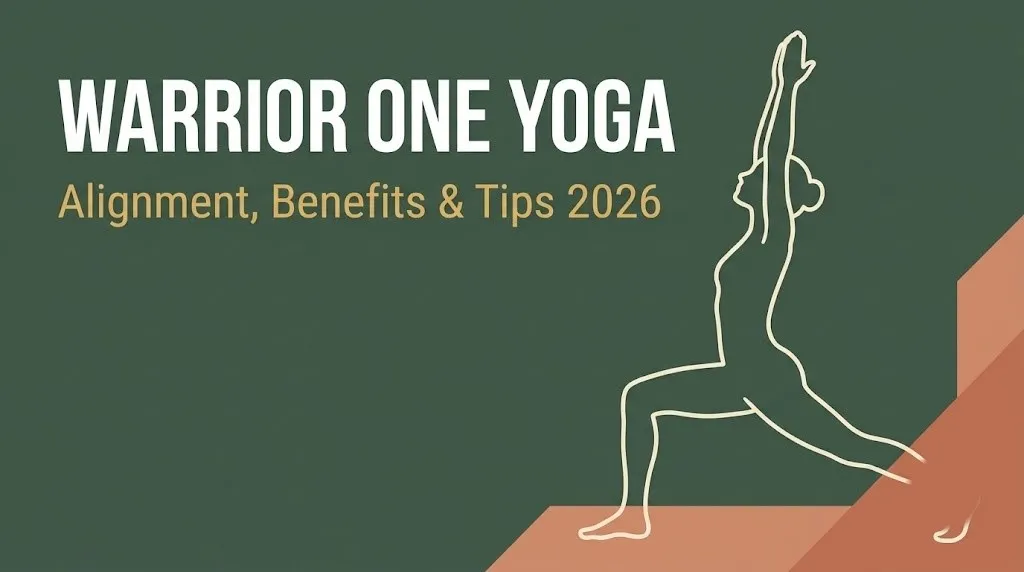
The pose is performed with one foot forward and one foot back. The front knee bends to roughly 90 degrees. Both arms reach overhead, framing the ears. The torso faces forward over the front leg.
Despite looking straightforward, Warrior One is technically demanding. It asks the hips to square toward the front of the mat while the back leg stays grounded. That combination of hip rotation, ankle stability, and upper-body reach places it firmly in the intermediate range of difficulty, even though it appears in many beginner classes.
Quick Summary:
- A standing lunge with arms reaching overhead
- Both feet grounded, hips squared forward
- Front knee bent to approximately 90 degrees
- Back leg extended and active, not passive
- Named after a mythological warrior in Hindu tradition
Warrior One appears in Ashtanga Primary Series, nearly every Vinyasa sun salutation variation, and standard Hatha yoga classes worldwide.
Virabhadrasana I: The Name and Its Meaning
Virabhadrasana I (pronounced veer-ah-bah-DRAHS-anna) takes its name from Virabhadra, a fierce warrior in Hindu mythology.
The name breaks down as: “Vira” meaning hero or warrior, “Bhadra” meaning friend or auspicious, and “asana” meaning pose or seat. Virabhadra was a being created by the god Shiva, described in the Shiva Purana as a warrior of great power and presence.
The three Warrior poses, Virabhadrasana I, Virabhadrasana II (Warrior II), and Virabhadrasana III (Warrior III), each represent a different moment in Virabhadra’s legendary battle. Warrior I is considered the first act: arrival on the battlefield, grounded and ready.
B.K.S. Iyengar, one of the most influential yoga teachers of the 20th century, described Warrior I as a pose that builds courage and steadiness. His systematic approach to alignment in this pose formed the foundation for how it is taught today across most yoga traditions.
Understanding the name does not change how you practice the pose. But it does explain why teachers often cue a sense of groundedness and resolve when they guide students into it.
How to Do Warrior One Yoga Pose: Step by Step
Warrior One is entered from Tadasana (Mountain Pose) or from Adho Mukha Svanasana (Downward Facing Dog) in a flow sequence.
To practice Virabhadrasana I (Warrior I):
- Start in Tadasana at the top of your mat. Stand with feet hip-width apart, weight evenly distributed.
- Step your left foot back approximately 3.5 to 4 feet, depending on your height and hip flexibility.
- Turn your left foot out to a 45-degree angle. Press the entire outer edge of the left foot into the mat.
- Square your hips toward the front of the mat. Draw the left hip forward and right hip back.
- Bend your right knee directly over your right ankle. Aim for a 90-degree angle at the front knee.
- On an inhale, sweep both arms overhead. Keep arms shoulder-width apart or bring palms to touch if your shoulders allow.
- Lengthen through the sides of the waist. Avoid collapsing into the lower back.
- Hold for 3 to 6 breath cycles. Release on an exhale by stepping back to Tadasana.
- Repeat on the opposite side.
Modification for beginners: Shorten your stance to reduce the demand on hip flexibility. Widen your feet slightly to improve balance. Keep hands on hips instead of reaching overhead if shoulder mobility is limited.
Key Takeaway: Warrior One demands more than a basic lunge. The back foot angle, hip squaring, and overhead reach must work together, and that coordination takes deliberate practice to build.
Warrior One Yoga Alignment: The Full-Body Breakdown
Good alignment in Warrior One means every body segment from the back foot to the fingertips is engaged and intentionally positioned.
Starting from the ground up, the back foot presses firmly into the mat at a 45-degree angle. The front foot points straight ahead. The front knee bends to approximately 90 degrees and tracks directly over the second toe, not collapsing inward.
The pelvis tries to square toward the front of the mat. This is the most demanding part of the pose. The back hip naturally wants to open to the side. Actively drawing the back hip forward and the front hip back creates the squared alignment. The core, specifically the transverse abdominis, engages to support the lumbar spine here.
The torso lifts tall from the hip crease. The lower ribs stay soft rather than flaring forward. Arms reach overhead with the deltoids and trapezius working to keep the shoulders away from the ears.
| Body Segment | Correct Alignment | Common Error |
|---|---|---|
| Back foot | 45 degrees, heel grounded | Heel lifting, foot too straight |
| Front knee | Over second toe, 90 degrees | Knee collapsing inward |
| Hips | Squared to front of mat | One hip rotating open |
| Lower back | Lengthened, not overarched | Ribs flaring, lumbar compression |
| Arms | Overhead, ears between arms | Shoulders shrugging up |
| Gaze | Forward or slightly upward | Looking down at the floor |
Pose Tip:
- Press all four corners of both feet into the mat
- Keep 3 inches of space between your shoulders and ears
- Beginners can place hands on hips to establish pelvic alignment before adding the arm reach
Warrior One Back Heel: Why Foot Placement Changes Everything
The back heel is the most frequently misaligned part of Warrior One, and fixing it changes the entire experience of the pose.
In Iyengar yoga tradition, the back heel presses firmly into the mat at a 45-degree angle from the front foot. This position does two things. First, it allows the back leg’s peroneal muscles along the outer lower leg to engage and stabilize the ankle. Second, it enables the back hip to rotate forward toward the squared position without straining the sacroiliac (SI) joint.
When the back heel lifts off the mat, the base of support shrinks. Balance becomes harder. The back leg becomes passive instead of active. The hip-squaring action becomes nearly impossible to achieve.
Think of it like trying to push a heavy door open while standing on your toes. You lose the ground connection that makes the effort possible. Pressing the back heel down restores that connection.
The 45-degree back foot angle also matters. A foot turned in too far (toward straight back) closes the hip and strains the SI joint. A foot turned out too far (toward 90 degrees) makes squaring the hips impossible. The 45-degree position is the mechanical compromise that serves both goals.
Modification: If your back heel lifts no matter what you try, slightly shorten your stance. Reducing the distance between your feet reduces the hip flexor stretch demand and makes heel grounding achievable.
How to Square Your Hips in Warrior One
Squaring the hips in Warrior One means rotating both hip points to face the front of the mat, which requires active work from the back leg’s hip rotator muscles.
The back hip naturally externally rotates when the foot turns out. To reverse this and bring the back hip forward, you need to internally rotate the back leg from the hip socket. The gluteus medius and deep hip rotators on the back side do this work.
A useful physical cue: imagine your front hip bones as headlights on a car. You want both headlights pointing straight forward. If the back “headlight” is angled to the side, the hips are open rather than squared.
Steps to build hip squaring:
- Set your feet in position. Do not add the arm reach yet.
- Place both hands on your hip bones so you can feel their position.
- Draw the back hip forward using an intentional muscular contraction.
- Draw the front hip slightly back to match.
- Hold this squared position. Now add the arm reach overhead.
According to the Journal of Alternative and Complementary Medicine, yoga practices that emphasize precise pelvic alignment improve proprioceptive awareness and hip stability over consistent practice. Warrior I is specifically well suited to building this pelvic control.
Modification for SI joint sensitivity: If squaring the hips causes lower back or sacral pain, slightly open the hips. A small external rotation of the back hip reduces SI joint compression without eliminating the pose’s benefits entirely.
Warrior One Muscles Worked
Virabhadrasana I engages muscles across the entire body simultaneously, making it one of the most complete standing poses in yoga.
The front leg does most of the strength work. The quadriceps (rectus femoris, vastus lateralis, vastus medialis, vastus intermedius) hold the front knee bent against gravity. The gluteus maximus controls the depth of the front hip’s flexion and stabilizes the pelvis.
The back leg provides the counterforce. The psoas major and iliacus, collectively called the hip flexors, stretch as the back hip extends. The hamstrings and gluteus maximus of the back leg contract to keep the leg straight and active. The tibialis anterior and peroneal muscles stabilize the back ankle.
The core engages throughout. The transverse abdominis and erector spinae work together to maintain spinal length. The arms lifting overhead activate the anterior deltoids, serratus anterior, and upper trapezius.
| Muscle Group | Location | Role in Warrior I |
|---|---|---|
| Quadriceps | Front of front thigh | Holds knee bent |
| Gluteus maximus | Buttocks | Stabilizes front hip, extends back hip |
| Psoas major / Iliacus | Front of back hip | Stretched as back hip extends |
| Hamstrings (back leg) | Back of back thigh | Active to stabilize extended leg |
| Transverse abdominis | Deep core | Spinal support, pelvic stability |
| Deltoids (anterior) | Shoulders | Lifts arms overhead |
| Erector spinae | Along the spine | Maintains upright torso |
Key Takeaway: Warrior One is not a leg pose with some arm reaching. It is a full-body coordination challenge that works the quadriceps, hip flexors, core, and shoulders at the same time.
Warrior One Pose Benefits
Warrior One pose builds lower-body strength, hip flexibility, and overhead shoulder stability in one integrated movement pattern.
The National Center for Complementary and Integrative Health (NCCIH) reports that yoga including standing poses improves lower-body strength, balance, and functional mobility, particularly in adults. Warrior I is one of the most commonly cited standing poses in yoga research because of how many muscle groups it engages simultaneously.
The hip flexor stretch is one of the most practical benefits of this pose. Most adults spend hours seated, shortening the psoas major and iliacus. The back leg position in Warrior I provides a sustained stretch to exactly these muscles, helping restore hip extension range of motion.
Key benefits of Warrior I:
- Quadriceps strengthening: builds the endurance needed for walking, stair climbing, and athletic activity
- Hip flexor lengthening: counters the effects of prolonged sitting on the psoas and iliacus
- Shoulder mobility: overhead arm position improves thoracic spine extension and shoulder flexion range
- Core stability: the anti-rotation demand of squaring the hips trains the deep stabilizers
- Proprioception and balance: standing on a split-stance base challenges the nervous system’s positional awareness
- Ankle stability: back foot pressing into the mat at an angle builds peroneal and tibial muscle control
Research published in the International Journal of Yoga has found that consistent yoga practice, including standing poses like Warrior I, improves balance scores and lower-body functional strength in both younger and older adult populations.
Warrior One for Beginners
Warrior One presents real challenges for beginners, but every element of the pose can be scaled to match where you are starting.
The most common beginner difficulty is feeling unstable. The split-stance base is narrower than it looks. A practical fix: widen your feet slightly so your front and back feet are on parallel tracks rather than on a single line. This gives you a wider lateral base and significantly improves balance without changing the essential shape of the pose.
The hip flexor stretch in the back leg feels intense for many beginners, especially those with desk-heavy daily routines. Shortening the stance reduces this intensity immediately. You can always lengthen the stance gradually over weeks as flexibility increases.
Beginner-specific guidance for Warrior One:
- Keep hands on hips for the first several sessions. Establish the foot and hip alignment before adding the arm reach.
- Use a wall behind you to guide back heel grounding. Press the back heel into the wall at 45 degrees.
- Look forward, not upward, to reduce neck strain until shoulder mobility improves.
- Hold for 3 breath cycles initially. Build toward 5 to 8 over time.
- Practice on both sides equally. Most people have a noticeably tighter side.
Pose Tip:
- Wider foot placement equals better balance for beginners
- Start with hands on hips to feel pelvic position
- Do not worry about a full 90-degree front knee bend right away
Warrior One Yoga Modifications
Modifications for Warrior One let the same essential pose work for bodies at very different ability levels.
The most common modification is a shortened stance. Bringing the feet closer together reduces the hip flexor stretch and lowers the balance demand. It is the single most effective modification for beginners and anyone with hip tightness.
For people who cannot ground the back heel, a folded blanket or wedge under the back heel provides the grounded surface without requiring full ankle dorsiflexion. This is common in Iyengar yoga practice and works well for people with tight calves or Achilles tendons.
| Modification | Who It Helps | How to Apply |
|---|---|---|
| Shortened stance | Tight hip flexors, beginners | Reduce distance between feet |
| Blanket under back heel | Limited ankle dorsiflexion, tight calves | Fold blanket, place under heel only |
| Hands on hips | Shoulder injury, beginners learning alignment | Skip overhead reach entirely |
| Chair-assisted version | Limited balance, knee concerns, seniors | Chair in front for hand support |
| Wall support | Balance issues, first-time practitioners | Back of back heel touches wall |
| Bent front knee at 45 degrees | Knee sensitivity, early sessions | Reduce front knee bend angle |
| Arms at cactus (bent elbows) | Shoulder impingement, rotator cuff issues | Bend elbows to 90 degrees instead |
A chair-assisted Warrior One is particularly useful in therapeutic and senior settings. Place a sturdy chair in front of you. Rest your fingertips on the chair back for balance support while maintaining the leg and hip position.
Key Takeaway: The back heel, shortened stance, and hands-on-hips adjustments solve the three most common Warrior One problems for beginners. You do not need a perfect pose to get the physical benefit.
Warrior One for Seniors
Warrior One is a practical and beneficial pose for older adults when adapted appropriately for balance, joint health, and range of motion changes.
The American College of Sports Medicine recommends balance and strength training for adults over 65 to reduce fall risk. Standing yoga poses like Warrior I directly address both. The pose trains the quadriceps, gluteal muscles, and hip stabilizers while simultaneously challenging proprioception through the split-stance base.
For seniors, the chair-modified version is a reliable starting point. Place a chair in front of you. Step one foot back into the Warrior I position. Rest both hands lightly on the chair back. Hold the position while focusing on grounding both feet and lengthening the spine. This version builds the same muscle patterns with significantly reduced fall risk.
Modifications specifically for seniors:
- Use a non-slip yoga mat to prevent foot slipping during stance changes
- Perform the pose near a wall or sturdy chair for stability on both sides
- Reduce front knee bend to 30 to 45 degrees if full 90 degrees causes knee discomfort
- Avoid the full overhead arm reach if shoulder arthritis or rotator cuff issues are present
- Shorten hold times to 2 to 4 breath cycles initially and build gradually
Research published in Complementary Therapies in Medicine found that yoga-based balance training in older adults reduced fall risk scores over a 12-week program. Warrior I was among the most-used poses in these protocols because of its combination of lower-body strengthening and balance challenge.
Warrior One Contraindications
Warrior One is not appropriate for everyone in its standard form, and knowing when to modify or skip it prevents injury.
People with recent or unresolved knee injuries should approach this pose carefully. The front knee bends under load, which places stress on the patellar tendon, meniscus, and knee ligament complex. If front knee pain occurs during the bend, reduce the depth of the bend or step out of the pose entirely. Anyone recovering from knee surgery should receive clearance from their physical therapist before practicing standing lunge poses.
Sacroiliac (SI) joint dysfunction is another concern. The hip-squaring demand of Warrior I can aggravate an already irritated SI joint by placing asymmetric rotational force across the pelvis. People with SI joint pain often find Virabhadrasana II (Warrior II) less provocative because the hips open to the side instead of squaring forward.
Conditions and situations requiring modification or avoidance:
- Active knee injury or recent knee surgery: skip or use chair support with minimal bend
- Sacroiliac joint dysfunction: switch to Warrior II or reduce hip-squaring effort
- High blood pressure: avoid full overhead arm reach; keep arms at heart height or on hips
- Shoulder impingement or rotator cuff tear: use cactus arms (bent elbows) or hands on hips
- Pregnancy (second and third trimester): widen the stance significantly; use wall or chair support; avoid deep front knee bend
- Severe ankle instability: use wall support for the back heel
When in doubt about whether this pose is appropriate for a specific condition, working one-on-one with a certified yoga teacher or physical therapist who can observe your alignment is the most reliable approach.
Warrior One vs. Warrior Two
Virabhadrasana I (Warrior I) and Virabhadrasana II (Warrior II) use similar lower-body positioning but differ in hip orientation, arm position, and which muscle groups are most challenged.
In Warrior I, the hips face forward. Arms reach overhead. This requires significant hip flexor engagement in the back leg and active internal rotation to square the pelvis. The challenge is hip squaring and spinal stability.
In Warrior II, the hips open to the long side of the mat. Arms extend out horizontally at shoulder height. The back hip externally rotates. The challenge shifts to hip adductor strength in the front leg and lateral shoulder endurance.
| Feature | Warrior I | Warrior II |
|---|---|---|
| Hip orientation | Squared forward | Open to the side |
| Arms | Overhead | Extended horizontally |
| Primary stretch | Back leg hip flexors | Front leg inner thigh (adductors) |
| Primary strength | Front quadriceps, core | Front quadriceps, hip abductors |
| Balance challenge | Higher (narrow base) | Moderate |
| SI joint demand | Higher | Lower |
| Best for | Hip flexor tightness, overhead mobility | Hip adductor strength, lateral stability |
Neither pose is harder than the other in absolute terms. Warrior I tends to feel harder for people with tight hip flexors. Warrior II tends to feel harder for people with weak hip abductors.
Key Takeaway: Warrior I and Warrior II look similar but work different muscle groups and joint mechanics. If Warrior I aggravates your SI joint or lower back, Warrior II is a biomechanically friendlier alternative.
Warrior One Yoga Sequence
Warrior One appears most naturally within sun salutation variations, standing pose sequences, and hip-opening flows.
In Ashtanga Primary Series, Warrior I appears as part of the standing sequence, transitioning from Adho Mukha Svanasana (Downward Facing Dog). In Vinyasa classes, it is woven into Sun Salutation B as a standard element. In Hatha classes, it is often practiced as a held standing pose with longer breath counts.
A practical Warrior One sequence for home practice:
- Tadasana (Mountain Pose): 5 breaths to establish grounding
- Anjaneyasana (Low Lunge): right leg forward, 5 breaths, warms up hip flexors
- Virabhadrasana I (Warrior I): right leg forward, 5 breaths
- Adho Mukha Svanasana (Downward Facing Dog): 5 breaths to reset
- Anjaneyasana (Low Lunge): left leg forward, 5 breaths
- Virabhadrasana I (Warrior I): left leg forward, 5 breaths
- Balasana (Child’s Pose): 8 to 10 breaths to release
This sequence takes approximately 10 to 12 minutes. It targets the same muscle groups in a progressive warm-up-to-peak pattern, which reduces injury risk and improves the quality of the Warrior I hold.
Warrior One Prep Poses
Specific preparatory poses build the flexibility and strength that Warrior One requires, making it both safer and more accessible.
The two biggest physical prerequisites for Warrior One are hip flexor flexibility in the back leg and front knee stability under load. Prep poses address both.
Anjaneyasana (Low Lunge) is the most direct preparation. It places the back knee on the mat and allows the hip flexor stretch to develop without the balance demand of a standing pose. Hold for 5 to 8 breaths per side before attempting Warrior I.
Ashta Chandrasana (High Lunge / Crescent Pose) is the closest standing relative. The feet are in the same position as Warrior I, but the back heel lifts. This warms up the legs and core while building proprioception in the split stance.
| Prep Pose | Sanskrit Name | What It Prepares |
|---|---|---|
| Low Lunge | Anjaneyasana | Hip flexor flexibility, back hip extension |
| High Lunge / Crescent | Ashta Chandrasana | Standing balance, leg strength |
| Mountain Pose | Tadasana | Foot grounding, posture alignment |
| Downward Facing Dog | Adho Mukha Svanasana | Calf and hamstring flexibility |
| Standing Forward Fold | Uttanasana | Hamstring length, pelvic mobility |
| Reclined Pigeon | Supta Kapotasana | Hip external rotator flexibility |
Practicing these poses for 2 to 3 minutes each before a Warrior I session reduces the resistance in the joints and makes the pose’s alignment demands far more achievable.
How Long to Hold Warrior One
The appropriate hold time for Warrior One depends on your experience level, the yoga style you are practicing, and what goal you are working toward.
In Hatha yoga, holds of 5 to 10 breath cycles (approximately 30 to 60 seconds) are standard. This duration allows the muscles to fatigue slightly and builds both strength and endurance in the quadriceps and hip flexors.
In Vinyasa yoga, Warrior I is often held for only 3 to 5 breaths before transitioning. The shorter hold is offset by the volume of repetition within the flow.
In Yin yoga, Warrior I is not traditionally used because it requires active muscular engagement. Yin poses are passive by design.
| Practice Level | Recommended Hold | Goal |
|---|---|---|
| Beginner | 3 to 5 breaths (15 to 25 seconds) | Learning alignment, building initial strength |
| Intermediate | 5 to 8 breaths (30 to 45 seconds) | Deepening alignment, building endurance |
| Advanced | 8 to 10+ breaths (45 to 60+ seconds) | Strength building, meditative focus |
| Seniors | 3 to 5 breaths with chair support | Balance training, functional strength |
| Therapeutic | Hold as long as comfortable, with props | Rehabilitation, gentle strengthening |
Research suggests that holds of 30 to 45 seconds are sufficient to produce muscle strength adaptations in yoga standing poses when practiced consistently three to four times per week. Yoga teachers and physical therapists generally recommend building hold times gradually rather than pushing for long holds before alignment is established.
Frequently Asked Questions About Warrior One Yoga
Why is Warrior One so hard for beginners?
Warrior One is hard for beginners because it requires hip flexor flexibility, balance on a split stance, and hip-squaring coordination all at the same time.
Most beginners have tight hip flexors from prolonged sitting, which makes the back leg position feel intensely stretched.
Shortening the stance and keeping hands on hips resolves most of the difficulty quickly.
What muscles does Warrior One work?
Warrior One primarily works the quadriceps, gluteus maximus, psoas major, transverse abdominis, and anterior deltoids.
The front leg works in strengthening while the back leg hip flexors are simultaneously stretched.
The core engages throughout to maintain spinal stability under the rotational demand of squaring the hips.
How is Warrior One different from Warrior Two?
In Warrior I, the hips face forward and both arms reach overhead.
In Virabhadrasana II (Warrior II), the hips open to the side of the mat and arms extend horizontally at shoulder height.
The hip mechanics and muscle engagement differ substantially, making them complementary rather than interchangeable poses.
Can I do Warrior One with bad knees?
Yes, with modifications. Reduce the front knee bend to 30 to 45 degrees instead of the full 90 to ease patellar tendon load.
Using a chair for hand support reduces the weight-bearing demand on the knee.
Anyone recovering from a knee injury should get clearance from a physical therapist before practicing standing lunge variations.
How long should I hold Warrior One?
Most yoga teachers recommend beginners hold Warrior One for 3 to 5 breath cycles, roughly 15 to 30 seconds.
Intermediate and advanced practitioners typically hold for 5 to 10 breaths, or 30 to 60 seconds.
Build hold time gradually as your alignment stabilizes and your leg strength develops.
Start with the back heel. That one adjustment, pressing it firmly into the mat at 45 degrees, changes how your hips align, how your core engages, and how stable the whole pose feels.
Practice Warrior One three times per week. Begin with 3-breath holds and a shortened stance. Add one breath per week. Let your body earn the depth rather than forcing it.
You will feel the quadriceps, the hip flexors, and the difference on each side. That asymmetry is useful information. Your practice is telling you exactly where to focus next.