Tantric Yoga for Couples: Poses, Benefits & How to Start
Tantric yoga for couples is a partner-based practice rooted in ancient Indian philosophy that uses synchronized breathwork, shared poses, and mutual presence to build physical and emotional attunement between two people. It is not a sexual practice, despite what popular culture suggests, and it requires no prior yoga experience to begin.
Research published in Frontiers in Psychology found that synchronized breathing and coordinated movement between partners activates the autonomic nervous system’s calming branch, reduces cortisol, and increases feelings of social bonding and trust. Those are measurable outcomes, not wellness platitudes.
This article covers what tantric yoga for couples actually is, where the tradition comes from, how to practice it with clear step-by-step instructions, what the science says about its relational and physical benefits, and how to find a class or build a home practice regardless of your flexibility level.
What Is Tantric Yoga for Couples?
Tantric yoga for couples is a structured partner practice drawn from Tantric philosophy and Hatha yoga that uses shared breath, synchronized movement, and sustained mutual awareness to cultivate presence and connection between two people.
The word “Tantric” comes from the Sanskrit root “tan,” meaning to weave or expand. In a couples context, the practice weaves two nervous systems together through coordinated breath and physical contact. It is not a romantic add-on to regular yoga. It is a distinct approach with its own techniques, sequencing logic, and philosophical grounding.
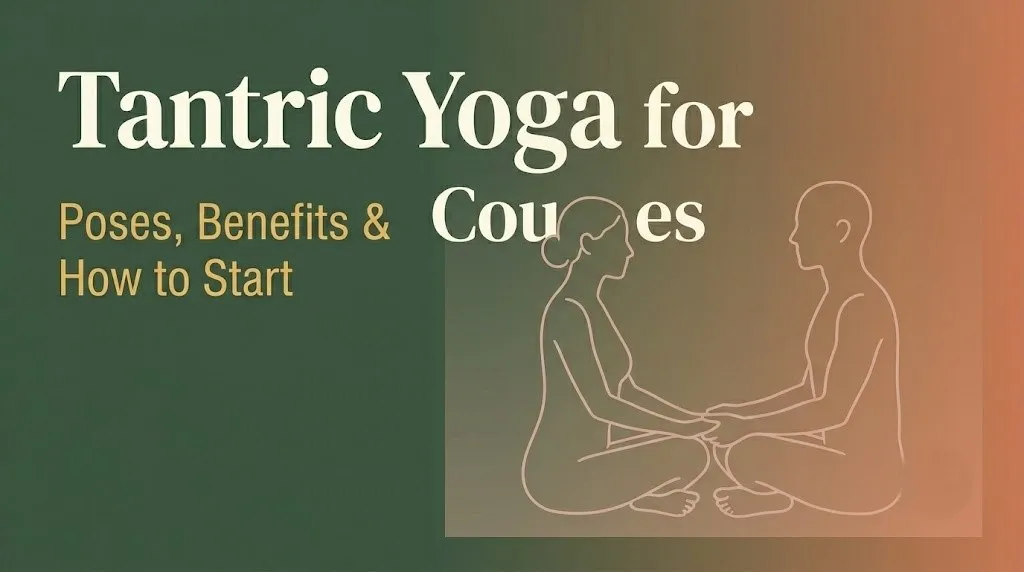
Practically speaking, a session involves sitting face-to-face or back-to-back, synchronizing the inhale and exhale, practicing partner-assisted stretches, and spending time in stillness while maintaining physical contact. The physical poses are secondary to the quality of attention brought to the practice.
What a typical session includes:
- Seated eye contact or touch meditation to open the session
- Pranayama (breath control) practiced in unison or in complementary rhythm
- Partner-assisted yoga poses emphasizing mutual support rather than performance
- Periods of stillness and shared breath between movements
- A closing Savasana (Corpse Pose) practiced side by side
Is Tantric Yoga Sexual? Clearing Up the Biggest Misconception
Tantric yoga for couples is not a sexual practice. This is the most persistently misunderstood aspect of the entire topic.
The confusion comes from Western popular culture, which in the 1960s and 1970s stripped certain elements from traditional Tantric texts and repackaged them as tools for sexual enhancement. The resulting “neo-Tantra” concept bears little resemblance to the original tradition. Classical Tantra is a vast philosophical and ritual system that addresses liberation, consciousness, and the relationship between the individual and the cosmos.
The yoga practiced by couples under the Tantric label in contemporary studios focuses on breath synchronization, sustained attention, partner-assisted asana, and nervous system calming. Physical touch in these sessions is practiced at the level of hands, back contact, and seated proximity, not in any intimate or sexual manner.
Yoga Alliance registered teachers who teach Tantra-informed partner yoga are trained to maintain clear professional boundaries, articulate the distinction between classical Tantra and neo-Tantra explicitly, and create a class environment that is appropriate for any couple regardless of whether they have a romantic or platonic relationship.
Pose Tip:
- Touch in couples Tantric yoga is always consensual and boundaried
- Both partners should verbally agree on comfort level with physical contact before starting
- A simple pre-practice check-in (“where are you comfortable being touched today?”) is standard in well-taught classes
The Tradition Behind Tantric Yoga for Couples
The tradition of Tantra dates to approximately the 5th to 9th centuries CE in India, emerging primarily through Kashmir Shaivism and various Shakta lineages.
Classical Tantra viewed the relationship between Shiva (the masculine, consciousness principle) and Shakti (the feminine, energy principle) as a model for all relationships. Practitioners sought to recognize and honor these complementary forces within themselves and within their partnerships. The body, including its sensations and breath, was seen as a direct vehicle for spiritual awareness rather than an obstacle to it.
This framework makes couples practice philosophically coherent within Tantra: two practitioners recognizing complementary aspects of awareness in each other, using breath and shared presence as the method. The physical yoga component emerged later as Hatha yoga developed techniques for working with the body’s energy systems.
Modern partner yoga classes that reference Tantra draw on this philosophical foundation while stripping away the ritual and religious context. What remains is the core practice structure: breath synchronization, shared stillness, and attentive physical contact. These elements have research support independent of their philosophical origins, as the science of co-regulation shows.
Key elements from Tantric tradition applied in modern couples practice:
- Recognition of complementary energies in each partner (active and receptive, solar and lunar)
- Use of Pranayama as the primary tool for nervous system and relational attunement
- Emphasis on presence and sensory awareness over physical achievement
- The body treated as a source of insight rather than a project to be perfected
Key Takeaway: Tantric yoga for couples is a breath-and-presence-centered partner practice rooted in classical Indian philosophy, and its core tools (synchronized breath, shared stillness, mindful touch) are supported by modern neuroscience research on co-regulation and social bonding.
Tantric Yoga vs. Regular Yoga: What Is Actually Different?
Tantric yoga for couples differs from regular solo yoga practice in three fundamental ways: the unit of practice, the primary tool, and the intended outcome.
In regular yoga, the unit of practice is the individual. You track your own breath, your own alignment, your own experience. In tantric couples yoga, the unit is the dyad: the relationship between two bodies and two nervous systems. Alignment cues shift from “where is your hip?” to “where is your breath relative to your partner’s?”
The primary tool also changes. While asana (physical poses) remain part of the practice, they are secondary to Pranayama (breath control). Many experienced couples yoga teachers structure sessions where 60% of the time is spent in breathwork and stillness, and 40% in physical poses. This is the opposite ratio of most Vinyasa classes.
The intended outcome in regular yoga is most often individual: flexibility, strength, stress reduction, or body awareness. In tantric couples practice, the intended outcome is relational: two people leaving the session feeling more attuned, calmer together, and more able to communicate non-verbally.
| Feature | Regular Yoga | Tantric Yoga for Couples |
|---|---|---|
| Unit of practice | Individual | Dyad (two people) |
| Primary tool | Asana (poses) | Pranayama (breathwork) |
| Alignment focus | Personal body mechanics | Breath synchronization |
| Touch involved | None (solo) | Yes, structured and consensual |
| Intended outcome | Individual wellbeing | Relational attunement |
| Suitable for beginners | Yes | Yes, with guidance |
| Typical session length | 60 to 90 minutes | 45 to 75 minutes |
| Props commonly used | Blocks, strap, bolster | Bolster, blanket, blocks |
How to Do Tantric Yoga for Couples: Breathwork and Presence
The foundation of tantric yoga for couples is not a pose. It is the breath, and specifically the practice of matching your breath rhythm to your partner’s.
Start by sitting in Sukhasana (Easy Pose) facing your partner. Both partners close their eyes. Each takes three unguided breaths to settle individually. Then open the eyes and begin to observe the other person’s breath rhythm without speaking. After one to two minutes, both partners begin to match the pace of the exhale. The inhale follows naturally.
This simple act, breathing together without instruction or music or distraction, activates what neurologists call inter-subject synchrony: the measurable alignment of two people’s physiological rhythms through shared attention. Research published in Frontiers in Psychology demonstrates that physiological synchrony of this type correlates with increased feelings of social connection and reduced stress biomarkers in both partners.
The presence element is equally non-negotiable. Many couples arrive at a session distracted by the day’s events. Tantric yoga teachers typically open sessions with a drishti (focused gaze) practice: partners hold eye contact for two minutes without speaking. This simple act often generates more discomfort, vulnerability, and eventual calm than any physical pose in the sequence.
To begin a basic presence and breath practice:
- Sit in Sukhasana (Easy Pose) facing your partner, knees nearly touching.
- Place both palms face-up on your knees. Invite your partner to rest their palms on yours.
- Close your eyes together. Breathe individually for 3 full cycles.
- Open your eyes. Hold a soft, relaxed gaze with your partner.
- Begin to slow your exhale to 6 counts. Inhale naturally.
- Continue for 5 to 10 minutes. Don’t rush. Don’t speak.
- Close by bowing the head gently toward each other.
Modification: Partners who find eye contact uncomfortable can sit back-to-back and feel each other’s breath through the contact of the spines instead.
Tantric Yoga Poses for Couples Step by Step
The physical poses in tantric yoga for couples are designed to create mutual support rather than mutual challenge. Neither partner is performing for the other. Both are practicing with the other.
Pose 1: Back-to-Back Sukhasana (Easy Pose)
To practice:
- Both partners sit in Sukhasana (Easy Pose) back to back.
- Press the entire length of the spine against your partner’s.
- Feel their breath enter and leave through the contact of your backs.
- Match your inhale to the moment you feel their back expand.
- Hold for 8 to 10 breath cycles.
- Release by leaning forward simultaneously.
Modification: Partners with tight hips sit on folded blankets to tilt the pelvis forward and reduce strain on the lower back.
Pose 2: Seated Partner Forward Fold (Paschimottanasana variation)
To practice:
- Both partners sit facing each other with legs extended in Dandasana (Staff Pose).
- Touch the soles of your feet to your partner’s feet. Adjust distance as needed.
- Both partners reach forward and hold each other’s wrists or forearms.
- Partner A gently leans back, drawing Partner B into a forward fold. Hold 5 breaths.
- Switch roles. Partner B leans back, Partner A folds forward.
- Release slowly, both returning to upright.
Safety note: Never pull a partner’s arms abruptly or apply sudden force. The movement should feel like a slow, mutual conversation, not a correction.
Modification: If hamstrings are tight, both partners bend their knees. Place a bolster under Partner B’s knees when they fold forward to reduce lumbar strain.
Pose 3: Seated Back-to-Back Twist
To practice:
- Sit back to back in Sukhasana (Easy Pose).
- Both partners inhale to lengthen the spine upward.
- On the exhale, Partner A rotates right; Partner B rotates left.
- Place the right hand on your own left knee; reach the left hand to your partner’s right knee.
- Hold for 5 breaths. Inhale to return to center.
- Switch directions and repeat.
Modification: Partners with spinal sensitivity practice a shorter rotational range, stopping when the first sensation of stretch arrives rather than seeking a full twist.
Couples Yoga Breathing Exercises and Synchronized Breath
Synchronized breathing is the core technology of tantric yoga for couples, and it works through a well-documented physiological mechanism.
When two people deliberately match their breathing patterns, their heart rate variability (HRV) profiles begin to align. HRV is a measure of the nervous system’s flexibility and stress resilience. Higher HRV is associated with better emotional regulation, calmer reactivity, and greater empathy. According to a study published in the Journal of Alternative and Complementary Medicine, couples who practiced synchronized slow breathing for 20 minutes showed measurable improvements in HRV in both partners, with effects lasting up to 2 hours post-session.
Three breathing practices for couples:
- Mirrored Breath: Both partners breathe at the same pace simultaneously. Begin with a 4-count inhale, 6-count exhale. This is the simplest starting point and the most immediately calming.
- Complementary Breath (Alternate Breathing): One partner inhales while the other exhales. This creates a continuous, wave-like rhythm between two bodies. It requires more attentiveness and works well after 2 to 3 sessions of Mirrored Breath practice.
- Nadi Shodhana (Alternate Nostril Breathing) practiced simultaneously: Both partners perform the same pranayama technique in unison, side by side. No physical synchronization with each other is required; the shared action creates connection through shared intention.
Modification for respiratory sensitivity: Partners with asthma or any breathing condition should avoid counted breath retention techniques. Mirrored Breath without breath holds is the safest starting point and remains effective.
Key Takeaway: Synchronized breathing is the most scientifically supported element of tantric yoga for couples, producing measurable changes in heart rate variability and nervous system calming in both partners within a single session.
Tantric Yoga Benefits for Couples: What Research Says
The benefits of tantric yoga for couples span the physiological, psychological, and relational, and the research base is stronger than most people expect.
On the physiological side, partner yoga and synchronized breathwork consistently reduce cortisol (the primary stress hormone) in both partners. The National Center for Complementary and Integrative Health identifies breath-focused yoga practices as among the most evidence-supported approaches to stress reduction, and this holds when the practice is conducted with a partner.
The relational benefits are equally measurable. According to research published in Frontiers in Psychology, coordinated movement and synchronized breathing between partners increases oxytocin release, the neuropeptide associated with social bonding, trust, and emotional safety. Importantly, this effect occurs through touch and synchronized rhythm, not through romantic context specifically. Non-romantic partners in the same research protocols showed similar oxytocin responses.
The communication benefits are perhaps the most practically useful for couples. Partner yoga requires continuous non-verbal negotiation: who leads, who follows, when to pause, when to deepen. Over time, couples who practice together report improved ability to read each other’s physical and emotional cues in daily life, a finding consistent with attachment research from the American Psychological Association on the role of attuned physical interaction in relationship quality.
Documented benefits of tantric and partner yoga for couples:
- Reduced cortisol in both partners after a single session
- Increased oxytocin through synchronized touch and breath
- Improved heart rate variability (nervous system flexibility)
- Enhanced non-verbal communication and relational attunement
- Reduced anxiety and improved sleep quality with regular practice (8 or more weeks)
- Increased body awareness and proprioception in both partners
Couples Yoga for Intimacy and Emotional Connection
Couples yoga builds emotional connection through a mechanism that has nothing to do with romance: nervous system co-regulation.
Co-regulation is the process by which one person’s calm nervous system helps settle another person’s activated one. It happens between parents and infants, between therapists and clients, and between partners who are physically close and breath-synchronized. It is a biological process, not a romantic concept.
In tantric yoga for couples, the practice deliberately creates conditions for co-regulation: close physical proximity, synchronized breath, matched movement pace, and sustained mutual attention. Think of it like two tuning forks placed next to each other. When one vibrates, the other begins to match its frequency. Two nervous systems in physical proximity and synchronized breath do something similar.
According to research from the American Psychological Association, couples who engage in shared physical activities that require non-verbal coordination report higher relationship satisfaction than couples who exercise separately, even when total exercise time is equal. The non-verbal attunement appears to be the active ingredient.
Practices that specifically build emotional connection in couples yoga:
- Drishti (soft gaze) practice: Holding relaxed eye contact for 2 minutes without speaking. Uncomfortable at first, calming within 60 seconds for most couples.
- Heartbeat meditation: One partner places a hand on the other’s sternum and feels the heartbeat. Two minutes per side.
- Synchronized walking meditation: Walking slowly side by side, matching stride length and pace. A surprisingly effective entry point for couples new to the practice.
Modification for couples with emotional guardedness: Start with back-to-back contact rather than face-to-face. The physical connection is present without the vulnerability of eye contact, making it a gentler starting point.
Tantric Yoga for Beginners: Starting as a Couple
Couples with no yoga experience can begin tantric yoga practice immediately. No prior flexibility, no prior yoga knowledge, and no special equipment is required to start.
The most important thing beginners get wrong is prioritizing physical poses over breath practice. In tantric couples yoga, breath synchronization is the practice. The poses are the framework. A couple that sits in Sukhasana (Easy Pose) back-to-back and breathes together for 15 minutes has had a more genuine tantric yoga experience than a couple that performs five partner poses without attending to their breath at all.
The second most common beginner mistake is treating the session like a performance. One partner is often more flexible or more experienced than the other. This creates a competitive or self-conscious dynamic that directly undermines the relational attunement the practice is designed to build.
A beginner’s first three sessions, structured:
| Session | Duration | Focus | Key Practice |
|---|---|---|---|
| Session 1 | 20 minutes | Breath and presence only | Mirrored Breath in Sukhasana, 15 minutes |
| Session 2 | 30 minutes | Breath plus one pose | Mirrored Breath + Back-to-Back Seated Pose |
| Session 3 | 40 minutes | Breath plus two poses | Add Partner Forward Fold; close with Savasana together |
Starting tips for beginners:
- Practice in a quiet, phone-free space to remove distraction
- Wear comfortable, non-restrictive clothing; yoga gear is not necessary
- Agree on a session length before starting; stop when agreed, not when energy runs out
- After each session, take two minutes to share one observation from the practice (not evaluation, observation)
Key Takeaway: Beginners in tantric couples yoga will get the most from prioritizing breath synchronization over physical poses, because the breath practice is the active ingredient for both the physiological and relational benefits the practice produces.
Couples Yoga for Limited Mobility and Modifications
Tantric yoga for couples is one of the most accessible partner practices available for people with limited mobility, because its primary tools (breath and attention) require no physical flexibility at all.
The poses in a standard couples yoga sequence can be adapted for a wide range of bodies. Every seated pose can be practiced in a chair. Every partner assist can be modified to use a yoga strap rather than direct hand contact. Every floor-level pose has a supported variant using bolsters and blankets.
The presence and breathwork elements require no physical capacity whatsoever. A couple in which one or both partners uses a wheelchair, has chronic pain, or is recovering from surgery can practice full breath synchronization, eye contact meditation, and heartbeat awareness without any physical modification needed.
Modification guide for common limitations:
| Condition | Pose Affected | Modification |
|---|---|---|
| Tight hips | Sukhasana (Easy Pose) | Sit on two folded blankets; legs extended if needed |
| Tight hamstrings | Seated Forward Fold partner assist | Both partners bend knees; use a strap to bridge the gap |
| Lower back pain | Back-to-back seated work | Use a chair back for lumbar support |
| Knee pain | All floor-seated poses | Practice from a chair; use blankets under knees |
| Shoulder injury | Wrist-hold partner folds | Hold forearms instead; reduce range of assist |
| Balance difficulty | Any standing elements | Remove standing poses; keep entire practice seated |
According to the National Center for Complementary and Integrative Health, yoga adaptations for people with chronic pain and mobility limitations show consistent benefits for pain perception and emotional wellbeing when modifications are appropriately tailored. A yoga teacher with a 500-hour certification and therapeutic yoga training can design a session specific to one or both partners’ conditions.
Restorative Couples Yoga: A Gentle Approach
Restorative couples yoga is the most accessible entry point for couples who find active partner poses overwhelming, intimidating, or physically demanding.
Restorative yoga as a style uses props, extended holds of 5 to 15 minutes, and passive body positioning to activate the parasympathetic nervous system. In a couples context, restorative poses are practiced simultaneously with physical proximity: lying head-to-head, resting back-to-back, or holding hands in supine positions.
The gentleness of restorative couples yoga makes it particularly well-suited for:
- Couples where one partner has chronic fatigue, illness, or is in recovery
- Seniors exploring partner practice for the first time
- Couples going through high-stress life periods (caregiving, grief, work pressure)
- Anyone who finds active movement in front of a partner self-conscious
A simple restorative couples sequence:
- Supported Savasana (Corpse Pose) side by side: each partner on a bolster under the spine, blanket over the body, hands loosely touching. 10 minutes.
- Supta Baddha Konasana (Reclined Bound Angle Pose) simultaneously: each partner on their own bolster, blocks supporting the outer thighs, hands touching in the center. 8 minutes.
- Child’s Pose (Balasana) back-to-back: one partner in Balasana (Child’s Pose), the other seated upright against their back, creating gentle traction. Switch after 5 minutes.
- Close in seated Sukhasana, three shared breaths, bow forward together.
Modification: Partners who cannot lie on the floor practice Supported Savasana in a reclining chair with a blanket. The hand-touch element remains intact and carries the relational benefit of the pose.
Tantric Yoga Contraindications and Safety for Couples
Tantric yoga for couples is a gentle practice for most people, but specific conditions warrant care or modification before beginning.
The most important safety framework for couples yoga is consent and communication. Every pose that involves partner assist (one person applying pressure to the other’s body) must be verbally agreed upon before it begins. The person receiving the assist must feel able to say “less” or “stop” at any point without social pressure to continue. This is not just an ethical standard; it is a physiological one. Any practitioner who feels they cannot signal discomfort will hold muscular tension throughout the session, directly undermining the nervous system benefits the practice is designed to produce.
Specific contraindications:
- Trauma history involving physical touch or boundary violation: Couples yoga involves sustained physical contact. People with relevant trauma histories should work with a trauma-informed yoga teacher and inform their partner clearly of any boundaries before starting.
- Acute musculoskeletal injury (either partner): Any partner assist directly loads the injured area and should be avoided until cleared by a physical therapist.
- Pregnancy (third trimester): Seated partner assists and forward fold assists should be modified significantly. Many floor-level poses are inappropriate in late pregnancy. A prenatal yoga teacher with partner yoga training can design appropriate alternatives.
- Active psychiatric crisis: Prolonged eye contact and sustained physical proximity can be dysregulating for some people in acute mental health states. This practice is most appropriate as a maintenance or wellness tool, not an acute intervention.
Safety note: The single most important safety rule in any couples yoga session is this: the person receiving an assist always controls the depth. The person providing the assist follows. Never push. Never hold. Assist means support, not correction.
Key Takeaway: Consent and clear communication are the foundational safety tools in tantric yoga for couples, and any pose involving partner-assisted stretching must be practiced with the receiver in full control of the depth and duration.
Couples Tantric Yoga Near Me: What to Look For in a Class
Finding a genuinely well-taught tantric yoga class for couples requires knowing which credentials and class structures to look for, because the term is used loosely and inconsistently across studios.
The most reliable indicator of a qualified teacher is Yoga Alliance RYT-500 registration combined with specific training in partner yoga, couples yoga, or Tantra-informed yoga philosophy. A 200-hour trained teacher may offer excellent couples yoga classes, but additional training in anatomy, assist safety, and Tantric philosophy signals more thorough preparation for this specific format.
When evaluating a class or studio, ask these specific questions before booking:
- Does the class description explicitly state that it is non-sexual and appropriate for all couples?
- Does the teacher conduct a pre-class check-in about physical limitations and touch preferences?
- Is there a clear explanation of the Tantric philosophy informing the class, separate from any sexual context?
- Are props (bolsters, blankets, blocks) provided and actively used in the class?
- Is the class size small enough (ideally under 8 couples) for the teacher to observe and cue individual pairs?
Class format comparison:
| Class Type | Tantric Philosophy | Physical Intensity | Suitable for Beginners |
|---|---|---|---|
| Tantra-informed partner yoga | Yes | Low to moderate | Yes |
| Acro yoga | No | High | No |
| Standard couples yoga | Varies | Moderate | Yes |
| Kundalini couples practice | Adjacent | Low | With guidance |
| Restorative partner yoga | Sometimes | Very low | Yes |
If no local classes meet these criteria, a structured home practice using the guidance in this article is a fully adequate starting point. Many couples find home practice preferable for its privacy and the ability to set their own pace.
How to Build a Tantric Yoga Sequence at Home
A complete tantric yoga sequence for couples at home requires about 45 minutes, a quiet space, two yoga mats placed side by side, and basic props.
The sequence below follows a three-part arc used in well-structured partner yoga classes: arriving together, practicing together, and closing together. Each phase serves a distinct physiological purpose.
Complete home tantric yoga sequence for couples:
- Opening: Drishti (Soft Gaze) Meditation (5 minutes): Sit facing each other in Sukhasana (Easy Pose). Hold a relaxed, non-intense gaze. Breathe individually. Let the eyes soften.
- Mirrored Breath Practice (5 minutes): Transition to back-to-back. Match breathing pace. No talking. 4-count inhale, 6-count exhale.
- Back-to-Back Seated Twist (3 minutes): Inhale to lengthen, exhale to rotate in opposite directions. 5 breaths per side.
- Seated Partner Forward Fold (4 minutes): Feet touching, hold forearms. Alternate forward fold. 5 breaths per partner.
- Baddha Konasana (Bound Angle Pose) side by side (3 minutes): Seated, soles of feet together, sitting back-to-back for support. 10 breaths.
- Partner Child’s Pose and Seated Back Support (5 minutes): One partner in Balasana (Child’s Pose), other seated against their back. Switch.
- Restorative Side-by-Side Savasana (Corpse Pose) (10 minutes): On bolsters, hands loosely touching. No movement. Full breath freedom.
- Closing Breath and Bow (5 minutes): Return to face-to-face Sukhasana. Three synchronized breaths. Bow forward together.
Modification for the full sequence: Any couple who cannot access the floor performs the entire sequence in chairs facing each other or side by side, replacing all floor poses with chair equivalents. The breathwork and presence elements remain identical.
According to the International Journal of Yoga, yoga practiced in pairs with a consistent weekly frequency of two to three sessions produces greater improvements in emotional regulation and stress markers than solo practice at the same frequency. The relational element adds a measurable dimension to the practice outcomes.
Frequently Asked Questions About Tantric Yoga for Couples
What is tantric yoga for couples and is it sexual?
Tantric yoga for couples is a partner practice using synchronized breath, shared poses, and sustained mutual presence to build relational attunement and calm the nervous system.
It is not a sexual practice; the sexual association comes from a 20th-century Western reinterpretation of Tantric philosophy that has no basis in the yoga practice taught in studios or this context.
Traditional and contemporary teachers are clear: this is a breath-and-body practice, not an intimacy technique.
Do you need yoga experience to start tantric yoga as a couple?
No prior yoga experience is needed to begin tantric yoga as a couple.
The primary practice is breath synchronization, which requires only the ability to breathe and attend to your partner; no flexibility, strength, or yoga background is necessary.
Beginners often find that starting without preconceptions about “doing yoga correctly” actually makes the presence-focused elements easier.
How long should a tantric yoga session for couples last?
A complete beginner session for couples should last 20 to 30 minutes, focusing primarily on breathwork and one or two seated poses.
Experienced couples typically practice for 45 to 75 minutes, including a longer restorative closing and extended breath synchronization.
Shorter, more frequent sessions (three times per week for 20 minutes) produce more consistent nervous system and relational benefits than occasional long sessions.
What is the difference between tantric yoga and partner yoga?
Partner yoga is a broad category describing any yoga practice performed with another person; tantric yoga for couples is a specific form of partner yoga informed by Tantric philosophy.
The key distinction is intentionality: partner yoga may focus on physical achievements like assisted backbends or balance poses, while tantric couples yoga prioritizes breath, presence, and nervous system attunement above physical performance.
Both can be valuable, but they serve different purposes and create different experiences.
Can seniors or people with limited mobility do tantric yoga for couples?
Yes, tantric yoga for couples is one of the most adaptable partner practices for seniors and people with limited mobility.
The core practice elements (breath synchronization, soft gaze, hand contact) require no physical capacity, and every seated pose can be practiced in a chair with full access to the relational and physiological benefits.
A yoga teacher with therapeutic training can design a session appropriate for any physical limitation.
Begin With the Breath
The single most practical thing you can do after reading this article is sit with your partner for ten minutes and breathe together. That’s it. Back to back, eyes closed, matching the pace of the exhale. No poses, no sequence, no pressure.
That practice alone delivers the core benefit: two nervous systems settling together. Build from there. Add one pose next week. Try a class if one is available in your area. Keep the breath as the anchor.
The practice grows from two people paying attention to each other, one breath at a time.