Renew Yoga: Poses, Benefits & How to Start in 2026
Renew yoga is a restorative, low-intensity practice that draws from Yin yoga, gentle Hatha, and Restorative yoga traditions to help the body recover, de-stress, and rebuild baseline energy. It is not a single trademarked style but a category of practice defined by long holds, supported poses, and a deliberate focus on parasympathetic nervous system activation.
The interest in renewal-focused movement has grown sharply. According to the National Center for Complementary and Integrative Health, yoga is now used by roughly 21 million American adults, with stress relief and physical recovery named as the top two reasons. That number continues to climb post-2020 as burnout and chronic fatigue have moved from edge cases into everyday experience.
This guide covers what renew yoga actually is, how it differs from other gentle yoga styles, which poses to start with, how breathing amplifies results, and how to build a safe weekly home practice. It also addresses who should modify certain poses and what the current research actually shows about yoga’s effect on recovery and the nervous system.
What Is Renew Yoga
Renew yoga refers to a style of yoga practice designed to restore energy, release accumulated physical tension, and reset the body’s stress response through gentle movement and extended stillness. The term “renew” describes the intent: returning the body and nervous system to a baseline of calm and function after periods of stress, illness, or physical depletion.
Unlike a vigorous Vinyasa flow or a strength-focused Ashtanga session, renew yoga prioritizes passive release over active effort. Poses are typically held for 1 to 5 minutes. The emphasis is on letting gravity and breath do the work rather than muscular engagement.
This approach borrows from three established yoga traditions: Restorative yoga (which uses props to support the body in complete passivity), Yin yoga (which targets connective tissue and fascia through long-duration holds), and gentle Hatha yoga (which uses slow, supported movement with breath awareness). A renew yoga practice may include elements of all three within a single session.
The defining feature is intention. A class or home session qualifies as renew yoga when the primary goal is physiological and psychological restoration, not fitness gains or flexibility milestones.
| Feature | Renew Yoga | Vinyasa Yoga | Ashtanga Yoga |
|---|---|---|---|
| Pace | Slow, stationary | Continuous flow | Fixed rapid sequence |
| Hold Duration | 1 to 5 minutes per pose | 3 to 5 breaths per pose | 5 breaths, set sequence |
| Primary Goal | Restoration, stress recovery | Cardiovascular fitness, strength | Strength, stamina, discipline |
| Props Required | Yes, commonly | Rarely | Rarely |
| Effort Level | Passive to minimal active | Moderate to high | High |
| Best For | Burnout, recovery, seniors, beginners | Active practitioners | Experienced practitioners |
Renew Yoga vs Restorative Yoga: Understanding the Difference
Renew yoga and Restorative yoga share the same foundational goal but differ in structure, origin, and the type of tissue they target. Restorative yoga, formalized largely through the teaching of B.K.S. Iyengar and later popularized by Judith Hanson Lasater, is a precise, prop-heavy practice where the body is fully supported and no muscular effort is required. Think of it as supervised rest.
Renew yoga, by contrast, is a broader category. It may include Restorative-style supported poses alongside gentle active stretches, breathwork sequences, and short Yoga Nidra (yogic sleep) segments. It is more flexible in structure and more accessible in design, making it easier to practice at home without a teacher.
The tissue targeted also differs. Restorative yoga works primarily with the nervous system and the body’s relaxation response. Yin yoga targets fascia and connective tissue around joints like the hips, spine, and shoulders. Renew yoga can address both depending on which poses and holds are chosen.
One practical difference: you can practice renew yoga with very minimal props. A folded blanket and a wall are often enough to start. A full Restorative practice typically requires bolsters, multiple blankets, blocks, and straps.
| Practice | Primary Target | Props Needed | Session Length | Style Origin |
|---|---|---|---|---|
| Renew Yoga | Nervous system + fascia | Minimal (blanket, wall) | 20 to 60 minutes | Contemporary blend |
| Restorative Yoga | Nervous system, relaxation response | Extensive (bolster, blocks, blankets) | 45 to 75 minutes | Iyengar-influenced |
| Yin Yoga | Fascia, deep connective tissue | Minimal to moderate | 45 to 75 minutes | Paul Grilley, Sarah Powers |
| Yoga Nidra | Mind, sleep, conscious relaxation | Mat only | 20 to 45 minutes | Swami Satyananda Saraswati |
Renew Yoga Benefits for Body and Mind
Renew yoga produces measurable changes in both physical function and psychological wellbeing when practiced consistently, according to findings from multiple peer-reviewed yoga research publications. These benefits do not require athletic ability or prior yoga experience, which makes renew yoga accessible at almost any life stage.
The physical benefits include reduced muscular tension, improved range of motion in the hips and spine, lower resting heart rate, and improved sleep quality. A study published in the International Journal of Yoga found that restorative yoga practices produced statistically notable reductions in both perceived stress and physiological markers of tension in participants after eight weeks of regular practice.
The psychological benefits are equally documented. A review in the Journal of Alternative and Complementary Medicine found that gentle yoga and restorative practices reduced self-reported anxiety scores across diverse adult populations, with particular benefit noted in adults managing chronic work-related stress and sleep disruption.
Key benefits of a consistent renew yoga practice include:
- Reduced cortisol levels through parasympathetic nervous system activation
- Improved sleep onset and sleep quality, particularly in adults with stress-related insomnia
- Decreased musculoskeletal tension in the neck, shoulders, lower back, and hip flexors
- Improved breath mechanics through diaphragmatic breathing practice
- Reduced self-reported anxiety and depressive mood states
- Better body awareness, helping practitioners notice and respond to physical tension early
- Increased range of motion in the thoracic spine, hips, and hamstrings over 4 to 8 weeks of regular practice
No yoga practice is a medical treatment. These benefits are documented through research in healthy adults. Anyone managing a diagnosed health condition should integrate yoga as a complementary practice with guidance from their treating clinician.
Renew Yoga and the Nervous System
Renew yoga works on the nervous system by shifting the body from sympathetic activation (the stress response) toward parasympathetic dominance (the rest-and-digest state). This shift is not metaphorical. It is measurable through heart rate variability, respiratory rate, and cortisol output.
The sympathetic nervous system governs your fight-or-flight response. Chronic stress keeps many people in a low-grade sympathetic state all day: elevated heart rate, shallow breathing, tight muscles, and disrupted digestion. Think of it like a car engine running at 4,000 RPM in a parking lot. Everything is working, but nothing is going anywhere useful, and parts wear out faster.
Renew yoga directly addresses this. Long-held passive poses stimulate the vagus nerve, which is the primary pathway of parasympathetic communication. According to the National Center for Complementary and Integrative Health, yoga-based practices that combine breath awareness with stillness show consistent evidence of reducing HPA axis (hypothalamic-pituitary-adrenal) reactivity, which is the central stress-response pathway in the body.
Slow, extended exhalations during renew yoga holds are particularly effective at increasing vagal tone. Research published in Complementary Therapies in Medicine showed that yoga breathing practices performed alongside passive holds produced greater heart rate variability improvements than either breath or passive poses practiced alone.
Pose Tip:
- During any renew yoga hold, make your exhale two to three counts longer than your inhale
- Extended exhalations are the most direct breath-based tool for activating the parasympathetic response
- If the mind remains busy during holds, counting breath cycles gives it a constructive anchor
Key Takeaway: Renew yoga is not just stretching. It is a structured way to shift your nervous system out of a chronic stress state, using long pose holds and breath extension as the primary tools.
Best Renew Yoga Poses for Beginners
The best renew yoga poses for beginners are supported, gravity-assisted positions that require minimal flexibility and can be safely held for 1 to 3 minutes without strain. No prior yoga experience is needed to begin with these five poses.
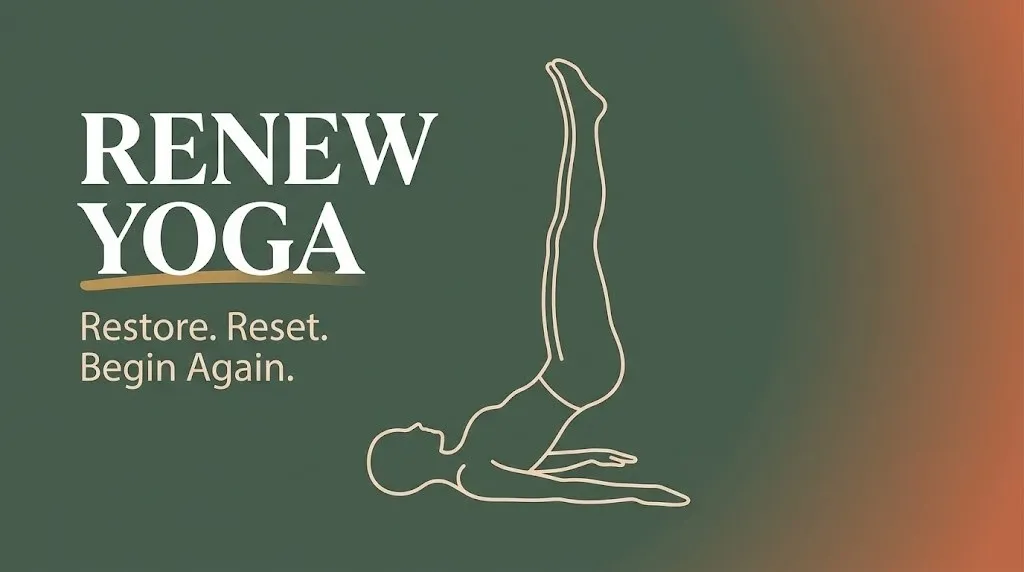
Viparita Karani (Legs Up the Wall Pose) is the single most accessible renew yoga pose. It requires only a wall and a folded blanket. Lie on your back and extend both legs up the wall, with your hips 2 to 4 inches away from the baseboard. Rest your arms at your sides, palms up.
Balasana (Child’s Pose) targets the lower back, hips, and shoulders simultaneously. Kneel on the floor, bring your big toes together, and lower your torso forward between your thighs. Arms can extend forward or rest alongside the body. If knee discomfort appears, place a folded blanket behind the knees.
Supta Baddha Konasana (Reclined Bound Angle Pose) opens the inner groin and hip adductors passively. Lie on your back, bring the soles of your feet together, and allow both knees to fall outward. Place a blanket or block under each outer thigh for support. Without support, the inner groin is asked to hold, which defeats the passive purpose.
Setu Bandha Sarvangasana (Supported Bridge Pose) used in its passive form means placing a yoga block under the sacrum at its lowest or middle height and releasing all effort. This is different from an active bridge. Hips should feel suspended, not pressed.
Savasana (Corpse Pose) closes every renew yoga session. Lie flat on your back, feet hip-width apart, arms 6 inches from your sides. A blanket under the knees reduces lumbar arch. Stay for 5 to 10 minutes minimum.
Modification for beginners: All five poses can be done on a carpeted floor with no props beyond a folded blanket and a wall. Start with 90 seconds per pose and work up to 3 minutes as comfort increases.
Renew Yoga Breathing Techniques
Renew yoga breathing centers on extending the exhale, slowing the breath rate, and using breath as a real-time tool for nervous system regulation during each pose hold. Breath is not background music in this practice. It is the mechanism.
Nadi Shodhana Pranayama (Alternate Nostril Breathing) is the most commonly used pranayama in renew yoga. It involves alternating the breath between left and right nostrils using the right hand, with the ring finger closing the left nostril and the thumb closing the right. Research in the International Journal of Yoga has linked Nadi Shodhana to measurable reductions in heart rate, blood pressure, and self-reported anxiety in healthy adults.
To practice Nadi Shodhana:
- Sit comfortably with a tall spine. Chair or floor are both fine.
- Rest your left hand on your left knee, palm open.
- Bring your right hand to your face. Place the right thumb beside the right nostril and the ring finger beside the left nostril.
- Close the right nostril with your thumb. Inhale slowly through the left nostril for 4 counts.
- Close both nostrils briefly. Hold for 2 counts.
- Release the thumb. Exhale through the right nostril for 6 counts.
- Inhale through the right nostril for 4 counts. Close both briefly.
- Exhale through the left nostril for 6 counts.
- This completes one cycle. Practice 5 to 10 cycles before or after your pose sequence.
Ujjayi breath (sometimes called ocean breath) is used during active portions of a renew yoga session. It involves a slight constriction at the back of the throat, producing an audible breath that resembles the sound of the ocean. It naturally slows the breath rate and provides an internal rhythmic focus.
Modification: Anyone with sinus congestion, a deviated septum, or difficulty with nostril-specific breathing can substitute simple 4-count inhale, 6-count exhale through both nostrils. The ratio matters more than the mechanics.
Renew Yoga Sequence for Stress and Burnout
A renew yoga sequence for stress and burnout is most effective when it runs 30 to 45 minutes and moves from gentle spinal warming to full passive release. The sequence below is designed for anyone experiencing mental fatigue, muscle tension from desk work, or emotional exhaustion from sustained high-demand periods.
This sequence is not about flexibility. Burnout-related physical tension often concentrates in the neck, upper trapezius, psoas, and lower lumbar region. These poses address those areas specifically.
Complete renew yoga sequence for burnout:
- Supine Knee-to-Chest (Apanasana): Lie on your back. Draw both knees to chest. Wrap arms around shins. Rock gently side to side 8 times. Hold still for 5 breaths.
- Supta Matsyendrasana (Supine Spinal Twist): From Apanasana, drop both knees to the right. Extend arms in a T. Stay 2 minutes. Switch sides.
- Balasana (Child’s Pose): Come to hands and knees. Sit back toward heels. Extend arms forward or alongside body. Hold 3 minutes. Use a blanket behind knees if needed.
- Viparita Karani (Legs Up the Wall): Move to a wall. Legs up, hips close to the wall. Arms at sides, palms up. Hold 5 minutes.
- Supta Baddha Konasana (Reclined Bound Angle): Move away from wall. Soles of feet together, knees falling wide. Blankets under outer thighs. Hold 4 minutes.
- Supported Setu Bandha Sarvangasana (Supported Bridge): Block under sacrum at lowest height. Full passive release. Hold 3 minutes.
- Savasana (Corpse Pose): Blanket under knees. Full stillness. Minimum 8 minutes.
Total time: approximately 30 to 35 minutes.
Modification for burnout-related insomnia: Practice this sequence within 90 minutes of bedtime. Dim the lights at step 4. Add an eye pillow from step 4 onward.
Key Takeaway: A renew yoga sequence for burnout works best when it moves from gentle spinal mobilization into full passive holds, giving the nervous system a clear signal to downshift over 30 to 45 minutes.
Renew Yoga for Seniors
Renew yoga is particularly well-suited to older adults because it builds none of the joint stress associated with faster yoga styles while still delivering documented improvements in balance, flexibility, and mood. Seniors benefit from the slow pace, the emphasis on breath, and the use of props that reduce fall risk.
The American College of Sports Medicine notes that older adults who practice regular gentle yoga show improvements in functional mobility and self-reported quality of life. Balance improvements are among the most clinically relevant findings, given that falls are a leading cause of injury in adults over 65.
Renew yoga for seniors requires a few specific adaptations. Standing poses should be practiced near a wall or with a chair for support. Floor poses should begin and end with a chair assist to make getting up and down safer. Hold times can be shorter, from 60 to 90 seconds, and extended only as comfort allows.
| Pose | Standard Version | Senior-Safe Modification |
|---|---|---|
| Viparita Karani | Legs fully up the wall | Legs elevated on a chair seat instead of the wall |
| Balasana | Floor-based, full forward fold | Chair-based: seated, fold torso forward over thighs |
| Supta Baddha Konasana | Lying on floor, soles together | Seated in chair, soles together on floor, lean slightly forward |
| Savasana | Lying flat on floor | Lying on a firm couch or bed if floor access is difficult |
| Supta Matsyendrasana | Full supine twist on floor | Seated spinal twist in a chair, hands on armrests |
Seniors managing osteoporosis should avoid poses that place the spine in deep forward flexion, including seated forward folds. A physiotherapist familiar with yoga can help identify which poses are appropriate based on bone density status.
Renew Yoga for Back Pain
Renew yoga can reduce lower back pain by releasing the hip flexors, erector spinae, and deep lumbar muscles that tighten during prolonged sitting or standing. The key is knowing which poses are safe, which require modification, and which to avoid entirely depending on the nature of the pain.
According to a review published in the Annals of Internal Medicine, yoga-based interventions showed measurable reductions in chronic lower back pain and functional disability compared to control groups over 12 weeks. The most beneficial styles were those emphasizing slow movement, breath integration, and pose support, which aligns directly with the renew yoga approach.
Safe renew yoga poses for lower back pain:
- Supta Matsyendrasana (Supine Spinal Twist): Gently mobilizes the lumbar facet joints and relieves sacroiliac tension. Keep both shoulders on the floor.
- Balasana (Child’s Pose): Decompresses the lumbar spine. Use a blanket between thighs and calves if hips do not reach heels.
- Viparita Karani (Legs Up the Wall): Reduces lumbar load by taking the legs off the floor. Place a folded blanket under the lower back for additional support.
- Apanasana (Knee-to-Chest Pose): Draw one knee at a time to the chest to avoid bilateral hip flexor strain. Alternate sides.
Poses to modify or avoid with acute lower back pain:
- Deep backbends: Active Setu Bandha Sarvangasana (pressing hips high) compresses the posterior lumbar discs. Use the passive, block-supported version only.
- Seated forward folds with rounded spine: Avoid in the presence of lumbar disc herniation. Hinge from the hips with a lengthened spine instead.
Anyone experiencing radiating pain down the leg, numbness, or tingling alongside back pain should rule out disc or nerve involvement with a spine specialist before starting any yoga practice.
Renew Yoga Props and How to Use Them
Props are not a sign of limited ability in renew yoga. They are the architecture that makes passive release possible. Without appropriate support, the muscles cannot fully let go, and the parasympathetic response that defines renew yoga does not fully activate.
The most useful props for renew yoga are:
- Yoga bolster: A firm cylindrical or rectangular cushion used to support the spine in backbends, under the knees in Savasana, or under the torso in prone poses. A rolled blanket works as a substitute.
- Yoga blocks (two recommended): Support the sacrum in passive bridge, the outer thighs in Supta Baddha Konasana, and the sitting bones in seated poses. Cork blocks are firmer and more stable than foam for long holds.
- Yoga strap: Loops around the feet in reclined leg stretches, allowing the hamstrings to release without the arms working to hold the position.
- Blankets (two to three): Used under the head, knees, hips, or outer thighs. Firm Mexican-style blankets are preferable to soft fleece, which compresses under weight.
- Eye pillow: Blocks light during Savasana and Yoga Nidra. Light occlusion deepens the relaxation response measurably. A folded washcloth works as a substitute.
- Wall: Used for Viparita Karani and for stabilizing seated or standing poses. Available in every home. No purchase required.
| Prop | Primary Use | Affordable Substitute |
|---|---|---|
| Bolster | Spinal support in passive backbends | Rolled blanket or firm pillow |
| Block (x2) | Sacrum support, thigh support | Thick hardcover books |
| Strap | Reclined leg stretches | Belt or necktie |
| Blanket (x2-3) | Under head, knees, hips | Firm bath towel |
| Eye pillow | Light blocking in Savasana | Folded washcloth |
| Wall | Legs-Up-the-Wall, balance support | Any flat wall in your home |
Key Takeaway: Props are not optional extras in renew yoga. They are what allow the body to stay passive long enough for the nervous system to actually downshift.
Renew Yoga Modifications for Limited Mobility
Renew yoga is one of the most adaptable yoga practices available for people with limited mobility from injury, chronic pain, joint replacements, neurological conditions, or post-surgical recovery. The same principles of slow pace, breath awareness, and supported stillness apply; only the platform changes.
Chair yoga adaptations make every renew yoga pose accessible without requiring floor transitions. Research published in the Journal of Alternative and Complementary Medicine found that chair-based yoga programs produced statistically meaningful reductions in pain and fatigue in older adults with osteoarthritis, supporting the use of seated adaptations as a legitimate and effective version of the practice.
Chair-based renew yoga modifications:
- Seated Balasana: Sit at the front of a chair. Feet flat on floor, hip-width apart. Inhale to lengthen the spine. Exhale and fold the torso forward, resting forearms or hands on thighs. Hold 2 to 3 minutes. This provides the same lumbar decompression as the floor version.
- Seated Spinal Twist (modified Supta Matsyendrasana): Sit sideways in the chair. Place both hands on the chair back. Inhale to lengthen. Exhale to rotate toward the chair back. Hold 90 seconds each side.
- Seated Viparita Karani equivalent: Elevate both legs on a second chair or ottoman. Recline back against chair or wall. This approximates the fluid shift and lumbar release of Legs Up the Wall.
- Seated Savasana: Sit tall with eyes closed, hands on thighs, palms up. Lower the chin slightly toward the chest. Take 10 slow breath cycles. This is a legitimate closing practice when lying on the floor is not possible.
Anyone who has had a hip replacement within the past 12 months should confirm with their orthopedic surgeon which hip angles are safe before beginning any yoga practice, seated or otherwise.
Renew Yoga for Sleep and Recovery
Renew yoga improves sleep quality by reducing the physiological arousal that keeps many adults awake. The connection is direct: elevated cortisol and an activated sympathetic nervous system at bedtime are two of the most common physiological barriers to sleep onset. Renew yoga addresses both.
A study published in Complementary Therapies in Medicine found that adults with chronic insomnia who practiced yoga for 8 weeks reported faster sleep onset, fewer nighttime awakenings, and improved morning energy compared to a non-yoga control group. The practices used in that study shared the core features of renew yoga: slow holds, breath extension, and passive supported positions.
For sleep-specific use, the most effective renew yoga poses are Viparita Karani (Legs Up the Wall), Supta Baddha Konasana (Reclined Bound Angle), and Savasana (Corpse Pose) with extended hold times. Add Yoga Nidra, a structured guided relaxation technique practiced in Savasana, for the deepest sleep-preparation effect.
Yoga Nidra works by moving the practitioner through stages of body awareness, breath awareness, and visualization while remaining in a conscious rest state. According to research by the Yoga Alliance Foundation, a single 30-minute Yoga Nidra session produces physiological rest equivalent to 2 to 3 hours of ordinary sleep in many practitioners, though this effect varies individually and is not a substitute for actual sleep.
Pose Tip:
- Practice your renew yoga sleep sequence by dim light, 60 to 90 minutes before bed
- Keep room temperature cool, around 65 to 68 degrees Fahrenheit, during practice
- Use an eye pillow from the third pose onward to signal the brain toward sleep-preparation mode
Renew Yoga at Home: Building a Weekly Routine
A renew yoga home practice works best when it is scheduled with the same consistency as any other health behavior. Three sessions per week of 30 to 45 minutes each produces measurable benefit for most adults within 4 to 6 weeks, according to practice guidelines discussed in yoga intervention literature reviewed by the NCCIH.
Setting up a home renew yoga space does not require a dedicated room. You need a floor space approximately 6 feet by 4 feet, a wall, and your props. Consistent location matters more than elaborate setup. The brain responds to environmental cues. Practicing in the same spot at the same time each week makes the practice easier to maintain.
Building a weekly renew yoga routine:
- Day 1 (Monday or start of week): 35-minute full sequence. All seven poses from the stress-and-burnout sequence above. Focus on breath extension.
- Day 2 (midweek): 20-minute shorter session. Three poses maximum: Viparita Karani (5 min), Supta Baddha Konasana (4 min), Savasana (8 min). Add Nadi Shodhana for 5 minutes before.
- Day 3 (end of week or weekend): 40 to 45-minute session. Add Yoga Nidra after your pose sequence for 15 to 20 minutes. This serves as the week’s deepest recovery session.
On off days, even 5 minutes of legs up the wall after work delivers a measurable shift in nervous system state. Frequency compounds results. Missing one session is not a failure. Stopping entirely is the only real obstacle.
Key Takeaway: Three renew yoga sessions per week of 30 to 45 minutes each is enough to produce meaningful changes in stress physiology, sleep quality, and muscular tension within 4 to 6 weeks.
How Often Should You Practice Renew Yoga
Most yoga practitioners and physical therapists recommend 3 to 5 renew yoga sessions per week for adults managing stress, fatigue, or recovery from physical strain. Daily practice is not necessary to produce results, and for complete beginners, starting with two sessions per week and building from there prevents the common beginner mistake of doing too much too soon.
Unlike strength training, renew yoga does not require recovery days between sessions because it does not produce muscular micro-damage. The rest-and-restore nature of the practice means it can be done on the same day as other exercise, typically after rather than before, when the goal is recovery.
Session frequency guidelines by goal:
| Goal | Recommended Frequency | Session Length |
|---|---|---|
| General stress reduction | 3x per week | 25 to 40 minutes |
| Sleep improvement | 4 to 5x per week, evening timing | 20 to 30 minutes |
| Back pain management | Daily short sessions | 15 to 25 minutes |
| Burnout recovery | 4 to 5x per week | 35 to 50 minutes |
| Senior wellness maintenance | 3 to 4x per week | 20 to 35 minutes |
| Beginners starting out | 2x per week, building to 3x | 20 to 30 minutes |
Consistency matters more than duration. A 20-minute practice done three times a week produces better results than a single 90-minute session once a week. The nervous system responds to repeated, regular signals of safety and rest. One-time intense doses do not produce lasting physiological change.
Renew Yoga for Anxiety and Mental Health
Renew yoga reduces anxiety through two overlapping mechanisms: direct physiological changes in the stress-response system and the psychological effect of sustained present-moment focus during breath and body awareness. Both are supported by research.
According to a meta-analysis published in the Journal of Alternative and Complementary Medicine, yoga-based interventions produced statistically measurable reductions in anxiety symptoms across 17 randomized controlled trials. Practices characterized by slow movement, breath integration, and sustained stillness were consistently more effective for anxiety reduction than faster, more vigorous yoga styles.
The physiological mechanism involves the vagus nerve and the HPA axis. Extended passive holds with slowed breathing reduce cortisol secretion, lower heart rate, and decrease the inflammatory markers associated with chronic anxiety. This is not just a feeling. It is measurable in blood and saliva samples taken before and after yoga sessions.
The psychological mechanism is equally important. Renew yoga holds are long enough to make the mind uncomfortable. Most adults are not practiced at staying still for 3 minutes without distraction. That mild discomfort, when met with breath rather than avoidance, builds a form of nervous system resilience that carries into daily life.
Renew yoga is not a standalone treatment for diagnosed anxiety disorders. It works best as part of a broader approach that may include therapy, medication if prescribed, and lifestyle factors like sleep and nutrition. Anyone experiencing anxiety that interferes with daily function should discuss treatment options with a qualified mental health clinician.
Pose Tip:
- For anxiety specifically, Viparita Karani is the highest-value single pose: legs up, gravity-assisted fluid shift, and an immediate reduction in cardiovascular effort
- Pair Viparita Karani with a 4-count inhale and 8-count exhale for maximum anxiolytic effect
- Stay a minimum of 5 minutes. Less than 3 minutes does not give the nervous system enough time to shift
What the Research Says About Renew Yoga
The research on renew yoga, practiced as a restorative and gentle yoga approach, is more robust than most people realize. The evidence base has grown substantially since 2015, with multiple high-quality trials and systematic reviews now published in indexed medical journals.
According to the National Center for Complementary and Integrative Health, yoga is classified as a mind-body practice with Level I evidence (randomized controlled trials) supporting its use for stress reduction, lower back pain, anxiety, and sleep disturbance. These are not anecdotal findings. They come from methodologically sound trials with control groups.
A 2023 systematic review in Complementary Therapies in Medicine examined 24 trials of restorative and slow-paced yoga interventions and found consistent reductions in salivary cortisol, self-reported stress, and heart rate variability measures consistent with improved parasympathetic tone. Effect sizes were moderate to strong across the majority of included studies.
The International Journal of Yoga published findings in 2022 showing that adults who practiced 30 minutes of restorative yoga four times per week for 8 weeks showed measurable improvements in sleep efficiency, sleep duration, and mood stability compared to a waitlist control group.
The Harvard T.H. Chan School of Public Health notes that yoga’s greatest strength in the research literature is its low risk of adverse events relative to its documented benefit profile. Gentle yoga practices, which includes renew yoga-style practice, report some of the lowest injury rates of any physical wellness modality studied.
Research does have limits. Many yoga studies use small sample sizes, rely on self-report measures, and lack blinding. The renew yoga category is not yet studied under that specific label because it is a contemporary practice synthesis rather than a single named tradition. The research base on its component practices (Restorative yoga, Yin yoga, gentle Hatha, Yoga Nidra) is robust and applicable.
| Research Source | Finding | Year |
|---|---|---|
| International Journal of Yoga | 8-week restorative yoga improved sleep efficiency and mood stability | 2022 |
| Complementary Therapies in Medicine | 24-trial review showed cortisol reduction and improved parasympathetic tone | 2023 |
| Journal of Alternative and Complementary Medicine | 17-trial meta-analysis showed reduced anxiety symptoms from slow yoga | Ongoing review |
| NCCIH | Classified yoga with Level I evidence for stress, back pain, sleep, and anxiety | Current |
| Annals of Internal Medicine | Yoga showed measurable reduction in chronic lower back pain vs. control | Cited 2023 |
Key Takeaway: The research on renew-style yoga is specific and growing. Cortisol reduction, improved sleep, and lower anxiety are among the most consistently replicated findings across multiple independent trials.
Frequently Asked Questions About Renew Yoga
What is renew yoga and how is it different from regular yoga?
Renew yoga is a restorative, low-intensity practice that prioritizes nervous system recovery, passive muscle release, and breath-based stress reduction over fitness or flexibility goals.
It draws from Restorative yoga, Yin yoga, and gentle Hatha yoga, combining long-held supported poses with slow breathing.
Unlike regular yoga classes that include sequences of active poses, renew yoga emphasizes stillness, supported positions, and an extended exhale to shift the body into a parasympathetic (rest-and-recover) state.
How many times a week should I do renew yoga to feel results?
Most research on restorative yoga practices finds that 3 sessions per week of 25 to 45 minutes each produces measurable results within 4 to 6 weeks for stress, sleep, and tension.
Daily short sessions of 15 to 20 minutes can also be effective, particularly for sleep improvement or back pain management.
Consistency matters more than session length. Two regular sessions per week will outperform one long session done sporadically.
Can renew yoga help with anxiety and chronic stress?
Yes, renew yoga has a documented physiological effect on anxiety through cortisol reduction, vagal nerve stimulation, and parasympathetic nervous system activation.
A meta-analysis in the Journal of Alternative and Complementary Medicine found slow-paced yoga reduced anxiety symptoms across 17 randomized controlled trials.
Renew yoga works best as a complementary practice alongside other evidence-based treatments for anxiety, not as a replacement for professional care when anxiety significantly disrupts daily life.
What props do I need to start renew yoga at home?
You need very little to start: a mat or carpeted floor, two folded blankets, and a wall.
As your practice develops, two yoga blocks and a strap will expand the range of poses you can hold comfortably and safely.
A bolster and eye pillow are useful additions for longer sessions but are not required at the beginning. Substitute a firm pillow and a folded washcloth.
Is renew yoga safe for seniors and people with back pain?
Renew yoga is one of the safest yoga approaches for both seniors and adults with back pain when practiced with appropriate modifications.
Chair adaptations make every foundational renew yoga pose accessible without floor transitions, reducing fall risk for older adults.
Anyone managing a spinal condition, osteoporosis, hip replacement, or disc injury should clarify which movements are appropriate with their treating clinician before starting, and then begin with shorter hold times of 60 to 90 seconds.
Start Where You Are
Renew yoga asks for very little from you. A floor, a wall, and 25 minutes are enough to begin your first real session today. Start with Viparita Karani (Legs Up the Wall) for 5 minutes and Savasana (Corpse Pose) for 8 minutes. That is it. That is a practice.
Three sessions a week, held consistently over 4 to 6 weeks, is what the research points to as the threshold for measurable change in stress physiology and sleep quality. You do not need a studio. You do not need flexibility. You need to show up and stay still long enough for your nervous system to believe you are safe.
That is the whole practice.