Newport Power Yoga: What to Know Before Your First Class
Newport power yoga is a physically demanding, breath-driven yoga practice available at studios throughout Newport, Rhode Island, and it suits a wider range of people than most first-timers expect. Whether you are a complete beginner or a regular gym-goer looking for something new, understanding the practice before you step on the mat makes every difference.
According to the National Center for Complementary and Integrative Health (NCCIH), yoga is now practiced by more than 36 million Americans, and physically active styles like power yoga account for a growing share of that number. The appeal makes sense: it combines cardiovascular effort, muscular endurance, and mental focus in one session.
This article covers what power yoga actually is, how it compares to other styles, what your first class in Newport will feel like, which poses are central to the practice, who benefits most, who needs to modify, and how to build a safe, consistent routine from the ground up.
Newport Power Yoga: The Practice Behind the Name
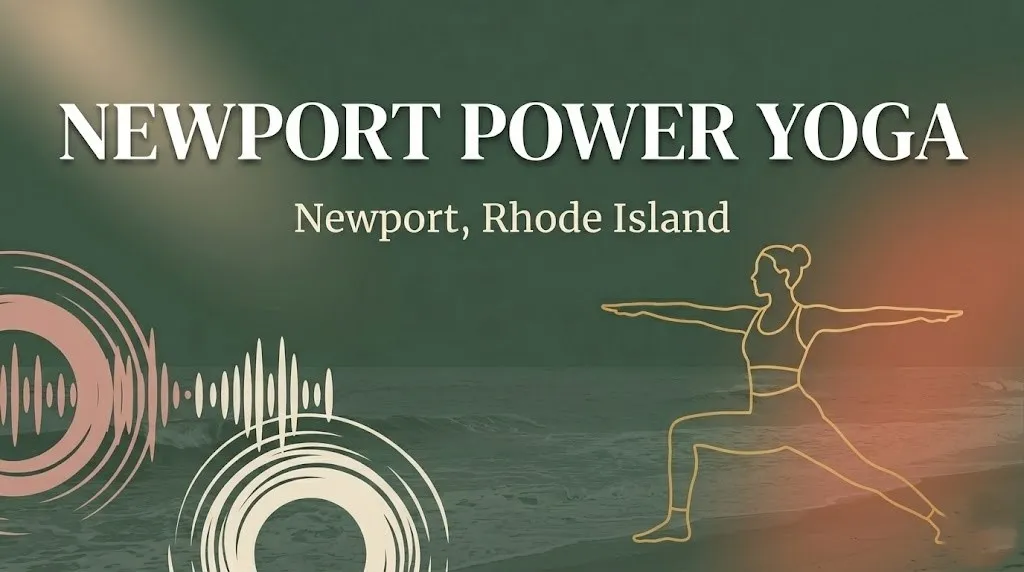
Newport power yoga refers to the style of vigorous, flowing yoga taught at studios in and around Newport, Rhode Island, drawing on the Baptiste Power Yoga lineage and broader athletic vinyasa traditions. It is not a single proprietary method but a category of practice known for continuous movement, breath synchronization, and physical challenge.
Classes typically run 60 to 90 minutes. You will move through standing sequences, balancing poses, core work, and floor work, linked by breath. The room may or may not be heated, depending on the studio.
The “power” in the name refers to the effort level, not a separate yoga philosophy. Think of it as yoga that functions more like an athletic training session than a meditative stretch class. You will sweat. You will work hard. And you will also be doing yoga.
Most Newport-area studios welcome students at all fitness levels. Teachers are trained to offer modifications. The goal is not perfection in every pose; it is showing up, moving, and breathing.
Pose Tip:
- Arrive 10 to 15 minutes early for your first class so you can introduce yourself to the teacher
- Let the teacher know if you have any injuries or conditions before class begins
- Beginners should place their mat near the middle or back of the room, where they can observe other students
Yoga Newport RI: What the Local Scene Looks Like in 2026
Yoga Newport RI describes a well-developed local wellness community centered in one of New England’s most active coastal cities. Newport has multiple yoga studios offering power yoga, alongside Hatha, Yin, Restorative, and heated formats.
The Newport yoga scene in 2026 reflects national trends toward active, athletic practice. Studios here typically blend traditional yoga lineages with modern fitness sensibilities. Class sizes tend to be small enough for teachers to offer personal attention.
Newport’s geographic character plays a role. Many locals and visitors practice yoga as part of an active outdoor lifestyle that already includes running, cycling, sailing, or hiking. Power yoga fits that context well. It builds the joint stability, core strength, and breath control that support all of those activities.
| Studio Feature | What to Look For |
|---|---|
| Class size | 10 to 20 students for meaningful teacher attention |
| Teacher credentials | Yoga Alliance registered (RYT-200 or RYT-500) |
| Beginner options | Clearly marked intro or Level 1 classes |
| Modification culture | Teachers who actively offer options during class |
| Room temperature | Ask ahead: heated vs. unheated formats vary widely |
If you are new to Newport yoga, a single drop-in class is a low-risk way to assess the studio’s teaching style and atmosphere before committing to a membership.
What Is Power Yoga? A Clear Definition
Power yoga is a vigorous, athletic style of yoga that links poses together through breath, emphasizing strength, endurance, and cardiovascular engagement rather than static holding or deep meditative stillness. It developed in the 1990s as American teachers, including Bryan Kest and Beryl Bender Birch, adapted Ashtanga Vinyasa yoga into a more flexible, accessible format for Western fitness culture.
Unlike Ashtanga, which follows a fixed sequence of poses every class, power yoga sequences vary by teacher and studio. Unlike Yin yoga, which holds poses for several minutes to target connective tissue, power yoga moves continuously. Unlike Hatha yoga, which moves at a measured pace with clear pauses between poses, power yoga flows without stopping.
The physical demands are real. Your heart rate will rise. Your muscles will fatigue. Your breath will become the primary tool for managing effort and attention.
According to the American College of Sports Medicine, yoga practices with continuous movement and elevated heart rate can meet the criteria for moderate-intensity aerobic activity when sustained for 30 minutes or more. Power yoga often qualifies.
Key characteristics of power yoga:
- Poses are linked by breath: each inhale or exhale initiates movement
- Surya Namaskar (Sun Salutation) sequences appear frequently as warm-up and conditioning tools
- Standing strength poses such as Virabhadrasana I (Warrior I) and Virabhadrasana II (Warrior II) anchor most sequences
- Core engagement is expected throughout, not just during dedicated abdominal poses
- Ujjayi pranayama (victorious breath, a gentle throat constriction technique) is often used to regulate pace and focus
Key Takeaway: Power yoga is a continuously moving, breath-synchronized practice that blends real cardiovascular effort with yoga’s structural alignment principles, and Newport studios offer this format with enough modification support to make it accessible far beyond elite athletes.
Power Yoga vs. Vinyasa Yoga: What Is Actually Different?
Power yoga and Vinyasa yoga are closely related but not identical, and the difference matters if you are choosing between classes. Vinyasa yoga is a broad category describing any yoga style where poses are linked by breath. Power yoga is a specific subset of Vinyasa that prioritizes intensity, athleticism, and physical output.
Think of it this way: all power yoga is Vinyasa, but not all Vinyasa is power yoga. A slow, creative Vinyasa flow class might barely raise your heart rate. A power yoga class is designed to challenge your muscular endurance and cardiovascular system throughout.
The practical differences show up in several ways:
| Feature | Power Yoga | Vinyasa Yoga |
|---|---|---|
| Pace | Fast to vigorous | Slow to fast, varies by class |
| Intensity | High | Low to high |
| Rest periods | Minimal | Teacher-dependent |
| Pose difficulty | Often includes advanced options | Wide range |
| Sequence structure | Athletic, repetitive strength focus | Creative, varied |
| Sweat level | High | Low to moderate |
| Best for | Building strength and endurance | General flexibility and flow |
If you are brand new to yoga, a Level 1 Vinyasa class is often a smarter starting point than power yoga. You will learn foundational alignment without the intensity pressure. Once you know what Chaturanga Dandasana (Four-Limbed Staff Pose) feels like and how to protect your wrists and shoulders, the jump to power yoga becomes much safer and more enjoyable.
What to Expect at Your First Power Yoga Class
Your first power yoga class will be physically harder than you expect and more structured than it looks from the outside. Most classes follow a recognizable arc: a warm-up phase, a peak intensity phase, and a cool-down that ends in Savasana (Corpse Pose).
The warm-up typically involves several rounds of Surya Namaskar A and B (Sun Salutation A and B). These sequences move you through standing, plank, lowering, and lifting poses, all linked to breath. By the third or fourth round, your body will understand what kind of class this is.
The middle section is where the real work happens. You will hold standing balance poses for multiple breaths, move through core sequences, and potentially encounter arm balances like Bakasana (Crow Pose) or inversions like Adho Mukha Vrksasana (Handstand), offered as optional challenges.
The cool-down slows everything down: seated stretches, hip openers, gentle twists, and finally Savasana, which lasts three to five minutes in a typical power class.
What to bring to your first class:
- A non-slip yoga mat (studio mats are often available but arrive early if you need one)
- A yoga towel if the class is heated (sweat makes mats slippery fast)
- A full water bottle
- Comfortable, form-fitting athletic clothes (loose fabric catches on poses)
- Nothing on your feet: power yoga is practiced barefoot
Tell the teacher you are new before class. A good teacher will check on you during the session and offer alternatives when a pose is outside your current range.
Power Yoga Benefits: What Research Says
Power yoga produces measurable physical and mental benefits, and the research base for vigorous yoga styles has grown substantially in the last decade. The benefits are not vague wellness promises; they are documented physiological changes.
According to a study published in the International Journal of Yoga, regular vigorous yoga practice was associated with improvements in muscular strength, flexibility, and cardiovascular endurance in previously sedentary adults over an 8-week period. The effects were comparable in magnitude to moderate-intensity aerobic training programs.
Mental health outcomes are also well-documented. The National Center for Complementary and Integrative Health notes that yoga practices, including physically active styles, have shown consistent results in reducing perceived stress, lowering salivary cortisol levels, and improving sleep quality in multiple randomized controlled trials.
Key documented benefits of regular power yoga practice:
- Muscular endurance: Repeated engagement of large muscle groups (glutes, quadriceps, core, shoulder stabilizers) builds functional strength over time
- Cardiovascular conditioning: Sustained elevated heart rate during class supports aerobic capacity
- Flexibility: Dynamic movement through full ranges of motion gradually increases joint mobility
- Balance and proprioception: Single-leg poses train the neuromuscular system’s ability to manage body position in space
- Stress reduction: Breath focus and physical exertion together lower resting stress hormone levels
- Body awareness: Regular practice improves the ability to sense and respond to physical signals, which reduces injury risk in other activities
Key Takeaway: Power yoga’s benefits are research-supported, not just anecdotal, covering measurable improvements in cardiovascular fitness, muscular endurance, flexibility, and stress physiology when practiced consistently.
Power Yoga and Weight Management: What the Evidence Actually Shows
Power yoga contributes to weight management primarily through caloric expenditure and the preservation of lean muscle mass, not through any metabolic “magic” the wellness industry sometimes implies. Being honest about this matters.
A study referenced by the Harvard T.H. Chan School of Public Health estimated that a 155-pound person burns approximately 298 calories during 60 minutes of Hatha yoga. Vigorous yoga styles like power yoga can increase that figure to an estimated 400 to 600 calories per hour, depending on body weight, class intensity, and individual metabolic rate. These are estimates, not guarantees.
The more sustainable weight-related benefit is muscular. Power yoga builds lean muscle tissue, and muscle tissue burns more calories at rest than fat tissue does. Over weeks and months of consistent practice, this shifts your baseline metabolic rate in a meaningful direction.
Power yoga is not a replacement for dietary awareness or other forms of cardiovascular exercise if weight management is a primary goal. It works best as one component of a broader active lifestyle. According to the American College of Sports Medicine, combined resistance and aerobic training produces the most favorable body composition outcomes, and power yoga addresses both in a single session.
People managing body weight through yoga should also account for the appetite effects of hard physical training: some people find increased hunger after vigorous classes, which can offset caloric expenditure if not monitored. This is not a reason to avoid power yoga. It is a reason to be realistic about it.
Power Yoga Poses for Strength and Flexibility
The poses that define power yoga are not exotic or inaccessible. They are foundational shapes repeated often and with increasing precision over time. The challenge comes from the speed, the breath link, and the sequential loading of the body.
Core power yoga poses every student will encounter:
Virabhadrasana I (Warrior I): Front knee bent to roughly 90 degrees, back foot planted at roughly 45 degrees, arms lifted. Targets the hip flexors, quadriceps, and shoulder girdle simultaneously.
Virabhadrasana II (Warrior II): Front knee bent, arms extended in opposite directions, gaze forward. Opens the hips while strengthening the inner thigh and building shoulder endurance.
Chaturanga Dandasana (Four-Limbed Staff Pose): The most technically demanding pose for beginners. The body lowers from Plank with elbows at 90 degrees, elbows tracking back (not flaring). Targets the triceps, pectorals, anterior deltoids, and entire core chain.
Adho Mukha Svanasana (Downward Facing Dog): An active resting pose and a strength pose simultaneously. Targets the posterior chain: hamstrings, calves, and the muscles of the upper back.
Navasana (Boat Pose): Hip flexors and deep abdominal stabilizers engaged with spine long. One of the most effective core conditioning poses in the style.
Utkatasana (Chair Pose): Both arms raised, hips sitting back as if toward a low chair. Targets the quadriceps, glutes, and thoracic extensors.
Modification note: Every pose above has a simplified version. Chaturanga can be practiced with knees down. Navasana can be practiced with knees bent and hands behind the thighs. No pose requires the “full expression” to be effective.
Power Yoga Core Strength Sequence
A power yoga core strength sequence uses the entire body to build deep abdominal and spinal stability, not just isolated crunches. This is one of the practice’s clearest advantages over gym-based core training.
To practice a foundational power yoga core sequence:
- Begin in Phalakasana (Plank Pose). Shoulders directly over wrists, hips level, core braced. Hold for 5 full ujjayi breaths.
- On an exhale, lower to Chaturanga Dandasana (Four-Limbed Staff Pose) with elbows at 90 degrees. Hold for one breath.
- On an inhale, roll over the toes into Urdhva Mukha Svanasana (Upward Facing Dog). Chest lifts, thighs off the floor.
- Exhale back to Adho Mukha Svanasana (Downward Facing Dog). Hold for 3 breaths.
- From Downward Dog, draw one knee toward your nose on an exhale (core contraction). Inhale it back. Repeat 5 times per side.
- Lower to the floor. Move into Navasana (Boat Pose): sit on the tailbone, lift both feet, lengthen the spine. Hold for 5 breaths.
- Lower legs halfway down (Ardha Navasana, Half Boat). Hold for 5 breaths.
- Rest in Balasana (Child’s Pose) for 5 to 10 breaths.
Modification: In Plank, keep knees on the floor. In Navasana, keep knees bent and hold behind the thighs until core strength increases. In Chaturanga, lower all the way to the floor and press up to Cobra rather than Upward Dog.
Key Takeaway: Core training in power yoga differs from gym-based ab work because it integrates the entire posterior and anterior chain through functional movement patterns, making the results more transferable to daily life and other physical activities.
Newport Yoga Class Schedule: What to Look For When Choosing
When evaluating a Newport yoga class schedule, look beyond the time slots and focus on the information that actually tells you whether a class is right for your body and experience level. Not all power yoga classes are equal in pacing, intensity, or teacher style.
Questions to ask or research before booking:
- Is the class labeled by level? Level 1, All Levels, and Advanced are meaningfully different.
- Is the room heated? Temperatures in hot yoga formats typically range from 85 to 105 degrees Fahrenheit, which changes the physical experience substantially.
- How long is the class? A 60-minute power class is very different from a 90-minute one, especially for beginners.
- What lineage does the teacher follow? Baptiste Power Yoga, CorePower, and independent athletic Vinyasa all share qualities but differ in sequencing philosophy.
| Class Label | What It Usually Means | Best For |
|---|---|---|
| Intro to Yoga | Foundational poses, slow pace, modification-heavy | Complete beginners |
| Level 1 | Basic poses, moderate pace, some flow | New to yoga or returning after a break |
| All Levels | Mixed class, teacher offers both easy and hard options | Intermediate practitioners |
| Power Yoga | Vigorous, continuous, athletic | Students with 3+ months of regular practice |
| Advanced | Complex poses, fast pace, minimal instruction | Experienced practitioners only |
Always read the class description. “All Levels” at a power yoga studio may still assume some baseline body awareness that a true beginner does not yet have. When in doubt, email or call the studio and describe your experience level directly.
Power Yoga for Beginners: How to Get Started Without Injury
Power yoga for beginners is absolutely possible, but it requires specific preparation and the right expectations. The biggest mistake beginners make is signing up for an All Levels power class before learning the foundational poses that make up every sequence.
The three poses to learn before your first power yoga class:
- Phalakasana (Plank Pose): The ability to hold a strong plank for 30 seconds tells you whether your wrists and core are ready for the demands of a power flow.
- Adho Mukha Svanasana (Downward Facing Dog): This pose appears dozens of times per class. Learning what it feels like in a slow Hatha context first means you won’t be figuring it out under time pressure later.
- Chaturanga Dandasana (Four-Limbed Staff Pose): A modified version with knees down is completely appropriate for beginners. Practicing this before your first power class protects your shoulders and wrists significantly.
A study published in the Journal of Alternative and Complementary Medicine found that yoga beginners who received foundational alignment instruction before attempting vigorous classes reported fewer shoulder and wrist complaints than those who entered vigorous classes without preparation.
If your local Newport studio offers a single introductory workshop or a Yoga Basics series, prioritize that before the power classes. Two to four foundational sessions will make your first power yoga class dramatically more enjoyable and far safer.
Do not let flexibility be your benchmark for readiness. Strength, breath awareness, and the ability to follow a fast-moving sequence matter far more in power yoga than whether your hamstrings are open.
Power Yoga Modifications for Limited Mobility
Power yoga modifications for limited mobility allow people with wrist injuries, knee pain, shoulder impingement, or reduced range of motion to participate meaningfully in a class without forcing their bodies into shapes that cause harm.
The most common modification needs in a power yoga class:
Wrist issues: Replace weight-bearing on flat hands with fists (pressing knuckles into the floor), forearms (forearm plank instead of full plank), or use folded blankets under the heel of the hand to reduce wrist extension. People with carpal tunnel syndrome or wrist fracture history should discuss their situation with a healthcare provider who understands yoga before attending a vigorous class.
Knee pain: In Virabhadrasana I and II, reduce the depth of the front knee bend. Keep the knee above the ankle rather than at or past it. In Utkatasana (Chair Pose), stay higher (less hip flexion) to reduce compressive load on the knee joint. Avoid deep squats and poses that require full knee flexion until a physical therapist has cleared this range of motion.
Shoulder impingement or rotator cuff issues: Skip Chaturanga Dandasana entirely and substitute by lowering to the belly and pressing to a low Bhujangasana (Cobra Pose). Avoid overhead pressing movements if they reproduce shoulder pain.
| Limitation | Standard Pose | Recommended Modification |
|---|---|---|
| Wrist pain | Plank on flat hands | Forearm plank or fist plank |
| Knee pain | Deep Warrior I | Shallow lunge with rear knee down |
| Shoulder pain | Chaturanga Dandasana | Belly lower to Cobra |
| Tight hamstrings | Forward fold straight legs | Knees generously bent |
| Low back sensitivity | Boat Pose | Reclined single-leg extension |
Key Takeaway: Limited mobility does not disqualify you from power yoga; it means you need a teacher who actively offers modifications and a studio where asking for adjustments is normalized, not stigmatized.
Power Yoga for Seniors: What Older Adults Need to Know
Power yoga for seniors is feasible for many older adults, provided the practice is approached with appropriate intensity management, honest self-assessment, and a teacher trained or experienced in working with mature bodies. Age alone is not a contraindication for vigorous yoga.
The relevant concern for adults over 60 is not age but baseline fitness, bone density, joint health, and cardiovascular status. A fit and active 65-year-old may handle power yoga better than a sedentary 40-year-old. The practice should be assessed individually.
According to the National Institutes of Health, regular yoga practice in older adults has been associated with improved balance, reduced fall risk, and better self-reported quality of life in multiple longitudinal studies. Active styles, when appropriately modified, preserve these benefits while adding a cardiovascular element.
Practical guidance for seniors considering Newport power yoga:
- Start with an All Levels or Level 1 class, not a class labeled simply “Power Yoga” or “Advanced Flow”
- Inform the teacher of any history of osteoporosis, joint replacement, or cardiovascular events before the session begins
- Prioritize the cool-down and Savasana sections rather than exiting class early
- Hydrate generously before class: older adults are more susceptible to dehydration during vigorous exercise
- If a heated class is under consideration, begin with an unheated format and build heat tolerance gradually
Inversions such as Sirsasana (Headstand) or Salamba Sarvangasana (Supported Shoulderstand) may be contraindicated for seniors with glaucoma, high blood pressure, or cervical spine issues. A teacher worth their credentials will never pressure a student into an inversion.
How Often Should You Do Power Yoga?
Most experienced yoga teachers and fitness professionals recommend practicing power yoga two to four times per week to build consistent strength and flexibility gains without accumulating fatigue or overuse injuries. Daily vigorous practice without adequate recovery can lead to joint strain, particularly in the wrists, shoulders, and knees.
The American College of Sports Medicine recommends that adults engage in moderate-to-vigorous physical activity on most days of the week. Power yoga can fulfill this recommendation, but the body also needs lower-intensity movement to balance the muscular demand.
A practical weekly structure:
| Day | Practice Type | Duration |
|---|---|---|
| Monday | Power yoga | 60 to 75 minutes |
| Tuesday | Rest or Yin yoga | 45 to 60 minutes |
| Wednesday | Power yoga | 60 to 75 minutes |
| Thursday | Active recovery (walk, swim) | 30 to 45 minutes |
| Friday | Power yoga | 60 to 90 minutes |
| Saturday | Restorative yoga or gentle stretch | 45 minutes |
| Sunday | Full rest | 0 minutes |
Beginners should start with two power yoga sessions per week, separated by at least one full rest day. This gives the connective tissues, which adapt more slowly than muscles, enough time to respond and strengthen between sessions. Three months of two sessions per week builds a foundation solid enough to increase frequency safely.
If you feel joint pain (not muscle soreness) between sessions, reduce frequency rather than pushing through. Muscle soreness typically peaks 24 to 48 hours after class and fades within 72 hours. Persistent joint pain is a signal to modify, rest, or consult with a physical therapist familiar with yoga-related injuries.
Power Yoga Safety: Who Should Approach It Carefully
Power yoga safety depends on matching the intensity of the practice to the current state of the body, not on avoiding the practice altogether. For most healthy adults, power yoga carries a low injury risk when taught by qualified instructors and practiced with appropriate modifications.
The groups who should approach power yoga carefully and communicate with a teacher before attending:
- People with active wrist injuries or a recent history of wrist fracture: weight-bearing through the hands is constant in power yoga
- People with shoulder impingement or a diagnosed rotator cuff tear: Chaturanga Dandasana and overhead poses place significant demand on the shoulder joint
- People with high blood pressure that is not well-controlled: inversions and extended physical exertion can elevate blood pressure further; working with a cardiologist alongside your yoga practice is appropriate here
- People with glaucoma or a detached retina: forward folds and inversions increase intraocular pressure
- Pregnant people, particularly in the second and third trimesters: the demands of power yoga and the heat exposure in heated formats make this a practice to approach only with explicit guidance from both a healthcare provider and a prenatal yoga specialist
- People with acute low back pain or a herniated disc: forward folds and the compressive loads in certain poses require careful evaluation by a physical therapist before vigorous class attendance
A Yoga Alliance registered teacher (RYT-200 or RYT-500) has training in contraindications and modifications. Choosing a credentialed teacher is the single most effective safety decision you can make before your first power yoga class.
Key Takeaway: Power yoga’s safety profile is good for most healthy adults when a credentialed teacher is involved, but anyone with cardiovascular conditions, active joint injuries, or pregnancy should communicate with both their healthcare team and their yoga teacher before attending a vigorous class.
Hot Power Yoga vs. Unheated Power Yoga: Which Is Right for You?
Hot power yoga and unheated power yoga share the same poses and sequencing principles, but the environmental difference changes the experience substantially. Knowing which format suits your body is more important than which one sounds more appealing.
Hot power yoga is practiced in a room heated to approximately 85 to 100 degrees Fahrenheit, sometimes with elevated humidity. The heat increases perceived flexibility by warming connective tissue more rapidly than unheated movement would. Sweat output increases significantly. Cardiovascular demand rises even at the same movement pace because the body is simultaneously working to thermoregulate.
Unheated power yoga produces the same muscular and flexibility outcomes over time but at a lower cardiovascular cost per session. The body has to warm itself through movement alone, which takes longer and means the first 20 minutes feel harder before the body reaches an optimal working temperature.
| Factor | Hot Power Yoga | Unheated Power Yoga |
|---|---|---|
| Room temperature | 85 to 100 degrees F | Ambient room temperature |
| Sweat level | Very high | Moderate |
| Cardiovascular load | Higher due to thermoregulation | Moderate |
| Flexibility sensation | Enhanced by external heat | Earned through movement |
| Injury risk from overstretching | Higher (heat masks sensation) | Lower |
| Recommended for beginners? | No: start unheated | Yes |
| Hydration needs | Critical before, during, after | Standard pre-class hydration |
The NCCIH and independent sports medicine researchers have flagged a specific risk of hot yoga formats: the warmth can mask the sensation of overstretching, making it easier to push a joint past its safe range without immediate pain feedback. The injury shows up hours later, not during class.
For anyone starting at a Newport power yoga studio in 2026, beginning with unheated formats is the clearer, safer choice. Once you know your body’s baseline range of motion and have established good alignment habits, adding heat is a reasonable next step.
Frequently Asked Questions About Newport Power Yoga
Is power yoga good for absolute beginners?
Power yoga can work for absolute beginners if they choose a Level 1 or Intro class and inform the teacher of their experience level before class starts.
Two to four foundational yoga sessions before attending a power class will make the experience safer and far more enjoyable.
The key limitation is not fitness level but familiarity with how to move between poses safely when the teacher is calling transitions quickly.
How many calories does a power yoga class burn?
The Harvard T.H. Chan School of Public Health estimates vigorous yoga burns approximately 400 to 600 calories per hour for a person weighing around 155 pounds.
Individual results vary based on body weight, class intensity, room temperature, and metabolic rate.
Heated power yoga formats tend to produce higher caloric expenditure per session due to the added thermoregulation demand.
What should I bring to my first power yoga class in Newport?
Bring a non-slip yoga mat, a full water bottle, a small yoga towel (especially if the class is heated), and comfortable form-fitting athletic clothes.
Leave jewelry and watches at home: you will be moving your hands to the floor frequently.
Arrive 10 to 15 minutes early so you can introduce yourself to the teacher and set up without rushing.
How is power yoga different from regular yoga?
Power yoga is a specific type of Vinyasa yoga that emphasizes athletic intensity, continuous movement, and physical conditioning more than traditional yoga styles do.
Most “regular yoga” classes people compare it to are Hatha-based, which moves at a slower pace with longer pauses between poses.
Power yoga keeps the heart rate elevated throughout class and requires more upper body and core strength than a typical beginner Hatha session.
Can someone over 60 do power yoga safely?
Many adults over 60 practice power yoga safely, particularly when they choose appropriately leveled classes and communicate any health conditions to the teacher beforehand.
The National Institutes of Health has documented that vigorous yoga adapted for older adults supports balance, strength, and quality of life.
Seniors with osteoporosis, joint replacements, uncontrolled blood pressure, or glaucoma should review specific poses with a physical therapist or physician before attending vigorous classes.
Start Where You Are, and Start Soon
Power yoga meets you where you are, provided you walk in honest about your current fitness level and open to the modifications your body needs. Newport’s yoga community in 2026 is well-equipped to support that process, with studios offering introductory options alongside vigorous classes.
Pick one beginner-friendly class this week. Tell the teacher you are new. Learn Downward Dog and Plank before you go if you want a head start. Those two shapes will carry you through most of the class.
The body adapts quickly when movement is consistent. Two sessions per week, practiced honestly, will build more strength and body awareness in three months than occasional intense sessions ever could.