Kid 3 Person Yoga Poses Easy: Fun Guide for 2026
Easy kid 3 person yoga poses are accessible group shapes that three children, or a mix of kids and adults, can practice together using foundational poses most beginners already know. With the right instructions and a clear focus on safety, a group of three can build balance, coordination, and genuine teamwork on a yoga mat in under 30 minutes.
Group yoga for children delivers benefits that go well beyond flexibility. The National Center for Complementary and Integrative Health identifies yoga as a practice with documented benefits for children’s focus, stress response, and body awareness, and research published in the International Journal of Yoga found that school-based yoga programs improved self-regulation and physical coordination in children ages 6 to 12.
This guide covers every practical detail: what three-person yoga actually involves, how to assign roles safely, which specific poses work best for kids with no prior experience, how to warm up the group, and how to run a fun 25-minute session at home or in a classroom with no special equipment required.
Kid 3 Person Yoga Poses Easy
Easy kid 3 person yoga poses are group yoga shapes where three participants, whether all children or a combination of kids and adults, each hold an individual pose while connecting physically in a light, cooperative way to create a shared formation. The goal is coordination and fun, not athletic performance.
These poses draw primarily from Hatha yoga traditions, using familiar foundational shapes like Tadasana (Mountain Pose), Vrksasana (Tree Pose), and Adho Mukha Svanasana (Downward-Facing Dog) as starting points. What makes them three-person poses is how participants position themselves relative to each other: side by side, in a circle, in a line, or with one person forming a shape that the others use as a gentle point of reference.
The difference between a standard yoga pose and a three-person version is mostly about spatial awareness and cooperative breath. Each participant still holds their own body weight independently. Nobody lifts, supports, or bears the weight of another person in beginner-level three-person poses. That is a key safety distinction that separates accessible group yoga from acro yoga, which requires specialized training.
Kids between ages 5 and 12 tend to do best with group yoga when the poses are introduced one participant at a time, when each person understands their specific role before the group connects, and when the instructor or parent keeps the tone playful and pressure-free.
- What makes a three-person yoga pose safe and accessible for kids:
- Each child maintains their own body weight independently
- Poses are based on familiar individual shapes children can already do alone
- Physical contact between participants is light: fingertips, hands, or standing side by side
- Instructions are role-specific so every child knows exactly what they are doing
- A supervising adult is present for any pose where balance is challenged
What Is 3 Person Yoga for Kids
Three person yoga for kids is a cooperative movement practice where three participants perform individual or synchronized yoga poses in a shared formation, building body awareness, communication skills, and physical coordination simultaneously. It is not a competitive activity and does not require any prior yoga experience.
This type of practice sits within the broader category of partner and group yoga, which itself draws from both traditional Hatha yoga and the more athletic tradition of acro yoga. For children, the relevant distinction is this: group yoga for kids at the beginner level uses only individual body weight, cooperative positioning, and synchronized breath. It does not involve one child supporting another from below or one child being lifted off the ground.
The “group” aspect of three-person yoga matters because it introduces a social layer to physical movement. Each participant must pay attention not just to their own body position but to the people next to them. That dual-focus is genuinely challenging in a productive way, requiring the kind of divided attention and spatial awareness that physical education researchers consistently associate with improved coordination and focus in school-age children.
A useful comparison: think of three-person yoga like a three-legged race, but slower and with breathing. Each person still runs their own leg. The coordination is in how they move together, not in one person carrying another.
According to research published in the Journal of Alternative and Complementary Medicine, cooperative movement practices that require synchronized attention between participants produced measurable improvements in social engagement and body awareness in school-age children over an eight-week intervention period.
Benefits of Group Yoga for Children
Group yoga gives children three distinct and research-supported categories of benefit: physical development including balance, coordination, and flexibility; social-emotional development including communication, trust, and cooperative awareness; and cognitive benefits including improved attention and self-regulation during structured activity.
The physical benefits are the most visible and the most frequently discussed. Children’s bodies are still developing proprioceptive sensitivity, the ability to sense where the body is in space. Group yoga poses, because they require awareness of both your own position and the positions of the people around you, train this system more richly than solo yoga practice does. A child holding Vrksasana (Tree Pose) alone must sense their own balance. A child holding it as part of a three-person formation must sense their balance and calibrate lightly to the people beside them.
The social-emotional benefits are equally documented. Yoga Alliance’s published guidance on children’s yoga emphasizes that group yoga teaches children to communicate physical boundaries, to ask for and receive consent before making contact, and to support a partner verbally without taking over their effort. These are the same skills taught in social-emotional learning curricula in schools.
The National Center for Complementary and Integrative Health notes that yoga-based interventions in school-age children consistently show improvements in self-regulation, anxiety reduction, and attention compared to non-yoga control groups across multiple randomized studies.
- Key benefits of group yoga specifically for children:
- Balance and proprioception: enhanced by awareness of others in the shared space
- Coordination: synchronized movement requires both individual and group body control
- Communication: participants must verbally check in about comfort and readiness
- Trust: cooperative poses build confidence in physical and social interactions
- Attention: holding poses while staying connected to partners trains focus
- Flexibility: group formations naturally encourage range of motion without competitive pressure
Key Takeaway: Three-person yoga for kids is not just a physical activity. It actively trains the same body awareness, cooperative communication, and attentional focus that teachers and researchers consistently identify as foundational to healthy child development.
Easy 3 Person Yoga Poses for Beginners
The easiest three person yoga poses for beginners are side-by-side variations of standing and seated poses that each participant already knows individually, connected by light hand or shoulder contact rather than weight sharing. These poses work precisely because they do not require anyone to learn a new physical skill, only to coordinate a familiar skill with others nearby.
The simplest possible starting point is the Triple Tadasana (Three-Person Mountain Pose). Three participants stand side by side, touching at the shoulder or holding hands lightly, each pressing all four corners of both feet into the floor. Every person finds their own upright standing alignment. The group then breathes together for five slow cycles. This is genuinely one of the best entry-level group yoga experiences for children because it strips away all complexity and focuses entirely on breath synchronization.
From there, the natural progression is Side-by-Side Virabhadrasana II (Warrior II), where all three participants step into the same pose simultaneously, facing the same direction or mirroring each other outward from a central person. Shoulder contact is optional. The focus is on matching timing and breath rather than physical connection.
Seated poses work equally well as a starting point. Three children sitting cross-legged in a small circle, each in Sukhasana (Easy Seated Pose), and passing a breath around the circle, one child inhales while the next exhales, is a remarkably effective introduction to group yoga attention and breath awareness.
| Pose | Formation | Contact Type | Difficulty | Best Age |
|---|---|---|---|---|
| Triple Tadasana | Side by side line | Shoulder or hand | Easiest | 4 and up |
| Seated Circle Sukhasana | Circle on floor | No contact needed | Easiest | 4 and up |
| Side-by-Side Warrior II | Line, same direction | Shoulder optional | Easy | 6 and up |
| Three-Person Tree Pose | Line or circle | Fingertip contact | Easy to moderate | 7 and up |
| Circle Forward Fold | Circle facing in | Hands joined | Moderate | 8 and up |
Modification: For very young children ages 4 to 6, skip hand-holding entirely in balance poses. Standing near each other without physical contact reduces the risk of one child accidentally pulling another off balance.
Roles in 3 Person Yoga
In three-person yoga for kids at the beginner level, participants take one of three roles: the anchor (the central or most stable participant), the wing (positioned on either side of the anchor), or the connector (the person whose movement or position links the other two). Understanding these roles before starting prevents confusion and keeps the group coordinated.
The anchor role is best suited to the most physically stable participant, often the tallest or most experienced child, or an adult in a family session. The anchor sets the timing for breathing, gives verbal cues like “ready, inhale, hold,” and maintains their individual pose with the least variation. In a side-by-side formation, the anchor is typically the middle person.
The wing roles belong to the two participants on either side of the anchor. They mirror or complement the anchor’s position, connecting lightly through fingertips or shoulder contact. Wings follow the anchor’s breath timing rather than setting their own. This follower dynamic actually makes the wing role excellent for younger or less experienced children because it removes the pressure of timing decisions.
The connector role applies in circular formations where one participant’s position completes the group shape. In a three-person seated circle, each participant is simultaneously an anchor to themselves and a connector to the others through joined hands or mirrored posture.
- Role assignments by experience level:
- Anchor: most stable participant, sets breath timing, holds center position
- Wing (left and right): follow anchor’s timing, maintain light contact, mirror the shape
- Connector: used in circle formations, completes the group shape through position
- For family sessions: adult most naturally serves as anchor in weight-relevant poses
- For classroom sessions: rotate roles so each child experiences every position over time
How to Safely Do 3 Person Yoga With Kids
Safe three-person yoga with children requires four non-negotiable conditions: adult supervision throughout, clear role assignments before the pose begins, verbal check-in communication between participants, and immediate permission to exit any pose that causes discomfort. None of these are optional for child participants.
Children’s growth plates, the areas of developing cartilage near the ends of long bones, are more vulnerable to stress than adult bone tissue. This is the specific anatomical reason why poses that compress, torque, or heavily load the spine, wrists, or ankles are not appropriate for young children. Beginner three-person yoga for kids avoids all poses where one child bears the body weight of another on any joint. It also avoids deep backbends, extreme spinal twists, and full inversions like headstands or handstands.
Safety caution: No child should serve as a base supporting another child’s full body weight in any three-person yoga pose without the direct guidance of a certified acro yoga or kids yoga instructor. This applies even to poses that look simple in social media videos. What looks effortless in a photo requires significant training, strength, and spotting technique to execute safely.
Verbal communication is the most underemphasized safety tool in group yoga for children. Teach children two phrases before beginning: “I’m ready” (said before making contact or entering a shared pose) and “Let’s stop” (said without judgment whenever something feels wrong). Normalizing the “let’s stop” phrase removes the social pressure children feel to continue through discomfort in group activities.
Pose Tip:
- Always demonstrate the pose individually before asking three children to attempt it together.
- Keep the first attempt of any new group pose brief: two breaths maximum before checking in verbally.
- Never push a child’s limb into a position. Verbal cues only.
- Safety caution: Wrists are the most commonly strained joint in beginners. Avoid any three-person pose where children bear weight on flat palms for more than 30 seconds without prior wrist preparation.
Key Takeaway: The single most important safety rule for three-person yoga with kids is that no child should bear another child’s full body weight on any joint. Beginner group yoga means independent body weight plus light cooperative contact, nothing more.
Three Person Yoga Tree Pose
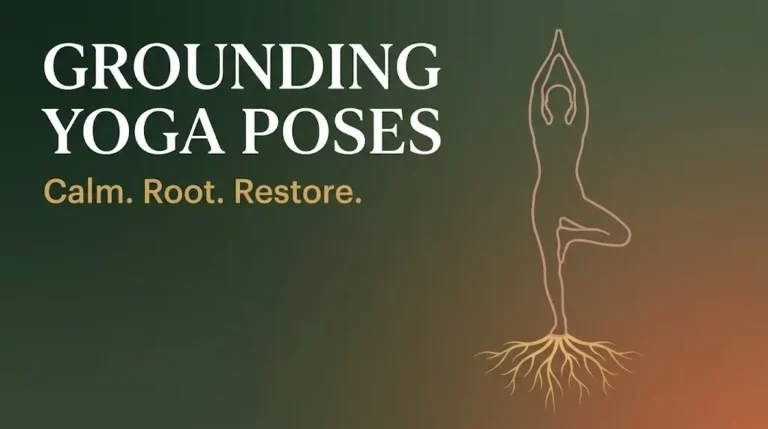
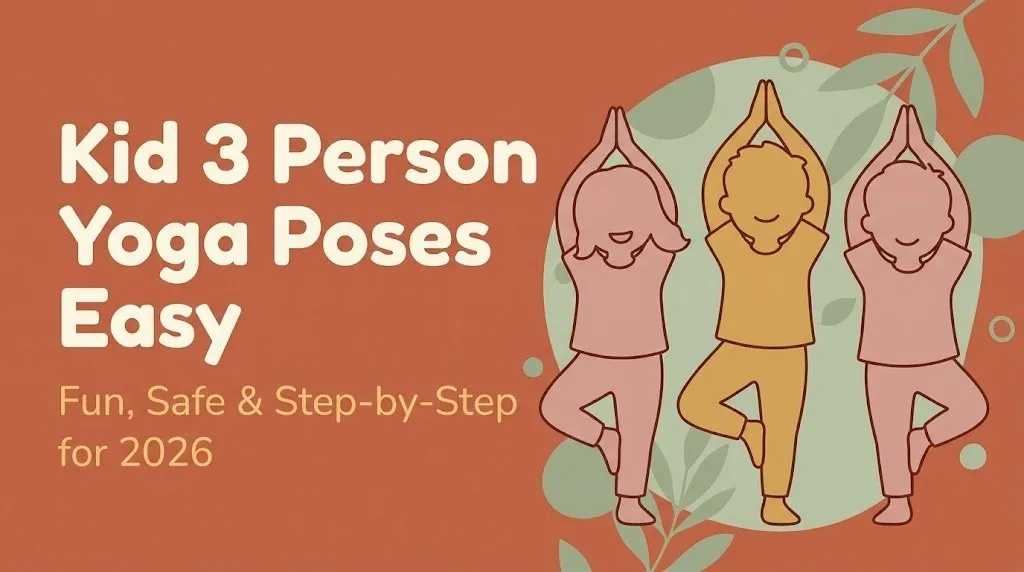
The Three-Person Vrksasana (Three-Person Tree Pose) is one of the most popular and well-suited three-person yoga poses for children because it challenges individual balance while adding a cooperative element through light fingertip or hand contact between participants. Each child maintains their own full body weight throughout.
The formation works best as a side-by-side line of three. The center child is the anchor. The two outer children stand on either side. All three raise the same-side foot, placing it on the inner calf or inner thigh (above or below the knee, never against it). The three participants connect by resting their nearest hand lightly on the shoulder of the person next to them, or by joining hands raised overhead in a connected branch shape.
The key teaching point that most guides miss: the light shoulder or hand contact is not for weight support. It is a sensory reference point. The touch gives each participant’s balance system a gentle signal about where the others are, which paradoxically can help individual balance rather than destabilize it, similar to the way lightly touching a wall helps you find your balance without actually leaning on it.
To practice Three-Person Tree Pose:
- Stand in a side-by-side line, feet hip-width apart, all three facing the same direction.
- Each person roots through their standing foot: spread toes, press all four corners into the floor.
- On a count from the anchor: “Ready, inhale, lift.” All three raise the same foot to the inner calf.
- Stabilize individually for two breaths before reaching toward each other.
- Connect lightly: fingertips to shoulders or hands raised and joined overhead.
- Hold for 3 to 5 breath cycles, then lower the foot together on the exhale.
- Shake out the standing leg gently before switching sides.
Modification for younger children ages 4 to 7: Keep the raised toes touching the floor rather than fully lifting the foot. This is called “sprouting tree” and provides full proprioceptive benefit without the full balance challenge of an unsupported single-leg hold.
Easy 3 Person Seated Yoga Poses
Easy three-person seated yoga poses are ground-level cooperative shapes practiced while sitting on the floor that eliminate the balance challenge of standing poses and make group yoga accessible to children of all ages, including those with balance difficulties or coordination challenges. They are the best starting point for groups with mixed ages or abilities.
The Seated Circle is the foundational three-person seated pose. Three participants sit cross-legged in Sukhasana (Easy Seated Pose) in a small circle, knees nearly touching, facing the center. Each person places their hands on the knees of the person on either side, or simply rests their own hands on their own knees. The group practices synchronized breathing, one full inhale together and one full exhale together, for five to eight cycles. The physical demands are minimal. The attentional demand of matching breath with two other people is surprisingly rich.
Three-Person Seated Forward Fold offers a step up in physical engagement. The three participants sit in a tight triangle, legs extended toward the center, feet almost touching at the middle of the triangle. Each person folds forward in Paschimottanasana (Seated Forward Fold), reaching hands toward the feet of the person across from them. The folding sequence goes one at a time: person one folds, persons two and three hold their spine tall. Then person two folds while others hold. This sequential approach removes any pulling between participants.
Safety note: In any seated forward fold, children should fold from the hips with a long spine rather than rounding aggressively from the lower back. A gentle reminder: imagine your belly button reaching toward your knees, not your nose reaching toward your feet.
- Best seated three-person poses for young children:
- Sukhasana Circle (Easy Seated Pose): synchronized breath practice, no physical contact required
- Seated Mountain Circle: tall spine, hands joined, eyes closed, breath awareness
- Sequential Paschimottanasana (Seated Forward Fold): one child folds at a time
- Back-to-Back Sukhasana: two children sit back-to-back while third sits facing one, great for breath awareness
- Savasana Row (Corpse Pose): all three lie on their backs in a row, arms extended toward each other, fingertips touching
Standing 3 Person Yoga Poses for Kids
Standing three-person yoga poses for children work best when all three participants perform the same foundational pose simultaneously rather than interlocking in complex weight-sharing formations. Same-pose group practice builds team cohesion and makes the session feel unified without adding safety risk.
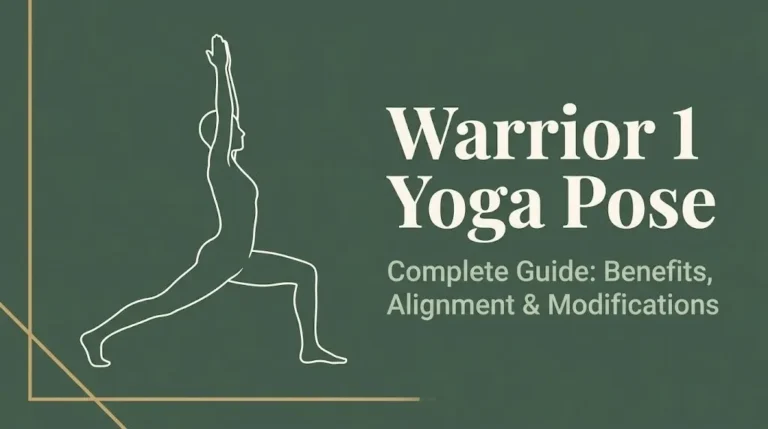
Triple Virabhadrasana I (Three-Person Warrior I) is one of the most satisfying standing group poses for children because the strong, grounded shape of Warrior I is visually impressive when three people do it in synchronized formation. All three step one foot back to the same distance, bend the front knee to approximately 90 degrees, and raise both arms overhead. The group faces the same direction. An adult can call the alignment cues: “step, bend, reach, hold, breathe.”
Side-by-Side Utkatasana (Chair Pose) is equally effective and slightly more demanding. Three children stand in a line, feet hip-width apart, then simultaneously bend their knees and shift their hips back as if sitting onto an invisible chair. Arms reach forward or overhead. This pose builds quadriceps and gluteal endurance in all three participants and works particularly well as a group challenge because children can see and be encouraged by each other’s effort.
For groups with mixed heights, standing poses in a line work better than circle formations because height differences become visually apparent in circles and can make children self-conscious. A line naturally accommodates height variation without drawing attention to it.
According to research in Complementary Therapies in Medicine, structured movement activities that require children to coordinate effort with peers produce greater sustained physical effort and higher enjoyment ratings than solo equivalent activities, suggesting that group yoga for children is inherently more motivating than individual practice.
Modification: Children with knee sensitivity should not bend past a 90-degree angle in Warrior I or Chair Pose. A shallower bend, hips higher than parallel, reduces knee joint compression while preserving all the muscle engagement benefit of the pose.
Key Takeaway: Standing three-person yoga works best when all three children do the same pose simultaneously in a line rather than linking into complex formations. Synchronized effort in a shared pose is both safer and more motivating than interlocked weight-sharing shapes.
3 Person Yoga Challenges for Beginners
A beginner three-person yoga challenge is a short, structured sequence of two to four poses that the group attempts to move through together with synchronized breath and coordinated timing, creating a mild degree of friendly challenge without competitive pressure. The goal is coordination, not perfection.
The simplest beginner yoga challenge for three is the Mountain-to-Tree Challenge: starting in Three-Person Tadasana (Mountain Pose), breathing together for three cycles, then simultaneously attempting to lift one foot into Three-Person Vrksasana (Tree Pose) and hold for three breaths before returning to Mountain together. The “challenge” is the synchronized transition rather than the pose itself.
A step up is the Warrior Sequence Challenge: Three-Person Virabhadrasana I, then all three pivot together to Virabhadrasana II, then all three return to Tadasana. The group must agree on the transition timing, check in verbally, and move together. This sequence introduces the skill of group coordination through movement rather than just through static holding.
Keep challenge language positive and non-competitive. The framing should always be “let’s see if we can do this together” rather than “who can hold it longest” or “last one standing wins.” Group yoga challenges lose their cooperative benefit the moment they become individual competitions dressed in group clothing.
- Progression of beginner three-person yoga challenges:
- Level 1: Synchronized breath in any shared standing pose (Mountain, Warrior II)
- Level 2: Simultaneous transition from one pose to another on a shared count
- Level 3: Three-pose sequence with verbal check-ins between each shape
- Level 4: Same sequence with eyes closed for the first pose (advanced attention challenge)
- Note: Never make “not falling” a competitive element. Wobbling is learning, not failure.
Cool Three Person Yoga Poses to Try
Cool three-person yoga poses that still work for beginners are shapes that look visually impressive in formation while remaining physically accessible to participants with no prior training. The visual appeal matters because it keeps kids engaged and motivated to try again.
The Three-Person Star is one of the most satisfying shapes visually. Three participants stand in a tight triangle facing outward, back-to-back in the center, then all three simultaneously step one foot out wide and extend their arms out to the sides in a variation of Utthita Tadasana (Five-Pointed Star Pose or Extended Mountain). The result is a six-armed star shape when viewed from above, which children find genuinely exciting. No weight is shared. Each person stands independently.
The Seated Wheel is a seated variation where three participants sit cross-legged in a circle, each person extending both arms to reach the hands of the two people beside them. All three lean back simultaneously to create a slight tension in the shared arm connection, feeling each other’s gentle counter-pull. This version of cooperative traction is safe because the effort is light, distributed evenly, and controlled entirely by each participant.
The Back-to-Back Triangle is a standing pose where all three participants stand with their backs touching in a tight triangle. Each person bends their knees slightly into a mini Utkatasana (Chair Pose). The backs provide a reference point but no actual weight support. The group breathes together for five cycles and then all three simultaneously straighten their legs and step apart.
Pose Tip:
- For the Three-Person Star, make sure all three step out simultaneously on a shared count to prevent anyone losing balance from an unexpected pull.
- The Seated Wheel works best with participants of similar arm length. If one child’s arms are much shorter, they can hold the wrists rather than the hands of their neighbors.
- In the Back-to-Back Triangle, the knee bend should be subtle. The backs touch but do not lean heavily into each other.
Family Yoga Poses for Three People
Family yoga poses for three people are three-person yoga shapes specifically designed for mixed-age, mixed-size groups, typically one or two adults practicing with one child, or two children with one supervising adult. The size and strength differences between adults and children require specific attention to role assignment and contact intensity.
The most effective family three-person formation places the adult as the anchor in the center. In Three-Person Tree Pose, the adult stands in the middle with a child on either side. Each child holds the pose independently, using the adult’s shoulder as a fingertip reference point rather than as support. The adult provides a stable presence without doing the balancing work for the children.
For a family Warrior II Circle, all three participants face outward from a central point, each stepping one foot toward the center and bending the front knee. The arms extend outward and the back hand of each participant nearly touches the back hand of the person beside them, creating a three-pointed star shape in the warrior position. This formation works beautifully for mixed heights because each person’s warrior is their own individual shape.
A study published in the International Journal of Yoga found that family-based yoga programs improved both parent-child interaction quality and children’s perceived physical competence compared to solo child yoga programs, suggesting that practicing together produces social and psychological benefits that solo practice for children does not replicate.
| Family Formation | Adult Role | Child Role | Physical Contact |
|---|---|---|---|
| Three-Person Tree Line | Anchor, center | Wing, each side | Fingertip to adult shoulder |
| Warrior II Outward Circle | One point of three | Two points of three | Near-touch, no contact needed |
| Seated Circle | Breath leader | Follow adult timing | Hands optional |
| Back-to-Back Mountain | Center anchor | Outer two | Back contact, light |
| Family Savasana Row | Beside children | Between or beside adult | Hand or fingertip touch |
Key Takeaway: In family yoga with mixed ages and sizes, the adult’s job is to be the steady center reference point, not to do the pose for the children. The children learn more when they find their own balance with a stable adult nearby than when they lean on the adult for support.
How to Teach Kids 3 Person Yoga at Home
Teaching kids three-person yoga at home requires three things: a clear teaching sequence, age-appropriate language, and a physical setup that removes hazards before the session starts. None of this requires formal yoga training, but it does require preparation.
Clear the practice area first. A space roughly 8 by 8 feet on a non-slip surface is sufficient for three children in most beginner poses. Remove furniture with sharp corners from within reach of the practice area. Yoga mats are helpful but not strictly necessary for standing poses. For floor poses, mats or thick blankets prevent knee discomfort on hard floors.
Use role names rather than abstract positional language. “You are the anchor, you stand in the middle” communicates more clearly to a child than “person B stands between person A and person C.” Assign roles before the group gets into position. Let each child understand their specific job before anyone moves. This reduces the chaotic pile-on effect that happens when three children are told to get into a pose without individual instructions first.
Demonstrate every pose individually before the group attempts it together. Show each child their specific role separately: “This is what the anchor does. This is what a wing does.” Then put the group together. The first group attempt will be imperfect. That is completely expected and appropriate.
- Step-by-step structure for a home three-person yoga session with kids:
- Minute 1 to 3: Group warm-up, shake out hands, roll shoulders, march in place
- Minute 3 to 7: Practice one individual pose everyone already knows (Mountain or Warrior I)
- Minute 7 to 12: Introduce the first group pose, assign roles, demonstrate each role
- Minute 12 to 18: Practice two to three group poses with verbal check-ins between each
- Minute 18 to 22: Try one fun challenge or cool group shape
- Minute 22 to 25: Savasana (Corpse Pose) together, lying side by side or in a row
Group Yoga Warm-Up for Kids
A group yoga warm-up for children is a two to four minute movement sequence that raises the heart rate gently, mobilizes the major joints, and builds attention before the structured yoga session begins. Skipping the warm-up in any yoga session with children is a mistake regardless of how simple the poses seem.
The warm-up does two things simultaneously. Physically, it increases blood flow to the muscles and lubricates the joint surfaces, reducing the risk of a strain during the poses that follow. Neurologically, it signals to a child’s brain that movement time has begun and that focused body attention is now appropriate. Children transition from one mental state to another more reliably through physical movement than through verbal instruction alone.
A simple three-person group warm-up that requires no yoga knowledge:
- Shake-out circle: All three stand in a small circle and shake both hands loosely for 15 seconds. Then shake both feet one at a time for 15 seconds.
- Shoulder rolls: All three roll both shoulders forward five times, then backward five times, in sync.
- Neck rolls (gentle): Slowly drop the right ear toward the right shoulder, hold two breaths, return to center. Repeat left. No full circular neck rotations for children.
- Mini march: March in place together, lifting knees to hip height, for 20 steps while breathing naturally.
- Group breath: Stand in a circle, all three inhale together slowly for a count of four, exhale together slowly for a count of four. Repeat three times.
Safety note: Avoid deep spinal twists, full backbends, or any pose that compresses the neck as a warm-up exercise for children. Joint mobilization in the warm-up should be gentle and stay well within a comfortable, pain-free range.
Yoga Games and Activities for Three People
Yoga games for three people turn structured poses into interactive activities that keep children engaged through playfulness while still delivering the physical and attentional benefits of yoga practice. Games work particularly well for ages 5 to 10, where sustained structured practice without a playful element tends to lose children’s attention after 10 to 12 minutes.
Yoga Simon Says is one of the most effective three-person yoga games for young children. One participant is Simon and calls out a yoga pose by name or by descriptive instruction (“Simon says make a tree”). The other two must match the pose as accurately as possible. Rotate Simon every two to three rounds so each child leads. This game teaches pose recognition, body imitation, and leadership within a yoga framework.
The Frozen Pose Game works beautifully for three people. One participant turns their back. The other two get into any yoga pose they know and then freeze. The first participant turns around, looks at the frozen pose, and tries to match it with their own body. This game builds observation skills and body awareness simultaneously.
Mirror Breathing is a quieter activity that works as a transition into Savasana (Corpse Pose) at the end of a session. Two participants face each other while the third watches. One person leads a series of slow arm movements tied to breath: arms rise on the inhale, lower on the exhale. The partner mirrors exactly. Switch leader every two rounds. Then all three try mirroring simultaneously in a triangle formation.
- Group yoga games for three that require no equipment:
- Yoga Simon Says: pose recognition and leadership rotation
- Frozen Pose Game: body observation and imitation skills
- Mirror Breathing: cooperative breath and movement synchronization
- Pose Telephone: one child shows a pose to the second privately, who then shows it to the third, see how it transforms
- Yoga Story Time: adult narrates a simple story, children act it out in yoga poses
Key Takeaway: Yoga games for three children are not a distraction from “real” yoga. They are an age-appropriate delivery mechanism for exactly the same body awareness, breath coordination, and attentional training that structured yoga provides.
How Long to Hold 3 Person Yoga Poses With Kids
Children should hold three-person yoga poses for 2 to 5 breath cycles, which translates to roughly 10 to 30 seconds depending on the breathing pace. This range is grounded in both child developmental physiology and what yoga teachers consistently observe in practice with young practitioners.
Shorter holds of 2 to 3 breaths are appropriate for first attempts at any new pose, for children under age 7, and for any group pose where balance is actively challenging. At this duration, the child gets the full neuromuscular experience of the pose without accumulating the muscular fatigue that causes compensatory movements and increases injury risk.
Holds of 4 to 5 breath cycles work well for children ages 8 to 12 who have some familiarity with the pose and have demonstrated stable form throughout the hold. This is not a rule; it is a guideline. A child who is shaking, losing alignment, or showing signs of strain at breath 3 should release the pose then, regardless of the planned duration.
Never apply a fixed hold time across an entire group regardless of individual readiness. The child who is struggling at breath 2 should be allowed to release before the child who is steady at breath 5 does. Group yoga does not mean every body follows the exact same timeline.
| Age Group | Recommended Hold | Key Guidance |
|---|---|---|
| Ages 4 to 6 | 2 to 3 breaths, 10 to 15 seconds | First attempts only; toes can touch the floor |
| Ages 7 to 9 | 3 to 4 breaths, 15 to 25 seconds | Full unsupported holds if form is stable |
| Ages 10 to 12 | 4 to 5 breaths, 20 to 30 seconds | Can begin to explore slightly longer holds |
| Mixed ages | Follow the youngest or least experienced | Never hold the group beyond the youngest child’s comfortable limit |
| Any age, first attempt | 2 breaths maximum | Assess stability before extending hold time |
Frequently Asked Questions About Kid 3 Person Yoga Poses Easy
What are the easiest 3 person yoga poses for kids with no experience?
The easiest three-person yoga poses for kids with no experience are Triple Tadasana (Three-Person Mountain Pose) and the Seated Circle in Sukhasana (Easy Seated Pose).
Both require no prior yoga knowledge, no balance challenge beyond what children manage daily, and no physical contact between participants beyond optional hand-holding.
Start with synchronized breathing in one of these two formations before attempting any single-leg or standing balance pose as a group.
Is 3 person yoga safe for young children?
Yes, three-person yoga is safe for young children when it is limited to beginner-level poses where each child bears only their own body weight.
The American Academy of Pediatrics advises that physical activities for young children should avoid loading or compressing developing growth plates, which means no child should support another child’s full weight in any three-person yoga pose without direct professional supervision.
Beginner group yoga with light fingertip contact, synchronized breath, and same-pose formations carries very low injury risk and is appropriate from approximately age 4 onward with adult supervision.
What is the best warm-up before doing group yoga with kids?
The best warm-up for group yoga with kids is a two to four minute sequence of gentle joint mobilization, a brief cardio element like marching in place, and two to three rounds of synchronized group breathing.
This combination raises muscle temperature, lubricates joint surfaces, and helps children shift their attention from play mode to body-aware movement mode.
Always include the synchronized group breath at the end of the warm-up because it sets the cooperative attention tone for everything that follows.
How long should kids hold a yoga pose in a group session?
Children should hold group yoga poses for 2 to 5 breath cycles, approximately 10 to 30 seconds, depending on age and experience level.
Children ages 4 to 6 do best with 2 to 3 breath holds. Children ages 8 to 12 with some experience can comfortably hold for 4 to 5 breath cycles.
Always allow any individual child to release a pose before the group hold time ends if their form is deteriorating or they show signs of strain.
Can adults and kids mix in 3 person yoga poses?
Yes, adults and children can mix effectively in three-person yoga when the adult serves as the anchor, the stable center reference point, and the children serve as the wing participants on either side.
The adult should use their position to provide a steady physical reference, like a shoulder for fingertip contact, rather than supporting any of the child’s body weight.
Family three-person yoga is most successful when the adult explicitly assigns roles before the group enters any pose and uses encouragement-based, non-competitive language throughout.
Get Started Today With Just Three People and One Idea
Pick one pose from this guide and try it today. Triple Tadasana (Mountain Pose) in a line costs nothing, requires no experience, and takes less than two minutes. Breathe together five times. That is a complete three-person yoga practice for a first session.
From there, add one pose per session as the group grows comfortable. The Seated Circle with synchronized breath, then Side-by-Side Warrior II, then Three-Person Tree Pose with fingertips on each other’s shoulders. Build gradually.
The whole point is cooperation and breath, not perfect form. Three people breathing together in any shared shape, done safely and with genuine attention, is worth more than an impressive pose done carelessly.