Vinyasa Flow Yoga: Poses, Benefits and Tips for 2026
Vinyasa flow yoga is a dynamic, breath-linked yoga style where each movement is synchronized with an inhale or exhale, creating a continuous physical sequence rather than a series of static held poses. It’s the most practiced yoga format in Western studios today, and it builds cardiovascular fitness, flexibility, and strength simultaneously in a single session.
The appeal is well-supported by research. According to the National Center for Complementary and Integrative Health (NCCIH), regular yoga practice is associated with reductions in stress hormones, improvements in flexibility and balance, and better self-reported mental health outcomes across diverse age groups. Vinyasa’s active, rhythmic format produces these benefits while adding a meaningful cardiovascular training component that slower yoga styles do not.
This guide covers everything from how Vinyasa differs from Hatha and Ashtanga, to the science of Ujjayi breath, to a complete beginner sequence you can follow today. You’ll also find specific guidance for seniors, practitioners with wrist concerns, and anyone wondering how often to practice to actually notice a difference.
Vinyasa Flow Yoga
Vinyasa flow yoga is a yoga style defined by the continuous linking of breath and movement, where each pose transition is driven by either an inhale or an exhale in a fluid, unbroken sequence.
The word “vinyasa” comes from the Sanskrit term meaning “to place in a special way.” In practice, this refers to placing each movement deliberately in alignment with the breath, so that the physical sequence becomes an expression of the breathing pattern rather than a series of exercises that happen to include breathing.
This is what separates Vinyasa from fitness-based exercise. The breath doesn’t accompany the movement. The breath drives it. Every inhale creates one action in the body (expansion, extension, rising). Every exhale creates the opposite (contraction, folding, descending). When this pattern is practiced consistently, the body and mind move together with a coordination that experienced teachers describe as meditative movement.
What defines vinyasa flow yoga:
- Breath-movement synchronization: Every transition is initiated by an inhale or exhale
- Sequential flow: Poses connect smoothly without stationary rest between each one
- Variable sequencing: Unlike Ashtanga, the sequence changes class by class based on the teacher
- Cardiovascular engagement: The continuous movement generates heat and elevates heart rate
- Drishti (focal gaze): A fixed gaze point used in each pose to support concentration
- Surya Namaskar (Sun Salutation): The foundational sequence used in most Vinyasa classes as a warm-up and structural template
What Is Vinyasa Flow Yoga?
Vinyasa flow yoga is a practice where breath and movement are treated as a single unified action, creating a sequence of poses that flows continuously from beginning to end without pause.
The style emerged from the Ashtanga tradition, developed by K. Pattabhi Jois in Mysore, India. Sri T. Krishnamacharya, widely credited as the father of modern yoga, developed the breath-movement linking principle that both Ashtanga and Vinyasa draw from. Vinyasa evolved as a more flexible, teacher-customizable interpretation of Ashtanga’s fixed series, allowing instructors to design sequences around specific physical themes: hip openers, backbends, arm balances, or whatever the session calls for.
In a typical Vinyasa class, you can expect the room to be warm from the collective body heat generated by continuous movement. Sessions usually run 45 to 90 minutes. Classes typically open with Surya Namaskar (Sun Salutation) rounds to build heat, move through a peak pose sequence, and close with floor-based cool-down poses and Savasana (Corpse Pose).
What to expect in a vinyasa flow yoga class:
| Class Element | Typical Duration | Purpose |
|---|---|---|
| Centering and breath awareness | 3 to 5 minutes | Nervous system arrival |
| Sun Salutation warm-up | 10 to 15 minutes | Heat building, body preparation |
| Standing pose sequence | 15 to 25 minutes | Strength, balance, peak poses |
| Floor-based sequence | 10 to 15 minutes | Hip openers, backbends, inversions |
| Cool-down and Savasana | 10 to 15 minutes | Recovery, integration |
Vinyasa vs Hatha Yoga
Vinyasa yoga and Hatha yoga are both foundational yoga styles, but they differ in pace, sequencing logic, and the role of the breath: Vinyasa links breath and movement continuously, while Hatha holds each pose statically for several breaths before transitioning.
In a Hatha class, you arrive in Tadasana (Mountain Pose), hold it for 5 to 8 breaths, receive alignment cues, and then transition deliberately to the next pose. The pause between poses is intentional and used for instruction and adjustment. In a Vinyasa class, the transition itself is a pose. You move through it on a specific breath, and the next pose begins before the previous exhale finishes.
This pacing difference changes the physical experience substantially. Hatha is generally more accessible for beginners learning alignment, because each pose receives individual attention. Vinyasa requires the practitioner to have enough pose familiarity to move quickly between shapes without losing form. That said, most beginning yoga students find a slow Vinyasa class accessible after a few weeks of Hatha foundation work.
Vinyasa vs Hatha comparison:
| Factor | Vinyasa | Hatha |
|---|---|---|
| Pace | Continuous flow | Pose-by-pose with pauses |
| Breath role | Initiates every transition | Sustains each held pose |
| Sequence | Variable, teacher-designed | Often fixed or traditional |
| Cardiovascular demand | Moderate to high | Low to moderate |
| Heat generated | High | Low to moderate |
| Best for | Intermediate+, cardiovascular fitness | Beginners, alignment learning |
| Modification ease | Harder in a fast class | Easier with individual pose attention |
Key Takeaway: If you’re completely new to yoga, a few sessions of Hatha builds the pose vocabulary that makes Vinyasa feel much more manageable and much safer to practice with confidence.
Vinyasa Yoga vs Ashtanga
Vinyasa yoga and Ashtanga yoga share the same breath-movement linking system but differ in a fundamental structural way: Ashtanga follows a fixed, unchanging series of poses, while Vinyasa sequences change with every class and every teacher.
Ashtanga’s Primary Series contains a specific order of poses practiced in the same sequence every time, as established by K. Pattabhi Jois. You progress through the series at your own pace, but the poses themselves and their order do not change. This creates a deep familiarity with specific shapes over years of practice and is associated with a more rigorous, self-disciplined approach.
Vinyasa takes the same breath-movement principle and removes the fixed sequence constraint. Teachers design their own flows, often around a theme or peak pose. This makes Vinyasa more varied and adaptable, which many practitioners find more engaging over time. It also makes the quality of a Vinyasa class more teacher-dependent than Ashtanga.
Vinyasa vs Ashtanga comparison:
| Factor | Vinyasa | Ashtanga |
|---|---|---|
| Sequence | Variable, teacher-designed | Fixed series, same every practice |
| Teacher role | Sequences and guides creatively | Observes and adjusts the fixed series |
| Repetition | Low: changes every class | High: same poses every session |
| Advancement | Teacher-determined | Pose-by-pose authorization |
| Class format | Studio group class or home practice | Often Mysore-style self-practice |
| Physical demand | Moderate to high | High, especially in Primary Series |
| Best for | Variety, cardiovascular fitness | Discipline, deep progressive mastery |
Safety note: Ashtanga’s fixed series includes advanced poses like Marichyasana D (Pose Dedicated to the Sage Marichi D) that are not appropriate for all bodies. A Vinyasa class allows a teacher to sequence around a student’s physical limitations in ways a fixed Ashtanga series cannot.
Vinyasa Flow Yoga Benefits
Vinyasa flow yoga produces documented physical and mental health benefits through its combination of cardiovascular demand, strength-building sequencing, flexibility work, and breath-focused nervous system regulation.
The NCCIH recognizes yoga broadly as a practice associated with reduced anxiety, improved sleep quality, lower perceived pain, and improvements in physical function. Vinyasa’s active format adds a cardiovascular training dimension to these benefits that slower styles like Yin or Restorative yoga do not provide at the same intensity.
A study published in the International Journal of Yoga found that regular yoga practice, including flow-based styles, was associated with improvements in autonomic nervous system regulation, measured through heart rate variability, suggesting that the breath-linked sequencing of Vinyasa may produce parasympathetic nervous system benefits even during physically active sessions.
Documented benefits of vinyasa flow yoga:
- Cardiovascular fitness: Continuous movement elevates heart rate into the moderate-intensity exercise zone, meeting American Heart Association guidelines for aerobic activity when practiced consistently
- Muscular strength: Poses like Chaturanga Dandasana (Four-Limbed Staff Pose) and Virabhadrasana I (Warrior I) build upper body, lower body, and core strength through repeated functional load
- Flexibility: Dynamic stretching through sequential movement improves range of motion in the hamstrings, hip flexors, thoracic spine, and shoulder girdle
- Stress reduction: Ujjayi breath practice throughout the session activates the parasympathetic nervous system, reducing cortisol response
- Body awareness: Breath-movement synchronization develops proprioceptive accuracy over time
- Mental focus: The continuous sequencing demands present-moment attention in a way that slower practices do not
Key Takeaway: Vinyasa is one of the few yoga styles that simultaneously addresses cardiovascular fitness, strength, flexibility, and stress reduction in a single session, which is why it’s the most practiced format in Western studio yoga.
Vinyasa Yoga for Weight Loss
Vinyasa yoga supports weight management primarily through calorie expenditure, muscle mass development, and cortisol regulation, though it works best as part of a broader approach rather than as a sole weight loss intervention.
The American Council on Exercise (ACE) conducted research measuring the cardiovascular intensity of yoga styles and found that Vinyasa yoga produces heart rate responses consistent with moderate-intensity aerobic exercise. Moderate-intensity exercise, sustained for 45 to 60 minutes, burns between 250 and 450 calories depending on body weight and session intensity. A vigorous Vinyasa power yoga session can reach the higher end of this range.
Muscle development from regular Vinyasa practice matters for weight management beyond the single-session calorie burn. Lean muscle tissue increases resting metabolic rate, meaning the body burns more energy at rest with more muscle mass. Poses like Chaturanga Dandasana (Four-Limbed Staff Pose), Utkatasana (Chair Pose), and the Warrior sequence all build functional muscular strength through bodyweight resistance.
Vinyasa yoga calorie burn estimates by body weight:
| Body Weight | 45-Min Moderate Vinyasa | 60-Min Vigorous Vinyasa |
|---|---|---|
| 130 lbs (59 kg) | 200 to 280 calories | 280 to 380 calories |
| 155 lbs (70 kg) | 240 to 330 calories | 330 to 450 calories |
| 180 lbs (82 kg) | 280 to 380 calories | 380 to 520 calories |
| 205 lbs (93 kg) | 320 to 430 calories | 430 to 590 calories |
Estimates based on MET values for moderate and vigorous yoga activity, per ACE and ACSM metabolic equivalent data.
Vinyasa Yoga for Flexibility
Vinyasa yoga builds flexibility primarily through dynamic stretching, where muscles move through their full range of motion repeatedly under controlled breath-paced loading, rather than through static long-hold stretching.
Dynamic flexibility, the kind developed through movement-based stretching, is generally more functionally applicable to daily life and athletic activity than passive static flexibility. When you repeatedly move through Uttanasana (Standing Forward Bend) with a breath-synchronized rhythm, the hamstrings and lumbar extensors experience progressive lengthening under active neural control. This is different from holding a static stretch, and the two methods produce overlapping but distinct flexibility adaptations.
Think of the difference between warming up a rubber band by stretching it repeatedly versus leaving it stretched in a fixed position. Dynamic stretching, as used in Vinyasa, warms the tissue from within through repeated excursion. Over consistent practice, this produces lasting increases in hamstring, hip flexor, thoracic spine, and shoulder girdle range of motion.
Flexibility focus areas in vinyasa yoga:
| Body Area | Primary Vinyasa Poses | Muscles Targeted |
|---|---|---|
| Hamstrings | Uttanasana, Adho Mukha Svanasana | Biceps femoris, semimembranosus, semitendinosus |
| Hip flexors | Anjaneyasana (Low Lunge), Virabhadrasana I | Psoas, iliacus, rectus femoris |
| Thoracic spine | Urdhva Mukha Svanasana, Ustrasana (Camel Pose) | Erector spinae, rhomboids |
| Shoulder girdle | Adho Mukha Svanasana, Gomukhasana (Cow Face) | Deltoids, rotator cuff, pectorals |
| Hip external rotators | Virabhadrasana II, Trikonasana (Triangle Pose) | Piriformis, gluteus medius |
Modification for tight hamstrings: Bend the knees generously in all forward-fold transitions. A slightly bent knee in Uttanasana (Standing Forward Bend) maintains spinal length and allows the hamstrings to respond without the lumbar spine rounding under tension.
Ujjayi Breath in Vinyasa Yoga
Ujjayi pranayama (ocean-sounding breath or victorious breath) is the primary breathing technique used throughout Vinyasa yoga, created by a slight constriction of the glottis at the back of the throat to produce a soft, audible breath on both inhale and exhale.
The audible quality of Ujjayi breath serves a specific function in Vinyasa practice. It provides the practitioner with real-time feedback about breath quality and pace. If the breath becomes silent, it usually means the practitioner has either held the breath or switched to shallow chest breathing. Both patterns increase sympathetic nervous system activation, which works against the stress-reducing goals of the practice.
Research published in the International Journal of Yoga has examined alternate nostril breathing and other pranayama techniques on autonomic nervous system regulation. Ujjayi’s extended, audible exhale pattern is consistent with the long-exhale breathing strategies documented in this research as promoting parasympathetic activation, specifically reduced heart rate and improved heart rate variability. Yoga teachers and physical therapists generally recognize Ujjayi as the primary tool for maintaining a calm internal state during physically demanding Vinyasa sequences.
How to practice Ujjayi breath:
- Sit or stand comfortably. Relax the jaw and tongue
- Inhale fully through the nose for 4 counts, allowing the ribcage to expand three-dimensionally
- On the exhale, slightly constrict the back of the throat (as if fogging a mirror, but with the mouth closed)
- The exhale should produce a soft, ocean-like sound audible to you but not to the person beside you
- Exhale fully for 4 to 6 counts, longer than the inhale
- Practice 10 breath cycles seated before attempting to maintain Ujjayi during poses
Modification for beginners: Start by practicing the exhale sound with the mouth open, as if sighing on “haah.” Once the throat constriction feels familiar, close the mouth and replicate the same feeling through the nose.
Key Takeaway: Ujjayi breath isn’t a background feature of Vinyasa. It’s the central regulating tool that keeps your nervous system calm during physically demanding sequences. Learn it seated before you try to maintain it in motion.
Vinyasa Yoga Poses
The core vinyasa yoga poses are a set of recurring shapes that appear in most Vinyasa sequences and form the building blocks of the breath-linked flow: Adho Mukha Svanasana (Downward-Facing Dog), Chaturanga Dandasana (Four-Limbed Staff Pose), Urdhva Mukha Svanasana (Upward-Facing Dog), and the Warrior series.
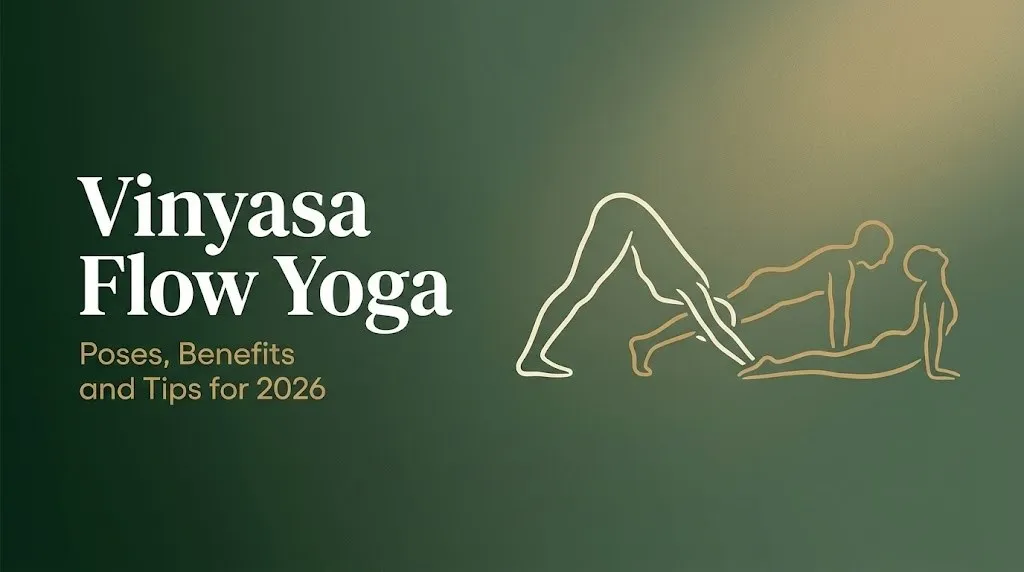
These poses are sequenced together repeatedly during class, often in the pattern: Downward Dog, transition to Plank on the inhale, Chaturanga on the exhale, Upward Dog on the inhale, Downward Dog on the exhale. This transition sequence is itself referred to as “a vinyasa” and functions as the connective tissue linking longer pose holds.
Core vinyasa yoga poses and their function:
| Sanskrit Name | English Name | Primary Physical Target | Key Alignment Cue |
|---|---|---|---|
| Adho Mukha Svanasana | Downward-Facing Dog | Hamstrings, shoulders, calves | Hips high, heels press toward floor |
| Chaturanga Dandasana | Four-Limbed Staff Pose | Triceps, shoulders, core | Elbows hug ribs, body in one line |
| Urdhva Mukha Svanasana | Upward-Facing Dog | Spinal extensors, chest, wrists | Thighs off floor, shoulders away from ears |
| Virabhadrasana I | Warrior I | Hip flexors, quadriceps, shoulders | Front knee over ankle, hips square forward |
| Virabhadrasana II | Warrior II | Hip abductors, quadriceps, adductors | Arms parallel to floor, gaze over front fingers |
| Utkatasana | Chair Pose | Quadriceps, gluteus maximus, core | Knees over toes, weight in heels |
| Uttanasana | Standing Forward Bend | Hamstrings, lumbar extensors | Knees soft, spine long |
| Tadasana | Mountain Pose | Full postural stabilizer chain | Four corners of foot pressing evenly |
Vinyasa Flow Sequence for Beginners
A beginner vinyasa flow sequence runs 20 to 30 minutes, starts with a slow warm-up, includes simplified transitions, and closes with 5 to 10 minutes of Savasana (Corpse Pose) for nervous system recovery.
The sequence below omits full Chaturanga Dandasana (Four-Limbed Staff Pose) for beginners, replacing it with lowered-knee Chaturanga until upper body strength develops. This is not a compromise in the practice. It is the correct technical progression.
Beginner vinyasa flow sequence (25 minutes):
- Sit in Sukhasana (Easy Seated Pose). Practice 10 Ujjayi breath cycles with eyes closed. Arrive fully
- Move to hands and knees. Flow through 5 rounds of Marjaryasana-Bitilasana (Cat-Cow): exhale to round the spine, inhale to arch it
- Tuck the toes and press to Adho Mukha Svanasana (Downward-Facing Dog). Hold for 5 breaths, bending the knees as needed
- Walk feet to hands. Rise to standing through Uttanasana (Standing Forward Bend) into Tadasana (Mountain Pose)
- Inhale arms overhead. Exhale fold forward to Uttanasana. Inhale to halfway lift (flat back). Exhale step back to Phalakasana (Plank Pose)
- Lower knees to mat. Lower chest and chin (modified Chaturanga). Inhale to Bhujangasana (Cobra Pose, the beginner alternative to Upward Dog). Exhale back to Downward Dog
- Step right foot forward: Virabhadrasana I (Warrior I). Hold 5 breaths. Open to Virabhadrasana II (Warrior II). Hold 5 breaths
- Step back to Downward Dog. Repeat on the left side
- Walk feet to hands. Rise to Utkatasana (Chair Pose). Hold 5 breaths
- Fold to Uttanasana. Lower to seated. Lie back for Savasana (Corpse Pose). Rest for 8 to 10 minutes
How to Do Vinyasa Flow
Vinyasa flow works by pairing each inhale with an opening or extending movement and each exhale with a folding or releasing movement, creating a physical rhythm that mirrors the breath cycle.
The most common error beginners make is treating Vinyasa as a fast yoga class where poses happen quickly. Speed is not the goal. Breath synchronization is the goal. A slow Vinyasa class where every transition is driven deliberately by one full breath cycle is more authentic to the practice than a fast class where the breath is abandoned to keep up with the pace.
The “vinyasa” transition, Plank to Chaturanga to Upward Dog to Downward Dog, is the technical centerpiece of the practice. Mastering this transition correctly, particularly the shoulder and elbow alignment in Chaturanga Dandasana (Four-Limbed Staff Pose), is the single most important technique skill in Vinyasa. More Vinyasa-related shoulder injuries originate from incorrect Chaturanga form than from any other pose.
How to do the vinyasa transition correctly:
- From Adho Mukha Svanasana (Downward-Facing Dog): inhale and shift forward over the wrists to Phalakasana (Plank Pose), body in one straight line
- On the exhale: lower slowly, keeping elbows close to the ribs. Stop when shoulders reach elbow height. This is Chaturanga Dandasana
- On the inhale: roll over the toes and lift the chest to Urdhva Mukha Svanasana (Upward-Facing Dog). Thighs fully off the floor, shoulders away from ears
- On the exhale: lift the hips and press back to Adho Mukha Svanasana. Hold for 3 to 5 breaths before the next transition
Safety caution: If the shoulders dip below elbow height in Chaturanga, lower the knees to the mat immediately. Shoulder impingement and rotator cuff strain are the documented risks of incorrect Chaturanga form. Strength builds with practice; technique comes first.
Key Takeaway: Vinyasa isn’t about moving fast. It’s about moving in complete synchronization with one breath per transition. Slow it down until you can feel the breath driving every movement before you increase the pace.
Vinyasa Yoga for Beginners
Vinyasa yoga is accessible for beginners with some yoga experience, but it’s generally better approached after at least a few sessions of Hatha yoga that establish foundational pose familiarity.
The reason is practical. In a studio Vinyasa class, the teacher moves the group through transitions relatively quickly. A practitioner who hasn’t yet learned what Adho Mukha Svanasana (Downward-Facing Dog) or Virabhadrasana II (Warrior II) look and feel like in their own body has to process the pose name, the shape, the alignment, and the breath cue simultaneously. That’s a lot of cognitive load in a moving practice.
A home Vinyasa practice using a video guide at beginner pace eliminates this barrier entirely. You can pause, rewind, and move at whatever speed allows genuine breath synchronization. Yoga Alliance encourages beginners to attend at least a few guided sessions before independent practice to establish foundational alignment understanding.
Beginner vinyasa checklist:
- Learn Tadasana (Mountain Pose) and basic standing poses in a Hatha or beginner class first
- Practice the vinyasa transition (Plank to Chaturanga to Upward Dog to Downward Dog) with knees lowered until upper body strength supports full form
- Use yoga blocks under the hands in all standing forward folds to maintain spinal length when hamstrings are tight
- Choose a class labeled “slow flow,” “gentle vinyasa,” or “beginner vinyasa” rather than an unlabeled flow class initially
- Arrive early and tell the teacher it’s your first Vinyasa class. A good teacher will offer individual modifications throughout
Vinyasa Yoga Modifications
Vinyasa yoga modifications make the practice accessible for practitioners with wrist pain, shoulder limitations, tight hamstrings, or any other physical consideration that affects common Vinyasa poses.
Wrist pain is the most frequently cited physical barrier to Vinyasa practice. The wrists bear significant load in Chaturanga Dandasana (Four-Limbed Staff Pose), Adho Mukha Svanasana (Downward-Facing Dog), and Phalakasana (Plank Pose). Wrist wedges (angled foam props placed under the heels of the hands) reduce wrist extension angle and are the most effective modification for practitioners with carpal tunnel symptoms or wrist tendinitis.
Practitioners with shoulder impingement or rotator cuff issues should replace Chaturanga Dandasana entirely with a controlled lowering to the belly from Plank, followed by Bhujangasana (Cobra Pose) instead of Urdhva Mukha Svanasana (Upward-Facing Dog). This eliminates the rotator cuff loading that makes Chaturanga problematic for compromised shoulders. Any practitioner with a current rotator cuff tear should clear specific weight-bearing yoga poses with their orthopedic surgeon before practicing.
Vinyasa modifications guide:
| Condition | Pose Modified | Standard Pose | Modification |
|---|---|---|---|
| Wrist pain | Chaturanga, Plank, Down Dog | Standard weight-bearing | Wrist wedges, or fists on mat |
| Shoulder impingement | Chaturanga Dandasana | Four-Limbed Staff Pose | Kneel and lower to belly, then Cobra |
| Tight hamstrings | Uttanasana, Down Dog | Straight-leg forward fold | Generous knee bend throughout |
| Knee sensitivity | Virabhadrasana I | Full lunge | Shorter stance, higher back heel |
| Lower back pain | Chaturanga transitions | Full vinyasa | Table-top transitions instead |
| High blood pressure | Inversions | Adho Mukha Svanasana | Keep head above heart level |
Vinyasa Yoga for Seniors
Vinyasa yoga is appropriate for many seniors in a modified format, specifically a slower pace, reduced number of Chaturanga transitions, and poses adapted for reduced joint range of motion and balance considerations.
The NCCIH notes that yoga practice in older adults is associated with improvements in balance, mobility, and self-reported quality of life. Vinyasa’s breath-movement linking is particularly beneficial for seniors because the rhythmic breath pattern supports cardiovascular regulation and proprioceptive awareness simultaneously. However, the standard pace of a studio Vinyasa class is often too fast and too demanding on wrists and shoulders for practitioners over 65 without prior Vinyasa experience.
A senior-appropriate Vinyasa adaptation removes all full Chaturanga transitions and replaces them with a simple: exhale to Balasana (Child’s Pose), inhale back to Downward Dog. This maintains the breath-linked flow without the shoulder and wrist demand of the standard vinyasa. Chair-supported versions of Warrior I, Warrior II, and forward folds make the standing sequence accessible for seniors with balance concerns.
Senior vinyasa adaptations:
- Replace Chaturanga Dandasana with Balasana (Child’s Pose) for every transition
- Use a chair for Warrior I and Warrior II if free-standing balance is limited
- Practice Adho Mukha Svanasana (Downward-Facing Dog) with hands on a chair seat rather than the floor to reduce wrist load
- Limit session length to 20 to 30 minutes initially and build gradually
- Include 10 minutes of Savasana (Corpse Pose) at the end of every session without exception
- Avoid inversions where the head goes below the heart if blood pressure conditions are present, and confirm appropriateness with a cardiologist if hypertension is being managed with medication
Key Takeaway: Seniors can absolutely practice vinyasa flow. The key adaptation is replacing Chaturanga transitions with Child’s Pose, which preserves the breath-linked flow structure while removing the wrist and shoulder demand that makes the standard transition inaccessible for many older bodies.
How Often Should You Do Vinyasa Yoga?
Most yoga teachers and exercise scientists recommend practicing vinyasa yoga 3 to 5 times per week to build strength, flexibility, and practice consistency, with at least one rest or gentle practice day between vigorous sessions.
The American College of Sports Medicine (ACSM) recommends that adults accumulate at least 150 minutes of moderate-intensity aerobic activity per week for general cardiovascular health. Three to four sessions of 45 to 60 minutes of Vinyasa yoga per week meets this guideline while simultaneously building the flexibility and body awareness that distinguish yoga from other forms of aerobic exercise.
Rest days between vigorous Vinyasa sessions are not optional for recovery. Chaturanga Dandasana loads the shoulder joint, wrists, and triceps significantly with each repetition. Practicing a demanding Vinyasa class every day without variation creates cumulative load in these structures that physical therapists identify as a common pathway to Vinyasa-related overuse injuries, particularly in the rotator cuff and wrist extensors.
Weekly vinyasa practice frequency guide:
| Goal | Weekly Frequency | Session Length | Notes |
|---|---|---|---|
| General wellness | 2 to 3 times | 30 to 45 minutes | Sustainable long-term |
| Cardiovascular fitness | 3 to 4 times | 45 to 60 minutes | Rest or Yin days between vigorous sessions |
| Flexibility focus | 3 times Vinyasa plus 1 Yin | Mixed | Yin complements dynamic flexibility |
| Stress management | Daily, alternating intensity | 20 to 60 minutes | Alternate vigorous and gentle days |
| Beginner | 2 times per week | 20 to 30 minutes | Build frequency gradually over 4 to 6 weeks |
One practical note: Two consistent sessions per week produce measurable results over time. Practicing twice a week for six months outperforms attempting daily practice that collapses into nothing after three weeks. Start with what you can sustain, not with the ideal.
Frequently Asked Questions About Vinyasa Flow Yoga
What is vinyasa flow yoga and is it good for beginners?
Vinyasa flow yoga is a breath-linked yoga style where each movement is synchronized with an inhale or exhale in a continuous sequence.
It is accessible for beginners when practiced in a slow or beginner-labeled format, ideally after a few Hatha yoga sessions that establish basic pose familiarity.
Starting with a “slow flow” or “beginner vinyasa” class gives you time to learn the transitions without the pace pressure of a standard studio flow class.
How many calories does vinyasa yoga burn per session?
A 45-minute moderate Vinyasa session burns approximately 200 to 380 calories, depending on body weight and session intensity, based on MET values for yoga documented by the American Council on Exercise.
A vigorous 60-minute Vinyasa class can reach 380 to 590 calories for practitioners in the 155 to 205 pound range.
These figures are estimates; individual calorie burn varies with fitness level, muscle mass, session temperature, and effort intensity.
What is the difference between vinyasa yoga and hatha yoga?
Vinyasa yoga links every pose transition to a specific inhale or exhale, creating a continuous moving flow.
Hatha yoga holds each pose statically for several breaths before transitioning, with deliberate pauses used for alignment instruction and adjustment.
Hatha is generally better for learning pose alignment; Vinyasa builds cardiovascular fitness and flow-state concentration once poses are familiar.
How often should I practice vinyasa yoga to see results?
Practicing Vinyasa 3 to 4 times per week produces noticeable improvements in strength, flexibility, and stress response within 4 to 8 weeks of consistent practice.
The American College of Sports Medicine’s moderate-intensity exercise guidelines are met by three to four weekly sessions of 45 to 60 minutes.
Two sessions per week produces slower but still meaningful results, and is the more sustainable starting point for most beginners.
Is vinyasa yoga safe if I have wrist pain?
Vinyasa yoga can be practiced with wrist pain using specific modifications, but standard Chaturanga Dandasana transitions should be avoided during flare-ups.
Use wrist wedges (angled foam props) under the heels of the hands to reduce wrist extension load in all weight-bearing poses, or practice on fists to keep the wrist in neutral alignment.
Anyone with diagnosed carpal tunnel syndrome, wrist tendinitis, or a previous wrist fracture should confirm which weight-bearing positions are appropriate with their physiotherapist before returning to a full Vinyasa practice.
The Breath Is the Practice
Vinyasa flow yoga is worth the learning curve. Once the breath and movement find each other, the whole practice shifts from exercise into something that also quiets the mind.
Start with the breath. Practice Ujjayi for five minutes before your next session, seated and still. Then try three rounds of Surya Namaskar (Sun Salutation) with one breath per transition. That’s a complete Vinyasa practice.
Three sessions per week, twenty minutes each, is enough to feel genuinely different in four weeks. Start there and build.