Short Sleeve Yoga Top Guide: Fabric, Fit & Style 2026
Choosing the right short sleeve yoga top is not about brand names or trends. It is about finding a garment that disappears during practice so your attention stays on your breath, your alignment, and the work happening in your body.
What you wear to the mat affects how you move. The American College of Sports Medicine recognizes that appropriate activewear, particularly moisture-managing and stretch-integrated fabrics, directly supports thermal comfort and range of motion during physical activity. A top that bunches, rides up, restricts your arms, or soaks through by the second Surya Namaskar (Sun Salutation) is a distraction you don’t need.
This guide covers everything from fabric science to fit philosophy, pose-specific considerations to senior adaptations, and practical guidance for building a wardrobe that serves your practice rather than competing with it. Whether you practice Vinyasa, Yin, or anything in between, there is a short sleeve top designed for exactly that practice.
Short Sleeve Yoga Top: What to Look For and Why It Matters
A short sleeve yoga top is a fitted or semi-fitted athletic garment with short sleeves designed specifically to support the range of motion, moisture management, and thermal regulation demands of yoga practice.
The distinction between a yoga top and a general athletic shirt matters in ways that show up on the mat. Yoga requires overhead arm extension, deep forward folds, spinal twists, and sometimes full inversion. A general athletic shirt may be cut for forward-facing movement in running or gym training. A yoga top is cut for multi-directional, full-range movement with fabric and seam placement that accounts for all of it.
The five features that separate a good yoga top from everything else:
- Four-way stretch fabric: Moves with the body in all directions without resistance or distortion
- Flatlock seams: Lie flat against the skin rather than raised, preventing chafing in poses where you hold positions for extended breaths
- Moisture management: Either wicking synthetic or breathable natural fiber, matched to your sweat level and practice type
- Length and hem stability: Long enough to stay in place during forward folds and overhead extensions without a belt or tuck
- Sleeve construction: Set-in or raglan sleeves that do not restrict shoulder flexion in overhead poses
The wrong top is not just uncomfortable. It creates compensations. Pulling a top down mid-pose, adjusting a neckline during a forward fold, or feeling restricted in a shoulder stretch all interrupt the breath-movement connection that yoga depends on.
Short Sleeve Yoga Top Fabric Guide: What Actually Works
The fabric of a short sleeve yoga top determines everything: how it manages sweat, how it feels against your skin, how it holds its shape over time, and how it performs at different temperatures.
The primary fabric options in yoga apparel and their practical characteristics:
| Fabric | Best For | Watch Out For |
|---|---|---|
| Polyester (100% or blended) | High-sweat practices, hot yoga, Vinyasa | Can retain odor over time without antimicrobial treatment |
| Nylon | Durability, soft hand feel, moderate sweat | Slightly less breathable than polyester in high heat |
| Spandex/Lycra blend | Stretch and recovery, shape retention | Used as a blend (5 to 20%), not a standalone fabric |
| Bamboo fabric | Sensitive skin, temperature regulation, natural softness | Less durable under high abrasion; may stretch out in humid conditions |
| Organic cotton | Gentle practices, cooler studios, Restorative yoga | Absorbs moisture rather than wicking; heavy when wet |
| Recycled polyester | Eco-conscious choice, similar performance to virgin poly | Identical functional performance to standard polyester |
| Modal | Ultra-soft, drapes well, good for low-intensity practice | Less sweat-management performance than polyester blends |
Research published in the Textile Research Journal has found that fabric construction (the weave and fiber treatment) affects moisture transport rate as much as fiber type alone. A loosely woven polyester moves sweat away faster than a tightly woven cotton. Fabric weight also matters: lighter-weight fabrics (measured in grams per square meter, or GSM) perform better in warmer practice environments.
For most yoga practitioners, a polyester-spandex blend in the 80/20 or 88/12 ratio offers the most consistent performance across practice types and temperatures.
Moisture-Wicking Short Sleeve Yoga Tops Explained
Moisture-wicking refers to a fabric’s ability to pull sweat away from the skin surface and spread it across a larger area of the fabric where it can evaporate, keeping the practitioner drier and cooler during practice.
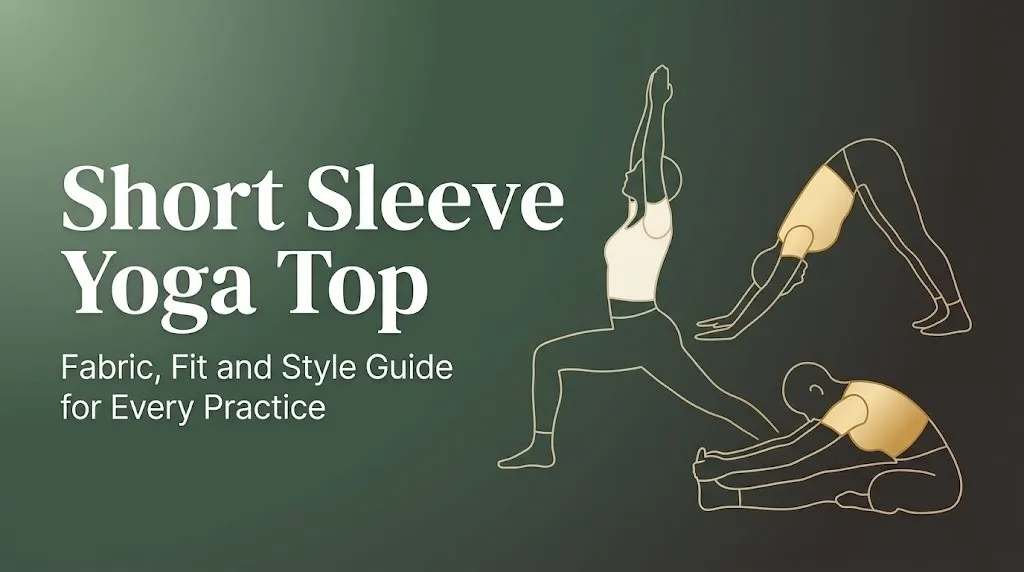
The mechanism works through capillary action in the fiber structure. Synthetic fibers like polyester and nylon are hydrophobic (they repel water) at the fiber level. When sweat contacts the fabric, it moves along the surface of the fiber rather than being absorbed into it. This spreads the moisture across the fabric face, increasing the evaporation surface area and accelerating drying time.
This is fundamentally different from absorption, which is what cotton does. Cotton fibers are hydrophilic: they absorb water into the fiber itself. This is why a cotton yoga top that is wet from sweat becomes heavy and stays wet. A polyester-wicking top may feel damp to the touch briefly but dries much faster.
According to the Journal of Sports Sciences, moisture management in athletic garments has a measurable effect on perceived exertion and thermal comfort during physical activity. Practitioners wearing moisture-wicking fabrics reported lower perceived effort and greater comfort in moderate-intensity sessions compared to those wearing absorbent fabrics.
Moisture-wicking performance degrades over time if the top is washed with fabric softener. Softeners coat the fiber surface and interfere with the capillary action that makes wicking work. Wash moisture-wicking yoga tops without fabric softener and line-dry or tumble-dry on low to preserve their performance.
Key moisture-wicking tips:
- Avoid fabric softener in every wash: it destroys wicking performance
- Line dry or low-heat tumble dry to preserve fiber structure
- Choose tops with antimicrobial treatment if odor is a concern
- Higher-sweat practitioners should choose lighter-weight wicking fabrics
Key Takeaway: Fabric choice is not an aesthetic decision. It is a performance decision. Match your fabric to your sweat level and practice type, and your top will stop being something you notice mid-class.
Cotton vs Synthetic Short Sleeve Yoga Tops
Cotton and synthetic short sleeve yoga tops serve different purposes, and neither is universally better. The right choice depends on your sweat level, practice intensity, studio temperature, and personal skin preferences.
Cotton feels softer and more natural against the skin. It breathes well in low-humidity environments. It does not carry the faint synthetic odor that some people notice with polyester after multiple wears. For gentle practices, Restorative yoga, meditation sessions, or cooler studio environments, a high-quality cotton or cotton-blend top works well.
The limitation of cotton appears under heat and effort. Cotton absorbs and holds sweat rather than transporting it away. In a Vinyasa or Bikram/26&2 class where body temperature rises significantly, a saturated cotton top becomes heavy, clingy, and uncomfortable. It stays wet long after the class ends, which increases the risk of chilling once you stop moving.
Synthetics perform better under sweat. They manage moisture actively, dry quickly, and maintain their shape through hundreds of washes. The trade-off is that polyester and nylon can feel less natural against sensitive skin and may require more frequent washing to manage odor from bacterial growth in the fabric.
| Feature | Cotton | Synthetic (Polyester/Nylon) |
|---|---|---|
| Moisture absorption | High (holds sweat) | Low (wicks sweat away) |
| Drying speed | Slow | Fast |
| Breathability | Good in low heat | Better in high heat with proper weave |
| Skin feel | Soft, natural | Can feel synthetic; varies by quality |
| Durability | Moderate | High |
| Odor management | Better baseline | Needs antimicrobial treatment |
| Best for | Gentle, cool practices | Vinyasa, hot yoga, high-sweat practice |
A cotton-polyester blend (such as 60% cotton, 40% polyester) offers a middle ground: the softness and naturalness of cotton with improved moisture management and faster drying compared to pure cotton.
Short Sleeve Yoga Top for Hot Yoga and Vinyasa
A short sleeve yoga top for hot yoga or Vinyasa yoga needs to manage high sweat output, maintain its shape and coverage through dynamic movement, and feel lightweight enough to not add to the thermal burden of an already warm practice.
In Bikram/26&2 yoga, room temperatures typically reach 105 degrees Fahrenheit (40.6 degrees Celsius) with approximately 40% humidity. The body’s primary cooling mechanism in this environment is evaporative sweating. A top that holds sweat against the skin rather than facilitating evaporation works against that cooling mechanism. This is the functional reason fabric choice matters physiologically, not just comfortably.
The best short sleeve yoga tops for hot yoga and Vinyasa share these features:
- Lightweight polyester or nylon blend, under 150 GSM fabric weight
- Active moisture-wicking construction, not simply moisture-absorbing
- Flatlock seams to prevent chafing during transitions and holds
- Hemline long enough to stay covered through sun salutations and inversions
- Minimal bulk at the underarm to prevent restriction in overhead poses
According to the American College of Sports Medicine, wearing appropriate moisture-management clothing during exercise in heated environments reduces the physiological strain of heat on the cardiovascular system compared to wearing non-wicking garments. This is a genuine functional concern in hot yoga, not just a comfort preference.
Sleeve fit matters in Vinyasa specifically. A sleeve that is too snug restricts shoulder flexion during Adho Mukha Svanasana (Downward Facing Dog) and overhead arm extensions in warrior poses. A sleeve set too far into the armpit causes discomfort in poses where the arms are elevated for extended periods.
Short Sleeve Yoga Top for Yin, Restorative, and Gentle Yoga
A short sleeve yoga top for Yin yoga, Restorative yoga, or gentle Hatha yoga prioritizes comfort, softness against the skin, and warmth retention rather than aggressive moisture management.
In these practice styles, the body generates less heat. Poses are held for minutes rather than breaths. The studio temperature is typically cooler or room-temperature. A heavy-duty moisture-wicking polyester top in this context will feel unnecessarily slick and cool, which works against the warmth and stillness these practices invite.
Yin and Restorative practitioners often prefer:
- Bamboo fabric or organic cotton for natural softness and gentle temperature regulation
- Slightly heavier fabric weight that retains modest warmth
- Looser fit that does not create pressure points during long-held floor poses
- Seams that do not dig in when lying on a bolster or yoga mat for extended periods
- A longer hem that maintains coverage in supine positions
Think of Yin yoga like a long soak in a warm bath. You want the fabric against your skin to support that sense of ease and surrender. A tight, cold, slick synthetic top pulls you in the opposite direction.
Restorative yoga specifically involves lying in supported positions for 5 to 20 minutes per pose. In this context, the seam placement of the top becomes more relevant than its moisture management. Raised seams pressing against the spine during a supported backbend, or bunched fabric around the armpits during a long shoulder opener, are exactly the kinds of distractions these practices are designed to eliminate.
Modification note: Seniors practicing Yin or Restorative yoga may benefit from a slightly heavier-weight cotton or bamboo top that provides more warmth, as body temperature regulation becomes less efficient with age.
Fitted vs Loose Short Sleeve Yoga Top: Which Is Better?
Neither a fitted nor a loose short sleeve yoga top is universally better. The right choice depends entirely on your practice type, personal comfort, and what poses you spend most of your time in.
Fitted tops stay in place. During inversions, forward folds, and arm balances, a fitted top does not shift, bunch, or fall toward the face. Practitioners who do a lot of Bakasana (Crow Pose), handstand preparation, or vigorous Vinyasa flows generally prefer fitted tops because they eliminate clothing management from the mental space of the practice.
The trade-off is compression against the torso and reduced airflow. In a warm studio, a fitted synthetic top may feel warmer against the skin. For practitioners who feel self-conscious about fitted garments, the physical experience of wearing something tight can itself become a distraction from practice.
Looser tops offer more airflow and a more relaxed feel against the body. They work well for standing poses, seated poses, and floor-based gentle practices. The limitation is that in forward folds, the fabric falls toward the face. In downward-facing positions, a loose top can shift away from the torso, creating unwanted exposure.
| Feature | Fitted Top | Loose/Relaxed Top |
|---|---|---|
| Stays in place during inversions | Yes | Often shifts |
| Airflow and breathability | Lower (fabric against skin) | Higher (air circulation) |
| Best practice type | Vinyasa, arm balances, hot yoga | Hatha, gentle yoga, seated practice |
| Forward fold coverage | Excellent | May fall toward face |
| Compression feel | Present | Absent |
| Body image consideration | More revealing | More concealing |
Many practitioners own both and choose based on the day’s practice plan. That is genuinely the most practical approach.
Key Takeaway: Fitted tops stay put in dynamic and inverted poses; loose tops breathe better in stationary and gentle practices. Your practice type should drive the choice, not trend preference.
Short Sleeve Yoga Top with Built-In Bra: Pros and Cons
A short sleeve yoga top with a built-in shelf bra or integrated support combines two garments into one, simplifying your practice wardrobe and eliminating the visibility of bra straps or band lines during practice.
The built-in option works best for practitioners with smaller cup sizes (up to approximately a B/C cup) who do not require substantial structured support. A shelf bra is a fabric panel sewn into the interior of the top that provides light coverage and containment rather than the underwire, molded cups, or encapsulation support that a dedicated sports bra offers.
For practitioners with D cup and above, a built-in shelf bra generally does not provide adequate support for any practice that involves jumping transitions, strong dynamic movements, or sustained inversions. These practitioners are typically better served by a supportive sports bra worn under the top.
Pros of built-in bra tops:
- Fewer layers in warm practices
- Eliminates bra strap visibility concerns
- Streamlined look and feel
- One less garment to shop for and launder
Cons of built-in bra tops:
- Limited to light support (not suitable for larger cup sizes in dynamic practice)
- Removable pads can shift or bunch unless secured
- Sizing becomes more complex as both top fit and support fit must align
- Less flexibility to pair different bras with the same top for varied practices
The Yoga Alliance does not have apparel standards, but certified yoga teachers consistently note that inappropriate support is one of the most common sources of physical discomfort and self-consciousness in beginner practitioners. Choosing appropriate support for your body is a practice-quality decision, not a vanity decision.
Short Sleeve Yoga Top for Large Chest and Plus Size
A short sleeve yoga top for practitioners with a large chest or plus-size body needs to address three specific concerns: adequate support during movement, coverage that stays consistent through the full range of yoga poses, and fabric that does not cling uncomfortably.
Support is the first priority for larger-chested practitioners. A dedicated high-impact or medium-impact sports bra worn beneath a short sleeve yoga top provides significantly better support than any built-in shelf bra. Look for sports bras with encapsulation rather than compression design for larger cup sizes, as encapsulation (where each breast is separately cupped) limits movement more effectively than simply compressing the chest as a unit.
Coverage is the second concern. Forward folds, arm raises, and inversions all challenge the hemline and neckline of any top. For plus-size practitioners, a longer hemline that hits at the high hip rather than the natural waist provides more consistent coverage through dynamic poses. A slightly higher neckline prevents the top from gaping in forward folds.
Fabric choices matter more for plus-size practitioners because fabrics behave differently under greater tension. A four-way stretch fabric that recovers to its original shape (high elastic recovery percentage) maintains its coverage and shape better than a budget synthetic that stretches out and stays stretched.
Practical tips for plus-size and large-chest practitioners:
- Pair a structured sports bra with any short sleeve top for practices involving jumping, dynamic transitions, or inversions
- Choose a hem length that covers the waistband of your bottoms in forward folds
- Opt for fabrics with at least 15 to 20% spandex for maximum stretch recovery
- Avoid tops with large horizontal seams across the chest, which add bulk and can shift during movement
Short Sleeve Yoga Top and Arm Mobility in Yoga Poses
A short sleeve yoga top directly affects the range of motion available at the shoulder joint during overhead and arm-extended yoga poses, and poor sleeve construction is one of the most overlooked sources of restriction during practice.
The shoulder joint requires approximately 150 to 180 degrees of flexion during a fully extended overhead arm position (as in Virabhadrasana I/Warrior I or Urdhva Hastasana/Upward Salute). Any restriction in the sleeve at the armpit or across the upper back limits this range. A top cut too tightly through the underarm creates a pulling sensation that forces the practitioner to either lower the arms or accommodate the restriction through spinal compensation.
Raglan sleeve construction (where the sleeve extends in one piece from the collar to the underarm rather than joining at the shoulder seam) generally provides more overhead mobility than a traditional set-in sleeve. This construction eliminates the shoulder seam that can dig in during full arm extension.
How top construction affects specific poses:
| Yoga Pose | Sanskrit Name | Sleeve Demand |
|---|---|---|
| Downward Facing Dog | Adho Mukha Svanasana | Full shoulder flexion; tight armpits restrict |
| Warrior I | Virabhadrasana I | Arms overhead with spinal extension; top must not ride up |
| Crow Pose | Bakasana | Arms bear weight; fabric must not bunch at elbow |
| Chair Pose | Utkatasana | Arms overhead; similar demand to Warrior I |
| Eagle Pose | Garudasana | Arms crossed and wrapped; tight sleeves restrict the wrap |
Testing a top’s mobility before committing to it: raise both arms fully overhead, then cross them in front of the body and wrap. Any pulling, bunching, or restriction in this test will be amplified during practice. This is the single most practical pre-purchase check for any short sleeve yoga top.
Key Takeaway: The sleeve construction of a yoga top matters as much as the fabric. Test overhead mobility and arm crossing before purchasing. Restriction you feel standing in a store doubles during an hour of practice.
Short Sleeve Yoga Top for Seniors
A short sleeve yoga top for older practitioners needs to prioritize warmth retention, non-restrictive sleeve construction, easy dressing (no tight overhead pulling), and fabric that is gentle on skin that may be more fragile or sensitive with age.
Temperature regulation becomes less efficient as we age. The National Center for Complementary and Integrative Health (NCCIH) notes that older adults are more susceptible to thermal discomfort during physical activity, both overheating and cooling too rapidly. A short sleeve yoga top in a natural fiber or bamboo blend provides gentle warmth without the clingy, synthetic feel that some older practitioners find uncomfortable.
Easy dressing matters more than most product guides acknowledge. Tops that require significant overhead stretch to put on or remove can be genuinely difficult for practitioners with shoulder mobility restrictions, a history of rotator cuff issues, or arthritis in the hands and wrists. Front-snap, wrap-style, or wide-neck tops eliminate this barrier.
Senior-specific short sleeve yoga top recommendations:
- Bamboo or bamboo-cotton blend: Soft against skin, modest warmth, natural moisture management without synthetic feel
- Wider neckline or front-open design: Easier to put on and remove without full overhead arm extension
- Longer hemline: Stays in place during any seated or supine pose without adjustment
- Flatlock seams throughout: Prevents skin irritation from seam pressure during long floor holds in Restorative or Yin yoga
- Relaxed fit: Does not create compression around the torso, which some practitioners with cardiovascular conditions may find uncomfortable
Seniors with lymphedema or post-mastectomy sensitivities should choose tops specifically without tight sleeve bands that could restrict lymphatic flow at the upper arm.
Short Sleeve Yoga Top for Men
A short sleeve yoga top for men addresses different fit and coverage needs than women’s yoga apparel, yet most buyer guides either ignore this demographic entirely or briefly note that “men can wear athletic shirts.”
Men’s yoga practice is growing. Yoga Alliance data consistently shows increasing male enrollment in yoga classes across all styles. Men practicing yoga have the same functional needs as women: moisture management, unrestricted shoulder mobility, and a top that stays in place through dynamic movement. What differs is cut, coverage preference, and typical sweat output.
Men generally produce more sweat volume during physical activity, which makes moisture-wicking fabric performance even more relevant. A 100% polyester or nylon-polyester blend with active wicking construction is particularly valuable for men’s yoga practice.
Cut differences in men’s yoga tops compared to women’s:
- Wider armhole depth to accommodate broader shoulder structures without sleeve restriction
- Longer back hem to prevent riding up during forward folds
- Straight or slightly tapered silhouette rather than fitted contour
- No built-in shelf bra (men require different underlayer considerations based on practice preference)
Men new to yoga often default to gym shirts or running tops. These work reasonably well but are frequently cut for forward-facing movement rather than the multi-directional range that yoga demands. A yoga-specific short sleeve top cut for men’s shoulders and torso proportions reduces the fit and restriction issues that general athletic shirts create in poses like Adho Mukha Svanasana (Downward Facing Dog) and Garudasana (Eagle Pose).
Short Sleeve Yoga Top for Sensitive Skin
A short sleeve yoga top for sensitive skin needs to minimize friction, avoid chemical treatments that cause skin reactions, and use fibers that are gentle at the contact level rather than abrasive or pilling over time.
Sensitive skin in yoga is more common than most people discuss. Conditions including eczema, psoriasis, contact dermatitis, and general tactile sensitivity all affect how a fabric feels during the sustained skin contact of a yoga session. A top that feels acceptable for 10 minutes can become genuinely irritating over a 60-minute class, particularly in any area where the fabric folds or creases during poses.
Research published in Skin Research and Technology has found that fabric friction against compromised skin barriers (as in eczema or dermatitis) increases inflammation and discomfort, with tighter-weave, smoother-surfaced fabrics showing lower friction coefficients and less skin reaction than rougher-textured synthetics.
Features to prioritize for sensitive skin:
- Bamboo fabric: Naturally smooth fiber surface, lower friction than most synthetics, inherently antibacterial
- Flatlock seams throughout: Raised seams become friction points during sustained poses
- No harsh antimicrobial chemical treatments: Some antimicrobial finishes use silver or chemical compounds that irritate sensitive skin; look for natural antimicrobial fibers instead
- OEKO-TEX certified fabrics: Independently tested for harmful substances; relevant for practitioners with chemical sensitivities
- Loose fit over affected areas: Reduces sustained contact pressure on sensitive skin zones
Note on synthetic care: Even a hypoallergenic fabric can cause irritation if residual laundry detergent remains in the fibers. Use a fragrance-free, dye-free detergent and run an extra rinse cycle for any yoga top worn against sensitive skin.
Short Sleeve Yoga Top Sizing and Fit Guide
Sizing a short sleeve yoga top correctly requires trying the garment in a yoga-specific range of motion rather than simply assessing how it feels standing in a dressing room.
Most yoga tops are sized in standard S/M/L/XL or numeric sizing based on chest measurements. The critical variables that sizing charts do not capture are sleeve restriction at full overhead extension, hem length during a forward fold, and neckline behavior in downward-facing positions. A top can size correctly by the chart and still fail on all three functional counts.
Before committing to any short sleeve yoga top, run this four-position fit test:
- Arms overhead: Raise both arms fully overhead. The hem should not expose the lower back. The sleeves should not pull or restrict.
- Forward fold: Fold forward with a flat back. The neckline should not gap or fall open. The hem should stay in place.
- Wide arm spread: Extend both arms wide to the sides. The sleeve should not dig into the underarm or restrict shoulder abduction.
- Cross and wrap: Cross both arms in front of the body and wrap them across the chest as in Garudasana (Eagle Pose). The fabric should stretch without pulling the neckline or hemline out of position.
Sizing guidance by body consideration:
| Body Consideration | Sizing Recommendation |
|---|---|
| Long torso | Size up or choose tops marketed as “long” length |
| Broad shoulders | Prioritize raglan sleeve construction; size to shoulder width |
| Larger chest | Size to chest measurement, pair with separate sports bra |
| Short torso | Standard length often sufficient; avoid “longline” cuts |
| Plus size | Choose tops with at least 20% spandex for full stretch recovery |
How to Build Your Short Sleeve Yoga Top Wardrobe
Building a practical short sleeve yoga top wardrobe means having the right top for each type of practice you do regularly, without accumulating garments that duplicate each other.
Start with two tops that cover your most frequent practice types. If you primarily practice Vinyasa, two moisture-wicking polyester-blend fitted tops in different colors serve you well for a full week of practice. If your practice is split between dynamic and gentle styles, one fitted synthetic and one relaxed bamboo or cotton top covers both contexts.
A minimal but complete short sleeve yoga top wardrobe might include:
- 1 to 2 fitted moisture-wicking tops: For Vinyasa, hot yoga, or any high-sweat practice
- 1 to 2 relaxed natural-fiber tops: For Yin, Restorative, Hatha, or cooler studio practices
- 1 supportive bra-top or well-paired bra and top combination: For practices involving significant jumping or strong dynamic movement
- 1 UV-protective or bamboo top: For outdoor yoga sessions or sensitive skin days
You do not need a different top for every class. You need tops that perform in the conditions you actually practice in. Spending on quality in two or three pieces outperforms spending on quantity in ten mediocre pieces every time.
Care matters as much as selection. Wash yoga tops in cold water, use fragrance-free detergent, skip fabric softener, and line dry or use low heat. Tops cared for properly last two to four years of regular practice. Tops washed carelessly degrade in months.
The best short sleeve yoga top wardrobe is the one you actually wear, the one that stops being something you think about during practice and becomes simply the layer between you and the work.
Frequently Asked Questions About Short Sleeve Yoga Tops
What fabric is best for a short sleeve yoga top?
A polyester-spandex blend (approximately 80% polyester, 20% spandex) is the best fabric for most short sleeve yoga tops because it wicks moisture, stretches in four directions, and recovers its shape after washing.
For sensitive skin or gentle practices, bamboo fabric or organic cotton offers a softer alternative with natural moisture management.
The best fabric depends on your practice type: high-sweat practices need active wicking synthetics; gentle or cooler practices tolerate natural fibers well.
Should a yoga top be tight or loose?
A yoga top should fit closely enough to stay in place during inversions and forward folds, but not so tightly that it restricts shoulder movement or causes discomfort during extended holds.
For dynamic practices like Vinyasa yoga, a fitted or semi-fitted top reduces fabric distraction during transitions and arm balances.
For Restorative or Yin yoga, a relaxed fit is appropriate and often more comfortable during long-held poses on the floor.
Can I wear a regular short sleeve shirt for yoga?
A regular short sleeve shirt works for gentle yoga but typically fails in dynamic practice because it lacks the four-way stretch, moisture management, and seam construction that yoga-specific tops provide.
Regular shirts are often cut for forward-facing movement, which creates restriction in the armpit and across the back during overhead and lateral yoga movements.
For occasional or beginner practice, a regular athletic shirt is an acceptable starting point. For regular practice, a yoga-specific top makes a noticeable functional difference.
What is the difference between a yoga top and a regular athletic top?
A yoga top is specifically constructed for multi-directional movement, with four-way stretch fabric, flatlock seams, and a cut that accommodates overhead extension, spinal twists, and inverted positions.
Regular athletic tops are often optimized for forward-facing activities like running or cycling and may have seam placement and sleeve construction that restricts yoga-specific ranges of motion.
The practical difference shows up most clearly in overhead poses, forward folds, and any arm balance where a regular top shifts, rides up, or pulls at the shoulder.
How do I stop my yoga top from riding up during practice?
Choose a top with a hemline that hits at the high hip rather than the natural waist, which provides more coverage through forward folds and overhead extensions.
Fitted tops with strong elastic recovery (at least 15 to 20% spandex content) stay in place better than loose or low-spandex tops during dynamic movement.
Tucking a yoga top into high-waisted bottoms is also a practical and widely used solution among practitioners who prefer loose-fitting tops but need coverage through standing and inverted poses.
Your Next Class Deserves Better Than a Guess
The right short sleeve yoga top makes your practice cleaner, your focus sharper, and your transitions easier. Start with one quality piece matched to your primary practice style.
If you practice mostly Vinyasa or hot yoga, choose a lightweight moisture-wicking polyester blend in a fitted cut. If your practice is primarily gentle or Yin, try a bamboo or cotton-blend relaxed top. Run the four-position fit test before you commit to any top.
One well-chosen top worn consistently reveals more about what you need next than ten impulse purchases ever will.