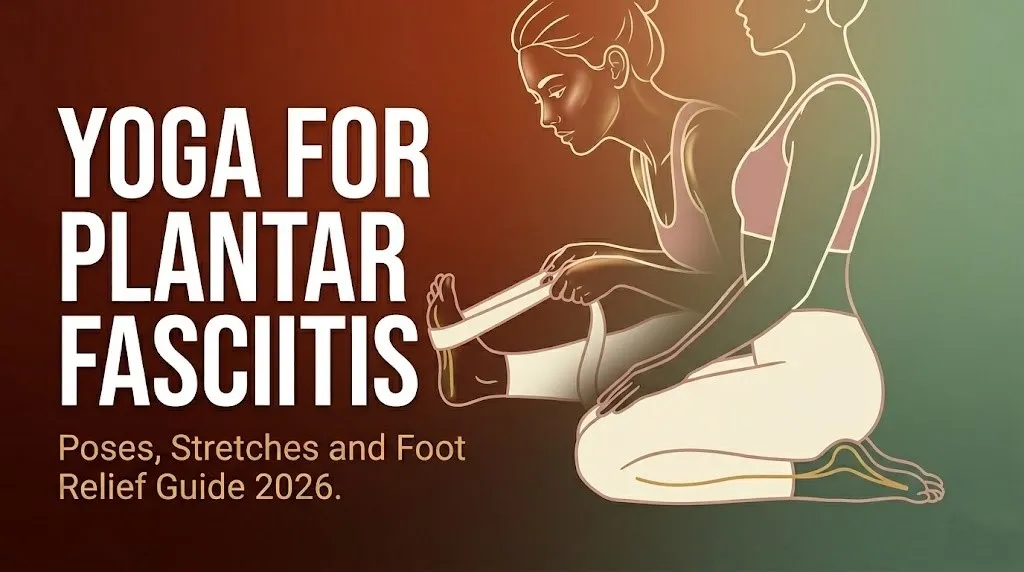
Yoga for Plantar Fasciitis: Poses and Relief Guide 2026
Yoga for plantar fasciitis works when it combines targeted stretching of the plantar fascia and calf complex with active strengthening of the intrinsic foot muscles that support the arch. Practiced with the right poses at the right times, yoga can meaningfully reduce heel pain and address the muscle imbalances that keep plantar fasciitis coming back.
Plantar fasciitis is the most common cause of heel pain in adults, affecting approximately 2 million people in the United States each year, according to the American Physical Therapy Association. Research published in the Journal of Foot and Ankle Research consistently identifies plantar fascia-specific stretching and calf flexibility work as two of the most effective conservative treatments available.
This guide covers every relevant category: the anatomy of the condition, the most effective poses and toe exercises, how to time your practice relative to morning pain, what to avoid, and how to start if you’re a complete beginner with sore feet.
Yoga for Plantar Fasciitis: What You Need to Know
Yoga for plantar fasciitis is a therapeutic approach that targets the plantar fascia, the calf muscles, the Achilles tendon, and the intrinsic foot muscles simultaneously through a combination of stretching and strengthening poses.
Most people with plantar fasciitis receive the same initial advice: rest, ice, and stretch. That advice is not wrong, but it is incomplete. The plantar fascia does not operate in isolation. It is the terminal end of a tensile chain that runs from the heel bone, up through the Achilles tendon, into the gastrocnemius and soleus of the calf, and ultimately through the hamstrings and into the lower back. Tightness anywhere along that chain increases load on the plantar fascia.
Yoga addresses this chain systematically. Poses like Adho Mukha Svanasana (Downward-Facing Dog) stretch the calf complex and Achilles. Toed-in variations of standing poses activate the intrinsic foot muscles. Specific toe exercises directly stretch the fascia itself. No single physical therapy exercise covers that range of targets in one practice session, but a well-designed yoga sequence does.
What this guide gives you:
- A clear understanding of why yoga works for plantar fasciitis
- The specific poses that stretch, strengthen, and decompress the affected structures
- Toe yoga and foot yoga exercises not covered by any competing resource
- Timing guidance for morning pain versus mid-day practice
- A complete list of poses to avoid and why
Does Yoga Help Plantar Fasciitis?
Yes, yoga helps plantar fasciitis when it includes poses that stretch the calf and plantar fascia and strengthen the intrinsic muscles that support the arch.
A 2019 systematic review published in the Journal of Foot and Ankle Research confirmed that plantar fascia-specific stretching and calf muscle stretching are among the most evidence-supported conservative interventions for plantar heel pain. Yoga delivers both types of stretching in a single practice, with the additional benefit of body awareness training that improves how practitioners load their feet during everyday movement.
The strengthening component matters as much as the stretching. Weak intrinsic foot muscles, particularly the abductor hallucis on the inner arch, allow the arch to collapse under load. That collapse increases tensile stress on the plantar fascia with every step. Yoga poses that require active toe spreading and foot gripping, such as Tadasana (Mountain Pose) practiced with deliberate engagement, directly train the muscles that reduce this collapse pattern.
According to the American Physical Therapy Association, eccentric loading of the calf and arch-supporting musculature accelerates recovery from plantar fasciitis compared to stretching alone. Yoga’s standing poses provide exactly this type of eccentric load when practiced with muscular engagement rather than passive standing.
The honest answer: yoga is not a quick fix for plantar fasciitis. It is a tool that addresses the root causes rather than just the symptom. Consistent practice over four to eight weeks produces the most meaningful results.
Understanding Plantar Fasciitis: The Anatomy Behind the Pain
Plantar fasciitis is an overuse injury of the plantar fascia, a thick band of connective tissue that runs from the calcaneus (heel bone) to the base of the toes, forming the primary structural support for the arch of the foot.
The “fasciitis” suffix is slightly misleading. Early research described the condition as purely inflammatory, but more recent imaging studies reviewed by Foot and Ankle International have characterized it more accurately as a degenerative process involving micro-tears and collagen disorganization within the fascia, rather than acute inflammation. This distinction matters for treatment: purely anti-inflammatory approaches address only part of the picture. Tissue loading through stretching and strengthening directly addresses the degenerative component.
Think of the plantar fascia like a thick rubber band stretched from your heel to your toes. Every time the foot bears weight, that band is loaded. When the calf muscles are tight, the Achilles tendon pulls harder on the heel bone, which in turn pulls harder on the attachment point of the plantar fascia. The result is micro-stress at the insertion point — the exact location where plantar fasciitis pain concentrates.
The windlass mechanism is the biomechanical principle most relevant to understanding why certain yoga poses work. When the toes are extended (pulled up toward the shin), the plantar fascia is tensioned like a winch cable, which lifts the arch and distributes load more evenly. Poses that create toe extension while bearing weight engage this mechanism therapeutically.
Key anatomical structures involved in plantar fasciitis:
- Plantar fascia: Primary affected tissue; runs calcaneus to metatarsal heads
- Calcaneus: Heel bone; medial tubercle is the typical pain location
- Gastrocnemius and soleus: Calf muscles whose tightness directly increases plantar fascia load
- Achilles tendon: Connects calf muscles to calcaneus; tension here transfers to the fascia
- Abductor hallucis: Inner arch muscle; weakness here contributes to arch collapse under load
- Intrinsic foot muscles: The small muscles within the foot itself that control toe position and arch support
Key Takeaway: Plantar fasciitis pain sits at the heel, but the real problem is usually a full-chain tension pattern from the calves through the Achilles to the plantar fascia, and yoga addresses that entire chain.
Yoga Poses for Plantar Fasciitis: The Full Library
The full yoga pose library for plantar fasciitis covers three therapeutic categories: poses that stretch the plantar fascia and calf chain, poses that strengthen the intrinsic foot muscles and arch, and poses that decompress the foot and promote circulation for tissue recovery.
Knowing which category a pose belongs to helps you sequence intelligently. Stretching poses are most valuable after the foot has warmed up and are particularly effective when held for 30 to 60 seconds with slow breathing. Strengthening poses are most effective in the mid-range of a session, not at the very beginning when the fascia is still stiff. Decompressive poses are ideal for closing a practice.
Full Pose Library for Plantar Fasciitis:
| Pose (English) | Sanskrit Name | Primary Function | Hold Time | Key Target |
|---|---|---|---|---|
| Downward-Facing Dog | Adho Mukha Svanasana | Calf and fascia stretch | 30 to 60 seconds | Gastrocnemius, soleus, plantar fascia |
| Pyramid Pose | Parsvottanasana | Deep calf and hamstring stretch | 30 to 45 seconds each side | Gastrocnemius, soleus, Achilles |
| Hero Pose with toes tucked | Virasana variation | Direct plantar fascia stretch | 20 to 30 seconds initially | Plantar fascia, toe flexors |
| Mountain Pose active | Tadasana | Intrinsic foot strengthening | 30 to 60 seconds | Abductor hallucis, intrinsic muscles |
| Chair Pose | Utkatasana | Arch and calf strengthening | 20 to 30 seconds | Intrinsic muscles, tibialis posterior |
| Eagle Pose (legs) | Garudasana | Calf and ankle mobilization | 20 to 30 seconds each side | Peroneals, calf complex |
| Big Toe Pose | Padangusthasana | Calf and hamstring stretch | 30 seconds | Gastrocnemius, plantar fascia |
| Reclined Hand-to-Big-Toe | Supta Padangusthasana | Supine calf and fascia stretch | 30 to 45 seconds each side | Gastrocnemius, hamstrings |
| Bridge Pose | Setu Bandha Sarvangasana | Foot and arch activation | 30 seconds per rep | Intrinsic muscles, plantar surface |
| Child’s Pose | Balasana | Decompression and recovery | 2 to 5 minutes | Full foot and ankle rest |
Modification for all poses listed: Anyone in an acute pain phase should reduce hold times by half and avoid any pose that creates sharp heel pain during or immediately after the hold.
Yoga Stretches for Plantar Fasciitis: Calf and Achilles Focus
The most therapeutically potent yoga stretches for plantar fasciitis target the gastrocnemius and soleus muscles of the calf, because calf tightness is one of the most consistently identified risk factors for developing and perpetuating plantar fasciitis.
Parsvottanasana (Pyramid Pose) is the most targeted single calf stretch in the yoga library. The combination of a long stance, front foot pointing forward, back foot at a mild angle, and a long-spine forward fold creates a sustained, deep stretch along the full length of the gastrocnemius, soleus, and Achilles tendon on the back leg. Physical therapists recommend holding a calf stretch for a minimum of 30 seconds to achieve meaningful connective tissue lengthening, and Pyramid Pose delivers exactly that duration in a functional position.
Adho Mukha Svanasana (Downward-Facing Dog) stretches both calves simultaneously and also creates a mild stretch along the plantar surface of the foot when the heels work toward the floor. The key for plantar fasciitis is to avoid forcing the heels down aggressively. A gentle, progressive approach with slightly bent knees is more therapeutic than a maximally stretched position that compresses the Achilles insertion at the heel.
To practice Parsvottanasana (Pyramid Pose) for plantar fasciitis:
- Stand in Tadasana (Mountain Pose). Step the right foot back 3 to 4 feet, keeping it angled slightly outward.
- Square the hips to the front of the mat. Both feet press firmly into the floor.
- Inhale to lengthen the spine upward. Place hands on the hips or interlace fingers behind the back.
- Exhale and hinge forward from the hips, keeping the spine long. Let the torso lower toward the front thigh.
- Press the back heel firmly into the floor. Feel the stretch along the entire back calf.
- Hold for 30 to 45 seconds with slow, even breathing. Inhale back to upright. Switch sides.
Modification: Place both hands on yoga blocks at each side of the front foot if hamstring tightness prevents the forward fold. The heel pressing action is what matters, not how far forward you reach.
Toe Yoga for Plantar Fasciitis
Toe yoga for plantar fasciitis refers to a set of isolated toe and foot exercises that directly stretch the plantar fascia, activate the intrinsic foot muscles, and retrain the neuromuscular coordination of the foot, all of which are impaired in chronic plantar fasciitis.
This category is almost entirely absent from competing articles, yet it represents some of the most direct therapeutic work available for this condition. The toes are not passive structures. The ability to spread the toes wide, curl them independently, and lift one toe at a time while keeping others on the floor reflects the health and coordination of the intrinsic foot musculature. In people with chronic plantar fasciitis, this coordination is typically disrupted, with the small toe muscles either overworking or completely disengaged.
Toe yoga exercises for plantar fasciitis:
- Toe Spreading: Sit in a chair or Sukhasana (Easy Pose). Press all ten toes firmly into the floor. Attempt to spread them as wide as possible without lifting them. Hold the spread for 5 seconds. Release. Repeat 10 times. This activates the abductor hallucis and abductor digiti minimi, the two most important arch-supporting intrinsic muscles.
- Big Toe Lift: Press all toes into the floor. Lift only the big toe while keeping the other four toes on the floor. Hold 3 seconds. Lower. Then lift only the four smaller toes while keeping the big toe down. Repeat 10 times each. This retrains the differentiated motor control of the toe extensors.
- Toe Curl: Sit in a chair with feet flat. Curl all toes downward as if picking up a marble from the floor. Hold 5 seconds. Release. Repeat 10 times. This engages the flexor digitorum brevis, a key intrinsic muscle of the plantar surface.
- Heel Toe Walking: From standing, walk forward 10 steps on only the heels with toes lifted. Then walk back on only the balls of the feet with heels lifted. Repeat 3 times. This strengthens the tibialis anterior (heel walking) and calf-toe complex (ball walking) alternately.
Modification: All toe exercises can be performed seated for anyone who cannot comfortably stand.
Foot Yoga for Plantar Fasciitis: Intrinsic Muscle Work
Foot yoga for plantar fasciitis goes beyond the calves and Achilles to address the small muscles within the foot itself, which are the first line of arch support and the most commonly neglected aspect of plantar fasciitis recovery.
The intrinsic foot muscles include the abductor hallucis, flexor digitorum brevis, abductor digiti minimi, and several smaller muscles between the metatarsal bones. Together, these muscles form the dynamic support system of the arch. When they are weak or uncoordinated, the plantar fascia bears more passive tensile load with every step. Strengthening these muscles reduces that passive load.
Virasana (Hero Pose) with toes tucked under is the most direct plantar fascia stretch in yoga and simultaneously the most underused. Sitting on the heels with toes curled under so the balls of the feet are on the floor creates a progressive stretch along the entire plantar surface. The weight of the body sitting back into the heels deepens the stretch organically without requiring any aggressive manual pressure.
To practice Virasana with toes tucked for plantar fascia release:
- Kneel on a padded surface with toes curled under so the balls of all ten toes press into the floor.
- Slowly sit your hips back toward your heels. Stop when you feel a deep stretch across the entire sole of the foot.
- Keep the spine tall. Breathe slowly and steadily.
- Hold for 20 seconds initially, building to 45 to 60 seconds over weeks as the fascia adapts.
- To release, come forward onto all fours and untuck the toes. Wiggle the feet gently before standing.
Modification: Place a folded blanket under the shins and knees for padding. If the knee feels any discomfort before the foot stretch is felt, place a rolled blanket behind the knees to reduce knee flexion. Skip this pose if knee pain prevents comfortable kneeling.
Key Takeaway: The toes and intrinsic foot muscles are where plantar fasciitis recovery either succeeds or stalls, and most yoga articles completely ignore this dimension of the practice.
Morning Yoga for Plantar Fasciitis
Morning yoga for plantar fasciitis should begin before the first step of the day is taken, because the characteristic heel pain of plantar fasciitis is at its worst during those first morning steps.
The reason for morning pain is biomechanical. During overnight sleep, the foot rests in a position of mild plantar flexion (toes pointing down), which allows the plantar fascia to shorten slightly. The first weight-bearing steps of the day suddenly reload a contracted, stiffened fascia, creating the sharp tearing pain that many people describe as “stepping on glass” first thing in the morning.
The most effective morning sequence begins before standing. Performing plantar fascia-specific stretches in bed or on the floor before loading the foot prepares the fascia for the loading that walking immediately imposes.
To practice morning yoga before standing:
- Before getting out of bed, flex both ankles fully by pulling the toes toward the shins. Hold 20 seconds. This pre-stretches the gastrocnemius and begins lengthening the contracted plantar fascia before weight is applied.
- Loop a yoga strap or towel around one foot. Extend the leg and pull the foot into dorsiflexion (toes toward your face). Hold 30 seconds each side. This delivers the plantar fascia-specific stretch that research identifies as most effective for reducing morning pain.
- Sit at the edge of the bed. Roll the foot over a firm ball or the edge of a yoga block for 60 seconds per foot. This provides light fascia mobilization before the first step.
- Stand slowly and take a few small steps before attempting full-stride walking.
- Practice 5 to 8 rounds of Seated Cat-Cow (adapted spinal mobility work from a seated position) to wake the full posterior chain before standing yoga begins.
Modification: For anyone who cannot reach the foot with a strap, simply flex the ankle actively by pulling the foot toward the shin without assistance. The active dorsiflexion still creates a meaningful fascial stretch.
Yin Yoga for Plantar Fasciitis
Yin yoga is particularly effective for plantar fasciitis because its long passive holds, typically three to five minutes per pose, target the fascia and connective tissue directly rather than the more superficial muscle belly that standard stretching reaches.
Fascia and connective tissue respond to time under gentle, sustained load rather than to intensity or repetition. This is the core principle of Yin yoga, and it is also the principle behind the most effective stretching protocols in physical therapy research. A 30-second stretch addresses muscle. A 3 to 5 minute passive hold begins to create the tissue remodeling response within the fascia itself.
For plantar fasciitis, Yin yoga’s value is in its ability to address the deeper fascial restrictions along the posterior chain — the plantar fascia, the deep calf fascia, and the thoracolumbar fascia — that contribute to excessive tension at the heel. These deeper tissues require longer holds and less muscular engagement to access.
Best Yin yoga poses for plantar fasciitis:
- Sleeping Swan (Yin version of Eka Pada Rajakapotasana, Pigeon Pose): Targets hip flexors and iliotibial band, which form part of the posterior chain connected to calf tension. Hold 3 to 5 minutes per side.
- Supported Saddle (reclined variation of Supta Virasana, Reclined Hero Pose): Creates a sustained plantar fascia and quadriceps fascial stretch. Use a bolster under the spine. Hold 3 to 5 minutes.
- Dragonfly (wide-legged forward fold, adapted Upavistha Konasana): Targets hamstrings and calf fascial connections. Hold 3 to 5 minutes.
- Supported Squat (Yin Malasana): Creates gentle ankle dorsiflexion with gravity assistance. Place a rolled blanket under the heels for support. Hold 2 to 4 minutes.
According to the National Center for Complementary and Integrative Health (NCCIH), mind-body practices that include sustained attention on body sensation during held postures produce measurable reductions in chronic pain perception, which is relevant for anyone managing the persistent heel pain of plantar fasciitis.
Yoga for Plantar Fasciitis and Achilles Tendon
Yoga for plantar fasciitis and Achilles tendon problems addresses a condition that often presents simultaneously, because the plantar fascia and Achilles tendon share a common attachment point at the heel and are mechanically interdependent.
The Achilles tendon inserts into the posterior calcaneus (back of the heel bone). The plantar fascia attaches to the medial tubercle of the calcaneus (bottom of the heel bone). These two structures are connected through the heel bone itself, and through a layer of deep fascia called the deep crural fascia that links them. When one is tight or inflamed, it alters the mechanics of the other.
Yoga poses that gently stretch the calf through both straight-knee and bent-knee positions address both muscle heads responsible for Achilles tightness. The gastrocnemius crosses the knee joint and is best stretched with the knee straight, as in Parsvottanasana (Pyramid Pose). The soleus lies beneath the gastrocnemius and does not cross the knee, so it is best stretched with the knee slightly bent, as in a bent-knee version of Adho Mukha Svanasana (Downward-Facing Dog) or a low lunge with the back knee slightly softened.
Pose Tip: Addressing Both Structures:
- Straight-knee calf stretch (gastrocnemius and Achilles): Pyramid Pose, standing wall calf stretch with knee extended
- Bent-knee calf stretch (soleus and deeper Achilles): Low Lunge with back knee raised, Downward Dog with alternating knee bends
- Combined stretch (both together): Adho Mukha Svanasana with one heel pressing down and one knee bent alternately
- Modification for Achilles tenderness: Reduce dorsiflexion range and never bounce into the stretch; sustained gentle holds only
Anyone managing both plantar fasciitis and Achilles tendinopathy simultaneously should work with a physical therapist or podiatrist to confirm that the calf stretching protocol is appropriate for their specific Achilles condition before deepening any yoga poses.
Key Takeaway: Addressing both the straight-knee (gastrocnemius) and bent-knee (soleus) calf stretch is essential for plantar fasciitis and Achilles tendon recovery, and most yoga routines cover only one of these two positions.
Best Yoga Poses for Plantar Fasciitis: Step by Step
The best yoga poses for plantar fasciitis are those that create a therapeutic combination of plantar fascia stretching, calf lengthening, and intrinsic foot muscle strengthening in a sequence that can be practiced in 20 to 25 minutes daily.
Complete Step-by-Step Plantar Fasciitis Yoga Sequence:
- Virasana with toes tucked (Hero Pose plantar fascia stretch): Kneel with toes curled under. Sit back toward the heels. Hold 20 to 30 seconds. Untuck toes and rest.
- Seated ankle circles: Sit cross-legged or on a chair. Circle each ankle 8 times clockwise and 8 times counterclockwise. This mobilizes the ankle joint and improves circulation to the plantar fascia before loading.
- Tadasana (Mountain Pose) with active toe spreading: Stand with feet hip-width apart. Press all four corners of each foot firmly into the mat. Spread all ten toes as wide as possible without lifting them. Hold this engagement for 30 seconds, breathing evenly.
- Utkatasana (Chair Pose): From Tadasana, bend the knees and sit the hips back as if toward a chair. Keep weight in the heels. Press the four corners of each foot firmly into the mat. Hold 20 to 30 seconds. Rise slowly.
- Parsvottanasana (Pyramid Pose): Step the right foot back. Hinge forward over the front leg with a long spine. Press the back heel firmly into the mat. Hold 30 to 45 seconds. Switch sides.
- Adho Mukha Svanasana (Downward-Facing Dog): From hands and knees, press the hips up and back. Keep a slight bend in both knees. Alternate pressing one heel toward the floor for 5 breaths, then the other. Hold the full pose with both heels reaching down for 30 seconds.
- Padangusthasana (Big Toe Pose): From standing, hinge forward with a slight bend in the knees. Wrap the first two fingers around the big toes. Hold the toes and gently increase the forward fold. Hold 30 seconds.
- Supta Padangusthasana (Reclined Hand-to-Big-Toe Pose): Lie on the back. Loop a strap around the right foot. Extend the leg toward the ceiling. Flex the foot strongly so toes point toward the face. Hold 30 seconds. Switch sides.
- Setu Bandha Sarvangasana (Bridge Pose): Lie on the back, knees bent, feet flat on the floor. Press through the entire sole of each foot equally as you lift the hips. Hold 30 seconds. Repeat 3 times.
- Balasana (Child’s Pose): End in a restful forward fold, knees wide or together, arms extended. Hold 2 to 3 minutes to close the practice.
Modification for the full sequence: Anyone with acute pain should begin with only poses 1, 2, 3, 8, and 10, building to the full sequence over two weeks.
Can Yoga Make Plantar Fasciitis Worse?
Yes, certain yoga poses and practices can make plantar fasciitis worse, particularly when performed too aggressively during the acute pain phase or when specific biomechanical errors are present.
The most common way yoga aggravates plantar fasciitis is through aggressive calf stretching in the early morning before the fascia has warmed up. Forcing the heels aggressively toward the floor in Adho Mukha Svanasana (Downward-Facing Dog) immediately after waking can overload a contracted, cold fascia and create new micro-tears at the calcaneal attachment. The solution is not to avoid Downward Dog — it is to approach it progressively with slightly bent knees and gentle, incremental heel pressing.
The second most common aggravating factor is barefoot practice on hard floors without adequate foot engagement. Yoga is traditionally practiced barefoot, which is generally beneficial for intrinsic foot muscle development. However, a passive, disengaged barefoot practice on a thin mat over a hard floor provides less arch support than the affected foot may need in an acute or sub-acute phase. Using a thicker mat, practicing on carpet, or temporarily using a minimal arch support insert during the first phase of recovery are reasonable adaptations.
Practices that can aggravate plantar fasciitis:
- Forcing heels to the floor in Downward Dog without warm-up
- Practicing standing poses for extended periods immediately after waking
- Running or any bouncing sequences (jump-throughs in Ashtanga, for example) before the fascia is symptom-free
- Using a very thin mat on a hard floor during the acute pain phase
- Holding Malasana (Garland Pose / Squat) deeply without adequate ankle flexibility, which creates excessive load on the plantar fascia insertion
If pain increases during or within 24 hours after a yoga session, that is the body’s signal to reduce intensity, shorten holds, and temporarily remove any pose that was practiced immediately before the pain increase.
Yoga Poses to Avoid With Plantar Fasciitis
Several yoga poses carry a higher risk of aggravating plantar fasciitis, particularly in the acute and sub-acute phases of the condition, and knowing which ones to approach cautiously protects recovery progress.
The poses to limit or avoid are those that create aggressive dorsiflexion of the ankle under high load, require the plantar fascia to bear significant tensile stress in a shortened or compressed position, or involve repeated impact through the heel.
Poses to avoid or modify with plantar fasciitis:
- Malasana (Garland Pose / Squat): Deep squatting with heels on the floor requires maximal ankle dorsiflexion and places high tensile load on the plantar fascia. If the Achilles or plantar fascia is inflamed, this position should be avoided or practiced with heels elevated on a folded blanket.
- Vrksasana (Tree Pose) on a hard, unsupported surface: Prolonged single-leg standing on a thin mat over a hard floor during an acute phase concentrates plantar fascia load on the affected foot. Use a thick mat or temporarily practice this pose near a wall.
- Virasana (Hero Pose) without toes tucked: Sitting directly on the tops of the feet with ankles in full plantar flexion removes all stretch from the plantar fascia and can allow the tight calf muscles to remain in a shortened position that perpetuates the condition. Use the toes-tucked variation instead.
- Jump-throughs and jump-backs in Ashtanga or Vinyasa sequences: Impact loading through the heel during jumping can create acute pain at the calcaneal attachment.
- Bakasana (Crow Pose) and arm balance entries requiring forceful foot push-off: The push-off from a plantar-flexed foot during arm balance entry places sudden tensile load on the plantar fascia.
Modification for all avoided poses: Most can be reintroduced with reduced range or prop support as the condition improves. The timeline for reintroduction depends on pain response, not a fixed number of weeks.
Yoga for Plantar Fasciitis Beginners: How to Start
Yoga for plantar fasciitis as a complete beginner should begin with just three exercises: the toes-tucked Hero Pose stretch, ankle circles, and active Tadasana with toe spreading.
These three practices together take less than 10 minutes and cover the three most important therapeutic targets: direct plantar fascia stretching, ankle joint mobility, and intrinsic foot muscle activation. Starting here rather than with a full standing practice protects against early overload and builds the foot awareness and strength that makes every subsequent pose more effective and more comfortable.
The most common beginner mistake is trying to do too much too soon. Plantar fasciitis responds poorly to aggressive loading in the early stages. The fascia needs progressive, graded exposure to load, not an hour of standing poses on the first week.
Week-by-week beginner progression:
| Week | Practices to Add | Daily Duration |
|---|---|---|
| Week 1 | Toes-tucked Hero Pose stretch, ankle circles, active Tadasana | 10 minutes |
| Week 2 | Add Supta Padangusthasana (reclined calf stretch with strap) | 15 minutes |
| Week 3 | Add Adho Mukha Svanasana (with bent knees) and Pyramid Pose | 20 minutes |
| Week 4 | Add Chair Pose, Bridge Pose, and full toe yoga sequence | 25 minutes |
| Weeks 5 to 8 | Full 10-pose sequence daily or five days per week | 25 to 30 minutes |
Shoe and mat note for beginners: For the first two to four weeks, practice yoga in minimal supportive footwear if barefoot practice consistently triggers acute heel pain. Some yoga traditions resist this suggestion, but protecting the healing tissue in the early stages is more important than adherence to convention. Barefoot practice can resume fully as the acute pain resolves.
Key Takeaway: Beginners with plantar fasciitis should build gradually over four to eight weeks, starting with floor-based and seated exercises before progressing to standing poses, to avoid the early overload that derails most recovery attempts.
Frequently Asked Questions About Yoga for Plantar Fasciitis
How long does yoga take to help plantar fasciitis?
Most people notice measurable reduction in morning heel pain within four to six weeks of daily yoga practice targeting the plantar fascia and calf.
Research published in the Journal of Foot and Ankle Research found that plantar fascia-specific stretching programs show meaningful pain reduction at the four-to-eight-week mark when practiced consistently.
Full recovery from chronic plantar fasciitis, defined as pain-free daily activity, typically takes three to six months with a consistent stretching and strengthening program.
Should I do yoga during a plantar fasciitis flare-up?
Yes, gentle yoga is appropriate during a flare-up, but only floor-based and seated practices that avoid direct weight-bearing on the inflamed heel.
Reclined calf stretches using a strap, supine toe exercises, and toes-tucked Hero Pose performed very briefly are all appropriate during an acute flare.
Standing poses and any practice that creates heel pain during the hold should be paused until the acute inflammation settles, typically within three to five days.
Is Downward Dog good or bad for plantar fasciitis?
Adho Mukha Svanasana (Downward-Facing Dog) is beneficial for plantar fasciitis when practiced correctly, with slightly bent knees and heels working progressively toward the floor rather than forced down.
The calf and Achilles stretch it provides directly addresses one of the primary mechanical causes of plantar fasciitis.
It becomes harmful when the heels are forced aggressively to the floor before the calves and fascia are warmed up, particularly first thing in the morning.
How many times a week should I do yoga for plantar fasciitis?
Daily practice of a 15 to 25 minute targeted sequence produces the best outcomes for plantar fasciitis, based on the stretching frequency recommendations reviewed by the American Physical Therapy Association.
A minimum of five days per week is the threshold below which tissue adaptation is unlikely to be maintained between sessions.
If daily practice is not immediately achievable, prioritize the morning pre-standing sequence every day and do the full practice on the days you can.
Can plantar fasciitis be permanently fixed with yoga?
Yoga can resolve plantar fasciitis for many people when practiced consistently and combined with appropriate load management in daily activities.
The condition recurs most often when people stop the stretching and strengthening routine after symptoms resolve, because the underlying muscle imbalances and fascial restrictions return without maintenance.
Treating yoga as a lifelong foot health maintenance practice, rather than a temporary fix, produces the most durable outcomes and the lowest recurrence rates.
Start With Your Feet Right Now
Take off your shoes. Sit on the floor with your feet flat. Try to spread all ten toes as wide as they’ll go without lifting any of them off the floor.
If that is harder than it sounds, your intrinsic foot muscles need the work that this guide covers. Start with the toes-tucked Hero Pose stretch and the toe-spreading exercise from the toe yoga section. Do those two things daily for one week before adding anything else.
Come back to the full sequence when your feet are ready for it. That’s the pace that actually heals.