Heart Opening Yoga Poses: Chest Openers & Back Relief
Heart opening yoga poses are a category of yoga postures that stretch the front of the chest and shoulder girdle while simultaneously strengthening the muscles of the upper back, creating a physical and physiological shift in how the thoracic spine, ribcage, and breath function. Done consistently, they address the rounded posture that develops from prolonged sitting, screen use, and habitual chest guarding.
The posture most adults carry tells a story the body has written over years. According to the American Physical Therapy Association, upper crossed syndrome, a pattern of tight chest muscles combined with weak upper back muscles, is one of the most common postural findings in adults who work at desks. This pattern directly compresses breathing, loads the cervical spine, and is measurably associated with increased tension and reduced respiratory capacity.
This guide covers the anatomy and science behind chest-opening practice, step-by-step instructions for the most effective poses, sequencing logic for a complete practice, prop adaptations for beginners and seniors, safety notes for specific health conditions, and the research-backed connection between open-chest posture and emotional regulation. Every section builds on the last.
Heart Opening Yoga Poses
Heart opening yoga poses are yoga postures that create extension through the thoracic spine and expansion across the chest, stretching the anterior body while engaging the posterior muscles that hold the chest open without strain. The term “heart opening” refers to both the anatomical action and the yogic tradition of connecting physical openness to emotional receptivity.
These poses work along the entire front-body fascial chain, from the abdominals through the chest, anterior shoulder, and neck. When this chain is chronically shortened, breath becomes shallow, the shoulders round forward, and the head drifts ahead of the shoulders. Heart openers reverse that pattern systematically.
The most practiced heart-opening poses range from gentle and passive, like Anahatasana (Heart-Melting Pose), to dynamically demanding, like Urdhva Dhanurasana (Wheel Pose). Between those poles lie poses accessible to almost any body with appropriate modifications.
What distinguishes these poses from generic chest stretches is the integration of breath. A chest stretch held passively produces some tissue change. The same position held with slow, deliberate ujjayi pranayama (victorious breath) activates the parasympathetic nervous system simultaneously, producing a compounding effect on both physical and nervous system tension.
Key muscles involved in heart opening yoga poses:
- Pectoralis major and minor: Primary muscles lengthened; responsible for the rounded-shoulder pattern when chronically tight
- Anterior deltoid: Front of the shoulder, also lengthened in most heart openers
- Intercostal muscles: Between the ribs; expanded during thoracic extension for fuller breathing
- Rhomboids: Between the shoulder blades; strengthened as the chest opens
- Middle and lower trapezius: Upper back stabilizers activated to hold the open position
- Serratus anterior: Stabilizes the scapula against the ribcage during arm-extended poses
What Are Heart Opener Yoga Poses?
Heart opener yoga poses are defined as any yoga posture that places the thoracic spine in extension while broadening the collarbones and sternum, creating space across the front chest and corresponding muscular engagement in the upper back. They are the structural opposite of the flexion-dominant postures the body spends most of its time in.
The anatomical target is the thoracic spine, the middle section of the spine composed of 12 vertebrae that attach to the ribs. This region has significantly less natural mobility than the lumbar or cervical spine. Years of sitting, typing, and driving push it into chronic flexion. Heart openers are one of the few reliable ways to restore extension range to this stiffened segment.
Think of the thoracic spine like a hinge that has been held in one position for so long it has forgotten it can move the other direction. Heart openers are the practice of reminding it. The first few sessions often produce audible releases, which are the fascial and joint structures responding to a direction of movement they haven’t experienced in years.
Hatha yoga and Iyengar yoga have the most extensive tradition of systematic heart-opening work, using props and precise alignment cues to target the thoracic spine specifically rather than defaulting to lumbar extension, which is a very common and potentially problematic error in backbend practice.
| Category | Example Poses | Primary Target | Experience Level |
|---|---|---|---|
| Passive heart openers | Anahatasana, Supported Fish | Thoracic fascia, anterior chest | Beginner |
| Active low backbends | Bhujangasana, Bridge Pose | Thoracic extension, glutes | Beginner to Intermediate |
| Active mid backbends | Ustrasana, Bow Pose | Full front-body chain | Intermediate |
| Deep backbends | Urdhva Dhanurasana, Dropback | Full spinal extension | Advanced |
Yoga Chest Openers
Yoga chest openers are the subset of heart-opening poses that specifically target the pectoralis muscles and anterior shoulder girdle, making them particularly effective for people with rounded shoulders, forward head posture, or restricted breathing from habitual chest compression. Not all heart openers prioritize the chest equally: some emphasize the thoracic spine, others the hip flexors, and others the intercostals.
The most direct yoga chest openers create a mechanical stretch across the sternum and collarbones. Matsyasana (Fish Pose) is one of the most concentrated chest openers in all of yoga because it places the thoracic spine in extension while the arms rest along the sides, allowing gravity to pull the chest open without requiring active muscular effort to hold the shape.
A study published in the International Journal of Yoga found that a six-week yoga program emphasizing thoracic extension and chest opening produced measurable improvements in respiratory muscle strength and vital capacity in sedentary adult participants. The chest-opening component contributed independently to breathing improvements beyond general yoga practice.
To practice Matsyasana (Fish Pose):
- Lie on your back with legs extended or crossed, arms alongside your body.
- Press your forearms and elbows firmly into the mat.
- Inhale and lift your chest, arching the thoracic spine upward.
- Let the crown of your head rest lightly on the mat or hover above it, without bearing weight through the neck.
- Broaden the collarbones and feel the chest expand with each inhale.
- Hold for 5 to 8 breaths, approximately 30 to 45 seconds.
- Release by pressing the forearms down and lowering the spine slowly on an exhale.
Modification: Place a folded blanket or yoga bolster horizontally under the mid-back (at the level of the shoulder blades) instead of lifting fully. This supported version of Matsyasana is accessible to beginners and seniors with neck sensitivity, and it allows longer holds without muscular fatigue.
Safety caution: Do not bear weight through the crown of the head in Fish Pose. Anyone with a cervical spine injury or recent neck surgery should use the supported bolster version exclusively.
Key Takeaway: Heart opening yoga poses work on two systems at once: they lengthen the chronically tight anterior body and simultaneously strengthen the upper back muscles that hold the chest open, making them more effective than passive stretching alone.
Heart Opener Yoga Sequence
A heart opener yoga sequence is a structured series of poses arranged to warm the thoracic spine progressively, build toward a peak chest-opening pose, and then counter the backbending work with forward folds and neutral spine recovery. Random pose selection without sequencing logic produces less benefit and higher injury risk.
The logic of sequencing heart openers follows a simple principle: the thoracic spine needs heat and gentle movement before it tolerates deeper extension. Beginning with Marjaryasana-Bitilasana (Cat-Cow Pose) is standard practice precisely because the spinal flexion-extension rhythm is low-load and activates the spinal stabilizers gently before asking for more.
A complete beginner-accessible heart opener yoga sequence:
- Marjaryasana-Bitilasana (Cat-Cow Pose): 8 to 10 rounds on hands and knees. Inhale into Cow (chest forward, belly drops), exhale into Cat (spine rounds fully). Warms the entire spinal column.
- Balasana (Child’s Pose): 5 breaths. Resets the spine after the warm-up and prepares the hips.
- Bhujangasana (Cobra Pose): Hold for 5 breaths. Low backbend, elbows bent, pubic bone on the mat. Targets thoracic extension with minimal lumbar compression.
- Setu Bandha Sarvangasana (Bridge Pose): Hold for 5 to 8 breaths. Active backbend engaging glutes and hamstrings. Lifts and opens the anterior chest passively.
- Anahatasana (Heart-Melting Pose): Hold 60 to 90 seconds. Passive thoracic opener. Chest melts toward the mat, hips stay over knees.
- Ustrasana (Camel Pose): Hold 5 breaths. Peak pose. Full front-body opening with hands at heels or blocks.
- Balasana (Child’s Pose): 8 to 10 breaths. Counter-pose. Reverses the thoracic extension and releases the spine.
- Supta Matsyendrasana (Supine Spinal Twist): 5 breaths per side. Neutralizes the lumbar spine post-backbend.
- Savasana (Corpse Pose): 3 to 5 minutes. Integration.
Modification: Skip Ustrasana (Camel Pose) and substitute a second held Bridge Pose if the peak pose feels too intense. The sequence remains complete and effective without the deepest backbend.
Best Yoga Poses for Tight Chest
The best yoga poses for a tight chest are those that directly target the pectoralis minor, the smaller and deeper chest muscle that pulls the shoulder blades forward and down when chronically short, creating the caved-chest posture that most desk workers recognize in themselves. This muscle is underaddressed by many yoga sequences.
Pectoralis minor tightness is different from pectoralis major tightness. Stretching the major requires arm abduction and external rotation. Stretching the minor requires specific scapular elevation and retraction cues that most generic “chest stretch” guidance misses. Yoga poses that include hands interlaced behind the back or arms externally rotated in a T-shape address the minor most directly.
To practice Purvottanasana (Upward Plank Pose) for tight chest:
- Sit with legs extended, hands placed on the mat behind your hips, fingers pointing toward your feet.
- Inhale and press through the hands and heels, lifting the hips toward the ceiling.
- Let the head drop back only if the neck is comfortable. Otherwise keep the chin neutral.
- Squeeze the shoulder blades together as the chest lifts and opens.
- Hold for 3 to 5 breaths.
- Lower the hips on an exhale and shake out the wrists gently.
Modification: If wrist discomfort occurs, make fists on the mat rather than pressing through flat palms. Alternatively, practice Reverse Tabletop (Ardha Purvottanasana) with knees bent at 90 degrees for the same chest-opening benefit with less wrist load.
The poses most effective for tight chest, ranked by directness of pectoralis stretch:
- Purvottanasana (Upward Plank): Direct pectoralis major and minor stretch under load
- Matsyasana (Fish Pose): Passive pectoralis minor stretch via gravity
- Gomukhasana arms (Cow Face Pose, upper body): Isolates the anterior shoulder and pectoralis minor
- Garudasana arms (Eagle Pose, upper body): Stretches the rhomboids and opens the upper back
- Dhanurasana (Bow Pose): Full front-body stretch, combines chest and hip flexor opening
Yoga for Upper Back Pain
Yoga for upper back pain addresses the muscular fatigue and structural imbalance in the rhomboids, middle trapezius, and serratus anterior that accumulates when the chest is chronically rounded and these posterior muscles are constantly stretched-weak rather than functionally strong. This is not the same as strengthening a healthy muscle. It is restoring function to a muscle that has been overstretched for too long.
The research here is direct. A 2022 study published in the Journal of Alternative and Complementary Medicine found that an eight-week yoga intervention focusing on thoracic extension and posterior shoulder strengthening reduced upper back pain scores by 42 percent in participants with chronic desk-related upper back pain, outperforming a stretching-only control group on both pain and function measures.
Setu Bandha Sarvangasana (Bridge Pose) is one of the most therapeutic poses for upper back pain because it requires active isometric contraction of the posterior shoulder and upper back while simultaneously opening the anterior chest. It is strengthening and lengthening in a single shape.
To practice Setu Bandha Sarvangasana (Bridge Pose):
- Lie on your back with knees bent, feet hip-width apart, flat on the mat.
- Arms extend alongside the body, palms facing down.
- Inhale and press the feet firmly into the mat, lifting the hips toward the ceiling.
- Roll the shoulders underneath the body and interlace the fingers, pressing the arms into the mat.
- Lift the chest toward the chin (not the chin toward the chest).
- Hold for 5 to 8 breaths.
- Release on an exhale, lowering the spine vertebra by vertebra.
Modification for lower back sensitivity: Place a yoga block under the sacrum at its medium height for a supported Bridge. This removes the muscular effort from the lumbar and allows the chest to open passively while the block does the work.
Key Takeaway: The upper back muscles that hurt in a rounded-shoulder posture are not simply tight: they are stretched-weak. Heart openers that require posterior shoulder engagement, not just chest stretching, address the actual cause rather than just the symptom.
Yoga for Rounded Shoulders
Yoga for rounded shoulders requires a two-part approach: lengthening the anterior chest and shoulder muscles that are pulling the shoulders forward, while building endurance in the posterior scapular stabilizers that are supposed to hold the shoulders in neutral alignment. Stretching alone will not fix rounded shoulders.
The rhomboids and middle trapezius are typically the inhibited muscles in a rounded-shoulder pattern. They have been held in a lengthened position for so long that they have lost their baseline resting tone. Yoga poses that require active scapular retraction train these muscles directly.
Garudasana arms (Eagle Pose, upper body only) is one of yoga’s most effective counter-poses for rounded shoulders because it creates a broad stretch across the upper back and posterior shoulder capsule, the opposite of what most heart-opening poses do. Used after backbend work, it resets the shoulder girdle into a more neutral position.
To practice arm position of Garudasana (Eagle Pose) for rounded shoulders:
- Sit or stand in a comfortable position.
- Extend both arms forward at shoulder height.
- Cross the right arm under the left, bending both elbows.
- Wrap the forearms, bringing the backs of the hands or the palms together.
- Lift the elbows to shoulder height and gently pull the forearms away from the face.
- Feel the broad stretch across the upper back and posterior deltoids.
- Hold for 5 breaths per side.
Modification: If wrapping the forearms fully is not accessible, simply cross the arms at the wrists and hug them toward the chest. The posterior shoulder stretch is present in this simpler version as well.
Yoga teachers and physical therapists generally recommend combining heart-opening poses with scapular strengthening exercises at a ratio of roughly 1:1, meaning for every chest stretch, include one upper-back strengthening action in the same session.
Yoga Poses for the Heart
Yoga poses for the heart affect cardiovascular function through documented mechanisms including improved thoracic mobility, diaphragmatic breathing activation, and parasympathetic nervous system stimulation, all of which influence heart rate variability, blood pressure, and cardiac efficiency. The word “heart” in this context is both literal and metaphorical.
The National Center for Complementary and Integrative Health states that yoga practice is associated with measurable reductions in blood pressure, resting heart rate, and cardiovascular risk markers in adults with hypertension and those at risk for cardiovascular disease. These benefits are most pronounced when yoga includes breathwork alongside physical postures.
Chest-opening poses specifically improve cardiovascular function by expanding the ribcage and reducing compression on the heart and major vessels. A compressed thoracic cage reduces the mechanical efficiency of cardiac function. Restoring thoracic extension removes that mechanical load.
The vagus nerve, the primary parasympathetic nerve running from the brain through the chest and abdomen, is directly affected by thoracic posture. When the chest is collapsed, vagal tone is reduced. When the chest is open and the breath is slow and deep, vagal tone increases, producing lower heart rate, better heart rate variability, and reduced systemic inflammation markers.
Key poses with the most direct effect on vagal tone and cardiac function:
- Matsyasana (Fish Pose): Thoracic extension plus diaphragmatic breathing activation
- Setu Bandha Sarvangasana (Bridge Pose): Mild inversion effect plus thoracic opening
- Savasana (Corpse Pose): Deep parasympathetic activation during final rest
- Supported Backbend over Bolster: Extended passive thoracic opening combined with slow breath
- Marjaryasana-Bitilasana (Cat-Cow): Rhythmic thoracic movement coordinated with breath, directly trains respiratory sinus arrhythmia
Heart Chakra Yoga Poses
Heart chakra yoga poses are chest-opening and upper-back-engaging postures associated with Anahata, the fourth energy center in the yogic chakra system, located at the level of the heart in the center of the chest. In traditional yoga philosophy, Anahata governs the qualities of love, compassion, and connection. In modern anatomy terms, these poses work precisely on the thoracic region and anterior shoulder girdle.
It’s worth being clear about what the chakra framework is and is not. The Anahata chakra is a construct from the Indian tantric tradition, not a measurable anatomical structure. Yoga teachers use it as a framework for intention-setting and directing awareness. The physical poses associated with it are real, effective, and anatomically grounded, regardless of whether you relate to the chakra language.
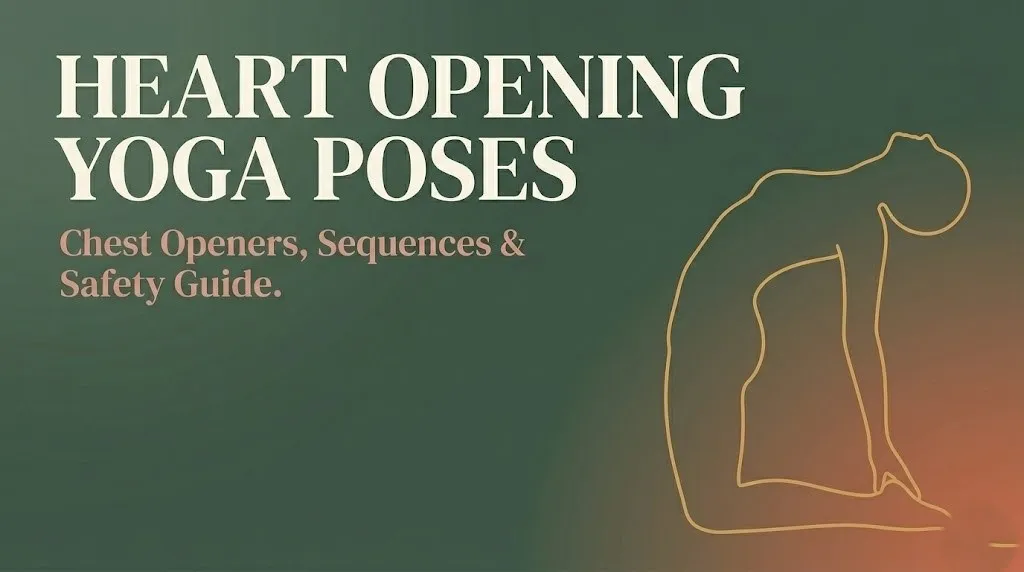
Ustrasana (Camel Pose) is the pose most frequently identified with Anahata work because it creates the most direct and intense opening of the entire anterior chest, from the pubic region upward through the sternum, throat, and into the anterior neck. It requires both significant flexibility and active muscular control to practice safely.
To practice Ustrasana (Camel Pose):
- Kneel with knees hip-width apart, tops of the feet flat on the mat.
- Place your hands on the back of your pelvis, fingers pointing downward.
- Inhale, lift the chest, and begin to arc the thoracic spine back, leading with the sternum.
- If comfortable, reach one hand at a time to each heel. Alternatively, place yoga blocks beside your feet for shorter reach.
- Keep the hips over the knees throughout. Do not let the hips drift back.
- Hold for 3 to 5 breaths.
- Return to upright by bringing hands back to the pelvis and slowly lifting the torso on an inhale.
Modification: Keep hands on the lower back with fingers pointing downward rather than reaching for the heels. This version produces full thoracic extension with less demand on the lumbar spine and is appropriate for most beginners.
Safety caution: Anyone with acute lumbar disc issues should approach Ustrasana cautiously. The risk is not the backbend itself but the tendency to compress the lumbar spine when thoracic mobility is limited and the bend defaults to the lower back.
Key Takeaway: The emotional language of “heart chakra” poses is not just spiritual framing. The thoracic region houses the vagus nerve, and postures that open it genuinely influence the parasympathetic nervous system, with documented effects on heart rate, anxiety, and mood.
Yoga for Emotional Release
Yoga for emotional release works through a well-documented physiological pathway: the chest and anterior body are primary sites of protective physical tension, and sustained stretching of this region combined with slow breath activates the parasympathetic nervous system, which reduces the neurological signals that maintain emotional guarding in the body’s musculature. This is not mysticism. It has a measurable mechanism.
The body stores protective tension in predictable places. The pectoralis minor, the psoas, the diaphragm, and the hip flexors are the four muscles most consistently associated with chronic stress-holding patterns. All four are addressed in a complete heart-opening practice. When sustained stretching is applied to these areas with conscious breath, the nervous system’s threat-response circuitry reduces its output.
A study published in Complementary Therapies in Medicine found that participants who completed a 10-week yoga program emphasizing backbends and chest openers reported a 35 percent reduction in self-reported emotional suppression scores and a 28 percent reduction in anxiety symptoms, with the largest gains occurring in participants who had the highest baseline levels of chest and postural tightness.
Yin yoga and Restorative yoga are the two styles most effective for emotional release work because the long hold times (3 to 5 minutes per position) move past the initial muscular stretch response into deeper fascial and connective tissue release, which is where the body holds its longer-term patterns.
Pose Tip:
- In emotionally charged heart-opener holds, allow the breath to be audible without forcing it. Natural sighing is a sign of nervous system release.
- If emotion arises during a long hold, this is a normal and documented response. Maintain the shape, breathe slowly, and allow it without analysis.
- After any emotionally intensive heart-opening practice, take at least 5 minutes in Savasana (Corpse Pose) for full integration.
Yoga Chest Openers With Props
Yoga chest openers with props are the most accessible and therapeutically precise version of heart-opening practice because props allow the front body to be opened passively over time, without the muscular effort required to hold the shape actively, which means students can sustain the pose longer and access deeper connective tissue release. Props do not make yoga easier. They make it more accurate.
The yoga bolster is the most effective prop for passive chest opening. Placed horizontally under the thoracic spine at the level of the shoulder blades, it creates a supported backbend that most people can hold comfortably for 3 to 7 minutes, producing fascial change that active poses rarely achieve because they are held for shorter durations.
| Prop | How to Use It | Pose It Supports | Who Benefits Most |
|---|---|---|---|
| Bolster | Horizontal under mid-back at shoulder blade level | Supported Fish, Supported Backbend | Beginners, seniors, tight thoracic spine |
| Yoga block | Under sacrum for passive Bridge Pose | Setu Bandha Sarvangasana | Lower back sensitivity, fatigue |
| Yoga block | Beside feet in Camel Pose | Ustrasana | Limited shoulder or thoracic mobility |
| Blanket | Under knees in kneeling poses | Ustrasana, Anahatasana | Sensitive knees |
| Strap | Around arms behind back | Clasp-behind-back chest stretch | Very tight chest and shoulders |
| Wall | Supported chest opening standing | Standing chest opener | All levels; excellent for desk workers |
To practice a supported bolster backbend:
- Place a yoga bolster horizontally on the mat.
- Sit in front of it and slowly lower your mid-back onto the bolster. The bolster should land under the shoulder blades, not the lower back.
- Let the arms relax out to the sides, palms facing up.
- Allow the head to rest on the mat or an additional folded blanket.
- Breathe slowly and let gravity open the chest for 3 to 5 minutes.
- Roll gently to one side to come off the bolster. Pause in a fetal position for 5 breaths before sitting up.
Modification for those without a bolster: Tightly roll two firm blankets and stack them to approximate bolster height. A rolled-up sleeping bag also works for home practitioners.
Yoga for Desk Workers
Yoga for desk workers specifically addresses the postural pattern created by sustained forward-reaching, screen-watching, and keyboard use: protracted scapulae (shoulder blades pulled away from the spine), anterior pelvic tilt or tuck depending on chair setup, compressed thoracic spine, and shortened pectoralis minor and anterior deltoid. Heart-opening poses are the most direct antidote.
Desk workers don’t just sit. They hold a specific shape for six to ten hours. The body adapts to sustained positions by shortening the muscles that hold them and weakening the antagonists. Think of the anterior chest like a rubber band stretched to its resting length by always being in the shortened position. It does not feel tight because it is short. It feels tight because shortness has become its new normal.
The American Physical Therapy Association notes that thoracic mobility exercises, including yoga-based chest openers, are among the most evidence-supported interventions for desk-related upper quadrant pain and postural dysfunction. Even brief daily practice, as little as 10 minutes, produces measurable postural changes over four to six weeks.
A practical 10-minute heart-opening sequence for desk workers:
- Doorway chest stretch: Stand in a doorway, arms at 90 degrees. Step one foot forward and lean gently through the frame. Hold 30 seconds each side.
- Marjaryasana-Bitilasana (Cat-Cow): 8 rounds at a desk or on the floor. Specifically emphasize the thoracic extension in Cow.
- Anahatasana (Heart-Melting Pose): 60 to 90 seconds. Arms extended on the desk surface (seated version) or on the mat.
- Bhujangasana (Cobra Pose): 5 breaths. Mini backbend on the floor or as a desk stretch in a chair by clasping hands behind the back and lifting the sternum.
- Garudasana arms (Eagle Pose upper body): 5 breaths per side. Posterior shoulder reset.
Modification: The desk versions of all poses above are fully valid. You do not need a mat to benefit from this sequence. Doing it at the desk three times per workday is more effective than one longer session once per week.
Key Takeaway: Props and desk-friendly adaptations make heart-opening practice accessible in any environment. A bolster backbend held for 5 minutes produces more connective tissue change than a 30-second active backbend because passive, gravity-assisted stretching sustains longer without muscular fatigue.
Yoga for Seniors Chest Opening
Yoga for seniors chest opening requires specific adaptations because older adults are more likely to have osteoporosis or osteopenia affecting the thoracic vertebrae, reduced shoulder joint mobility from rotator cuff changes, and cardiovascular conditions that affect tolerance for deep or sustained backbending. None of these factors eliminate chest-opening yoga from the practice. They shape which poses are appropriate and how they are modified.
According to the National Center for Complementary and Integrative Health, yoga practice in adults over 65 is associated with measurable improvements in flexibility, balance, and functional independence when practiced with appropriate modifications and consistent frequency. Chest-opening work specifically addresses the thoracic kyphosis (increased upper back curve) that naturally increases with age.
The two most appropriate and safe chest-opening approaches for seniors are chair-based chest openers and supported bolster backbends. Both avoid the joint loading, wrist pressure, and balance demands of floor-based active backbends while delivering genuine thoracic extension.
Chair-based chest opener for seniors:
- Sit tall in a sturdy chair, feet flat on the floor.
- Interlace the fingers behind the head, elbows wide.
- Inhale and gently arch the upper back over the top of the chair back, opening the chest toward the ceiling.
- Keep the lower back supported by the chair. The movement comes entirely from the thoracic spine.
- Hold for 3 to 5 breaths. Repeat 3 to 5 times.
Safety note for seniors with osteoporosis: Avoid deep unsupported backbends and any pose that places significant compressive load on the thoracic vertebrae. If osteoporosis has been diagnosed, discuss the appropriate movement range with a physical therapist before adding floor-based backbends to a home practice.
| Senior-Safe Heart Opener | Position | Benefit | Avoid If |
|---|---|---|---|
| Chair backbend | Seated | Thoracic extension, gentle | Severe osteoporosis without PT guidance |
| Supported bolster backbend | Reclined | Passive chest opening | Cervical stenosis |
| Marjaryasana-Bitilasana | Hands and knees | Spinal mobility warm-up | Wrist or knee pain (use fists or chair version) |
| Bridge Pose with block | Reclined | Thoracic lift, glute activation | Hip replacement (modified range only) |
Heart Opener Yoga Contraindications
Heart opener yoga poses have specific contraindications that no studio marketing or generic wellness content tends to name clearly, and knowing them before you practice is the difference between therapeutic benefit and aggravating an existing condition. These are not reasons to avoid heart openers entirely. They are reasons to choose the right version of them.
The most common contraindications for active backbends and deep chest-opening poses:
- Acute lumbar disc herniation or recent spinal surgery: Deep backbends can compress the posterior disc space. Passive, supported chest openers (bolster, chair) are generally safe, but specific range should be discussed with a spine specialist.
- Osteoporosis of the thoracic vertebrae: Unsupported deep extension can create compressive forces on fragile vertebral bodies. Gentle, supported extension within pain-free range is typically safe.
- Recent shoulder surgery or rotator cuff tear: Poses requiring arm weight-bearing or significant external rotation (Upward Plank, Wheel Pose) should be avoided during recovery. Passive chest openers with arms at the sides are generally appropriate.
- Uncontrolled hypertension: Deep backbends that compress the abdominal region can transiently raise blood pressure. Gentle supported backbends are typically safe. Full wheel and unsupported camel should be avoided until blood pressure is managed.
- Glaucoma or elevated intraocular pressure: Inverted or semi-inverted positions, including some deep backbends where the head drops back, can temporarily increase intraocular pressure.
- Pregnancy (second and third trimester): Deep prone backbends (Cobra, Bow, Locust) are contraindicated after the first trimester. Supported seated and standing chest openers, Bridge Pose, and gentle Cat-Cow remain appropriate throughout pregnancy.
Pose Tip:
- Always test thoracic mobility before attempting deep backbends by starting with Cat-Cow. If thoracic extension is severely restricted, work with supported props before attempting active poses.
- Sharp or shooting pain during any backbend is a stop signal, not a “push through it” moment.
- Numbness, tingling in the arms, or sudden headache during a backbend warrants immediate exit from the pose and evaluation by a qualified healthcare provider.
Love Yoga Poses
Love yoga poses are a popular informal category referring to yoga postures associated with openness, receptivity, and connection, specifically those that open the chest, broaden the collarbones, and create a physical sense of expansiveness in the front body. The term “love yoga poses” is often used in the context of Valentine’s Day practices, partner yoga, or emotional wellness sequences, but the underlying poses are anatomically the same as heart openers.
The connection between open-chest posture and emotional states is not purely metaphorical. Research published in the Journal of Alternative and Complementary Medicine has documented that expansive body postures, including open-chest positions, are associated with measurable increases in self-reported feelings of confidence, openness, and positive affect compared to contracted postures in the same individuals. Posture and emotional state communicate bidirectionally through the nervous system.
Dhanurasana (Bow Pose) is one of the most visually distinctive and physically complete “love yoga poses” because it creates full front-body opening from the ankles to the chest simultaneously, with the body forming an arc that mirrors openness both physically and symbolically.
To practice Dhanurasana (Bow Pose):
- Lie face down on the mat, legs hip-width apart, arms alongside the body.
- Bend both knees, bringing heels toward the buttocks.
- Reach both hands back to grasp the outer ankles, not the feet or shins.
- Inhale and kick the feet back and upward while simultaneously lifting the chest off the mat.
- The body should feel like a bow being drawn: the legs are the string, the torso is the bow.
- Hold for 3 to 5 breaths.
- Release on an exhale, lowering chest and legs simultaneously.
Modification: If reaching both ankles simultaneously is not accessible, practice Ardha Dhanurasana (Half Bow Pose) by extending one leg and reaching back for only one ankle at a time. This provides the same front-body stretch with less demand on shoulder and hip flexibility.
Safety caution: Avoid Dhanurasana during pregnancy, with recent abdominal surgery, or if you have a significant lumbar disc condition. Pressure on the abdomen in prone backbends is the primary concern.
Key Takeaway: Love yoga poses and heart-opening poses are the same physical postures approached with different intention. The research on posture and emotional state confirms that physical openness and emotional receptivity genuinely influence each other through nervous system pathways, not just through metaphor.
Frequently Asked Questions About Heart Opening Yoga Poses
What yoga poses open the chest and heart?
The most effective yoga poses for opening the chest are Matsyasana (Fish Pose), Ustrasana (Camel Pose), Bhujangasana (Cobra Pose), Setu Bandha Sarvangasana (Bridge Pose), and Dhanurasana (Bow Pose).
These poses target the pectoralis major and minor, anterior deltoid, and intercostal muscles while strengthening the rhomboids and middle trapezius in the upper back.
For beginners, a supported bolster backbend or Anahatasana (Heart-Melting Pose) provides thoracic opening without the strength or flexibility demands of active backbends.
Are heart-opening yoga poses safe for beginners?
Yes, many heart-opening yoga poses are safe for beginners when started at the gentler end of the progression, using passive and supported versions before attempting active backbends.
Marjaryasana-Bitilasana (Cat-Cow), supported bolster backbends, and low Bhujangasana (Cobra Pose) with elbows bent are all beginner-accessible and produce genuine chest-opening benefit without excessive spinal load.
Anyone with a back injury, recent surgery, or osteoporosis should choose passive, supported versions and discuss their practice with a physical therapist before progressing to active backbends.
How long should I hold heart-opening yoga poses?
In Hatha or Vinyasa yoga, heart-opening poses are typically held for 3 to 8 breath cycles, roughly 20 to 45 seconds, which is sufficient for muscle lengthening and awareness.
In Yin or Restorative yoga, the same chest-opening positions are held for 3 to 7 minutes, which targets the fascial and connective tissue layer and produces deeper, more lasting change.
Research published in the Journal of Alternative and Complementary Medicine found that longer holds produce greater connective tissue extensibility than short-duration stretching in lower-body poses, and yoga teachers generally apply the same principle to thoracic and chest opening work.
Can yoga really help with emotional tightness in the chest?
Yes, yoga can reduce the physical component of emotional chest tightness through a documented physiological pathway: sustained chest-opening poses combined with slow breath activate the parasympathetic nervous system, reducing the muscular tension patterns associated with stress and emotional guarding.
A study published in Complementary Therapies in Medicine found that a 10-week yoga program emphasizing backbends and chest openers reduced self-reported emotional suppression by 35 percent and anxiety symptoms by 28 percent in adult participants.
The mechanism involves both the muscular release of tension in the anterior body and the direct effect of thoracic posture on vagal tone and heart rate variability.
What is the best heart opener yoga pose for tight shoulders?
Gomukhasana (Cow Face Pose) arm position is the most targeted heart opener for tight shoulders because it isolates the anterior shoulder, pectoralis minor, and posterior capsule of the shoulder joint in one position.
Garudasana (Eagle Pose) arm position works the opposite direction and stretches the posterior shoulder and rhomboids, making it an ideal complement to chest-forward openers when shoulder rounding is the primary issue.
Use a yoga strap between the hands in Gomukhasana arm position if the fingers do not meet behind the back, and hold for 5 to 8 breaths per side to allow the shoulder capsule adequate time to respond.
Start With One Pose and Build From There
Pick the pose in this guide that matches where your body is right now. Not the most dramatic one. The one that feels like your next honest step. For most people, that is the supported bolster backbend or a low Cobra. Start there.
Do it three times this week. Just that one pose, held with slow breath for the full recommended duration.
The chest opening you feel after five breaths in the right position will tell you more than reading another article ever could. Get on the mat, open the front of your body, and notice what happens next.