Yoga Mat Dimensions: Standard Sizes, Length, and Width
A standard yoga mat measures 68 inches long and 24 inches wide, but that size does not fit every body or every practice style equally well. Knowing the right yoga mat dimensions for your height, your chosen yoga style, and your available space will save you from buying the wrong mat twice.
Getting mat size right matters more than most beginners expect. The National Center for Complementary and Integrative Health notes that yoga’s growing adoption as a health practice depends partly on how accessible the practice feels from the first session. Practicing on a mat that is too short, too narrow, or too thin undermines that accessibility immediately.
This guide covers every mat size category in clear measurements, including standard, extra long, wide, travel, and children’s options. You’ll also find guidance matched to specific yoga styles, body types, home space requirements, and thickness considerations.
What Are the Standard Yoga Mat Dimensions
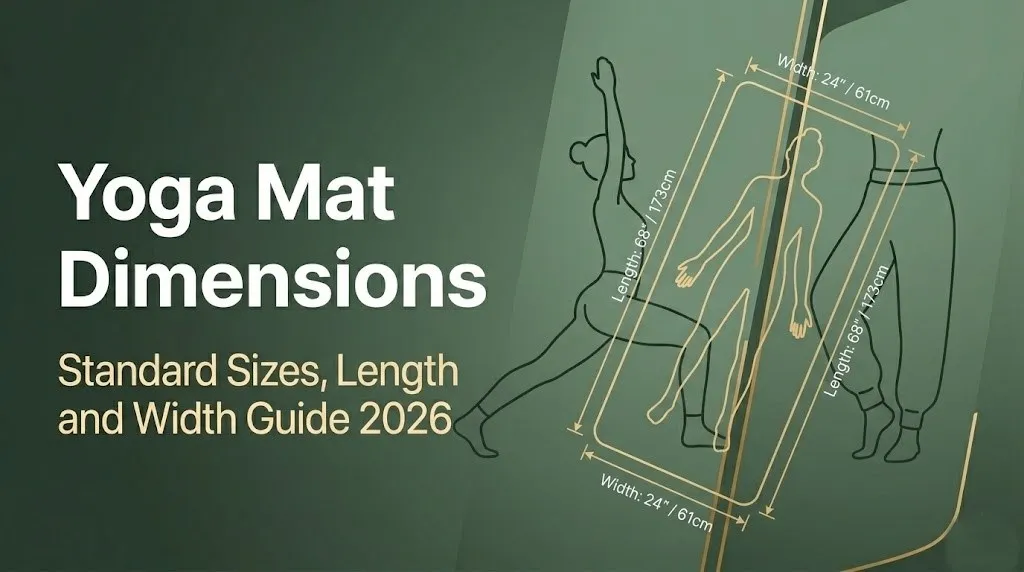
A standard yoga mat is 68 inches long (approximately 173 centimeters) and 24 inches wide (approximately 61 centimeters). These dimensions became the industry default in the late 20th century and remain the most widely produced size across all mat materials and brands.
The 68×24 inch standard was not established by a governing body or safety organization. It emerged organically from early yoga equipment manufacturers in the United States and Europe based on average adult body dimensions at the time. Yoga Alliance recognizes this as the conventional starting point for mat sizing discussions but does not mandate a specific size for registered teachers or studios.
The measurements translate cleanly into metric units. 68 inches equals 172.7 centimeters. 24 inches equals 60.9 centimeters. For practitioners in countries using the metric system, most manufacturers now list both measurements on product labels.
| Measurement | Inches | Centimeters | Feet |
|---|---|---|---|
| Standard length | 68 in | 173 cm | 5 ft 8 in |
| Standard width | 24 in | 61 cm | 2 ft |
| Extra long length | 72-84 in | 183-213 cm | 6-7 ft |
| Wide mat width | 26-36 in | 66-91 cm | 2 ft 2 in to 3 ft |
| Travel mat length | 60-68 in | 152-173 cm | 5-5 ft 8 in |
This standard size works well for practitioners up to approximately 5 feet 8 inches (173 cm) tall doing most yoga styles. Taller practitioners, those with wider builds, or people doing styles that involve large lateral arm movements frequently find the standard size limiting.
How Long Is a Yoga Mat
Most yoga mats are 68 inches long, which is equivalent to 5 feet 8 inches or approximately 173 centimeters. This is the most common length across all price points, brands, and materials.
The length of 68 inches was designed to accommodate the average adult lying flat in Savasana (Corpse Pose) with a few inches of clearance above the crown of the head. However, yoga teachers and physical therapists generally recommend at least 6 inches of clearance beyond the top of the head in Savasana to allow full spinal decompression without the sensation of being constrained by the mat edge.
For a practitioner who is exactly 68 inches tall, a standard 68-inch mat provides zero clearance above the crown. In practice, this means the heels hang off one end during Savasana or the head has no buffer at the other. This is a common complaint from practitioners in the 5’8″ to 5’10” range.
Length also matters during standing forward folds. In Uttanasana (Standing Forward Fold), the hands reach toward the mat in front of the feet. The mat needs to be long enough that both the feet and the fingertips remain on the surface simultaneously. For taller practitioners, this requires more length than the standard provides.
- Average adult male height in the US (approximately 5 ft 9 in): standard mat is borderline
- Average adult female height in the US (approximately 5 ft 4 in): standard mat provides comfortable clearance
- Practitioners over 6 ft tall: standard mat length is functionally insufficient for many poses
How Wide Are Yoga Mats
Standard yoga mats are 24 inches wide (61 centimeters), which accommodates most adult shoulder widths in standing poses with a small margin on each side.
Width becomes most relevant in two scenarios. The first is lateral arm-extended poses like Virabhadrasana II (Warrior II), where the arms extend parallel to the floor over the length of the mat rather than the width. In this pose, width does not constrain the arms since they extend along the mat’s long axis. The second scenario is poses like Supta Baddha Konasana (Reclined Bound Angle Pose) or wide-legged seated poses, where the knees and thighs drop outward beyond shoulder width.
A 24-inch mat accommodates average adult hip width comfortably for most seated and reclined poses. Practitioners with wider hips, those who practice with legs significantly apart, or larger-framed individuals often find the standard width causes the outer edges of the thighs or knees to hang off the mat edge.
The American Council on Exercise notes that an appropriate exercise surface should support the full range of motion for the activity being performed. In yoga terms, this means the mat width should allow the practitioner to feel fully supported in their widest lateral position without any body part hanging off the edge mid-pose.
Wide mats address this by extending to 26, 30, or 36 inches. The 30-inch wide mat is the most practical upgrade for practitioners who feel constrained by standard width without wanting the bulk of a 36-inch option.
Key Takeaway: A standard yoga mat is 68 inches long and 24 inches wide, but that size only works well for practitioners up to about 5’8″ tall doing styles that don’t require large lateral body positioning.
Yoga Mat Size in Feet and Inches
Expressed in feet and inches, a standard yoga mat measures 5 feet 8 inches long by 2 feet wide. Extra long mats run from 6 feet to 7 feet long. Wide mats range from 2 feet 2 inches to 3 feet wide.
These foot-and-inch measurements matter most when shopping in physical stores or planning a home practice space. Most yoga studio floors are measured in feet, and knowing your mat footprint in those terms helps you plan for prop placement, wall clearance, and neighbor distance in group classes.
For reference, a standard 68×24 inch mat covers exactly 11.33 square feet of floor space. An extra long mat at 84×26 inches covers approximately 15.2 square feet. A wide mat at 68×36 inches covers 17 square feet. These numbers become directly relevant when calculating how many mats fit in a home yoga room or how much floor clearance you need around the mat for arm-wide standing poses.
| Mat Type | Length (ft/in) | Width (ft/in) | Floor Area (sq ft) |
|---|---|---|---|
| Standard | 5 ft 8 in | 2 ft | 11.3 sq ft |
| Extra long (72 in) | 6 ft | 2 ft | 12 sq ft |
| Extra long (84 in) | 7 ft | 2 ft 2 in | 15.2 sq ft |
| Wide (30 in) | 5 ft 8 in | 2 ft 6 in | 14.2 sq ft |
| Travel (60 in) | 5 ft | 2 ft | 10 sq ft |
| Children’s | 4 ft | 1 ft 8 in | 6.7 sq ft |
Practitioners who practice in small apartments or shared spaces benefit from knowing the floor area of their mat in advance. A standard mat plus arm-wide clearance on each side requires approximately 6 feet of width in the practice space.
What Size Yoga Mat Should I Get
The right yoga mat size depends primarily on your height, your shoulder and hip width, and the yoga style you practice most often. For most adults under 5 feet 8 inches, a standard 68×24 inch mat is adequate. Taller practitioners, wider-framed individuals, or those doing expansive styles should consider longer or wider options.
Think of choosing a yoga mat like choosing a bed. A person who is 6 feet 2 inches tall doesn’t sleep comfortably in a twin bed, and they won’t practice comfortably on a 68-inch mat either. The mat needs to contain your full body in its longest and widest position simultaneously.
The most practical sizing rule yoga teachers use: stand on the mat, raise your arms overhead, and lie down in Savasana. Your head should have at least 4 to 6 inches of mat above the crown. Your heels should be fully on the mat with an inch or two to spare. Both conditions must be met at once.
For width, sit in a wide-legged seated position, like Upavistha Konasana (Wide-Angle Seated Pose). Both thighs should rest fully on the mat surface. If either thigh drops off the edge, the mat is too narrow for your practice.
Questions to ask before choosing:
- Are you taller than 5 feet 8 inches? If yes, consider a 72 to 84 inch mat.
- Do you have wider hips or shoulders than average? Consider a 26 to 30 inch wide mat.
- Do you practice Restorative or Yin yoga, which involves more floor-contact positions? Prioritize both length and width.
- Do you travel frequently with your mat? Consider a compact travel mat at 60 to 68 inches.
- Are you buying for a child? A dedicated children’s mat at 48 inches is the appropriate starting point.
Yoga Mat Size Guide for Beginners
Beginners should start with a standard 68×24 inch mat if they are under 5 feet 8 inches tall, or a 72×24 inch mat if they are taller. The extra length costs only slightly more and removes a common early frustration.
The National Center for Complementary and Integrative Health emphasizes that reducing early barriers to yoga practice improves long-term adoption. A mat that feels physically uncomfortable from the first session is one of those early barriers. Getting the size right before the first class matters.
Beyond length and width, beginners should pay attention to thickness. A 4 to 6 mm thick mat provides enough cushioning for knees and wrists during foundational poses without creating instability during standing balance poses. Very thin mats (1 to 2 mm) are designed for experienced practitioners who prioritize floor feel and grip. They are not ideal for beginners whose joints need more support.
Mat size guidance for beginners:
- Under 5 ft 8 in tall: Standard 68×24 in, 4-6 mm thick
- 5 ft 8 in to 6 ft tall: 72×24 in, 4-6 mm thick
- Over 6 ft tall: 84×24 in or 84×26 in, 4-6 mm thick
- Wider hip or shoulder width than average: Add a wide mat (26-30 in) regardless of height
- Joint sensitivity (knees, wrists, hips): 6 mm or thicker, regardless of body size
- Seniors beginning yoga: 68-72 in length, 6-8 mm thick, non-slip surface prioritized
Beginners do not need to spend heavily on their first mat. A well-sized mid-range mat at the right dimensions will serve a beginner’s developing practice better than an expensive mat in the wrong size.
Yoga Mat Dimensions for Tall People
Tall practitioners, generally those over 5 feet 10 inches (178 cm), need a mat longer than the standard 68 inches to practice comfortably and safely. A mat that ends at the heels during standing poses and cuts off the head during Savasana creates constant postural adjustments that disrupt concentration and alignment.
The specific problem tall practitioners encounter: in Adho Mukha Svanasana (Downward Facing Dog), the hands and feet both need to be on the mat simultaneously. The distance between a tall practitioner’s hands and feet in this pose often exceeds 68 inches, placing either the hands or feet on bare floor. Floor contact outside the mat in this pose means less grip and a higher slip risk, particularly on smooth hardwood or tile studio floors.
According to yoga teachers and physical therapists who work with tall clients, a mat of at least 72 inches (6 feet) is the minimum recommendation for practitioners between 5 feet 10 inches and 6 feet 2 inches. Practitioners over 6 feet 2 inches typically need an 84-inch (7-foot) mat to practice without body parts extending beyond the mat edge in common poses.
| Height Range | Recommended Mat Length | Recommended Mat Width |
|---|---|---|
| Under 5 ft 4 in | 68 in (standard) | 24 in (standard) |
| 5 ft 4 in to 5 ft 8 in | 68 in (standard) | 24-26 in |
| 5 ft 8 in to 5 ft 10 in | 68-72 in | 24-26 in |
| 5 ft 10 in to 6 ft 2 in | 72 in | 24-26 in |
| Over 6 ft 2 in | 84 in | 24-26 in |
Tall practitioners should also confirm width needs independently of length. Being tall does not automatically mean being wide. Assess shoulder width and hip width separately when choosing mat dimensions.
Key Takeaway: Tall practitioners (over 5’10”) need at minimum a 72-inch mat; those over 6’2″ need 84 inches to keep hands and feet on the mat simultaneously in poses like Downward Facing Dog.
Extra Long Yoga Mat Dimensions
Extra long yoga mats come in two primary lengths: 72 inches (6 feet) and 84 inches (7 feet). Some specialty manufacturers produce mats at 80 inches (6 feet 8 inches), though this length is less common and harder to find.
The 72-inch mat is the most practical upgrade from standard. It adds 4 inches of length, enough to give a practitioner up to 5 feet 11 inches comfortable clearance in Savasana and standing forward folds. The 84-inch mat is the choice for practitioners over 6 feet 2 inches or anyone who wants generous clearance in all poses without exception.
Extra long mats typically weigh more and roll into a larger bundle than standard mats. This affects portability. An extra long natural rubber mat at 84 inches can weigh 6 to 9 pounds, compared to a standard PVC mat at approximately 2.5 to 3 pounds. If you commute to a studio by public transit, this weight difference matters considerably.
Key facts about extra long yoga mat dimensions:
- 72-inch mat: Best for practitioners 5’10” to 6’2″. Most widely available extra long option.
- 84-inch mat: Best for practitioners over 6’2″. Less widely available. Often costs 20-40% more than standard.
- Width options: Extra long mats typically come in standard 24-inch width. Some brands offer 26-inch wide versions of their extra long mats.
- Weight consideration: Extra length adds approximately 0.5 to 1 pound per additional foot of mat length, depending on material.
- Storage: An 84-inch rolled mat is approximately 7 inches taller than a standard rolled mat when stored upright.
Extra long mats are also a practical choice for practitioners who use their mat for both yoga and supplementary floor stretching, foam rolling, or Pilates mat work, where the additional length accommodates full body positions not common in yoga alone.
Wide Yoga Mat Dimensions
Wide yoga mats typically measure 26 to 36 inches across, with 30 inches being the most popular option for practitioners who need more lateral room without a bulky mat.
Width needs are most commonly underestimated when purchasing a first mat. Practitioners often focus on length because height is an obvious measurement. Width is more subtle. You don’t notice the constraint until you’re in a reclined pose with your knees dropping outward and one knee hits bare floor.
A study published in the International Journal of Yoga has confirmed that physical comfort during yoga practice directly affects practitioners’ ability to maintain focus and proper alignment. A mat that doesn’t fully support the body in lateral positions creates low-level physical discomfort that compounds across an entire session.
The practical width check: lie on your back on the mat. Let your arms fall out to a 45-degree angle from your body. Do your elbows remain on the mat? Then bend your knees, let them fall outward in Supta Baddha Konasana (Reclined Bound Angle Pose). Do both knees touch the mat? If either check fails, a wider mat will meaningfully improve your floor practice.
| Wide Mat Width | Best For | Trade-off |
|---|---|---|
| 26 in | Slightly wider frames, minor upgrade from standard | Minimal extra bulk |
| 30 in | Plus-size practitioners, Restorative yoga | Moderate bulk, heavier to carry |
| 36 in | Larger body frames, Pilates mat work combined | Heavy, not designed for studio commuting |
Wide mats at 30 to 36 inches are particularly valuable for Restorative yoga and Yin yoga, where practitioners spend extended time in supine and reclined positions with the body fully supported by the mat surface.
Travel Yoga Mat Dimensions and Size
Travel yoga mats are typically 60 to 68 inches long, 24 inches wide, and significantly thinner than standard mats, ranging from 1 to 2 mm thick compared to the standard 4 to 6 mm.
The reduced thickness is the primary design trade-off. A 1.5 mm travel mat folds flat rather than rolling into a cylinder, and some designs fold small enough to fit inside a regular backpack or checked luggage without taking up dedicated space. This portability comes at a cost to joint cushioning.
Travel mats are appropriate for practitioners who:
- Already have a regular mat at their destination (hotel gym, studio)
- Practice primarily standing sequences with minimal kneeling or wrist-bearing poses
- Have no joint sensitivity in the wrists, knees, or hips
- Need a mat for occasional travel, not as a primary daily practice mat
Travel mats are not recommended as the only mat for practitioners with wrist sensitivity, knee concerns, or any condition where joint cushioning is a factor in safe practice. A physical therapist working with someone managing carpal tunnel syndrome, for example, would generally advise against thin travel mats for regular Vinyasa or Ashtanga practice.
Dimensions to look for in a travel mat:
- Length: minimum 60 inches for practitioners under 5’6″. At least 68 inches if you’re taller.
- Width: standard 24 inches is fine for most. Look for non-slip grip texture to compensate for the thin profile.
- Folded size: under 12×12 inches is the benchmark for true backpack portability.
- Weight: under 2 pounds is the benchmark for true travel portability.
Key Takeaway: Travel mats sacrifice joint cushioning for portability. They work well as a supplement to your regular mat but shouldn’t be your only mat if you practice kneeling poses or have any wrist or knee sensitivity.
Children’s Yoga Mat Size
A children’s yoga mat is typically 48 to 60 inches long (4 to 5 feet) and 24 inches wide, with thickness ranging from 3 to 5 mm to balance cushioning needs with the lighter bodyweight of young practitioners.
Children’s mats are proportioned for smaller bodies, typically fitting children aged 3 to 10 years. A child practicing on a full adult 68-inch mat can lose spatial awareness of their mat edges, which affects the development of their body-space relationship during foundational poses. A correctly sized mat gives children a clear physical boundary that supports pose learning.
The Yoga Alliance has noted the growth of children’s yoga programs as part of broader school wellness and mindfulness initiatives. Age-appropriate equipment, including correctly sized mats, is part of creating an accessible practice environment for young practitioners.
Children’s mat considerations:
- Ages 3-5: 48-inch length, bright non-toxic materials, lightweight (under 1.5 lb)
- Ages 6-10: 54-60 inch length, more durable material, standard 24-inch width
- Ages 10+: Adult standard mat (68 in) is appropriate for most children over 10
- Material: Look for phthalate-free, non-toxic materials. Children’s skin contact time with mats is high.
- Grip: Children’s mats should prioritize grip texture. Young practitioners are still developing balance and proprioception.
Parents choosing mats for children should avoid very thin mats. Children’s developing joints benefit from at least 4 mm of cushioning during kneeling and seated poses. A mat that is too thin for an adult is not automatically appropriate for a child.
Yoga Mat Size for Specific Yoga Styles
Different yoga styles create meaningfully different demands on mat dimensions. The right mat size for Bikram/26&2 yoga differs from what works best for Yin yoga, and both differ from Ashtanga or Restorative yoga.
In Vinyasa yoga and Ashtanga, the practice involves continuous transitions between standing, kneeling, and prone positions. The mat needs to be long enough for a tall stance lunge while keeping both hands planted, and wide enough that the knees don’t slide off during Balasana (Child’s Pose). A 72-inch length and 24-inch width serves most Vinyasa practitioners well.
In Yin yoga and Restorative yoga, practitioners spend 3 to 10 minutes in each pose, most of which involve the full body lying on the mat. Width matters as much as length here. A wider mat (26 to 30 inches) meaningfully improves the experience of long passive holds.
In Bikram/26&2 yoga, the 26-posture sequence is fixed. Most postures are standing or prone with limited lateral spread. A standard 68×24 inch mat works adequately for practitioners under 5’8″. The heated room means the mat also needs to handle significant moisture, making material choice (beyond dimensions) critical.
| Yoga Style | Priority Mat Dimension | Recommended Size |
|---|---|---|
| Vinyasa / Ashtanga | Length | 72×24 in for most; 84×24 in for tall |
| Yin / Restorative | Width and length equally | 68-72×26-30 in |
| Bikram/26&2 | Standard sufficient; material critical | 68×24 in |
| Hatha | Standard sufficient for most | 68×24 in |
| Iyengar | Length and stability | 68-72×24 in; non-slip surface essential |
| Kundalini | Standard sufficient | 68×24 in |
| Chair yoga / Senior yoga | Thickness and non-slip surface | 68×24 in, 6-8 mm thick |
| Prenatal yoga | Width and cushioning | 68×26-30 in, 6 mm thick |
Iyengar yoga practitioners should pay particular attention to non-slip mat surfaces. Iyengar practice involves precision alignment and extended holds in standing poses where grip stability directly affects alignment quality and safety.
How Much Space Do You Need for Yoga at Home
A home yoga practice requires more floor space than just the yoga mat itself. A standard 68×24 inch mat sits within a minimum recommended practice space of 6 feet wide by 7 feet long, which allows arm extension in all directions without hitting walls or furniture.
Think of the mat as the center of a safety bubble. In Virabhadrasana II (Warrior II), both arms extend horizontally along the length of the mat. The rear arm extends beyond the mat’s back edge by 1 to 2 feet, depending on arm length. In Trikonasana (Triangle Pose), the top arm extends straight overhead while the bottom arm reaches toward the floor. These extensions require clear space beyond the mat perimeter on every side.
The American College of Sports Medicine recommends that exercise spaces allow for full range of motion in all planes without obstruction. For yoga specifically, this means planning not just for the mat footprint but for the full body movement radius around the mat.
Minimum home yoga space planning guide:
- Behind the mat: 2 feet minimum for the rear arm in Warrior II and backward steps in lunge sequences
- In front of the mat: 1 to 2 feet for forward reach in standing poses and arm extension in forward folds
- To each side of the mat: 2 feet for arm extension in lateral poses and side planks
- Above the mat: 8-foot ceiling minimum for poses with arms fully raised overhead; some tall practitioners need more
- Total recommended floor area: 6 feet wide by 8 feet long as a practical minimum
Home practitioners using props should account for additional space. A bolster placed lengthwise alongside the mat adds another 27 inches (standard bolster length) to the required space. Blocks positioned at the head and sides of the mat need another 12 to 18 inches of clear space.
Key Takeaway: Your yoga mat footprint is just the starting point. Plan for at least 6 feet of width and 7 to 8 feet of length in your practice space to allow full arm extension in standing poses without restriction.
Yoga Mat Thickness and How It Relates to Size Choice
Yoga mat thickness is measured in millimeters and ranges from 1 mm (travel mats) to 8 mm or more (extra-thick cushion mats). Thickness affects joint support, stability, and portability, but it also interacts with your mat size choice in specific ways.
A thicker mat adds volume when rolled. An 84-inch mat at 8 mm thick rolls into a substantially larger bundle than the same mat at 4 mm. If you carry your mat to a studio, thickness affects practical portability as much as length does. A 6 mm mat at 72 inches is often the best balance of cushioning, length, and carry-ability for commuting practitioners.
Thickness and size interact most directly for seniors and practitioners with joint concerns. According to the American Council on Exercise, joint protection during exercise depends on both the surface cushioning and the surface stability. A mat that is too thick becomes unstable underfoot during single-leg balance poses like Vrksasana (Tree Pose). Most yoga teachers and physical therapists recommend a maximum of 6 mm for standing balance work, reserving thicker mats for practitioners who do primarily seated or reclined practice.
Thickness recommendations by practice need:
- 1-2 mm: Travel only. Minimal cushioning. Not for kneeling or wrist-bearing work.
- 3 mm: Lightweight but low cushioning. Better for experienced practitioners with no joint sensitivity.
- 4-5 mm: Standard cushioning. Good all-purpose choice for most yoga styles.
- 6 mm: Enhanced cushioning. Best for beginners, seniors, and practitioners with knee or wrist sensitivity.
- 8 mm+: Maximum cushioning. Best for chair yoga, primarily floor-based practice, or post-injury rehab situations. Consult a physical therapist about appropriate thickness if recovering from a lower limb or wrist injury before resuming practice.
How to Measure If a Yoga Mat Is the Right Size for You
The most reliable way to measure if a yoga mat fits you correctly is to perform a three-part physical check before committing to a mat. This takes about 90 seconds and removes all guesswork from the sizing decision.
These checks work in a store, at a studio, or when testing a mat you already own. They replicate the actual demands yoga places on mat dimensions.
To check if a yoga mat is the right size for you:
- Savasana test: Lie flat on your back on the mat. Let your heels relax. Look straight up. You should have at least 4 to 6 inches of mat above the crown of your head. Your heels should be fully on the mat surface. If either condition fails, the mat is too short.
- Downward Dog test: Come into Adho Mukha Svanasana (Downward Facing Dog). Both hands and both feet must be completely on the mat surface. If your fingers or heels hang off the edge, the mat is too short for your body’s standing reach.
- Wide-seated test: Sit cross-legged, then extend into a wide-legged seated position. Both outer thighs should rest on the mat. If either thigh drops off the mat edge, the mat is too narrow.
Quick Summary:
- Savasana: 4 to 6 inches of mat above the crown of your head
- Downward Dog: all four contact points (two hands, two feet) fully on the mat
- Wide-seated: both outer thighs fully supported on the mat surface
- If you fail any check, move to the next size up in that dimension
- Retest after selecting the larger size before purchasing
For online purchases, use your height and the chart in the “Yoga Mat Dimensions for Tall People” section of this guide to pre-select the correct length. For width, measure your hip width and add 4 to 6 inches. Compare that number to the mat’s width specification before ordering.
Frequently Asked Questions About Yoga Mat Dimensions
What are the dimensions of a standard yoga mat?
A standard yoga mat measures 68 inches long and 24 inches wide, which equals approximately 173 centimeters by 61 centimeters.
This size suits most adults under 5 feet 8 inches tall doing standard yoga styles.
Longer and wider options are available for taller practitioners, wider body frames, or styles requiring more floor contact.
How long should a yoga mat be for my height?
Your yoga mat should be at least 6 inches longer than your height to allow proper clearance during Savasana and standing forward folds.
Practitioners under 5’8″ fit well on a standard 68-inch mat; those between 5’8″ and 6’2″ should choose a 72-inch mat.
Practitioners over 6’2″ need an 84-inch mat to keep hands and feet on the mat simultaneously in poses like Downward Facing Dog.
What size yoga mat is best for beginners?
Beginners should start with a 68×24 inch mat at 4 to 6 mm thick if they are under 5’8″ tall.
Taller beginners should choose a 72×24 inch mat to avoid the common frustration of hands or heels hanging off the mat edge.
Thickness of at least 4 mm is recommended for beginners to protect knees and wrists during foundational poses.
How wide are most yoga mats?
Most yoga mats are 24 inches wide (61 centimeters), which is the industry standard width.
Wide mats are available at 26, 30, and 36 inches for practitioners who need more lateral support in reclined or wide-legged positions.
A 30-inch wide mat is the most practical upgrade for practitioners who feel their thighs or knees drop off the mat edge during floor poses.
Do I need an extra long yoga mat?
You need an extra long yoga mat if you are taller than approximately 5 feet 10 inches or if your hands and feet cannot both rest on the mat during Downward Facing Dog.
A 72-inch mat serves most tall practitioners well; an 84-inch mat is best for those over 6 feet 2 inches.
Extra long mats are heavier and less portable than standard mats, so confirm the longer size is genuinely needed before purchasing.
Getting the Size Right the First Time
Standard measurements give you a starting point, not a final answer. Your body dimensions, your yoga style, and your practice space all shape which mat size actually works. The three-part physical check, Savasana clearance, Downward Dog contact, and wide-seated support, gives you reliable confirmation that no size chart alone can provide.
If you’re buying online, use your height as the primary filter. Then check your hip width for the secondary width decision. Standard beats travel for daily practice. Extra long beats standard if you’ve ever felt your heels hanging off the mat.
Buy the right size once and practice without distraction from day one