Yoga Saratoga Springs NY: Top Classes and Studios 2026
Yoga in Saratoga Springs, NY is more available than most newcomers expect, with studios offering styles ranging from heated power flows to gentle restorative sessions suitable for first-timers and seniors alike. Whether you are stepping onto a mat for the first time or returning to yoga after a long break, this city has a class that fits where your body is right now.
Saratoga Springs has a strong wellness culture rooted in its mineral springs history and its identity as an athletic hub. According to the National Center for Complementary and Integrative Health, yoga is now one of the three most commonly practiced complementary health approaches in the United States, used by roughly 21 million adults for physical and mental health reasons.
This guide covers every key decision you will face as a yoga student in Saratoga Springs. You will learn which style suits your goals, what to expect in a first class, which options serve seniors and people managing pain, and what the research says about yoga’s real benefits.
Yoga in Saratoga Springs NY: What Makes This City a Great Place to Practice
Saratoga Springs is one of upstate New York’s most wellness-oriented communities, and that creates genuinely good conditions for yoga students at every level. The city’s history with mineral spring bathing, its role as a destination for thoroughbred racing athletes, and its active arts and cultural scene have all contributed to a local population that takes physical and mental wellbeing seriously.
That translates into something practical for yoga students: studios here tend to attract experienced, caring teachers, and the community around classes tends to be welcoming rather than competitive. You are unlikely to walk into a studio and feel judged for using props or for modifying a pose.
The wellness infrastructure in Saratoga Springs also means yoga often shows up in settings beyond dedicated studios. Gyms, community centers, hospital wellness programs, and seasonal outdoor events frequently include yoga classes as part of a broader offering.
The city’s athletic identity matters too. Many students here practice yoga as a complement to running, cycling, swimming, or equestrian sport. That means you are as likely to find a class designed for athletic recovery as one focused on slow, meditative movement.
Pose Tip:
- If you are brand new, look for classes explicitly labeled “beginner,” “level 1,” or “all levels.” These are not just marketing words. They signal that the teacher plans for students who do not know pose names yet.
- Ask studios if teachers circulate and offer hands-on adjustments, or if they primarily teach verbally. Both styles work, but knowing which to expect helps you relax.
- Community classes offered at parks or public venues in Saratoga Springs are often donation-based and a low-pressure way to experience yoga before committing to a studio membership.
Yoga Studios in Saratoga Springs: What to Look for Before You Choose
Choosing a yoga studio in Saratoga Springs means matching what the studio offers to what your body, schedule, and comfort level actually need. Not every studio is right for every student, and that is by design.
Before you book a class, check whether the studio lists its teachers’ credentials and training hours. Yoga Alliance, the primary accrediting organization for yoga teachers in the United States, sets standards for 200-hour and 500-hour registered teacher certifications. A teacher with an RYT-200 or RYT-500 designation has completed verified training. This matters for safety, especially if you are managing a health condition or recovering from injury.
Class size also matters more than most beginners realize. Smaller classes give teachers more opportunity to notice misalignment, offer you a modification, or simply acknowledge that you exist. A class of eight students is a fundamentally different experience than one of thirty.
Trial class policies vary widely. Many Saratoga Springs studios offer a first class free or a discounted introductory week. Use that offer. No website description of a studio’s “vibe” is a substitute for spending thirty minutes in the actual room with the actual teacher.
| What to Check | Why It Matters | What to Look For |
|---|---|---|
| Teacher credentials | Safety and instructional quality | RYT-200 or RYT-500 from Yoga Alliance |
| Class size | Attention and modification options | Under 15 students for beginners |
| Style offered | Matches your body and goals | Hatha or Restorative for new students |
| Trial policy | Low-risk way to evaluate fit | Free first class or intro week discount |
| Schedule | Consistency builds habit | Multiple time slots per week |
| Props available | Accessibility for all body types | Blocks, straps, bolsters, blankets on site |
Yoga Classes in Saratoga Springs NY for Beginners
Beginner yoga classes in Saratoga Springs are specifically structured to teach foundational poses, breathing, and studio etiquette without assuming any prior knowledge. The right beginner class should feel like being welcomed, not sorted.
What makes a class genuinely beginner-friendly is not just the label. It is the pacing. A good beginner class introduces one pose at a time, explains alignment in plain language, and leaves pauses for students to actually feel what is being described before moving on.
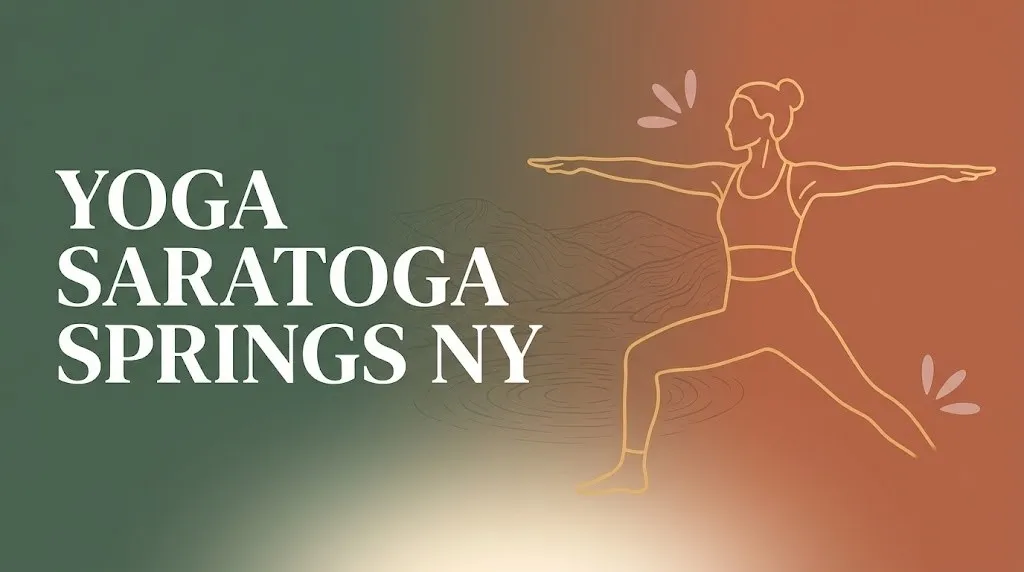
Look for classes that run between 60 and 75 minutes. Shorter classes sometimes rush through setup and cool-down, which are often the most important parts for a new student’s nervous system and body awareness. Classes that run 90 minutes can feel overwhelming at first.
According to the American College of Sports Medicine, new practitioners benefit most from classes that prioritize body awareness and breath coordination before adding strength or flexibility demands. That recommendation aligns with what most experienced yoga teachers advise: start with Hatha yoga or clearly labeled beginner Vinyasa before exploring more physically demanding styles.
- Arrive 10 to 15 minutes early for your first class. You will need time to find props, choose a spot, and speak briefly with the teacher.
- Tell the teacher before class if you have any injuries, chronic pain, recent surgery, or specific concerns. A 30-second conversation can prevent a painful experience.
- You do not have to touch your toes. You do not have to be flexible. Flexibility is a result of yoga practice, not a requirement to begin it.
Yoga Styles Explained: Hatha, Vinyasa, Yin, and Restorative
The four styles most commonly found in Saratoga Springs studios each serve a different purpose, work the body differently, and suit different students at different times. Choosing the wrong style is the most common reason beginners quit after one class.
Hatha yoga is the broadest category. It generally refers to a slower-paced class that holds poses for several breaths and emphasizes alignment over flow. Most beginner classes are Hatha-based. If a class is simply labeled “yoga” without a style modifier, it is likely Hatha-influenced.
Vinyasa yoga links poses together through breath-directed movement. Inhale lifts you into a pose; exhale carries you to the next. It is more physically demanding than Hatha because the body rarely rests. Beginners can take Vinyasa classes, but look for ones labeled “slow flow” or “level 1 Vinyasa” first.
Yin yoga holds poses for two to five minutes, targeting deep connective tissue, fascia, and joints rather than muscles. It is profoundly still and sometimes uncomfortable in a productive way. Think of tight hip flexors held in a long stretch until they slowly release. Yin is appropriate for beginners, but the extended holds can feel mentally challenging if you are not prepared for stillness.
Restorative yoga uses props to fully support the body in passive shapes. There is no muscular effort. The goal is nervous system downregulation. The American College of Sports Medicine notes that restorative practices activate the parasympathetic nervous system, reducing cortisol and heart rate more consistently than passive rest alone.
| Style | Pace | Physical Demand | Best For | Props Used |
|---|---|---|---|---|
| Hatha | Slow to moderate | Low to moderate | Beginners, all ages | Mat, blocks, straps |
| Vinyasa | Moderate to fast | Moderate to high | Active adults, cross-training | Mat, occasionally blocks |
| Yin | Very slow | Low physically, high mentally | Flexibility, joint health, stress | Blocks, bolsters, blankets |
| Restorative | Stillness | Very low | Illness recovery, nervous system, sleep | Bolsters, blankets, eye pillows |
Hot Yoga in Saratoga Springs: What You Need to Know
Hot yoga refers to any yoga class practiced in a heated room, typically between 85 and 105 degrees Fahrenheit with added humidity. Bikram yoga, also called 26 and 2 yoga, is the most well-known structured hot yoga format, using a fixed sequence of 26 poses in a 105-degree room. Other studios use the heat format with non-Bikram sequences.
The heat increases circulation, allows muscles to release tension more readily, and creates significant cardiovascular demand. It is not automatically harder or better than unheated yoga. It is simply a different physiological experience.
People with cardiovascular conditions, high blood pressure, a history of heat-related illness, or any condition that impairs thermoregulation should speak with their cardiologist or primary care physician before attempting hot yoga. The heat is the variable that changes the risk profile significantly.
For healthy beginners trying hot yoga in Saratoga Springs for the first time, the practical rules are straightforward:
- Drink at least 16 ounces of water two hours before class, and bring a full water bottle.
- Eat a light meal no less than two hours before class. A full stomach in extreme heat causes nausea in most people.
- Sit or lie down on your mat if you feel dizzy. Leaving the room briefly is always the right choice over pushing through lightheadedness.
- Expect to sweat significantly more than in any unheated class. Bring a large towel and a change of clothes.
A study published in the International Journal of Yoga found that participants in heated yoga sessions showed measurable improvements in flexibility compared to non-heated sessions of equal length, though cardiovascular stress was also higher. That trade-off is worth understanding before you commit to a heated format.
What to Expect at Your First Yoga Class
Your first yoga class in Saratoga Springs will likely feel unfamiliar, slightly awkward, and also surprisingly manageable, especially if you go in knowing what actually happens.
Classes typically begin with a few minutes of settling in: lying down, sitting quietly, or beginning simple breath awareness. The teacher will often ask students to set an intention or simply arrive mentally. This is not mandatory spiritual participation. It is a practical transition from the noise of your day to the focus of practice.
The body of the class moves through a sequence of poses. In a beginner Hatha class, you might hold eight to twelve poses total, spending several breaths in each. In a Vinyasa class, the poses link continuously and the count is harder to track. The class ends with Savasana (Corpse Pose), a five- to ten-minute period of complete stillness. Most teachers and students consider this the most important part of the class. Do not leave early.
Key Takeaway: Choosing the right yoga style before your first class matters as much as choosing the right studio. Hatha and Restorative are the lowest-barrier entry points for new students and people managing health conditions.
Pose Tip:
- You do not have to know pose names. When the teacher demonstrates, watch and copy the shape. Verbal cues and demonstrations happen simultaneously in every well-taught class.
- If you are in the wrong position, the teacher will not embarrass you. They will walk over, offer a gentle verbal cue or light hands-on adjustment, and move on.
- Child’s Pose (Balasana) is your built-in rest button. You can take it at any point during class, for any reason, without explanation.
Yoga for Beginners: Poses and Sequences to Start With
The best starting poses for yoga beginners are ones that teach body awareness, introduce foundational alignment principles, and build functional strength without requiring pre-existing flexibility. You do not need to be flexible to start. The poses build flexibility over time.
These five poses appear in nearly every beginner class and form the backbone of a home practice you can start this week:
- Stand at the top of your mat in Tadasana (Mountain Pose). Feet hip-distance apart, weight even across both feet. Stack your hips over your ankles and your shoulders over your hips. Breathe here for five counts.
- From Tadasana, hinge at your hips and fold forward into Uttanasana (Standing Forward Bend). Bend your knees generously. Let your head hang heavy. Hold for five breaths. Modification: place hands on blocks or shins.
- From the floor, come to hands and knees (Table Top). Press your hands firmly, spread your fingers, and lift your hips into Adho Mukha Svanasana (Downward-Facing Dog). Bend your knees if needed. Hold for five breaths. Modification: keep knees bent throughout, or use fists instead of flat palms for wrist comfort.
- From Table Top, lower your hips toward your heels in Balasana (Child’s Pose). Arms extend forward or rest alongside the body. Hold for five to ten breaths. Modification: place a folded blanket between your thighs and calves if knees are uncomfortable.
- Lie on your back. Press your feet into the mat and lift your hips in Setu Bandha Sarvangasana (Bridge Pose). Hold for five breaths, then lower slowly. Modification: place a block under your sacrum for supported bridge.
Finish with two minutes of Savasana (Corpse Pose): lie flat, eyes closed, arms slightly away from the body, palms up. Let the nervous system integrate the practice.
Yoga for Seniors in Saratoga Springs
Yoga for seniors in Saratoga Springs is widely available and genuinely well-suited to older adults, particularly because many local studios and community centers offer classes explicitly designed for aging bodies. The goal is not to achieve complex poses. It is to maintain mobility, reduce fall risk, support joint health, and sustain the kind of functional strength that makes daily life easier.
According to the National Center for Complementary and Integrative Health, research supports yoga as an effective practice for older adults managing osteoarthritis, chronic lower back pain, and balance-related fall risk. Studies indicate that consistent yoga practice over eight to twelve weeks improves balance scores and reduces fear of falling in adults over 65.
The best yoga styles for seniors are Hatha yoga, Restorative yoga, and Chair yoga. All three can be practiced with significant modifications, require no prior yoga experience, and are low-impact enough to accommodate common age-related conditions including osteoporosis, arthritis, reduced range of motion, and chronic pain.
| Age-Related Concern | Recommended Style | Key Benefit | Modification Focus |
|---|---|---|---|
| Reduced balance | Hatha or Chair Yoga | Proprioceptive training | Wall support, chair as prop |
| Arthritis in hands/wrists | Restorative Yoga | Low weight-bearing | Fists or forearms instead of palms |
| Osteoporosis | Gentle Hatha | Bone loading in safe range | Avoid deep spinal flexion poses |
| Chronic lower back pain | Yin or Restorative | Fascia and muscle release | Supported Bridge, Reclined poses |
| Sleep disruption | Restorative or Yin | Parasympathetic activation | Evening class or bedtime sequence |
Chair Yoga in Saratoga Springs NY
Chair yoga is a complete yoga practice adapted so that most or all poses are performed while seated in or standing beside a standard chair. It is not a simplified or lesser version of yoga. It is a purposeful adaptation that makes the full benefits of yoga accessible to people who cannot comfortably sit on the floor, kneel, or bear weight on their hands and wrists.
Chair yoga is particularly appropriate for seniors, people recovering from surgery, individuals with neurological conditions, anyone managing severe arthritis, and people in workplace settings who want movement breaks without changing clothes or unrolling a mat.
According to a study published in the Journal of Alternative and Complementary Medicine, chair yoga participants over the age of 65 showed statistically meaningful reductions in pain intensity and fatigue after an eight-week chair yoga program compared to control groups receiving health education only.
To practice a basic seated version of Virabhadrasana II (Warrior II) in a chair:
- Sit sideways on the chair with your right hip facing the back of the chair. Place your right foot flat on the floor, toes pointing toward the chair back.
- Extend your left leg out to the side, foot flat on the floor if possible, or resting on the toes.
- Open your arms wide: right arm reaching toward the chair back, left arm reaching behind you.
- Turn your gaze over your right hand. Hold for three to five breaths.
- Release and repeat on the other side.
Modification: If your hips are tight or one leg does not reach easily, shorten your stance width and keep both feet parallel.
Key Takeaway: Yoga for seniors and chair yoga are not compromises. They are intentional adaptations that produce measurable benefits including improved balance, reduced pain, and better sleep in adults over 65.
Yoga for Back Pain and Injury Recovery
Yoga is one of the most well-researched complementary approaches for chronic lower back pain, and it is frequently used as part of physical therapy protocols and post-surgical recovery programs across the country. The key is using the right poses, at the right intensity, with appropriate modifications.
The Spine Journal published research showing that yoga-based interventions for non-specific chronic lower back pain produced improvements in pain intensity and functional disability comparable to standard physical therapy over twelve weeks. That does not mean yoga replaces physical therapy. It means the two approaches often work well together.
Poses that are generally well-tolerated for lower back pain include Balasana (Child’s Pose), Setu Bandha Sarvangasana (Bridge Pose), Supta Baddha Konasana (Reclined Bound Angle Pose), and gentle spinal twists performed while lying on the back. Poses that require significant spinal flexion or forward folding under load, such as Uttanasana (Standing Forward Bend) with a flat back, should be approached cautiously and with a teacher’s guidance if you have disc involvement or sciatic symptoms.
If you are recovering from surgery or a specific orthopedic injury, your surgeon or physical therapist should confirm that yoga is appropriate before you begin. Ask them specifically: which movement directions are restricted, how much weight-bearing on my hands and knees is safe, and are there any poses to avoid entirely. A yoga teacher with a specialty in therapeutic yoga can work directly from those restrictions.
- Avoid: deep backbends, inversions, and poses that require strong core engagement immediately post-abdominal surgery
- Approach carefully: any pose that compresses the lower spine or requires extreme hip flexion if you have hip replacement hardware
- Start with: Restorative yoga or a one-on-one private session with a teacher trained in yoga therapy
Yoga for Runners and Athletes in Saratoga Springs
Saratoga Springs has a significant athletic community, particularly around running, cycling, and equestrian sport. Yoga functions as a highly effective cross-training tool for all of these disciplines, targeting the specific tight or overworked muscle groups that repetitive athletic movement creates.
Runners, specifically, develop predictable tightness patterns. The hip flexors (particularly the iliopsoas) shorten from repeated hip flexion. The hamstrings develop tension and sometimes microtears. The IT band (iliotibial band) and the piriformis become overactive to compensate for weak glutes. The thoracic spine stiffens from forward-leaning running posture.
Think of a runner’s hip flexors like a rubber band that has been held in the same shortened position for thousands of repetitions. Yoga does not just stretch the band. It teaches the nervous system to release the tension it has been holding habitually.
According to the American College of Sports Medicine, flexibility training that includes sustained holds (as in Yin yoga) and active mobility work (as in Vinyasa or Hatha yoga) both contribute to reduced injury rates and improved recovery times in endurance athletes when practiced two to three times per week.
| Athletic Need | Yoga Style to Use | Key Poses | Target Tissue |
|---|---|---|---|
| Hip flexor tightness | Yin or Hatha | Low Lunge, Pigeon Pose | Iliopsoas, rectus femoris |
| Hamstring tightness | Yin or Restorative | Seated Forward Fold, Supported Forward Fold | Hamstring group |
| IT band tension | Yin | Supine Twist, Thread the Needle | TFL, IT band |
| Thoracic stiffness | Hatha or Vinyasa | Camel Pose, Cobra Pose | Thoracic extensors |
| Post-race recovery | Restorative | Legs Up the Wall, Supported Bridge | Full body, nervous system |
Yoga for Stress, Anxiety, and Sleep
Yoga is one of the few physical practices with a direct and well-documented mechanism for reducing psychological stress, and the mechanism is physiological, not philosophical. Slow, breath-focused movement activates the parasympathetic nervous system, sometimes called the “rest and digest” system, which counteracts the stress response driven by the sympathetic nervous system.
The ujjayi breath (victorious breath) used in many Hatha and Vinyasa classes creates slight resistance at the back of the throat during inhalation and exhalation. This extended, controlled breathing pattern lengthens the exhalation, which specifically signals the vagus nerve to downregulate the stress response. Research published in the International Journal of Yoga found that ujjayi-based pranayama practice reduced self-reported anxiety scores in participants after six weeks of twice-weekly practice.
For sleep, Restorative yoga practiced within two to three hours of bedtime shows particularly consistent results. A sequence as simple as five minutes in Supta Baddha Konasana (Reclined Bound Angle Pose), five minutes in Viparita Karani (Legs Up the Wall), and five minutes of Savasana (Corpse Pose) is enough to measurably reduce heart rate and lower cortisol levels in most adults.
For anxiety specifically, the style matters. High-intensity heated yoga can temporarily elevate cortisol for anxious nervous systems that are already in a heightened state. Yin yoga and Restorative yoga are the safer entry points for anxiety management, particularly for students who find that faster movement classes feel stimulating rather than calming.
Key Takeaway: For stress and anxiety, the breath is as important as the movement. Yin and Restorative yoga styles with extended exhalation breathing are more effective than heated or high-intensity classes for nervous system regulation.
Yoga Benefits: What Research Actually Says
The research base behind yoga’s health benefits has grown considerably in the past decade, and it is now possible to make specific, evidence-backed statements about what yoga does and does not reliably do for the human body.
According to the National Center for Complementary and Integrative Health, yoga has shown consistent evidence of benefit for chronic lower back pain, stress reduction, and anxiety management across multiple well-designed clinical trials. The NCCIH also notes that evidence is promising but less conclusive for conditions including multiple sclerosis, menopause symptoms, and PTSD.
A 2019 systematic review published in the Journal of Alternative and Complementary Medicine found that yoga interventions reduced systolic blood pressure by an average of 3 to 5 mmHg in adults with prehypertension or hypertension over eight to twelve weeks of practice. That is a clinically meaningful reduction for many patients.
For flexibility, the evidence is straightforward and consistent. A study in Complementary Therapies in Medicine found that yoga practitioners demonstrated 35% greater hamstring flexibility and 25% greater shoulder range of motion than non-practitioners after 12 weeks of practice, across age groups from 30 to 70.
What yoga does not do is replace medical treatment. It is most accurately described as a complement to, not a substitute for, medical care, physical therapy, or psychological treatment. The honest framing: yoga addresses the functional and physiological effects of conditions. It does not cure the conditions themselves.
- Strongly supported by research: back pain reduction, stress and cortisol reduction, flexibility improvement, balance improvement in older adults
- Moderately supported: blood pressure reduction, anxiety reduction, sleep quality improvement
- Under-researched or mixed results: weight loss as a primary outcome, chronic disease management as standalone treatment
Yoga Props for Beginners: Blocks, Straps, and Bolsters
Yoga props are tools that make poses accessible, safe, and effective for more body types and ability levels. Using them is not a sign of weakness or insufficient flexibility. It is a sign that you understand how yoga actually works.
A yoga block is the single most useful prop for beginners. It effectively brings the floor closer to you in standing poses, supports your hand in balancing poses, and provides a stable surface under your sacrum in supported backbends. Blocks come in foam (lightest, cheapest), cork (heavier, more stable), and wood (most stable, least comfortable). Cork is the best all-purpose choice for most beginners.
A yoga strap extends your reach. If your hamstrings are tight and you cannot reach your foot in a seated forward fold, a strap loops around your foot and gives your hands something to hold without rounding your spine. Straps are particularly useful in Yin yoga and for students with shoulder limitations.
A bolster is a firm, cylindrical or rectangular cushion used primarily in Restorative and Yin yoga. It supports the body in passive shapes, allowing the muscles to release completely because they do not have to work to hold the position. A folded firm blanket can substitute for a bolster in most situations.
| Prop | Primary Use | Best For | Budget Alternative |
|---|---|---|---|
| Yoga Block (cork) | Bringing floor closer; hand support | All beginners | Thick hardcover books |
| Yoga Strap | Extending reach; holding foot | Tight hamstrings, shoulder limits | Bathrobe tie or belt |
| Bolster | Passive body support | Restorative, Yin, prenatal | Firm folded blankets |
| Blanket | Padding, warmth, support | Knees, seated poses, Savasana | Folded bath towel |
| Wall | Balance support | Standing poses, inversions | Any interior wall |
Home Yoga Practice and Online Yoga Options
A home yoga practice is a completely viable and research-supported way to build consistency, particularly for students in Saratoga Springs who want more practice than local studio schedules allow, or who prefer to start privately before attending group classes.
The primary challenge of home practice is not the lack of a teacher. It is the lack of structure. In a studio, the class begins and ends at a fixed time. At home, it is easy to shorten the practice, skip the warm-up, or abandon Savasana entirely in favor of getting on with the day. Setting a consistent time and duration before you begin solves this problem better than any app or playlist.
For beginners building a home practice, a 20 to 30 minute session three times per week is a more sustainable starting point than ambitious daily practice. Research from Complementary Therapies in Medicine indicates that practitioners who begin with moderate frequency and build gradually show better six-month retention rates than those who begin with daily ambitious goals.
Online yoga classes have expanded dramatically since 2020, and the quality range is wide. Look for teachers who name poses in both Sanskrit and English, who regularly offer modifications, and who verbally explain alignment cues rather than simply demonstrating and expecting you to copy. A 200-hour trained teacher who teaches on camera is still a trained teacher.
Pose Tip:
- Your home practice surface matters. A sticky yoga mat on a firm, non-carpeted floor is safest for balance poses. Carpet makes hand and foot placement unstable.
- A bare wall is your best free prop. Use it for standing balance poses, supported inversions, and Viparita Karani (Legs Up the Wall).
- Keep your blocks and strap visible and accessible, not packed away. If props require effort to find, you will skip them.
Key Takeaway: A home practice three times per week, even for 20 minutes, produces measurable flexibility and stress reduction benefits when maintained consistently over eight to twelve weeks.
Yoga Teacher Training in Saratoga Springs NY
Yoga teacher training in Saratoga Springs is an option worth considering even for students who have no intention of becoming a professional teacher. Many people complete a 200-hour yoga teacher training program to deepen their personal practice, understand anatomy and alignment more thoroughly, and develop a sustainable self-directed practice.
A Yoga Alliance RYT-200 program is the minimum standard for teacher certification. It covers yoga history and philosophy, anatomy and physiology as applied to yoga, teaching methodology, and hundreds of hours of practice and observation. The training typically runs over several months of weekends, or as an intensive format over three to four weeks.
Studios in Saratoga Springs that offer teacher training programs typically hold small cohorts, which means more individualized instruction and a genuine sense of community among trainees. If you are considering training anywhere, verify that the program is registered with Yoga Alliance before enrolling. Ask for the school’s exact registration number and check it against the Yoga Alliance public directory.
The financial investment is real. RYT-200 programs typically run between $2,500 and $4,500 depending on format, duration, and location. Some studios offer payment plans. Some offer scholarship or work-study options in exchange for helping with studio operations. Ask directly. Studios that want serious students tend to accommodate serious financial conversations honestly.
- Training is appropriate for: students with at least six months of regular practice, people interested in anatomy and movement science, anyone wanting a structured deep-dive into yoga philosophy and technique
- Training may not be the right timing if: you are brand new to yoga, you are in the middle of managing a significant health crisis, or you are looking for yoga primarily for physical fitness rather than understanding the practice deeply
- Graduating from a 200-hour training does not make you a skilled teacher immediately. Teaching experience and ongoing education build competency over years, not months.
Frequently Asked Questions About Yoga in Saratoga Springs NY
What is the best yoga studio for beginners in Saratoga Springs NY?
The best studio for a beginner is the one with credentialed teachers (RYT-200 or higher), small class sizes, and explicit beginner programming.
Look for studios that offer a free or discounted first class, because no description replaces actually experiencing a teacher’s communication style and pacing.
Ask specifically whether beginner classes move at a pace that allows you to learn alignment cues, not just follow along by watching.
What should I bring to my first yoga class in Saratoga Springs?
Bring a yoga mat (or confirm the studio rents or loans one), a water bottle, and clothes that allow a full range of hip and shoulder movement.
Wear fitted or close-to-the-body clothing so the teacher can see your alignment and so fabric does not fall toward your face in inverted or forward-folding poses.
Arrive 10 to 15 minutes early, introduce yourself to the teacher, and mention any injuries or physical limitations before class begins.
Is hot yoga safe for beginners?
Hot yoga is not automatically unsafe for beginners, but it adds significant physiological demand that unheated yoga does not.
People with cardiovascular conditions, high blood pressure, or a history of heat illness should get medical clearance before attending a heated class.
If you are healthy and curious, take one unheated beginner class first to learn basic poses before adding the variable of extreme heat.
Can seniors do yoga in Saratoga Springs if they have joint pain?
Yes, and yoga is particularly well-suited to seniors managing joint pain when the right style and modifications are used.
Chair yoga and Restorative yoga require minimal weight-bearing on the joints and can be fully adapted around arthritis, knee pain, or hip replacements.
A study published in the Journal of Alternative and Complementary Medicine found that chair yoga reduced pain and fatigue in adults over 65 after eight weeks of twice-weekly practice.
How often should I practice yoga to see real results?
Most yoga teachers and research studies use two to three sessions per week as the minimum frequency that produces measurable changes in flexibility, balance, and stress markers.
The benefits accumulate over eight to twelve weeks of consistent practice, not after a single class or a single week.
Daily practice accelerates results, but consistency at any frequency matters more than intensity or session length.
Start Where You Are
Yoga in Saratoga Springs gives you genuine options, from heated power flows to gentle chair classes. The first step is simpler than most people make it: pick one class, show up, tell the teacher your name and any physical concerns, and let the practice begin.
If studios feel intimidating, start at home with the five beginner poses in this guide. Three sessions per week, 20 minutes each, for eight weeks. See what changes.
You do not need flexibility, experience, or the right clothes. You need a mat, an honest conversation with a teacher, and enough curiosity to show up more than once.