Chair Yoga Free: Best Poses, Benefits, and Programs 2026
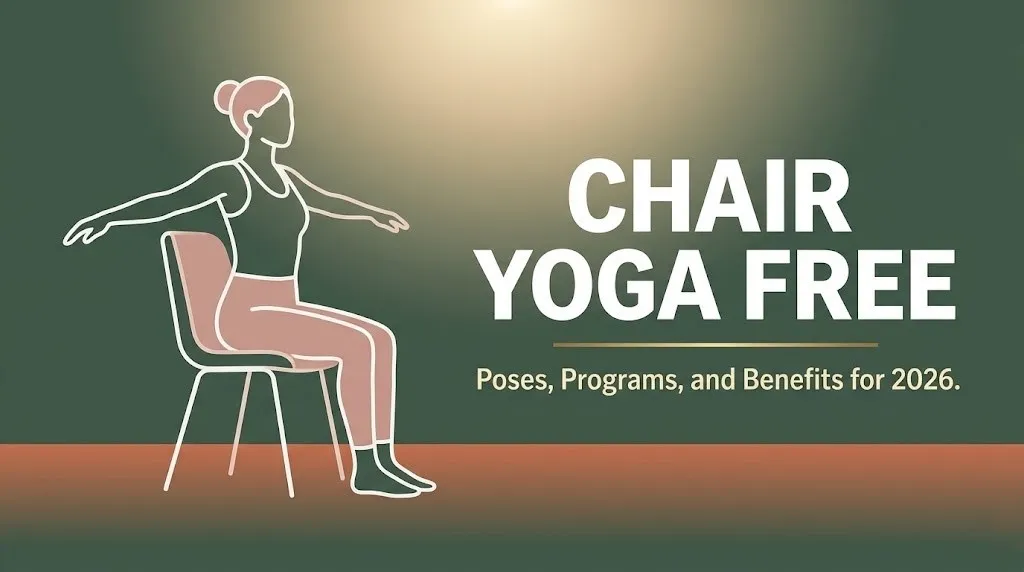
Chair yoga free resources exist right now, and you do not need a studio membership, a mat, or even a yoga background to get started. Everything in this guide is designed to be practiced from a stable chair in your home, office, or living room, starting today.
Seate is not a compromise or a lesser version of the real thing. According to the National Center for Complementary and Integrative Health (NCCIH), yoga practiced in adapted forms, including chair-based yoga, produces measurable improvements in flexibility, balance, and psychological well-being, especially in adults over 60. The evidence behind chair yoga has grown steadily through 2023 and 2024, and the 2026 landscape of free programs is better than it has ever been.
This guide covers what chair yoga actually is, which free programs are worth your time, how specific poses work for conditions like arthritis and back pain, and what a science-backed beginner sequence looks like from start to finish.
Chair Yoga Free
Free chair yoga is genuinely accessible in 2026, with no cost barriers standing between you and a complete practice. Public libraries, community centers, senior centers, and online platforms run entirely on public funding offer structured chair yoga programs at zero cost.
The best free programs are not watered-down yoga. Many draw directly from Hatha yoga and Iyengar yoga traditions, both of which have long histories of adapting poses with props and structural support. Chair yoga simply treats the chair as the primary prop, the way an Iyengar teacher might use a wall, a block, or a bolster.
What makes free access matter so much is adherence. Research published in the Complementary Therapies in Medicine journal found that cost is one of the top reported barriers to consistent yoga practice among adults over 65. Removing that barrier leads to longer-term participation, and that is where yoga’s real benefits compound.
Quick Summary: What Free Chair Yoga Looks Like
- No paid subscription required
- No yoga mat, special clothing, or studio needed
- Suitable for complete beginners and people with health conditions
- Practiced from a standard sturdy armless chair
What Is Chair Yoga
Chair yoga is a style of yoga where all or most poses are performed while seated in or supported by a stable chair. It adapts traditional yoga postures so that practitioners who cannot safely kneel, lie on the floor, or bear weight through their wrists can still access the benefits of movement, breath, and mindfulness.
The practice is not a single yoga style. It borrows from Hatha yoga, Iyengar yoga, and Restorative yoga, depending on the instructor and class format. A Hatha-influenced chair class moves through poses with attention to alignment and breathing. A Restorative-influenced chair class holds supported positions longer to release deep tension in the connective tissue.
What stays consistent across all chair yoga formats is the use of the chair as structural support. This removes the fear of falling during balance poses. It reduces wrist and knee pressure in weight-bearing positions. It makes a wide range of spinal movements, hip openers, and shoulder stretches available to people who would otherwise sit those poses out.
| Chair Yoga Type | Primary Influence | Pace | Focus |
|---|---|---|---|
| Seated Hatha | Hatha yoga | Moderate | Alignment and strength |
| Seated Restorative | Restorative yoga | Slow | Deep tissue release |
| Seated Flow | Vinyasa-inspired | Flowing | Breath and movement coordination |
| Adaptive/Therapeutic | Iyengar yoga | Varied | Condition-specific modifications |
Free Chair Yoga Programs
Several legitimate, well-structured chair yoga programs are available at no cost in 2026, offered through public institutions and nonprofit organizations. The quality varies widely, and knowing what to look for saves you from wasting time on programs that are little more than a few basic stretches with yoga branding.
Look for programs that name and teach specific poses with alignment cues. Avoid programs that treat chair yoga as simply “sitting and reaching around a bit.” Good free programs include breath instruction, clear modification options, and a logical sequence that warms the body up before asking it to do more.
Public library systems in the United States frequently offer free yoga classes, including chair yoga, as part of their community programming. Many use certified yoga instructors registered with Yoga Alliance, the primary professional credentialing body in the United States. Senior centers run by local Area Agencies on Aging often partner with health insurers to provide free chair yoga under programs like SilverSneakers or the Silver&Fit initiative, both of which are included in many Medicare Advantage plans.
| Source | Cost | Format | Who It Serves |
|---|---|---|---|
| Public library classes | Free | In-person or Zoom | Community adults |
| Senior center programs | Free | In-person | Adults 60 and over |
| Medicare Advantage plans | Included with insurance | In-person or online | Medicare-eligible adults |
| Nonprofit community centers | Free or donation-based | In-person | Open to all |
| University extension programs | Free | In-person or video | Adults and caregivers |
Chair Yoga Benefits
Chair yoga produces real, documented improvements in flexibility, strength, balance, mood, and pain levels, even in people who have never practiced yoga before. The benefits are not hypothetical wellness promises. They are supported by peer-reviewed research involving older adults, people with chronic pain, and individuals managing specific health conditions.
A study published in the Journal of Alternative and Complementary Medicine found that older adults who practiced chair yoga twice weekly for eight weeks showed significant reductions in pain and fatigue compared to a control group. The same participants reported improved sleep quality and lower rates of self-reported depression.
Beyond pain relief, chair yoga builds functional fitness. The movements required in chair yoga, spinal rotation, hip flexion, shoulder mobilization, and diaphragmatic breathing, are the same movements needed for daily activities like turning to look behind you while driving, reaching into a high cabinet, or getting up from a seated position without help.
Key benefits include:
- Improved range of motion in the hips, spine, and shoulders
- Reduced joint pain and morning stiffness
- Better seated and standing balance through proprioception training
- Lower perceived stress and anxiety through breath-focused movement
- Increased muscle activation in the core, glutes, and hip abductors
- Enhanced circulation in the lower extremities
- Improved posture and spinal alignment awareness
Key Takeaway: Chair yoga is not beginner yoga with a chair tossed in. It is a legitimate, research-supported practice that recruits the same muscle groups and nervous system responses as floor-based yoga, just adapted so that no one gets left out because of mobility limitations.
Is Chair Yoga as Effective as Regular Yoga
Chair yoga produces comparable benefits to mat-based yoga in the areas that matter most for older adults and people with mobility limitations: pain reduction, flexibility, and psychological well-being. It does not replace every benefit of floor-based practice. Understanding which benefits transfer and which require more is important for setting realistic expectations.
For cardiovascular conditioning, chair yoga is less intense than vigorous Vinyasa or Ashtanga practice. Heart rate elevation is moderate. That said, the American College of Sports Medicine recognizes gentle yoga forms, including chair-based yoga, as contributing to physical activity guidelines for adults with limited mobility, particularly when combined with other low-impact movement.
For flexibility and joint mobility, chair yoga is highly effective. The seated position actually allows deeper hip and hamstring stretching for some people, because the chair removes the need to stabilize the pelvis against gravity during forward bends. Think of it like this: your hip flexors and hamstrings can release more fully when your lower back is not working overtime just to hold you upright.
For mental health benefits, including stress reduction and mood improvement, chair yoga performs on par with mat yoga. The NCCIH notes that breath-coordinated movement, which is the central mechanism of all yoga styles, produces parasympathetic nervous system activation regardless of whether it is practiced on a mat or a chair.
| Outcome | Chair Yoga | Mat Yoga |
|---|---|---|
| Flexibility improvement | High | High |
| Balance training | Moderate to High | High |
| Core strength | Moderate | High |
| Cardiovascular benefit | Low to Moderate | Moderate to High |
| Stress reduction | High | High |
| Accessibility for limited mobility | Very High | Low to Moderate |
| Fall risk during practice | Very Low | Moderate |
Chair Yoga for Seniors
Chair yoga is one of the most evidence-supported physical activities for adults over 65, specifically because it addresses the three most common fitness concerns in that age group: balance, joint pain, and fear of falling. Unlike gym-based exercise, it does not require grip strength, floor transfers, or any load-bearing position that puts the wrists or knees at risk.
According to the International Journal of Yoga, adults over 65 who practiced chair yoga consistently for 12 weeks showed measurable improvements in lower limb strength and static balance compared to those who did standard seated stretching without the yogic breath component. The breath coordination piece matters more than it might seem.
Sarcopenia, the gradual loss of muscle mass that accelerates after age 60, is a real concern for aging adults. Chair yoga cannot replace resistance training as the primary tool for building muscle mass. It does, however, activate the glutes, quadriceps, hip abductors, and erector spinae meaningfully enough to slow functional decline when practiced consistently.
What makes chair yoga particularly appropriate for seniors:
- No floor transfers required, which eliminates one of the highest-risk moments in physical activity for older adults
- Low joint loading on the knees, hips, and wrists
- Balance poses practiced with structural support nearby
- Breath-based practice that supports lung function and diaphragmatic strength
- Social class environments that reduce isolation, which the Harvard T.H. Chan School of Public Health has consistently linked to better health outcomes in older adults
How to Do Chair Yoga at Home
You can start chair yoga at home with a single sturdy chair, your normal clothing, and 15 minutes. No mat, no props, and no prior experience are required to begin.
The most important thing you can set up is your chair. Use an armless chair with a firm, flat seat. The chair should not roll, rock, or tip. Its legs should be on a non-slip surface. Place it in a cleared space where you have at least one arm’s length of room on each side.
Sit toward the front of the seat, not pushed all the way back. Your feet should rest flat on the floor with your knees at roughly 90 degrees. If your feet do not reach the floor comfortably, place a folded blanket or a thick book under them. Your spine should be able to lengthen upward without pressing against the chair back.
Home setup checklist:
- Armless, non-rolling chair on a non-slip floor
- Feet flat on the floor or supported (blanket/firm cushion)
- Comfortable, non-restrictive clothing
- Space cleared on all four sides of the chair
- Optional: a small blanket or yoga block within reach
- Optional: a yoga strap for hamstring stretches
Before starting, take three slow breaths in through the nose and out through the mouth. Notice where your body makes contact with the chair. This two-minute grounding step is not filler. It activates interoceptive awareness, which is your body’s ability to sense its own position in space, and research in proprioception and mindful movement suggests this primes the nervous system for safer, more effective movement.
Key Takeaway: Seniors get the most from chair yoga when the breath component is treated as part of the practice, not an afterthought. The breath-movement coordination is what separates chair yoga from basic seated stretching and what produces the documented improvements in balance and mood.
Free Chair Yoga Sequence for Beginners
Here is a complete, free chair yoga sequence for beginners that takes 20 to 25 minutes and requires nothing more than a stable chair. Each pose is described with step-by-step instructions, breath cues, and modifications.
Practice this sequence three to four times per week. Hold each pose for 3 to 5 breath cycles unless otherwise noted.
Seated Mountain Pose (chair-adapted Tadasana)
- Sit at the front of the chair, feet flat on the floor, hip-width apart.
- Press your sitting bones down into the seat.
- Lengthen your spine upward as if someone is gently lifting the crown of your head.
- Rest your hands on your thighs, palms face down.
- Breathe in through your nose for 4 counts. Breathe out slowly for 6 counts.
- Hold for 5 breath cycles.
Modification: If your feet do not reach the floor, place a folded blanket beneath them.
Seated Cat/Cow (Marjaryasana/Bitilasana)
- Place both hands on your knees.
- On your exhale, round your spine toward the chair back. Drop your chin gently to your chest. This is Cat.
- On your inhale, lift your chest, draw your shoulder blades together, and let your lower back curve slightly forward. This is Cow.
- Move between these two shapes slowly with each breath.
- Repeat for 6 to 8 breath cycles.
Safety note: If you have an acute disc herniation, practice only the Cat rounding and skip the Cow extension until cleared by a physical therapist or spine specialist.
Seated Forward Fold (chair-adapted Paschimottanasana)
- Sit at the front of the chair with feet flat.
- Exhale and hinge forward from your hips, not your waist.
- Let your hands slide down your shins or rest on your thighs.
- Keep a gentle bend in your knees.
- Hold for 4 breath cycles. Inhale to come back up slowly.
Modification: Place a folded blanket on your lap to rest your torso on if bending forward is uncomfortable.
Seated Spinal Twist (Parivrtta Sukhasana)
- Sit tall, both feet flat on the floor.
- Place your right hand on your left knee and your left hand behind you on the seat of the chair.
- On your inhale, lengthen your spine upward.
- On your exhale, rotate your chest gently to the left, leading with your ribcage, not your chin.
- Hold for 3 breath cycles. Return to center and repeat on the other side.
Safety note: People with osteoporosis should keep rotation gentle. Do not force the twist. Stop if you feel any sharp sensation in your lower back.
Chair-Supported Tree Pose (Vrikshasana adapted)
- Sit tall. Hold the side of the chair seat with your right hand for support.
- Press your left foot firmly into the floor.
- Lift your right foot and rest it on top of your left foot, or just rest it lightly beside it.
- Find a fixed point in front of you and hold your gaze there.
- Hold for 3 to 5 breath cycles. Repeat on the other side.
Modification: Both feet can remain on the floor. Simply shift your weight slightly to the left foot to practice the balance shift without lifting the right foot.
Chair Yoga Poses
Chair yoga poses fall into four categories: spinal movements, hip openers, shoulder and neck work, and balance training. A well-rounded session draws from all four categories, not just the easiest or most familiar ones.
Most people default to neck rolls and shoulder shrugs and call it chair yoga. That is warm-up work, not a complete practice. The poses below represent a more complete toolkit.
| Category | Pose Name | Sanskrit Name | Primary Target |
|---|---|---|---|
| Spinal movement | Seated Cat/Cow | Marjaryasana/Bitilasana | Thoracic and lumbar spine |
| Spinal movement | Seated Spinal Twist | Parivrtta Sukhasana | Thoracic rotators, obliques |
| Hip opener | Seated Figure Four | Adapted Agnistambhasana | Piriformis, hip external rotators |
| Hip opener | Seated Forward Fold | Adapted Paschimottanasana | Hamstrings, lower back |
| Shoulder and neck | Seated Eagle Arms | Adapted Garudasana | Rhomboids, posterior deltoids |
| Shoulder and neck | Neck side stretch | Adapted Parsva Sukhasana | Cervical lateral flexors |
| Balance training | Chair-supported Tree | Adapted Vrikshasana | Glutes, hip abductors, ankle stabilizers |
| Balance training | Seated Mountain | Adapted Tadasana | Core, postural muscles |
Pose Tip:
- In all seated poses, your sitting bones are your foundation. Press them down before doing anything else.
- Never lock your jaw during challenging holds. A soft jaw signals the nervous system to stay calm.
- For all balance poses near the chair, one hand resting lightly on the chair back is sufficient support. Gripping tightly reduces proprioceptive feedback.
Key Takeaway: A complete chair yoga session includes spinal flexion and extension, rotation, hip work, shoulder opening, and at least one balance challenge. If your current practice only covers one or two of these categories, add one new category per week.
Chair Yoga Breathing Exercises
Breath control, known in yoga as pranayama, is the foundation of every chair yoga session, and it produces measurable effects on the nervous system independent of the physical poses. You do not have to do a single stretch to begin experiencing these effects. Breath work alone counts.
The most accessible breath for beginners is diaphragmatic breathing, or belly breathing. Most adults breathe shallowly into their upper chest, which keeps the sympathetic nervous system slightly activated. Diaphragmatic breathing shifts that pattern within minutes.
To practice diaphragmatic breathing in your chair:
- Sit tall at the front of the chair, spine long.
- Place one hand on your chest and one hand on your belly, just below your navel.
- Inhale slowly through your nose for 4 counts. Let your belly expand outward, pushing your lower hand out. Your upper hand should barely move.
- Exhale through your nose for 6 counts. Let your belly draw gently back in.
- Repeat for 5 to 10 breath cycles.
Ujjayi breath is another technique commonly used in chair yoga flows. It involves a slight constriction at the back of the throat during both inhale and exhale, producing a soft ocean-like sound. This breath pattern slows the breathing rate, extends the exhale, and produces a consistent internal focus point during movement.
A study published in the International Journal of Yoga found that consistent pranayama practice, including both diaphragmatic and Ujjayi breathing, reduced markers of autonomic stress and improved heart rate variability in older adult participants. Heart rate variability is a measurable indicator of how well your nervous system regulates stress.
Safety note: If you feel lightheaded during breath exercises, return to normal breathing immediately. Breath retention exercises are not appropriate for people with uncontrolled high blood pressure without guidance from a qualified yoga therapist.
Chair Yoga for Back Pain
Chair yoga is one of the most well-tolerated movement approaches for chronic lower back pain, because it allows spinal mobility without the compressive forces that floor-based exercise can place on the lumbar vertebrae. The seated position naturally offloads some of the vertical compression on the spine, which reduces pain signals during movement.
The key poses for back pain are the ones that address the two most common contributing factors: tight hip flexors and weak erector spinae. Think of tight hip flexors like a rope pulling your pelvis forward and down. That pull increases lumbar lordosis, which loads the facet joints in the lower back. Releasing the hip flexors and gently strengthening the muscles alongside the spine reduces that pull.
Seated Cat/Cow (Marjaryasana/Bitilasana) and Seated Spinal Twist (Parivrtta Sukhasana) are the two highest-priority poses for back pain relief in chair yoga. Cat/Cow mobilizes the lumbar and thoracic spine through flexion and extension. The Seated Spinal Twist introduces rotational mobility to the thoracic spine, which often becomes stiff and forces the lumbar spine to compensate.
Poses to approach carefully with back pain:
- Deep forward folds: Keep the knees generously bent and hinge from the hips, not the waist
- Seated backbends: Keep these small and chest-led, never collapsing into the lumbar
- Twists: Move slowly and stop before any sharp or shooting sensation
According to the Spine Journal, gentle yoga-based movement that includes both flexion and extension patterns, practiced consistently, is more effective for chronic low back pain than either rest or passive stretching alone. Chair yoga delivers exactly that combination.
Chair Yoga for Arthritis
Chair yoga is particularly well-matched to arthritis because it promotes joint mobility and reduces inflammation markers without placing impact load on the affected joints. Synovial fluid, the lubricating fluid inside your joints, is only distributed through movement. Sitting still all day literally starves arthritic joints of the lubrication they need.
The Arthritis Foundation has endorsed yoga, including chair-based yoga, as a safe and beneficial practice for people managing both osteoarthritis and rheumatoid arthritis. The key is keeping movement within a pain-free range and avoiding any position that creates sharp or stabbing sensation in the affected joint.
For people with arthritis in the hands and wrists, chair yoga is especially advantageous compared to mat yoga. There is no downward dog, no plank, and no weight bearing through the palms. Hands rest comfortably on knees or the chair seat during most poses.
Arthritis-friendly chair yoga approach:
- Warm up with 3 to 5 minutes of gentle diaphragmatic breathing before any movement
- Start with small range-of-motion circles in the ankles, wrists, and shoulders
- Move at a pace that allows you to feel the joint moving, not a pace that forces it
- On high-inflammation days, treat breath work and gentle seated mountain pose as a complete session
- Avoid practicing during acute flares in the affected joints. Gentle movement on low-symptom days builds long-term resilience; forcing movement during flares does the opposite
Key Takeaway: For arthritis and back pain, chair yoga works best when it is consistent and moderate, not intense and occasional. Two 20-minute sessions per week practiced steadily over 8 to 12 weeks outperforms one intense session per week in every published study on this topic.
Chair Yoga for Balance and Fall Prevention
Chair yoga improves balance by training the neuromuscular system, specifically the communication between the brain, the inner ear, and the stabilizing muscles of the ankles, hips, and core. This is called proprioception, and it can be meaningfully improved at any age.
Falls are the leading cause of injury-related death in adults over 65 in the United States, according to the Centers for Disease Control and Prevention. The muscles most responsible for preventing falls, the glutes, hip abductors, quadriceps, and tibialis anterior, are all recruited during chair yoga balance work.
Chair-supported balance poses are the right starting point precisely because they let you safely overload your balance system without the fall risk of unsupported practice. By holding the chair, you can explore the edge of your stability without the consequence of losing it completely.
To build balance through chair yoga:
- Practice Chair-Supported Tree Pose (adapted Vrikshasana) daily, even for just 2 minutes per side.
- Add heel raises while seated, pressing through the ball of each foot and lifting both heels simultaneously, for 10 repetitions.
- Try seated weight shifts: from sitting bones evenly to gently loading left, then right, building awareness of your lateral stability margins.
- Progress to standing chair-supported single-leg stands, holding for 5 seconds per side, as balance improves.
A clinical trial published in Complementary Therapies in Medicine found that older adults who practiced chair yoga for 45 minutes twice weekly over 12 weeks showed a 30% improvement in self-reported balance confidence and measurable improvement in the Timed Up and Go test, a standard clinical balance assessment.
Chair Yoga for Osteoporosis
Chair yoga can be practiced safely with osteoporosis, but it requires specific pose modifications to avoid placing flexion load on the vertebrae, which is the primary fracture risk in osteoporotic spines. Not all chair yoga is equally safe for this condition. The details matter.
Osteoporosis reduces bone density, particularly in the thoracic vertebrae, the hip, and the wrist. Compression fractures in the thoracic spine can be triggered by forward flexion under load. This means deep forward bends and extreme spinal rounding are contraindicated for people with moderate to severe osteoporosis.
The poses that remain safe and beneficial are those that involve extension, gentle rotation within a neutral spine, and weight-bearing through the legs. Standing chair-supported poses, where one or both hands hold the chair while you shift weight through your feet, are especially valuable. They apply gentle, beneficial mechanical load to the hip joint and femur, which stimulates bone remodeling.
Osteoporosis safety rules for chair yoga:
- Avoid full seated forward folds where the spine rounds under load
- Avoid unsupported twists that take the spine past neutral
- Prioritize spinal extension and neutral-spine movements
- Standing chair-supported poses apply load to hip and leg bones safely
- Seated Mountain Pose practiced actively, pressing through sitting bones and lengthening the spine, trains postural muscles that protect the vertebrae
If you have a confirmed osteoporosis diagnosis, working initially with a yoga teacher who holds a Yoga Alliance certification in adaptive or therapeutic yoga, or collaborating with a physical therapist to identify your specific spine stability before starting a home practice, gives you a safer foundation than starting alone.
Chair Yoga Modifications and Props
Chair yoga modifications exist for every pose, every mobility level, and every health condition. No one in a chair yoga class should be doing a pose that causes pain, and no one should sit one out because they cannot reach the standard expression.
Props are not training wheels. Experienced Iyengar yoga practitioners use blocks, straps, and bolsters deliberately because they produce better alignment and safer access to poses than forcing unassisted positions. The same logic applies in chair yoga.
| Prop | Primary Use in Chair Yoga | Who Benefits Most |
|---|---|---|
| Yoga block | Under feet for grounding, between knees for alignment | Short-statured practitioners, people with hip stiffness |
| Yoga strap | Extended reach in forward folds and shoulder stretches | Limited shoulder or hamstring flexibility |
| Folded blanket | Seat height adjustment, knee support, belly support in folds | People with knee pain, very short torsos |
| Second chair or wall | Additional balance support in standing poses | People with severe balance impairment or vertigo |
| Rolled towel | Lumbar support, placed behind lower back during seated holds | People with lower back pain or hyperlordosis |
Modification options by condition:
- Limited hip flexibility: Place a yoga block or firm cushion on the seat to raise the hip height. This reduces hip flexion demand and makes seated forward work more accessible.
- Knee pain: Keep both feet firmly on the floor. Avoid any pose where the knee is flexed past 90 degrees or loaded in a rotated position.
- Shoulder impingement: In arm-raising poses, only lift the arms to the height where you feel no pinching at the top of the shoulder. That is your safe range for today.
- Numbness in the hands or feet: Check your seated posture first. Crossing your legs or sitting asymmetrically often cuts off circulation. Return to a neutral, symmetrical seated position and see if the sensation resolves within 30 seconds.
Key Takeaway: Props are not a sign of limitation. They are precision tools that make poses more anatomically correct, not less. A yoga strap that lets you reach your foot with a long straight spine is doing more for your hamstrings than a rounded forward fold done without one.
How Often Should You Do Chair Yoga
Most yoga teachers and physical therapists recommend practicing chair yoga 3 to 5 times per week for 20 to 45 minutes per session to see consistent improvements in flexibility, balance, and mood. Daily shorter sessions of 10 to 15 minutes also work well and are easier to sustain for beginners.
Frequency matters more than duration in the early months. A 15-minute session practiced five days per week will produce more lasting change than a 90-minute session once on the weekend. The nervous system, which governs balance, coordination, and stress response, adapts through repetition. It needs consistent exposure to new movement patterns, not occasional large doses.
According to the American College of Sports Medicine, older adults benefit most from physical activity that is moderate in intensity and spread across most days of the week. Chair yoga fits this prescription well, especially when the sessions include both movement and breath work.
Session length guide by goal:
| Goal | Recommended Session Length | Frequency Per Week |
|---|---|---|
| Stress reduction and mood | 15 to 20 minutes | 4 to 5 days |
| Flexibility improvement | 25 to 35 minutes | 3 to 4 days |
| Balance training | 20 to 30 minutes | 4 to 5 days |
| Joint pain management | 20 to 25 minutes | Daily if tolerated |
| General health maintenance | 20 to 30 minutes | 3 times minimum |
Listen to your body’s signals in each session. Mild muscle warmth and gentle fatigue are expected. Sharp pain, joint locking, shortness of breath beyond mild exertion, or dizziness are reasons to stop and, if they persist, to discuss them with a physician or physical therapist who can assess what is happening specifically in your body.
Rest days matter too. Your connective tissue and nervous system need recovery time. If you practice daily, alternate between more active sessions with balance and strength work, and lighter sessions focused purely on breath and gentle spinal movement.
Frequently Asked Questions About Chair Yoga
Is chair yoga free to learn at home?
Yes, chair yoga is completely free to learn and practice at home.
Public libraries, senior centers, Medicare Advantage programs, and nonprofit community organizations offer free chair yoga classes both in-person and online.
All you need is a stable armless chair, comfortable clothing, and enough floor space to sit safely.
Can chair yoga help seniors with balance problems?
Chair yoga can meaningfully improve balance in older adults, particularly through poses that train the hip stabilizing muscles and the neuromuscular communication system.
A study published in Complementary Therapies in Medicine found that twice-weekly chair yoga practice over 12 weeks produced measurable improvement in clinical balance assessments.
The chair provides a safe support structure during balance training, which reduces fall risk during the practice itself.
How long should a chair yoga session be for beginners?
Beginners should start with 15 to 20 minute chair yoga sessions and increase gradually as their body adapts.
Even 10 minutes of focused breath-coordinated movement produces measurable benefits in stress markers and joint mobility.
Consistency matters far more than session length in the first 8 to 12 weeks of practice.
Is chair yoga good for people with arthritis?
Chair yoga is one of the most appropriate movement practices for people with arthritis, because it promotes joint mobility without impact load.
The Arthritis Foundation recognizes yoga as safe and beneficial for both osteoarthritis and rheumatoid arthritis when practiced within a pain-free range.
On high-inflammation days, a session focused purely on gentle breath work and small range-of-motion movements is still worthwhile and appropriate.
What do I need to start chair yoga at home?
You need a single sturdy, armless chair on a non-slip surface, with enough clear space on all sides to move your arms freely.
Comfortable, non-restrictive clothing is all you need to wear.
Optional props that improve practice include a yoga block, a yoga strap, and a folded blanket, but none of these are required to begin today.
Start Small and Stay Consistent
Sit down in your most stable chair right now. Press your sitting bones down, lengthen your spine, and take three slow breaths. That is chair yoga. That is also the beginning of something your body will thank you for over the coming weeks.
Pick one sequence from this guide and practice it three times this week. The beginner sequence in this article takes 20 minutes and covers every major body region. Do not wait for a perfect time, perfect props, or perfect health. The chair is the modification. The accessibility is the point.
Free chair yoga in 2026 is better, more structured, and more evidence-backed than it has ever been. You have everything you need.