Free Yoga Near Me: Find Classes and Start in 2026
Free yoga near me is not as hard to find as most people assume. In 2026, no-cost yoga options exist in parks, community centers, libraries, online platforms, and through studio trial programs in virtually every mid-size city and many smaller towns.
This matters more than ever. According to the National Center for Complementary and Integrative Health (NCCIH), yoga is one of the most practiced complementary health approaches in the United States, with an estimated 21 million adults participating annually. Cost is consistently cited as the top barrier to starting.
This article covers where to find free yoga locally, how to identify which style fits your body and goals, what to expect at your first class, and how to build a real home practice from scratch. You’ll find specific pose guidance, style comparisons, and options for kids, couples, families, and beginners with no experience at all.
Free Yoga Near Me: Where Real Options Actually Exist in 2026
Free yoga is available through parks, public libraries, community centers, YMCA programs, studio promotional classes, and structured online platforms, all at no cost to you.
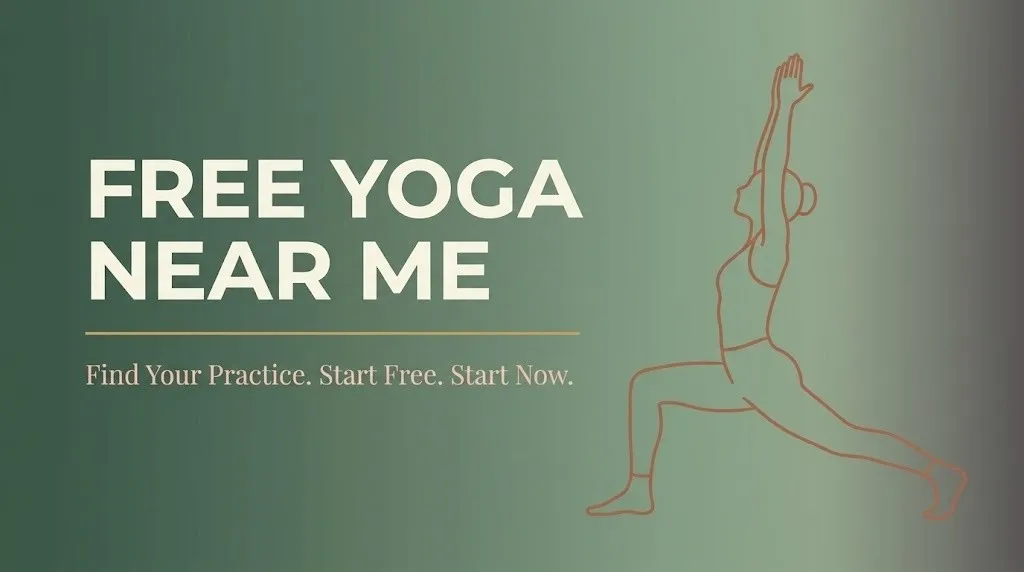
The most reliable free yoga sources in 2026 are not apps trying to upsell you. They are physical community resources that have existed for decades and have expanded their offerings.
Here is where to look first:
- Parks and Recreation Departments: Many city park districts run free outdoor yoga from spring through fall. Check your city or county parks website directly.
- Public Libraries: Library yoga programs have grown substantially since 2020. These are often taught by certified instructors and are genuinely beginner-friendly.
- YMCA: A standard YMCA membership (often free or reduced for low-income households) includes group yoga classes at most locations.
- Studio Trial Weeks: Most yoga studios offer one free week or a single free class for new students. This is not a trick. Use it.
- Community Centers and Recreation Programs: Many offer subsidized or free yoga as part of wellness programming for residents.
- University Campus Programs: If you are near a college or university, student wellness centers often open yoga sessions to the public at no charge.
Yoga Alliance notes that community-based yoga programs have expanded by over 30 percent since 2020, driven in part by public health initiatives around stress reduction and movement.
Do not overlook local Facebook groups, Nextdoor postings, and community boards. Volunteer instructors and trainee teachers frequently offer free classes to build their hours and client base. These classes are often small, personal, and surprisingly high quality.
Community Yoga Near Me: What to Expect at No-Cost Local Classes
Community yoga is a drop-in format class, often held in a shared space like a park, library, or rec center, designed to be accessible to all levels with no prior experience required.
These classes differ from studio yoga in a few important ways. The space may not be a dedicated yoga room. Mats are sometimes provided, but bringing your own is always safer. The instructor may be a volunteer or a teacher-in-training working toward their 200-hour Yoga Alliance certification.
That does not mean the class is low value. Many of the best introductory yoga experiences happen in community settings precisely because there is no performance pressure. Beginners report feeling far less self-conscious in a park class than in a formal studio.
| Feature | Community Yoga | Studio Yoga | Home Practice |
|---|---|---|---|
| Cost | Free to low cost | $15 to $30 per class | Free |
| Instruction quality | Variable, often good | Consistently certified | Self-directed |
| Class size | 5 to 30 people | 10 to 25 people | Solo |
| Props available | Sometimes | Yes | Bring your own |
| Beginner-friendly | Usually yes | Depends on class type | Yes |
| Schedule flexibility | Fixed times | Fixed times | Anytime |
What to bring to a free community yoga class:
- Your own yoga mat (a folded blanket works in a pinch)
- Water bottle
- Comfortable, non-restrictive clothing
- One yoga block if you own one (more useful than most beginners expect)
- An open mind about outdoor conditions if it is a park class
Safety note: If you have an existing injury to your knees, wrists, or lower back, tell the instructor before class begins. A good instructor will offer you modifications without drawing attention to it.
Beginner Yoga Classes Near Me: How to Find the Right Starting Point
A beginner yoga class is specifically paced for people with no prior yoga experience, focusing on foundational poses, basic breathing, and body awareness before introducing complex sequences.
The word “beginner” on a class listing means different things at different studios. Always read the class description. A true beginner class should not include handstands, arm balances, or rapid-fire Vinyasa flows. If the description mentions any of those, it is not the right class for your first month.
The best search terms to find genuine beginner classes:
- “Foundations yoga” or “Yoga Basics”
- “Level 1 yoga”
- “Intro to yoga” or “New to yoga”
- “Hatha yoga” (the style most suited to beginners due to its pace and focus on individual poses)
- “Gentle yoga” (for those managing joint sensitivity or returning from injury)
Avoid classes labeled only as “All levels” without a description. These classes often cater to intermediate practitioners and assume basic knowledge of pose names and sequences.
According to the American College of Sports Medicine, beginners benefit most from structured yoga instruction that emphasizes body alignment and breath coordination before progressing to flow-based formats. Starting with proper alignment in Tadasana (Mountain Pose) and Balasana (Child’s Pose) builds the physical awareness needed for safer, more effective progression.
Modification for absolute beginners: In any standing pose, keep a slight bend in the knees rather than locking them straight. This protects the knee joints and makes balance easier while your body adapts to the demands of yoga.
Key Takeaway: The fastest way to find genuinely beginner-friendly free yoga is to search for “Foundations,” “Level 1,” or “Hatha” classes at your local library, park district, or YMCA rather than using broad “yoga near me” searches that pull up intermediate studio classes.
What Yoga Style Is Best for Beginners
Hatha yoga is the style most appropriate for beginners because it moves at a slower pace, holds individual poses long enough to understand alignment, and emphasizes breath-body connection without requiring prior fitness or flexibility.
The yoga style landscape is wide, and conflating styles leads beginners into the wrong room on day one. Here is a clear breakdown:
| Style | Pace | Best For | Avoid If |
|---|---|---|---|
| Hatha | Slow to moderate | True beginners, anyone learning poses | You want a cardio workout |
| Vinyasa | Moderate to fast | People with some yoga base | You’re brand new with no pose knowledge |
| Yin | Very slow, long holds | Flexibility, stress, joint health | You have acute joint injuries |
| Restorative | Extremely slow | Recovery, nervous system, illness | You want active movement |
| Ashtanga | Fast, structured | Athletic practitioners, discipline-focused | Beginners with no yoga experience |
| Iyengar | Slow, precision-based | People with injuries, need for alignment detail | Those who dislike props |
| Kundalini | Variable | Breathwork, spiritual focus | Those expecting physical movement only |
| Hot Sculpt | Fast, heated | Fitness-focused, experienced movers | Anyone unaccustomed to heat or exercise |
Start with Hatha. Once you can name 10 poses by their English names, feel stable in Adho Mukha Svanasana (Downward-Facing Dog), and hold Virabhadrasana I (Warrior I) for five breaths without wobbling, you are ready to explore Vinyasa.
A 2022 study published in the International Journal of Yoga found that beginners who started with slower-paced Hatha instruction reported higher adherence rates and fewer injuries over a 12-week period compared to those who began in flow-based formats.
Gentle Yoga Near Me: Who It’s For and What It Feels Like
Gentle yoga is a slow, low-impact practice that prioritizes joint mobility, breath awareness, and relaxation over physical challenge, making it appropriate for seniors, people managing chronic pain, and anyone returning to movement after a break.
“Gentle” is not a beginner synonym, though. A gentle class may include practitioners who have done yoga for decades. The defining characteristic is the absence of high-intensity effort or forceful stretching. Poses are held carefully. Props are common. Nobody is rushing.
Gentle yoga is particularly well-matched for:
- Adults over 60 working on joint mobility and balance
- People managing arthritis, fibromyalgia, or chronic lower back pain
- Individuals recovering from illness or surgery (with physician clearance for movement)
- Anyone dealing with high stress levels who needs a parasympathetic reset
According to the NCCIH, yoga-based interventions for chronic low back pain have demonstrated measurable improvements in function and pain levels when the practice is gentle and prop-supported. Research reviewed in 2023 showed meaningful reduction in pain interference scores after 12 weeks of gentle practice.
What a gentle class feels like physically: slower than you expect, supported more than you think you need, and surprisingly effective. You may sweat very little. Your nervous system will likely notice the difference the next morning.
Modification: If a pose requires kneeling and your knees are sensitive, a folded blanket under the knees reduces joint pressure immediately. Any gentle class teacher should already have this cue built in.
Pose Tip:
- In Sukhasana (Easy Seated Pose), place a folded blanket under your sitting bones to reduce lower back strain
- Keep your spine long rather than slumped by rooting through the sitting bones, not by forcing your chest forward
- If the hips are tight, elevating the seat reduces the pull on the sacroiliac joint
Yin Yoga Classes Near Me: The Style That Changes How You Feel in One Session
Yin yoga is a slow-paced practice where poses are held for two to five minutes or longer, targeting the connective tissues (fascia, ligaments, and joint capsules) rather than the muscles, making it fundamentally different from any other style on this list.
Most people are surprised by how demanding yin yoga is in its own way. You are not moving quickly. You are not sweating. But holding a hip opener like Eka Pada Rajakapotasana (Pigeon Pose) in its yin variation for four minutes asks your nervous system and connective tissue to respond in ways that faster practices cannot reach.
Think of your connective tissue like dry leather. Brief contact with water (a fast stretch) barely changes it. Sustained, gentle pressure over time (a long yin hold) begins to rehydrate and restructure it. That is the mechanic behind yin yoga’s effectiveness for flexibility.
A study published in the Journal of Alternative and Complementary Medicine found that a regular Yin yoga practice of three sessions per week over eight weeks produced statistically meaningful improvements in hip and lumbar flexibility compared to control groups.
What to expect at your first yin class:
- You will use bolsters, blocks, and blankets constantly. This is correct.
- Poses will feel intense but should never feel sharp or shooting. Sharp pain means back off immediately.
- The teacher will talk less than in other classes. Silence is part of the practice.
- You may feel emotionally uncomfortable in some holds. This is a documented phenomenon related to connective tissue and the nervous system, not a sign something is wrong.
Modification: In all seated forward folds, place a bolster across your thighs and rest your torso on it. This reduces the hamstring load and allows the spine to release without strain.
Yoga Nidra Near Me: The Practice That Looks Like Sleep but Isn’t
Yoga Nidra is a guided meditation technique practiced in Savasana (Corpse Pose) that systematically brings the practitioner to the threshold between wakefulness and sleep, producing measurable changes in brainwave activity without the practitioner actually falling asleep.
Yoga Nidra is not a nap. It is a structured practice with specific stages: body scan, breath awareness, visualization, and setting of sankalpa (intention). A trained guide leads participants through these stages, which typically span 20 to 45 minutes.
Research published in the International Journal of Yoga has documented that Yoga Nidra practice consistently reduces cortisol levels, decreases anxiety scores on standardized psychological measures, and improves sleep quality in people with insomnia, often after just four sessions.
Who benefits most from Yoga Nidra:
- People with chronic stress or anxiety
- Individuals with insomnia or disrupted sleep cycles
- Those recovering from burnout or emotional exhaustion
- Anyone who finds seated meditation difficult due to restlessness or physical discomfort
Finding Yoga Nidra near you: look for restorative yoga studios, integrative wellness centers, and meditation centers rather than traditional fitness studios. Many libraries and community centers now offer it specifically as a mental health support program.
Safety note: Yoga Nidra is one of the few practices genuinely appropriate for people with almost all physical limitations. Because it is practiced lying down with no active movement, physical contraindications are rare. The exception: people with severe trauma histories should work with a trauma-informed teacher, as body-scan practices can trigger somatic responses.
Key Takeaway: Yin yoga and Yoga Nidra look passive from the outside but create distinct, research-supported physiological changes that faster, more active styles cannot replicate, making them especially worth trying if stress, poor sleep, or tight connective tissue are your starting concerns.
Hot Yoga Sculpt Near Me: What It Is and Whether You Should Try It
Hot yoga sculpt is a hybrid class format that combines standard heated yoga postures with light weights and cardio intervals, practiced in a room heated to approximately 95 to 100 degrees Fahrenheit, designed to maximize caloric expenditure and muscular endurance simultaneously.
This is not a beginner style. It is not free yoga in most cases. And it is not appropriate for everyone, regardless of fitness level.
Hot sculpt differs from traditional Bikram (26&2) hot yoga in two important ways: it adds resistance training through hand weights, and the sequence is not fixed. Bikram follows a strict 26-posture sequence. Hot sculpt classes vary by instructor.
Who should approach hot yoga sculpt with caution:
- People with cardiovascular conditions or high blood pressure
- Pregnant practitioners (heat exposure above safe thresholds poses documented risks)
- Anyone with a history of heat exhaustion or heat stroke
- Beginners with no yoga base (the pace and heat combination makes form correction nearly impossible)
- People taking medications that affect hydration or temperature regulation
If you are otherwise healthy, experienced in yoga, and interested in a fitness-forward practice, hot sculpt offers genuine benefits. The American College of Sports Medicine notes that exercise in moderate heat (when properly hydrated) can increase cardiovascular challenge without added resistance, which hot sculpt effectively combines with strength training.
Hydration rule: Drink at least 16 ounces of water in the two hours before a hot sculpt class. Have water accessible throughout. Electrolytes matter more in heated classes than in any other yoga format.
Modification: If you are new to heat-based yoga but want to try it, take your first class without weights. Learn the pose sequence in the heat before adding resistance.
Kids Yoga Near Me: What Makes a Good Class for Children
Kids yoga is a structured, age-appropriate movement practice that uses games, storytelling, animal-themed poses, and breath exercises to build children’s body awareness, focus, and emotional regulation skills.
Good kids yoga looks nothing like adult yoga. That is by design.
Children process learning through play. A well-run kids yoga class uses Bhujangasana (Cobra Pose) as “the snake pose” and tells a story around it. Balasana becomes “turtle.” Adho Mukha Svanasana (Downward-Facing Dog) is “the dog stretching in the morning.” The physical learning is real, but it is wrapped in language children engage with.
Research published in Complementary Therapies in Medicine found that school-based yoga programs for children ages 6 to 12 produced measurable improvements in attention, impulse control, and self-reported emotional regulation after eight weeks of twice-weekly practice.
What to look for in a quality kids yoga class:
- Instructor has completed specialized children’s yoga training (separate from standard 200-hour adult certification)
- Class size is small (no more than 12 children for under-7 groups)
- No competitive elements or comparison between children’s abilities
- Breath awareness is taught as a self-regulation tool, not just a warm-up
- Savasana or a quiet ending is included to complete the nervous system cycle
Ages and modifications:
| Age Group | Class Length | Format | Key Focus |
|---|---|---|---|
| 3 to 5 years | 20 to 30 minutes | Story-based, song, animal poses | Gross motor, breath intro |
| 6 to 9 years | 30 to 45 minutes | Theme-based, simple sequences | Balance, focus, teamwork |
| 10 to 13 years | 45 to 60 minutes | More structured, some breathwork | Core strength, emotional tools |
Family Yoga Near Me: Practicing Together Without the Chaos
Family yoga is a multigenerational class designed for parents and children to practice together using partner poses, shared breathing exercises, and playful sequences that work regardless of individual experience levels.
The appeal of family yoga is real. The challenge is also real. A class built for both a 42-year-old with tight hamstrings and a 7-year-old with boundless energy requires a very specific instructional approach. Not every “family yoga” listing delivers that.
Look for classes taught by instructors with both adult yoga and children’s yoga training. The best family yoga teachers essentially run two classes simultaneously: they keep the adults engaged in real physical work while children are challenged at their own level.
What family yoga actually looks like:
- Partner poses where a parent and child balance against each other or counterweight one another
- Breathing games (breathing like animals, making sounds together on the exhale)
- Shared Savasana with children lying on a parent’s back
- No competitive elements and no separation of skill levels
According to research reviewed by the Harvard T.H. Chan School of Public Health, shared physical activity between parents and children strengthens attachment, improves parent-child communication, and increases children’s intrinsic motivation to be physically active long-term.
Safety note for partner poses: Any pose where a child is lifted or supported by an adult should only be attempted with direct teacher supervision. Do not attempt partner inversions (lifting a child overhead) without proper instruction.
Key Takeaway: Family and kids yoga classes work best when taught by instructors with specific children’s yoga training, not just adult certification. The format, language, and safety management of kids’ classes are genuinely different skills.
Early Morning Yoga Classes Near Me: Why Morning Practice Hits Differently
Morning yoga is typically the most widely available class time slot, often offered between 6 and 8 AM, and research suggests that practicing yoga in the morning may produce specific benefits related to cortisol regulation, mental clarity, and habit formation.
Your cortisol level naturally peaks within 30 to 45 minutes of waking. This is your body’s internal alarm system. Morning yoga does not suppress this peak; it channels the physical energy associated with it into intentional movement. By the time class ends, you have moved through that cortisol spike rather than carrying it into a stressful commute.
The NCCIH notes that consistent morning physical activity is associated with higher long-term adherence rates compared to evening exercise, likely because morning practice is less vulnerable to schedule disruption from work and family demands.
For free morning yoga, the best sources are:
- Park district outdoor classes (typically 7 AM in warmer months)
- Library-run early programs specifically aimed at working adults
- Online live-streamed community classes, which increasingly offer 6 AM time slots
Who benefits most from morning yoga:
- People with high-stress jobs who want to regulate their nervous system before the workday
- Individuals who struggle to sleep past 5 or 6 AM and want structured movement
- Parents who need to practice before household activity begins
- Anyone building a new habit who has found evening practice inconsistently achievable
Modification for morning stiffness: Early morning bodies are genuinely tighter than afternoon bodies. Spend the first three minutes in Balasana (Child’s Pose) or gentle spinal rolling before entering any standing sequence. This is not laziness. It is physiologically appropriate warm-up.
Yoga and Pilates Near Me: How to Tell the Difference and Pick One
Yoga and Pilates are distinct movement practices with different origins, different physical emphases, and different neurological and philosophical frameworks, though both are associated with improved flexibility, core strength, and stress reduction.
Here is the direct breakdown:
| Feature | Yoga | Pilates |
|---|---|---|
| Origin | Ancient India, 5,000+ years | Joseph Pilates, 1920s Germany/New York |
| Primary focus | Whole body, breath, mind-body connection | Core stability, spinal alignment, controlled movement |
| Spiritual dimension | Yes (varies by style) | None |
| Equipment | Mat, blocks, strap, bolster | Mat, reformer machine, ring, ball |
| Breath approach | Pranayama, nasal breathing | Lateral thoracic breathing, coordinated with movement |
| Injury rehab use | Yes | Yes, especially spine and postpartum |
| Flexibility emphasis | High | Moderate |
| Strength emphasis | Moderate | High, especially core |
You do not have to choose permanently. Many hybrid classes called “Yoga Pilates” or “Yogilates” combine elements of both. These are not a recognized separate discipline but can be excellent for general fitness.
Choose yoga first if: you want to manage stress and anxiety, you are interested in breathwork and meditation, or you want to improve whole-body flexibility and balance.
Choose Pilates first if: you are recovering from a spinal injury, you have a strong fitness background and want core-specific work, or your physical therapist has recommended it.
Modification: If a studio offers a free trial of both yoga and Pilates, take one class of each in the same week before committing to either.
Private Yoga Instructor Near Me: When One-on-One Instruction Is Worth It
A private yoga instructor delivers individualized yoga instruction in one-on-one or small-group sessions, tailoring every pose, modification, and sequence specifically to your body, health history, and goals.
Private instruction is not just for advanced practitioners. It is actually most valuable at the beginning of a yoga practice and during recovery from injury.
In a group class, an instructor may have 15 to 20 students. They cannot watch your knee alignment in Virabhadrasana I (Warrior I) while simultaneously cueing five other people through the transition. A private instructor can.
When private instruction is worth the investment:
- You have a specific injury (lower back, shoulder, knee) that requires pose adaptation
- You have tried group classes and consistently feel lost or unsafe
- You are preparing for a specific health goal and need an individualized plan
- You are managing a condition where incorrect alignment poses real risk (osteoporosis, scoliosis, hip replacement)
Yoga Alliance certifies instructors at the 200-hour and 500-hour levels. A 500-hour certified instructor has completed advanced training that typically includes therapeutic applications and anatomy. For medical or injury-related private sessions, seek an instructor with 500-hour certification and ideally additional training in yoga therapy.
On cost: private yoga sessions typically range from $60 to $150 per hour in 2026. Some instructors offer sliding-scale pricing. Yoga teacher trainees often offer free or very low-cost private sessions as part of their required practice hours. This is a legitimate way to access one-on-one instruction at no cost.
Pose Tip:
- Always disclose your full injury history before your first private session
- A qualified private instructor should ask you to complete a health intake form
- If they skip the intake entirely, that is a red flag about their training standards
Key Takeaway: Private yoga instruction is most valuable for beginners with injuries or specific health conditions, and it does not have to be expensive: yoga trainees legally offering free or discounted sessions are a legitimate, high-quality resource.
Free Yoga at Home for Beginners: How to Build a Real Practice Without a Studio
You can build a complete, effective, and free yoga practice at home using only a mat, two household books as makeshift blocks, and a consistent 20-minute daily commitment.
Home practice is the most underestimated option in yoga. Most beginners assume they need a studio and a teacher physically present. For safety in complex poses, yes. For a foundational daily practice, no.
What you actually need to start:
- A yoga mat or a non-slip surface (a thick bath towel works temporarily)
- Two firm household objects as blocks (hardcover books, stacked magazines, a firm pillow)
- A belt or necktie as a makeshift strap
- 20 minutes of uninterrupted time
A beginner home sequence to practice three times per week:
- Begin in Balasana (Child’s Pose): kneel, sit back toward heels, extend arms forward on the floor. Hold for 8 breath cycles. Keep knees wide if hips are tight.
- Move to Marjaryasana/Bitilasana (Cat/Cow Pose): on all fours, inhale as spine drops (Cow), exhale as spine rounds (Cat). Repeat 8 times slowly.
- Press into Adho Mukha Svanasana (Downward-Facing Dog): lift hips high, press heels toward the floor (they do not need to touch). Hold for 5 breaths. Bend knees generously if hamstrings are tight.
- Step to Tadasana (Mountain Pose) at the front of the mat. Stand tall, feet hip-width apart, arms at sides. Hold for 5 breaths. Feel your weight evenly distributed across all four corners of each foot.
- Move into Virabhadrasana I (Warrior I) on the right side: step left foot back, bend right knee to 90 degrees (or less if needed), raise arms overhead. Hold for 5 breaths. Repeat on the left.
- Return to Tadasana. Sit down and move into Sukhasana (Easy Seated Pose) for 5 minutes of breath awareness: simply count your exhales from 1 to 10, repeat.
- End in Savasana (Corpse Pose): lie flat, arms slightly away from body, eyes closed. Stay for 5 minutes. This is not optional. It is where your nervous system integrates the session.
A 2024 review in Complementary Therapies in Medicine found that home-based yoga practice, when structured and consistent, produced comparable improvements in stress, flexibility, and sleep quality to studio-based practice over a 12-week period.
Modification for lower back sensitivity: In Warrior I, shorten your stance so the back heel can stay grounded. A wider, shorter stance dramatically reduces lumbar compression.
Frequently Asked Questions About Free Yoga Near Me
Where can I find free yoga classes near me?
Free yoga near me options include city park districts, public libraries, YMCA locations included with membership, studio trial weeks, and community centers offering subsidized programs.
Search your local parks and recreation department website directly, as these programs are rarely listed on general fitness directories.
University wellness centers and faith communities also frequently offer free or donation-based yoga to the public.
What type of yoga is best if I have never practiced before?
Hatha yoga is the most appropriate starting style for complete beginners because it teaches individual poses at a slower pace with clear alignment instruction.
A true beginner class should hold poses long enough for you to understand what your body is doing before moving to the next one.
Avoid Vinyasa, Ashtanga, and Hot Sculpt classes until you can name at least 10 common poses and feel stable in basic standing and seated postures.
Can I do yoga at home for free with no experience?
Yes, a complete beginner can build a real home practice for free using a mat and basic household props like firm books and a belt.
Start with a sequence of seven to eight foundational poses: Child’s Pose, Cat/Cow, Downward Dog, Mountain Pose, Warrior I, seated breath work, and Savasana.
Practice three times per week for 20 minutes. Research from Complementary Therapies in Medicine supports home-based yoga as equally effective as studio practice when done consistently.
Is free community yoga good quality or just a beginner-level class?
Free community yoga varies in quality but is often genuinely good. Many instructors who teach free community classes are fully certified at the 200-hour or 500-hour level.
The class is almost always designed for mixed levels, which means true beginners are welcome, but the instruction is not dumbed down.
Look for classes where the instructor provides verbal alignment cues and offers pose modifications. That is the mark of real teaching regardless of the setting or price.
How often should a beginner do yoga to see real results?
Most yoga teachers and physical therapists generally recommend that beginners practice three times per week to see measurable improvements in flexibility, strength, and stress levels within four to six weeks.
Practicing every day is not required and may lead to overuse fatigue for complete beginners, especially in hip and shoulder joints.
Even two sessions per week produces documented benefits in well-being measures, according to research reviewed by the NCCIH, as long as each session includes a complete sequence with Savasana.
The single most practical step you can take today is to search your local parks department website and your nearest public library for yoga programs. Both are almost always free, both operate in 2026 with certified instructors, and both welcome absolute beginners with zero equipment.
If no local options fit your schedule, build the seven-pose home sequence described in the final section of this article. Practice it three mornings per week. Add a five-minute Yoga Nidra recording in the evening. Within four weeks, you will have a real practice.
Free yoga is not a compromise. For many people, it is exactly where the best yoga of their life begins.