What Are Sun Salutations in Yoga? Complete 2026 Guide
Sun salutations yoga is a structured sequence of poses linked together by breath, designed to move the entire body through flexion, extension, and transition in one continuous flow. Known in Sanskrit as Surya Namaskar, this sequence is one of the most widely practiced yoga routines in the world, taught across Hatha, Vinyasa, and Ashtanga traditions alike.
Research consistently links regular yoga practice to reduced markers of stress and improved musculoskeletal health. According to the National Center for Complementary and Integrative Health (NCCIH), yoga is practiced by over 36 million Americans, and sun salutations represent the most common entry point into daily movement for many of those practitioners.
This guide covers everything you need to know: what the sequence is, how to do both versions correctly, which muscles it works, how to modify it safely, and how to build a consistent practice around it. Whether you’ve never stepped on a mat or you want to refine what you already know, there’s something concrete here for you.
What Are Sun Salutations in Yoga?
Sun salutations in yoga are a linked series of poses performed in sequence, synchronized with breath, that warm up the spine, open the hips, and activate the whole body simultaneously. Each pose flows directly into the next, creating a moving meditation that functions as both a warm-up and a complete practice on its own.
The sequence typically includes 8 to 12 distinct poses, depending on the tradition. You move forward into a fold, lower toward the floor, press into a backbend, lift into an inverted V shape, and then return standing. That circular arc is the core structure.
No equipment is required beyond a yoga mat and enough floor space to extend your arms and legs fully. A single round takes roughly 60 to 90 seconds when practiced at a moderate pace.
Key characteristics of sun salutations:
- Breath drives every transition. Each movement corresponds to either an inhale or an exhale.
- The sequence moves the spine in all major directions: flexion, extension, and neutral.
- It can be practiced slowly for a meditative effect or briskly for cardiovascular conditioning.
- Both beginners and advanced practitioners can use the same sequence with different intensity levels.
The History and Meaning of Surya Namaskar
Surya Namaskar translates from Sanskrit as “salutation to the sun,” with surya meaning sun and namaskar meaning respectful greeting or acknowledgment.
The practice has roots in ancient Indian ritual, where movement, breath, and devotion were woven together in morning routines. Some historians trace early formalized versions to the late 19th and early 20th century, when physical culture influenced how yoga asana (poses) were systematized and taught. The version most Western practitioners recognize today was largely shaped by Indian teachers including Krishnamacharya, whose students carried the practice globally.
The sun itself holds significance here. Practiced traditionally at dawn, the sequence was oriented toward the rising sun as a way to mark the start of the day with intentional movement. Whether or not you hold the spiritual framing, the physiological logic holds up independently: slow, full-body movement in the morning raises core temperature, activates the parasympathetic to sympathetic nervous system shift, and prepares joints and connective tissue for the demands of the day.
Quick Summary:
- Sanskrit name: Surya Namaskar (sun salutation)
- Origin: Ancient Indian ritual practice, formalized in modern form during the 20th century
- Traditional timing: Dawn, facing east toward the rising sun
- Core purpose: Full-body movement with breath awareness, honoring the beginning of the day
Sun Salutation A: Step-by-Step Sequence
Surya Namaskar A (Sun Salutation A) is the foundational version of the sequence, used in Ashtanga and most Vinyasa traditions as the starting point for every practice.
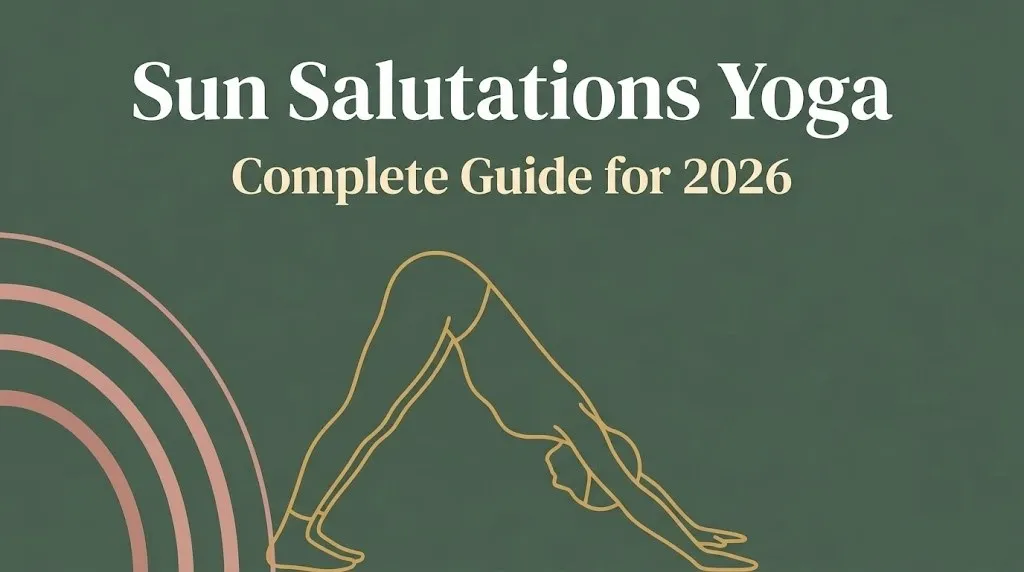
To practice Sun Salutation A:
- Begin in Tadasana (Mountain Pose). Stand at the top of your mat. Feet together or hip-width apart. Arms at your sides. Take one full breath here.
- Inhale into Urdhva Hastasana (Upward Salute). Sweep your arms overhead. Press your palms together or keep them shoulder-width apart. Gaze forward or slightly up.
- Exhale into Uttanasana (Standing Forward Bend). Hinge at your hips. Let your torso fall toward your thighs. Bend your knees generously if your hamstrings are tight.
- Inhale into Ardha Uttanasana (Half Standing Forward Bend). Lift your chest halfway up. Lengthen your spine flat. Hands can rest on shins or thighs.
- Exhale and step or jump back to Plank Pose. Align your wrists under your shoulders. Engage your core. Keep your hips level with your shoulders.
- Lower on your exhale into Chaturanga Dandasana (Four-Limbed Staff Pose). Bend elbows to 90 degrees. Keep elbows tracking toward your ribs. Beginners: lower the knees first.
- Inhale into Urdhva Mukha Svanasana (Upward-Facing Dog) or Bhujangasana (Cobra Pose). Press the tops of your feet down. Lift your chest. Only your hands and feet (or tops of feet) touch the floor.
- Exhale into Adho Mukha Svanasana (Downward-Facing Dog). Press your hips up and back. Pedal your heels gently. Hold for 5 breaths in the traditional Ashtanga format.
- Inhale and step or jump your feet to your hands. Return to Ardha Uttanasana briefly.
- Exhale fully into Uttanasana.
- Inhale back to Urdhva Hastasana. Sweep arms wide and up.
- Exhale and return to Tadasana. Lower your arms. That completes one full round.
Pose Tip:
- In Chaturanga Dandasana, dropping your hips below your elbows strains the rotator cuff. Keep hips level.
- In Downward-Facing Dog, micro-bend your knees if your hamstrings pull your lower back into a curve.
- Beginners: use Bhujangasana (Cobra Pose) instead of Urdhva Mukha Svanasana. Keep your hips on the floor.
Sun Salutation B: How It Differs and When to Use It
Surya Namaskar B (Sun Salutation B) builds on the A variation by adding two standing poses: Utkatasana (Chair Pose) and Virabhadrasana I (Warrior I).
Sun Salutation B is longer, more demanding, and generates significantly more heat in the body. Ashtanga tradition practices five rounds of A followed by five rounds of B at the start of every session. Vinyasa teachers often use B as the middle portion of a warm-up, once the body is moving.
To practice Sun Salutation B:
- Begin in Tadasana (Mountain Pose).
- Inhale into Utkatasana (Chair Pose). Bend your knees deeply. Sink your hips back as if lowering onto a chair. Reach both arms overhead. Keep your chest from collapsing forward.
- Exhale into Uttanasana (Standing Forward Bend).
- Inhale to Ardha Uttanasana (Half Standing Forward Bend).
- Exhale to Chaturanga Dandasana (Four-Limbed Staff Pose). Keep your core firm.
- Inhale to Urdhva Mukha Svanasana (Upward-Facing Dog).
- Exhale to Adho Mukha Svanasana (Downward-Facing Dog). Hold briefly.
- Inhale and step your right foot forward. Spin your left heel down at a 45-degree angle. Rise into Virabhadrasana I (Warrior I). Arms reach overhead. Square your hips forward as best you can.
- Exhale back to Chaturanga Dandasana.
- Inhale to Upward-Facing Dog.
- Exhale to Downward-Facing Dog.
- Inhale and step your left foot forward. Repeat Virabhadrasana I on the left side.
- Exhale back through Chaturanga.
- Inhale to Upward-Facing Dog.
- Exhale to Downward-Facing Dog. Hold for one breath.
- Inhale and step or jump forward. Return through Ardha Uttanasana.
- Exhale to Uttanasana.
- Inhale to Utkatasana.
- Exhale to Tadasana. That completes one full round of B.
Modification: In Utkatasana, keep your knees tracking over your second toe. If your knees ache, reduce the depth of your bend. For wrist sensitivity, use fists instead of flat palms on the floor.
Sun Salutation A vs B: Key Differences Explained
The differences between Surya Namaskar A and Surya Namaskar B go beyond just length. Each version trains different qualities in the body.
| Feature | Sun Salutation A | Sun Salutation B |
|---|---|---|
| Poses in sequence | 12 | 17 |
| Additional standing poses | None | Utkatasana, Virabhadrasana I |
| Duration per round | 60 to 90 seconds | 2 to 3 minutes |
| Intensity level | Moderate | High |
| Primary training focus | Spinal mobility, warm-up | Leg strength, heat building |
| Best used for | Beginning of practice | Middle warm-up, after A |
| Recommended for beginners | Yes | After 4 to 6 weeks of A |
| Ashtanga tradition rounds | 5 rounds at practice start | 5 rounds following A |
Practically speaking, start with A. Master the breath-movement connection and the basic transitions. Then add B when you can move through A without stopping to think about the next pose.
Key Takeaway: Sun Salutation A builds the foundation; Sun Salutation B adds leg strength and intensity. Most teachers recommend 4 to 6 weeks of A before introducing B regularly.
The Breath Pattern in Sun Salutations
Every transition in sun salutations is breath-led, which is what separates this from generic calisthenics and ties it directly to yoga’s neurological benefits.
The rule is consistent: inhale to expand, exhale to compress or fold. Movements that open the chest, lift the arms, or extend the spine happen on the inhale. Movements that fold the torso forward, lower the body, or compress the abdomen happen on the exhale.
| Movement | Breath |
|---|---|
| Arms sweep overhead (Upward Salute) | Inhale |
| Forward fold (Uttanasana) | Exhale |
| Half lift (Ardha Uttanasana) | Inhale |
| Step back to Plank, lower to Chaturanga | Exhale |
| Press up to Upward-Facing Dog | Inhale |
| Press back to Downward-Facing Dog | Exhale |
| Step forward, half lift | Inhale |
| Forward fold | Exhale |
| Arms sweep up | Inhale |
| Return to standing | Exhale |
Many Ashtanga and Vinyasa teachers cue Ujjayi pranayama (victorious breath) throughout. This is a slightly constricted breath through the nose that creates an audible ocean-like sound. Research published in the International Journal of Yoga has linked Ujjayi breath practice to reduced heart rate and improved parasympathetic tone, meaning it actively calms the nervous system even during vigorous movement.
Breath Tip: If you run out of breath mid-sequence, pause in Downward-Facing Dog for an extra inhale and exhale. Never hold your breath to keep pace.
What Muscles Do Sun Salutations Work?
Sun salutations work nearly every major muscle group in the body, which is why they function as a standalone full-body conditioning tool, not just a yoga warm-up.
The sequence moves through pushing, pulling, hinging, and extending patterns. That variety is part of its efficiency.
Primary muscles engaged by pose:
- Tadasana and Urdhva Hastasana: Postural muscles of the spine (erector spinae), shoulder stabilizers (serratus anterior, trapezius)
- Uttanasana and Ardha Uttanasana: Hamstrings, calves (gastrocnemius and soleus), erector spinae under eccentric load
- Plank Pose: Core stabilizers (transverse abdominis, rectus abdominis, obliques), shoulder girdle, wrist extensors
- Chaturanga Dandasana: Triceps brachii, pectorals, anterior deltoids, core throughout
- Urdhva Mukha Svanasana (Upward-Facing Dog): Spinal extensors, glutes, wrist flexors and extensors, anterior shoulder
- Adho Mukha Svanasana (Downward-Facing Dog): Hamstrings, calves, deltoids, triceps, wrist flexors
- Virabhadrasana I (Sun Salutation B): Quadriceps, gluteus maximus, hip flexors (lengthening), shoulder flexors
- Utkatasana (Sun Salutation B): Quadriceps, gluteus medius, ankle stabilizers
According to a study published in the Journal of Bodywork and Movement Therapies, Chaturanga Dandasana generates muscle activation levels comparable to a modified push-up, specifically in the pectorals and triceps, making it a meaningful upper body strengthening exercise when performed with correct alignment.
Sun Salutation Benefits for the Body and Mind
Sun salutations benefit the body by building strength, improving flexibility, and supporting cardiovascular health, all within a single brief daily practice.
The physical benefits accumulate across four main systems:
Musculoskeletal: Regular practice lengthens the hamstrings, opens the hip flexors, and builds functional upper body and core strength. A 2022 study published in the International Journal of Yoga found that 12 weeks of daily Surya Namaskar practice produced measurable improvements in spinal flexibility and upper body endurance in previously sedentary adults.
Cardiovascular: Practiced at a brisk pace of one round every 60 seconds, sun salutations elevate heart rate into a light aerobic zone. The American College of Sports Medicine classifies yoga sequences at this intensity as moderate-intensity physical activity, meeting partial weekly movement recommendations for healthy adults.
Nervous system: The synchronized breath-movement pattern activates the parasympathetic nervous system, reducing circulating cortisol. According to the NCCIH, yoga practices that combine controlled breathing with physical movement show consistent evidence for reducing self-reported stress and anxiety symptoms across multiple study populations.
Mental focus: The structured sequence demands present-moment attention. Each transition requires you to track your breath, your body position, and the next movement simultaneously. Over time, that attentional training generalizes beyond the mat.
Key Takeaway: Sun salutations work the full body structurally, support the cardiovascular system, and calm the nervous system simultaneously. That three-system effect is what makes them more efficient than most single-modality exercises.
Sun Salutations and Weight Loss: What the Research Says
Sun salutations can support weight management, but calling them a weight loss tool requires some honest context about what the research actually shows.
A study published in the Journal of Yoga & Physical Therapy found that 24 rounds of Surya Namaskar performed daily over 6 months led to statistically meaningful reductions in body weight and body mass index in overweight women. The average caloric expenditure was approximately 13.9 calories per minute during active practice, comparable to a moderate-intensity aerobic session.
That’s a real finding. But 24 rounds daily is a high-volume practice that most beginners won’t reach for several months. Starting with 5 to 10 rounds produces health benefits, including improved metabolic markers and reduced waist circumference, without requiring an elite-level commitment.
The honest position: sun salutations support weight management most effectively when combined with consistent nutrition habits and adequate sleep. They are not a shortcut. What they offer is a sustainable, joint-friendly daily movement habit that adds up over months and years.
Caloric Comparison (Approximate, based on 150 lb/68 kg individual):
| Activity | Calories per 10 minutes |
|---|---|
| Sun Salutations (moderate pace) | 100 to 130 |
| Walking (3.5 mph) | 55 to 65 |
| Cycling (moderate) | 90 to 110 |
| Light jogging | 110 to 130 |
How Many Sun Salutations Should You Do Per Day?
The right number of sun salutations per day depends on your experience, your goals, and your recovery capacity, but most yoga teachers and movement researchers agree on a practical starting range.
For beginners, 3 to 6 rounds of Sun Salutation A is a reasonable daily target. That takes 5 to 10 minutes. It’s enough to warm the body, create some cardiovascular response, and build the movement pattern into muscle memory without overwhelming someone new to the practice.
Intermediate practitioners often practice 10 to 12 rounds of combined A and B sequences. In the traditional Ashtanga format, that means 5 rounds of A followed by 5 rounds of B, which forms the opening section of the Primary Series.
For those seeking cardiovascular conditioning or weight management support, 24 rounds is the research-cited benchmark. Working up to that volume should take 6 to 12 weeks, not days.
Daily Round Guidelines by Experience Level:
| Experience Level | Recommended Daily Rounds | Approximate Time |
|---|---|---|
| Beginner (0 to 3 months) | 3 to 6 rounds (Salutation A) | 5 to 10 minutes |
| Intermediate (3 to 12 months) | 8 to 12 rounds (A and B) | 15 to 20 minutes |
| Advanced (1 year and beyond) | 12 to 24 rounds (A, B, and variations) | 25 to 45 minutes |
| Therapeutic or recovery use | 3 to 5 slow rounds (modified as needed) | 10 to 15 minutes |
Listen to your joints. Fatigue in the wrists or shoulders after 6 rounds is your body telling you 6 is the number for now.
Key Takeaway: Beginners should start with 3 to 6 rounds of Salutation A and build volume over weeks, not days. More rounds per day only help if your form and breath stay consistent throughout.
Sun Salutation Modifications for Beginners
Beginners can practice sun salutations safely by substituting gentler pose options at the points in the sequence that demand the most upper body strength or spinal flexibility.
The three most commonly modified sections are the lowering phase (Chaturanga), the backbend (Upward-Facing Dog), and the forward fold (Uttanasana).
Beginner Modifications Table:
| Pose | Standard Version | Beginner Modification |
|---|---|---|
| Chaturanga Dandasana | Full push-up style lower to 90 degrees | Lower knees first, then chest. Reduce load significantly. |
| Urdhva Mukha Svanasana | Hips off floor, arms straight | Bhujangasana (Cobra). Hips stay down. Elbows may bend. |
| Uttanasana | Straight legs, hands near floor | Knees bent generously. Hands on blocks or shins. |
| Adho Mukha Svanasana | Heels pressing toward floor | Knees bent. Focus on long spine, not straight legs. |
| Plank to step-back | Jump back both feet simultaneously | Step one foot back, then the other. Controlled and quiet. |
| Ardha Uttanasana | Spine fully flat, hands on floor | Hands on blocks at shin level. Focus on spinal length. |
Prop Tip: Place two yoga blocks at medium height under your hands in Uttanasana and Ardha Uttanasana. This shortens the distance to the floor and removes strain from the lower back and hamstrings immediately.
Chair Sun Salutations for Seniors and Limited Mobility
Chair sun salutations adapt the full Surya Namaskar sequence to a seated or standing-with-support format, making it accessible to seniors, people recovering from injury, and anyone whose balance or joint health requires additional support.
The core structure of the sequence remains intact: breath leads movement, the body moves through extension and flexion, and the nervous system benefits carry through regardless of whether you’re on a mat or in a chair.
Chair Sun Salutation Sequence (Seated Variation):
- Sit tall at the front edge of a sturdy chair. Place feet flat on the floor. Hands rest on thighs. Take one grounding breath.
- Inhale and sweep both arms overhead, palms facing. Lengthen through the spine.
- Exhale and hinge forward from the hips. Let your hands lower toward your feet or rest on your thighs. Gentle forward fold.
- Inhale and lift back halfway. Hands on thighs. Spine long.
- Exhale and fold again. Soften the neck.
- Inhale and sweep the arms back up overhead.
- Exhale the arms down to your sides. Return to upright seated position.
- That completes one round. Repeat 3 to 5 times.
For standing support, perform the sequence while holding the back of the chair with one hand. Step one foot back instead of jumping back. Use the chair seat to support yourself during the forward fold.
According to a 2021 review in Complementary Therapies in Medicine, adapted yoga sequences for older adults showed measurable improvements in balance, functional mobility, and self-reported quality of life after 8 weeks of regular practice. Chair-based formats specifically reduced fall-related fear without reducing participation.
Sun Salutations for Back Pain: What to Know
Sun salutations can be genuinely helpful for certain types of back pain, but they require careful modification, especially in the backbend and forward fold phases.
For people with non-specific chronic lower back pain, a slow, modified Surya Namaskar practice can reduce pain over time. A study published in the Annals of Internal Medicine found that yoga was as effective as physical therapy for chronic low back pain in reducing pain intensity and improving functional movement over 12 weeks.
The poses that require the most attention for anyone with back pain are:
- Uttanasana (Standing Forward Bend): Always bend your knees. Never force a straight-leg fold if your lower back rounds aggressively.
- Chaturanga Dandasana: If your lower back arches or your hips drop, your lumbar spine bears excess load. Lower knees first every time.
- Urdhva Mukha Svanasana (Upward-Facing Dog): This is the highest-demand backbend in the sequence. People with lumbar disc issues should replace it with Bhujangasana (Cobra Pose) and keep the elbows bent.
- Adho Mukha Svanasana (Downward-Facing Dog): Tight hamstrings pull the pelvis into a posterior tilt and flatten the lumbar curve. Bend your knees liberally to keep the spine long.
People with acute back injuries, herniated discs, or sciatica flare-ups should work with a physical therapist or qualified yoga therapist before practicing any full sequence. This is not a precaution to wave away.
Sun Salutation Contraindications: Who Should Be Cautious
Sun salutations are safe for most healthy adults, but specific conditions require meaningful modifications or a medical conversation before beginning.
Conditions requiring caution or modification:
- Wrist injuries or carpal tunnel syndrome: Weight-bearing on flat palms in Plank and Chaturanga compresses the wrist joint. Use fist variations (knuckles down), place forearms on the floor, or use wedge props under the palms to reduce extension angle.
- High blood pressure (unmanaged): The inversions in the sequence, particularly Downward-Facing Dog and forward folds, shift blood pressure in the head. People with hypertension should practice slowly, avoid breath-holding, and work with their prescribing physician to determine appropriate activity intensity.
- Pregnancy (second and third trimester): The prone backbend poses press against the abdomen. A certified prenatal yoga instructor can provide a complete pregnancy-adapted version of the sequence.
- Recent shoulder surgery or rotator cuff tear: Chaturanga and Upward-Facing Dog both demand significant rotator cuff stability. These should be skipped entirely post-surgery until cleared by a physical therapist.
- Severe osteoporosis: Spinal flexion under load (forward folds with body weight) carries fracture risk at the vertebral bodies in people with significant bone density loss. Work with a yoga therapist trained in bone health before practicing.
- Vertigo or inner ear conditions: The repeated transitions between standing and floor positions can trigger dizziness. Chair-based modifications remove this risk entirely.
When to pause mid-sequence:
- Sharp pain anywhere. Pressure or pulling is normal. Sharp pain is not.
- Wrist or shoulder pain that does not resolve within one breath.
- Lightheadedness or shortness of breath beyond normal exertion.
Key Takeaway: The sequence is broadly accessible, but wrist health, blood pressure, pregnancy, and spinal conditions all need individualized attention. Modifying the sequence is not failure. It’s smart practice.
Sun Salutations as a Daily Yoga Warm-Up Sequence
As a warm-up tool, sun salutations work because they systematically prepare every joint and muscle group that a typical yoga class or athletic session will demand.
Think of your connective tissue before movement like cold taffy. It’s stiff, it resists, and forcing it creates tearing rather than lengthening. Sun salutations heat the tissue gradually, raise core body temperature, and stimulate synovial fluid production in the joints, which is the body’s natural lubrication system.
Three rounds of Surya Namaskar A, performed slowly and with full breath, raise the heart rate modestly, increase spinal mobility measurably, and prepare the shoulders and hips for weight-bearing poses like arm balances or deep hip openers.
Warm-Up Timing Guide:
| Practice Goal | Recommended Warm-Up Rounds | Pace |
|---|---|---|
| Gentle Hatha class | 3 rounds of A only | Slow |
| Vinyasa flow class | 5 rounds of A, 3 rounds of B | Moderate |
| Strength or arm balance work | 5 rounds of A, 5 rounds of B | Moderate to brisk |
| Athletic training warm-up | 3 to 5 rounds of A | Slow to moderate |
| Restorative or Yin session | Optional. 2 slow rounds of A only | Very slow |
As a standalone morning practice, 10 minutes of sun salutations at a moderate pace addresses cardiovascular activation, flexibility, and stress regulation before the rest of the day begins.
Sun Salutations Yoga Flow: How to Build a Full Practice Around It
Sun salutations yoga flow becomes a complete practice when you layer structured sequences before and after the core rounds, creating a session with a clear arc: opening, peak, and settling.
A well-designed flow built around sun salutations follows this pattern:
Full 45-Minute Sun Salutation-Based Practice:
- Opening (5 minutes): Seated or lying breathwork. Bring attention inward. Set a breath rhythm before the body starts moving.
- Sun Salutation A warm-up (10 minutes): 3 to 5 rounds at a slow to moderate pace. Focus on breath timing and joint awareness, not speed.
- Sun Salutation B peak (15 minutes): 3 to 5 rounds building to your working pace. This is your cardiovascular and strength center.
- Standing pose sequence (10 minutes): Add 2 to 3 standing poses like Trikonasana (Triangle Pose), Virabhadrasana II (Warrior II), or Ardha Chandrasana (Half Moon Pose). These expand on the hip and leg opening begun in the salutations.
- Cool-down and floor sequence (5 minutes): Settle into a seated forward fold, a supine spinal twist, and Savasana (Corpse Pose). Let the nervous system complete its parasympathetic reset.
This structure applies whether you’re practicing at home alone or following a Vinyasa class format. The salutations are the engine. Everything else builds on the foundation they create.
A 2023 study in the Journal of Alternative and Complementary Medicine found that structured yoga sessions following this warm-to-peak-to-cool format produced greater improvements in perceived stress and physical recovery compared to unstructured yoga movement of the same duration. Structure matters.
Frequently Asked Questions About Sun Salutations Yoga
What are sun salutations in yoga for beginners?
Sun salutations are a linked sequence of yoga poses synchronized with breath, designed to warm the body and build foundational movement patterns.
Beginners start with Surya Namaskar A, which includes 12 poses moving through standing, folding, and floor-based backbend positions.
Start with 3 rounds at a slow pace and replace Chaturanga with a knees-down lowering to make the sequence immediately accessible.
How many sun salutations should you do a day to see results?
Most yoga teachers recommend 3 to 6 rounds daily for beginners to establish the movement pattern and begin seeing flexibility improvements within 2 to 4 weeks.
Research on more significant physical conditioning results, including weight management and upper body endurance, cites 12 to 24 rounds daily as the working volume.
Build your rounds gradually over 8 to 12 weeks rather than starting at high volume.
What muscles do sun salutations work?
Sun salutations work the hamstrings, hip flexors, quadriceps, core stabilizers, triceps, pectorals, deltoids, and spinal extensors across the full sequence.
No single pose targets all these groups. The value comes from moving through each transition in order, which trains the body through multiple movement patterns in one session.
Is sun salutation good for weight loss?
Sun salutations can support weight management as part of a consistent daily practice. Research published in the Journal of Yoga & Physical Therapy found approximately 13.9 calories burned per minute during active practice.
They are most effective for weight management when practiced at higher daily volumes (12 to 24 rounds) combined with consistent nutrition habits.
Can you do sun salutations every day?
Yes, most healthy adults can practice sun salutations every day without recovery concerns, especially at moderate volumes of 5 to 12 rounds.
The sequence is low-impact enough for daily use when performed with correct alignment. Listen to wrist and shoulder fatigue as your primary signals to reduce volume.
People with active injuries or joint inflammation should rest those tissues and practice modified or chair-based versions during recovery.
Sun salutations are as practical as yoga gets. They ask for 10 minutes, a mat, and your breath. In return, they warm your entire body, calm your nervous system, and build real strength over time.
Start today with 3 rounds of Surya Namaskar A. Move slowly. Let the breath lead. Use blocks under your hands if the floor feels far away. Your only job in the first week is to learn the order of the poses without stopping to think about it.
Come back to those 3 rounds every morning. Add one round per week. Within a month, you’ll have a practice worth building on