Yoga Belt Strap Guide: Poses, Benefits, and How to Use
A yoga belt strap is one of the most underused and misunderstood props in yoga, and once you understand how to use it correctly, it changes the quality and safety of your practice in ways that no amount of forcing ever could. This guide covers everything you need to know: which strap to buy, the specific poses it supports, who benefits most, and exactly how to use it without hurting yourself.
Prop-assisted yoga practice has a documented evidence base. According to the National Center for Complementary and Integrative Health (NCCIH), yoga is practiced by more than 21 million American adults, and props like straps are specifically recommended by yoga therapists and physical therapists to make poses accessible when range of motion is limited by tight tissue rather than structural restriction.
You’ll find step-by-step strap exercises with alignment cues, a clear buying guide covering length, material, and buckle type, and specific guidance for beginners, seniors, people managing back pain, and anyone recovering from a hamstring or shoulder injury. No fluff. No filler. Just what you need to actually use this prop well.
What Is a Yoga Belt Strap and What Is It Used For
A yoga belt strap is a long, flat, flexible band used in yoga practice to extend a practitioner’s reach, support alignment in poses where flexibility is a limiting factor, and allow safe, sustained holds in stretches that would otherwise be inaccessible. It functions as an arm extender, a holding tool, and a feedback device for proper alignment.
The strap does not do the stretching for you. Think of it the way you’d think about a handrail on a staircase. The rail doesn’t carry you up the stairs. It gives you a point of contact that makes the movement more controlled, safer, and less dependent on compensatory effort. A yoga strap works identically: it gives your hands a point of contact that allows your spine and shoulders to stay in correct position while your hamstrings or hips gradually lengthen over time.
Yoga straps are used most often in these situations:
- Reaching the foot in hamstring stretches when the hamstrings are too tight to bridge the gap without rounding the spine
- Shoulder openers where the hands cannot yet clasp behind the back
- Reclining leg stretches where the leg cannot fully extend while the hip remains stable
- Seated forward folds where spinal rounding compensates for hamstring restriction
- Restorative poses where the strap loops around the body to hold a position passively without muscular effort
According to the Yoga Alliance, props including straps are a foundational element of Iyengar yoga, the style specifically developed around safe, alignment-precise practice for all body types and abilities. The strap is not a beginner’s crutch. It is a precision tool used by practitioners at every level.
Yoga Belt Strap vs Yoga Belt: Is There a Difference
A yoga belt strap and a yoga belt refer to the same piece of equipment, with “yoga belt” being the older, more traditional term and “yoga belt strap” being the more common modern search and product name. The terms are interchangeable in practice and in retail contexts.
The traditional yoga community, particularly in Iyengar yoga, uses “yoga belt” because the prop was introduced as part of B.K.S. Iyengar’s system of prop-supported alignment practice. As hot yoga, home yoga, and commercially marketed yoga equipment expanded in the United States, “yoga strap” and “yoga belt strap” became the dominant consumer-facing terminology.
There is one minor practical distinction worth noting. Some products marketed as “yoga belts” are wider, stiffer bands designed specifically for Restorative and Yin yoga, where the strap loops around the body (around the ankles in Supta Baddha Konasana (Reclining Bound Angle Pose), for example) rather than being gripped by the hands. Standard yoga straps are narrower, typically 1 to 1.5 inches wide, and designed for hand-gripping.
Quick Summary:
| Term | Traditional Use | Modern Use | Width |
|---|---|---|---|
| Yoga belt | Iyengar yoga tradition | Still used, especially in studios | 1 to 1.5 inches |
| Yoga strap | Home yoga, commercial retail | Most common term in the US market | 1 to 1.5 inches |
| Yoga belt strap | Combined search term | Common in product descriptions | 1 to 1.5 inches |
| Wide yoga belt | Restorative, Yin yoga | Body-wrapping holds | 2 to 3 inches |
Do You Really Need a Yoga Strap for Your Practice
You need a yoga strap if any pose in your practice requires you to compromise your spinal alignment to reach your foot, clasp your hands, or maintain a hold. If you’re rounding your back in Paschimottanasana (Seated Forward Fold) to grab your toes, you need a strap. If your shoulders hike up toward your ears every time you try a hamstring stretch, you need a strap.
The honest answer is that most people would benefit from using a strap more than they currently do, and most people resist using one because it feels like an admission that they’re “not flexible enough.” This logic is backwards. Flexibility is the goal of using the strap, not the prerequisite for it.
Physical therapists and yoga therapists consistently recommend prop-assisted stretching for patients with hamstring tightness, hip restrictions, and shoulder mobility limitations because it allows tissue to lengthen at its actual current limit rather than forcing the joint to compensate. A strap used correctly produces faster flexibility gains than forcing a pose without one, because the correct alignment means the target tissue is actually being stretched rather than the nearby compensating structures.
Who genuinely needs a yoga strap:
- Beginners with limited hamstring or shoulder mobility
- Practitioners over 50 whose connective tissue has less natural elasticity
- People recovering from hamstring strains, rotator cuff issues, or hip surgery
- Pregnant practitioners who cannot reach their feet as the belly grows
- Anyone whose spine rounds before their target muscle is actually being stretched
Key Takeaway: A yoga strap is not for people who can’t do yoga. It is for people who want their yoga poses to actually work on the right muscles instead of the wrong ones.
How to Choose the Right Yoga Strap: Length, Material, and Buckle
Choosing the right yoga belt strap means matching the strap’s length, material, and buckle type to your body height, intended use, and the specific poses you practice most. Getting all three right makes the difference between a prop that genuinely helps and one that sits in a drawer.
Length is the most important variable. A strap that is too short forces you back into the reaching and compensating pattern you’re trying to escape. A strap that is too long creates excess slack that is awkward to manage during a pose. General guidance:
- 6-foot straps: Best for practitioners under 5’4″ or for upper body work (shoulder openers, binding attempts)
- 8-foot straps: The most versatile length, suitable for most adults up to 6′ for hamstring and hip work
- 10-foot straps: Best for taller practitioners, full-body stretching sequences, and Restorative holds where the strap loops around multiple body parts
Material affects grip, durability, and skin feel. Cotton is the most common and the most comfortable against bare skin. It grips well when dry and is machine washable. Nylon is more durable and holds buckles more securely, but it can feel slippery against skin. Hemp is a sustainable option with texture similar to cotton but with greater durability over time.
Buckle type affects ease of adjustment during practice. A D-ring buckle is simple, reliable, and inexpensive. A cinch (cam) buckle allows faster single-hand adjustment, which matters when you’re mid-pose and need to shorten the loop. A quick-release buckle adds convenience but is less common and sometimes less durable than D-ring or cinch options.
Yoga Strap Length Guide: 6-Foot vs 8-Foot vs 10-Foot
The standard yoga strap lengths available are 6 feet, 8 feet, and 10 feet, and the right choice depends on your height, arm length, and the types of stretches you’ll primarily use the strap for. Most yoga teachers recommend an 8-foot strap as the default because it works for the widest range of bodies and poses.
Here is a practical guide:
| Strap Length | Best For | Practitioner Height | Primary Use Cases |
|---|---|---|---|
| 6 feet | Shoulder work, shorter practitioners | Under 5’4″ | Shoulder openers, seated forward fold, binding poses |
| 8 feet | General practice, most adults | 5’4″ to 6’0″ | Hamstring stretches, hip openers, reclining poses, most standing stretches |
| 10 feet | Tall practitioners, Restorative, full-body loops | Over 6’0″ or anyone doing body-wrap Restorative holds | Supta Baddha Konasana loops, tall body hamstring work, full shoulder sequences |
If you are unsure which length to start with, 8 feet is the correct default. An 8-foot strap has enough length for full hamstring stretches on a 6-foot body and can be shortened by folding and gripping closer to the buckle end for shorter-reach work.
One practical tip experienced teachers consistently give: buy one longer strap rather than a shorter one. You can always grip the strap higher up to create a shorter functional length. You cannot add length to a strap that is already too short.
D-Ring vs Cinch Buckle Yoga Strap: Which Is Better
A D-ring buckle yoga strap uses two metal D-shaped rings through which the strap threads and folds back on itself to lock in place, while a cinch (cam) buckle uses a spring-loaded mechanism that grips the strap when tension is applied and releases when pressed. Both hold reliably during practice. The differences are about ease of use and adjustment speed.
D-ring buckles are the most common type. They are simple, nearly indestructible, and require no moving parts that can wear out. The adjustment process requires two hands: you release the strap, rethread it to a new length, and retighten. For most yoga poses, this two-hand adjustment happens before you get into position, so it works fine.
Cinch buckles allow single-handed mid-pose length adjustment. If you’re in Supta Padangusthasana (Reclining Hand-to-Big-Toe Pose) and want to shorten the strap as your hamstring warms up, a cinch buckle lets you pull one end with one hand without releasing the entire loop. This is a genuine convenience advantage during long holds.
| Feature | D-Ring Buckle | Cinch (Cam) Buckle |
|---|---|---|
| Ease of adjustment | Requires two hands | Can adjust with one hand mid-pose |
| Reliability | Very high (no moving parts) | High (mechanism can wear with heavy use) |
| Price | Lower | Slightly higher |
| Best for | Beginners, general practice | People who do long holds and adjust frequently |
| Durability over time | Excellent | Good; check mechanism periodically |
| Common in Iyengar practice | Yes | Less common in traditional studios |
For a first yoga strap purchase, a D-ring cotton strap in 8 feet is the most practical starting point for most practitioners.
Key Takeaway: For most practitioners, an 8-foot cotton strap with a D-ring buckle covers every use case at a low cost with maximum durability. Upgrade to a cinch buckle when long holds with frequent mid-pose adjustments become part of your regular practice.
How to Use a Yoga Belt Strap: Step-by-Step for Key Poses
Using a yoga belt strap correctly means looping it around the relevant body part, holding the strap at a length that allows the spine to stay in its natural position, and never using shoulder or arm tension to pull yourself into a stretch. The strap holds the position. Your muscles do the lengthening.
Here is how to use the strap in Paschimottanasana (Seated Forward Fold), one of the most common strap applications:
- Sit on the floor with legs extended in front of you. Place a folded blanket under the sitting bones if the pelvis tilts backward.
- Loop the strap around both feet, holding one end of the strap in each hand.
- Sit tall, lengthening the spine upward before hinging forward. The movement begins at the hips, not the waist.
- Hinge forward from the hips until you feel a stretch in the hamstrings. Stop there. Do not round the spine to go further.
- Hold the strap at the length where your spine stays long. If the spine rounds, you have gone too far. Shorten the hold by gripping closer to your feet on the strap.
- Hold for 5 to 10 breath cycles, approximately 30 to 60 seconds. Inhale to lengthen. Exhale to deepen the hip hinge slightly.
- Release the strap and sit upright to exit.
Modification for beginners: If the pelvis tips backward and the lower back rounds immediately upon sitting, place a folded blanket or yoga block under the sitting bones before looping the strap. Elevating the hips allows the pelvis to tilt forward, making the hip hinge accessible.
Modification for seniors or people with hamstring injuries: Bend the knees to 45 degrees rather than extending the legs fully. Loop the strap around the arches of the feet and hinge forward only until a mild stretch is felt. Full knee extension is the long-term goal, not the starting requirement.
Yoga Strap Exercises for Hamstrings and Tight Hips
The yoga belt strap is most commonly used for hamstring and hip stretches, because these are the areas where limited flexibility most frequently causes practitioners to compensate with spinal rounding or joint stress. The strap restores the mechanical relationship between the pelvis and the leg, allowing the target muscle to actually lengthen.
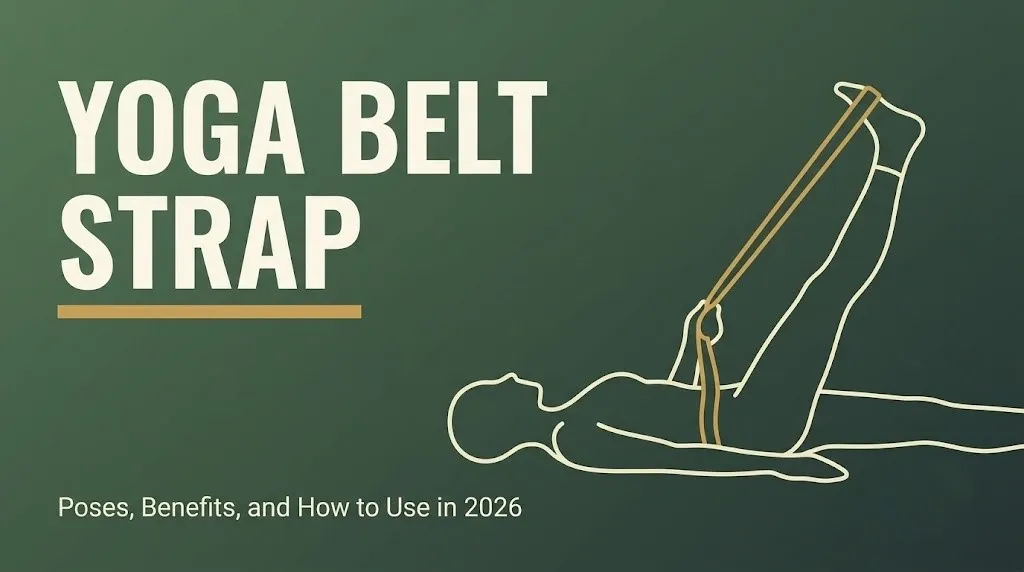
Supta Padangusthasana (Reclining Hand-to-Big-Toe Pose) with a strap is the single most effective tool for isolated hamstring lengthening in yoga. Here is how to practice it correctly:
- Lie on your back with both legs extended on the floor.
- Loop the strap around the arch of the right foot. Hold one end of the strap in each hand.
- Press the back of the left leg firmly into the floor. This stabilizes the pelvis and prevents the opposite hip from rising.
- Inhale, then on the exhale, lift the right leg toward the ceiling, stopping when the hamstrings produce a clear but comfortable stretch sensation.
- Keep the knee of the lifted leg straight if possible. If straightening the knee causes sharp discomfort in the back of the knee, keep a slight bend.
- Hold for 8 to 10 breath cycles. The leg does not need to reach 90 degrees to produce benefit.
- Slowly lower the leg on an exhale. Switch sides.
For tight hip work, loop the strap around the top of the foot in a hip flexor-opening version: lie prone, bend the knee, and use the strap to gently draw the heel toward the glute while keeping the hip bones pressing into the floor.
Safety note: Do not use the strap to pull the leg aggressively toward you. The hamstring should feel a sustained, steady stretch sensation, not a sharp pull. Sharp or shooting pain down the back of the leg should prompt you to immediately release and reduce the range.
Yoga Strap for Shoulder Openers and Upper Back Mobility
A yoga belt strap is one of the most effective tools for improving shoulder mobility and thoracic extension, particularly for people who sit at desks, drive frequently, or have chronically tight chest and shoulder tissue. The strap allows the arms to be positioned behind the body in ways that are impossible through grip alone when internal rotation restriction is present.
Think of your pectoral muscles and anterior deltoids like a jacket that has been worn too tight across the front for years. The seams (your posterior shoulder and thoracic spine) are being continuously pulled forward. A strap used in shoulder opening work begins to gently let out those seams, restoring the natural posterior shoulder positioning.
Gomukhasana (Cow Face Pose) arm variation with a strap:
- Stand or sit in any comfortable position.
- Raise the right arm overhead. Bend the elbow so the right hand drops down between the shoulder blades.
- Hold the top end of the strap in the right hand, letting it hang down the back.
- Bring the left arm behind the back, reaching upward from below to grip the strap.
- Gently walk the left hand up the strap toward the right hand. Stop when a strong stretch is felt across the left shoulder and chest.
- Keep the right elbow pointing directly up, not flaring out to the side. The rotator cuff is under load here.
- Hold for 5 to 8 breath cycles. Switch sides.
Modification: People with rotator cuff injuries or recent shoulder surgery should keep the strap long and the hands far apart. Avoid any position that produces pain rather than stretching sensation in the shoulder joint itself. If pain occurs in the joint (not just the muscle), release immediately and work with a physical therapist before progressing this stretch.
Key Takeaway: The yoga strap works for shoulders exactly as it works for hamstrings: it bridges the gap between where your hands are and where they need to be, so the spine and joint stay in correct position while the tight tissue gradually lengthens.
Yoga Strap Benefits: What Research Says About Prop-Assisted Stretching
Yoga belt straps produce real flexibility and alignment benefits when used consistently, and the research on prop-assisted stretching supports these outcomes more clearly than most yoga equipment marketing acknowledges.
A study published in the Journal of Bodywork and Movement Therapies found that consistent prop-assisted hamstring stretching over an 8-week period produced measurable improvements in active straight-leg raise range of motion in adults with chronic hamstring tightness. The prop-assisted group showed greater gains than the unassisted group, because maintaining correct pelvic position allowed the hamstring to lengthen along its full length rather than being partially obscured by lumbar compensation.
The American College of Sports Medicine notes that regular static stretching held for 15 to 60 seconds produces flexibility improvements over time, with consistency being more predictive of results than session length. A yoga strap enables consistent static stretching at the correct muscle end point by making the hold sustainable without compensatory muscle engagement.
Research in the International Journal of Yoga consistently links yoga practice that incorporates props with greater accessibility for older adults and people with limited baseline mobility, including improved balance, joint range of motion, and quality of life scores compared to unpropelled yoga practice in these populations.
Documented benefits of consistent yoga strap use include:
- Improved hamstring flexibility and straight-leg raise range of motion
- Reduced lumbar spine compensation during forward folds
- Greater shoulder external rotation over time in desk workers
- More sustainable long holds in Yin and Restorative yoga without muscular fatigue
- Accessible practice for individuals with limited baseline flexibility due to age, injury, or sedentary lifestyle
Yoga Stretch Straps for Beginners: Where to Start
Beginners using yoga stretch straps for the first time should start with one pose and one strap application rather than attempting multiple exercises in a first session. The strap introduces a new variable into your practice, and learning how it functions in one pose first means you’ll use it correctly across all others.
The best starting pose for a beginner strap user is Supta Padangusthasana (Reclining Hand-to-Big-Toe Pose). It is performed lying down, which removes balance as a variable. It isolates the hamstrings clearly so you can feel exactly what the strap is doing. And it allows you to practice the most important strap rule, which is maintaining a long spine while the target muscle works, in a position where spinal length is automatically supported by the floor.
After three to four sessions of comfortable strap use in a reclining hamstring stretch, add Paschimottanasana (Seated Forward Fold) with the strap. This introduces the seated hip hinge, which is the foundational movement pattern behind dozens of yoga poses. Once you can hinge from the hips rather than round the spine in a seated forward fold, your entire seated practice quality improves.
Beginner strap setup tips:
- Start with the strap looped wider than you think you need. You can shorten the loop during the hold as flexibility allows.
- Never grip the strap above the point where your spine starts to round. Rounding the spine is the signal to stop going further, not to use more effort.
- Hold the strap with soft hands and relaxed shoulders. Gripping tightly and raising the shoulders defeats the alignment purpose of the prop.
- Breathe consistently throughout every hold. Breath-holding during a stretch increases muscular tension and reduces flexibility gains.
Yoga Strap for Seniors: Safety, Technique, and Best Poses
A yoga strap is one of the safest and most beneficial props for seniors, because it allows access to the flexibility work that maintains joint health and functional mobility without requiring the end-range flexibility that most aging bodies have lost through years of reduced movement. The strap meets the body where it is, rather than demanding the body perform where it was decades ago.
According to the International Journal of Yoga, yoga practice adapted for older adults produces improvements in balance, joint mobility, and fall-prevention outcomes over 8 to 12-week programs. Props including straps are specifically cited as key adaptations that make these outcomes accessible to older participants.
For seniors, the three most beneficial strap applications are:
| Pose | Sanskrit Name | Primary Benefit for Seniors | Key Safety Note |
|---|---|---|---|
| Reclining Hand-to-Big-Toe | Supta Padangusthasana | Hamstring length, hip mobility, floor-level balance practice | Keep opposite leg pressed into floor; bend knee if hamstring pull is sharp |
| Seated Forward Fold | Paschimottanasana | Hamstring and low back length; hip hinge pattern | Sit on a folded blanket; never round the spine to reach further |
| Cow Face Arms | Gomukhasana (arms only) | Shoulder mobility, rotator cuff flexibility | Keep the strap long; never force the hands toward each other |
Safety note specific to seniors: Never use the strap to force a range of motion beyond what the tissue allows comfortably. For older adults, whose connective tissue has less elasticity than in younger years, the appropriate stretch sensation is mild to moderate, never sharp or burning. Stop any strap stretch immediately if joint pain (rather than muscle stretch) is felt.
Yoga Strap for Back Pain and Injury Recovery
A yoga belt strap is commonly recommended by physical therapists and yoga therapists for people managing chronic low back pain or recovering from hamstring, hip, or shoulder injuries, because it allows therapeutic stretching without the spinal loading or compensatory movement patterns that often aggravate these conditions.
The NCCIH identifies yoga as an evidence-supported intervention for non-specific chronic low back pain. The strap’s role in back pain management is specific: it allows practitioners to achieve the hamstring and hip flexor length that reduces posterior pelvic tilt and lumbar loading, without forcing the lumbar spine into the flexion positions that worsen most disc and facet conditions.
For hamstring injury recovery, the strap is valuable because it allows progressive, controlled increases in range of motion over weeks without the tendon being placed under sudden, high-load demand. Yoga teachers and physical therapists generally recommend beginning strap-assisted hamstring work at 50 to 60 percent of perceived maximum range, holding for 10 to 15 breath cycles, and increasing range only when that level feels entirely comfortable.
Important modification for people with disc herniations: In Paschimottanasana (Seated Forward Fold), anyone with an active lumbar disc herniation should avoid full spinal flexion, even with a strap. Instead, place a bolster across the thighs and fold forward until the chest rests on the bolster. The strap loops around the feet and is held loosely, providing tactile feedback without pulling. This passive, supported version provides hamstring input without compressing the posterior disc.
Key Takeaway: For back pain and injury recovery, the yoga strap’s value is not about going further. It is about going to the right place, the actual target muscle, without loading the vulnerable structure nearby.
Yoga Strap vs Resistance Band: Which Should You Use
A yoga belt strap and a resistance band are fundamentally different tools that serve different purposes, and choosing between them depends on whether your goal is flexibility and alignment support or strengthening and loaded movement. They are not interchangeable.
A yoga strap is a non-elastic, fixed-length prop. It holds a position. It does not push back. When you loop a yoga strap around your foot in a hamstring stretch, the strap provides a stable endpoint that your hands can hold without the spine compensating. It does not add resistance to the movement. Its value is entirely in the support and reach extension it provides.
A resistance band is elastic. It provides progressive resistance that increases as the band is stretched. It is designed for strengthening exercises, rehabilitation protocols involving muscular loading, and functional movement training. Using a resistance band in a yoga flexibility context produces an inconsistent, elastic endpoint that varies with every shift of position, which undermines the alignment precision that a strap is designed to provide.
| Feature | Yoga Strap | Resistance Band |
|---|---|---|
| Elasticity | None. Fixed length. | High. Variable resistance. |
| Primary purpose | Flexibility, alignment support, reach extension | Strengthening, rehabilitation loading |
| Use in yoga poses | Yes, specifically designed for this | Limited and imprecise |
| Use in physical therapy | Flexibility protocols | Strengthening protocols |
| Best for tight hamstrings | Yes | No |
| Best for shoulder strengthening | No | Yes |
| Price range | $8 to $20 | $5 to $25 |
Use a yoga strap for flexibility and pose access. Use a resistance band for strengthening. Both can be part of a well-rounded home practice. They are not substitutes for each other.
Yoga Strap Safety Tips: How Tight Is Too Tight
A yoga strap should be firm enough to hold its position without slipping, but never tight enough to restrict circulation, compress nerves, or pull tissue beyond a comfortable, sustainable stretch. If you have to grip the strap hard with raised shoulders and held breath to maintain a pose, the strap is set too short or the range is too large for your current flexibility.
The correct tension for a yoga strap in a hamstring stretch feels like a light, consistent resistance that your hands hold with relaxed arms. Your shoulders should be down and back. Your jaw should be unclenched. If any of those cues disappear during the hold, the strap is pulling you too hard.
Key safety rules for yoga strap use:
- Never loop the strap tightly around joints. When the strap goes around the ankle or wrist rather than the arch of the foot or the forearm, it can compress superficial nerves with sustained pressure.
- Never jerk or pulse the strap. Static holds build flexibility safely. Pulsing or jerking creates sudden load changes that can strain the muscle-tendon junction.
- Do not hold your breath. Breath-holding during a strap stretch increases intramuscular tension and reduces the effectiveness of the stretch. Keep the breath slow and consistent.
- The stretch sensation should be in the belly of the muscle. Stretching felt at the joint (behind the knee in a hamstring stretch, for example) suggests the tendon rather than the muscle is under load. Reduce the range until the sensation moves to mid-muscle.
- Release immediately if you feel tingling, numbness, or sharp pain. These are signals that the strap is compressing a nerve or exceeding the tissue’s comfortable limit.
Best Yoga Strap Poses for a Home Flexibility Routine
The best yoga belt strap poses for a home flexibility routine target the body’s most commonly restricted areas: the hamstrings, hip flexors, inner thighs, and shoulders. A complete strap routine addressing all four areas takes approximately 15 to 20 minutes and can be practiced 3 to 5 days per week with consistent flexibility results over 4 to 8 weeks.
A practical home strap sequence:
| Pose | Sanskrit Name | Target | Hold Time |
|---|---|---|---|
| Reclining Hand-to-Big-Toe | Supta Padangusthasana | Hamstrings, hip flexors | 8 to 10 breaths per side |
| Reclining Hand-to-Big-Toe, side variation | Supta Padangusthasana variation | Inner thighs, IT band | 8 breaths per side |
| Seated Forward Fold | Paschimottanasana | Hamstrings, low back | 10 breaths |
| Bound Angle with strap around back | Baddha Konasana variation | Inner thighs, groin | 10 breaths |
| Cow Face Arms | Gomukhasana (arms only) | Shoulders, rotator cuff | 8 breaths per side |
| Prone quad and hip flexor stretch | Supta Virasana variation | Quadriceps, hip flexors | 8 breaths per side |
Sequencing note: Always begin with reclining poses before seated or standing poses. The floor-supported starting position allows the nervous system to release muscular guarding before adding the challenge of maintaining upright posture.
Modification for home practitioners without a mat: A folded bath towel works as a beginner substitute for a yoga mat in all reclining strap poses. For seated poses, sit on a folded blanket or firm cushion to elevate the hips and facilitate the pelvic forward tilt that makes hamstring stretching accessible.
Frequently Asked Questions About Yoga Belt Straps
What is the difference between a yoga strap and a yoga belt?
A yoga strap and a yoga belt refer to the same prop, with “yoga belt” being the traditional term from Iyengar yoga and “yoga strap” being the more common modern commercial name.
Both are long, flat, non-elastic bands used to extend reach and support alignment in yoga poses.
The only meaningful product distinction is between standard width straps (1 to 1.5 inches) used for hand-gripping and wider belts (2 to 3 inches) used in Restorative yoga for body-wrapping holds.
What length yoga strap should a beginner buy?
Most yoga teachers recommend beginners start with an 8-foot yoga strap, as it works for the widest range of adult heights and use cases.
A 6-foot strap may be too short for full hamstring stretches on taller bodies, and a 10-foot strap creates more excess slack than beginners need to manage.
If you are under 5’4″, a 6-foot strap is sufficient for most beginner poses.
Can a yoga strap help with tight hamstrings?
Yes, a yoga strap is one of the most effective tools for improving hamstring flexibility when used consistently in poses like Supta Padangusthasana (Reclining Hand-to-Big-Toe Pose) and Paschimottanasana (Seated Forward Fold).
Research published in the Journal of Bodywork and Movement Therapies found that prop-assisted hamstring stretching over 8 weeks produced greater flexibility gains than unassisted stretching, because correct pelvic alignment allowed the full hamstring length to be targeted.
Hold each strap-assisted hamstring stretch for 8 to 10 breath cycles and practice 3 to 5 times per week for measurable results within 4 to 6 weeks.
Is a yoga strap safe for seniors to use?
A yoga strap is safe and beneficial for most seniors when used with appropriate range limits and without forcing the joint beyond a comfortable stretch sensation.
The International Journal of Yoga documents improved joint mobility and balance in older adults who practice prop-supported yoga compared to those practicing without props.
Seniors should begin with reclining strap poses rather than seated or standing variations, use a folded blanket under the sitting bones in seated work, and stop any stretch that produces joint pain rather than muscle stretch sensation.
How tight should a yoga strap be around my foot?
The strap should be looped around the arch of the foot firmly enough that it does not slip during the hold, but not so tight that it compresses the ankle joint or restricts circulation.
You should be able to hold the strap with relaxed hands and shoulders throughout the entire hold. If your shoulders are raised or your jaw is clenched, the strap is set too short or the range is too extreme.
Never loop the strap directly around the ankle joint, as sustained pressure on the ankle can compress the superficial peroneal nerve.
Give the Strap One Week and Notice What Changes
A yoga belt strap is not exciting equipment. It doesn’t look impressive and it doesn’t make you feel like an advanced practitioner. What it does is something more useful: it puts your flexibility work in the right place, on the right muscle, in the right alignment, every single time.
Start with Supta Padangusthasana (Reclining Hand-to-Big-Toe Pose) tonight. One leg at a time, 10 breaths per side, strap looped around the arch of the foot. Keep the opposite leg pressed into the floor. Keep your spine long. That’s it.
Practice that one pose with the strap five days this week. At the end of the week, notice whether your hamstrings feel different. They will.