Extra Large Yoga Mat: Size, Material and Top Tips 2026
An extra large yoga mat is any mat that exceeds standard dimensions (typically 68 inches long by 24 inches wide) in length, width, or both, giving practitioners more surface area for poses, transitions, and floor-based rest. If your hands or feet regularly slide off your current mat, if your body fully extends beyond its edges in Savasana (Corpse Pose), or if you want a dedicated home practice space with room to move freely, an oversized mat solves a real problem rather than just offering a luxury upgrade.
The mat you practice on directly affects your safety and alignment. According to the American College of Sports Medicine, surface stability and grip quality are among the most important factors influencing fall risk and joint stress during floor-based exercise. A mat that does not cover your full practice area removes the surface protection that yoga mats are specifically designed to provide.
This guide covers every dimension of choosing a large format yoga mat correctly: size standards, materials, thickness, grip, and specific guidance for tall practitioners, seniors, people with back pain, hot yoga students, and beginners who do not yet know what size they actually need.
What Is an Extra Large Yoga Mat and Who Needs One?
An extra large yoga mat is a mat that measures larger than the standard yoga mat dimensions of approximately 68 inches (173 cm) long by 24 inches (61 cm) wide, typically extending to 72 to 84 inches in length, 30 to 36 inches in width, or both. Giant yoga mats and oversized yoga mats are informal names for the same category.
The need for a larger mat is not primarily about preference. It is about whether your body and practice fit within the boundaries of the mat surface you are using. If your wingspan in Adho Mukha Svanasana (Downward-Facing Dog) extends beyond the mat’s edges, your hands are practicing on a surface with different grip characteristics than your feet. That inconsistency affects joint stability at the wrist, shoulder, and ankle.
Certain practitioners consistently need a larger mat. Tall adults (roughly above 5 feet 10 inches) often find that a standard mat’s 68-inch length leaves their head or feet unsupported. Practitioners with broad shoulders or wide stances find that the standard 24-inch width is insufficient for seated hip-opening poses. People who practice dynamic styles involving large stepping or jumping transitions need more surface area to land safely.
The following groups most commonly benefit from upgrading to an oversized mat:
- Adults taller than 5 feet 10 inches who practice any style involving full-body extension
- Practitioners who do Yin yoga or Restorative yoga and need a fully supported floor area during long holds
- Home practitioners who want a defined movement space without repositioning the mat mid-session
- People sharing a practice space with a partner or child
- Seniors who need more surface area for safe floor transitions and getting up and down
- Pilates mat practitioners combining yoga and Pilates in a single session
Extra Large Yoga Mat vs Standard Mat: Key Differences
The difference between an extra large yoga mat and a standard mat goes beyond simple dimensions. It affects your practice safety, your comfort in specific poses, and the physical space your home practice occupies.
A standard yoga mat typically measures 68 inches long by 24 inches wide, with a thickness of 3 to 4mm for general practice or 6mm for added cushioning. An extra large yoga mat typically starts at 72 inches (183 cm) long and may extend to 84 inches (213 cm). Width typically ranges from 30 to 36 inches (76 to 91 cm). Some giant yoga mats designed for shared practice reach 6 by 4 feet (183 by 122 cm) or larger.
Think of the difference this way: a standard mat is like a narrow hiking trail. It works perfectly when you stay on the path, but one step to the side puts you on unsupported ground. An extra large mat is a wide open trail. You move freely without the constant mental monitoring of whether your next step lands on safe surface.
The weight difference is the main practical trade-off. Standard mats weigh approximately 2 to 3 pounds. Extra large mats typically weigh 4 to 8 pounds depending on material and thickness. If you travel to a studio regularly, that weight difference matters. For home practice, it is largely irrelevant.
| Feature | Standard Mat | Extra Large Mat |
|---|---|---|
| Typical length | 68 inches (173 cm) | 72 to 84 inches (183 to 213 cm) |
| Typical width | 24 inches (61 cm) | 30 to 36 inches (76 to 91 cm) |
| Weight | 2 to 3 lbs | 4 to 8 lbs |
| Best for | Studio classes, travel | Home practice, tall users, shared use |
| Price range | $20 to $120 | $60 to $200 plus |
| Storage | Easy to roll and carry | Requires dedicated storage space |
Extra Large Yoga Mat Dimensions and Size Guide
Choosing the right dimensions for your extra large yoga mat requires measuring two things: your own body proportions and your typical practice poses. Both determine which size actually serves you.
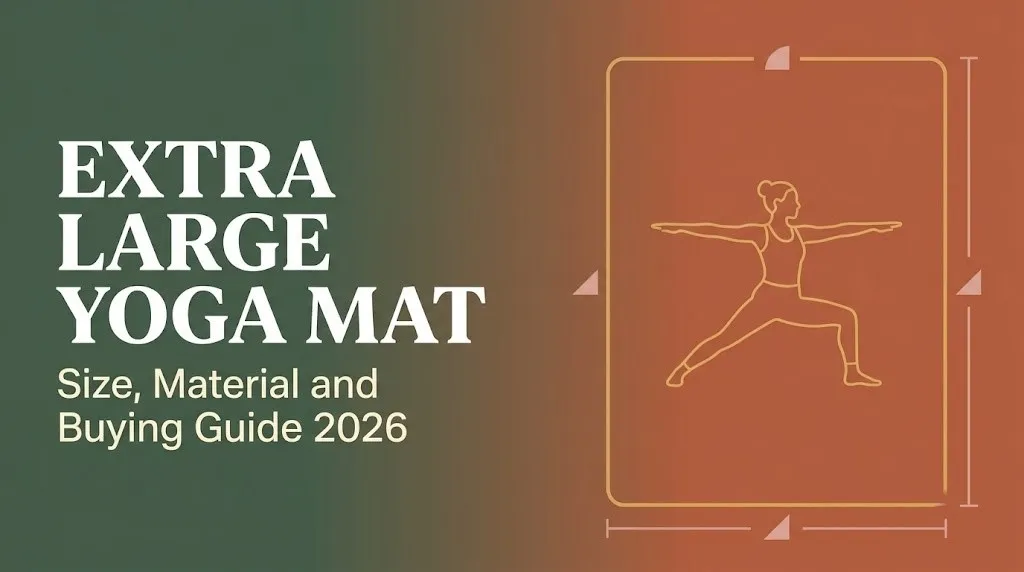
For length, the relevant measurement is your full-body length from crown to heel. Add 6 to 12 inches to that number to determine your minimum comfortable mat length. A six-foot practitioner needs a mat of at least 78 to 84 inches to rest comfortably in Savasana (Corpse Pose) without the head or feet hanging off the edge. For practice styles involving large strides or jumps, the relevant measurement is your stride length in your widest standing pose, typically Virabhadrasana II (Warrior II), measured from back heel to front toe.
For width, the relevant measurement is your shoulder width plus the space your arms need to be extended sideways. In Vasisthasana (Side Plank Pose), for example, the body is fully extended laterally. A 24-inch mat is often insufficient for this pose in practitioners with broad shoulders. A width of 30 to 36 inches covers most body types adequately.
The terms “extra large,” “giant,” and “oversized” are not standardized across brands. Always check the specific dimensions before purchasing rather than relying on the marketing label.
| Practitioner Profile | Recommended Length | Recommended Width |
|---|---|---|
| Under 5’8″ with moderate wingspan | 72 inches (183 cm) | 26 to 28 inches (66 to 71 cm) |
| 5’8″ to 6’0″ with average wingspan | 78 inches (198 cm) | 28 to 30 inches (71 to 76 cm) |
| Over 6’0″ or broad shoulder/hip width | 84 inches (213 cm) | 32 to 36 inches (81 to 91 cm) |
| Partner or shared practice | 84 inches (213 cm) | 48 to 60 inches (122 to 152 cm) |
| Seniors needing transition space | 72 to 78 inches (183 to 198 cm) | 30 to 36 inches (76 to 91 cm) |
Key Takeaway: The biggest mistake buyers make is choosing mat size based on marketing labels rather than their own body measurements. Measure your full standing height and your widest pose stride before selecting dimensions.
Extra Large Yoga Mat Materials: Rubber, TPE, PVC, and Cork Compared
The material of an extra large yoga mat determines its grip, durability, weight, environmental impact, cushioning characteristics, and how it responds to sweat and moisture. The four most common materials each have genuine trade-offs.
Natural rubber is the most widely respected material among experienced yoga teachers and practitioners. It provides consistent grip across a wide range of moisture conditions, offers excellent proprioceptive feedback (the sense of body position and joint angle through the surface beneath you), and is biodegradable. The trade-off is weight: natural rubber mats are heavier than synthetic alternatives, typically 6 to 8 pounds in large sizes, and they off-gas a natural latex smell initially. People with latex allergies must avoid natural rubber entirely.
TPE (thermoplastic elastomer) is the most common eco-friendly synthetic alternative. It is lighter than natural rubber, odor-free, and provides good grip for moderate-intensity practice. It is not as durable as rubber under sustained high-friction movement, such as frequent Vinyasa transitions, and grip quality decreases more noticeably than rubber does when wet. For home Hatha or Restorative practice, TPE performs well.
PVC (polyvinyl chloride) is the least environmentally sustainable option but the most durable and the most affordable. PVC mats maintain grip over many years of use. They are not biodegradable. For budget-conscious practitioners who prioritize longevity over sustainability, PVC remains a practical choice.
Cork is naturally antimicrobial and becomes grippier as it gets wet, which is the opposite of most other materials. This makes cork particularly useful for hot yoga or any high-sweat practice. Cork’s firmness provides less cushioning than rubber or foam-based materials, which matters for practitioners with sensitive joints.
| Material | Grip in Dry Conditions | Grip in Wet/Sweat | Weight | Durability | Eco-Friendly |
|---|---|---|---|---|---|
| Natural rubber | Excellent | Very good | Heavy | High | Yes (biodegradable) |
| TPE | Good | Moderate | Light | Moderate | Partially |
| PVC | Good | Moderate | Moderate | Very high | No |
| Cork | Good | Excellent (improves) | Moderate | High | Yes |
Extra Large Yoga Mat Thickness and Cushioning Guide
The thickness of an extra large yoga mat determines how much cushioning it provides to the joints, how stable it feels underfoot in standing poses, and how heavy it is. These three factors often pull in opposite directions, and understanding the trade-offs helps you choose the right thickness for your body and practice.
Standard yoga mat thickness ranges from 1.5mm (travel mat) to 6mm (extra cushion mat). Extra large mats typically range from 4mm to 8mm. The thicker the mat, the more cushioning it provides for the knees, hips, and wrists in floor-based poses. However, thicker mats are also less stable in standing poses. A very thick, soft mat creates a slightly unstable surface underfoot, which reduces proprioceptive feedback and can challenge balance in single-leg poses like Vrikshasana (Tree Pose).
The ideal thickness depends on what you are protecting and what you are practicing:
- 3 to 4mm: Best for standing-dominant styles like Vinyasa, Ashtanga, or Hatha when joint cushioning is not a primary concern. Provides firm, stable feedback underfoot.
- 5 to 6mm: The most commonly recommended range for general practice, providing adequate joint cushioning without compromising standing balance. Suitable for most practitioners including beginners and seniors.
- 7 to 8mm: Best for floor-dominant styles like Yin, Restorative, or Pilates, or for practitioners with significant knee, hip, or wrist sensitivity. Less suitable as a standing practice surface due to reduced stability.
According to the American College of Sports Medicine, surface firmness and stability are among the most important factors in preventing joint stress during floor-based exercise. An excessively soft mat surface can increase joint loading in standing positions rather than reduce it.
Modification for seniors or people with knee pain: A 6mm mat paired with a folded blanket under the knees for kneeling poses provides the most protective combination without compromising standing stability throughout the rest of the session.
Extra Large Yoga Mat Grip and Non-Slip Surface: What to Look For
Grip is the single most important functional characteristic of any yoga mat, and it matters even more in an extra large format because the larger surface area means you are placing your hands and feet in positions further from the center, where edge stability is especially important.
Grip operates through two mechanisms: texture and material. Texture refers to the physical surface pattern of the mat, open-cell versus closed-cell foam, raised patterns, or microfiber coverage. Material refers to the inherent stickiness or friction coefficient of the base material itself. The best-performing mats combine both.
Dry grip (how the mat grips when your hands and feet are dry) and wet grip (how it grips when sweat is present) are different properties. PVC and TPE mats tend to grip well when dry but become slippery as sweat accumulates. Natural rubber maintains grip through moderate moisture. Cork mats become grippier as they get wet, making them the top choice for high-sweat practice.
A practical test for grip before purchasing: place the mat on a hard floor, step on it with bare feet, and push laterally with moderate force. The mat should resist sliding against the floor and grip your foot simultaneously. A mat that slides on the floor is not simply a minor inconvenience. It is a fall risk during any dynamic transition.
Pose Tip:
- For Adho Mukha Svanasana (Downward-Facing Dog), the hand grip matters most. Test grip with your palms flat, spreading your fingers and pressing your fingertips down. If your hands slide even slightly, the mat will not hold when you are supporting body weight.
- For standing poses, test the mat’s floor grip by pressing laterally with one foot. Any sliding indicates insufficient floor friction for safe single-leg balance work.
- Modification for practitioners with hyperhidrosis (excessive sweating): a microfiber towel layer over a rubber base mat provides the highest wet grip combination available in any mat format.
Extra Large Yoga Mat for Tall People and Wide-Body Practitioners
Tall practitioners and people with wide shoulders, broad hips, or long limbs consistently outgrow standard yoga mat dimensions in specific poses. The solution is not to practice with less range of motion. It is to use a mat that accommodates your actual body.
For tall practitioners, the critical poses that expose mat length limitations are Savasana (Corpse Pose) (full body length from head to heel), Uttanasana (Standing Forward Bend) when walking the hands forward (the distance from standing feet to the hands on the floor), and any jumping or stepping transition in Vinyasa yoga (the distance from the feet in Adho Mukha Svanasana (Downward-Facing Dog) to the landing position).
A practitioner who is 6 feet tall and practices Vinyasa yoga is dealing with a body that exceeds standard mat length in at least three poses per class. That means at least three moments per class when the hands or feet are on an unprotected floor surface rather than a mat surface. Over dozens of sessions, this is not a trivial consideration for joint health.
For wide-body practitioners, the critical poses that expose mat width limitations are Baddha Konasana (Bound Angle Pose) (knees extending beyond mat edges in wider hip structures), Eka Pada Rajakapotasana (Pigeon Pose) (the front shin and rear leg extending sideways), and lateral arm extensions in Virabhadrasana II (Warrior II).
- Tall practitioners (over 5’10”): prioritize mat length of at least 78 to 84 inches
- Wide shoulder or hip structure: prioritize mat width of 30 to 36 inches
- Both tall and wide: look for mats in the 84 by 36 inch range, sometimes marketed as “giant yoga mats”
- Practitioners with both long limbs and wide stances: consider a dedicated large-format mat of 6 by 4 feet for home use
Key Takeaway: A mat that does not cover your full practice area is not just uncomfortable. In standing and transitioning poses, hands and feet on unprotected floor surfaces create genuine grip inconsistency that increases joint stress and fall risk.
Extra Large Yoga Mat for Seniors and Joint Protection
An extra large yoga mat benefits seniors in two specific ways: it provides more cushioning surface for the joints that bear the most load in floor-based yoga (knees, hips, wrists, and spine), and it gives more room for the wider, more deliberate transitions that older bodies use when moving from standing to floor and back again.
According to the National Center for Complementary and Integrative Health, yoga practice in adults over 65 produces measurable improvements in balance, functional mobility, and fall risk scores over eight to twelve weeks of consistent practice. The surface quality of the mat matters for all three of these outcomes: a mat with insufficient grip or inadequate cushioning reduces the safety of the very practice designed to improve safety.
For seniors, the recommended mat thickness is 5 to 6mm for a combination of floor-based cushioning and standing stability. A mat that is too thin creates discomfort in kneeling and supine poses. A mat that is too thick reduces the proprioceptive feedback that supports balance in standing poses.
Width matters as much as thickness for senior practitioners. Wider mats provide more surface area during transitions from floor to standing, which involve a sequence of intermediate positions (rolling to the side, pressing to hands and knees, stepping one foot forward) that require stable ground contact in positions that are not traditional yoga poses. A wider mat means fewer moments when a transitioning hand or knee lands off the mat edge.
Modification guidance for seniors using an extra large yoga mat:
- Place the mat near a wall or sturdy chair during standing poses. The mat provides floor grip. The wall or chair provides balance support. Both together create the safest practice environment.
- Use a folded blanket on top of the mat under the knees for any kneeling pose, regardless of mat thickness. Stacked cushioning is always safer than relying on mat thickness alone.
- In Balasana (Child’s Pose), place a folded blanket between the thighs and calves to reduce knee flexion load. The extra mat width gives you room to position the blanket without it sliding off the mat edge.
Extra Large Yoga Mat for Home Practice and Restorative Yoga
An extra large yoga mat for home practice serves a different purpose than a studio mat. In a home setting, the mat defines your practice space. A larger mat means a larger defined space, which creates both a physical and psychological boundary for your practice session.
Restorative yoga is the style most consistently served by an oversized mat. Restorative poses use props to fully support the body in passive shapes, and those props (bolsters, blankets, blocks) take up significant surface area around the practitioner. A Supta Baddha Konasana (Reclined Bound Angle Pose) with a bolster under the spine, blocks under the knees, and a blanket over the body easily requires 6 feet of length and 3 feet of width. A standard mat is simply insufficient for a fully propped Restorative practice.
Yin yoga similarly benefits from a wider mat. Long-held poses in Yin often involve the legs extending to the sides, the body rolling slightly off center, or props shifting position during a two to five minute hold. A wider surface means you stay on the mat throughout the hold without having to adjust position mid-pose.
For home practice in general, an oversized mat eliminates the mid-session interruption of repositioning a mat that has slid or shifted. A heavier, larger mat is less likely to move on a hard floor surface than a lightweight standard mat.
Pose Tip:
- For Restorative yoga at home, position your bolster lengthwise on the mat before you lie down. Confirm both ends of the bolster land on the mat surface. If they do not, your mat is too short for the prop setup.
- For Yin yoga long holds, sit cross-legged in the center of the mat and extend both arms sideways. Your fingertips should land on the mat surface. If they do not, the mat width is insufficient for your wingspan in wide-arm poses.
- Modification for small home spaces: a 72 by 30 inch mat is the minimum that serves Restorative practice adequately without requiring a very large room.
Extra Large Yoga Mat for Hot Yoga and Vinyasa Practice
Hot yoga and Vinyasa yoga place the highest physical demands on mat grip and durability of any yoga style, and these demands increase proportionally in an oversized format because there is more surface area to maintain grip quality across.
In hot yoga (typically Bikram yoga or the 26 and 2 format, practiced in a room heated to 95 to 105 degrees Fahrenheit), sweat is the primary grip challenge. Most standard mat materials, including TPE and PVC, become significantly more slippery when wet. Natural rubber maintains grip better than both. Cork improves grip when wet, making it the strongest performer in a hot yoga environment. For an oversized hot yoga mat, the recommended materials are natural rubber or cork, with a microfiber towel layer for maximum sweat absorption.
Vinyasa yoga creates sustained friction between hands, feet, and mat surface through continuous transitions. Over time, this friction degrades foam-based materials faster than it degrades rubber or cork. An extra large Vinyasa mat needs to be made from a material that holds up under repeated high-friction use, not just initial-purchase grip quality.
The larger footprint of an oversized mat in a studio setting requires consideration of class room size. Many studio hot yoga rooms have designated mat spaces. An extra-wide mat may not fit within the assigned space without overlapping a neighbor’s area. For home hot yoga practice, this is not a concern.
According to the American College of Sports Medicine, exercising in environments above 80 degrees Fahrenheit significantly increases cardiovascular demand. For hot yoga practitioners, hydration before, during, and after class is non-negotiable regardless of mat choice.
- Natural rubber or cork: best grip in heated and sweat conditions
- Microfiber towel layer: required addition for hot yoga on any mat material
- Minimum recommended thickness for Vinyasa: 4mm for stability in standing transitions
- Avoid: thick foam mats (above 6mm) for Vinyasa practice due to reduced stability in standing poses
Extra Large Yoga Mat for Two People and Partner Practice
A giant yoga mat designed for two practitioners simultaneously needs dimensions of at least 6 by 4 feet (183 by 122 cm), and ideally larger, to allow two adults to practice side by side without their movements interfering.
Partner yoga and shared practice sessions use a wide mat in specific ways. Two people lying in Savasana (Corpse Pose) side by side require at least 4 feet of width assuming average shoulder breadth. Two people seated for meditation or pranayama require similar width. For partner poses involving physical contact and mutual support, additional mat space allows both practitioners to move independently without stepping off the mat.
Giant yoga mats designed for shared use are also useful for parents practicing with young children. Children’s yoga sequences typically involve wide, floor-based movements, crawling, rolling, and large arm swings, that benefit from a large unobstructed surface. A 6 by 4 foot mat gives an adult and a child enough shared space to practice in the same session without constant repositioning.
The weight of a giant yoga mat designed for shared use is typically 8 to 12 pounds. These mats are not designed for transportation. They are home practice investments that stay in a dedicated practice space. If you want to practice at home and occasionally attend studio classes, a personal standard mat for the studio and a giant mat for home is the most practical combination.
- Minimum dimensions for two adults: 72 inches long by 48 inches wide (183 by 122 cm)
- Minimum for parent and young child: 72 inches long by 36 inches wide (183 by 91 cm)
- Best material for shared use: natural rubber base with microfiber top layer (washable)
- Weight consideration: 8 to 12 pounds; intended as a permanent home installation, not a portable mat
Key Takeaway: A giant yoga mat for two people needs to be at least 4 feet wide to accommodate two adults side by side. At this size, the mat becomes a home installation rather than a portable piece of equipment, and should be chosen accordingly.
Extra Large Yoga Mat for Back Pain and Floor-Based Recovery
An extra large yoga mat for back pain serves two functions: cushioning the spine and pelvis during supine poses, and providing enough surface area for the supported prop arrangements that back-pain-appropriate yoga requires.
Yoga is one of the most researched complementary approaches for chronic lower back pain. Research published in the Spine Journal found that yoga-based interventions for non-specific chronic lower back pain produced improvements in pain intensity and functional disability comparable to standard physical therapy over twelve weeks. The surface quality of the mat matters for back pain practice because many of the most effective poses for lower back relief are performed supine, with the spine and pelvis in direct contact with the mat.
For back pain practice, the relevant mat specifications are:
- Thickness: 6mm minimum to cushion the lumbar and sacral area in supine poses. For practitioners with prominent spinal anatomy or very little subcutaneous tissue, 6 to 8mm is more comfortable.
- Width: 28 to 30 inches minimum to allow the knees to fall to the side in Supta Baddha Konasana (Reclined Bound Angle Pose) without the thighs or prop blocks hanging off the edge.
- Length: At least 72 inches to allow both head and feet to rest on the mat in Savasana (Corpse Pose) with props placed alongside.
The surface texture matters for back pain practice specifically because supine poses often involve slow rolling transitions (from back to side, from side to hands and knees) that create lateral friction. A mat with a smooth, low-texture surface makes these transitions easier for practitioners with limited spinal mobility.
Modification for acute back pain: begin any mat-based practice in Supta Baddha Konasana (Reclined Bound Angle Pose) with a bolster under the spine and blocks under the outer thighs. This position requires no spinal effort and creates the conditions for parasympathetic nervous system activation that reduces pain amplification through the nervous system.
Extra Large Yoga Mat Cleaning, Care, and Storage
An extra large yoga mat requires more deliberate cleaning and storage than a standard mat because of its size. Skipping regular cleaning allows bacteria, sweat, and skin oils to degrade the mat surface and reduce grip quality over time.
The correct cleaning method depends on the mat material:
- Natural rubber: wipe with a damp cloth and a gentle, diluted solution of water and a few drops of dish soap or a yoga mat spray. Do not submerge rubber mats in water or machine wash them. Avoid alcohol-based cleaners, which dry out and crack rubber.
- TPE: wipe clean with a damp cloth. TPE is more moisture-tolerant than rubber but should not be soaked. Air dry fully before rolling.
- PVC: the most moisture-tolerant material. Can be wiped down with diluted soap solution or a yoga mat cleaner spray. Air dry fully before storage.
- Cork: wipe gently with a barely damp cloth. Cork is naturally antimicrobial but can be damaged by excessive moisture. Do not use soap on cork; plain water is sufficient for routine cleaning.
Storage of an extra large yoga mat presents a practical challenge. Most oversized mats are too large and heavy to hang on a standard mat hook. Rolling the mat loosely (with the practice surface facing outward) and storing it upright in a corner or a large mat storage bag is the most practical approach.
For home practice spaces, a dedicated mat storage rack designed for large format mats prevents the mat from deforming under its own weight when stored rolled up for extended periods. Storing a heavy rubber or cork mat tightly rolled for weeks can create permanent creases that affect the flatness of the practice surface.
- Clean after every sweaty session; wipe down after dry sessions weekly
- Full air dry before rolling; moisture trapped inside a rolled mat promotes bacterial growth
- Do not store in direct sunlight; UV exposure degrades rubber and TPE over time
- Do not store in a car trunk in extreme heat; heat distorts mat shape permanently in TPE and PVC materials
How to Choose the Best Extra Large Yoga Mat for Your Practice
Choosing the best extra large yoga mat for your practice means prioritizing the specifications that match your body and practice style rather than selecting based on brand reputation or price alone.
The selection process works most reliably when you answer four questions in order:
- What are my actual body dimensions (height, shoulder width, stride in widest standing pose)?
- What yoga style or styles do I practice most often?
- What surface conditions does my practice create (dry hands, heavy sweating, heated room)?
- Do I have any joint conditions or sensitivities that require specific cushioning?
Your answers to these four questions produce a clear specification: minimum length, minimum width, preferred thickness range, and required material. Any mat that meets those specifications is a viable option. Any mat that does not, regardless of price or marketing, will not serve your practice correctly.
The table below organizes the key selection criteria by practice profile:
| Practice Profile | Length | Width | Thickness | Material |
|---|---|---|---|---|
| Tall Vinyasa or Ashtanga | 84 inches | 30 to 32 inches | 4 to 5mm | Natural rubber |
| Restorative or Yin at home | 72 to 78 inches | 32 to 36 inches | 6 to 8mm | TPE or natural rubber |
| Hot yoga (high sweat) | 72 to 84 inches | 30 to 36 inches | 4 to 5mm | Cork or rubber with towel |
| Senior or joint-sensitive | 72 to 78 inches | 30 to 36 inches | 5 to 6mm | TPE or natural rubber |
| Shared or partner practice | 84 inches | 48 to 60 inches | 5 to 6mm | Natural rubber with microfiber |
| Beginner at home | 72 to 78 inches | 30 to 32 inches | 5 to 6mm | TPE or PVC |
Extra Large Yoga Mat for Beginners: What to Prioritize First
An extra large yoga mat is a genuinely good choice for beginners, specifically because it removes the constraint of needing to stay within a narrow mat boundary before you know where your hands and feet will land in any given pose.
Beginners frequently make positional errors in their first weeks of practice. Hands land wider than intended. Feet step outside the line of the mat in standing sequences. The body rotates unexpectedly in balancing poses. All of these normal learning-phase movements are better managed on a surface that has enough room to contain them rather than a surface that requires precise foot and hand placement from session one.
For beginners, the priority order for mat selection is: grip first, cushioning second, size third, material fourth, price fifth. A cheap mat with poor grip is more dangerous for a beginner than an expensive mat with excellent grip and adequate size. Beginners fall more than experienced practitioners. A mat that slides on the floor or fails to hold the hands and feet creates injury risk at exactly the stage of practice when the body has the least body awareness and the least balance experience.
The recommended starting specification for a beginner extra large mat:
- Length: 72 to 78 inches (accommodates most adults and leaves room for learning-phase positional variation)
- Width: 30 to 32 inches (wider than standard without requiring a very large home practice space)
- Thickness: 5 to 6mm (adequate cushioning for floor work without compromising standing balance)
- Material: TPE or PVC (durable, affordable, consistent dry grip, easy to clean)
Price range for a quality beginner extra large mat is approximately $50 to $90. Spending more does not automatically produce better results for a beginner. Spending less risks a mat that degrades within months under regular use.
Frequently Asked Questions About Extra Large Yoga Mats
What size is considered an extra large yoga mat?
An extra large yoga mat is generally any mat longer than the standard 68 inches (173 cm) or wider than 24 inches (61 cm), with most extra large mats measuring 72 to 84 inches long and 30 to 36 inches wide.
Some giant yoga mats designed for shared or full-body practice reach 84 inches by 48 inches or larger.
Always check the specific dimensions listed by the manufacturer rather than relying on “extra large” as a standardized size label, because it is not consistent across brands.
Is a thicker yoga mat better for bad knees and joints?
A thicker yoga mat, specifically 5 to 6mm, provides better cushioning for the knees, hips, and wrists during floor-based poses.
However, mats thicker than 6mm can reduce stability in standing poses by creating a slightly unstable surface underfoot, which can increase joint stress rather than reduce it.
For most practitioners with joint sensitivity, a 5 to 6mm mat paired with a folded blanket under the knees during kneeling poses is the most effective combination.
What is the best material for an extra large yoga mat?
Natural rubber is the most consistently recommended material for an extra large yoga mat because it provides reliable grip across moisture conditions, excellent proprioceptive feedback, and long-term durability.
Cork is the best choice for hot yoga or high-sweat practice because it becomes grippier as moisture increases.
TPE is the best budget-friendly eco-conscious option for general home practice in Hatha, Restorative, or Yin yoga.
Can two people use a giant yoga mat at the same time?
Yes, a giant yoga mat can accommodate two people practicing simultaneously when it measures at least 72 inches long by 48 inches wide (183 by 122 cm).
At that size, two adults can practice side by side in most non-partner poses without their movements interfering.
Giant mats at this size are heavy (8 to 12 pounds) and designed as home practice installations rather than portable mats.
How do I clean and store an oversized yoga mat?
Clean natural rubber and TPE mats by wiping with a damp cloth and a small amount of diluted soap solution, then air drying completely before rolling.
Cork mats should be wiped with a barely damp cloth and plain water only; soap damages the cork surface over time.
Store an oversized mat rolled loosely with the practice surface facing outward, standing upright in a corner or a large mat bag, away from direct sunlight and extreme heat.
Get the Right Mat, Then Use It
The best extra large yoga mat is the one that matches your actual body dimensions and your actual practice style. Measure your height and your widest stance before you shop. Choose thickness based on your joint needs and your style, not based on the assumption that thicker always means better.
Once you have the right mat, the next step is simpler than choosing the mat: unroll it, stand on it, and practice three times this week. The mat is the foundation. What you build on it is the work.
Your home practice deserves a surface that fits you completely.